
Study Guides
IB DP Business Management: Stakeholders
Study guide to internal and external stakeholders and conflict between stakeholders for IB DP Business Management, section 1.4, with two worked cases.
- Subject
- Business
- Level
- IB
- Topic
- Unit 1: Introduction to business management
- Author
- Marlbridge Academic Team
- Updated
- Reviewed by
- Salman Ahmad (what this means)
Aligned to International Baccalaureate IB Diploma Programme Business (DP Business Management), First assessment 2024. Official specification .
Syllabus page (what it covers and how it is assessed): IB Diploma Programme Business.
Syllabus points this page covers
DP Business Management
- 1.4 Stakeholders
Found an error? Report a correction.
Need help with this topic? Request a free trial class for IB Diploma Programme Business (DP Business Management).
This guide covers section 1.4 (Stakeholders) of Unit 1 in the IB Business management guide, first assessment 2024. The section applies to both SL and HL and is not marked as an HL extension. It lists two content points, each with a stated depth of AO2 (application and analysis): internal and external stakeholders, and conflict between stakeholders. The guide also describes stakeholders as a recurring topic across the whole syllabus, so the ideas here come back in finance, marketing, operations and the case-study papers.
Follow the course hub at IB DP Business Management and tick off what you have learned on the printable checklist. The revision-notes page is revision notes and the practice set is practice questions. For the wider course, see the syllabus guide and the exam preparation guide. You can also test yourself with the free 10-minute diagnostics.
What section 1.4 asks of you
| Content point in the guide | Depth | What you should be able to do | Level |
|---|---|---|---|
| Internal and external stakeholders | AO2 | Say who the stakeholders of a business are, sort them into internal and external, and apply this to a business in a case | SL and HL |
| Conflict between stakeholders | AO2 | Show where the interests of two stakeholder groups clash, and analyse why | SL and HL |
AO2 is the “application and analysis” level. The guide places command terms such as analyse, apply, explain and suggest at this level. In practice, that means you will usually be asked to use the stakeholders of a named business, not to recite a list. The guide also gives a suggested inquiry statement that fits this section: why change could bring conflict among stakeholders. That is a useful lens throughout this page.
What is a stakeholder?
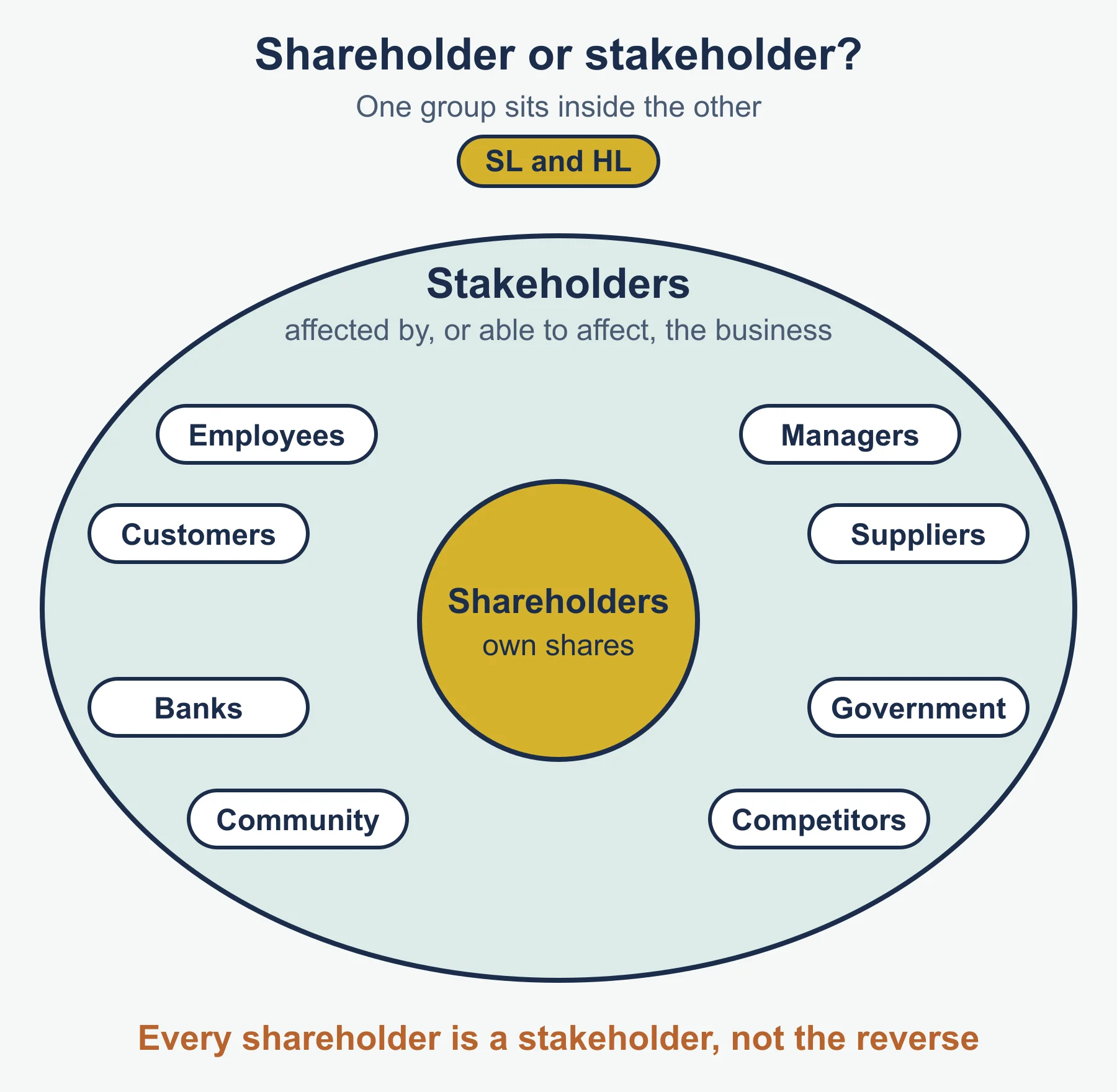
The guide does not print a formula or a one-line definition for this section, so this is the standard form used in most business courses: a stakeholder is any person or group that a business’s activities affect, or that is able to affect those activities. Two points follow from this:
- A stakeholder does not need to own anything. A neighbor who lives beside the factory and hears it is a stakeholder.
- The interest can be positive or negative. A customer likes low prices. A competitor would like the business to fail.
Stakeholders are different from shareholders. A shareholder is one type of stakeholder: an owner of shares in a company. Do not use the two words as though the two meant one thing.
Internal and external stakeholders
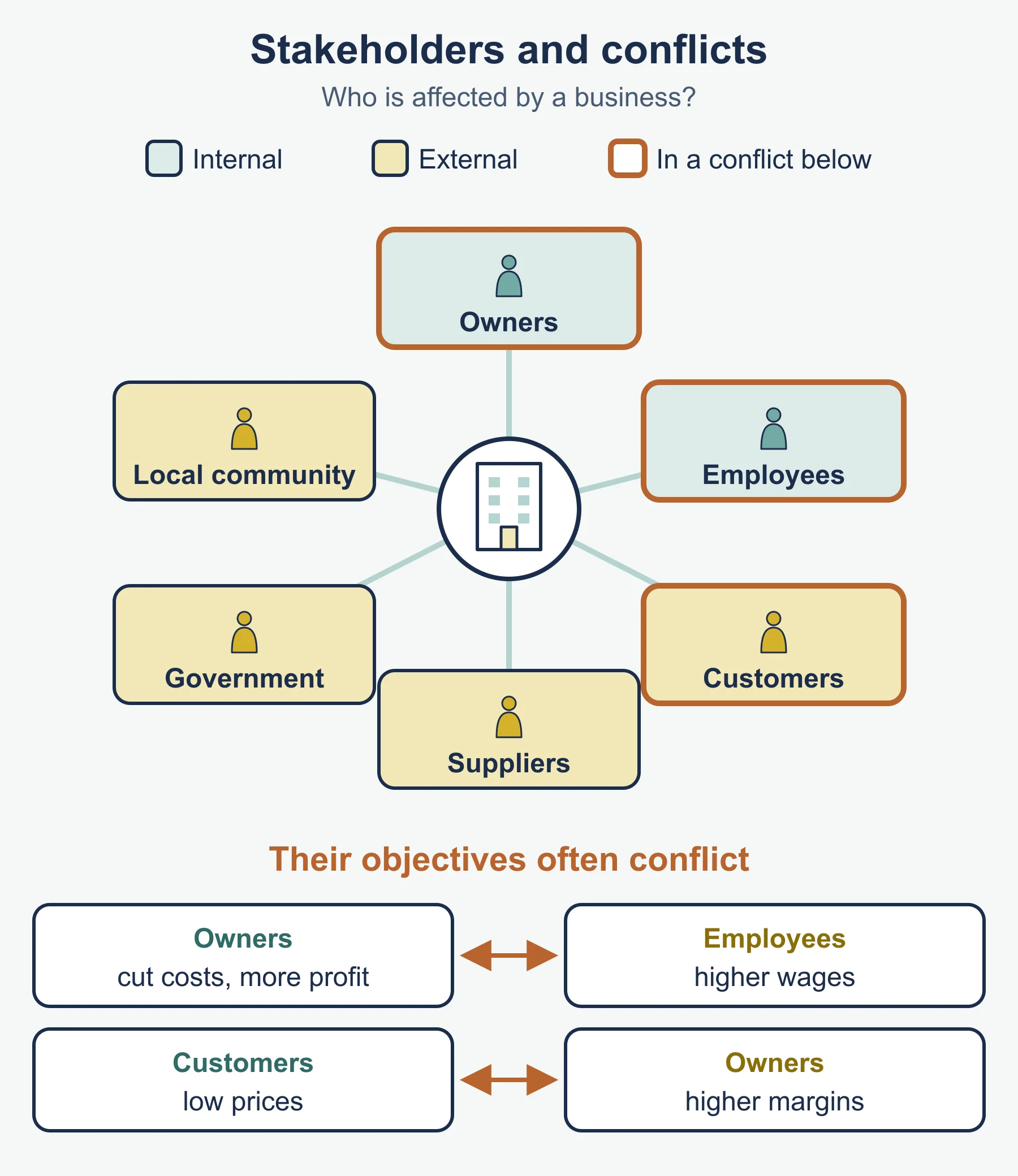
Internal stakeholders are individuals or groups inside the organization. External stakeholders are individuals or groups outside it who are affected by it, or who can affect it. The table gives common examples and the interest each group typically has. These are standard groups, not an official list.
| Group | Internal or external | Typical interest | A way it can influence the business |
|---|---|---|---|
| Employees | Internal | Pay, job security, working conditions, development | Productivity, turnover, industrial action, ideas |
| Managers | Internal | Pay, status, reaching targets, career | Decide how resources are used and communicate with others |
| Owners (shareholders in a company) | Internal, in most treatments | Profit, dividends, share value | Vote at meetings, appoint directors, sell shares |
| Customers | External | Quality, price, service, ethical behavior | Buy or switch to a rival |
| Suppliers | External | Regular orders, prompt payment, fair prices | Change prices, delay delivery, tighten credit terms |
| Lenders such as banks | External | Repayment of loan with interest | Refuse further loans, charge higher interest |
| Government | External | Tax paid, law followed, jobs created | Change laws, taxes, regulation |
| Local community | External | Jobs, noise, traffic, pollution, local spending | Protest, complain, support or oppose planning requests |
| Competitors | External | Market share | Cut prices, copy products, recruit staff |
| Pressure groups | External | A particular cause, such as the environment | Campaign, publicize behavior, lobby |
Two comments on this table.
First, classification depends on the argument. Owners and shareholders are usually treated as internal, because they own the business. Some courses count shareholders in a large publicly held company as external, since they may never meet the managers. If a case does not settle it, state your choice and your reason in one sentence. Examiners reward a clear reason far more than the label.
Second, the natural environment cannot speak, yet the guide’s description of the ethics concept names it alongside internal and external stakeholders. Where a case involves pollution or resource use, you can treat the environment as an affected party and say who speaks for it, such as a pressure group or the government.
Interest versus influence
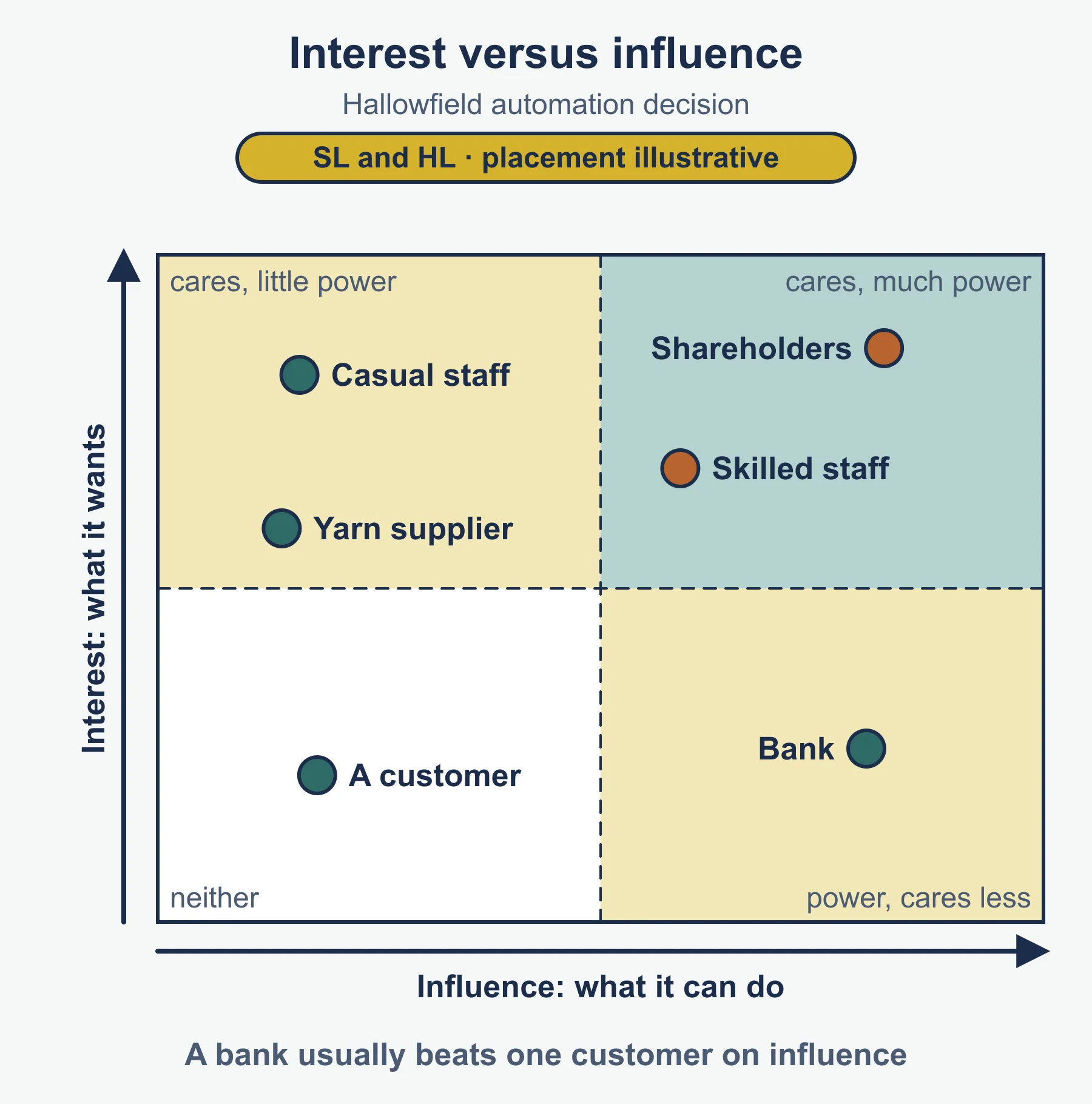
Two stakeholders may both care about an issue, yet only one can change the outcome. A large bank holding the business’s overdraft usually has more influence than a single customer. A group of employees with scarce skills has more influence than a casual worker. When you analyse a case, say what each group wants and what it can do about it. Both parts earn application credit when you tie them to details in the stem.
Worked example 1: identifying and applying stakeholders
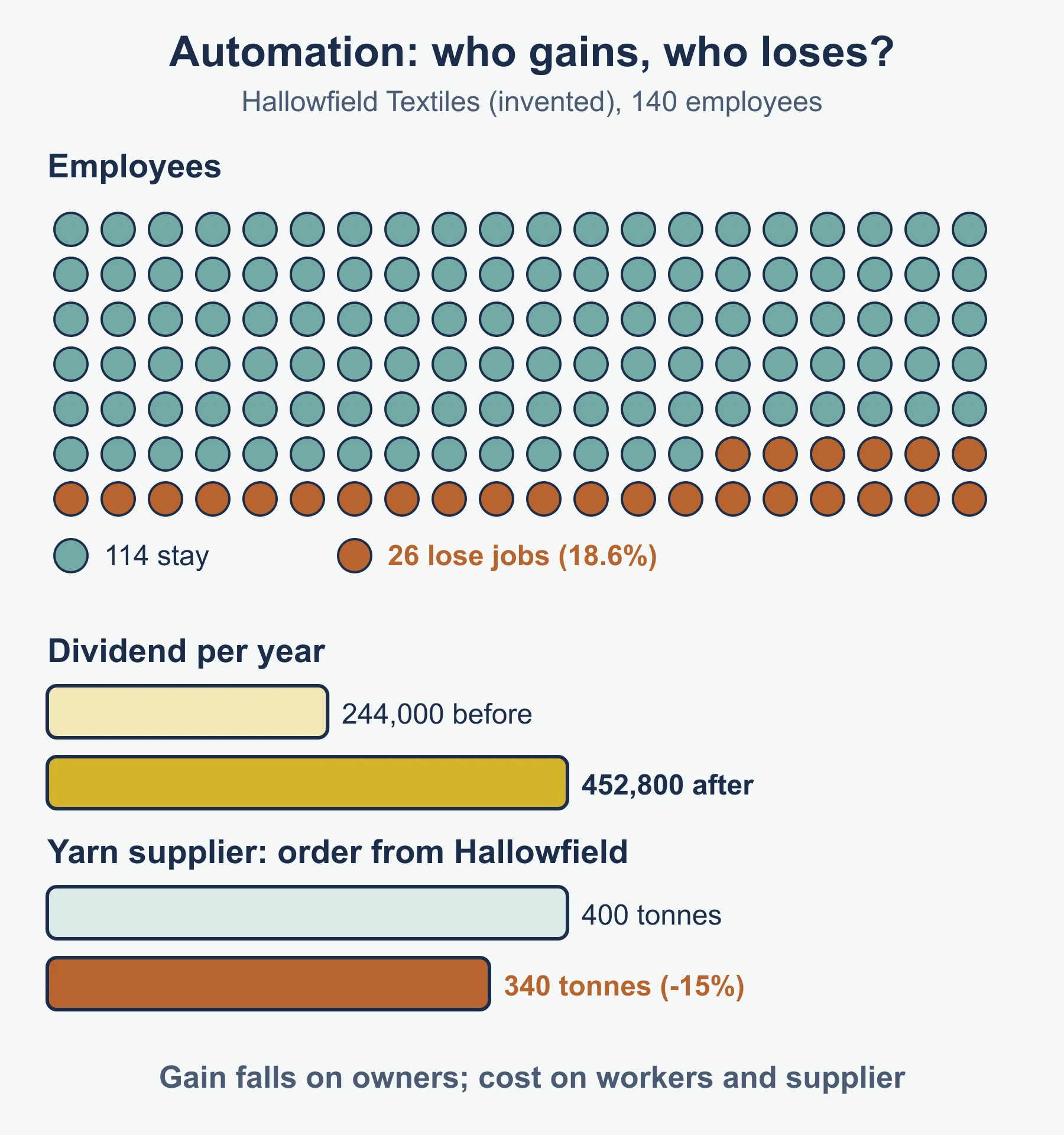
Hallowfield Textiles is an invented privately held company with 140 employees. Its average wage is 29,500 per employee per year, so the annual wage bill is 140 × 29,500 = 4,130,000. The board plans to install automated looms. The change would remove 26 jobs, a saving in wages of 26 × 29,500 = 767,000 per year. The new machines cost 245,000 a year to run and maintain. Annual profit is currently 610,000. The company pays 40% of profit as dividends. The weaver that supplies the specialist yarn would see Hallowfield’s order fall from 400 tonnes to 340 tonnes.
Step 1: Identify the stakeholders and sort them. Internal: the 140 employees, the managers, the shareholders. External: the yarn supplier, customers, the local community, the government and the bank.
Step 2: Calculate what changes.
- Net annual saving = 767,000 − 245,000 = 522,000.
- New profit = 610,000 + 522,000 = 1,132,000, which is an increase of 85.6%.
- Dividend at 40% of profit goes from 244,000 to 452,800.
- Share of workforce losing jobs = 26 ÷ 140 = 18.6%.
- Yarn order change = (340 − 400) ÷ 400 = −15%.
Step 3: Analyse the effect on each group.
- Shareholders gain, because the dividend rises by 208,800.
- The 26 employees lose their jobs. The 114 who stay may feel insecure, which could lower motivation.
- The yarn supplier loses 15% of its volume from this customer, so it may seek other buyers or ask for higher prices.
- The local community loses 26 jobs, which cuts local spending.
- Customers might gain faster delivery or, if prices fall, lower prices, but only if Hallowfield chooses to pass on savings.
Step 4: Make a judgment about interests. The gain falls mainly on the owners, and the cost falls mainly on the workers and the supplier. This sets up the next section.
Conflict between stakeholders
A conflict arises when the interests or objectives of two groups cannot both be fully met. The business has limited money, and many decisions give a gain to one group and a loss to another. A change makes conflict likelier because it moves benefits and costs around, and the people on the losing side have little time to adjust.
Common sources of conflict
| Between | Why they clash |
|---|---|
| Shareholders and employees | Profit paid out as dividends is not available for wages or bonuses |
| Shareholders and customers | Higher prices raise profit, but lower value for customers |
| Managers and owners | Managers may favor growth and status, while owners want dividends and share value |
| Business and suppliers | The business wants low prices and long credit terms; suppliers want the opposite |
| Business and local community | Expansion adds jobs but also noise, traffic and building work |
| Business and government | Lower taxes and lighter rules help the business; the government wants revenue and protection of the public |
| Short term and long term | Cutting research spending lifts profit this year but may harm the future |
| Business and the environment | Cheaper production methods may cause more pollution |
Notice that conflicts are not always between an internal and an external group. Employees and shareholders are both internal, yet they often disagree.
Why change creates conflict
Change brings uncertainty. Jobs may be lost, supplier contracts altered, or the location of the site moved. People who benefit support it. People who lose may resist it, with go-slows, complaints or public campaigns. Managers who introduce change without explaining it can create conflict that would not otherwise exist.
Ways a business may respond
The guide lists the content point as conflict between stakeholders, not a set of strategies, so these are standard approaches rather than a syllabus list. Treat them as tools to suggest or evaluate in a case:
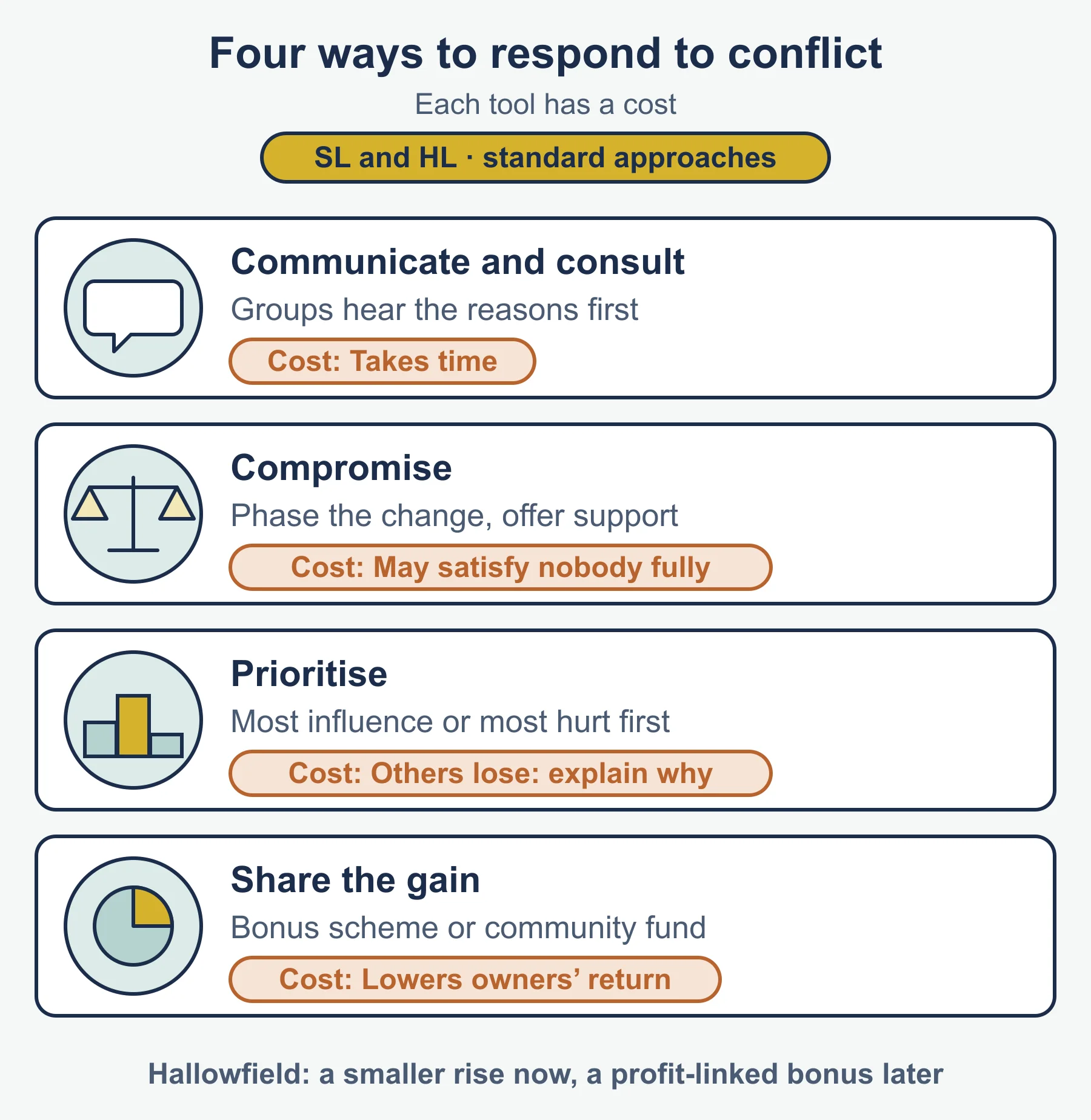
- Communication and consultation, so groups understand the reasons and can comment before a decision.
- Compromise, such as phasing a change over time or paying redundancy support.
- Prioritizing the group with the most influence or the one affected most seriously, and explaining why.
- Sharing the gain, such as a bonus scheme or a community fund.
Each has a cost. Consultation takes time, compromise may satisfy nobody fully, and sharing gains lowers the owners’ return.
Worked example 2: analysing a conflict with numbers
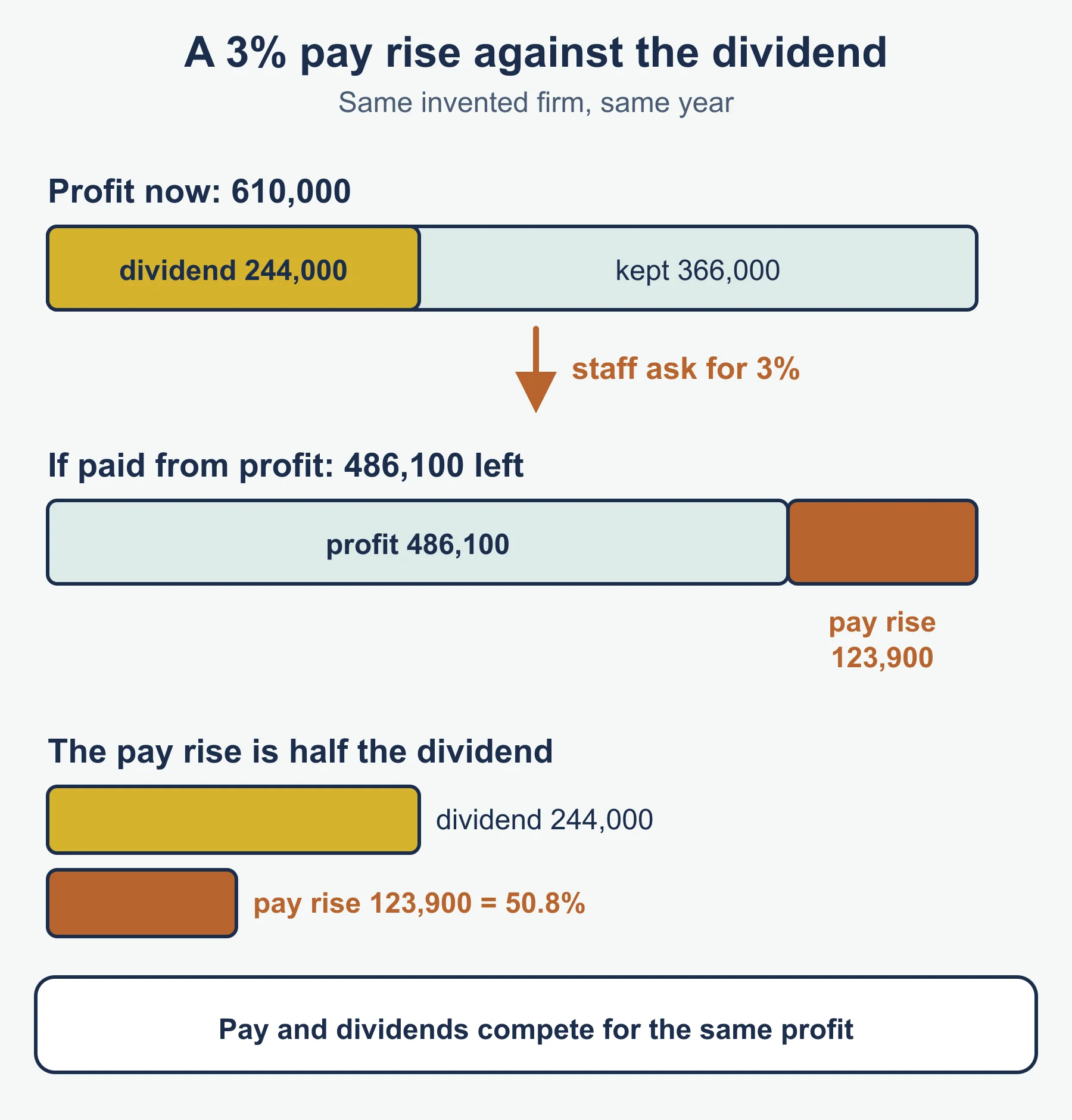
Return to Hallowfield. Staff representatives ask for a 3% pay rise.
Step 1: Cost of the pay rise. 3% × 4,130,000 = 123,900 per year, or 885 per worker.
Step 2: Compare. If paid from current profit, profit would fall from 610,000 to 486,100, a fall of 20.3%. The rise is equal to 50.8% of the 244,000 dividend.
Step 3: Identify the conflict. Employees want more pay; shareholders want to protect the dividend and the share value. Each pound used for one purpose is not available for the other.
Step 4: Analyse. The 3% rise is small per worker, but large compared with the dividend. Hallowfield could meet staff halfway, for example by agreeing a smaller rise now and a profit-linked bonus later. That keeps the dividend steadier and still recognizes the staff. The final choice depends on how scarce the workers’ skills are and how much the owners value stable returns.
How to write a good AO2 answer on stakeholders
- Name the group exactly (“the yarn supplier”, not “outsiders”).
- State the interest in a few words, tied to the stem.
- Show the effect, using a figure from the case when one is given.
- Link to the conflict or the business decision, and say who gains and who loses.
- For questions beyond analysis, such as discuss or recommend, weigh both sides and reach a judgment with a reason.
If a question asks you to analyse, a chain of reasoning for one or two groups usually reads better than a long list of groups with one phrase each.
Common errors
- Treating “stakeholder” and “shareholder” as the same thing.
- Listing groups with no tie to the particular business in the case.
- Saying a group has an interest without saying what it can do.
- Placing every conflict between “workers” and “owners” and ignoring suppliers, communities and the environment.
- Forgetting that a decision may help one stakeholder group and harm another.
- Writing a recommendation with no reason or no acknowledgement of who loses.
Frequently asked questions
What is the difference between internal and external stakeholders? Internal stakeholders are individuals or groups inside the organization, such as employees, managers and owners. External stakeholders are outside it, such as customers, suppliers, lenders, government, the local community and pressure groups.
What is the difference between a stakeholder’s interest and its influence? Interest is how much a group cares about an issue; influence is whether it can change the outcome. Two groups may care equally, but only one may have the power to affect the business’s decision.
Does a stakeholder have to own part of the business? No. A stakeholder does not need to own anything: a neighbor who lives beside a factory and hears its noise is affected by the business, and so is a stakeholder.
Is stakeholder conflict always between owners and workers? No. Conflicts can occur within the internal group or between the business and suppliers, communities, government or the environment, so strong answers look beyond workers and owners.
Official syllabus
This page follows the Business management guide, first assessment 2024, published by the International Baccalaureate Organization, section 1.4 Stakeholders. The practice set and revision notes use invented businesses and figures.
Get free revision emails (optional)
Occasional emails with practice questions, worked explanations and links to free resources for the qualification and subjects you choose. No spam, and you can unsubscribe from any email. The free tools on this site never need an email.
Related resources
-
Practice questions
IB DP Business Management: Stakeholders – Practice Questions
Original practice questions with worked answers on internal and external stakeholders and stakeholder conflict, IB DP Business Management section 1.4.
Business · International Baccalaureate · IB
Try questions -
Revision notes
IB DP Business Management: Stakeholders – Revision Notes
Condensed revision notes on internal and external stakeholders and stakeholder conflict for IB DP Business Management section 1.4, with a self-test.
Business · International Baccalaureate · IB
Revise topic -
Study guides
IB DP Business Management: What is a business? and Types of business entities
Study guide to IB DP Business Management sections 1.1 and 1.2: sectors, entrepreneurship, start-up challenges, and sole traders to NGOs.
Business · International Baccalaureate · IB
Read guide
Related articles
-
teaching
A Level tuition in Dubai: Cambridge or Pearson Edexcel International A Level?
Schools in Dubai and Abu Dhabi teach either Cambridge International AS & A Level or Pearson Edexcel International A Level. How the two are structured, why it matters for tuition, and how online classes from Lahore work.
9 October 2026
-
curriculum guides
Choosing subjects at IGCSE and A Level
How subject choices at 14 and 16 affect university options later, and how to keep pathways open without overloading a timetable.
28 July 2026
Studying this with a teacher
Working through Business IB?
This page is free and stays free. If you would rather be taught it, Marlbridge runs Business classes one-to-one, online in your own time zone. The first trial class is free. WhatsApp replies within an hour (8am–11pm Pakistan time, every day); email the same day.
IB Business teachers at Marlbridge

