
Study Guides
IB DP Business Management: What is a business? and Types of business entities
Study guide to IB DP Business Management sections 1.1 and 1.2: sectors, entrepreneurship, start-up challenges, and sole traders to NGOs.
- Subject
- Business
- Level
- IB
- Topic
- Unit 1: Introduction to business management
- Author
- Marlbridge Academic Team
- Updated
- Reviewed by
- Salman Ahmad (what this means)
Aligned to International Baccalaureate IB Diploma Programme Business (DP Business Management), First assessment 2024. Official specification .
Syllabus page (what it covers and how it is assessed): IB Diploma Programme Business.
Syllabus points this page covers
DP Business Management
- 1.1 What is a business?
- 1.2 Types of business entities
Found an error? Report a correction.
Need help with this topic? Request a free trial class for IB Diploma Programme Business (DP Business Management).
This study guide is aligned to the IB Business management guide, first assessment 2024. It covers sections 1.1 (What is a business?) and 1.2 (Types of business entities) of Unit 1. All of this content is SL and HL; the guide marks no HL-only material in either section. It applies to the sessions assessed under that guide.
Pair it with the revision notes and the practice questions. Course pages: the IB DP Business Management hub and the printable checklist. To find weak spots first, try the free diagnostics.
What the guide asks of you
| Section | Content point | Depth the guide gives |
|---|---|---|
| 1.1 | The nature of business | AO1 |
| 1.1 | Primary, secondary, tertiary and quaternary sectors | AO2 |
| 1.1 | Entrepreneurship | AO2 |
| 1.1 | Challenges and opportunities for starting up a business | AO2 |
| 1.2 | Distinction between the private and the public sectors | AO2 |
| 1.2 | Main features of sole traders, partnerships, privately held companies, publicly held companies | AO3 |
| 1.2 | Main features of for-profit social enterprises: private sector companies, public sector companies, cooperatives | AO3 |
| 1.2 | Main features of a non-profit social enterprise: non-governmental organizations (NGOs) | AO3 |
AO1 means you must know and understand. AO2 means you apply and analyse. AO3 means you synthesize and evaluate. So for 1.2 it is not enough to list features: you should be able to weigh them for a given business. The guide does not give formal definitions for these points, so the definitions below are standard textbook forms.
1.1 The nature of business
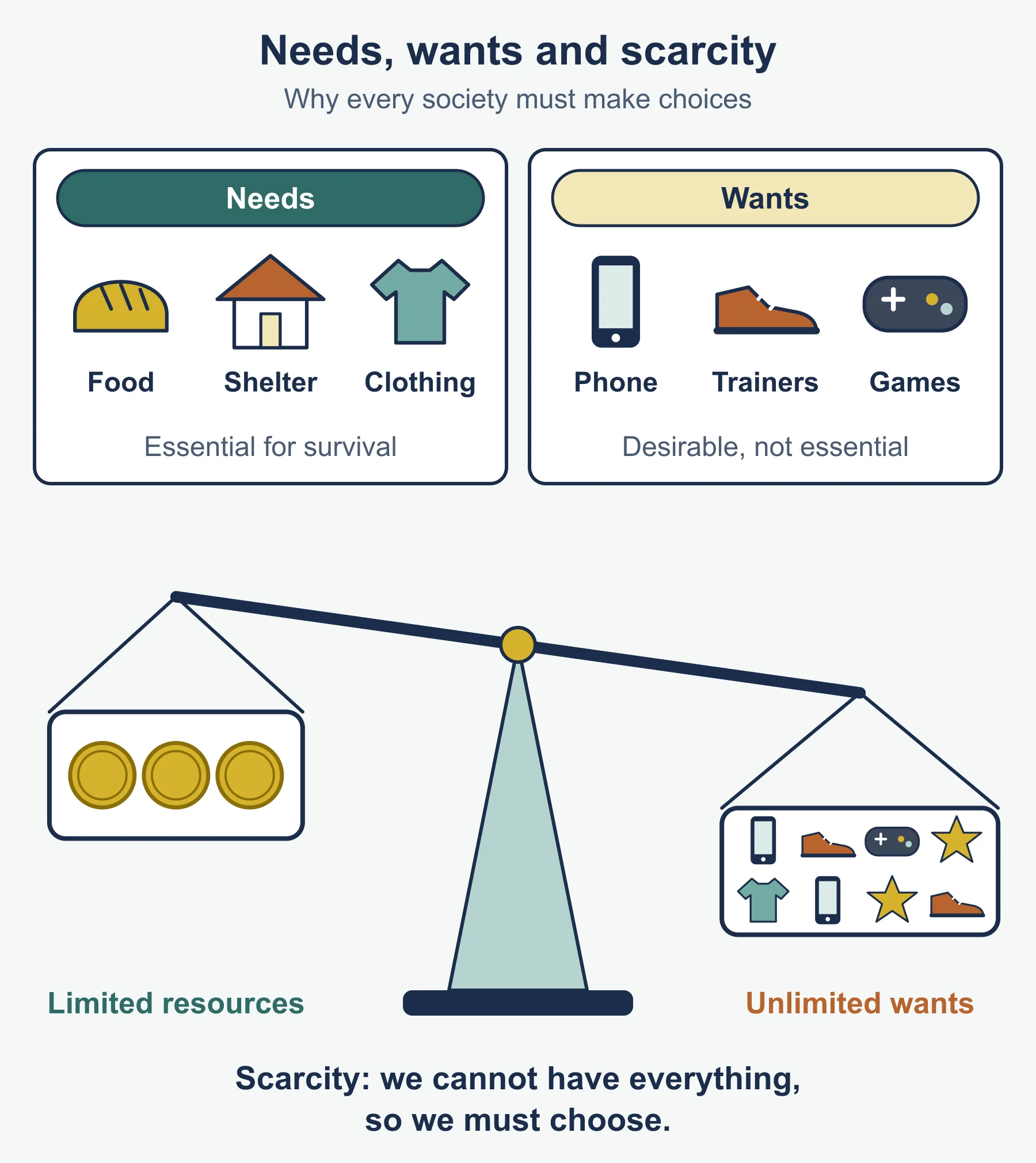
A business is an organization that combines resources (land, labor, capital and enterprise) to produce goods or services that satisfy the needs and wants of customers. This is the standard form of the definition. Three ideas sit underneath it.
- Needs and wants. A need is something required to live or function, such as food or shelter. A want is something desired beyond that, such as a particular brand of trainers.
- Goods and services. Goods are tangible products. Services are intangible activities, such as repair, advice or transport. Many businesses sell both.
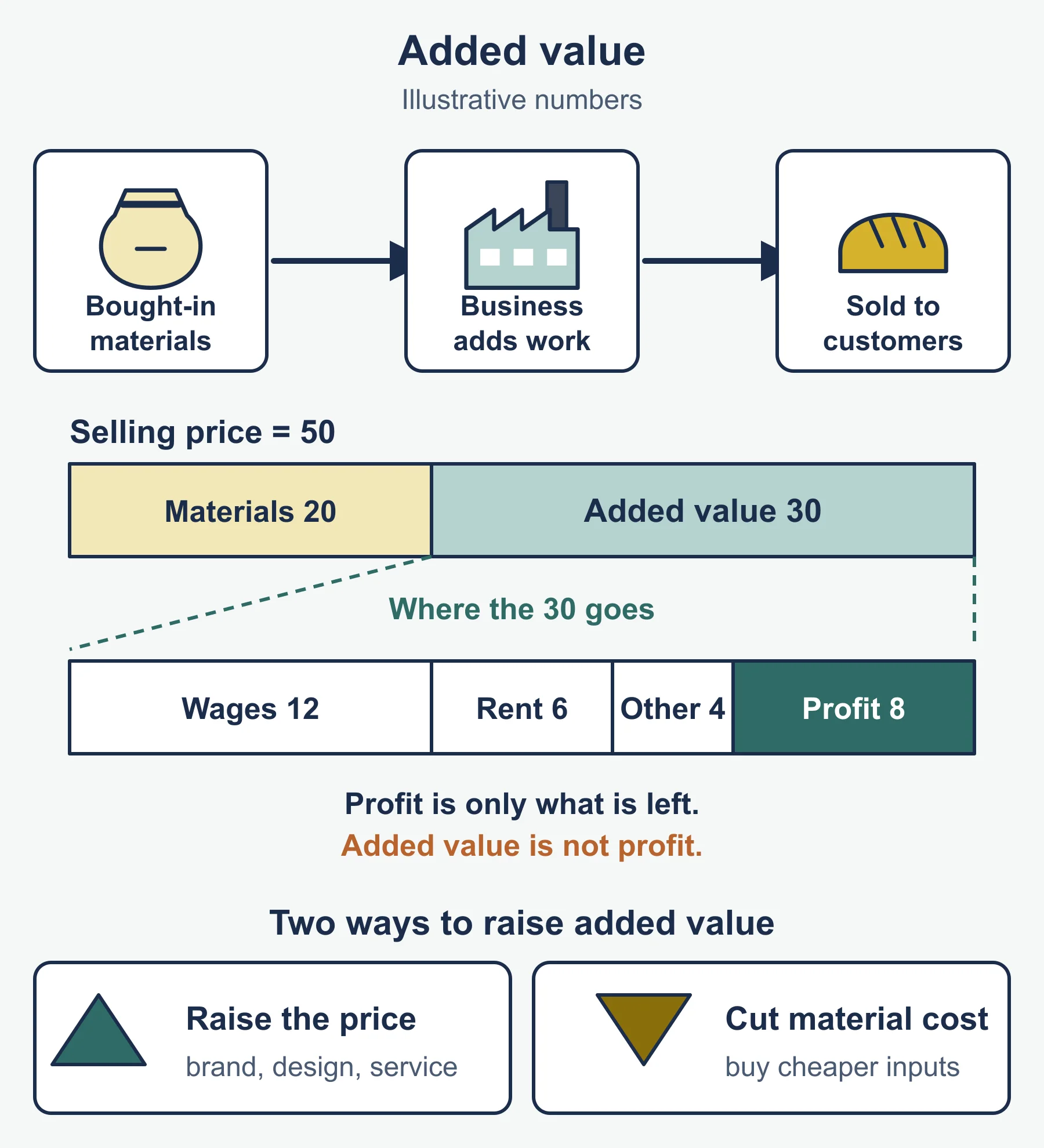
- Adding value. Value added is the difference between what a business pays for its inputs and what customers pay for the output. A business that cannot add value does not survive for long.
Businesses may aim at profit, at a social purpose, or at both. Section 1.2 returns to this.
Primary, secondary, tertiary and quaternary sectors
Economic activity is grouped by what stage of production it covers. The guide names four sectors.
| Sector | What it does | Typical examples |
|---|---|---|
| Primary | Takes or grows output directly from nature | Farming, fishing, mining, forestry |
| Secondary | Makes raw materials into finished or part-finished goods | Manufacturing, construction, food processing |
| Tertiary | Provides services | Shops, banking, transport, teaching, healthcare |
| Quaternary | Knowledge-based activity | Research and development, information technology, consultancy |
Some textbooks place quaternary activity inside the tertiary sector. The guide lists it separately, so treat it as its own sector in an answer.
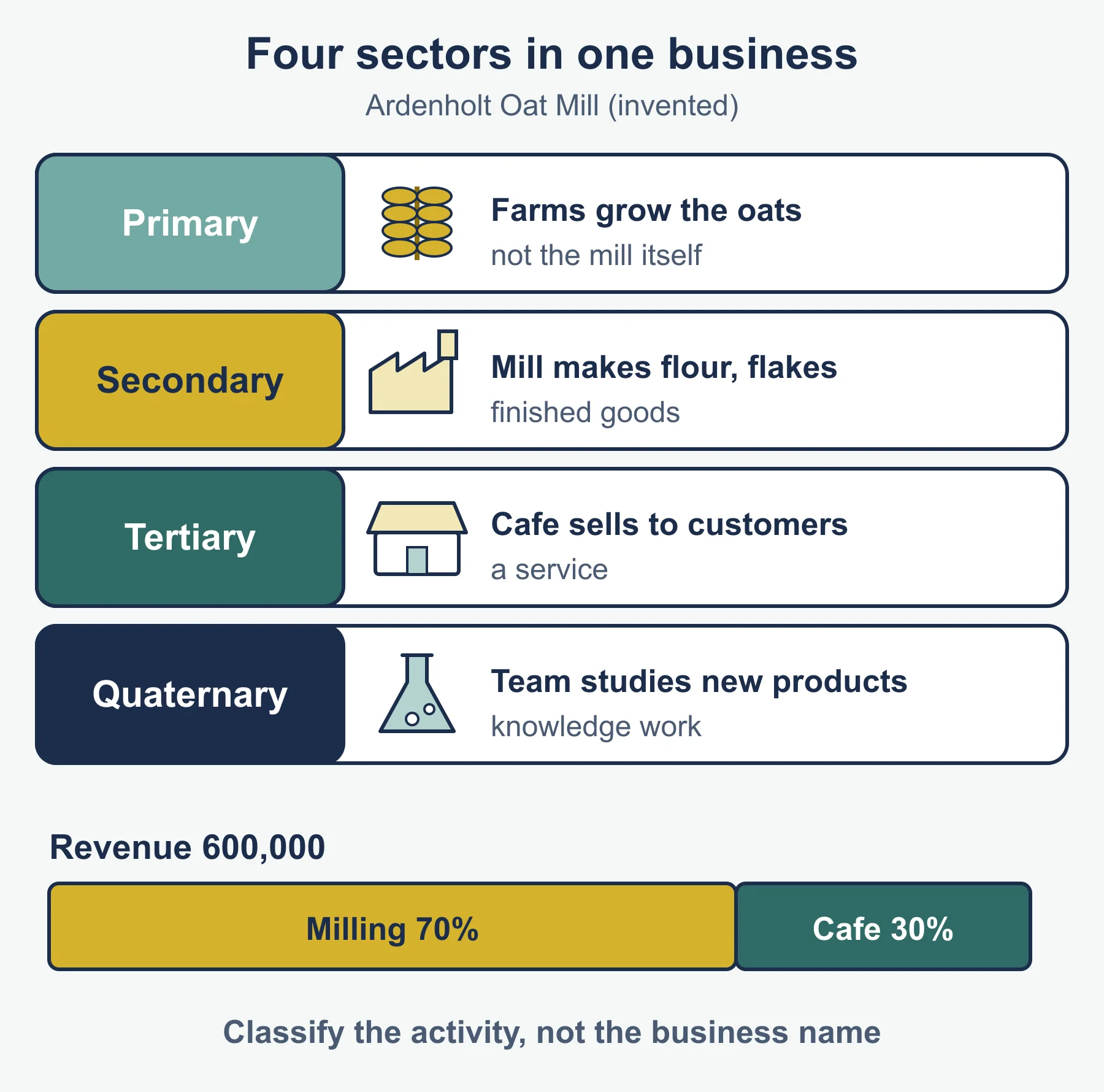
Worked example 1. Ardenholt Oat Mill is invented for this guide. It buys oats from farms, mills them into flour and flakes, sells packs through its own cafe, and runs a small team that studies new low-sugar oat products. Of its sales revenue of £600,000, £420,000 comes from milling and £180,000 from the cafe.
- Growing the oats is primary-sector work, but the mill does not do it. The farms are primary; the mill is a customer of the primary sector.
- Milling is secondary: raw material becomes a finished good.
- The cafe is tertiary: a retail service.
- The product research team is quaternary: knowledge work.
- Milling contributes 420,000 ÷ 600,000 × 100 = 70% of revenue, so the business is mostly secondary-sector.
The point to notice is that one business can operate in several sectors. Classify the activity, not the business name.
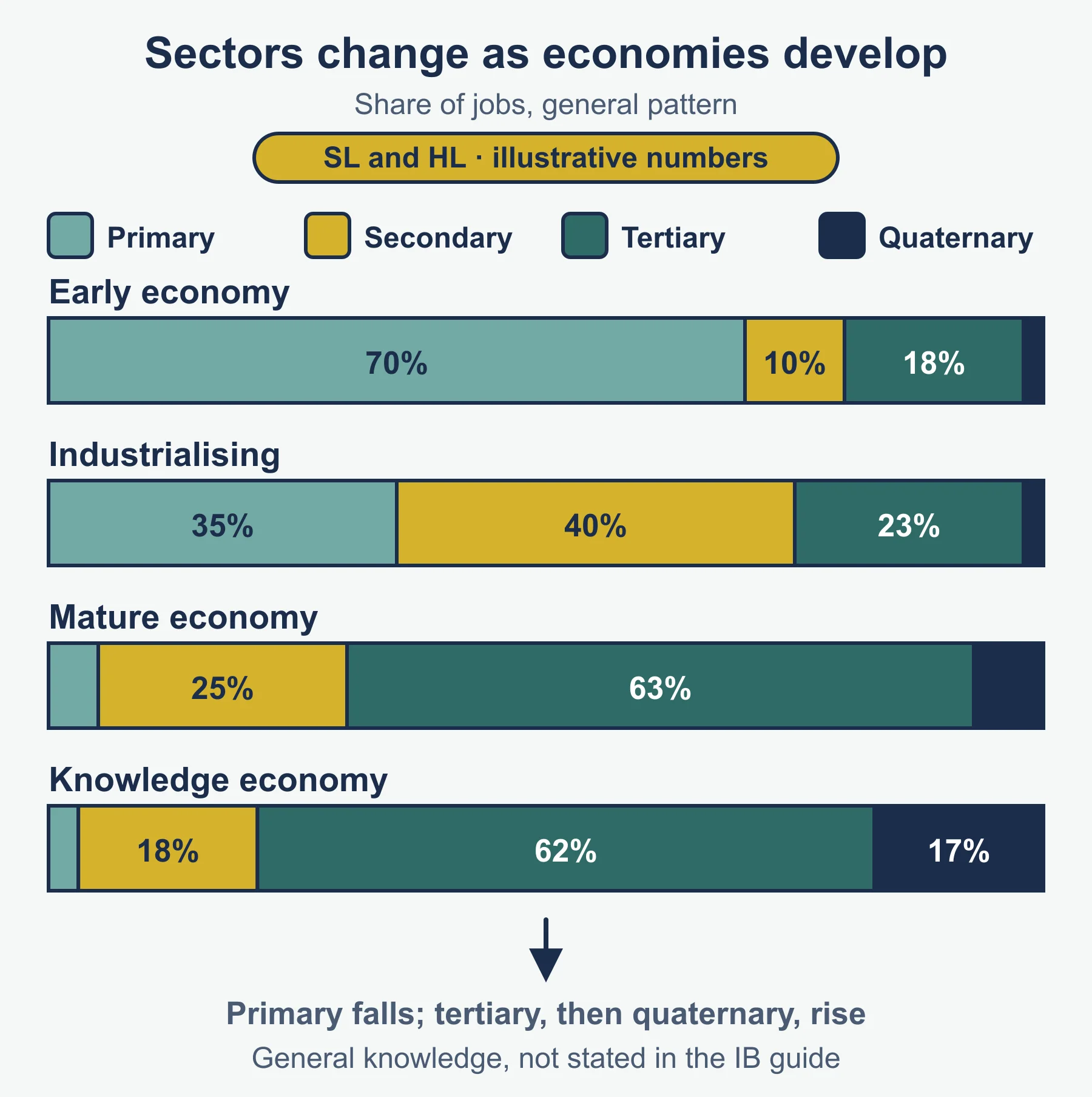
Sectors also change as economies develop. This is general knowledge, not a point the guide makes. Many economies see employment move from primary toward secondary and then tertiary, and some toward quaternary. For a business, this shapes where demand and skilled workers are found.
Entrepreneurship
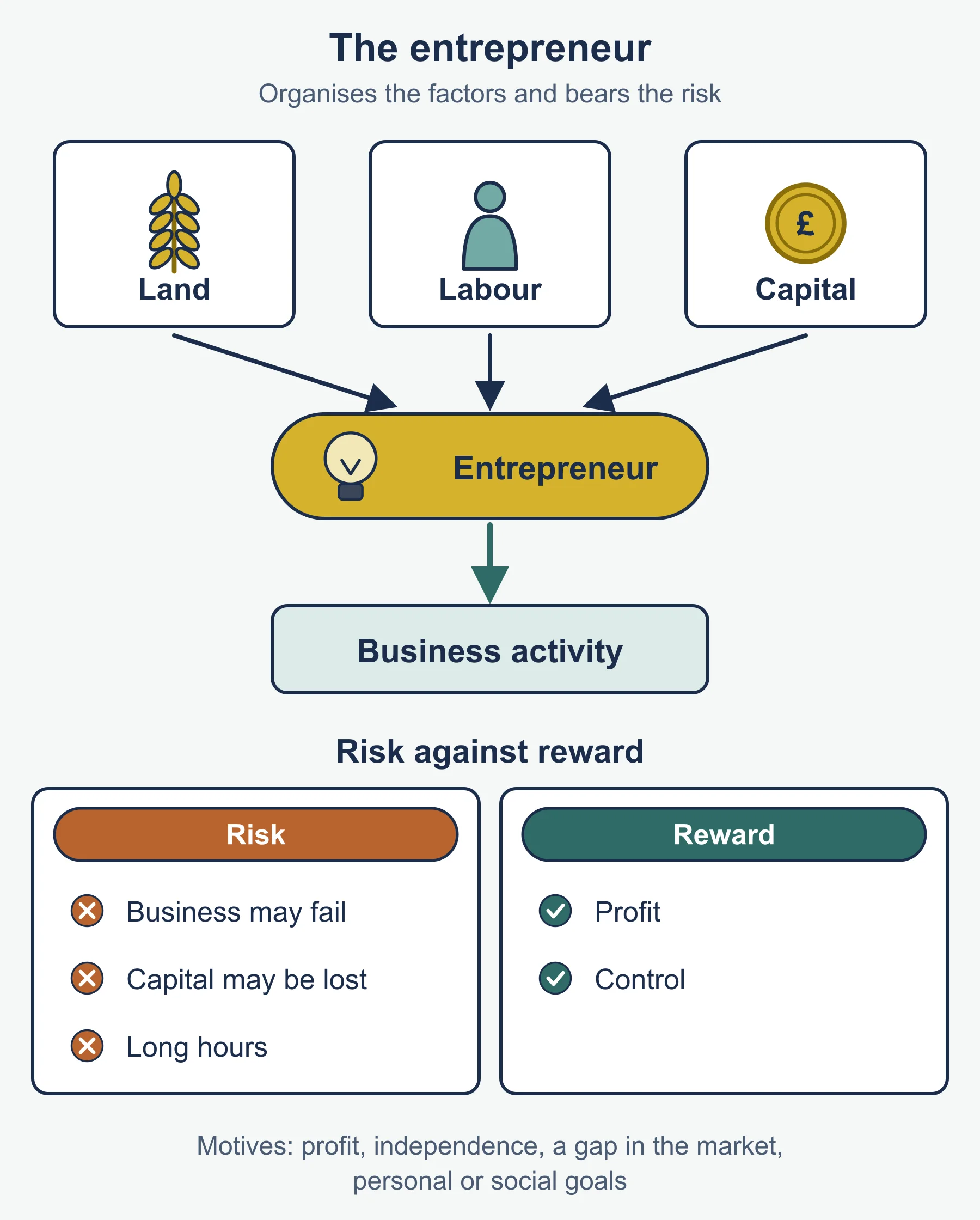
An entrepreneur is a person who identifies a business opportunity, takes the risk of organizing resources to exploit it, and bears the possible loss. Entrepreneurship is the process of doing this. Typical qualities are willingness to take risks, creativity, determination, and the ability to spot unmet needs.
The guide also refers to social entrepreneurs. A social entrepreneur applies the same drive to a social or environmental need, with that need as the main purpose rather than maximum profit. Paper 3, which only HL students sit, is about a social enterprise, so this idea is worth knowing even at SL, where one Paper 2 stimulus option may also be a social enterprise.
An entrepreneur is not the same as a manager. The entrepreneur starts and risks the venture; a manager runs an existing one for owners. In small firms one person is often both.
Challenges and opportunities for starting up a business
The guide lists this as AO2, so you need to analyse the factors in a context. Use the table, then link each point to the case.
| Opportunities | Challenges |
|---|---|
| Being your own boss and keeping the profit | Raising start-up finance with no trading record |
| Meeting a gap in the market | Cash flow in the first months, with costs before sales |
| Flexibility to change quickly | Competition from established firms with brand loyalty and scale |
| Personal satisfaction and creative control | Heavy workload and personal financial risk |
| Chance of growth, or of a later sale | Finding customers, staff and a suitable location |
| Support such as grants, mentors or incubators (where they exist) | Meeting regulations and tax duties |
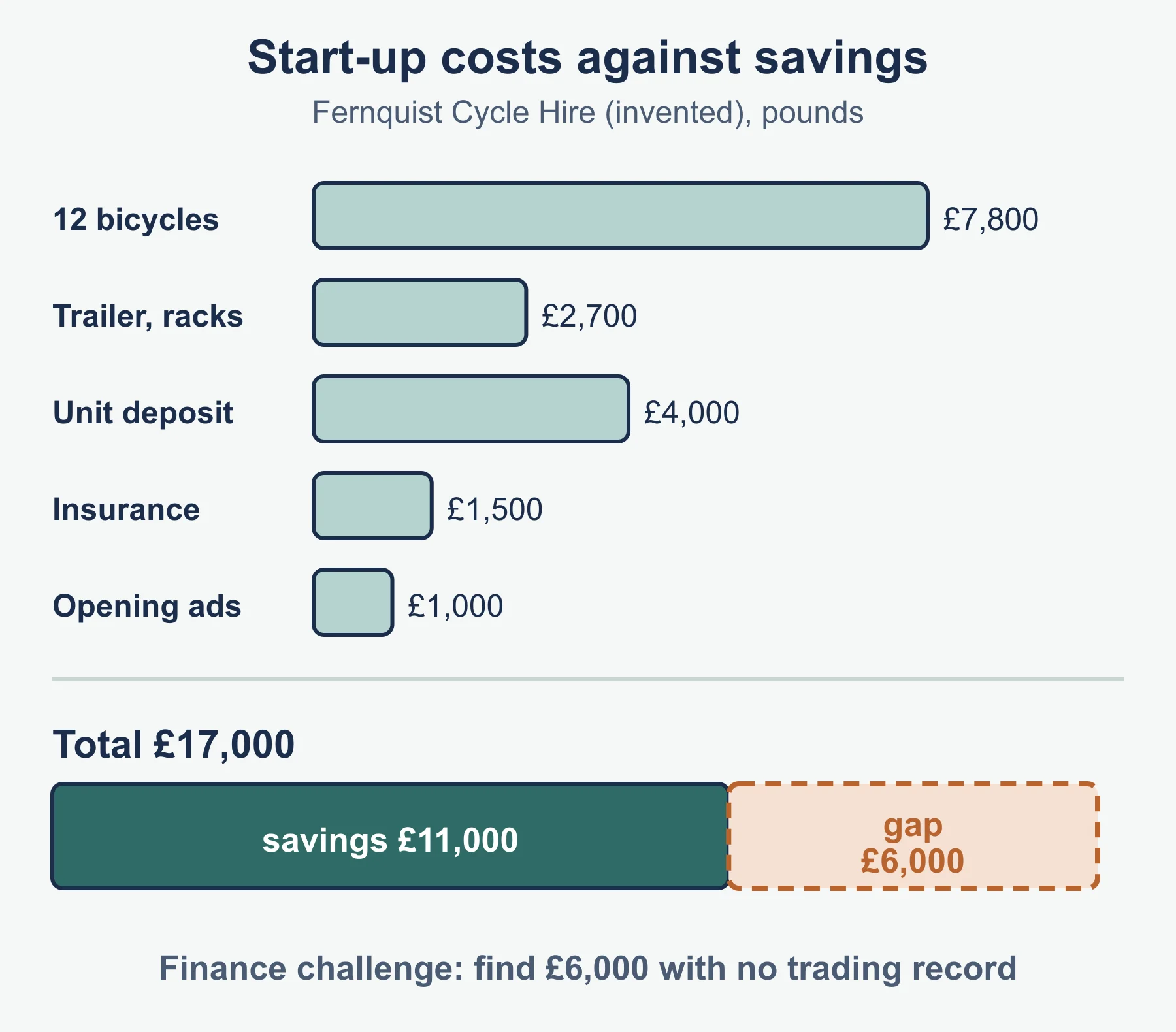
Worked example 2. Fernquist Cycle Hire is invented. Ravi plans to rent bicycles to tourists at a lakeside town. Start-up costs are:
| Item | Cost |
|---|---|
| 12 bicycles at £650 each | £7,800 |
| Trailer and racks | £2,700 |
| Deposit on a small unit | £4,000 |
| Insurance and licences | £1,500 |
| Opening marketing | £1,000 |
| Total | £17,000 |
Ravi has £11,000 of savings, so he must find £17,000 − £11,000 = £6,000 from elsewhere. That is the finance challenge in numbers.
- Opportunity: tourists want to hire bikes, there is no hire shop in the town, and low overheads let him price competitively.
- Challenge: income is seasonal, so cash flow in winter is weak while the unit rent continues.
- Challenge: a lender may hesitate to fund a firm with no record.
A good answer would judge which factor matters most. Here the seasonal cash-flow gap is likely to decide whether Ravi survives his first year, so he should plan a cash reserve before opening.
1.2 Types of business entities
The private and the public sectors
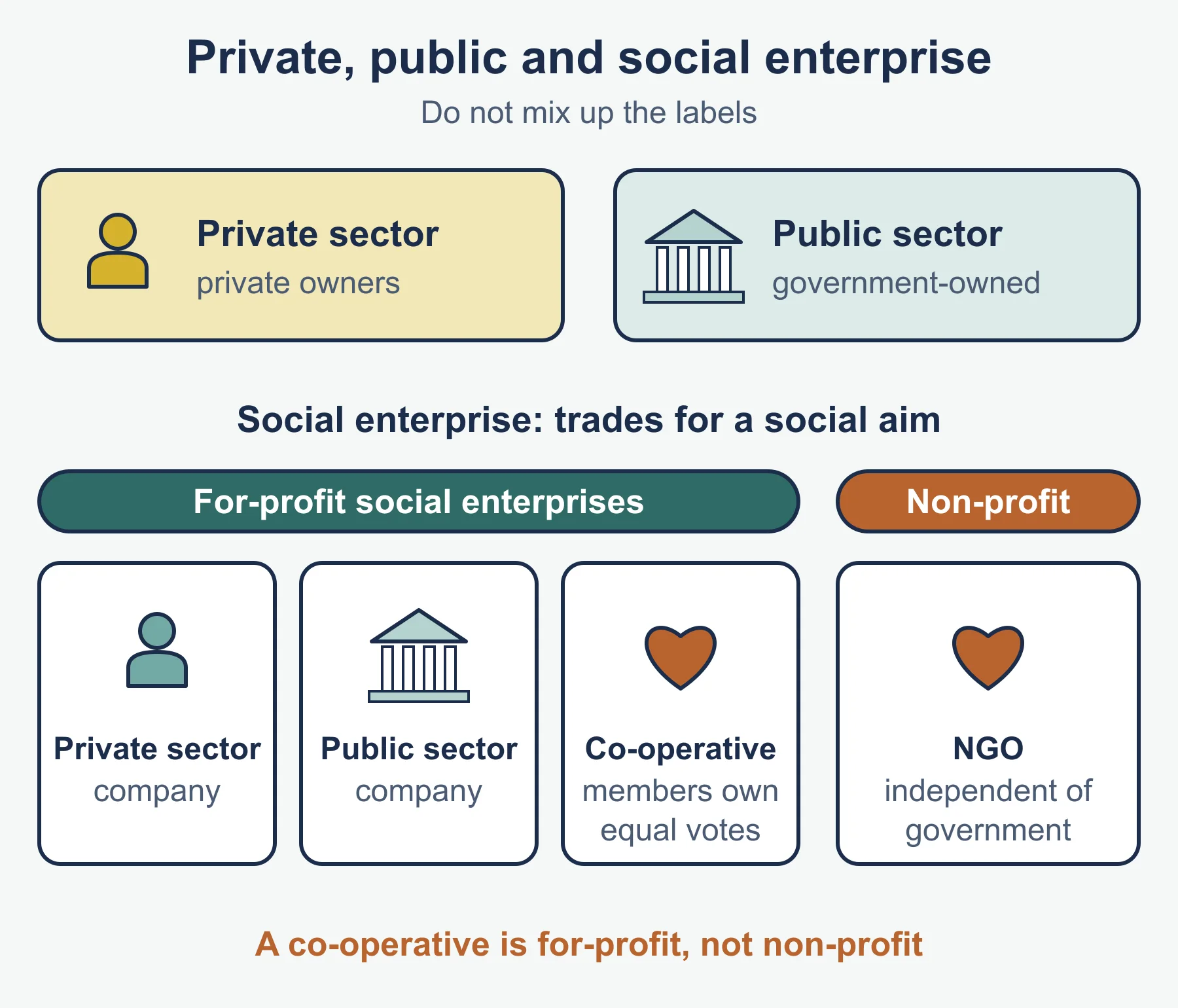
This is a different split from the four sectors above, so do not mix them up.
- The private sector is made up of businesses owned by individuals or groups of private owners. They are usually run to make a profit for the owners, though some have a social purpose.
- The public sector is made up of organizations owned and controlled by the government (national or local). Their aim is often to provide a service, such as public transport or state schools, rather than to maximize profit.
Money, ownership and accountability differ. Private firms answer to owners and customers. Public organizations answer to government, and in turn to taxpayers and voters.
Main features of the four organization types
Legal rules differ between countries, so describe features in general terms and say so in your answer if the case gives no country.
| Feature | Sole trader | Partnership | Privately held company | Publicly held company |
|---|---|---|---|---|
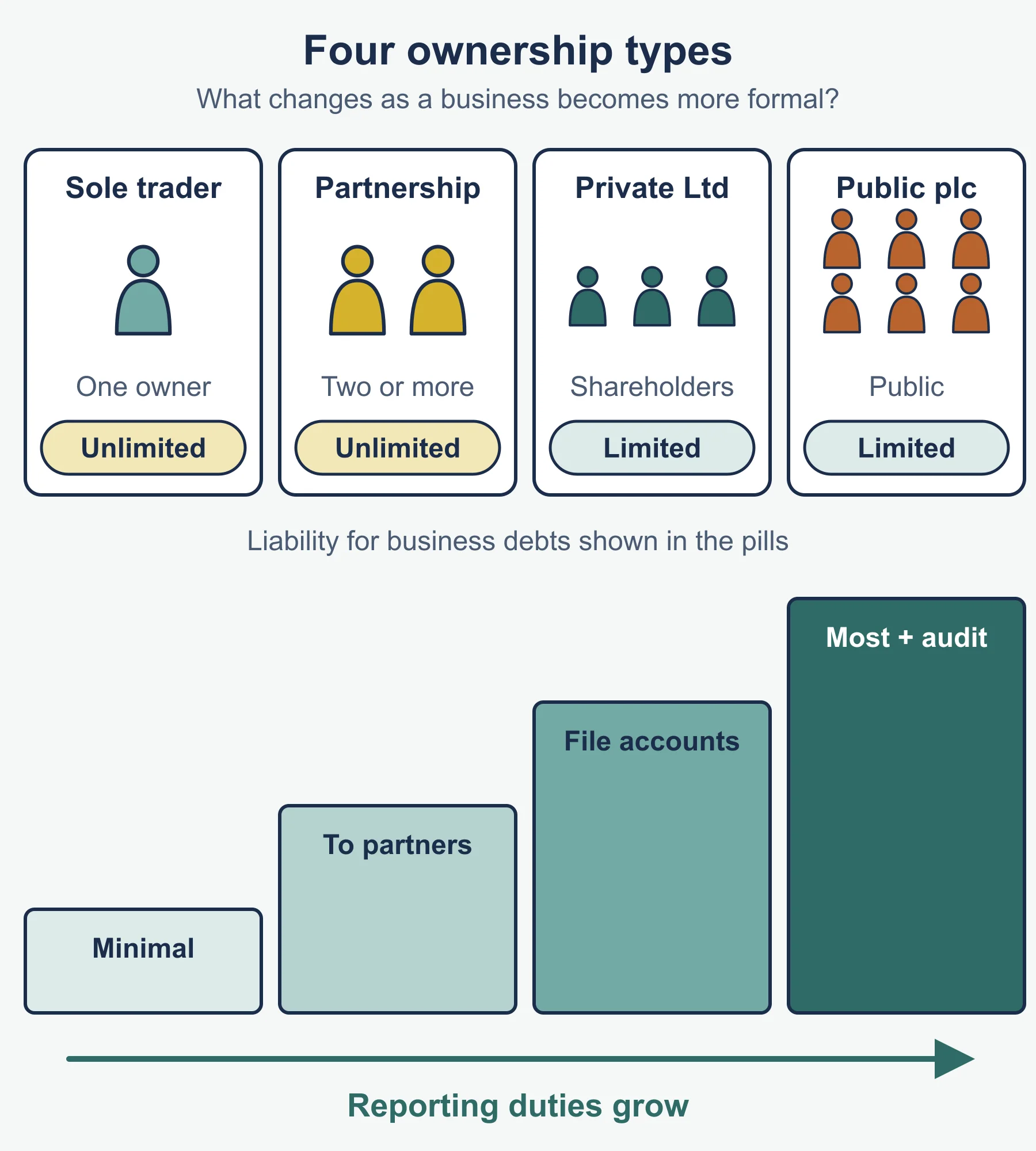
| Owners | One person | Two or more people | Usually a small group of shareholders | Many shareholders, often thousands |
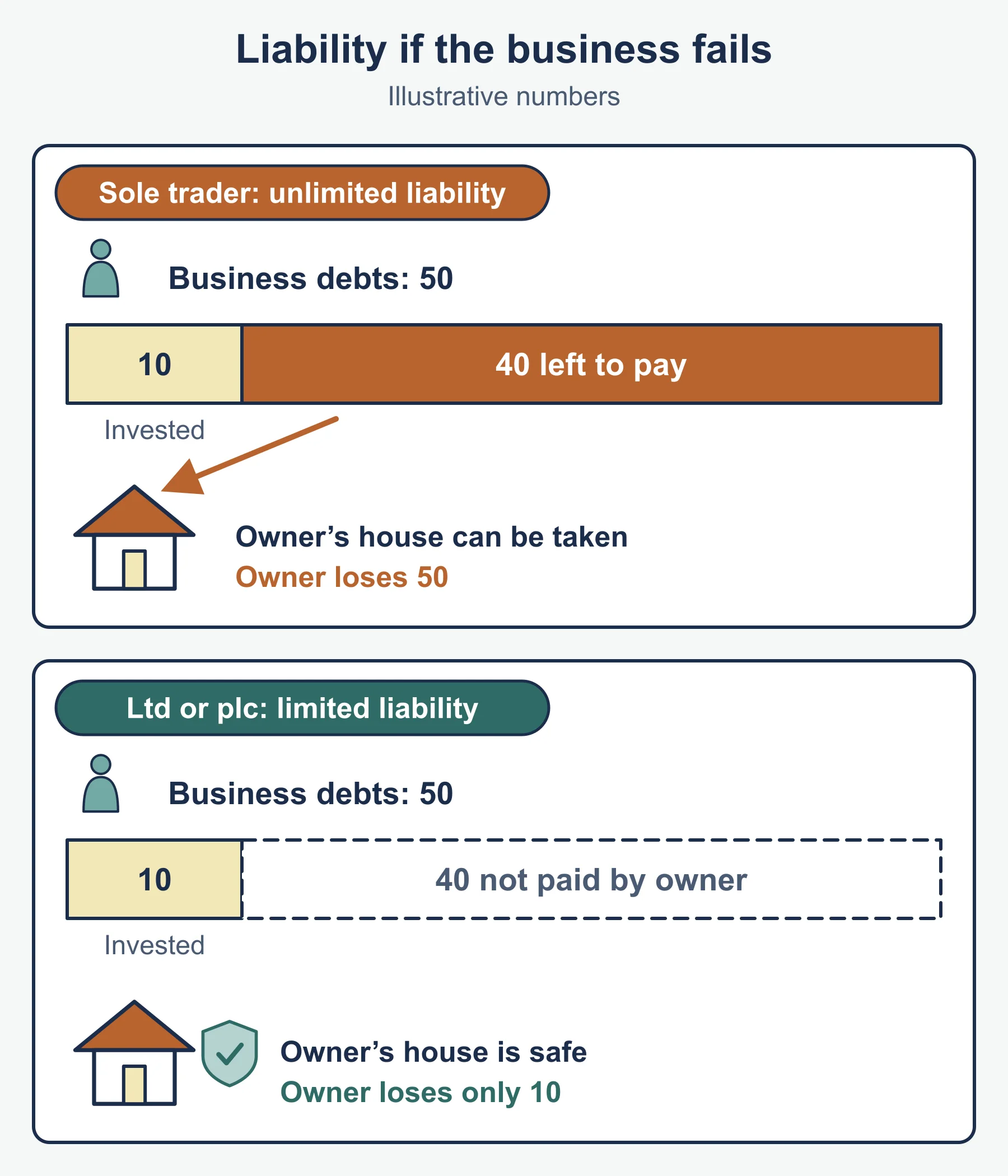
| Liability | Unlimited in general: personal assets at risk | Unlimited in general for partners | Limited to the money invested | Limited to the money invested |
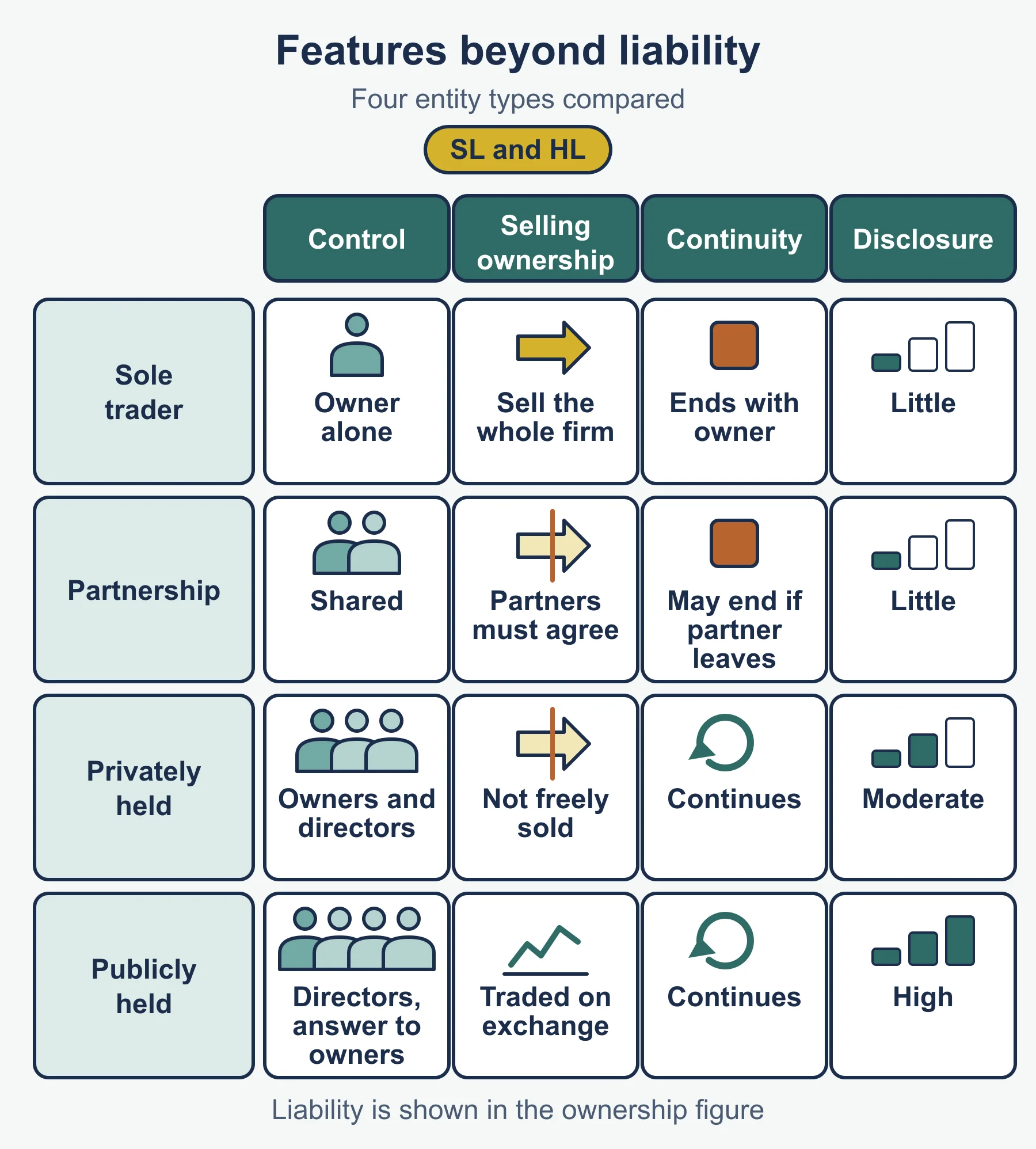
| Control | The owner decides alone | Shared, often by agreement | Owners and directors | Directors, accountable to shareholders |
| Raising finance | Savings, loans, profit kept in the firm | Partners’ capital, loans, retained profit | Existing owners, loans, new private investors | Selling shares to the public, loans |
| Selling ownership | Sell the whole business | Usually needs the partners’ agreement | Shares usually cannot be sold freely to the public | Shares are traded on a stock exchange |
| Disclosure | Little | Little | Moderate | High, because published reports are required |
| Continuity | Ends when the owner stops | May end if a partner leaves, unless agreed otherwise | Continues if owners change | Continues if owners change |
In general, a sole trader keeps all profit and decisions but carries all risk. A partnership shares workload, skills and capital but can suffer disagreement, and each partner may be answerable for the others’ decisions. A privately held company is a separate legal entity, which gives limited liability, but it has less access to capital than a public one. A publicly held company can raise very large sums by selling shares, but ownership can be diluted, managers face short-term pressure from shareholders, and disclosure is costly.
Worked example 3. Strathovane Joinery is invented. Two joiners, Maeve and Dilip, want to open a workshop together. They can put in £40,000 between them but need £60,000.
- As a partnership they would raise the money from their own capital plus a loan, and keep decisions simple. The risk is that each could be held responsible for the other’s debts.
- As a privately held company they would gain limited liability, but the set-up and reporting duties are heavier.
- A publicly held company is not realistic at this size.
A reasoned recommendation might be a privately held company, because the £20,000 gap to be borrowed makes limited liability valuable. A weaker answer lists features without choosing.
For-profit social enterprises
A social enterprise (standard form) is an organization that trades to meet a social or environmental aim. The guide splits the type into for-profit and non-profit. Its for-profit list has three items.
- Private sector companies. Privately owned firms that make profit while also pursuing a stated social purpose, for example by employing people who find it hard to get work, or by reinvesting part of profit in a cause.
- Public sector companies. Government-owned organizations run as businesses. They charge for goods or services and aim for surplus, but exist to serve the public interest, such as a state-owned water or rail operator.
- Cooperatives. Businesses owned and run by members, who may be workers, customers or producers. Typically each member has an equal vote, and surplus is shared among members or reinvested.
Non-profit social enterprise: NGOs
A non-governmental organization (NGO) is independent of government and does not aim to make profit for owners. It exists for a social, humanitarian or environmental purpose. Funding often comes from donations, grants and fundraising, and any surplus is kept for its mission. Its stakeholders include donors, volunteers and the people it helps. A common challenge is dependence on funding that may not be renewed.
Common errors
- Writing that a sole trader has “no” capital problems. Raising finance is usually its hardest challenge.
- Saying limited liability means the owners can lose nothing. They can lose what they invested.
- Using “public limited” and “public sector” as if they meant the same. Publicly held means shares are open to the public; public sector means government-owned.
- Treating a cooperative as non-profit by definition. The guide places it among for-profit social enterprises.
- Listing features with no link to the case.
Frequently asked questions
What are the four sectors of economic activity? The IB guide names the primary sector (taking or growing output from nature), secondary (making goods), tertiary (providing services) and quaternary (knowledge-based activities such as research). Some textbooks place quaternary activity inside the tertiary sector, but the guide lists it separately.
What is value added? Value added is the difference between what a business pays for its inputs and the price at which it sells its output.
What are the main challenges of starting a business? Common challenges include raising start-up finance with no trading record, weak cash flow in the first months when costs come before sales, and competition from established firms. Opportunities include being your own boss, keeping the profit and meeting a gap in the market.
What is an NGO? A non-governmental organization is independent of government and does not aim to make a profit. In the IB guide it is the non-profit form of social enterprise.
What is the difference between a sole trader and a partnership? A sole trader has one owner who keeps all profit and decisions but carries all risk. A partnership has two or more owners who share capital, skills and decisions; in general both have unlimited liability.
Official syllabus
IB Diploma Programme Business management guide, first assessment 2024, published by the International Baccalaureate Organization. Sections 1.1 and 1.2 of Unit 1.
Get free revision emails (optional)
Occasional emails with practice questions, worked explanations and links to free resources for the qualification and subjects you choose. No spam, and you can unsubscribe from any email. The free tools on this site never need an email.
Related resources
-
Practice questions
IB DP Business Management: What is a business? and Types of business entities – Practice Questions
Original IB DP Business Management practice questions with worked answers on sectors, entrepreneurship, start-ups, entity types and social enterprises.
Business · International Baccalaureate · IB
Try questions -
Revision notes
IB DP Business Management: What is a business? and Types of business entities – Revision Notes
Condensed IB DP Business Management revision notes for 1.1 and 1.2: sectors, entrepreneurship, start-up issues, entity types, social enterprises.
Business · International Baccalaureate · IB
Revise topic -
Study guides
IB DP Business Management: Business objectives
Study guide to vision and mission statements, growth, profit, shareholder value, ethics, strategic and tactical aims and CSR in IB Business Management.
Business · International Baccalaureate · IB
Read guide
Related articles
-
teaching
A Level tuition in Dubai: Cambridge or Pearson Edexcel International A Level?
Schools in Dubai and Abu Dhabi teach either Cambridge International AS & A Level or Pearson Edexcel International A Level. How the two are structured, why it matters for tuition, and how online classes from Lahore work.
9 October 2026
-
curriculum guides
Choosing subjects at IGCSE and A Level
How subject choices at 14 and 16 affect university options later, and how to keep pathways open without overloading a timetable.
28 July 2026
Studying this with a teacher
Working through Business IB?
This page is free and stays free. If you would rather be taught it, Marlbridge runs Business classes one-to-one, online in your own time zone. The first trial class is free. WhatsApp replies within an hour (8am–11pm Pakistan time, every day); email the same day.
IB Business teachers at Marlbridge

