
Study Guides
IB DP Business Management: Leadership and management
Study guide to IB DP Business Management 2.3: management and leadership, five leadership styles, and scientific and intuitive thinking (HL only).
- Subject
- Business
- Level
- IB
- Topic
- Unit 2: Human resource management
- Author
- Marlbridge Academic Team
- Updated
- Reviewed by
- Salman Ahmad (what this means)
Aligned to International Baccalaureate IB Diploma Programme Business (DP Business Management), First assessment 2024. Official specification .
Syllabus page (what it covers and how it is assessed): IB Diploma Programme Business.
Syllabus points this page covers
DP Business Management
- 2.3 Leadership and management
Found an error? Report a correction.
Need help with this topic? Request a free trial class for IB Diploma Programme Business (DP Business Management).
This guide covers section 2.3, Leadership and management, in Unit 2 (Human resource management) of the IB Business management guide, first assessment 2024. Most of the section applies to both SL and HL. One point, scientific and intuitive thinking/management, is labelled HL only in the guide. The wording of the official text is short, so this guide fills in each named idea with the standard textbook account and says where it does so.
Related pages: the Business Management hub, the printable checklist, the revision notes and the practice questions. To find weak spots first, try the free diagnostics.
What section 2.3 asks you to know
| Content point in the guide | Depth of teaching (as the guide labels it) | Level |
|---|---|---|
| Scientific and intuitive thinking/management | AO2 | HL only |
| Management and leadership | AO2 | SL and HL |
| Leadership styles: autocratic, paternalistic, democratic, laissez-faire, situational | AO3 | SL and HL |
AO2 is application and analysis, so you must use an idea on a business, not only recall it. AO3 is synthesis and evaluation, so for leadership styles you must be ready to weigh a style against a situation and reach a judgement. The guide gives no formulas or calculations for this section. Every mark comes from precise definitions, linking to the case, and balanced argument.
Management and leadership
The guide lists “management and leadership” as one point, so expect to be asked how the two ideas differ and how they work together.
Management (standard account) is about running the organization’s resources to meet its objectives. Typical tasks are planning, organizing people and resources, directing day-to-day work, coordinating teams and controlling results against targets. A manager works within the existing structure and focuses on how things get done.
Leadership (standard account) is about influencing and guiding people toward a vision or goal. A leader sets a direction, communicates it and gets people to follow willingly. A leader may have no formal title: an experienced technician who steers colleagues through a new process is leading.
Distinguishing them
| Feature | Management | Leadership |
|---|---|---|
| Main focus | Tasks, resources, systems | People, direction, change |
| Source of influence | Formal position and authority | Personal influence, trust, example |
| Time horizon | Often short and medium term | Often longer term and vision-based |
| Typical question | How do we do this efficiently? | Where are we going and why? |
The two overlap. A head of department who sets a timetable is managing. When the same person explains why a new teaching approach matters and persuades colleagues to try it, she is leading. Good answers say that one person can do both and that a business usually needs both.
Worked example: applying the distinction
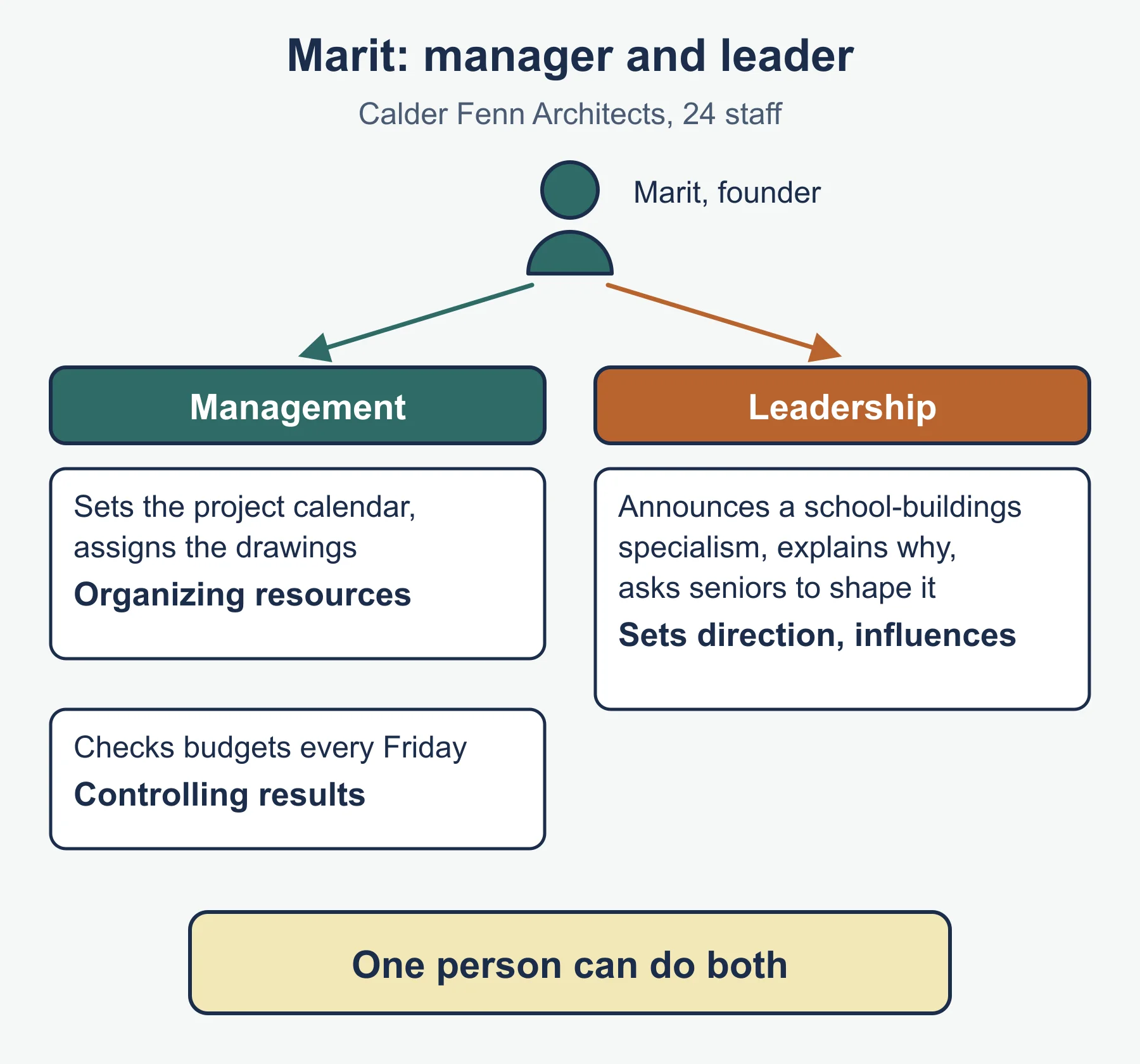
Calder Fenn Architects employs 24 people. Its founder, Marit, drew up the project calendar, assigns drawings to staff and checks budgets each Friday. Last spring she also announced that the firm would specialize in school buildings, held a meeting to explain the reasons, and asked senior architects to shape the plan.
Question: explain two ways Marit acts as a manager and one way she acts as a leader.
- Management: she builds the project calendar and assigns drawings, which is organizing resources and coordinating work.
- Management: the Friday budget check is controlling, because actual spending is compared with a plan.
- Leadership: announcing a specialism in school buildings and persuading staff to buy into it sets a direction and influences people toward a shared goal.
Notice the pattern. Each point names the idea, quotes a detail from the stem and links the two with a reason. That is what AO2 asks for.
Leadership styles
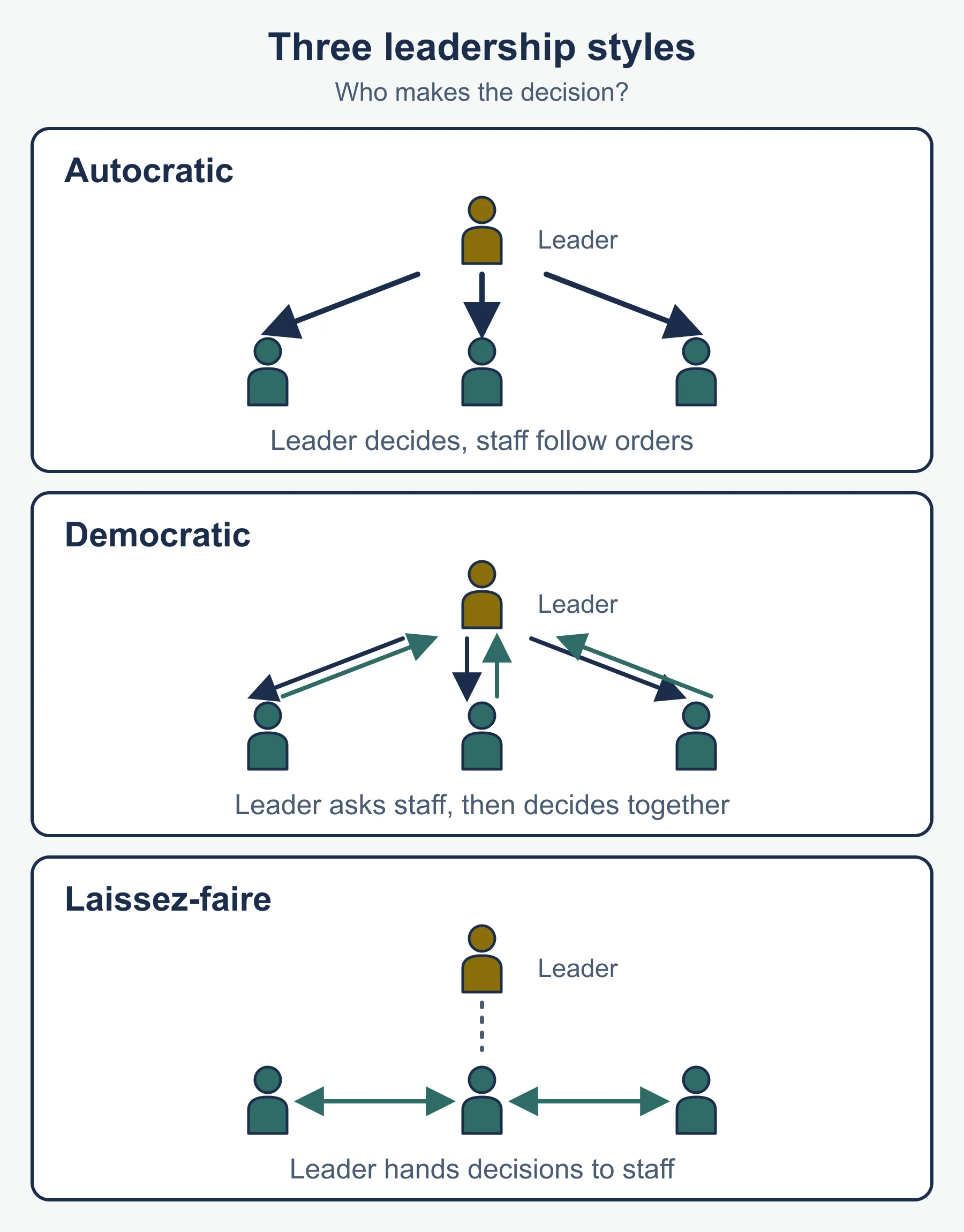
The guide names five styles. The official text does not define them, so the descriptions below are standard accounts. In an answer, show you can recognize a style from behavior, not from a label alone.
Autocratic
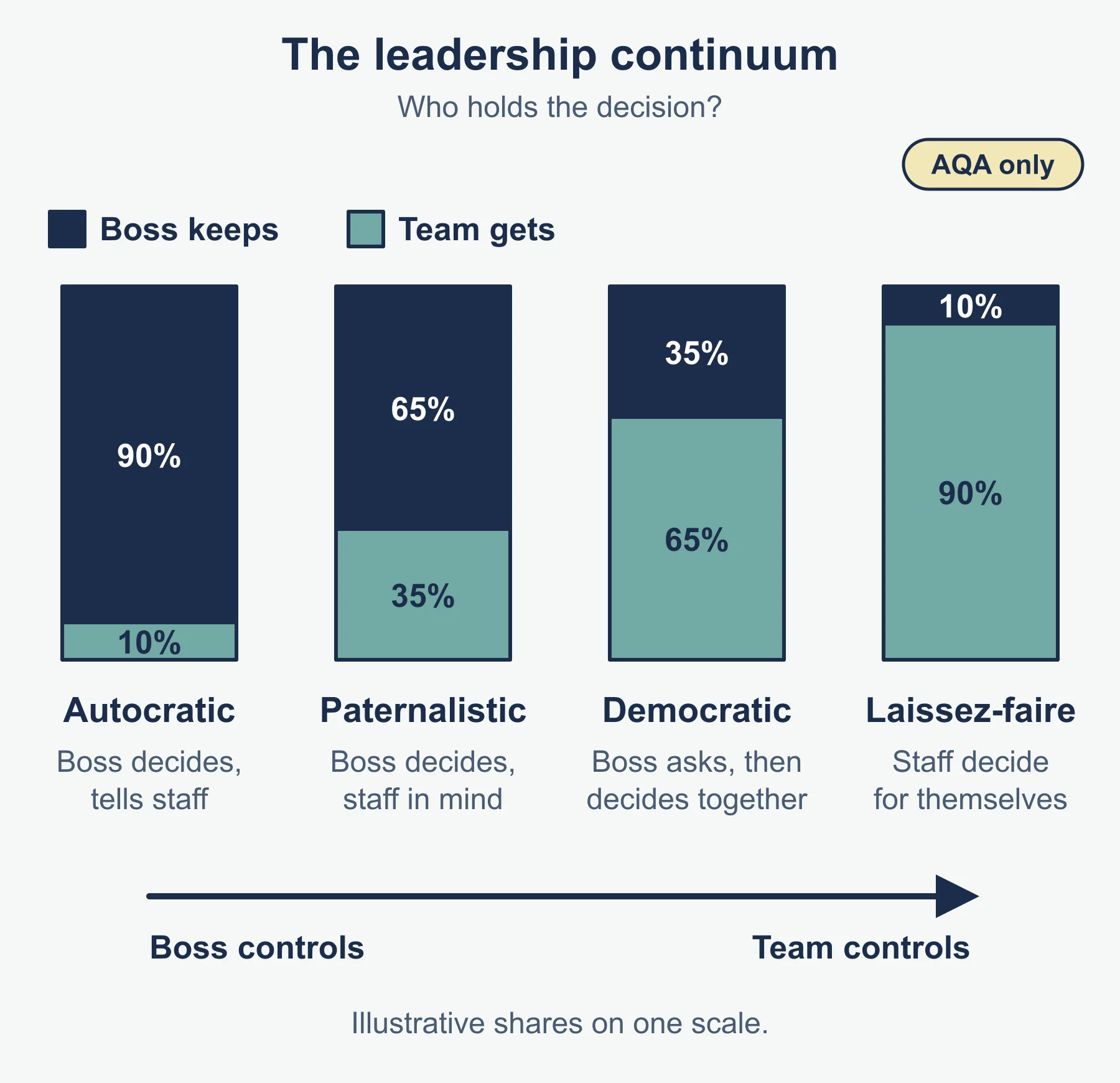
The leader makes decisions alone and expects them to be followed. Communication is mostly top-down.
- Strengths: fast decisions, clear accountability, useful in a crisis or with untrained staff.
- Limitations: little input from staff, which may lower motivation and creativity, and may raise staff turnover.
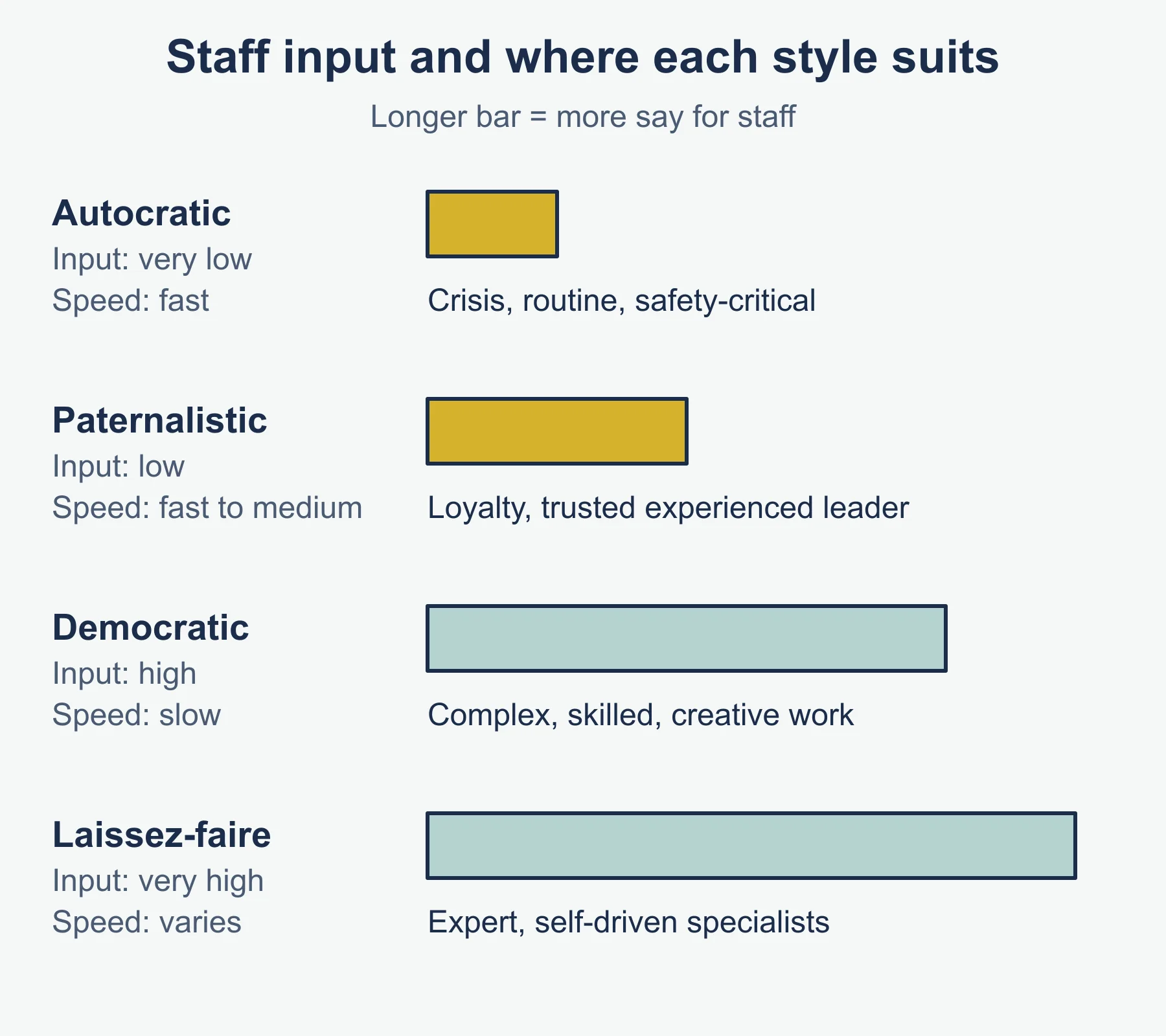
- Suits: urgent situations, routine tasks, safety-critical work, inexperienced teams.
Paternalistic
The leader decides, but with the stated aim of acting in the staff’s interest. Reasons may be explained, and the leader shows concern for welfare, for example through generous benefits, while keeping control of the decision.
- Strengths: staff may feel looked after and loyal, which can reduce turnover.
- Limitations: staff may feel treated like children, and decisions still rest on one person’s view of what is good for others.
- Suits: businesses where long-term loyalty matters and where the leader holds experience that staff trust.
Democratic
The leader involves staff in decisions, through discussion, consultation or voting, and takes their views seriously.
- Strengths: more ideas, stronger commitment to the outcome, a sense of ownership.
- Limitations: slower, risk of conflict or compromise decisions, and difficulty if staff lack the knowledge to contribute.
- Suits: complex problems, skilled and experienced teams, creative work, change that needs buy-in.
Laissez-faire
The leader gives staff wide freedom to decide how to work, with minimal direction. The French phrase is often translated as “let it be”.
- Strengths: freedom can motivate capable, self-driven people and encourages innovation.
- Limitations: lack of direction, uneven standards, poor coordination, and the risk that the leader appears absent.
- Suits: highly skilled specialists such as research scientists or senior designers, who need little supervision.
Situational
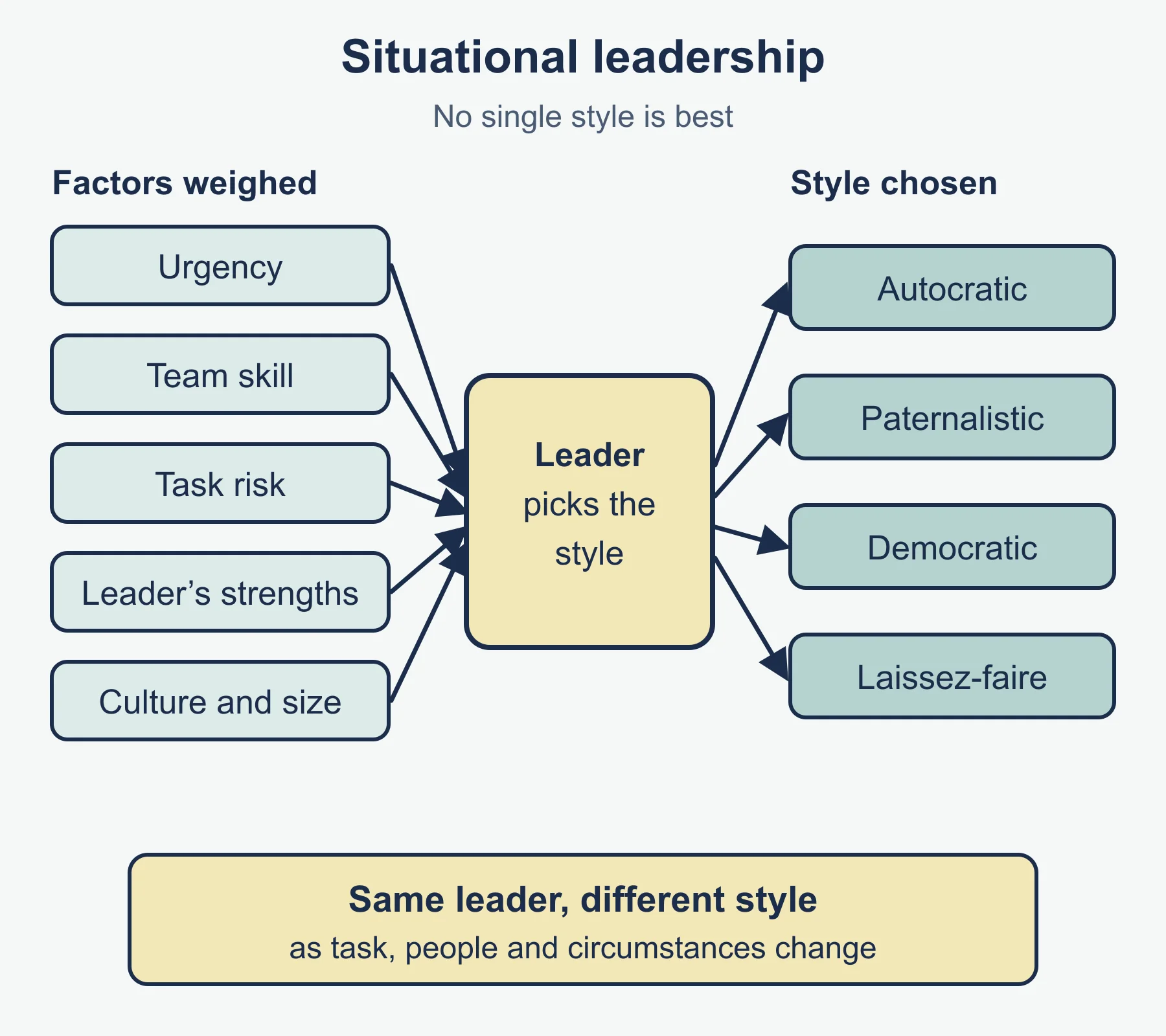
The guide lists situational leadership as the fifth style. In the standard account, no single style is best. The leader chooses or changes style depending on the task, the people and the circumstances. The official text names no particular model of it, so write about it in these general terms.
Factors a situational leader weighs include:
- how urgent the decision is
- how skilled and experienced the team is
- how important the task is and how risky mistakes would be
- the leader’s own strengths
- the culture and size of the organization
Choosing between styles: a comparison
| Style | Who decides | Staff input | Speed | Typical risk |
|---|---|---|---|---|
| Autocratic | Leader | Very low | Fast | Demotivation |
| Paternalistic | Leader, explained as for staff benefit | Low | Fast to medium | Resentment at control |
| Democratic | Group, led by the leader | High | Slow | Delay, compromise |
| Laissez-faire | Staff | Very high | Varies | Lack of direction |
| Situational | Depends on circumstances | Varies | Varies | Inconsistency if style shifts without explanation |
Worked example: evaluating a style
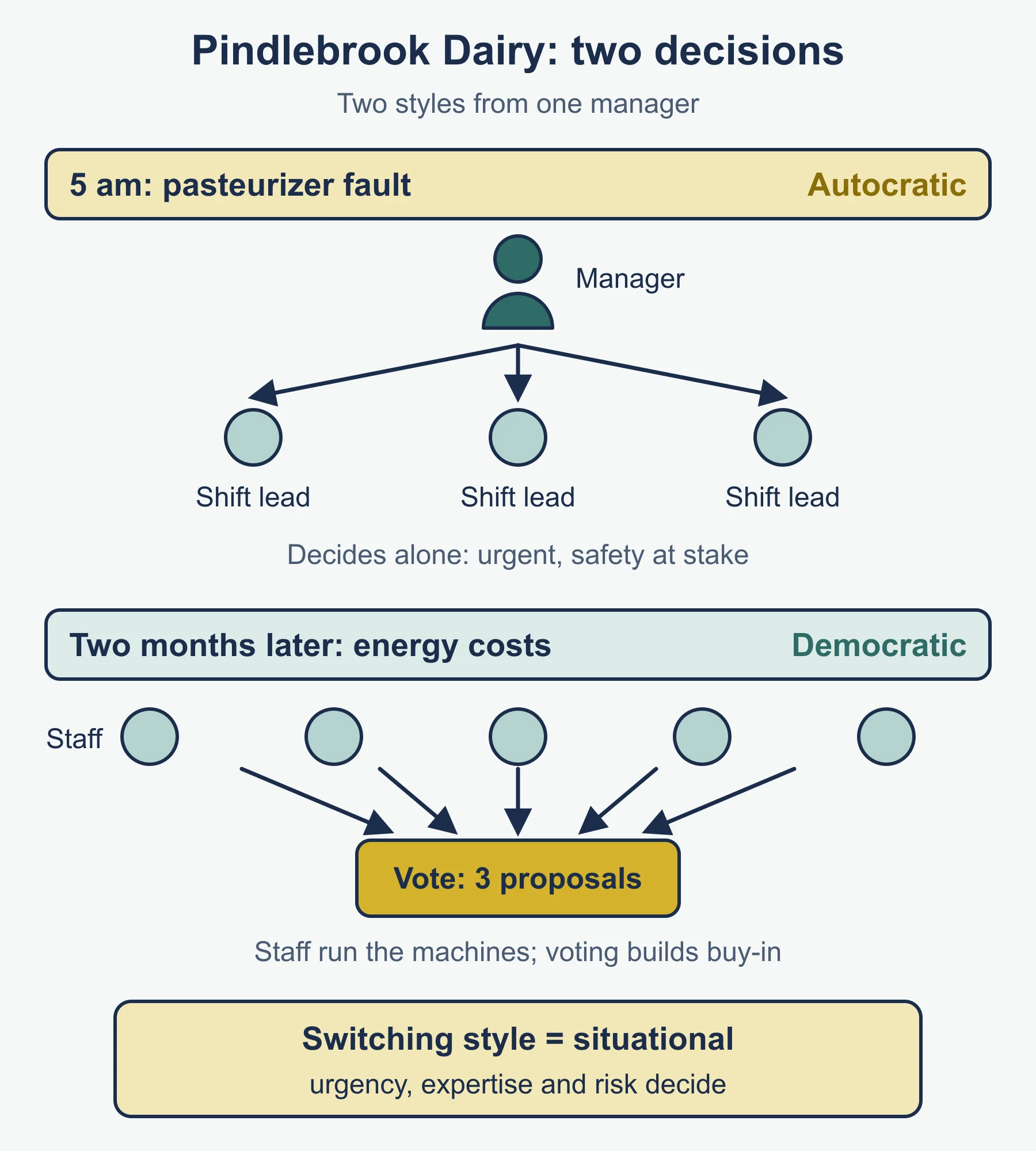
Pindlebrook Dairy runs a milk-processing plant. A fault in the pasteurizer is found at 5 am. The plant manager immediately stops the line, tells each shift lead what to do, and does not consult anyone. Two months later, she holds an open meeting to decide how the plant should reduce energy costs, and staff vote on three proposals.
Question: evaluate the manager’s choice of leadership style.
- The fault: she is autocratic. This is justified because the matter is urgent, safety and product quality are at stake, and there is no time to consult. The cost is lost staff input, but that cost is small in a one-off emergency.
- The energy plan: she is democratic. Staff operate the machines daily and hold practical knowledge. Voting should raise commitment to the chosen plan. The cost is time.
- Judgement: her ability to switch is the strongest feature of her leadership. It suggests a situational approach. The risk is that staff may find the change confusing, so she should explain why she acts differently in a crisis. A manager who used one style all the time would probably handle at least one of these two events badly.
That final step is the AO3 skill: a conclusion backed by criteria such as urgency, expertise and risk.
Scientific and intuitive thinking/management (HL only)
This point is labelled HL only in the guide, and it is taught at AO2. The guide gives no definitions, so the following is a standard account.
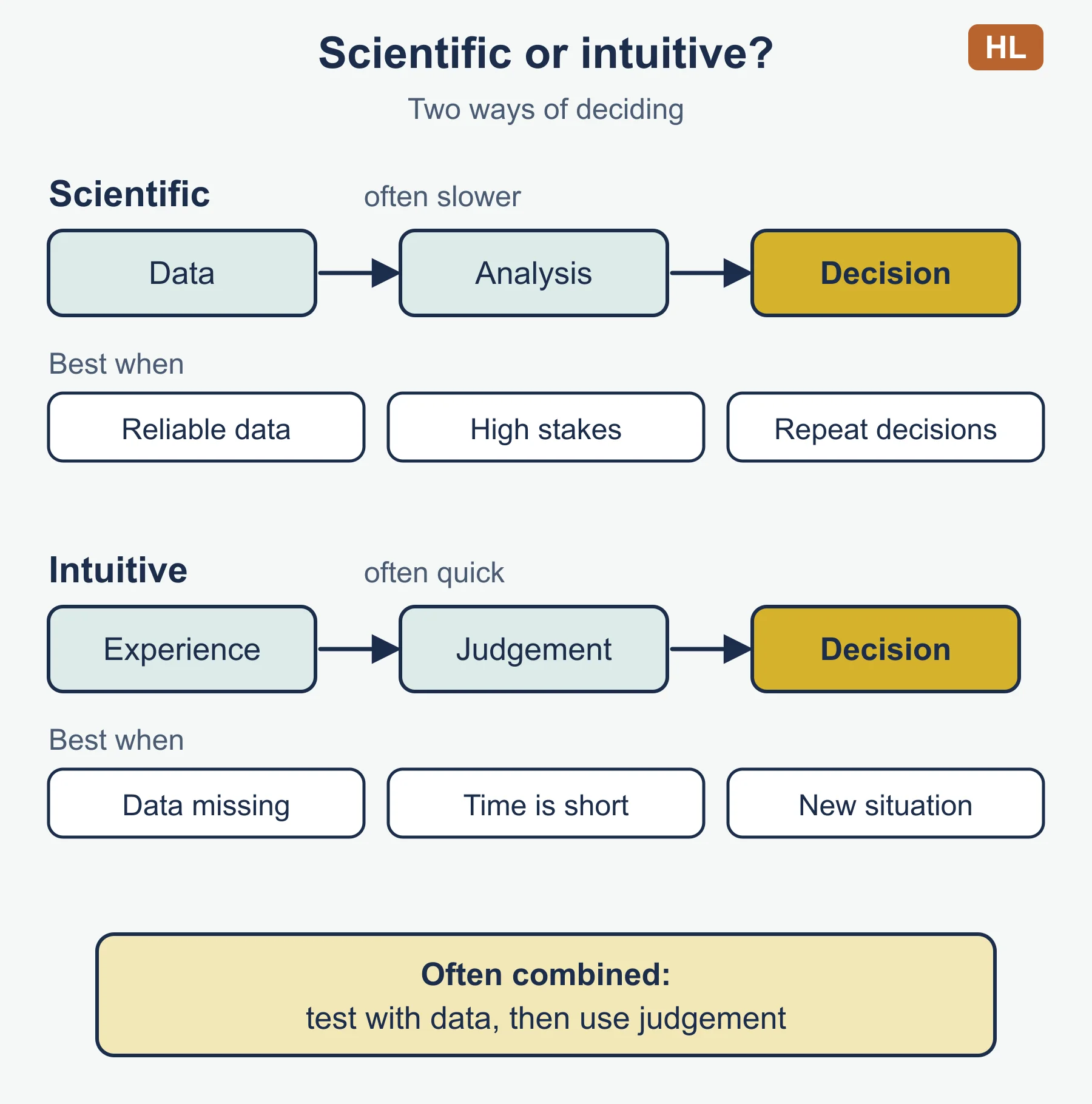
Scientific thinking/management relies on data, analysis and testing. Decisions come from evidence such as sales data, time studies, experiments or models. The approach is systematic and repeatable.
Intuitive thinking/management relies on experience, judgement and instinct. It is often fast, and it draws on patterns the manager has noticed over years, even when they cannot fully explain them.
| Feature | Scientific | Intuitive |
|---|---|---|
| Basis | Data and analysis | Experience and judgement |
| Speed | Often slower | Often quick |
| Best when | Reliable data exist, the stakes are high, the decision repeats | Data are missing, time is short, the situation is new or very human |
| Risk | Over-reliance on data that is old or incomplete | Bias, error, difficulty justifying the decision to others |
Good HL answers avoid presenting one as always right. Managers often combine both: they test an idea with data and then use judgement on the final call. For application, ask what data the business actually has and how much time the decision allows.
Common errors
- Treating “manager” and “leader” as exact synonyms, or saying leadership is just a more senior form of management.
- Calling any decisive boss autocratic. Check whether the leader consults, and whether the aim is staff welfare, which points to paternalistic.
- Describing laissez-faire as “no leadership”. The leader still sets goals and may provide support.
- Writing that one style is always best. The guide treats situational leadership as a named style because the answer depends on context.
- Listing advantages and disadvantages with no link to the case. At AO3, a verdict is needed.
- Forgetting that scientific and intuitive thinking is HL only if you sit SL.
Next steps
Condense this page with the revision notes, then test yourself on the practice questions. Tick off the section on the checklist when you are confident.
Frequently asked questions
What is the difference between management and leadership? Management is about running the organization’s resources to meet its objectives, through tasks such as planning, organizing and controlling. Leadership is about influencing and guiding people toward a vision or goal; the two overlap, and one person can do both.
What is situational leadership? Situational leadership is the idea that no single style is best, so the leader adapts to the task, the team and the circumstances. Its strength is flexibility, but staff may feel unsure what to expect.
What is the difference between scientific and intuitive management? Scientific thinking/management relies on data, analysis and testing, while intuitive thinking/management relies on experience, judgement and instinct. This is an HL only content point in section 2.3, and strong answers note that managers often combine both.
When is a laissez-faire leadership style appropriate? Laissez-faire suits highly skilled, self-driven specialists such as research scientists or senior designers who need little supervision. Its risks are a lack of direction, uneven standards and poor coordination.
Official syllabus
IB Diploma Programme Business management guide, first assessment 2024, published by the International Baccalaureate Organization. This page covers section 2.3, Leadership and management.
Get free revision emails (optional)
Occasional emails with practice questions, worked explanations and links to free resources for the qualification and subjects you choose. No spam, and you can unsubscribe from any email. The free tools on this site never need an email.
Related resources
-
Practice questions
IB DP Business Management: Leadership and management – Practice Questions
Original practice questions with worked answers on IB DP Business Management 2.3: leadership, five styles, and HL scientific and intuitive thinking.
Business · International Baccalaureate · IB
Try questions -
Revision notes
IB DP Business Management: Leadership and management – Revision Notes
Revision notes for IB DP Business Management 2.3: management versus leadership, five leadership styles and HL scientific and intuitive thinking.
Business · International Baccalaureate · IB
Revise topic -
Study guides
IB DP Business Management: Motivation and demotivation
Study guide to section 2.4 of IB DP Business Management: motivation theories, rewards, training, and the HL points on turnover, appraisal and recruitment.
Business · International Baccalaureate · IB
Read guide
Related articles
-
teaching
A Level tuition in Dubai: Cambridge or Pearson Edexcel International A Level?
Schools in Dubai and Abu Dhabi teach either Cambridge International AS & A Level or Pearson Edexcel International A Level. How the two are structured, why it matters for tuition, and how online classes from Lahore work.
9 October 2026
-
curriculum guides
Choosing subjects at IGCSE and A Level
How subject choices at 14 and 16 affect university options later, and how to keep pathways open without overloading a timetable.
28 July 2026
Studying this with a teacher
Working through Business IB?
This page is free and stays free. If you would rather be taught it, Marlbridge runs Business classes one-to-one, online in your own time zone. The first trial class is free. WhatsApp replies within an hour (8am–11pm Pakistan time, every day); email the same day.
IB Business teachers at Marlbridge

