
Study Guides
IB DP Business Management: Motivation and demotivation
Study guide to section 2.4 of IB DP Business Management: motivation theories, rewards, training, and the HL points on turnover, appraisal and recruitment.
- Subject
- Business
- Level
- IB
- Topic
- Unit 2: Human resource management
- Author
- Marlbridge Academic Team
- Updated
- Reviewed by
- Salman Ahmad (what this means)
Aligned to International Baccalaureate IB Diploma Programme Business (DP Business Management), First assessment 2024. Official specification .
Syllabus page (what it covers and how it is assessed): IB Diploma Programme Business.
Syllabus points this page covers
DP Business Management
- 2.4 Motivation and demotivation
Found an error? Report a correction.
Need help with this topic? Request a free trial class for IB Diploma Programme Business (DP Business Management).
This guide covers section 2.4, Motivation and demotivation, in Unit 2 (Human resource management) of the IB Business management guide, first assessment 2024. The guide labels several content points in this section “HL only”. Those are marked below, and everything else applies to SL and HL. The official text lists names and headings without long explanations, so where this guide gives the standard textbook account of a theory or formula it says so. All amounts of money are in dollars.
Related pages: the Business Management hub, the printable checklist, the revision notes and the practice questions. For the neighbouring topics, see leadership and management and introduction to HRM and organizational structure. To find weak spots first, try the free diagnostics.
What section 2.4 asks you to know
| Content point | Depth label in the guide | Level |
|---|---|---|
| Taylor, Maslow, Herzberg (motivation-hygiene theory) | AO3 | SL and HL |
| McClelland’s acquired needs theory; Deci and Ryan’s self-determination theory; equity and expectancy theory | AO3 | HL only |
| Labour turnover | AO2, AO4 | HL only |
| Appraisal: formative, summative, 360-degree feedback, self-appraisal | AO2 | HL only |
| Methods of recruitment | AO2 | HL only |
| Internal and external recruitment | AO3 | HL only |
| Financial rewards: salary, wages (time and piece rates), commission, performance-related pay (PRP), profit-related pay, employee share ownership schemes, fringe payments | AO2 | SL and HL |
| Non-financial rewards: job enrichment, job rotation, job enlargement, empowerment, purpose/the opportunity to make a difference, teamwork | AO2 | SL and HL |
| Training: induction, on the job, off the job | AO2 | SL and HL |
AO3 means you are expected to synthesize and evaluate. For the theories, that means judging how well each explains behavior in a given business, not only describing it.
Motivation and demotivation
Motivation is the internal drive that leads a person to put effort into work. A demotivated employee has lost some of that drive. Typical signs are absence, lateness, low output, more errors and resignation. Managers want motivated staff because effort, quality and loyalty affect productivity and costs. Each theory below offers a different answer to the question “what motivates people?”
Taylor
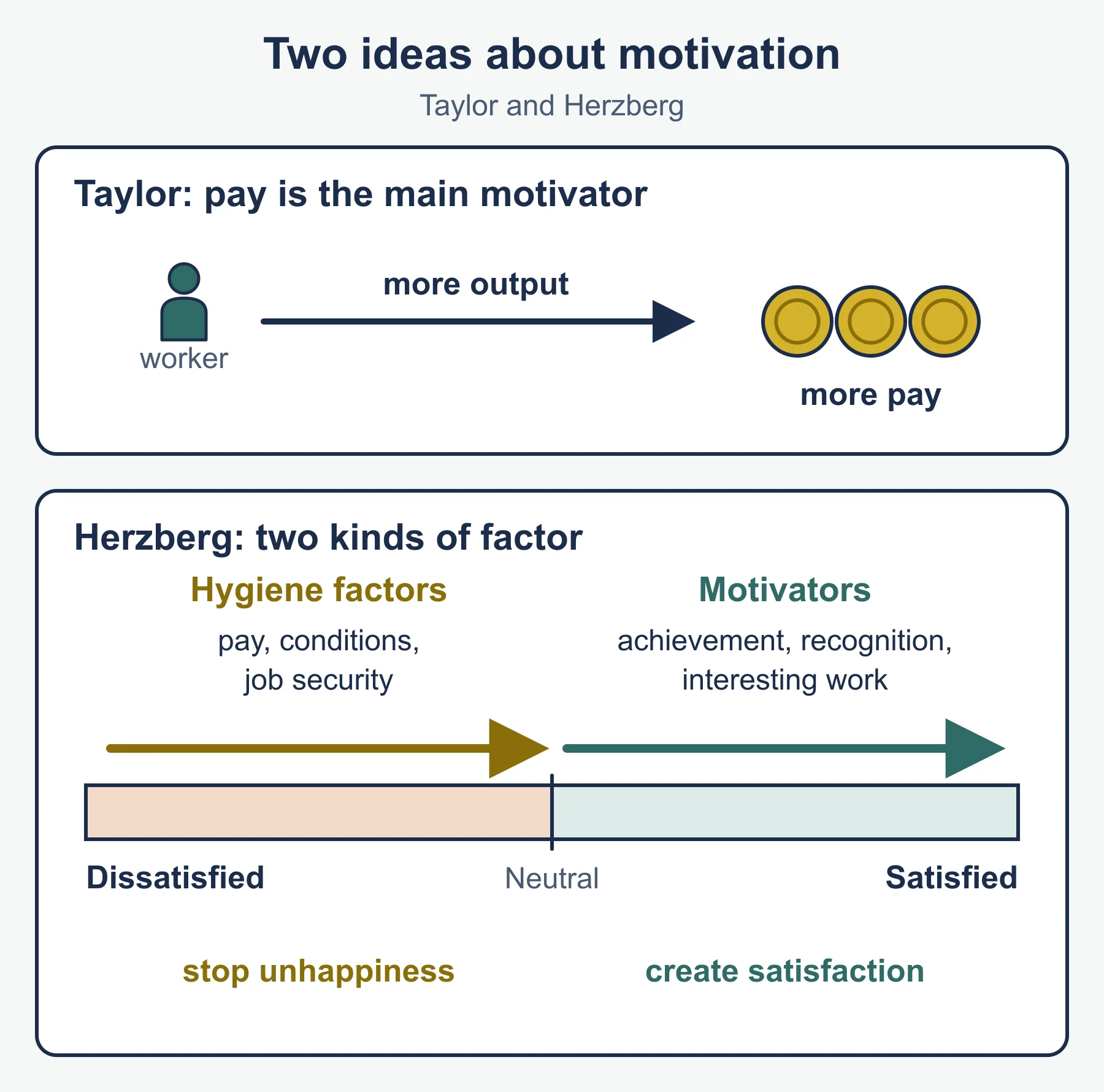
Frederick Taylor developed scientific management. His view is that workers are motivated mainly by pay, so a business should design jobs scientifically and link earnings to output.
- Break jobs into small tasks and study the quickest method (time and motion study).
- Train workers in that one method and supervise closely.
- Pay a piece rate so that more output earns more money.
Strengths: output can rise quickly, and the approach suits repetitive work with measurable output. Weaknesses: it ignores the social and creative needs of employees, narrow tasks can bore people, and workers may rush and cut quality.
Worked example: piece rate against time rate
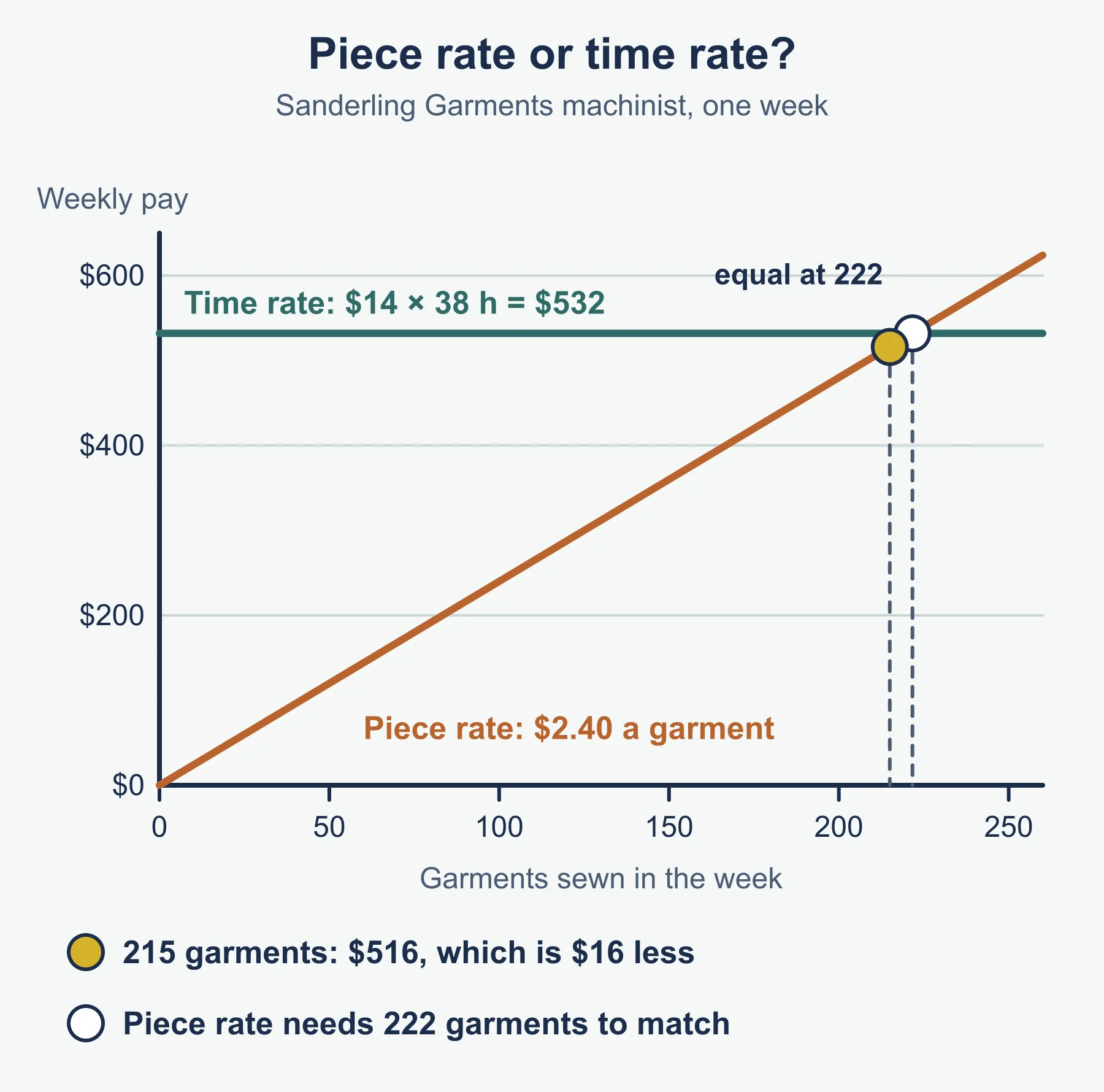
Sanderling Garments pays machinists 2.40 per garment sewn. A machinist sews 215 garments in a week. Another employer offers 14 an hour for a 38-hour week.
- Piece-rate pay = 215 × 2.40 = 516.
- Time-rate pay = 14 × 38 = 532.
- The machinist needs 532 ÷ 2.40 = 221.67, so 222 garments, to match the time rate.
At 215 garments the piece rate pays 16 less. The comparison shows why Taylor’s logic depends on workers being able to reach a high output.
Maslow
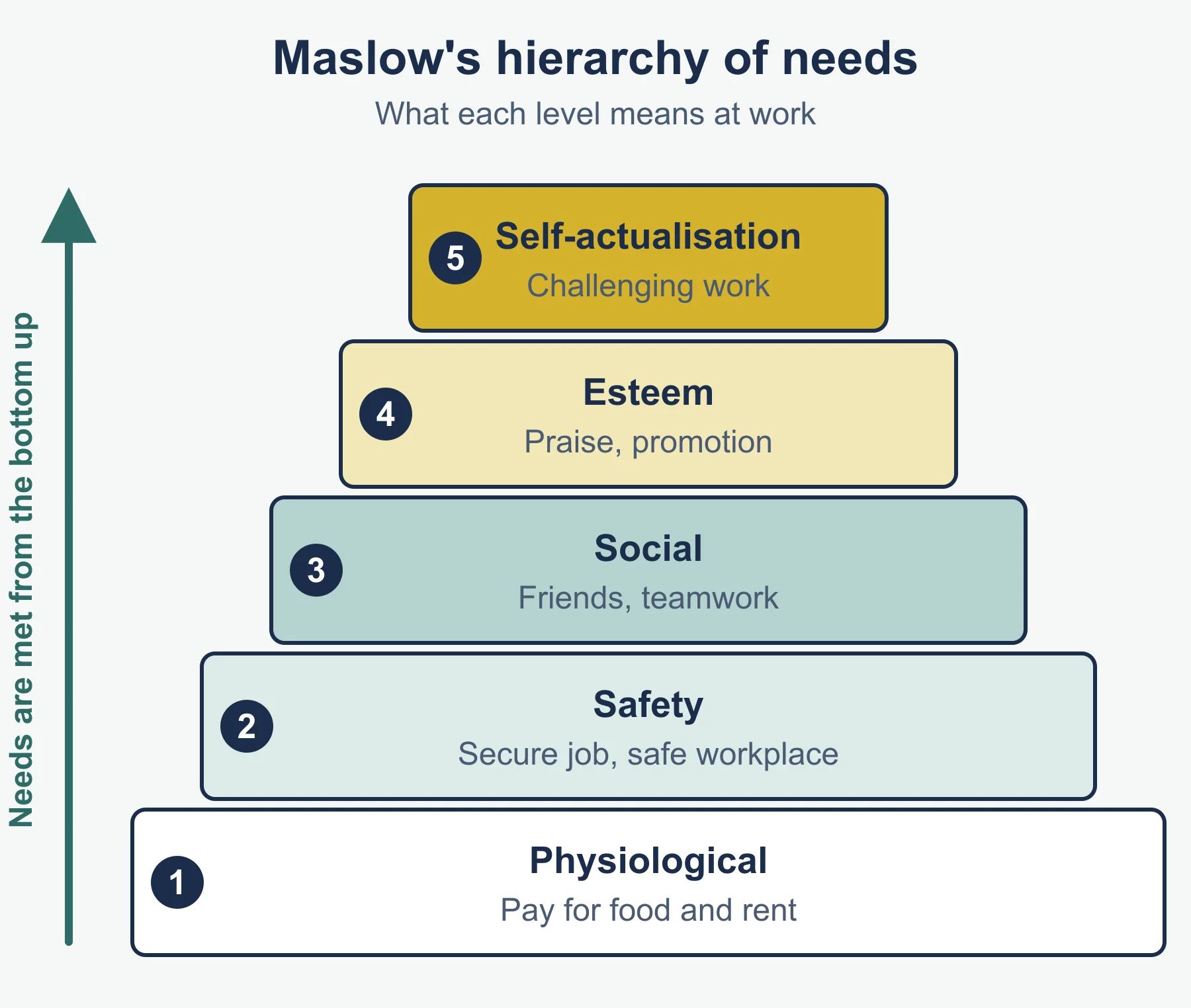
Abraham Maslow proposed a hierarchy of needs. People satisfy lower needs first, and a satisfied need no longer motivates.
| Level (lowest to highest) | Example at work |
|---|---|
| Physiological | Enough pay for food and housing, rest breaks |
| Safety | Job security, safe conditions |
| Love/belonging (social) | Teamwork, friendly colleagues |
| Esteem | Recognition, status, promotion |
| Self-actualization | Challenging work, chance to reach one’s potential |
Use: a manager should find out which level an employee is trying to satisfy and offer rewards that fit. Evaluation: the order is not the same for everyone, needs overlap, and the theory is hard to test. It is still useful as a checklist for reward design.
Herzberg (motivation-hygiene theory)
Frederick Herzberg argued that satisfaction and dissatisfaction come from different factors.
- Hygiene factors (for example pay, working conditions, company policy, supervision, job security) prevent dissatisfaction if adequate. Improving them does not create lasting motivation.
- Motivators (for example achievement, recognition, responsibility, the work itself, advancement) create satisfaction and motivation.
Link to practice: job enrichment, empowerment and recognition target motivators. A pay rise alone mostly targets hygiene. Evaluation: the findings came from a particular group of employees and the theory assumes satisfaction leads to productivity. Some people are motivated by pay.
HL only: further motivation theories
The guide names these theories without detail, so the accounts below are the standard textbook ones.
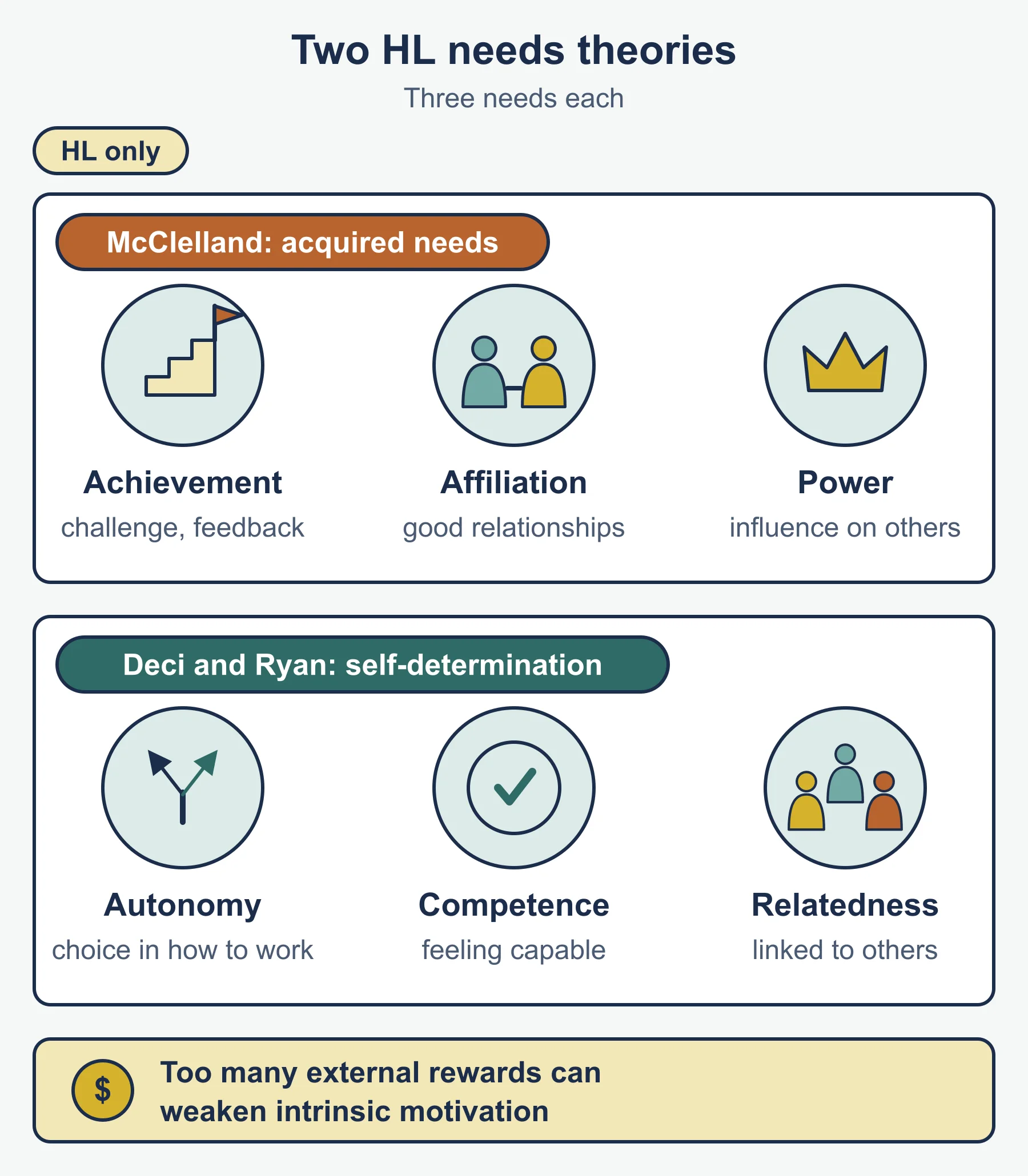
- McClelland’s acquired needs theory: people acquire, through experience, strengths in three needs: achievement (challenge, feedback), affiliation (good relationships) and power (influence over others). A business can match roles to the dominant need, such as stretching targets for high achievers.
- Deci and Ryan’s self-determination theory: motivation is highest when three needs are met: autonomy (choice over how to work), competence (feeling capable) and relatedness (connection with others). It stresses intrinsic motivation, which comes from the task itself, and warns that heavy use of external rewards can weaken it.
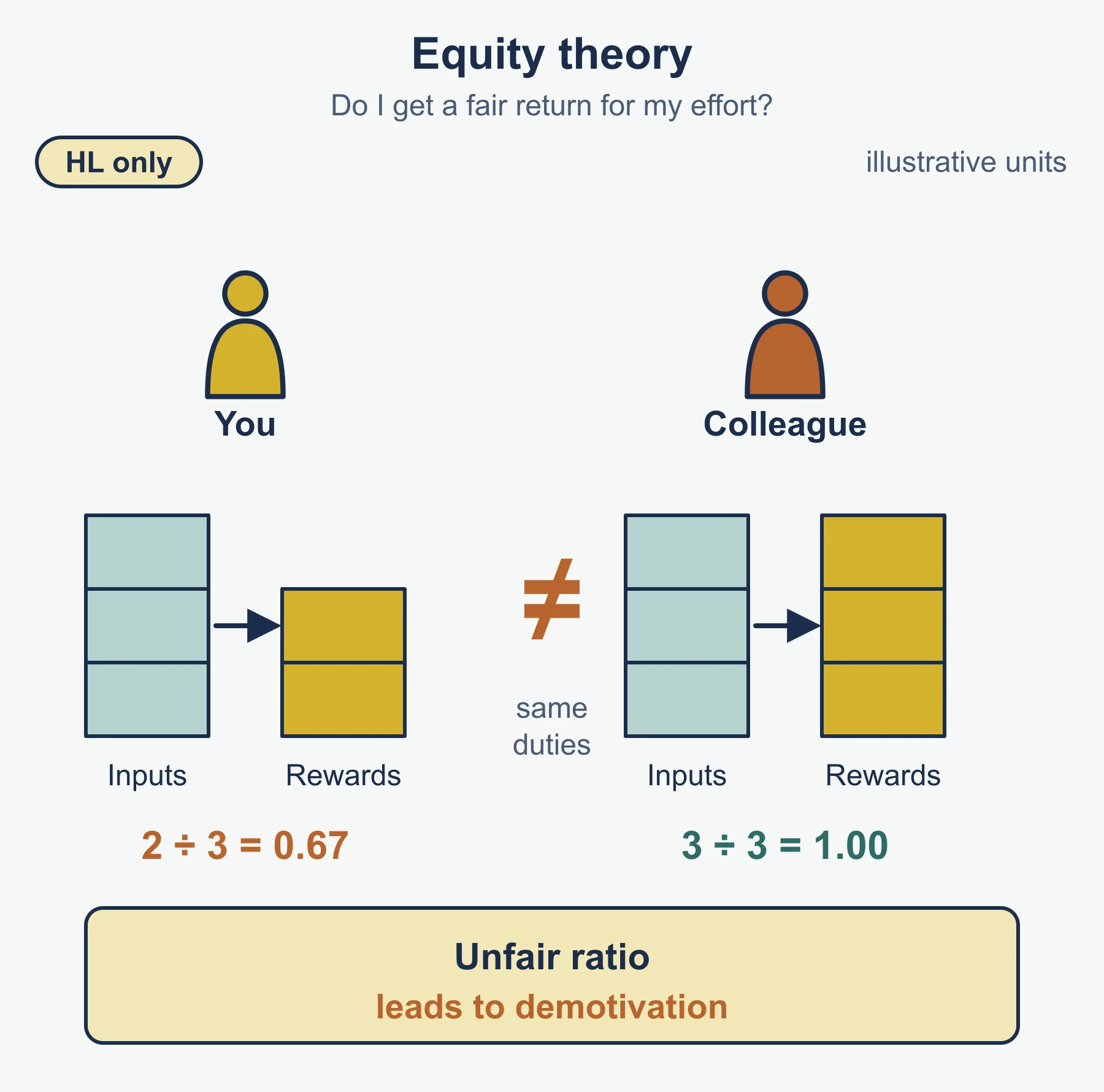
- Equity theory: employees compare their inputs and rewards with those of others. A perceived unfair ratio causes demotivation, for example when a colleague on equal duties earns more.
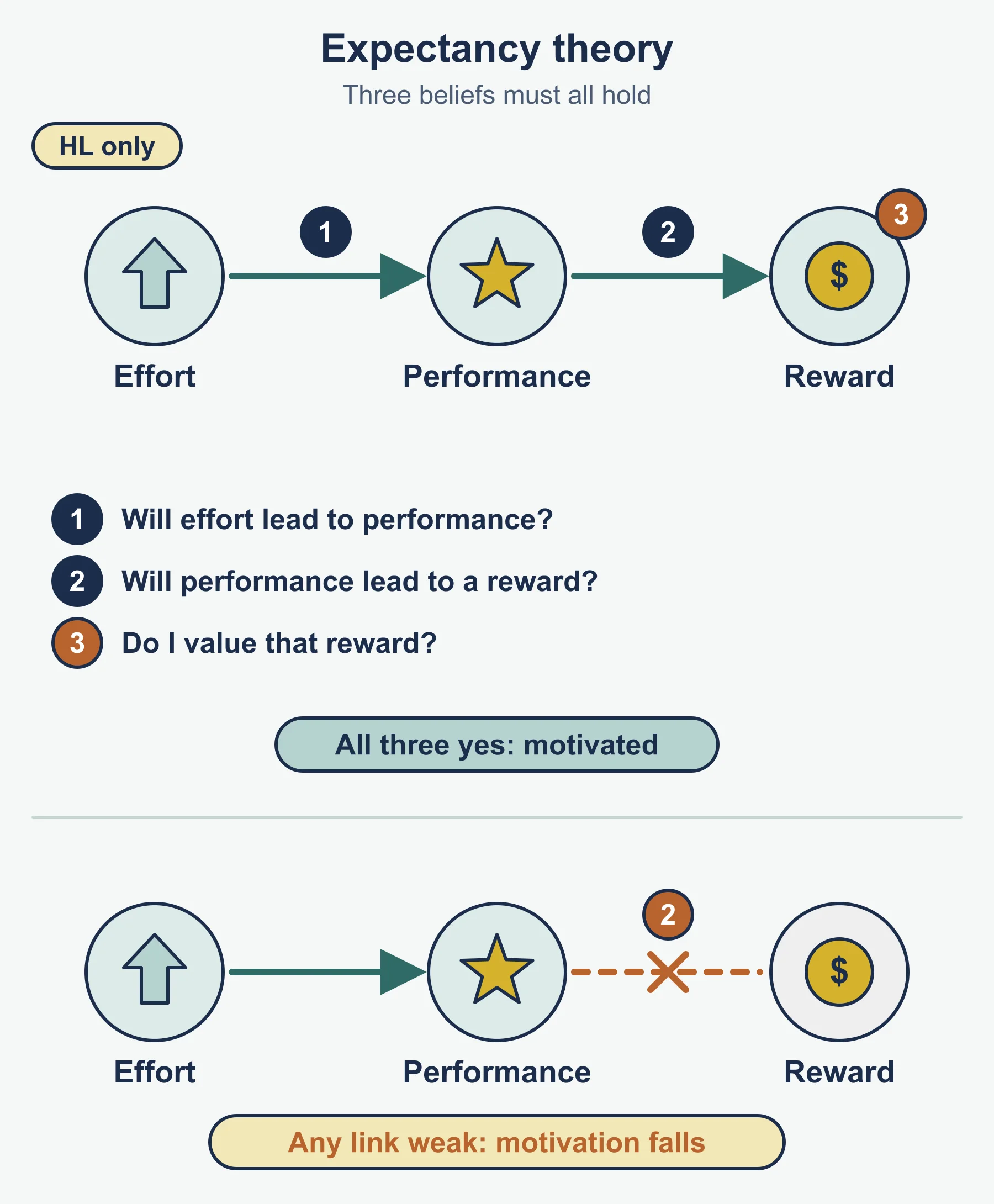
- Expectancy theory: effort depends on whether an employee expects effort to lead to performance, performance to lead to a reward, and values that reward. If any link is weak, motivation falls.
HL only: labour turnover
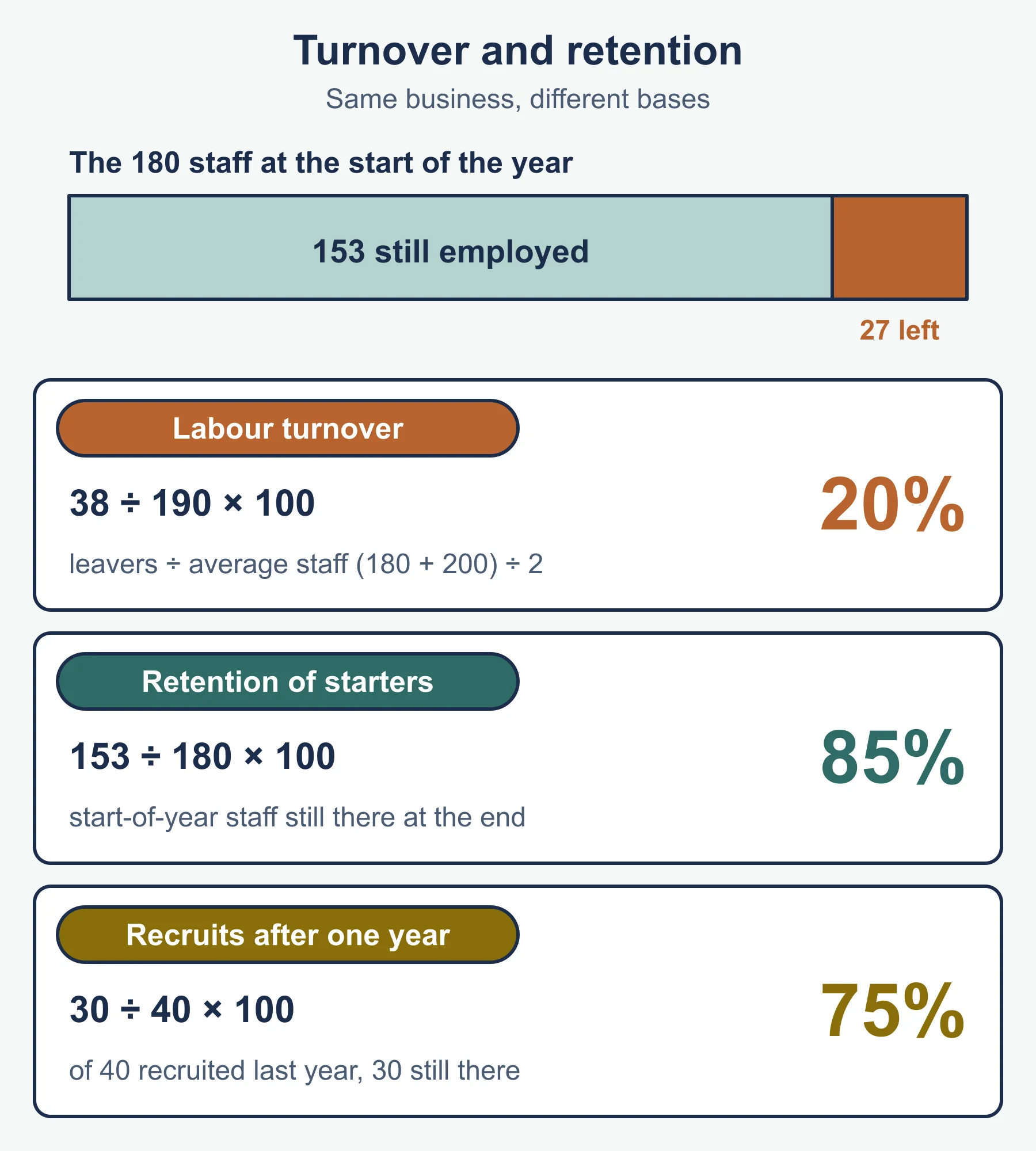
Labour turnover measures how many employees leave. The guide does not give a formula, so this is the standard form:
labour turnover (%) = (number of employees leaving in a period ÷ average number of employees) × 100
Worked example
Harnell Couriers had 18 leavers in a year and averaged 120 employees. Labour turnover = 18 ÷ 120 × 100 = 15%.
Causes can be low pay, poor management, little promotion, or a lack of training. High turnover raises recruitment and training costs, and it loses experience. Some turnover can be healthy because it brings new ideas. Judge it against the industry norm and the reasons staff give for leaving.
HL only: appraisal
- Formative appraisal: ongoing feedback aimed at development, such as coaching conversations.
- Summative appraisal: a review at the end of a period that judges performance, often linked to pay or promotion.
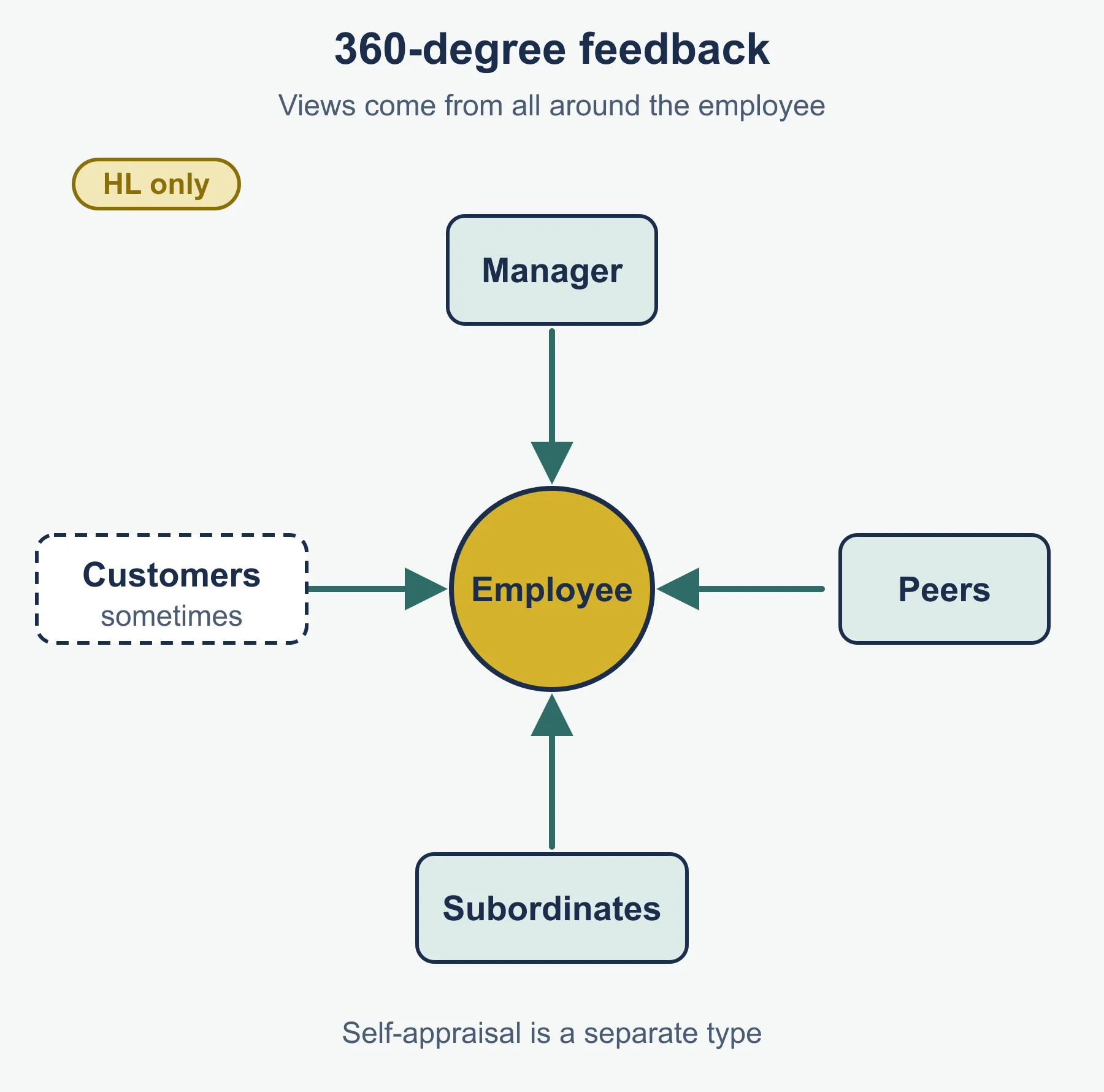
- 360-degree feedback: views gathered from managers, peers, subordinates and sometimes customers.
- Self-appraisal: the employee assesses their own performance against agreed goals.
Appraisal can motivate by recognizing achievement and showing a path forward. It can demotivate when it feels unfair or is used only for punishment.
HL only: recruitment
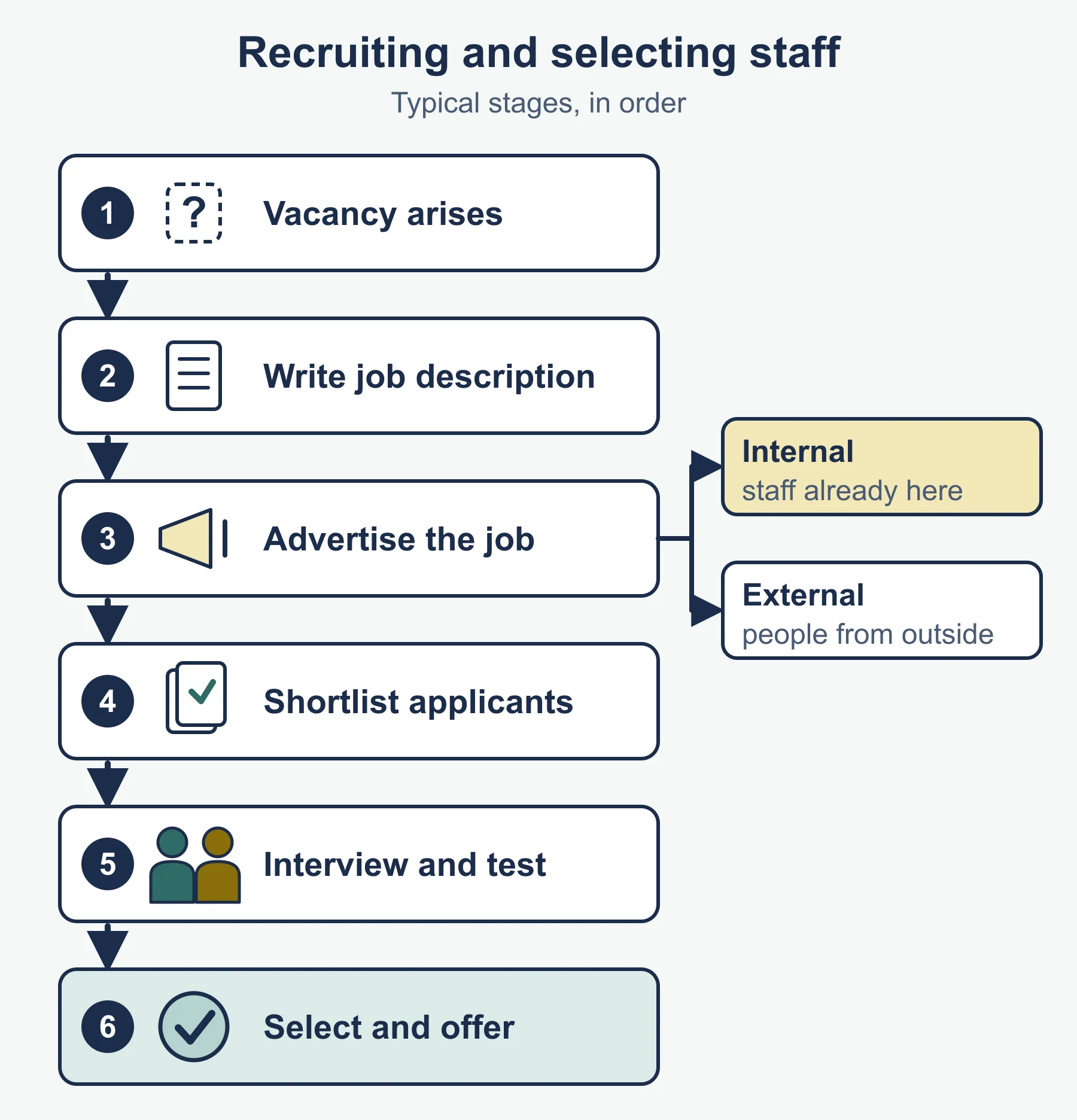
The guide lists “methods of recruitment” without naming them. Standard methods include job advertisements, recruitment agencies, headhunting and employee referrals.
- Internal recruitment (filling a vacancy from current staff). Advantages: cheaper and faster, shows that promotion is possible, and the person already knows the business. Disadvantages: a smaller pool, few new ideas, and a gap left elsewhere.
- External recruitment (from outside the business). Advantages: a bigger pool and fresh skills. Disadvantages: higher cost and a longer induction, with a risk of upsetting staff who expected promotion.
Financial rewards
| Reward | What it is | Motivation point |
|---|---|---|
| Salary | Fixed annual amount, paid monthly | Secure, but unrelated to effort |
| Wages | Time rate: pay per hour. Piece rate: pay per unit produced | Piece rate rewards output but can hurt quality |
| Commission | Percentage of sales made | Drives sales, but can encourage pressure selling |
| Performance-related pay (PRP) | Pay linked to meeting individual or team targets | Rewards results; hard to measure fairly |
| Profit-related pay | Share of business profit paid to employees | Encourages shared interest; payout depends on market conditions |
| Employee share ownership schemes | Employees own or can buy shares | Long-term commitment; value can fall |
| Fringe payments | Benefits such as health cover, a company car, discounts | Valued, but not tied to effort |
Worked example: commission and profit-related pay
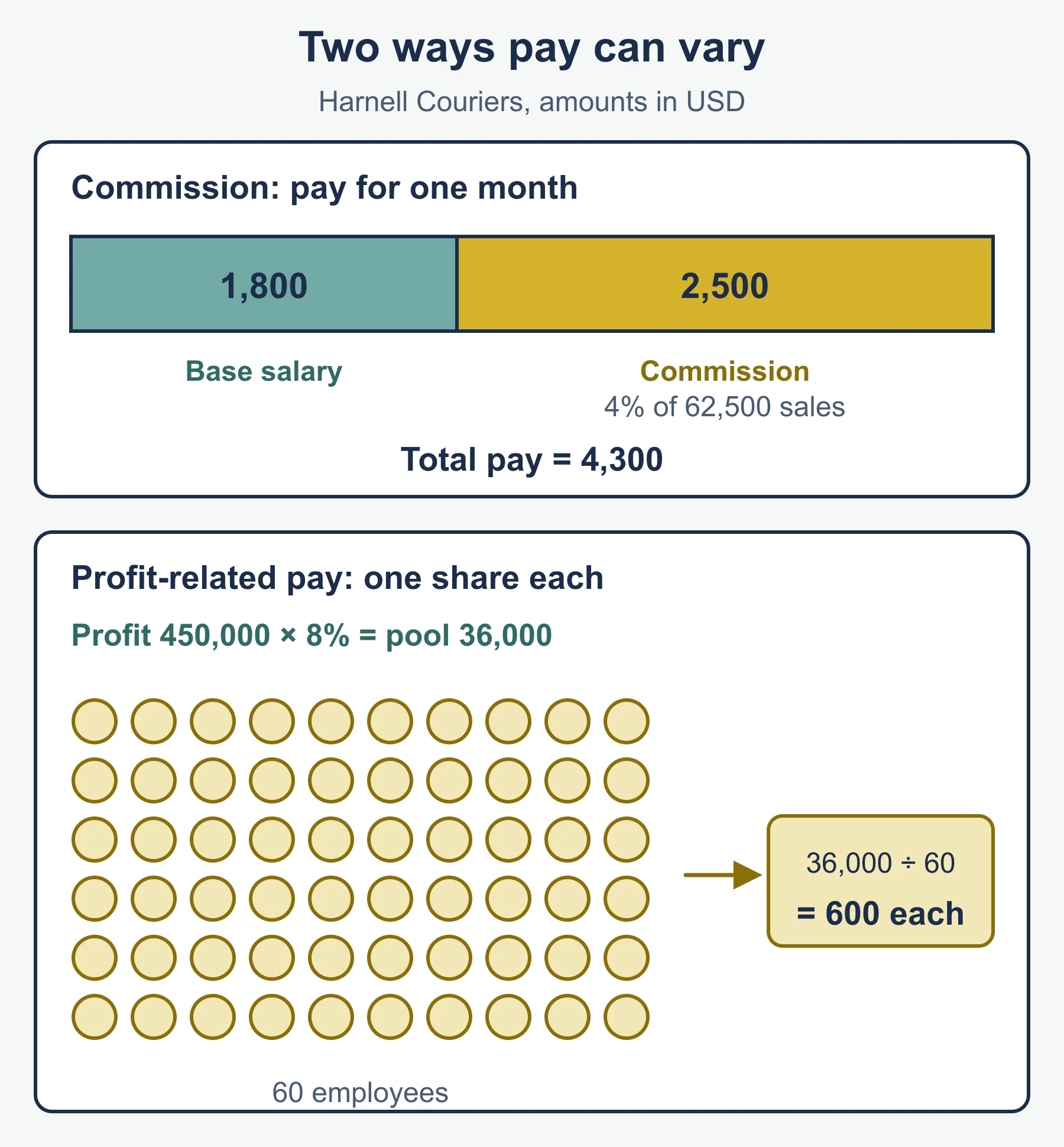
A Harnell Couriers sales executive earns a base salary of 1,800 a month plus 4% commission on sales. Sales of 62,500 give commission of 2,500, so total pay is 4,300. If the business sets aside 8% of a 450,000 profit and shares it among 60 employees, each receives 36,000 ÷ 60 = 600.
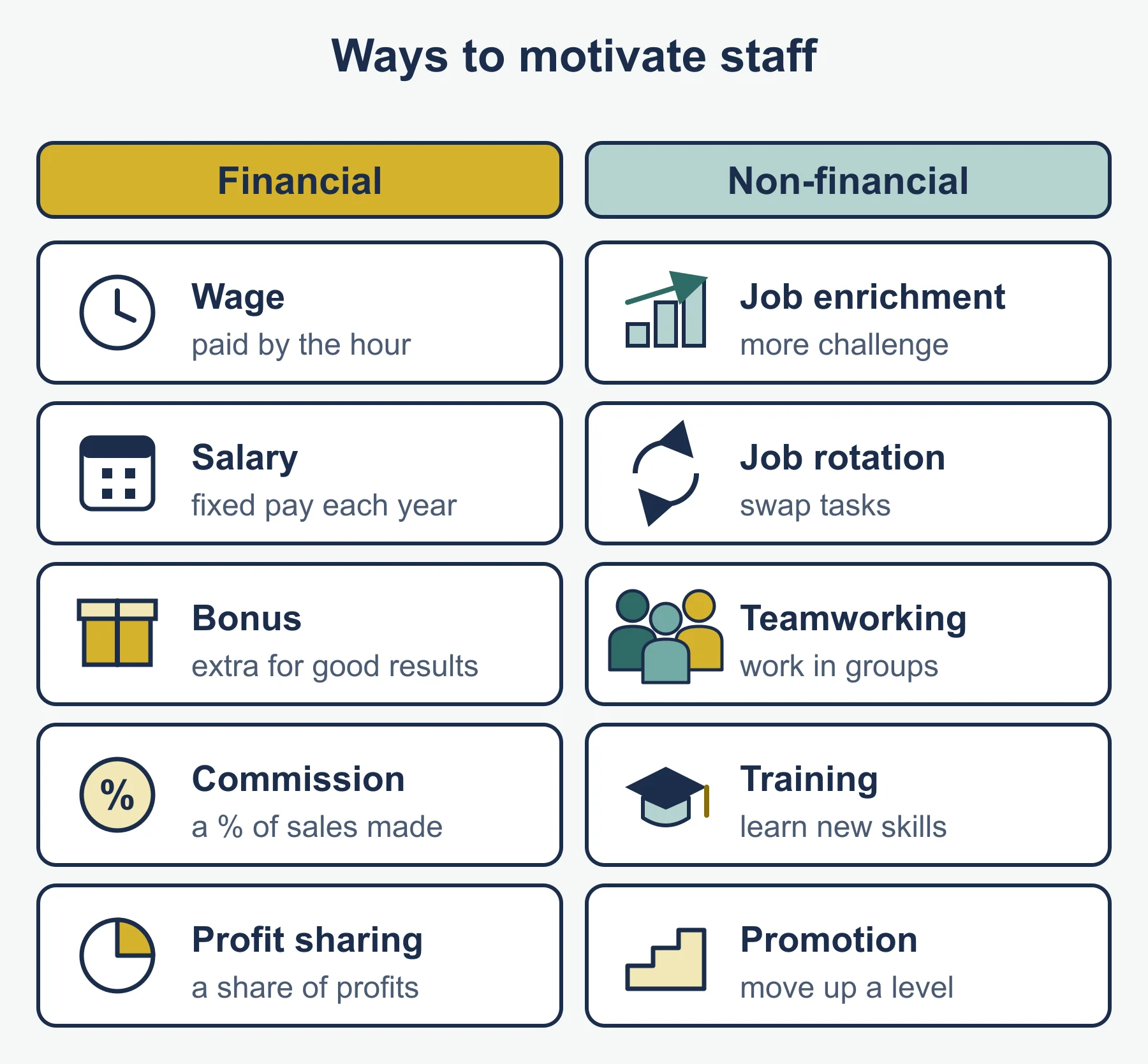
Non-financial rewards
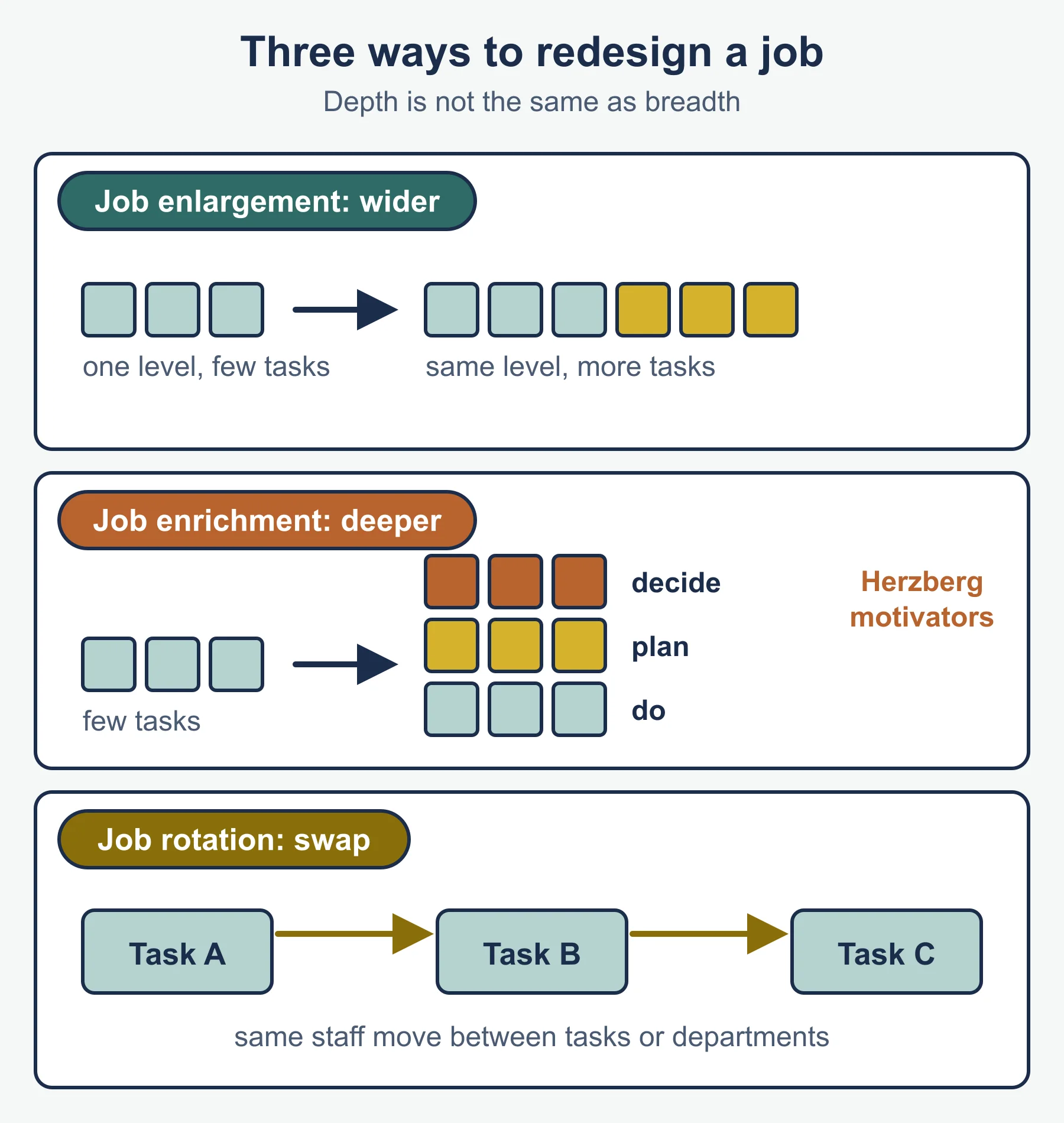
- Job enrichment: adding more responsibility, challenge and planning to a role (vertical). It targets Herzberg’s motivators.
- Job enlargement: adding similar tasks at the same level (horizontal), which reduces boredom but not necessarily responsibility.
- Job rotation: moving employees between tasks or departments, which builds skills and variety.
- Empowerment: giving employees authority to make decisions about their work.
- Purpose/the opportunity to make a difference: linking work to a worthwhile outcome, such as patient care or environmental benefit.
- Teamwork: working in a group gives belonging and shared responsibility.
Non-financial rewards cost less than pay rises, but they will not replace a fair wage. If hygiene factors are poor, enrichment alone may not work.
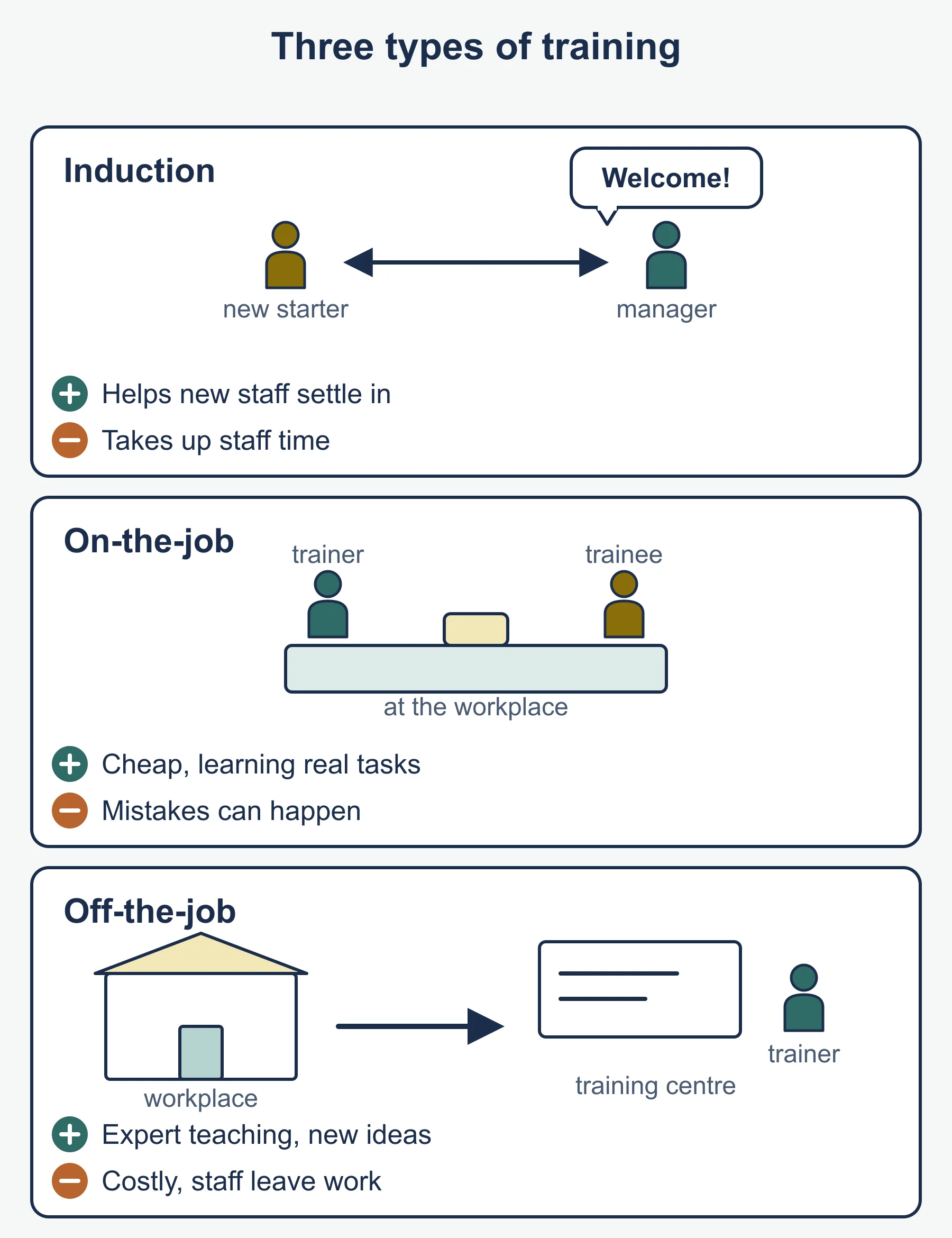
Training
- Induction: introduction for new staff to the business, rules, safety and colleagues. It helps new employees settle and reduces early leavers.
- On the job training: learning while working, for example shadowing a colleague. It is cheaper and relevant, but quality depends on the trainer.
- Off the job training: courses away from the workplace, such as college or external workshops. It can give wider skills but costs more, including time away from work.
Training can motivate because it signals investment and builds competence. It may raise the risk that trained staff leave for a better offer.
Case-study skills
- Identify the stakeholders and the problem (low output, high turnover, poor morale).
- Choose a theory that fits the evidence. Quote the data.
- Link a reward or training method to the theory and give a reason.
- For “evaluate” or “justify”, weigh the other side: cost, time frame, the type of employee, the type of work. Then reach a judgment.
Common errors
- Treating pay as the only motivator, or as irrelevant.
- Describing a theory without applying it to the business.
- Confusing job enrichment (depth) with job enlargement (more of the same).
- Calculating turnover using the opening headcount rather than the average number of employees.
- Writing HL content in an SL answer without being asked.
Frequently asked questions
What did Taylor believe motivates workers? Frederick Taylor’s scientific management holds that workers are motivated mainly by pay, so jobs are broken into small tasks, workers are trained in one method and paid a piece rate so that more output earns more money.
What is the difference between job enrichment and job enlargement? Job enrichment adds more responsibility, challenge and planning to a role, a vertical change that targets Herzberg’s motivators. Job enlargement adds similar tasks at the same level, a horizontal change that reduces boredom but may not motivate.
What is self-determination theory? Deci and Ryan’s self-determination theory says motivation is highest when three needs are met: autonomy, competence and relatedness. It is an HL only theory in section 2.4.
What is the difference between on the job and off the job training? On the job training is learning while working, for example by shadowing a colleague, which is cheaper and directly relevant. Off the job training uses courses away from the workplace, which can give wider skills from experts but costs more and takes time away from work.
Official syllabus
IB Diploma Programme Business management guide, first assessment 2024, International Baccalaureate Organization. Section 2.4, Motivation and demotivation, in Unit 2: Human resource management.
Get free revision emails (optional)
Occasional emails with practice questions, worked explanations and links to free resources for the qualification and subjects you choose. No spam, and you can unsubscribe from any email. The free tools on this site never need an email.
Related resources
-
Practice questions
IB DP Business Management: Motivation and demotivation – Practice Questions
Original practice questions with worked answers on IB DP Business Management 2.4: motivation theories, rewards, training, turnover and appraisal.
Business · International Baccalaureate · IB
Try questions -
Revision notes
IB DP Business Management: Motivation and demotivation – Revision Notes
Condensed revision notes for IB DP Business Management section 2.4: motivation theories, rewards, training, labour turnover, appraisal and recruitment.
Business · International Baccalaureate · IB
Revise topic -
Study guides
IB DP Business Management: Organizational (corporate) culture (HL only)
Study guide to IB DP Business Management 2.5 (HL only): organizational culture, Handy's Gods of management and cultural clashes in change.
Business · International Baccalaureate · IB
Read guide
Related articles
-
teaching
A Level tuition in Dubai: Cambridge or Pearson Edexcel International A Level?
Schools in Dubai and Abu Dhabi teach either Cambridge International AS & A Level or Pearson Edexcel International A Level. How the two are structured, why it matters for tuition, and how online classes from Lahore work.
9 October 2026
-
curriculum guides
Choosing subjects at IGCSE and A Level
How subject choices at 14 and 16 affect university options later, and how to keep pathways open without overloading a timetable.
28 July 2026
Studying this with a teacher
Working through Business IB?
This page is free and stays free. If you would rather be taught it, Marlbridge runs Business classes one-to-one, online in your own time zone. The first trial class is free. WhatsApp replies within an hour (8am–11pm Pakistan time, every day); email the same day.
IB Business teachers at Marlbridge

