
Revision Notes
IB DP Business Management: Organizational (corporate) culture (HL only) – Revision Notes
Condensed revision notes for IB DP Business Management 2.5 (HL only): definitions, Handy's four cultures, Hofstede and cultural clashes, with a self-test.
- Subject
- Business
- Level
- IB
- Topic
- Unit 2: Human resource management
- Author
- Marlbridge Academic Team
- Updated
- Reviewed by
- Salman Ahmad (what this means)
Aligned to International Baccalaureate IB Diploma Programme Business (DP Business Management), First assessment 2024. Official specification .
Syllabus page (what it covers and how it is assessed): IB Diploma Programme Business.
Syllabus points this page covers
DP Business Management
- 2.5 Organizational (corporate) culture (HL only)
Found an error? Report a correction.
Need help with this topic? Request a free trial class for IB Diploma Programme Business (DP Business Management).
These notes condense section 2.5, Organizational (corporate) culture, of the IB Business management guide (first assessment 2024). The section is HL only. For full explanations and worked examples, read the study guide, then test yourself with the practice questions. The course hub is IB DP Business Management, the printable list is the syllabus checklist, and the free diagnostics can show weak spots. Related pages: leadership and management, organizational structure and growth and evolution.
The three content points
| Point in the guide | Depth | What the question wants |
|---|---|---|
| Organizational culture | AO1 | Define it, state features, say why it matters |
| Types of culture, for example Handy’s “Gods of management” | AO2 | Name the type, apply it to the case, explain strengths and limits |
| Cultural clashes when organizations change, including growth, mergers and changes of leadership style | AO3 | Analyse causes and effects, weigh them, judge or recommend |
All three points are HL only. HL extension topics are examined in Paper 2 and Paper 3 for HL, as the guide’s assessment outline sets out.
Definitions
| Term | Standard form (the guide gives the term, not a definition) |
|---|---|
| Organizational (corporate) culture | Shared values, beliefs and accepted behaviour in a business; “the way we do things here” |
| Strong culture | Values widely shared and acted on by most staff |
| Subculture | A distinct set of values in one team, site or department |
| Cultural clash | Conflict that arises when groups with different values must work together, or when an existing culture is disturbed |
| Staff turnover rate | Leavers in a period divided by average staff, times 100 |
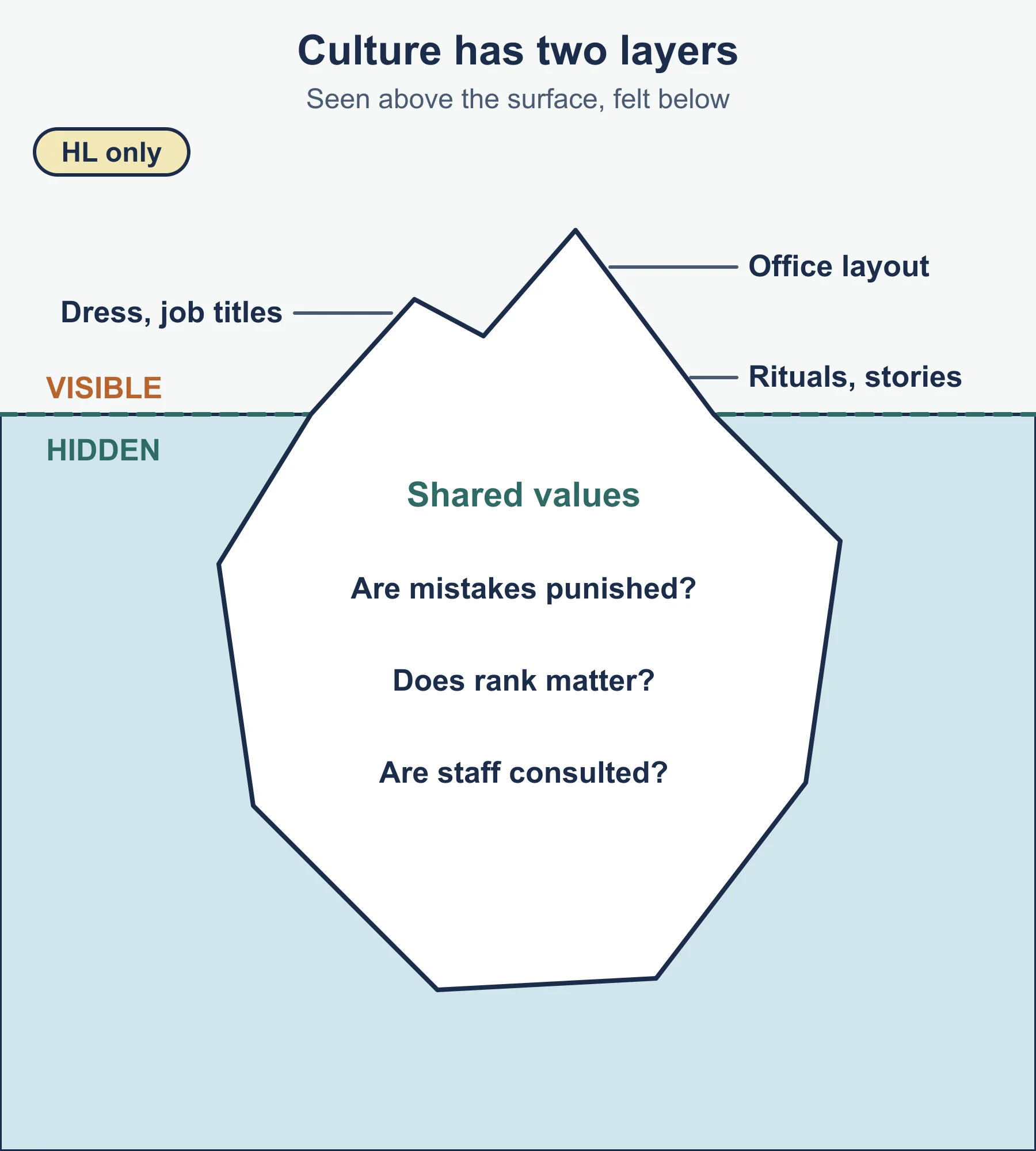
Visible signs: dress, layout, titles, rituals, stories, speed of replies. Hidden core: values about rank, risk, mistakes and consultation.
What shapes culture: founder and leaders, history, structure, size, industry, national culture, and who is hired.
Handy’s Gods of management
| God | Type | Power comes from | Best suited to | Main risk |
|---|---|---|---|---|
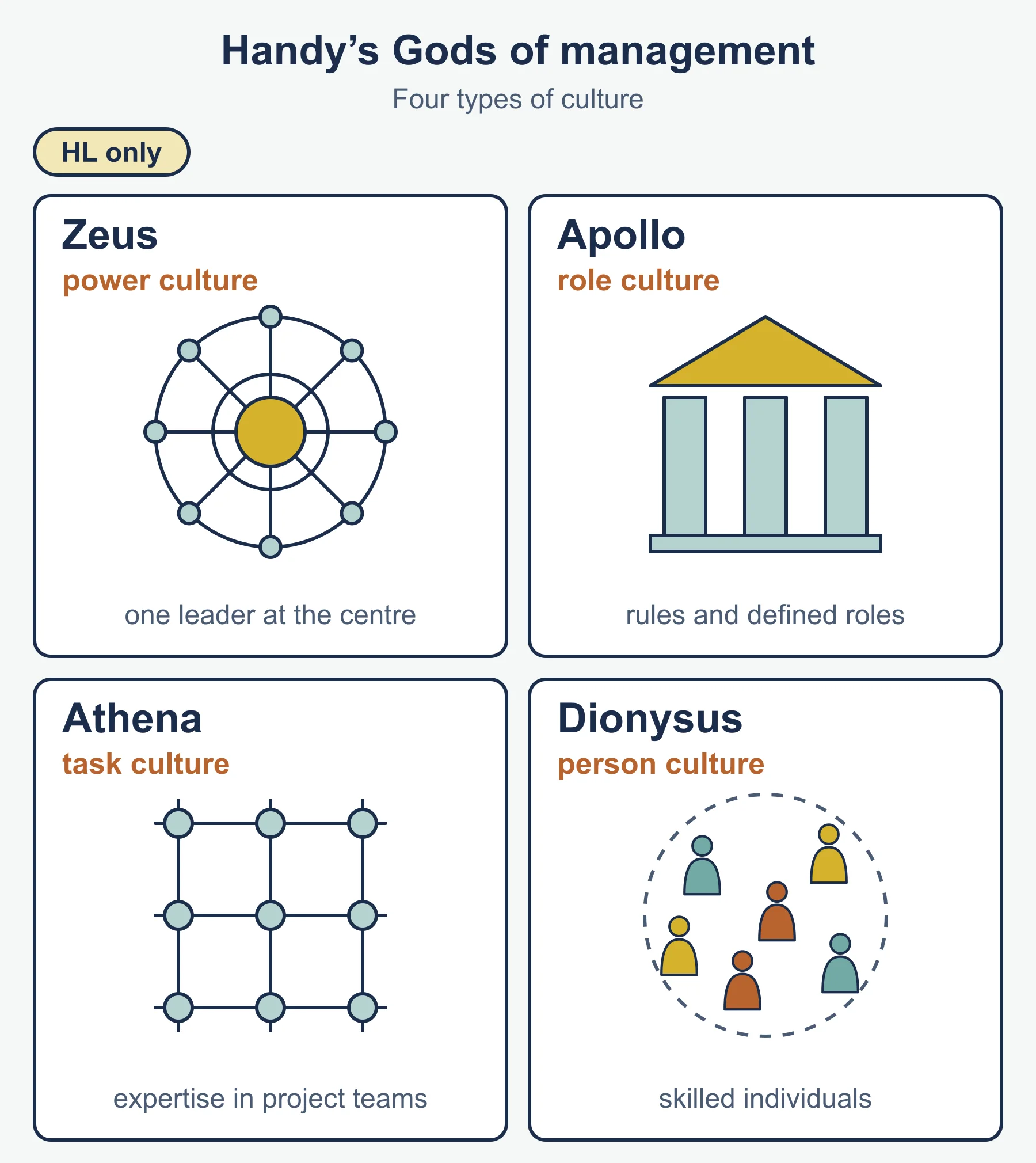
| Zeus | Power | Central person or small group | Small, entrepreneurial firms; crises | Over-dependence on one leader |
| Apollo | Role | Rules, roles, procedures | Stable, large-scale, safety-critical work | Slow, bureaucratic |
| Athena | Task | Expertise and the job to be done | Project work and fast-changing markets | Control and resource conflicts |
| Dionysus | Existential or person | The individual professional | Skilled specialists who value autonomy | Hard to direct; group serves members |
Memory aid by structure: Zeus is a web, Apollo is a set of pillars (a hierarchy), Athena is a net of teams, Dionysus is a loose cluster of individuals.
Method for a “type of culture” question
- Name the dominant type.
- Quote or point to two pieces of evidence in the case (who decides, how rules are used, how teams form).
- Explain the effect on performance, motivation or flexibility.
- Judge whether it fits the business’s situation now. If it does not, say what is likely to go wrong.
Do not say one type is best. Fit decides.
Hofstede’s cultural dimensions (HL only tool)
The guide lists the tool without naming the dimensions, so these are the standard ones.
| Dimension | High score suggests |
|---|---|
| Power distance | People accept unequal power and expect clear authority |
| Individualism versus collectivism | High: personal goals and choice. Low: group loyalty and shared goals |
| Uncertainty avoidance | Strong preference for rules and clear plans |
| Masculinity versus femininity | Emphasis on competition and achievement versus care and quality of life |
| Long-term orientation | Planning for the future and perseverance |
| Indulgence versus restraint | Freedom to enjoy life versus strict social norms |
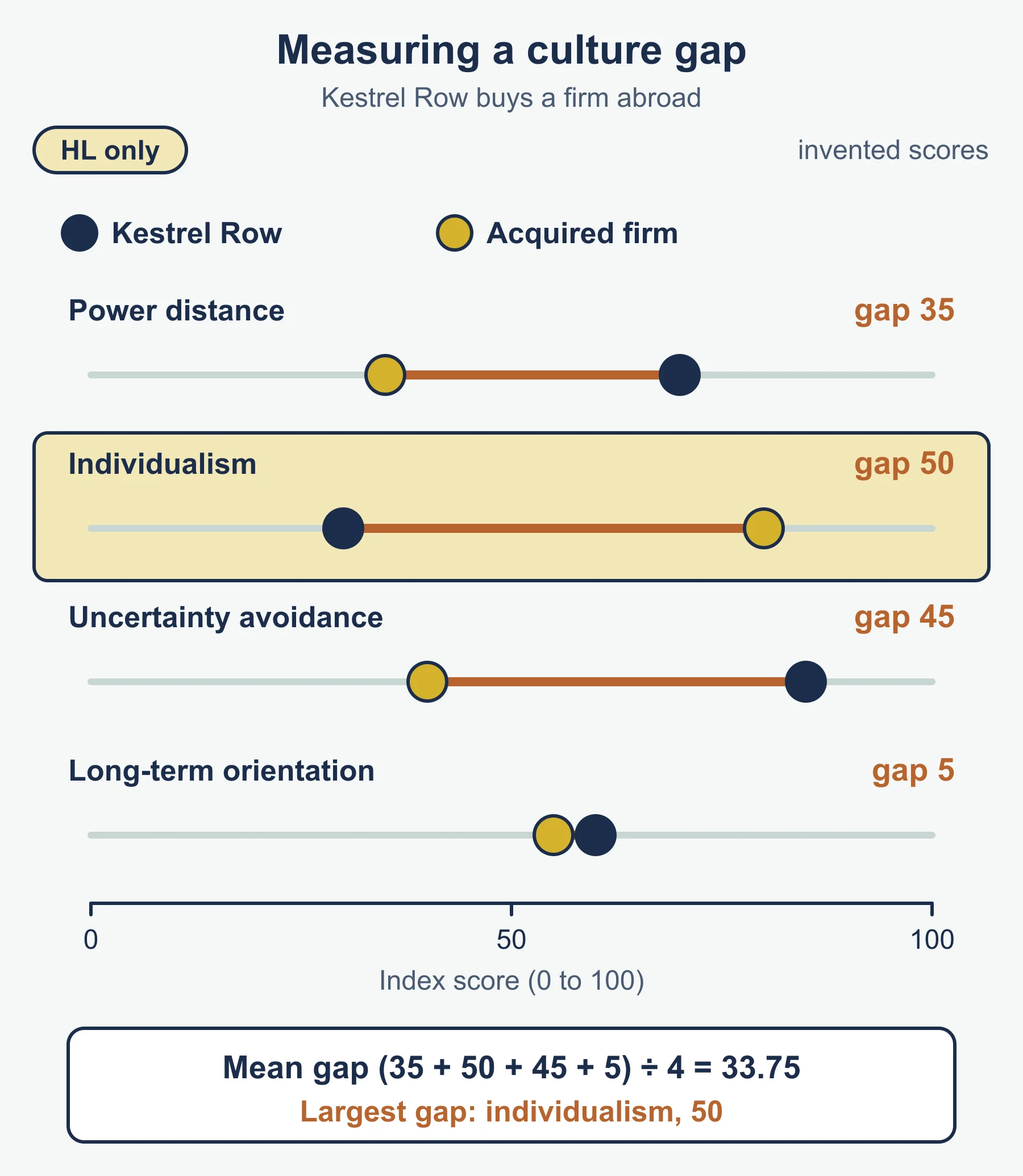
Gap calculation: gap = the difference between two scores on the same dimension. Mean gap = total of gaps divided by the number of dimensions.
Worked reminder: scores 60 and 20 give a gap of 40; 30 and 55 give 25; 75 and 60 give 15. Mean gap = (40 + 25 + 15) / 3 = 80 / 3 = 26.7 (1 d.p.). The largest gap, 40, marks the most likely source of friction.
Limits: national averages say little about one person; teams and firms differ from their country; scores date. Treat them as a starting point.
Cultural clashes
| Trigger | Typical clash | Typical effect |
|---|---|---|
| Growth (new staff, new sites, new countries) | Informal habits meet rules and layers of management | Original staff feel loss of closeness; newcomers misread unwritten habits |
| Merger or takeover | Two sets of values and routines | “Us and them”, loss of key staff, slow integration |
| Change of leadership style | Staff expect the old style | Confusion, lower morale, resistance |
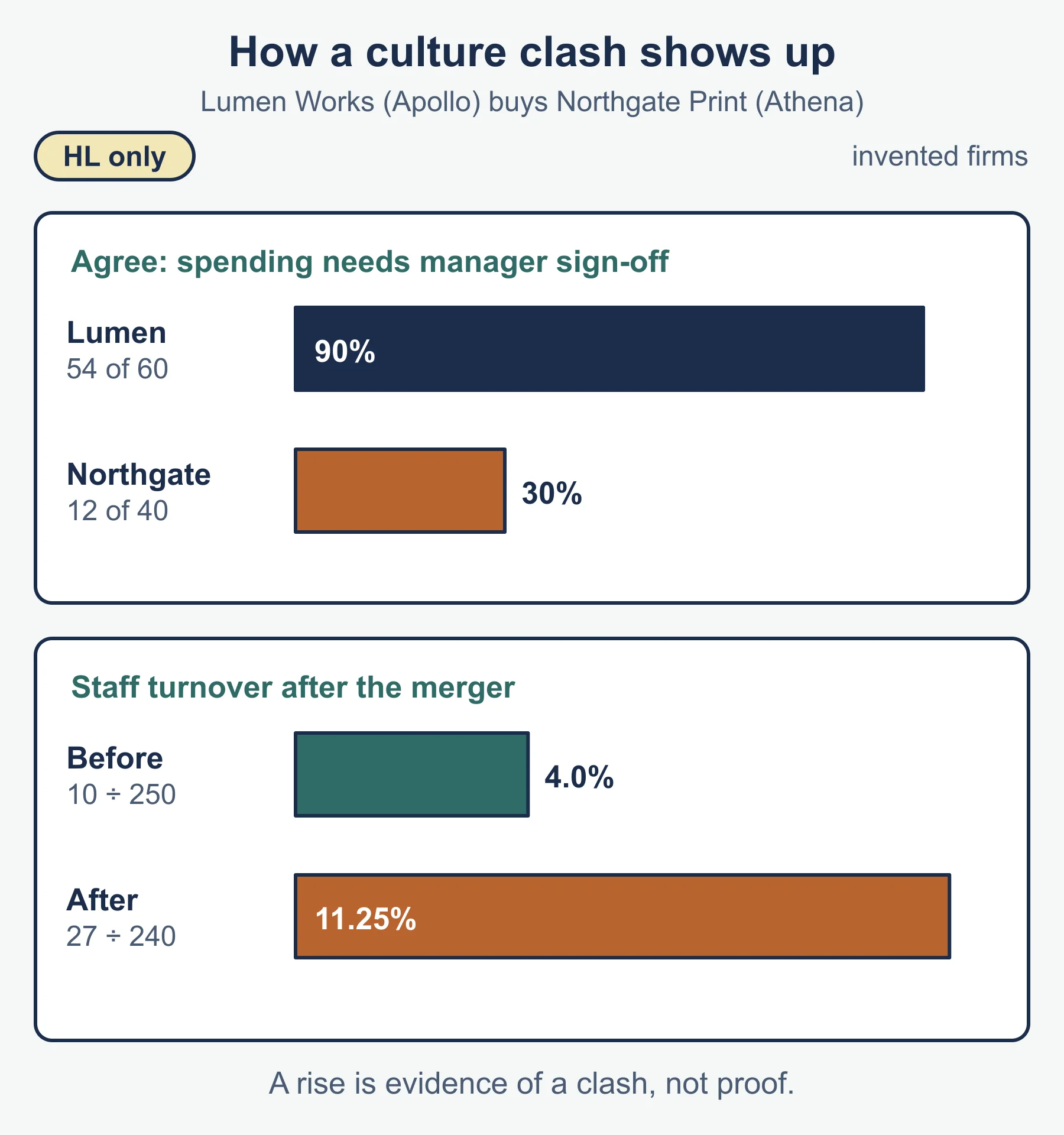
Indicators that a clash is happening: rising staff turnover, falling productivity, conflict between groups, absenteeism, survey results that differ sharply between the two sides.
Worked reminder: 18 leavers from an average of 360 staff gives 18 / 360 x 100 = 5% turnover. Compare with the earlier year, and say whether the cause is the clash or something else.
Managing a clash
- Run a culture audit before a merger.
- Communicate the reasons for the change and what will stay the same.
- Involve staff through consultation and mixed teams.
- Managers follow the new values themselves.
- Train and induct staff in the new routines.
- Choose an approach: one culture dominates, a blend, or separate units for a period.
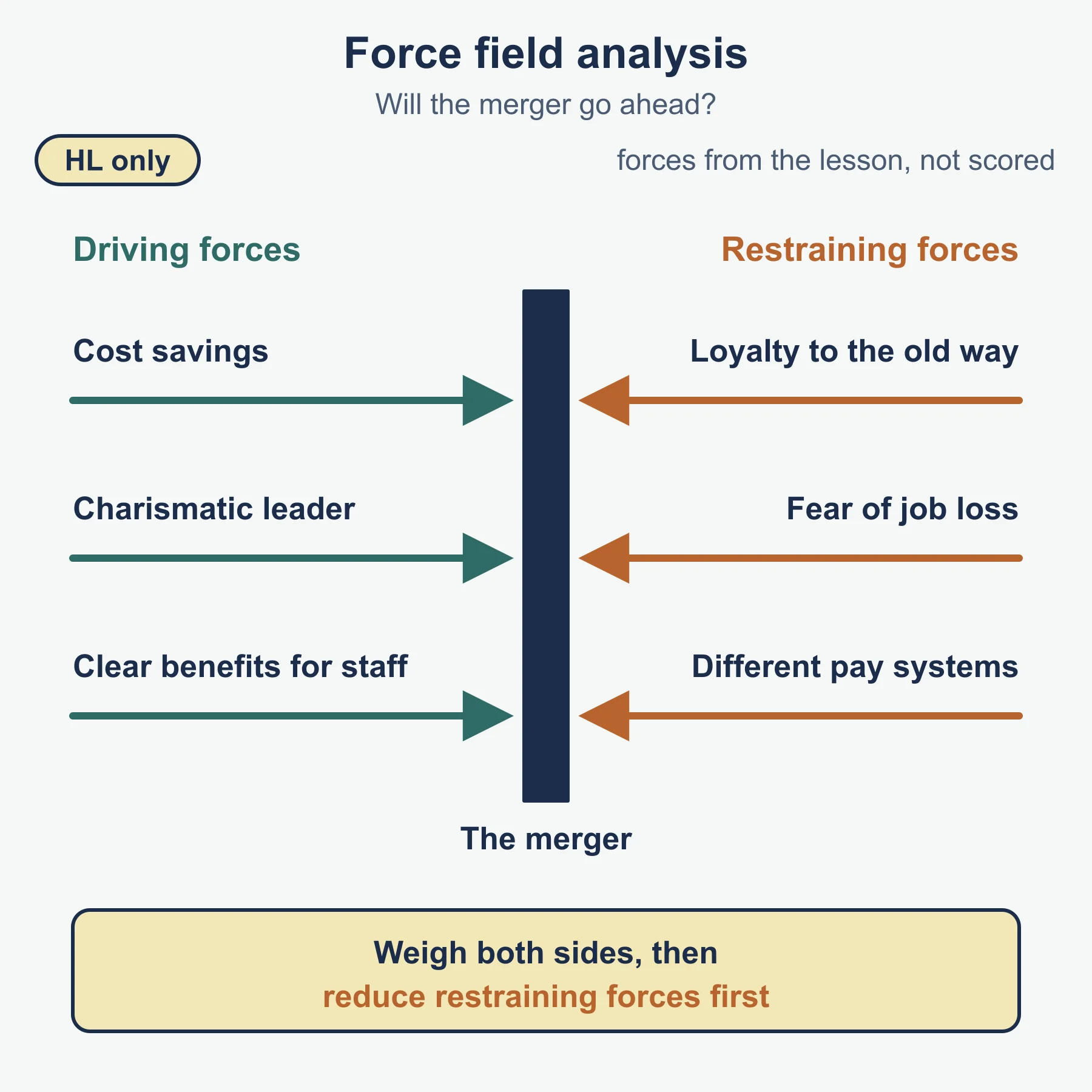
Force field analysis (HL only, suggested for Unit 2): list driving and restraining forces, weigh them, and decide which restraining forces to reduce. It supports a recommendation.
Method for a “clash” question
- Identify the trigger (growth, merger, leadership change).
- Name the cultures meeting, using Handy or Hofstede if the case supports it.
- Analyse two consequences with evidence from the case.
- Weigh severity: size of the gap, importance of the staff who may leave, urgency of the change.
- Judge or recommend in one clear sentence, with a reason.
Must-know distinctions
- Organizational culture versus national culture: the first belongs to the firm, the second to the country. Hofstede describes the second.
- Role culture (Apollo) versus task culture (Athena): rules and position versus expertise and teams.
- Power culture (Zeus) versus person culture (Dionysus): one dominant leader versus individual professionals with autonomy.
- Strong versus good: a strong culture is shared, but it may not suit the strategy.
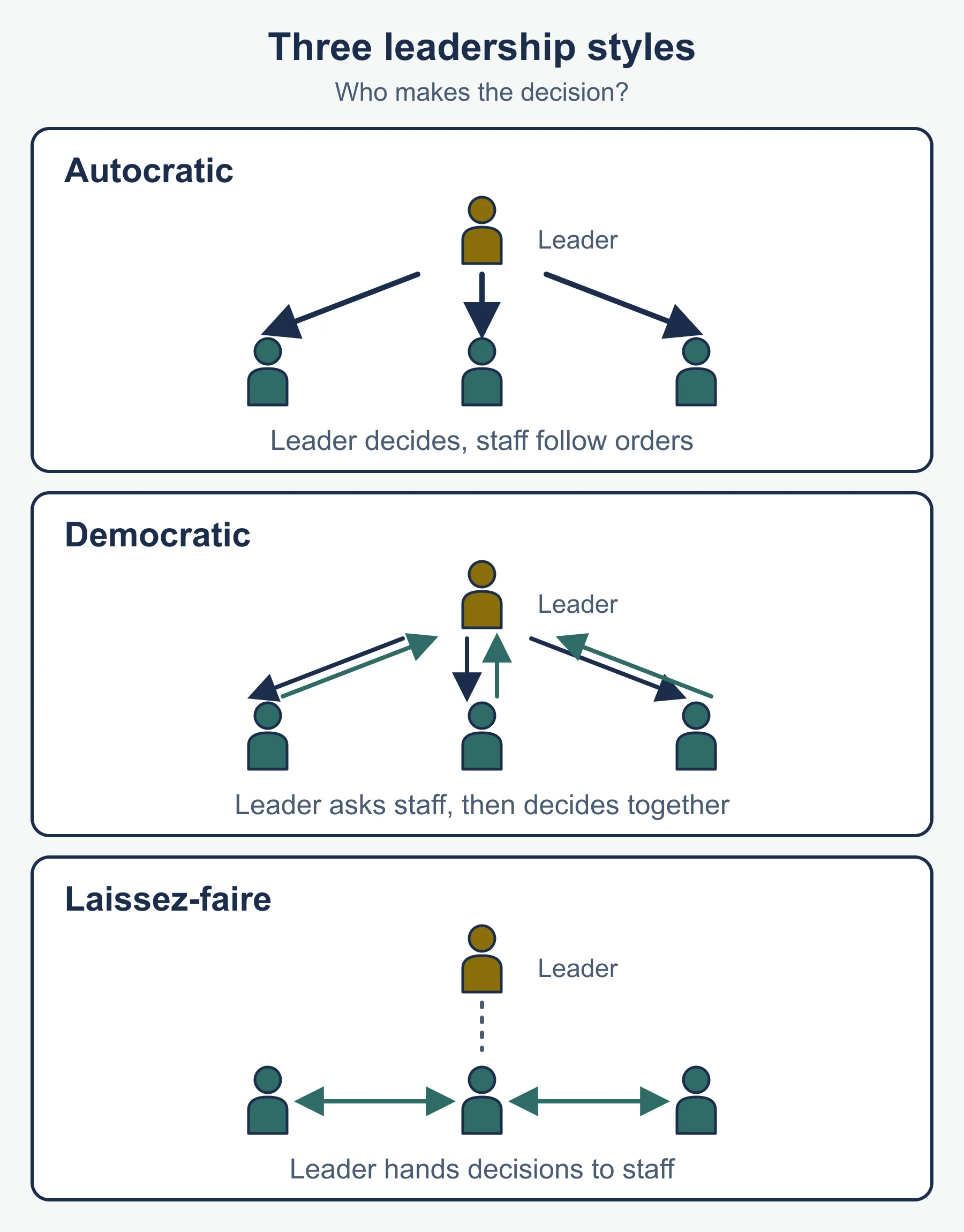
- Leadership style versus culture: style is how one leader behaves; culture is shared across the group.
Evaluation checklist for AO3 answers
For “evaluate”, “discuss”, “justify” or “recommend” on a clash, check that you have covered each of these.
- Both sides: a benefit of keeping or blending the cultures, and a cost.
- A criterion: say what you are judging by, such as retention of skilled staff, speed of integration or customer service.
- Short run versus long run: forced change can save money now and lose staff later.
- Who is affected: staff of each firm, managers, customers and owners.
- A conclusion that depends on something in the case, for example “this is the better option because the acquired staff are hard to replace”.
Quick self-test
- Define organizational culture.
- Name Handy’s four cultures, with the god for each.
- Which Handy culture relies on rules and defined roles?
- State one strength and one weakness of a power culture.
- A firm moves from a few staff to many layers of management. State the likely shift in Handy’s types.
- Name two Hofstede dimensions.
- Two firms score 60 and 20 on power distance. State the gap.
- 18 staff leave from an average of 360. Calculate the turnover rate.
- State two possible effects of a culture clash after a merger.
- Explain one way to reduce resistance to a cultural change.
- In a survey, 21 of 28 staff agree with a statement. Calculate the percentage.
- Why is the choice of leadership style a possible source of cultural clash?
Answers
- The shared values, beliefs and accepted behaviour in a business, “the way we do things here”.
- Zeus (power), Apollo (role), Athena (task), Dionysus (existential or person).
- Apollo, the role culture.
- Strength: fast decisions. Weakness: depends on one person, with little say for others.
- Likely from Zeus towards Apollo.
- For example power distance and uncertainty avoidance.
-
- 18 / 360 x 100 = 5%.
- For example loss of key staff and an “us and them” attitude, or slower decisions and lower morale.
- For example consult staff early and explain the reasons, so people feel involved.
- 21 / 28 x 100 = 75%.
- Staff expect a style that matches the old norms; a sudden change breaks those expectations and shakes trust.
Where marks are usually lost
- Giving a vague definition such as “how a company behaves” with no mention of shared values.
- Naming a Handy type with no evidence from the case.
- Mixing up the gods, especially Apollo and Athena.
- Saying a culture is bad when the question is about fit.
- Using “evaluate” or “recommend” but only listing problems, with no judgement.
- Treating Hofstede scores as true of every individual.
- Writing a general essay about mergers without naming the cultural difference.
- Quoting a turnover figure without an average staff base or a comparison year.
- Leaving out the case: a correct but generic answer cannot show application.
Frequently asked questions
What are Handy’s four types of organizational culture? Charles Handy’s “Gods of management” are Zeus (power culture), Apollo (role culture), Athena (task culture) and Dionysus (existential or person culture).
What are the signs of a cultural clash in a business? Indicators include rising staff turnover, falling productivity, conflict between groups and an “us and them” attitude. Compare a turnover figure with an earlier year so it shows a change.
How can a business manage a cultural clash? Options include a culture audit before a merger, clear communication about what will change, involving staff through consultation and mixed teams, managers leading by example, training and induction, and choosing whether one culture dominates, the two blend, or the units stay separate for a period.
What is the difference between a strong culture and a good culture? A strong culture is one whose values are widely shared and acted on by most staff. It is not automatically good, because a strong culture may not suit the business’s strategy or situation.
Official syllabus
IB Diploma Programme Business management guide (first assessment 2024), International Baccalaureate Organization, Unit 2, section 2.5 Organizational (corporate) culture (HL only).
Get free revision emails (optional)
Occasional emails with practice questions, worked explanations and links to free resources for the qualification and subjects you choose. No spam, and you can unsubscribe from any email. The free tools on this site never need an email.
Related resources
-
Study guides
IB DP Business Management: Communication and Industrial/employee relations (HL only)
Study guide to IB DP Business Management 2.6 communication and HL-only 2.7 industrial/employee relations: methods, barriers, conflict, resolution.
Business · International Baccalaureate · IB
Read guide -
Practice questions
IB DP Business Management: Communication and Industrial/employee relations (HL only) – Practice Questions
Original practice questions with worked answers on IB DP Business Management 2.6 communication and HL-only 2.7 industrial/employee relations.
Business · International Baccalaureate · IB
Try questions -
Revision notes
IB DP Business Management: Communication and Industrial/employee relations (HL only) – Revision Notes
Condensed revision notes for IB DP Business Management 2.6 communication and HL-only 2.7 employee relations, with a self-test and common mark losses.
Business · International Baccalaureate · IB
Revise topic
Related articles
-
teaching
A Level tuition in Dubai: Cambridge or Pearson Edexcel International A Level?
Schools in Dubai and Abu Dhabi teach either Cambridge International AS & A Level or Pearson Edexcel International A Level. How the two are structured, why it matters for tuition, and how online classes from Lahore work.
9 October 2026
-
curriculum guides
Choosing subjects at IGCSE and A Level
How subject choices at 14 and 16 affect university options later, and how to keep pathways open without overloading a timetable.
28 July 2026
Studying this with a teacher
Working through Business IB?
This page is free and stays free. If you would rather be taught it, Marlbridge runs Business classes one-to-one, online in your own time zone. The first trial class is free. WhatsApp replies within an hour (8am–11pm Pakistan time, every day); email the same day.
IB Business teachers at Marlbridge

