
Study Guides
IB DP Business Management: Introduction to finance and Sources of finance
Study guide to IB DP Business Management 3.1 and 3.2: capital and revenue expenditure, internal and external sources of finance, and choosing between them.
- Subject
- Business
- Level
- IB
- Topic
- Unit 3: Finance and accounts
- Author
- Marlbridge Academic Team
- Updated
- Reviewed by
- Salman Ahmad (what this means)
Aligned to International Baccalaureate IB Diploma Programme Business (DP Business Management), First assessment 2024. Official specification .
Syllabus page (what it covers and how it is assessed): IB Diploma Programme Business.
Syllabus points this page covers
DP Business Management
- 3.1 Introduction to finance
- 3.2 Sources of finance
Found an error? Report a correction.
Need help with this topic? Request a free trial class for IB Diploma Programme Business (DP Business Management).
This guide covers sections 3.1 (Introduction to finance) and 3.2 (Sources of finance) of the IB Business management guide, first assessment 2024. Both sections are SL and HL content. Section 3.1 is listed at AO2 depth, and so are the internal and external sources in 3.2. The last point in 3.2, appropriateness of short- or long-term sources of finance for a given situation, is listed at AO3, which means you must weigh options and reach a judgment, not just describe them.
Use it with the revision notes and the practice questions. For the whole unit see the Unit 3 overview, the Unit 3 revision notes and the Unit 3 practice set. The course hub is IB DP Business Management and the tick-list is the printable checklist. To find weak spots first, try the free diagnostics.
What the guide asks for
| Section | Content point | Depth |
|---|---|---|
| 3.1 | Role of finance for businesses | AO2 |
| 3.1 | Capital expenditure; revenue expenditure | AO2 |
| 3.2 | Internal: personal funds (for sole traders), retained profit, sale of assets | AO2 |
| 3.2 | External: share capital, loan capital, overdrafts, trade credit, crowdfunding, leasing, microfinance providers, business angels | AO2 |
| 3.2 | Appropriateness of short- or long-term sources of finance for a given situation | AO3 |
The guide gives the headings only. The definitions below are the standard textbook forms.
3.1 Introduction to finance
The role of finance
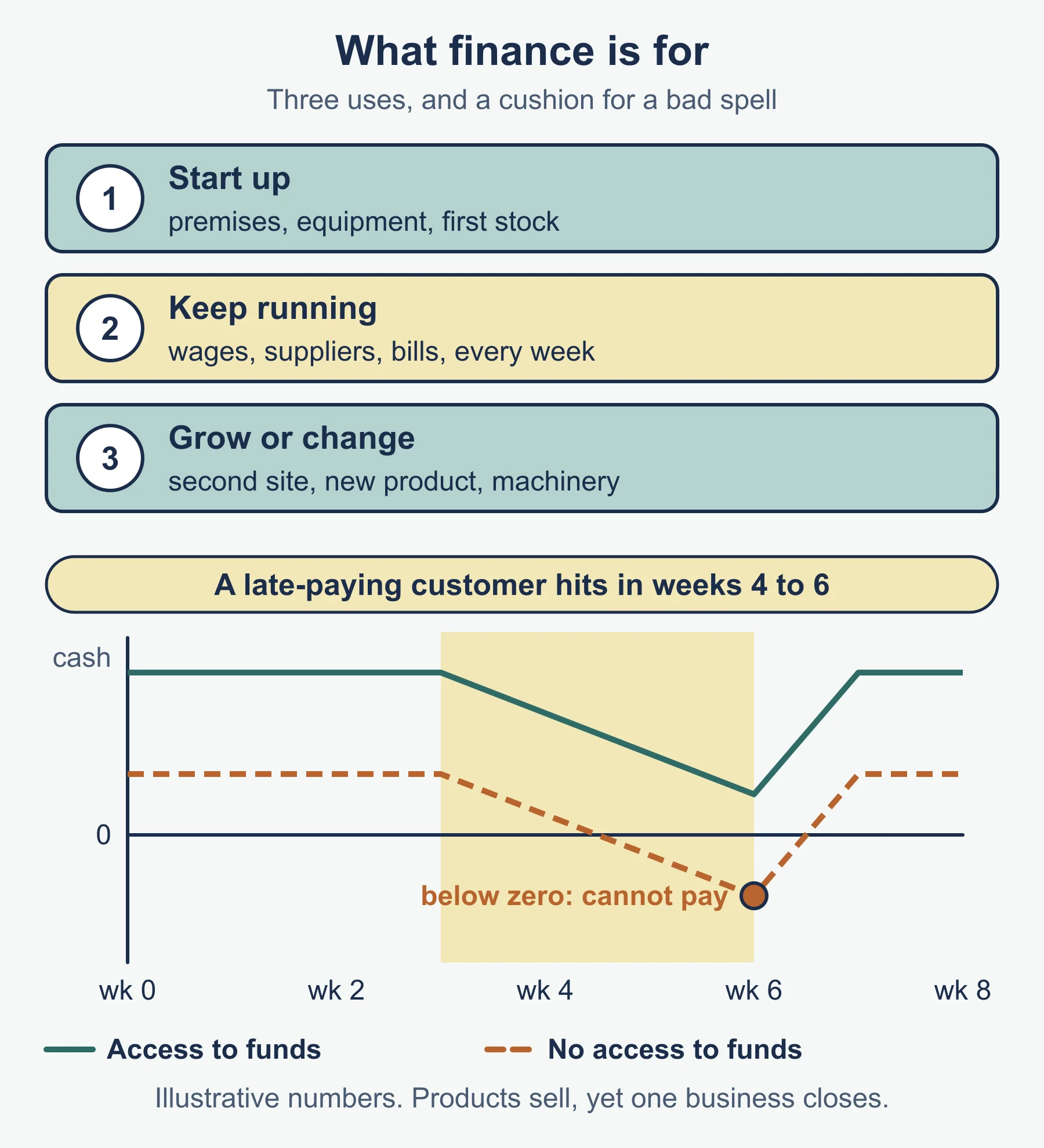
Finance is the money a business needs to operate. Every business uses it in three broad ways.
- To start up: buying premises, equipment and the first stock before any sales arrive.
- To keep running: paying wages, suppliers and utility bills on time. Cash is needed every week, even when profit looks healthy.
- To grow or change: opening a second site, launching a product, or replacing worn-out machinery.
Finance also lets a business survive a bad period. A business with access to funds can ride out a late-paying customer or a poor season. One without it may have to close even though its products sell.
Capital expenditure and revenue expenditure
Capital expenditure is spending on non-current assets, items the business will use for more than one year. Examples are machinery, vehicles, buildings, and major improvements that add to an asset’s value or life. It is usually large and occasional.
Revenue expenditure is spending on the everyday running of the business, whose benefit is used up within the year. Examples are wages, raw materials, rent, utilities, advertising and repairs that only restore an asset to its working condition. It is smaller and recurring.
The test is what the spending does. If it buys or improves something that will serve the business for years, it is capital. If it keeps the business running this year, it is revenue. Repairs are the usual trap: mending a broken part is revenue expenditure, but a major upgrade that extends the asset’s life or adds a new capability is capital.
Each type tends to be funded differently. Revenue expenditure is normally paid from the cash flowing in from sales. Capital expenditure is often too large for that, so owners look for longer-term finance. This link between the type of spending and the type of finance leads straight into 3.2.
Worked example: classifying spending
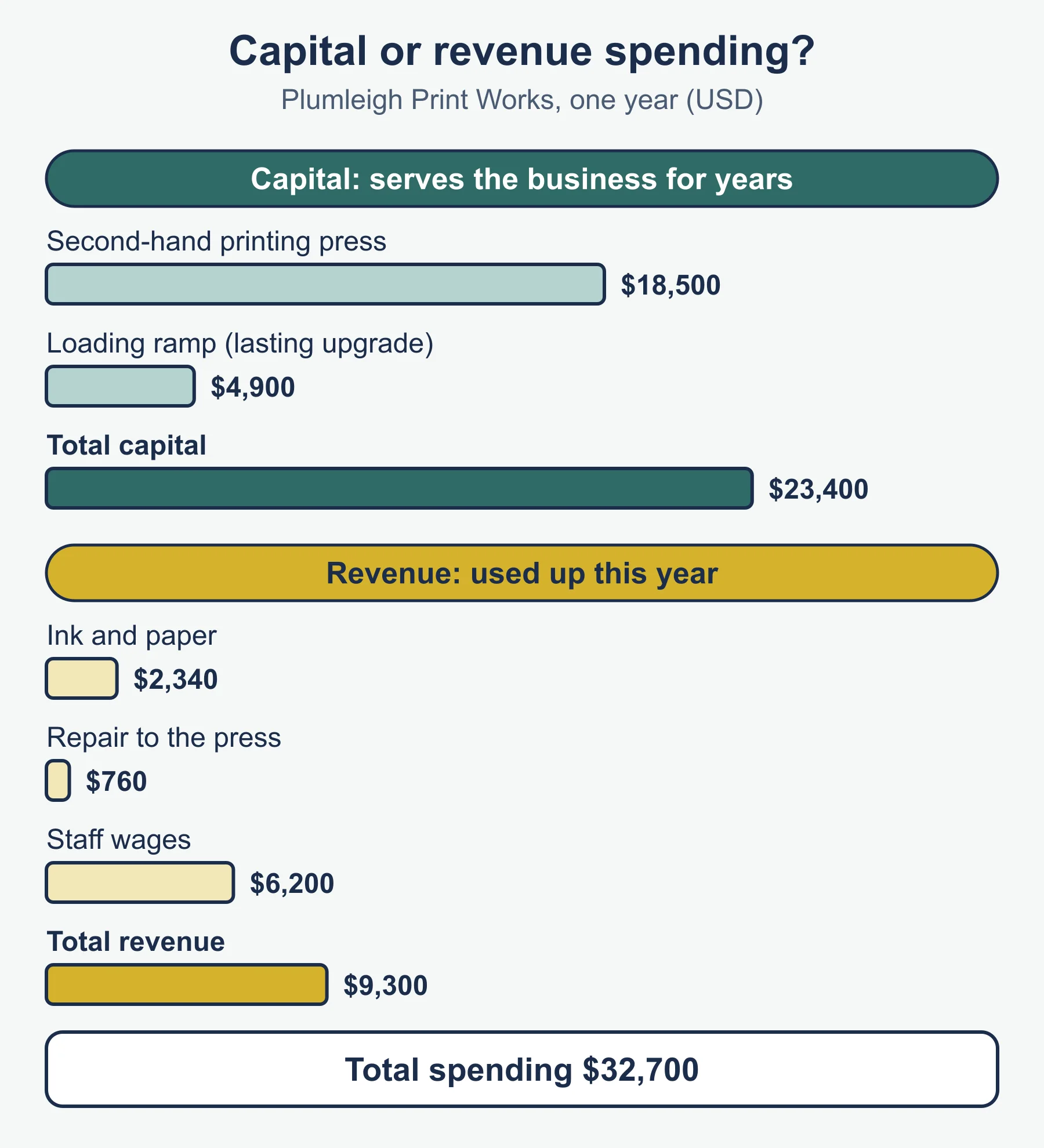
Plumleigh Print Works spent the following in one year.
| Item | Amount (USD) |
|---|---|
| Second-hand printing press | 18,500 |
| Ink and paper | 2,340 |
| Repair to the existing press | 760 |
| New loading ramp that lets the building take larger deliveries | 4,900 |
| Staff wages | 6,200 |
Capital expenditure: the press and the ramp, so 18,500 + 4,900 = USD 23,400. The ramp permanently improves the building, so it is capital. Revenue expenditure: ink and paper, the repair and wages, so 2,340 + 760 + 6,200 = USD 9,300. Total spending is USD 32,700.
The comment a high-scoring answer adds is that the 23,400 is probably too large to fund from one month’s cash, so the owner will need a longer-term source, while the 9,300 comes out of ordinary trading cash.
3.2 Sources of finance
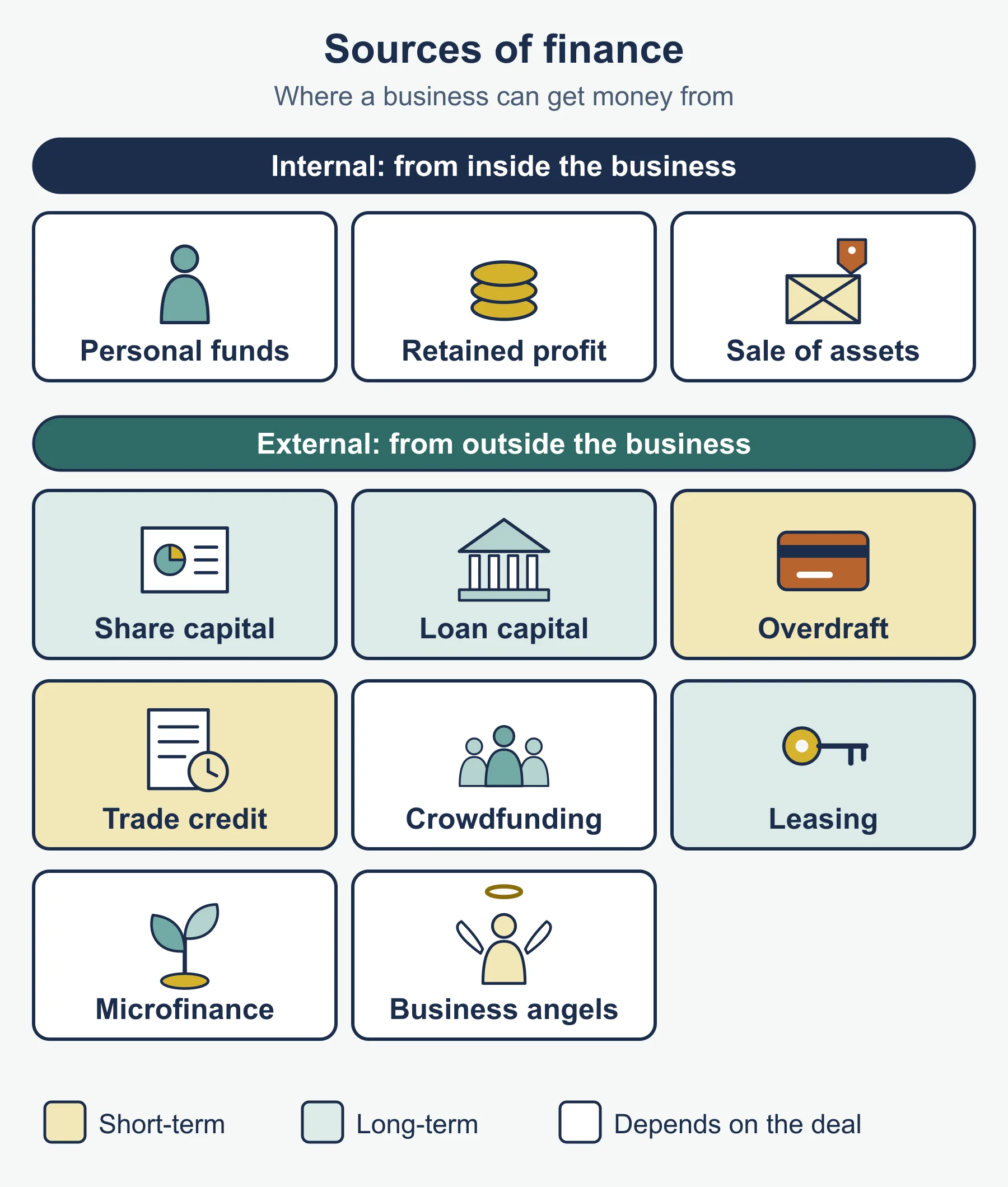
Sources are split by where the money comes from. Internal sources come from inside the business or its owner. External sources come from outside. A second split is by time: short-term finance is repaid within about a year, while long-term finance is repaid over several years or never.
Internal sources
Personal funds (for sole traders). The owner puts in their own savings. It is quick, has no interest and keeps full control. The limits are that savings are small and a sole trader carries unlimited liability, which puts personal assets on the line if the business fails.
Retained profit. Profit after tax that is kept in the business instead of being paid out as dividends. It has no interest and no outside lender, but it only exists once the business has made profits, so a start-up cannot use it. Keeping more also means smaller dividends for shareholders.
Sale of assets. Selling non-current assets that the business no longer needs, such as spare land or old machinery, turns them into cash. It involves no debt. The limits are that the business may have few spare assets, a sale can take time, and selling an asset it still needs reduces productive capacity.
External sources
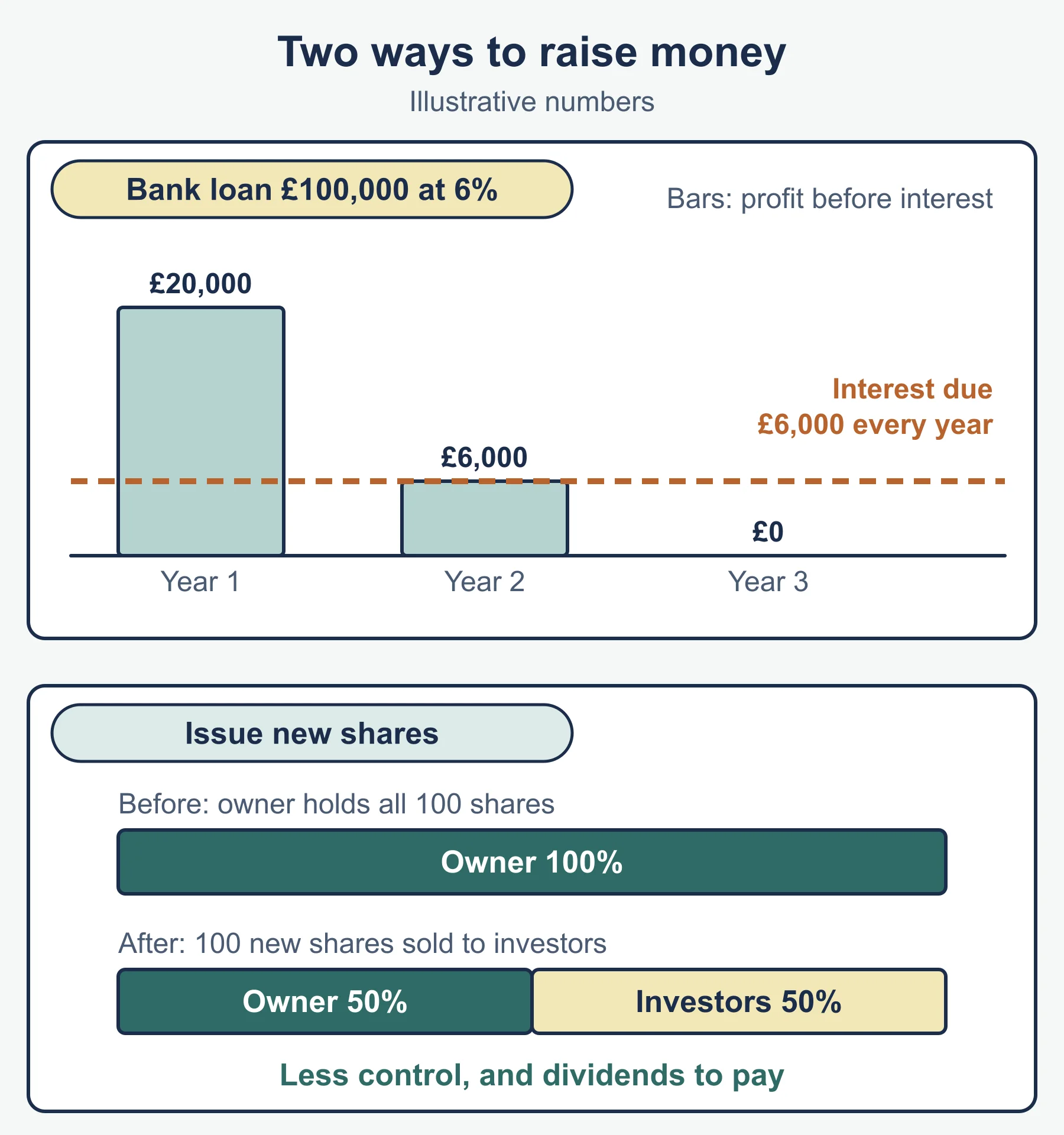
Share capital. Funds raised from investors in return for shares in a company. It is long-term and need not be repaid. Shareholders may receive dividends, and ownership and control are shared among more people. A private company usually offers shares to chosen investors, while a public limited company can sell to the public. The cost is dilution of the founders’ share.
Loan capital. Money borrowed, usually from a bank, and repaid with interest over a fixed period. It is long-term, so it suits capital expenditure, and ownership is not diluted. But interest must be paid whatever the profit, and lenders may ask for collateral (an asset pledged as security).
Overdrafts. An agreed facility to spend more than the account holds, up to a limit. It is flexible, because the borrower pays interest on the part actually drawn. It is short-term, the rate can be steep, and the bank may demand repayment. It suits a temporary cash gap.
Trade credit. The supplier delivers goods now and the business pays later, often after 30 or 60 days. It has no interest if paid on time and improves cash flow. The risks are lost discounts for early payment, penalties for late payment and damaged supplier relationships.
Crowdfunding. Many individuals each contribute a small amount, usually through an online platform, to a project. It tests demand and builds a customer base. Returns to backers may be a product, a reward or a share, depending on the platform. The business must run a convincing campaign, and if the target is not met the project may not be funded.
Leasing. The business pays regular fees to use an asset owned by someone else, without buying it. It avoids a large upfront payment and maintenance is often included. But total payments over the lease can exceed the purchase price, and the business does not own the asset at the end unless the contract says so.
Microfinance providers. Organizations that make small loans, and sometimes offer savings or advice, to entrepreneurs who cannot get ordinary bank credit, often because they have no collateral or credit history. They support very small businesses and self-employed people. Loan sizes are small and interest can be relatively high.
Business angels. Wealthy individuals who invest their own money in a start-up, usually in return for a share of ownership. Many also offer experience and contacts. The owner gives up part of the ownership and some control, and the angel will expect a return when the business succeeds.
Worked example: how much can retained profit fund?
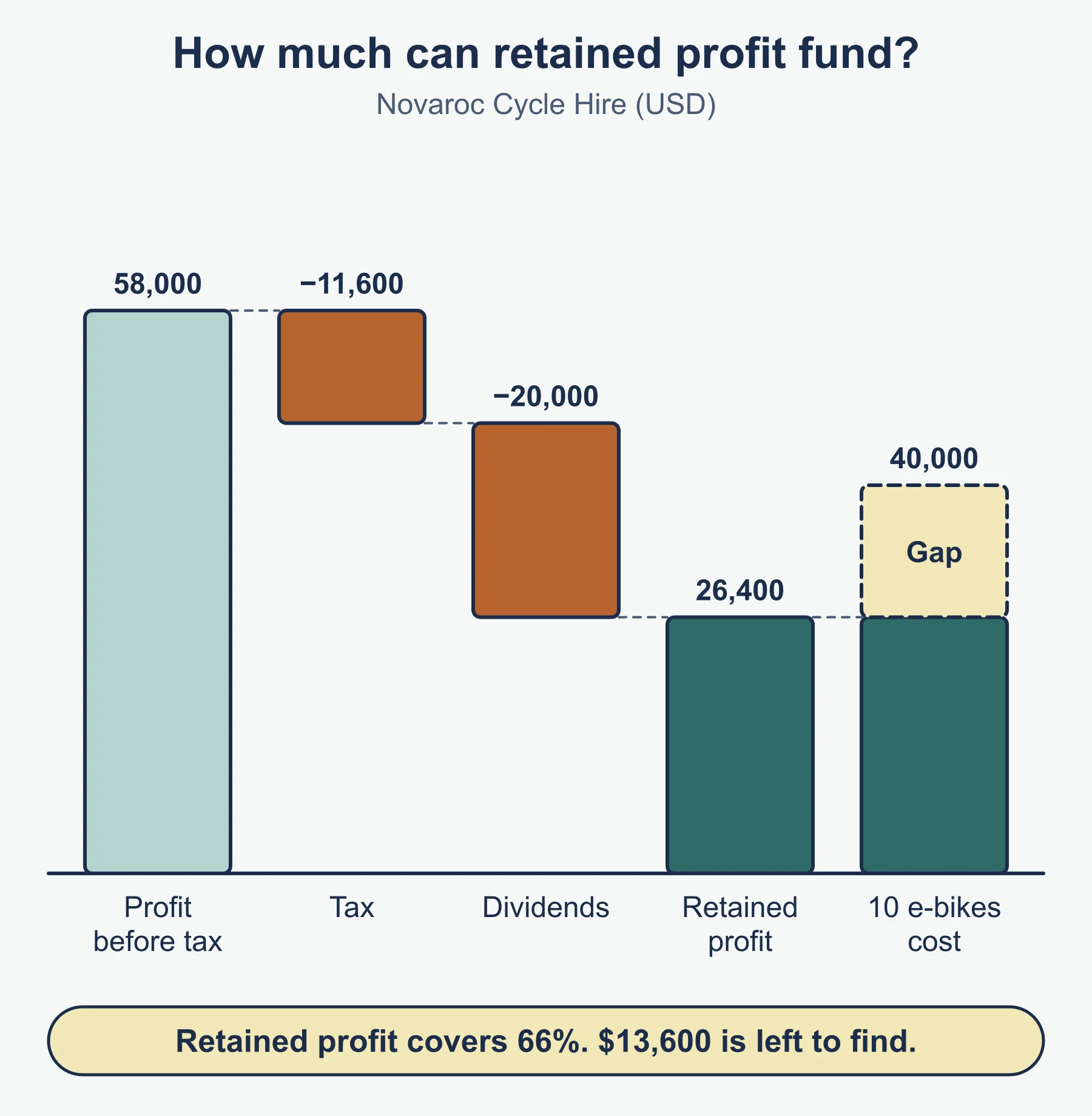
Novaroc Cycle Hire made a profit before tax of USD 58,000. Tax was USD 11,600, and the owners paid USD 20,000 in dividends. It wants to spend USD 40,000 on ten new e-bikes (USD 4,000 each).
Profit after tax = 58,000 - 11,600 = USD 46,400. Retained profit = 46,400 - 20,000 = USD 26,400. Shortfall = 40,000 - 26,400 = USD 13,600.
Retained profit covers about two-thirds of the purchase (26,400 / 40,000 = 66%). The USD 13,600 gap needs another source, and that is where the choice below comes in.
Worked example: share issue and ownership
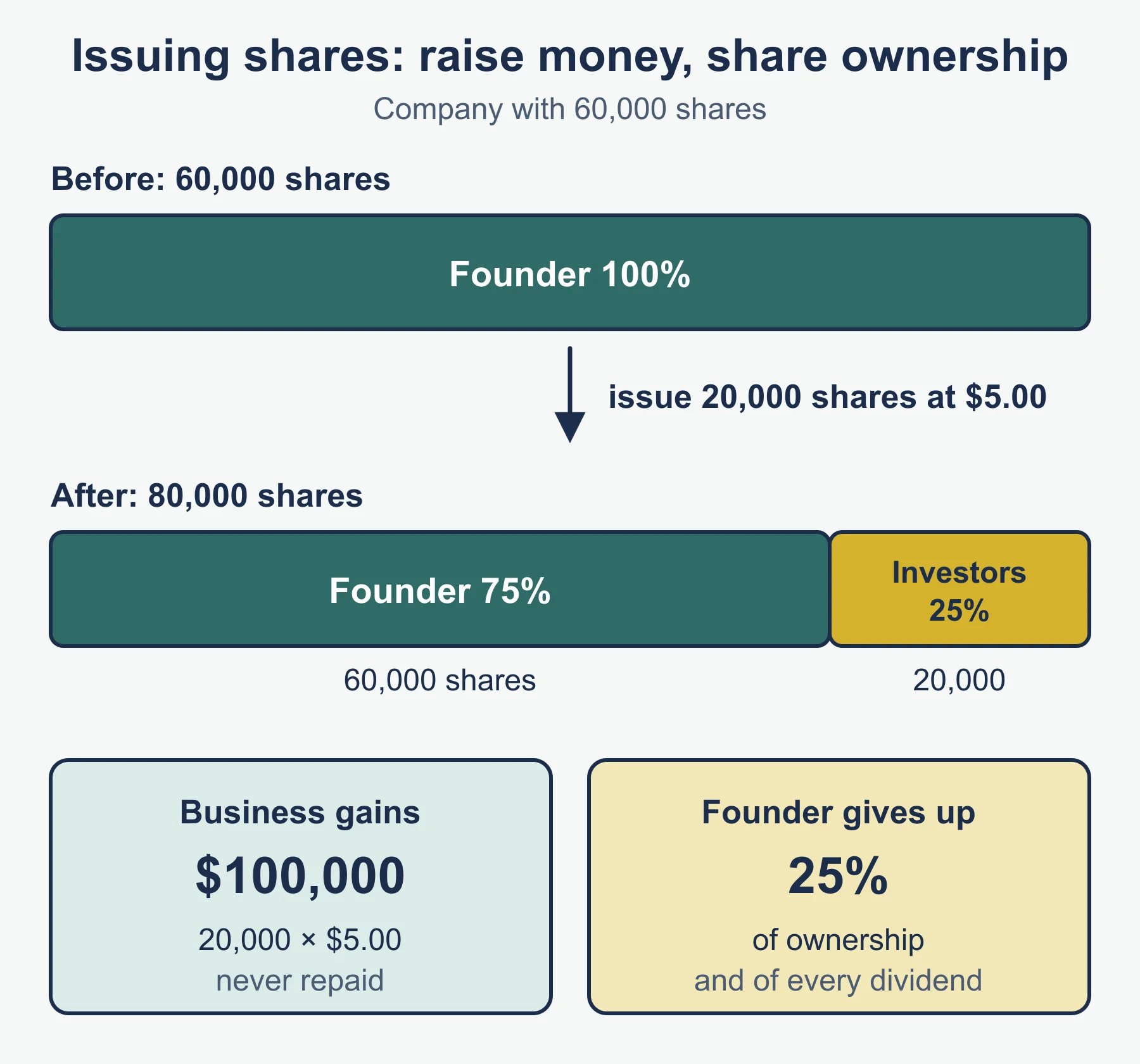
A company has 60,000 shares, all held by its founder. It issues 20,000 new shares at USD 5.00 each to outside investors.
Funds raised = 20,000 x 5.00 = USD 100,000. Total shares = 80,000, so the founder now holds 60,000 / 80,000 = 75%.
The business gains USD 100,000 that never has to be repaid. The founder gives up 25% of the ownership and, with it, a quarter of every future dividend.
Choosing between sources: the AO3 skill
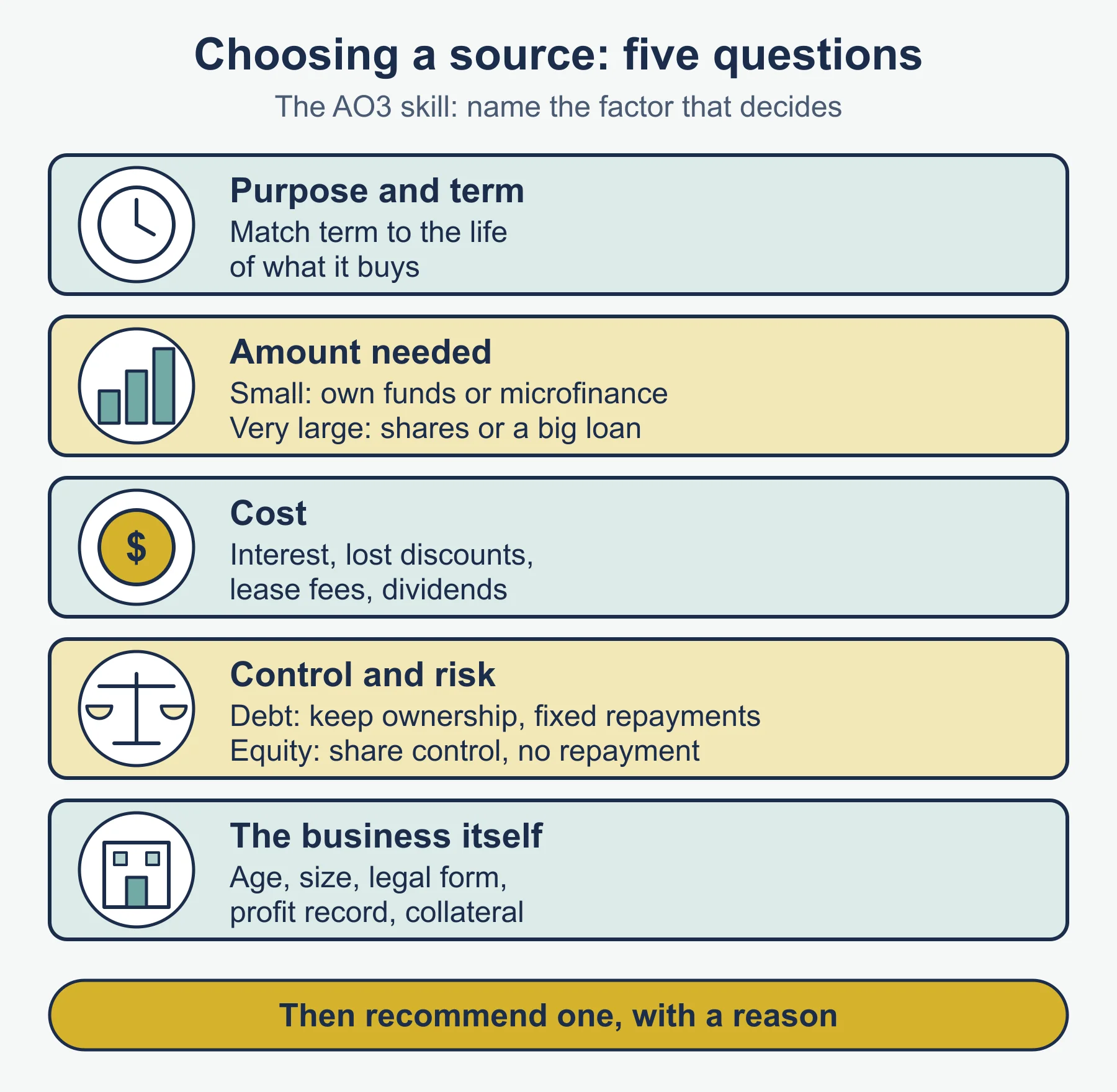
Appropriateness depends on the situation. Work through these factors.
- Purpose and time horizon. Match the term of the finance to the life of what it buys. Long-lived assets suit long-term sources (loan capital, share capital, leasing). Short gaps suit short-term sources (overdraft, trade credit).
- Amount needed. A small sum may come from personal funds or a microfinance loan. A very large sum often needs share capital or a large loan.
- Cost. Interest, lost discounts, lease fees and dividends all count.
- Control and risk. Debt keeps ownership but adds fixed repayments. Equity shares control but removes the repayment burden.
- The business itself. Its age, size, legal form, profit record and available collateral decide which sources are open to it.
Worked example: a judgment on Novaroc’s shortfall
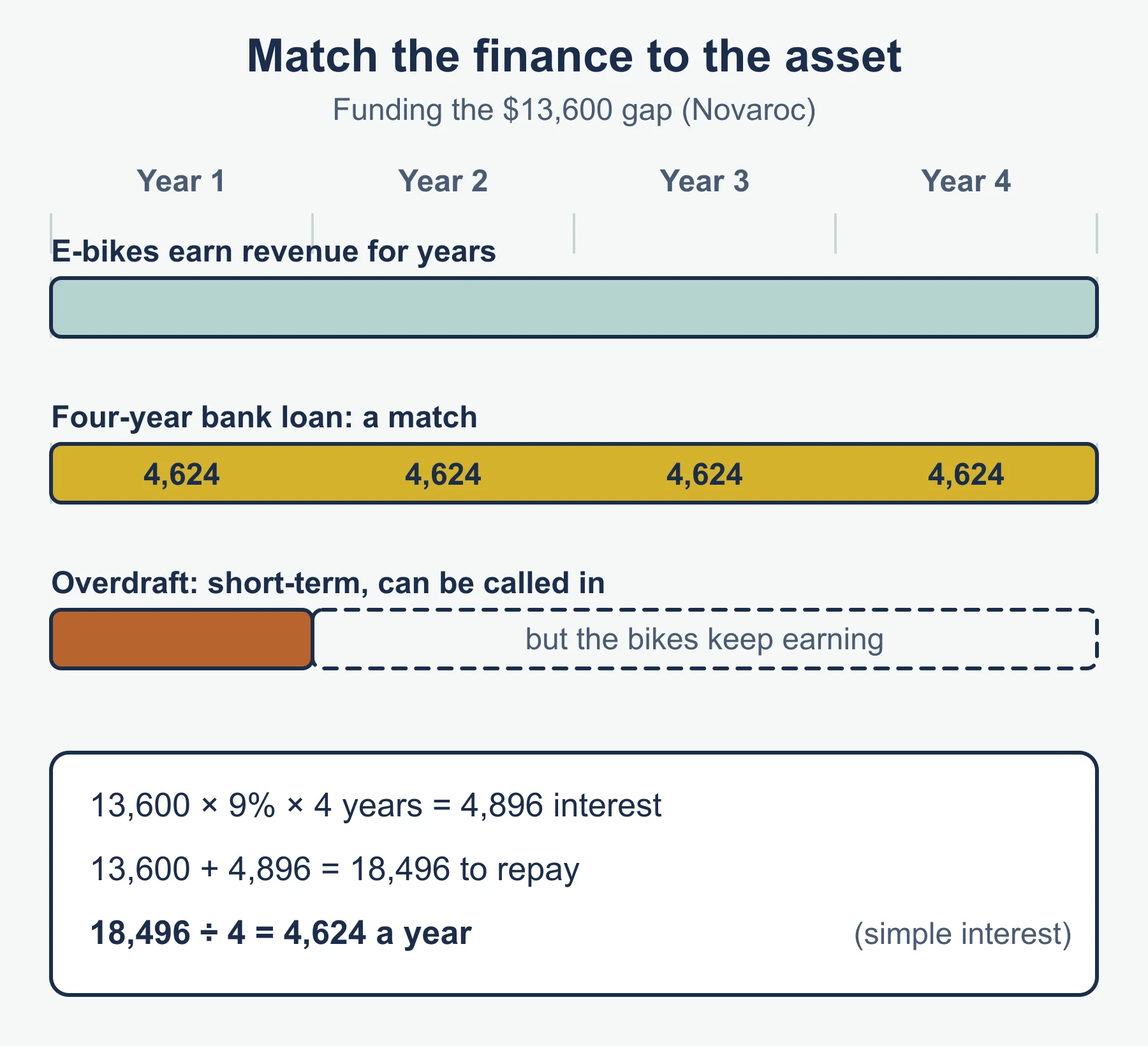
For the USD 13,600 gap, an overdraft is short-term and can be called in, so it is a poor match for bikes that will earn revenue for years. A four-year bank loan matches the asset’s life. At 9% simple interest on the amount borrowed, the interest is 13,600 x 0.09 x 4 = USD 4,896. Total repayment is USD 18,496, or USD 4,624 a year. Leasing the last few bikes is an alternative that avoids the upfront payment.
A justified answer would recommend the loan, because it matches the life of the asset and keeps ownership, while noting that the owners must be confident the bikes will earn more than the USD 4,624 yearly repayment. The judgment should name the factor that decides it.
Common errors
- Calling any repair capital expenditure. Restoring working order is revenue; adding to value or life is capital.
- Saying retained profit is “cash in the bank”. It is a record of profit kept in the business, which may already have been spent on assets.
- Treating an overdraft as long-term finance because the facility is renewed each year.
- Describing a source without applying it. Say why it does or does not suit the business in the question.
- Listing advantages and disadvantages but never reaching a recommendation in an AO3 question.
Frequently asked questions
What is the difference between capital and revenue expenditure? Capital expenditure is spending on non-current assets that the business will use for more than a year, such as machinery or vehicles. Revenue expenditure covers everyday running costs whose benefit is used up within the year, such as wages, materials and ordinary repairs.
What is the role of finance for a business? Finance is needed to start up, to keep running by paying wages and suppliers on time, and to grow or change. It also helps a business survive a bad period, such as a late-paying customer or poor sales.
What is a business angel? A business angel is a wealthy individual who invests their own money in a start-up, usually in return for a share of ownership. Many also offer experience and contacts.
How do you choose the most appropriate source of finance? Consider the purpose and time horizon, the amount needed, the cost, how much control and risk the owner will accept, and which sources the business can actually access given its age, size, legal form and record. In IB Business Management this is an AO3 skill, so finish with a justified recommendation.
Official syllabus
IB Diploma Programme Business management guide, first assessment 2024, published by the International Baccalaureate Organization. Sections 3.1 Introduction to finance and 3.2 Sources of finance.
Get free revision emails (optional)
Occasional emails with practice questions, worked explanations and links to free resources for the qualification and subjects you choose. No spam, and you can unsubscribe from any email. The free tools on this site never need an email.
Related resources
-
Practice questions
IB DP Business Management: Introduction to finance and Sources of finance – Practice Questions
Original IB DP Business Management practice questions with worked answers on 3.1 and 3.2: expenditure types and sources of finance.
Business · International Baccalaureate · IB
Try questions -
Revision notes
IB DP Business Management: Introduction to finance and Sources of finance – Revision Notes
Condensed revision notes for IB DP Business Management 3.1 and 3.2: expenditure types, each source of finance compared, and a quick self-test.
Business · International Baccalaureate · IB
Revise topic -
Study guides
IB DP Business Management: Investment appraisal
Study guide to IB DP Business Management section 3.8: payback period, average rate of return and NPV (HL only), with worked examples and judgement skills.
Business · International Baccalaureate · IB
Read guide
Related articles
-
teaching
A Level tuition in Dubai: Cambridge or Pearson Edexcel International A Level?
Schools in Dubai and Abu Dhabi teach either Cambridge International AS & A Level or Pearson Edexcel International A Level. How the two are structured, why it matters for tuition, and how online classes from Lahore work.
9 October 2026
-
curriculum guides
Choosing subjects at IGCSE and A Level
How subject choices at 14 and 16 affect university options later, and how to keep pathways open without overloading a timetable.
28 July 2026
Studying this with a teacher
Working through Business IB?
This page is free and stays free. If you would rather be taught it, Marlbridge runs Business classes one-to-one, online in your own time zone. The first trial class is free. WhatsApp replies within an hour (8am–11pm Pakistan time, every day); email the same day.
IB Business teachers at Marlbridge

