
Study Guides
IB DP Business Management: Investment appraisal
Study guide to IB DP Business Management section 3.8: payback period, average rate of return and NPV (HL only), with worked examples and judgement skills.
- Subject
- Business
- Level
- IB
- Topic
- Unit 3: Finance and accounts
- Author
- Marlbridge Academic Team
- Updated
- Reviewed by
- Salman Ahmad (what this means)
Aligned to International Baccalaureate IB Diploma Programme Business (DP Business Management), First assessment 2024. Official specification .
Syllabus page (what it covers and how it is assessed): IB Diploma Programme Business.
Syllabus points this page covers
DP Business Management
- 3.8 Investment appraisal
Found an error? Report a correction.
Need help with this topic? Request a free trial class for IB Diploma Programme Business (DP Business Management).
This guide covers section 3.8, Investment appraisal, of the IB Business management guide (first assessment 2024). The section lists three methods: payback period and average rate of return (ARR), which are SL and HL, and net present value (NPV), which is HL only. The guide gives the depth of teaching as AO3 and AO4, so you must be able to calculate and then use the results to reach a judgement about a business decision. Related pages: Unit 3 study guide, Unit 3 revision notes and Unit 3 practice questions. Course hub: IB DP Business Management. Printable list: checklist. Check yourself with the free diagnostics.
Companion pages for this topic: revision notes and practice questions.
What the guide asks for
| Content point in 3.8 | Level | What you must be able to do |
|---|---|---|
| Payback period | SL and HL | Calculate it for even and uneven returns, interpret it, judge it |
| Average rate of return (ARR) | SL and HL | Calculate it with the guide formula, interpret it, judge it |
| Net present value (NPV) | HL only | Discount returns with a given table, calculate NPV, interpret it, judge it |
| Appraising investment opportunities | SL and HL | Compare projects and recommend, using the results and the context |
The guide’s formulae page says a copy of the formulae will be provided for the examination. For HL, the guide’s appendix says a discount table will be provided in the examination paper when required. Learn how to use both rather than memorize numbers.
Why businesses appraise investments
An investment opportunity means spending money now (the capital cost) in the hope of earning returns over several years. Examples are buying a machine, fitting out a new site or launching a service. The business forecasts the net returns each year, then uses appraisal methods to decide whether the project is worth its cost, or which of several projects is best.
Every method below depends on forecasts. If sales are overestimated, every result is overstated. Keep that in mind when you evaluate.
Payback period
Payback period is the length of time it takes for the returns from an investment to repay its capital cost. The guide does not print a formula for it, so the standard form is used here.
For even annual returns: payback period = capital cost ÷ annual net return.
For uneven returns, add the returns year by year until the running total reaches the capital cost, then take the fraction of the final year needed.
Worked example 1 (even returns). Sundial Bakery is considering a new oven costing 75,000 (all figures in dollars). It expects an extra net return of 15,000 each year.
Payback = 75,000 ÷ 15,000 = 5 years.
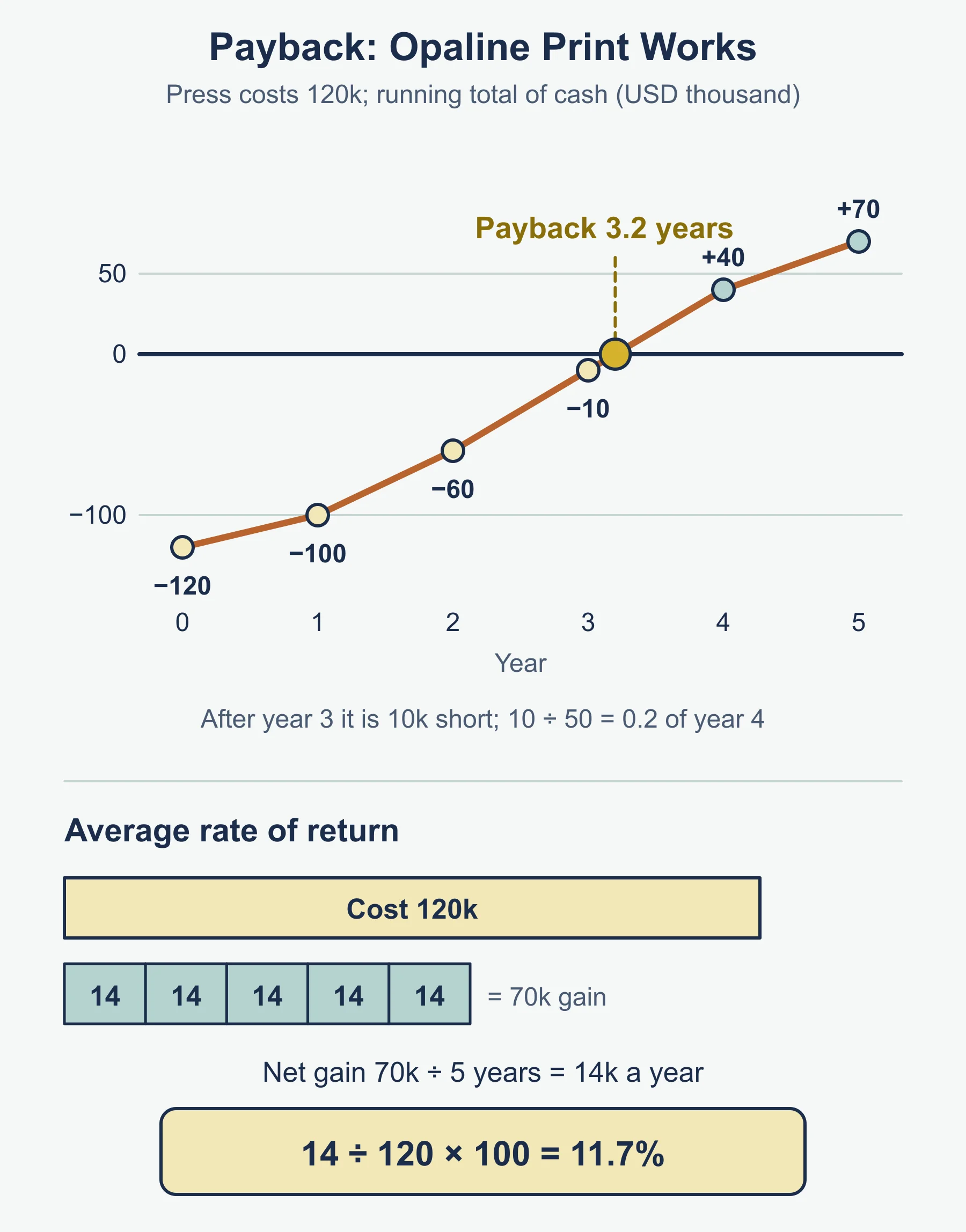
Worked example 2 (uneven returns). Opaline Print Works plans to buy a press for 120,000. Forecast net returns are:
| Year | Net return | Cumulative return |
|---|---|---|
| 1 | 20,000 | 20,000 |
| 2 | 40,000 | 60,000 |
| 3 | 50,000 | 110,000 |
| 4 | 50,000 | 160,000 |
| 5 | 30,000 | 190,000 |
After year 3 the business is still 10,000 short of 120,000. Year 4 brings 50,000, so it needs 10,000 ÷ 50,000 = 0.2 of that year. Payback = 3.2 years. To express this in months, 0.2 × 12 = 2.4, so 3 years and about 2 months. This assumes returns arrive evenly within each year.
Reading the result. With a shorter payback, the cash is tied up for a briefer spell and flows back to the business earlier. A business would often set a maximum acceptable payback. The method does not say whether the project is profitable overall.
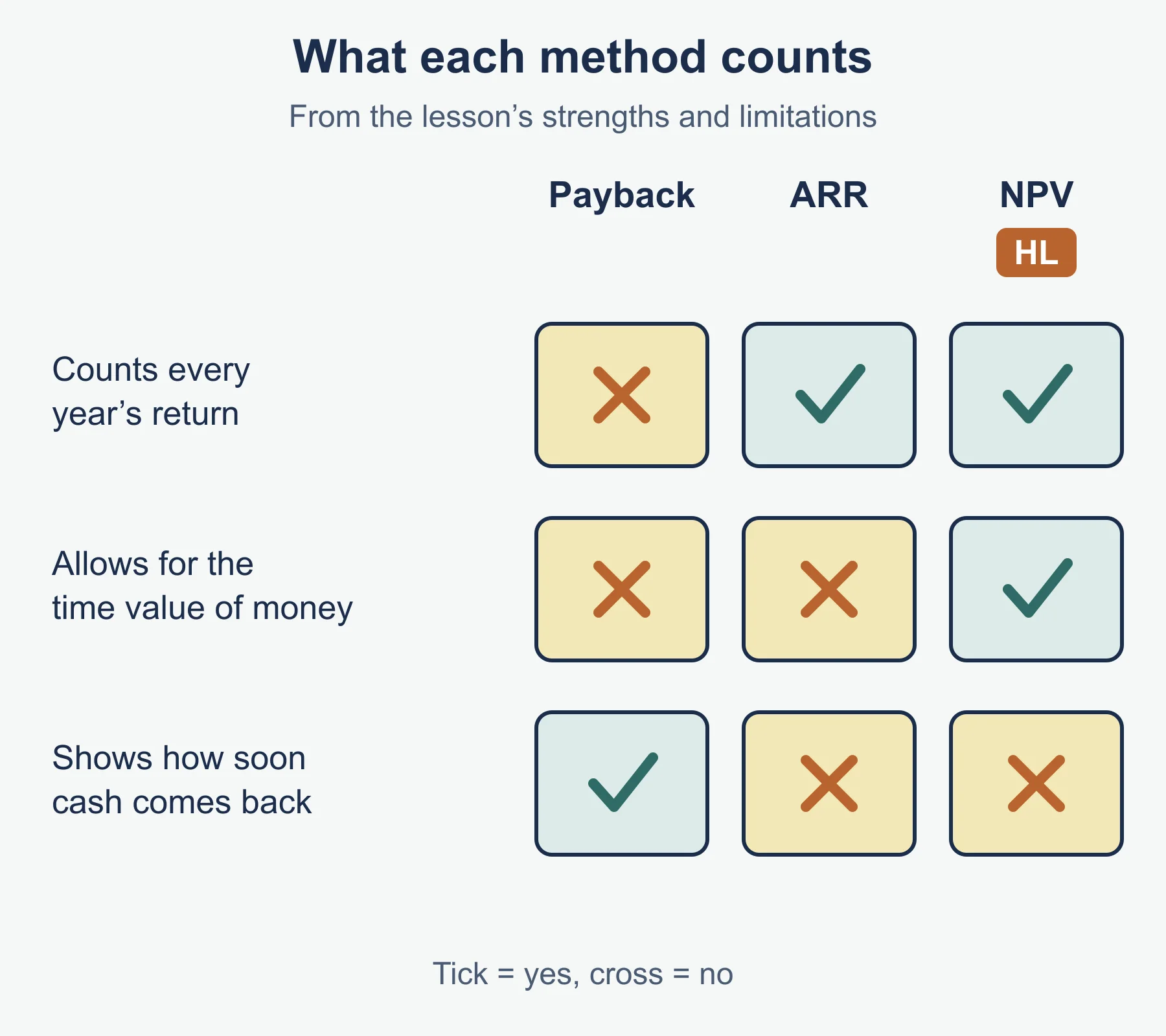
Strengths: quick, easy to explain, and it highlights liquidity and risk because it focuses on how soon the money comes back.
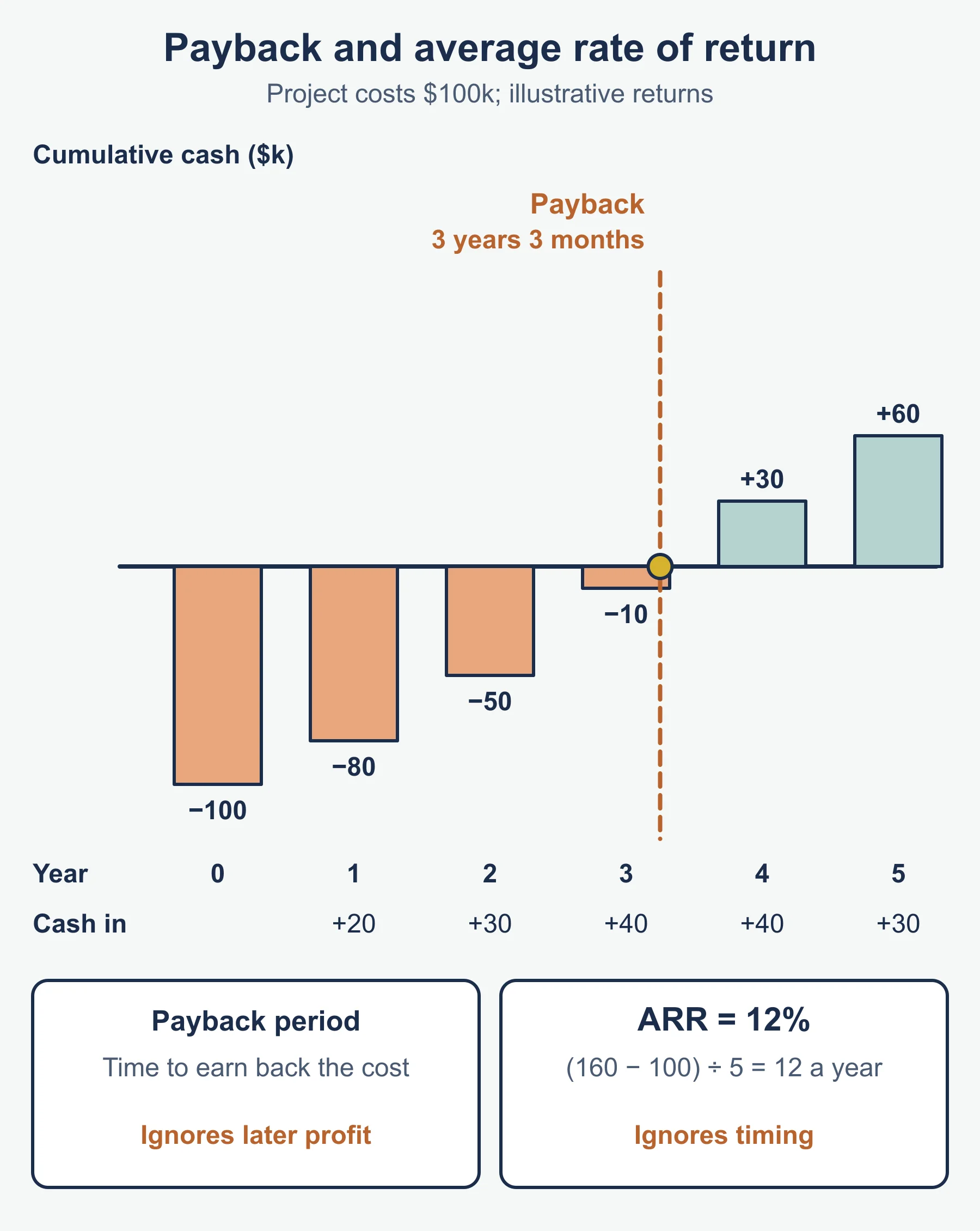
Limitations: it ignores returns after the payback point, so a project with a long profitable life can look poor. It ignores the timing of returns within the payback period, and it ignores the time value of money.
Average rate of return (ARR)
ARR expresses the average yearly return, after recovering the capital cost, as a percentage of the capital cost. The guide gives it as:
ARR = [(total returns − capital cost) ÷ years of use] ÷ capital cost × 100
Steps:
- Add all the returns over the life of the project.
- Subtract the capital cost to find the total net gain.
- Divide by the number of years of use to get the average annual gain.
- Divide by the capital cost and multiply by 100.
Worked example 3. Using the Opaline press: total returns = 190,000. Total net gain = 190,000 − 120,000 = 70,000. Average annual gain = 70,000 ÷ 5 = 14,000. ARR = 14,000 ÷ 120,000 × 100 = 11.7% (to 1 decimal place).
Using the result. ARR can be compared with a target return the business sets, with the cost of borrowing, or with the ARR of another project. A higher ARR is better, other things equal. Before using it as a target comparison, check that you are comparing like with like (the same measure of return).
Strengths: uses the whole life of the project, gives a percentage that is easy to compare across projects of different size, and is simple to calculate.
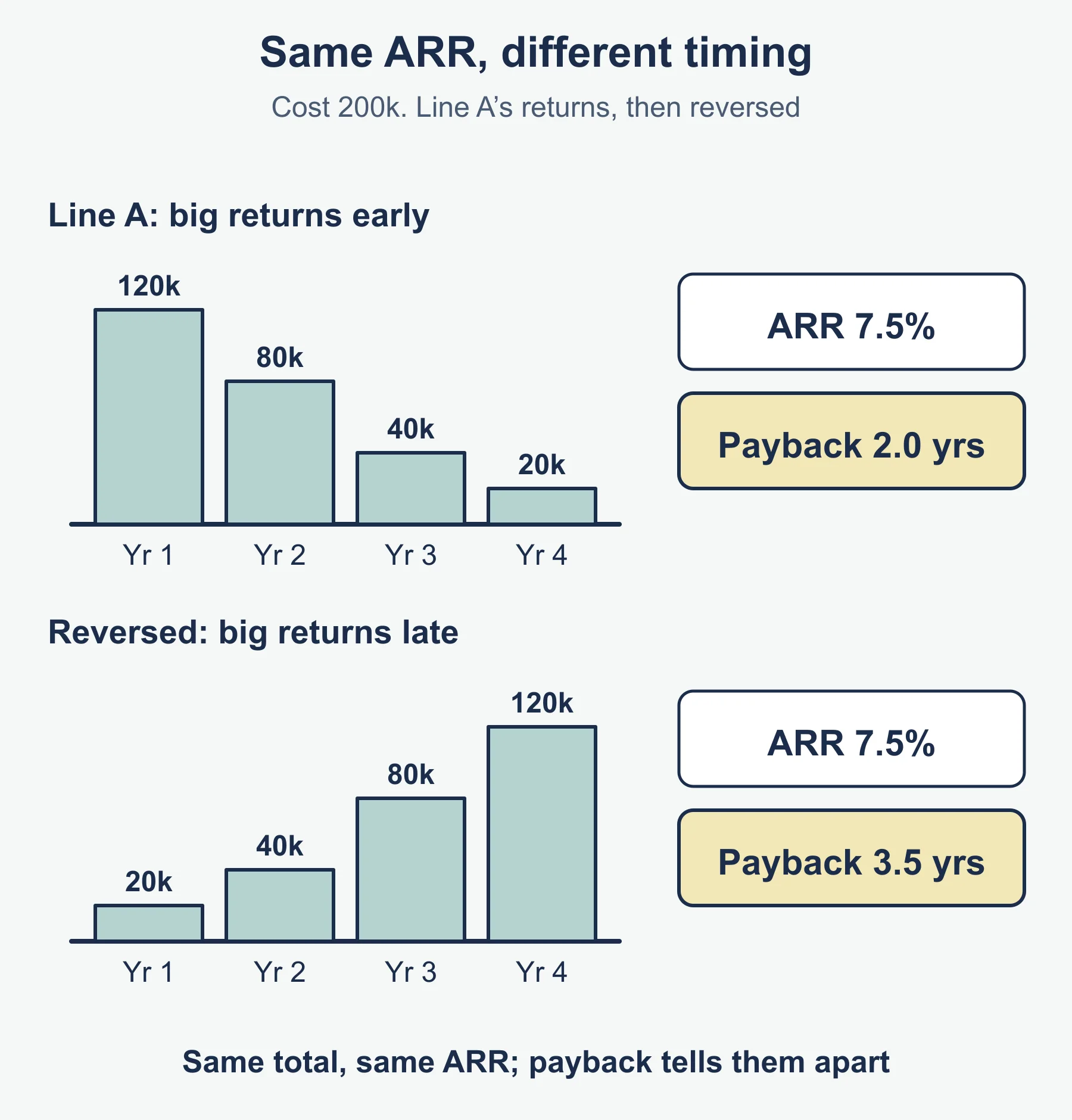
Limitations: it ignores when the returns arrive (a project that pays late can have the same ARR as one that pays early), it ignores the time value of money, and it depends on forecasts over the full life of the project, which are less reliable the further ahead they run.
Net present value (HL only)
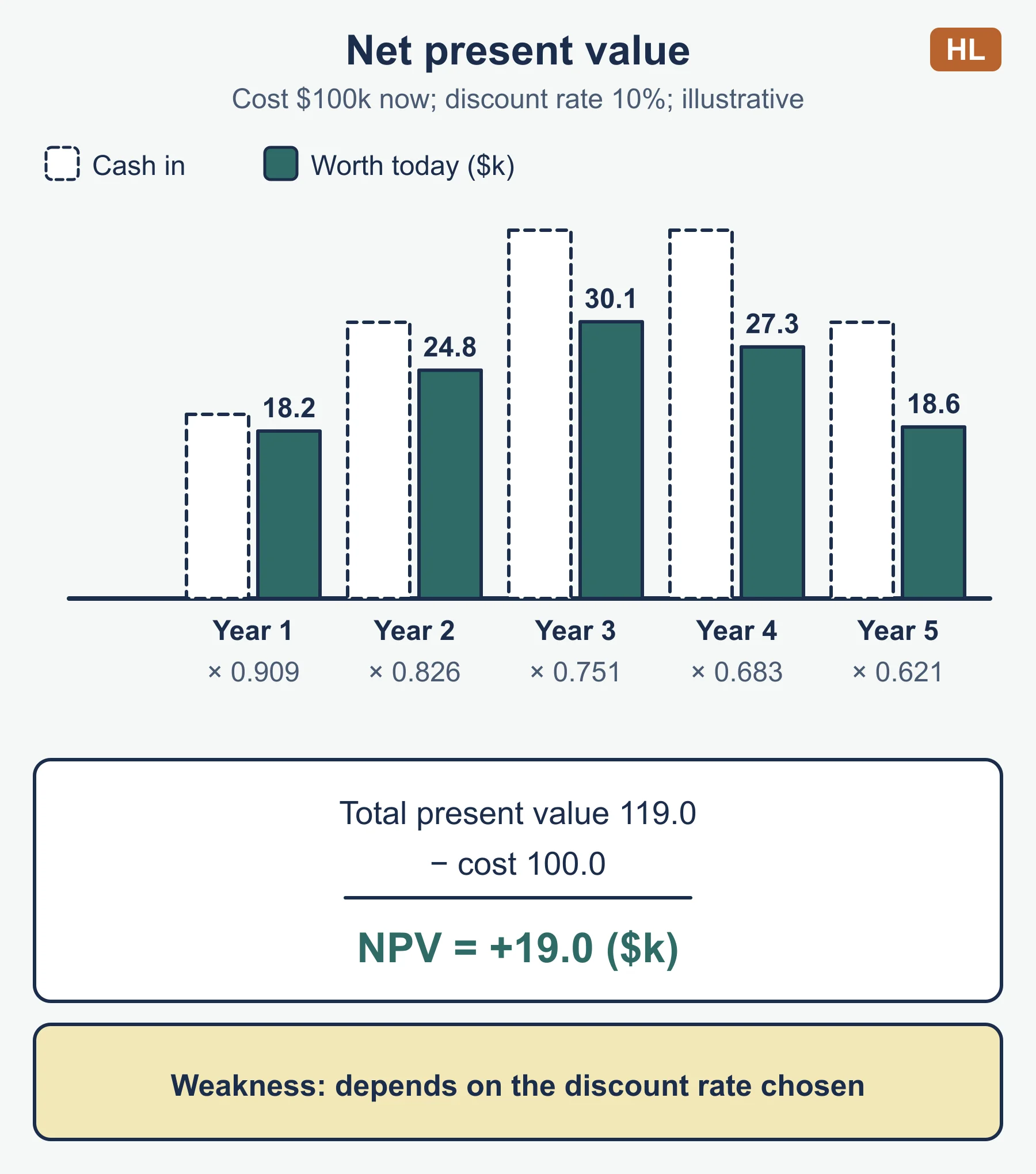
NPV takes account of the time value of money: a sum due later is worth less than an identical sum received today, because money today can be used or invested now, and because the future is uncertain. NPV therefore converts each future return into a present value using a discount rate.
The guide gives the formula as: NPV = Σ present values of return − original cost.
The present value of a return is the return multiplied by the discount factor for that year and rate. The discount factors come from the discount table in the examination paper. For example, at 8% the guide’s table gives 0.9259 for year 1, 0.8573 for year 2, 0.7938 for year 3, 0.7350 for year 4 and 0.6806 for year 5. The rates in the guide’s table are 4%, 6%, 8%, 10% and 20%, for years 1 to 10.
The discount rate reflects what the business could earn or must pay for its money elsewhere. It is a judgement made by the business, which is one limitation of the method (see below).
Steps:
- Take the discount factor for each year at the given rate.
- Multiply each year’s return by its factor to get present values.
- Add the present values.
- Subtract the original cost.
Worked example 4. Opaline’s press at a discount rate of 8%.
| Year | Return | Factor (8%) | Present value |
|---|---|---|---|
| 1 | 20,000 | 0.9259 | 18,518 |
| 2 | 40,000 | 0.8573 | 34,292 |
| 3 | 50,000 | 0.7938 | 39,690 |
| 4 | 50,000 | 0.7350 | 36,750 |
| 5 | 30,000 | 0.6806 | 20,418 |
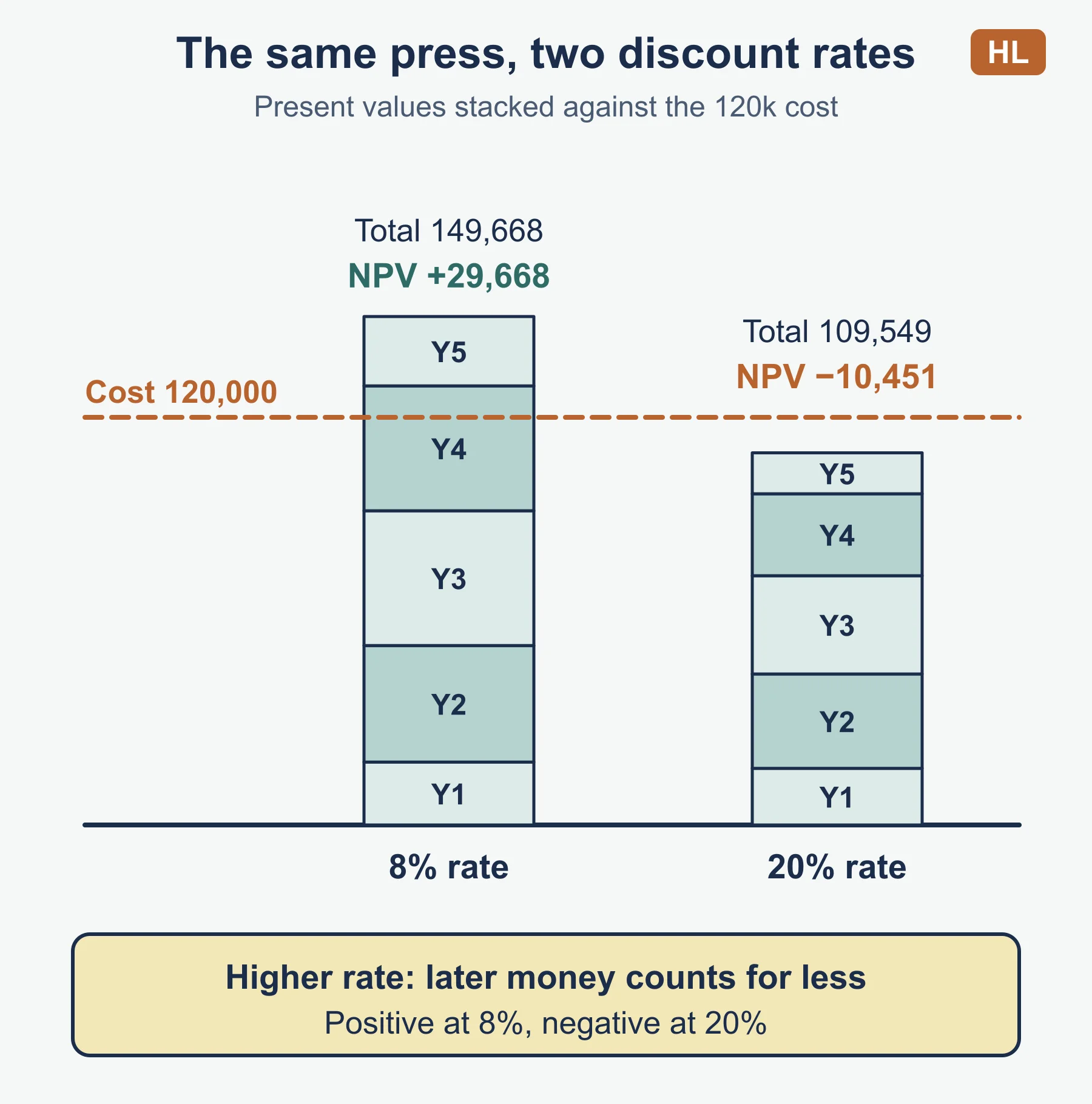
Total present value = 149,668. NPV = 149,668 − 120,000 = 29,668.
A positive NPV means the discounted returns exceed the original cost, so the project more than earns the required return. A negative NPV means it does not. When choosing between projects, a higher NPV is better (this is the standard decision rule).
Sensitivity to the rate. Repeat the press at 20%, with factors 0.8333, 0.6944, 0.5787, 0.4823 and 0.4019. Present values: 16,666, 27,776, 28,935, 24,115 and 12,057, totalling 109,549. NPV = 109,549 − 120,000 = −10,451. The same project moves from clearly worthwhile to unacceptable when the rate changes, so the chosen rate matters.
Strengths: accounts for the time value of money, uses the whole project life, and gives a value in money terms.
Limitations: harder to calculate and explain, the result depends on the discount rate chosen, and it relies on forecast returns for every year. It does not show how quickly the money is recovered.
Comparing methods and recommending
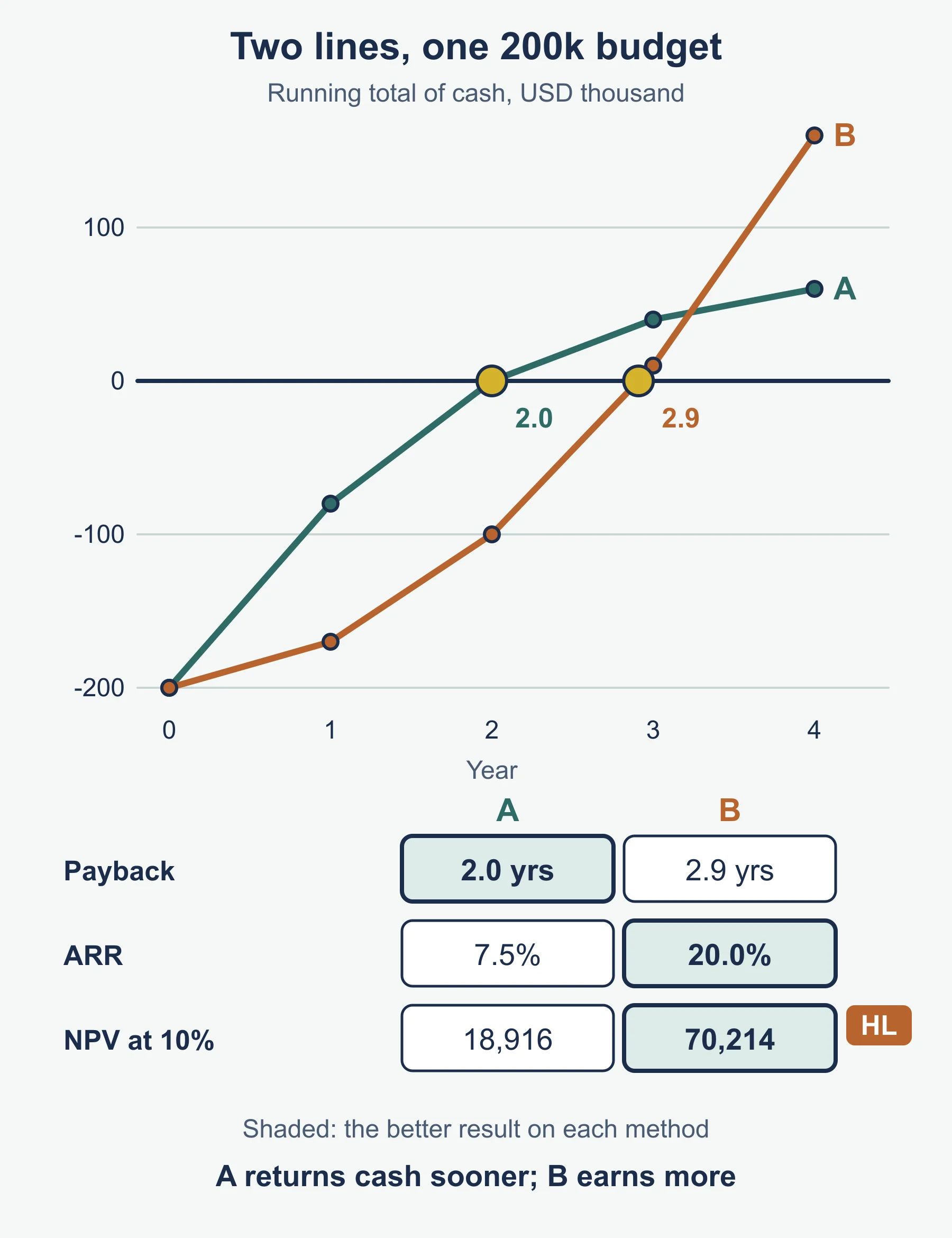
Different methods can rank projects differently, so you need to say why. Zephyrwood Labs can fund one of two lines, each costing 200,000 and each lasting four years.
| Line A | Line B | |
|---|---|---|
| Returns, years 1 to 4 | 120,000; 80,000; 40,000; 20,000 | 30,000; 70,000; 110,000; 150,000 |
| Total returns | 260,000 | 360,000 |
| Payback | 2.0 years | 2.9 years |
| ARR | 7.5% | 20.0% |
| NPV at 10% (HL) | 18,916 | 70,214 |
Line A pays back sooner, so it suits a business that needs its cash back quickly or fears change in the market. Line B has a far higher ARR, and (for HL) a far higher NPV, because its large returns come later but are large. If the forecasts are reliable and Zephyrwood can wait, Line B is the stronger choice. If cash is tight or the late returns look uncertain, Line A is safer.
ARR for Line A: (260,000 − 200,000) ÷ 4 = 15,000; 15,000 ÷ 200,000 × 100 = 7.5%. Line B: (360,000 − 200,000) ÷ 4 = 40,000; 40,000 ÷ 200,000 × 100 = 20.0%.
Beyond the numbers
Quantitative results are only part of a recommendation. In a case study, consider:
- How reliable the forecasts are, and what could change them (competitors, costs, demand).
- Risk: a long project is exposed to more uncertainty than a short one.
- Liquidity and how the project would be financed, including whether the business can afford a long wait for returns.
- Stakeholders: employees, customers, the local community and investors may be affected differently.
- Ethical and environmental effects, and whether the project fits the business’s objectives and strategy.
Case-study skills (AO3 and AO4)
- Calculate accurately, show each step, and give units or a percentage.
- Say what the number means for this business, not only what it is.
- Compare with a benchmark from the case, such as a target payback or the cost of borrowing.
- Weigh the limitations of each method against the context.
- Reach a clear judgement and say what would change it.
Common errors
- Giving payback as a number of years without allowing for the part year.
- Using profit instead of net return when the question gives returns.
- Forgetting to subtract the capital cost in ARR, or forgetting to divide by years.
- Forgetting to subtract the original cost in NPV, so a present value total is reported as NPV.
- Applying a year 1 discount factor to the wrong year.
- Describing a method’s limitation without linking it to the business in the case.
- Recommending a project from one method only, with no judgement.
Continue with the revision notes, then test yourself with the practice questions.
Frequently asked questions
What is the payback period? The payback period is the length of time it takes for the returns from an investment to repay its capital cost. For even returns it is the capital cost divided by the annual net return.
What are the limitations of the payback method? Payback ignores returns after the payback point, so a project with a long profitable life can look poor. It also does not measure profitability on its own.
What is the time value of money? The time value of money means a sum due later is worth less than the same sum received today. Net present value (HL only) takes account of this by discounting future returns.
What non-financial factors should you consider in investment appraisal? Consider how reliable the forecasts are, risk, liquidity and how the project would be financed, effects on stakeholders, ethical and environmental effects, and fit with the business’s objectives and strategy.
Official syllabus
Source: Business management guide, first assessment 2024, International Baccalaureate Organization. Section 3.8, Investment appraisal; formulae and discount table as printed in the guide.
Get free revision emails (optional)
Occasional emails with practice questions, worked explanations and links to free resources for the qualification and subjects you choose. No spam, and you can unsubscribe from any email. The free tools on this site never need an email.
Related resources
-
Practice questions
IB DP Business Management: Investment appraisal – Practice Questions
Original IB DP Business Management practice questions on 3.8 Investment appraisal: payback, ARR and NPV (HL only), with fully worked answers.
Business · International Baccalaureate · IB
Try questions -
Revision notes
IB DP Business Management: Investment appraisal – Revision Notes
Condensed IB DP Business Management revision notes for 3.8 Investment appraisal: payback, ARR, NPV (HL only), method steps, a self-test and common slips.
Business · International Baccalaureate · IB
Revise topic -
Study guides
IB DP Business Management: Profitability and liquidity ratio analysis and Efficiency ratio analysis (HL only)
IB DP Business Management study guide to profitability, liquidity and HL efficiency ratios, with worked examples, strategies and insolvency.
Business · International Baccalaureate · IB
Read guide
Related articles
-
teaching
A Level tuition in Dubai: Cambridge or Pearson Edexcel International A Level?
Schools in Dubai and Abu Dhabi teach either Cambridge International AS & A Level or Pearson Edexcel International A Level. How the two are structured, why it matters for tuition, and how online classes from Lahore work.
9 October 2026
-
curriculum guides
Choosing subjects at IGCSE and A Level
How subject choices at 14 and 16 affect university options later, and how to keep pathways open without overloading a timetable.
28 July 2026
Studying this with a teacher
Working through Business IB?
This page is free and stays free. If you would rather be taught it, Marlbridge runs Business classes one-to-one, online in your own time zone. The first trial class is free. WhatsApp replies within an hour (8am–11pm Pakistan time, every day); email the same day.
IB Business teachers at Marlbridge

