
Revision Notes
IB DP Business Management: Investment appraisal – Revision Notes
Condensed IB DP Business Management revision notes for 3.8 Investment appraisal: payback, ARR, NPV (HL only), method steps, a self-test and common slips.
- Subject
- Business
- Level
- IB
- Topic
- Unit 3: Finance and accounts
- Author
- Marlbridge Academic Team
- Updated
- Reviewed by
- Salman Ahmad (what this means)
Aligned to International Baccalaureate IB Diploma Programme Business (DP Business Management), First assessment 2024. Official specification .
Syllabus page (what it covers and how it is assessed): IB Diploma Programme Business.
Syllabus points this page covers
DP Business Management
- 3.8 Investment appraisal
Found an error? Report a correction.
Need help with this topic? Request a free trial class for IB Diploma Programme Business (DP Business Management).
These notes condense section 3.8, Investment appraisal, of the IB Business management guide (first assessment 2024). Payback period and average rate of return (ARR) are SL and HL. Net present value (NPV) is HL only. The [study guide] holds fuller explanations and longer examples(/resources/ib-dp-business-management-investment-appraisal/). Then try the practice questions. Wider Unit 3 recall is in the Unit 3 revision notes. Course hub: IB DP Business Management. Printable list: checklist. Not sure where you stand? Take a free diagnostic.
Definitions
| Term | Meaning |
|---|---|
| Investment appraisal | Evaluating whether an investment opportunity is worth its cost, using forecast returns |
| Capital cost | The money spent at the start of the project (also called the original cost) |
| Returns | The forecast net money earned from the project each year |
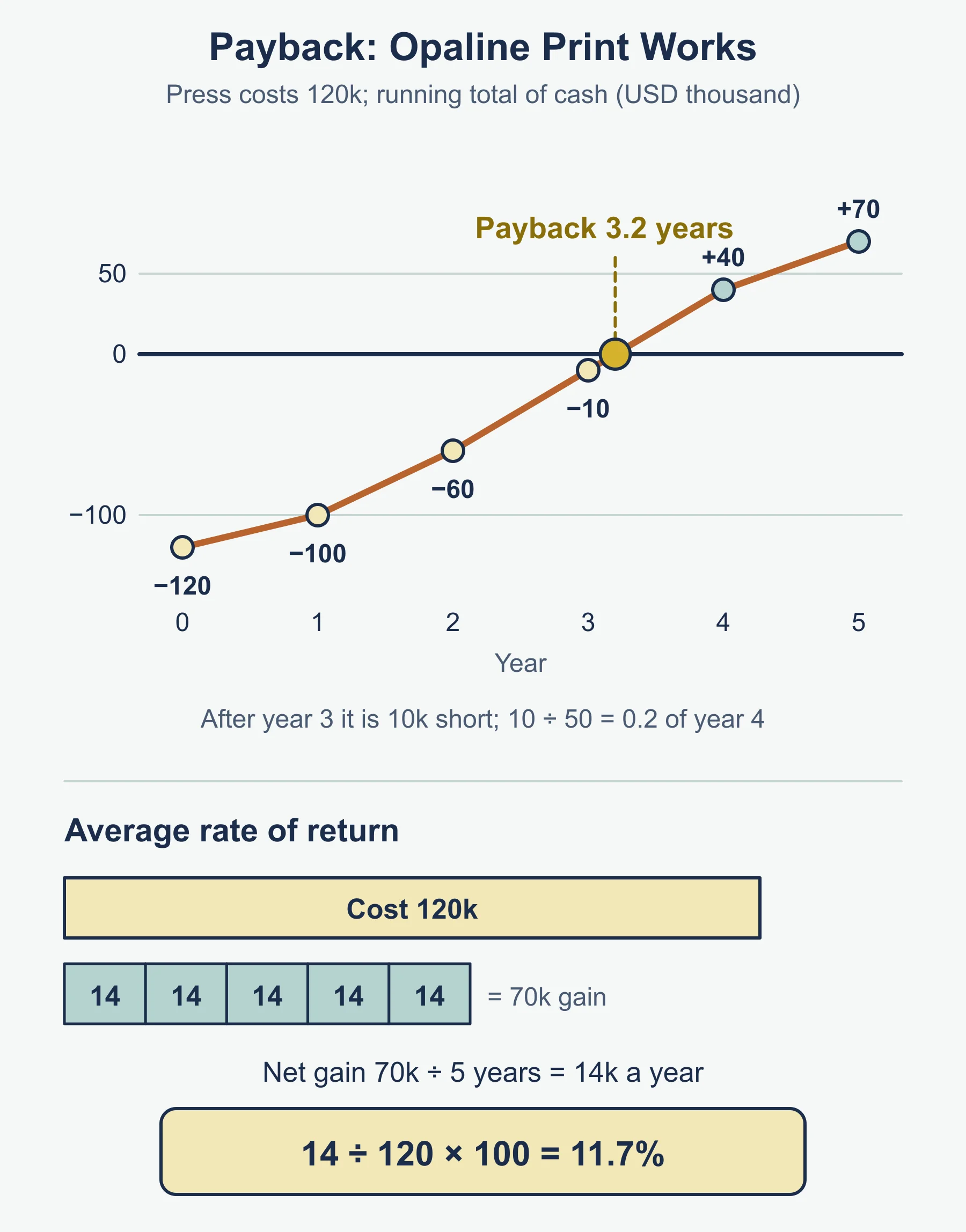
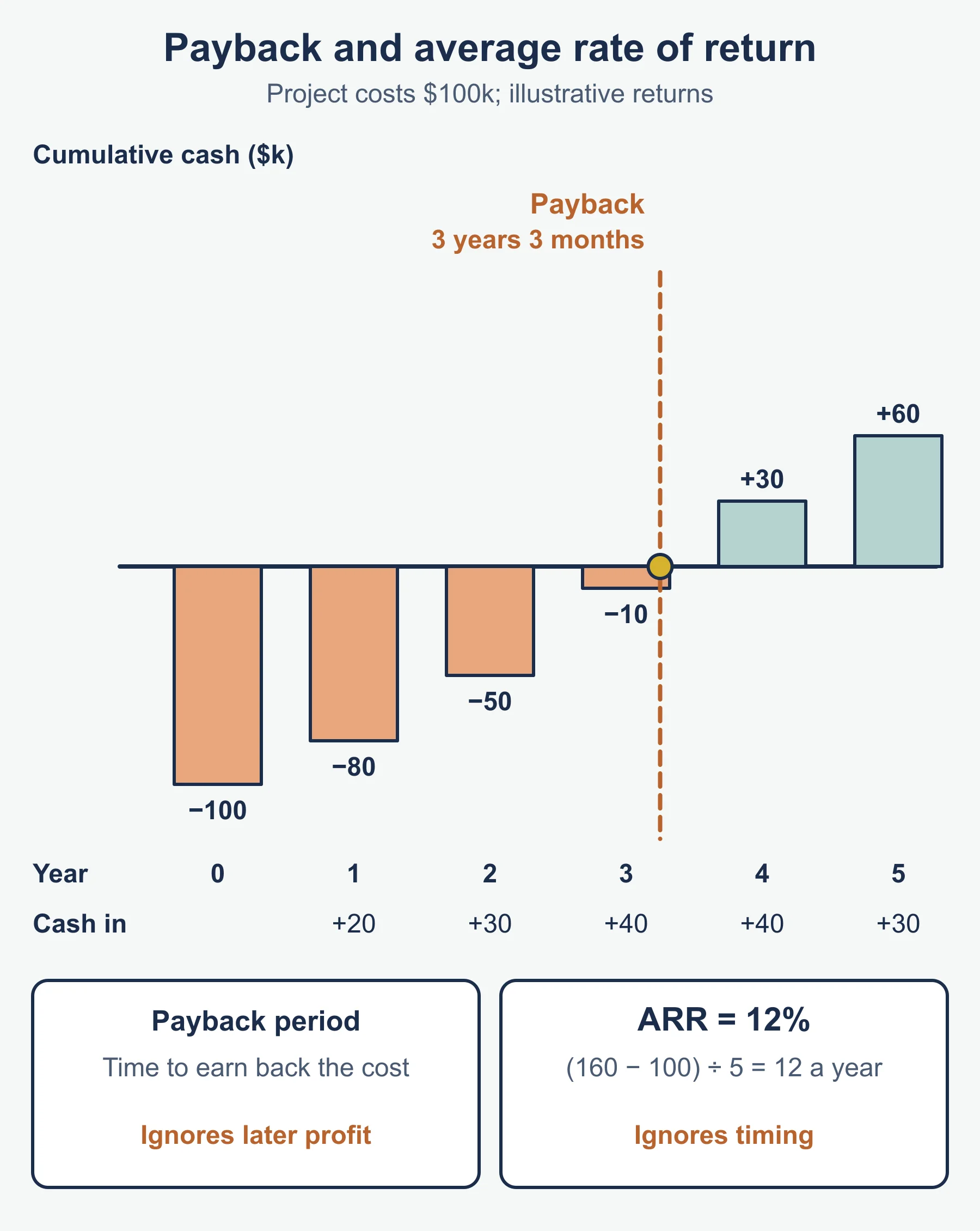
| Payback period | The time taken for returns to repay the capital cost |
| Average rate of return (ARR) | The average yearly gain after recovering the capital cost, as a percentage of the capital cost |
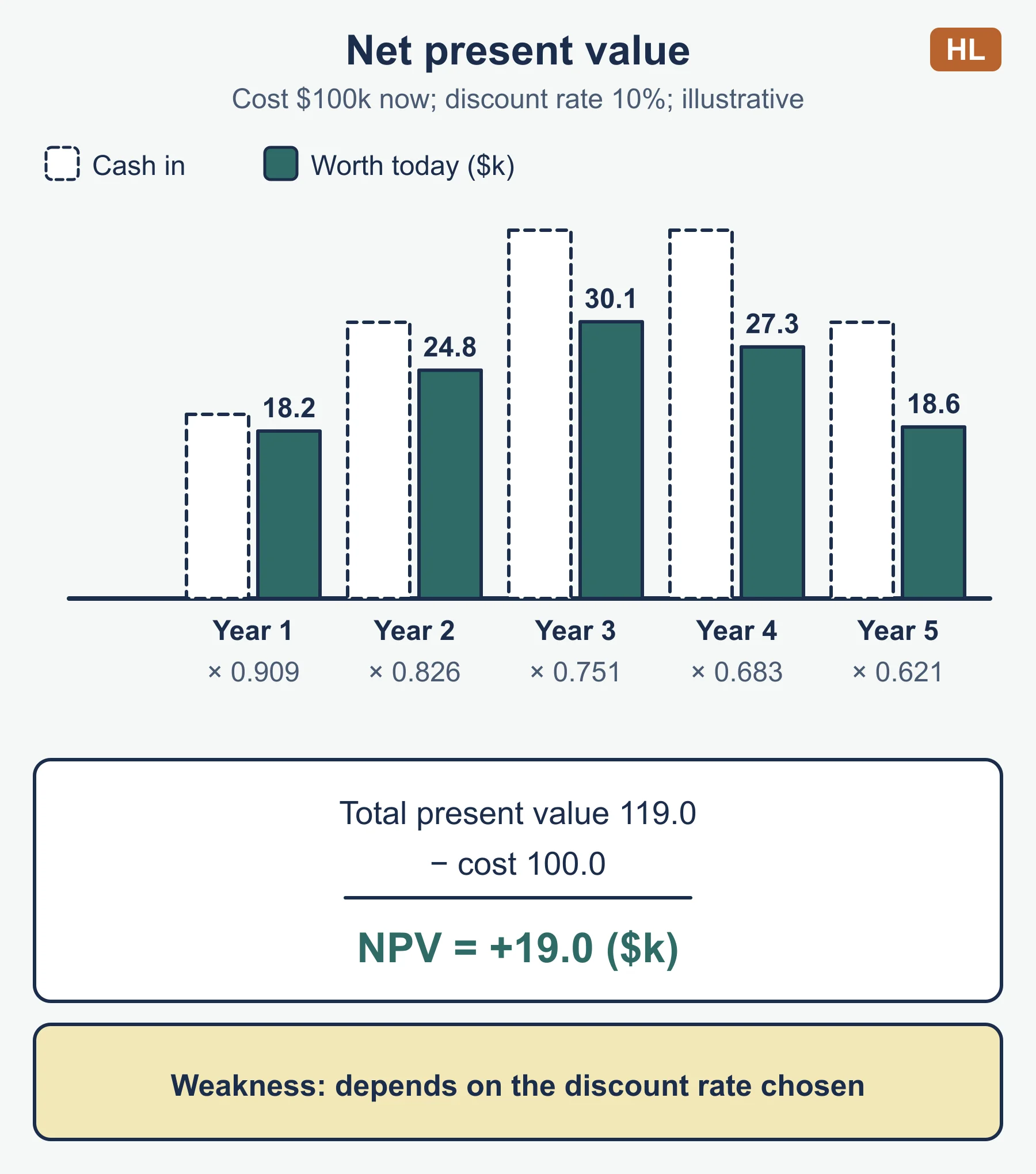
| Net present value (NPV), HL only | The total of the present values of the returns, minus the original cost |
| Discount rate, HL only | The rate used to convert future returns into present values |
| Discount factor, HL only | The number by which a future return is multiplied to give its present value |
Formulae
| Method | Formula | Source |
|---|---|---|
| Payback (even returns) | capital cost ÷ annual net return | Standard form (the guide does not print one) |
| Payback (uneven returns) | years until cumulative returns reach the cost, plus the fraction of the final year needed | Standard form |
| ARR | [(total returns − capital cost) ÷ years of use] ÷ capital cost × 100 | Printed in the guide |
| NPV (HL only) | Σ present values of return − original cost | Printed in the guide |
| Present value (HL only) | return × discount factor | Standard form |
The guide says a copy of its formulae will be provided for the examination, and that HL candidates are given a discount table in the paper when required. The table covers 4%, 6%, 8%, 10% and 20% for years 1 to 10.
Method in steps
Payback with uneven returns
- Write the cumulative returns year by year.
- Find the year in which the running total passes the capital cost.
- Fraction = amount still needed at the start of that year ÷ that year’s return.
- Payback = completed years + fraction. Convert to months if asked (fraction × 12).
ARR
- Total returns − capital cost = total net gain.
- Total net gain ÷ years of use = average annual gain.
- Average annual gain ÷ capital cost × 100.
NPV (HL only)
- Pick the factor for each year at the stated rate from the table.
- Return × factor = present value, year by year.
- Add the present values.
- Subtract the original cost.
Worked reminder
Polbrook Cycles is considering a workshop extension costing 90,000 (dollars). Forecast net returns: year 1, 25,000; year 2, 35,000; year 3, 45,000; year 4, 30,000.
Payback: cumulative returns are 25,000, 60,000 and 105,000. After two years 30,000 is still needed, and year 3 brings 45,000. Fraction = 30,000 ÷ 45,000 = 0.667. Payback = 2.7 years (2 years 8 months).
ARR: total returns = 135,000. Net gain = 135,000 − 90,000 = 45,000. Per year = 45,000 ÷ 4 = 11,250. ARR = 11,250 ÷ 90,000 × 100 = 12.5%.
NPV at 6% (HL only): factors 0.9434, 0.8900, 0.8396, 0.7921. Present values: 23,585; 31,150; 37,782; 23,763. Total = 116,280. NPV = 116,280 − 90,000 = 26,280.
NPV at 10% (HL only): factors 0.9091, 0.8264, 0.7513, 0.6830. Present values: 22,727.5; 28,924; 33,808.5; 20,490. Total = 105,950. NPV = 15,950. The NPV falls as the discount rate rises, but stays positive here.
Must-know distinctions
| Payback | ARR | NPV (HL only) | |
|---|---|---|---|
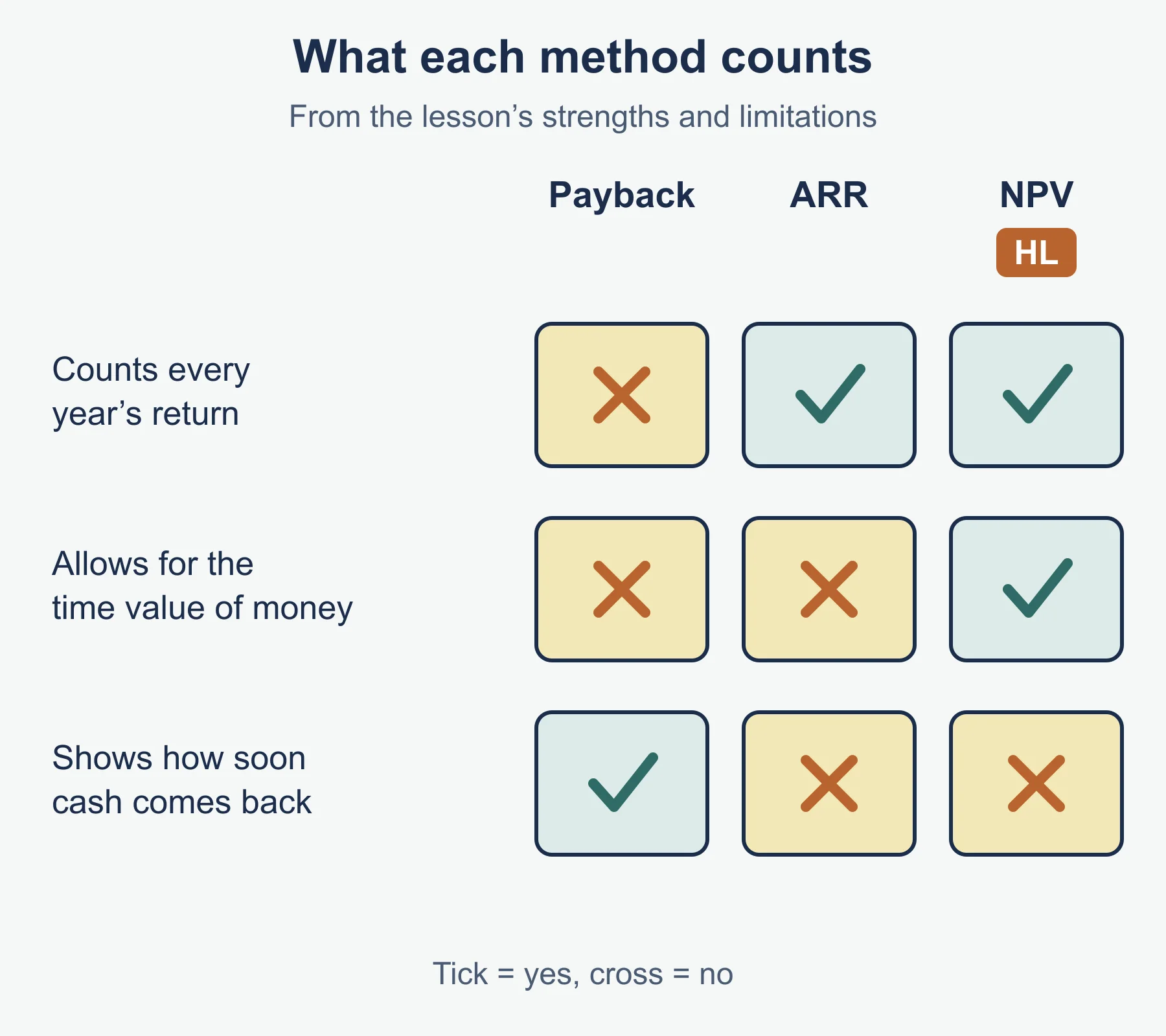
| Measured in | Time | Percentage | Money |
| Uses whole project life | No | Yes | Yes |
| Considers timing of returns | Only crudely (when cost is recovered) | No | Yes |
| Time value of money | Ignored | Ignored | Included |
| Main use | Speed of recovery, liquidity, risk | Comparing average profitability with a target | Judging overall value in today’s terms |
| Key weakness | Ignores returns after payback | Ignores when returns arrive | Depends on the chosen discount rate and on forecasts |
Other contrasts to remember:
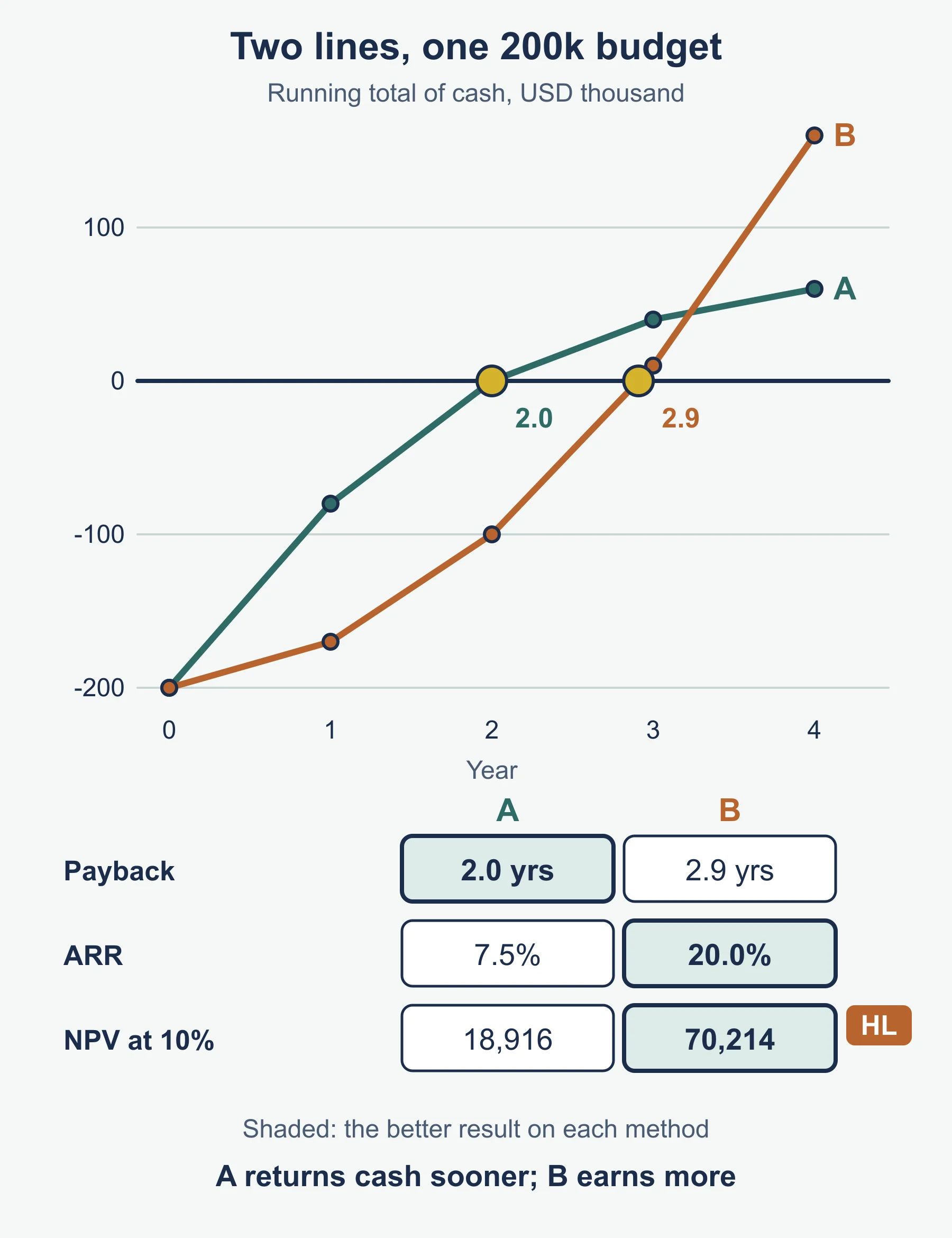
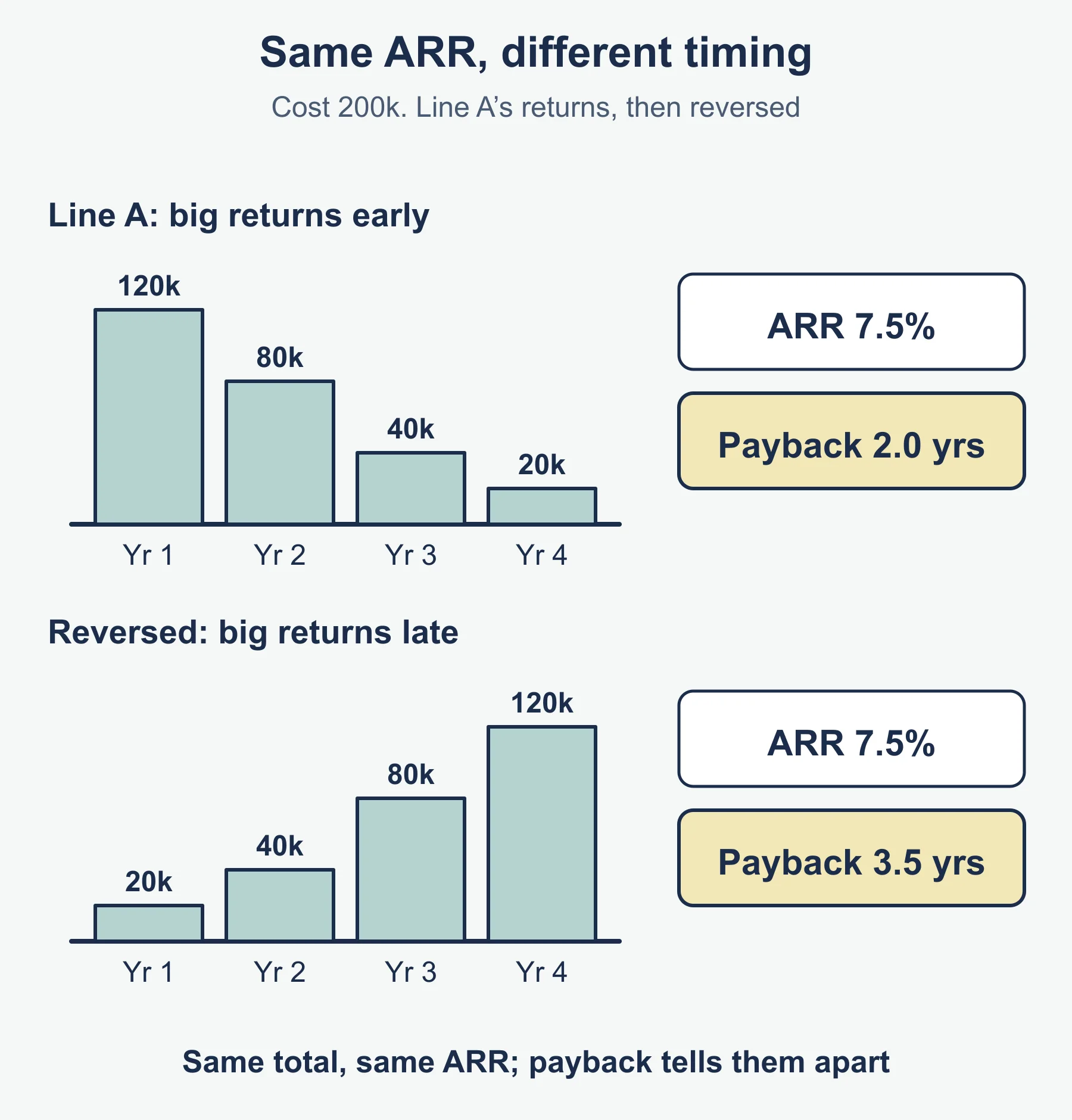
- A short payback does not mean a high ARR or a high NPV, and the reverse.
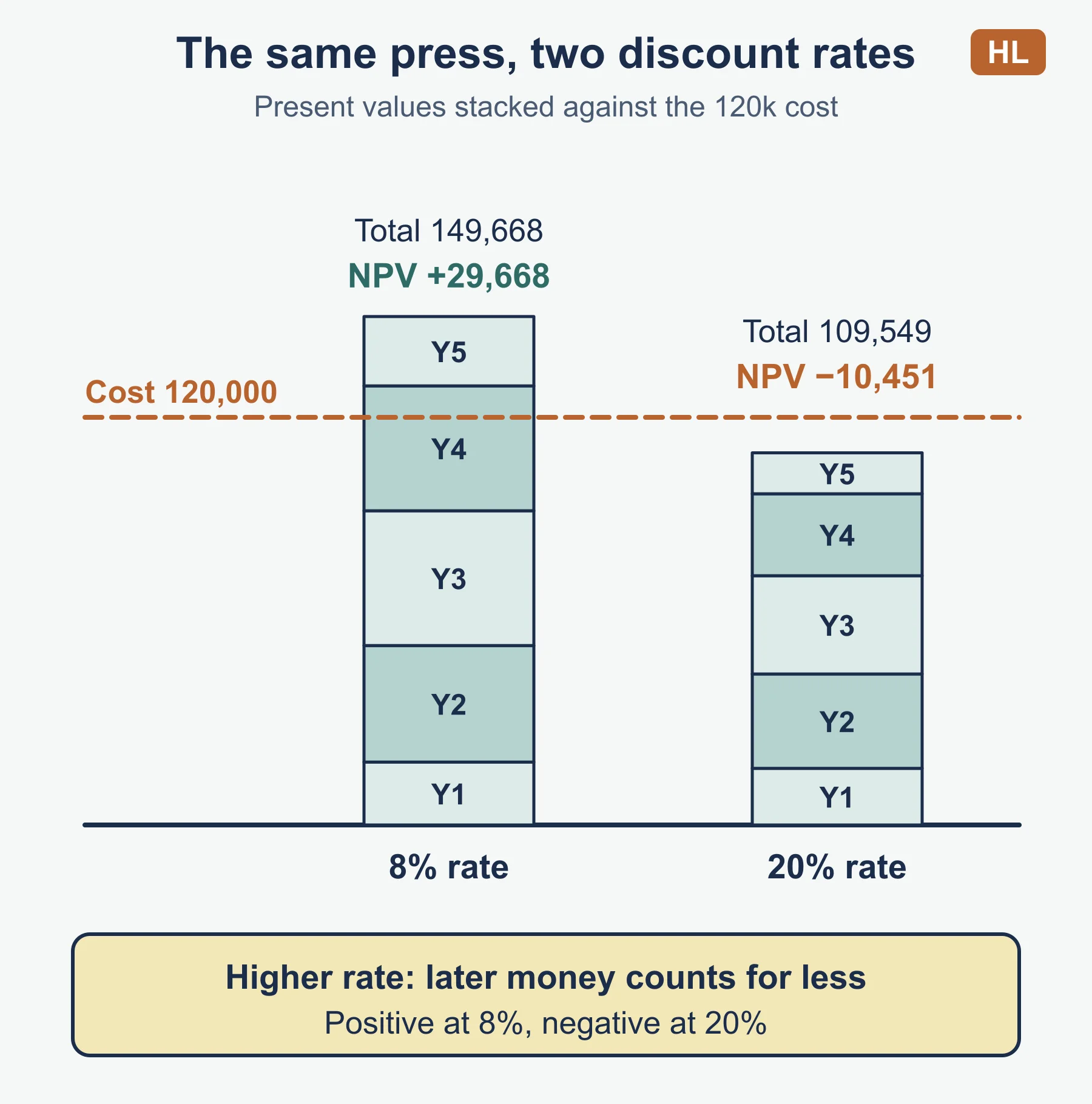
- A project can have a positive ARR but a negative NPV if the discount rate is high enough.
- Higher discount rates reduce present values, so NPV falls.
Evaluating an appraisal
Quantitative results are one input. Strong answers also weigh:
- Reliability of forecasts and the risk that returns do not arrive.
- Liquidity and how the project would be financed.
- Fit with objectives and strategy.
- Effects on stakeholders, including ethical and environmental effects.
- Whether the business has a benchmark such as a target payback or a cost of borrowing.
Structure for a recommendation: state the result, interpret it for this business, give the limitation that matters most, give a counter-point, then reach a judgement.
Quick self-test
- A business buys equipment for 84,000 and expects net returns of 12,000 each year. Calculate the payback period.
- A project costs 50,000 and returns 10,000 in year 1, 20,000 in year 2 and 30,000 in year 3. Calculate the payback period in years to two decimal places.
- A machine costs 80,000 and brings total returns of 104,000 over four years. Calculate the ARR.
- A shop refit costs 200,000 and brings 50,000 each year for six years. Calculate the ARR to two decimal places.
- State one limitation of ARR.
- (HL only) Using the 10% factor of 0.7513 for year 3, find the present value of a return of 40,000 received in year 3.
- (HL only) A project costs 30,000 and returns 12,000 in year 1 and 18,000 in year 2. At 4%, the factors are 0.9615 and 0.9246. Calculate the NPV.
- (HL only) Explain why the NPV of a project falls if the discount rate rises.
- Project X has a payback of 2 years and an ARR of 6%. Project Y has a payback of 3 years and an ARR of 14%. State which project each method favors.
- Identify two non-financial factors a business might consider before investing.
- (HL only) A project has an NPV of +5,000 at 8% and −2,000 at 10%. Explain what this suggests about the project.
Answers
- 84,000 ÷ 12,000 = 7 years.
- Cumulative: 10,000; 30,000; 60,000. After two years 20,000 is still needed. 20,000 ÷ 30,000 = 0.67. Payback = 2.67 years.
- (104,000 − 80,000) ÷ 4 = 6,000. 6,000 ÷ 80,000 × 100 = 7.5%.
- Total returns = 300,000. (300,000 − 200,000) ÷ 6 = 16,666.67. 16,666.67 ÷ 200,000 × 100 = 8.33%.
- It ignores the timing of returns (or the time value of money), so a project paying late can look as good as one paying early. Forecasts across the whole life may also be unreliable.
- 40,000 × 0.7513 = 30,052.
- Present values: 12,000 × 0.9615 = 11,538; 18,000 × 0.9246 = 16,642.8. Total = 28,180.8. NPV = 28,180.8 − 30,000 = −1,819.2 (a negative NPV).
- A higher rate gives smaller discount factors, so each future return has a smaller present value. The total falls while the original cost stays the same, so NPV falls.
- Payback favors X (shorter). ARR favors Y (higher).
- Any two, for example: effect on employees, environmental impact, fit with the business’s objectives, effect on reputation, ethical concerns.
- The project earns more than the required return at 8% but fails to at 10%, so the decision is sensitive to the rate. The business should check which rate best reflects its cost of finance and how reliable its forecasts are.
Command words in this topic
- Calculate: work out a number, showing each step, with units.
- Define or state: give a precise meaning or a short fact.
- Explain: give a reason or consequence, not only a name.
- Analyse: break the issue into parts and link each to the business in the case.
- Evaluate: weigh strengths against limitations, using the data, and reach a supported conclusion.
- Justify or recommend: choose an option and support the choice with reasons from the case, while acknowledging what could change it.
For a decision question, a useful habit is to write the numbers first, then one line on what each number tells you, then the judgement. This keeps the calculation and the evaluation connected.
Where marks are usually lost
- Stopping at the cumulative table without turning the final fraction into years or months.
- Using the wrong discount factor, for example the year 2 factor for a year 1 return.
- Reporting total present value as the NPV and forgetting to deduct the original cost.
- Dividing ARR by total returns instead of by the capital cost.
- Quoting a limitation (such as ignoring the time value of money) that does not apply to the method in question.
- Writing a recommendation based on one number with no counter-argument.
- Giving general advantages and disadvantages without using the figures or facts in the case.
- Leaving out units: years, months, percentage or dollars.
Frequently asked questions
How do you calculate payback with uneven returns? Write the cumulative returns year by year, find the year in which the running total passes the capital cost, then divide the amount still needed at the start of that year by that year’s return. Add this fraction to the completed years, and multiply the fraction by 12 if months are asked for.
How do you calculate the average rate of return (ARR)? Subtract the capital cost from total returns, divide by the years of use to get the average annual gain, then divide by the capital cost and multiply by 100.
Why does NPV fall when the discount rate rises? A higher rate gives smaller discount factors, so each future return has a smaller present value. The total present value falls while the original cost stays the same, so NPV falls.
Can different appraisal methods rank projects differently? Yes. A short payback does not guarantee a high ARR or a high NPV, and a project can have a positive ARR but a negative NPV if the discount rate is high enough.
Official syllabus
Source: Business management guide, first assessment 2024, International Baccalaureate Organization. Section 3.8, Investment appraisal; formulae and discount table as printed in the guide.
Get free revision emails (optional)
Occasional emails with practice questions, worked explanations and links to free resources for the qualification and subjects you choose. No spam, and you can unsubscribe from any email. The free tools on this site never need an email.
Related resources
-
Study guides
IB DP Business Management: Profitability and liquidity ratio analysis and Efficiency ratio analysis (HL only)
IB DP Business Management study guide to profitability, liquidity and HL efficiency ratios, with worked examples, strategies and insolvency.
Business · International Baccalaureate · IB
Read guide -
Practice questions
IB DP Business Management: Profitability, liquidity and efficiency ratios (HL only) – Practice Questions
Original IB DP Business Management practice questions with worked answers on profitability, liquidity and HL efficiency ratios, strategies and insolvency.
Business · International Baccalaureate · IB
Try questions -
Revision notes
IB DP Business Management: Profitability, liquidity and efficiency ratios (HL only) – Revision Notes
Condensed IB DP Business Management revision notes on ratio analysis: formulae, method steps, strategies, insolvency and a self-test for 3.5 and 3.6.
Business · International Baccalaureate · IB
Revise topic
Related articles
-
teaching
A Level tuition in Dubai: Cambridge or Pearson Edexcel International A Level?
Schools in Dubai and Abu Dhabi teach either Cambridge International AS & A Level or Pearson Edexcel International A Level. How the two are structured, why it matters for tuition, and how online classes from Lahore work.
9 October 2026
-
curriculum guides
Choosing subjects at IGCSE and A Level
How subject choices at 14 and 16 affect university options later, and how to keep pathways open without overloading a timetable.
28 July 2026
Studying this with a teacher
Working through Business IB?
This page is free and stays free. If you would rather be taught it, Marlbridge runs Business classes one-to-one, online in your own time zone. The first trial class is free. WhatsApp replies within an hour (8am–11pm Pakistan time, every day); email the same day.
IB Business teachers at Marlbridge

