
Study Guides
IB DP Business Management: Budgets (HL only)
Study guide to IB DP Business Management 3.9 (HL only): cost and profit centres, constructing a budget, variances and budgets in decision-making.
- Subject
- Business
- Level
- IB
- Topic
- Unit 3: Finance and accounts
- Author
- Marlbridge Academic Team
- Updated
- Reviewed by
- Salman Ahmad (what this means)
Aligned to International Baccalaureate IB Diploma Programme Business (DP Business Management), First assessment 2024. Official specification .
Syllabus page (what it covers and how it is assessed): IB Diploma Programme Business.
Syllabus points this page covers
DP Business Management
- 3.9 Budgets (HL only)
Found an error? Report a correction.
Need help with this topic? Request a free trial class for IB Diploma Programme Business (DP Business Management).
This guide covers section 3.9, Budgets, in Unit 3 (Finance and accounts) of the IB Business management guide, first assessment 2024. The whole section is HL only, so SL candidates do not need it.
Use it with the revision notes and the practice questions. The course hub is IB DP Business Management, the printable list is the syllabus checklist, and the free diagnostics show where to start. Earlier Unit 3 pages that help: the Unit 3 overview, costs and revenues and final accounts. A shorter Unit 3 revision summary and a Unit 3 practice set also exist.
What 3.9 asks you to know
| Content point in the guide | Depth of teaching in the guide | Where this guide covers it |
|---|---|---|
| The difference between cost and profit centres | AO2 | Cost and profit centres |
| The roles of cost and profit centres | AO2 | Roles of the two types of centre |
| Constructing a budget | AO2, AO4 | Constructing a budget |
| Variances | AO2, AO4 | Variances |
| The importance of budgets and variances in decision-making | AO2 | Budgets and decision-making |
The guide’s appendix says that where budgets appear in case studies or examination questions they will follow the layout in its figure 11, “Budget: Profit and non-profit entity”. Look at that figure in your copy of the guide so the layout is familiar. The figure covers non-profit entities too, so budgeting is not only for businesses that aim to make a profit.
Cost and profit centres
A large organization is split into parts, and each part can be given its own financial target. The guide asks you to know how the two main kinds of part differ.
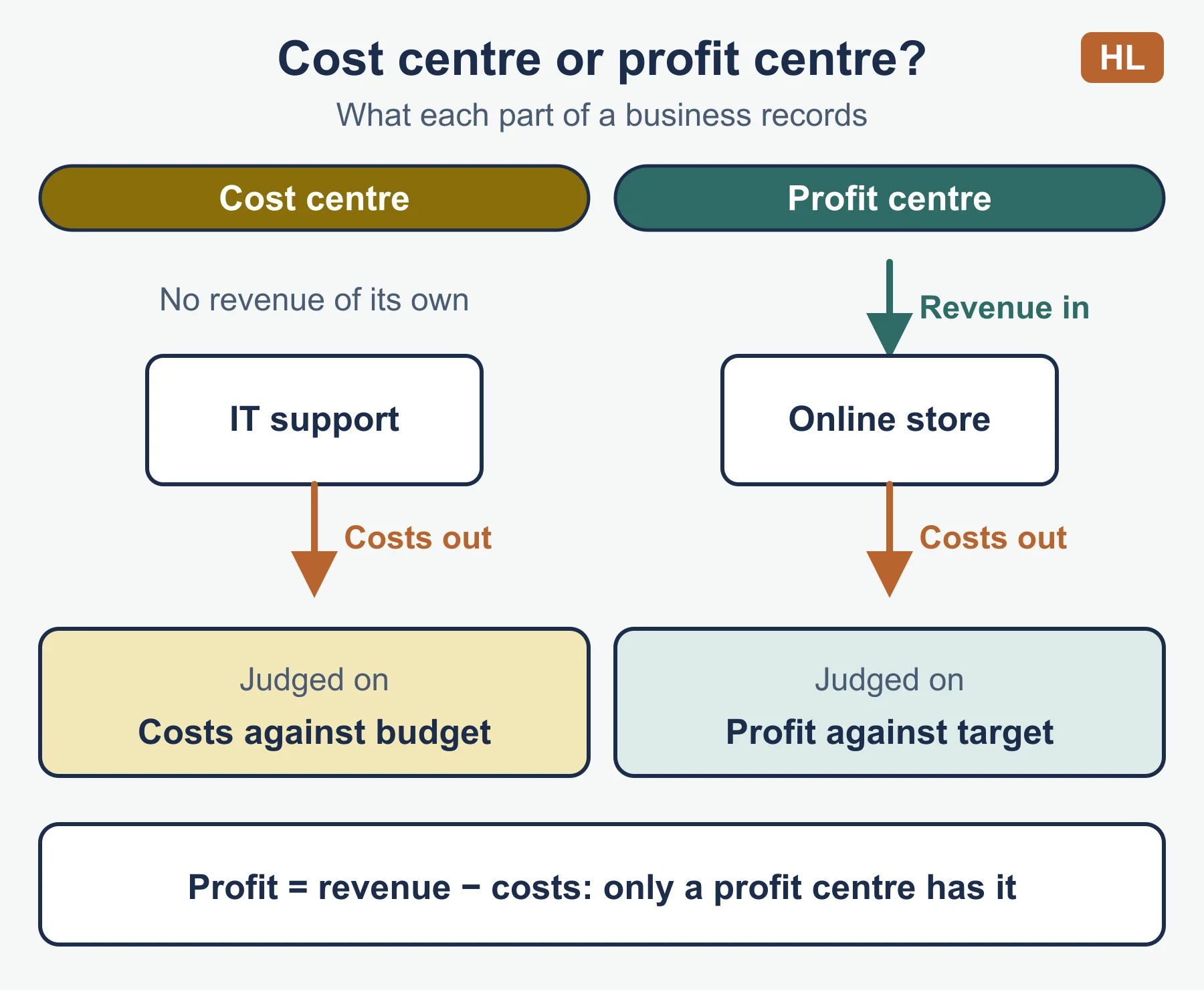
A cost centre is a part of a business, such as a department, a site or a product line, to which costs can be identified and charged, but which does not earn revenue of its own. A profit centre is a part of a business to which both costs and revenue can be identified, so its profit can be measured. These are the standard working definitions. Check them against your teacher’s wording, as the guide itself lists the terms without defining them in the content table.
| Feature | Cost centre | Profit centre |
|---|---|---|
| Costs recorded | Yes | Yes |
| Revenue recorded | No | Yes |
| What is measured | Spending against a budget | Revenue, costs and profit |
| Typical examples | Human resources, IT support, finance, maintenance | A retail shop, an online store, a hotel restaurant |
| Manager is judged on | Keeping costs within budget | Meeting profit targets |
Roles of the two types of centre
Cost centres have these roles:
- They collect the costs of a support activity in one place, so managers can see what the activity costs.
- They give a manager a spending limit and make that manager answerable for staying within it.
- They allow comparison of cost between periods or between similar departments.
Profit centres have these roles:
- They let the organization judge how much each part earns, not only how much it spends.
- They give managers responsibility for revenue as well as cost, which encourages decisions about price, quality and promotion.
- They help owners decide where to invest more and which parts to review or close.
- They can motivate managers, who see results they can influence.
A weakness of profit centres is that managers may chase their own profit at the expense of the whole business. A weakness of cost centres is that cutting cost to meet a budget can lower service quality for everyone who relies on the centre.
Constructing a budget
A budget is a financial plan, in money terms, for a future period. A budget is built from forecasts of revenue and costs. The guide asks you to construct one, so you need a method and a layout.
Method in steps
- State the period and divide it, usually into months.
- Forecast sales volume and price for each month, then calculate sales revenue.
- Work out each cost. Variable costs rise with output, so multiply the cost per unit by the units. Fixed costs stay the same over the period unless the question says otherwise.
- Subtract cost of sales from sales revenue to give gross profit, subtract the other expenses, and finish with profit or loss.
- Total each row across the period, and check each total two ways.
Every figure in a budget rests on an assumption. Is the sales forecast realistic? Will supplier prices hold? The guide’s theory of knowledge prompt asks what assumptions underlie the techniques used when budgeting, so state yours.
Worked example: a budget for a profit centre
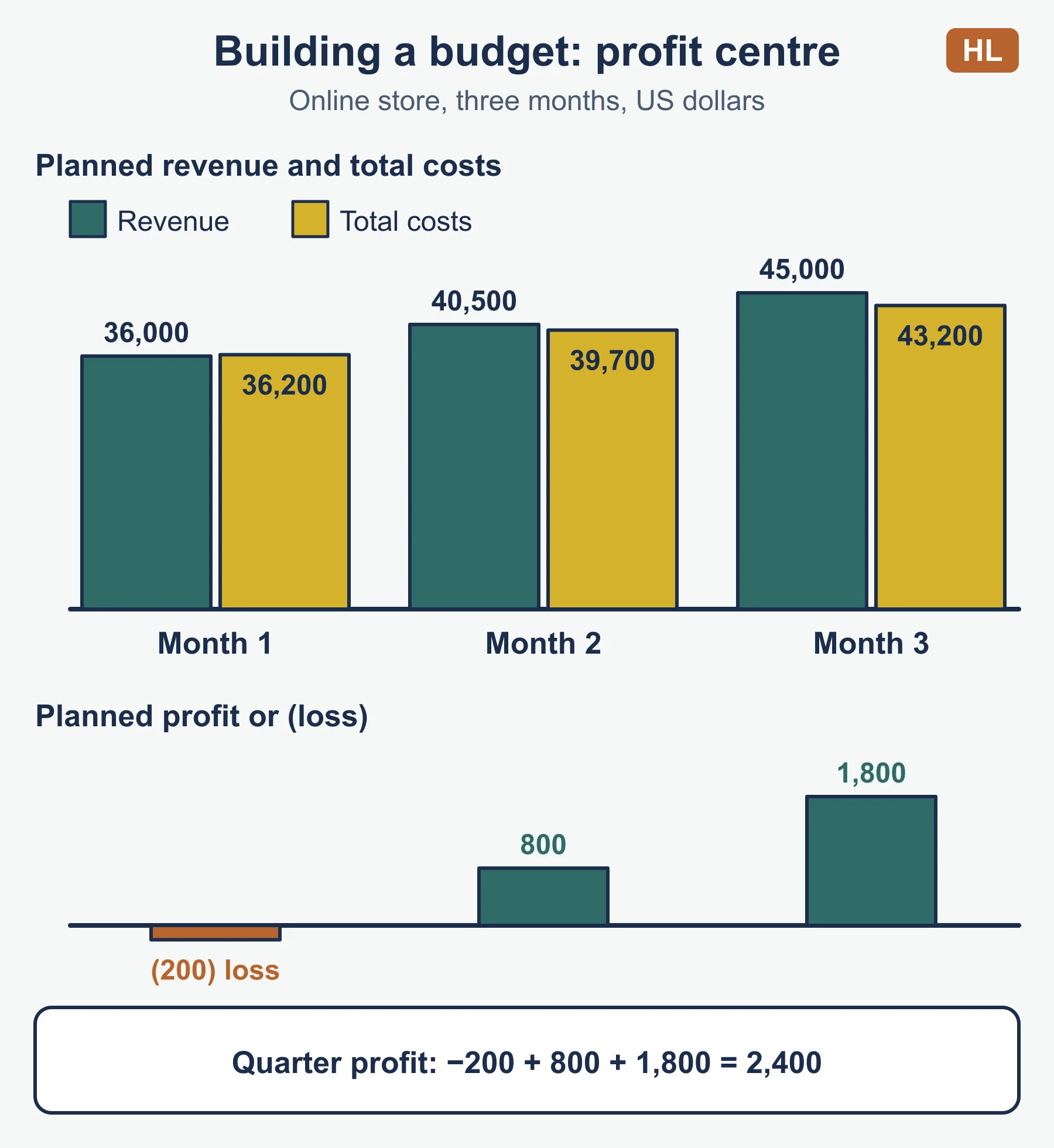
Ruddock Outdoor Supplies has an online store that it treats as a profit centre. The manager plans to sell 800 units in the first month, 900 in the second and 1,000 in the third, at a price of 45 dollars per unit. Cost of sales is 27 dollars per unit. Delivery costs 3 dollars per unit. Website hosting is 1,200 dollars a month, salaries are 9,000 dollars a month, and advertising is planned at 2,000, 2,500 and 3,000 dollars for the three months.
| US dollars | Month 1 | Month 2 | Month 3 | Quarter |
|---|---|---|---|---|
| Sales revenue | 36,000 | 40,500 | 45,000 | 121,500 |
| Cost of sales | 21,600 | 24,300 | 27,000 | 72,900 |
| Gross profit | 14,400 | 16,200 | 18,000 | 48,600 |
| Delivery | 2,400 | 2,700 | 3,000 | 8,100 |
| Hosting | 1,200 | 1,200 | 1,200 | 3,600 |
| Salaries | 9,000 | 9,000 | 9,000 | 27,000 |
| Advertising | 2,000 | 2,500 | 3,000 | 7,500 |
| Total expenses | 14,600 | 15,400 | 16,200 | 46,200 |
| Profit or (loss) | (200) | 800 | 1,800 | 2,400 |
Check: month 1 sales revenue is 800 × 45 = 36,000, and cost of sales is 800 × 27 = 21,600, so gross profit is 14,400. Expenses are 2,400 + 1,200 + 9,000 + 2,000 = 14,600, which leaves a loss of 200. The planned quarter profit is 2,400.
A budget for a cost centre has no revenue row. It is a list of costs by month with a total, which becomes the spending limit.
Variances
A variance is the difference between a budgeted figure and the actual figure for the same item and period. This section is the one most likely to involve calculation.
Standard form (the guide does not print a variance formula in its formulae list):
- Variance = actual − budgeted figure
- Variance as a percentage of budget = (variance ÷ budgeted figure) × 100
A variance is favorable if it increases profit compared with the budget, and adverse if it reduces profit. The direction depends on the type of item:
| Item | Actual above budget | Actual below budget |
|---|---|---|
| Revenue or profit | Favorable | Adverse |
| Cost or expense | Adverse | Favorable |
So a positive number is not always good. A cost variance of +800 is adverse, whereas a revenue variance of +800 is favorable. Always write the letter F or A, or the word, beside the figure.
Worked example: variance analysis for the online store
At the end of the quarter, Ruddock’s actual results are 2,820 units sold at an average price of 44 dollars, giving sales revenue of 124,080. Cost of sales was 78,000, delivery 8,900, hosting 3,600, salaries 27,900 and advertising 8,200.
| US dollars | Budget | Actual | Variance | Variance % | F or A |
|---|---|---|---|---|---|
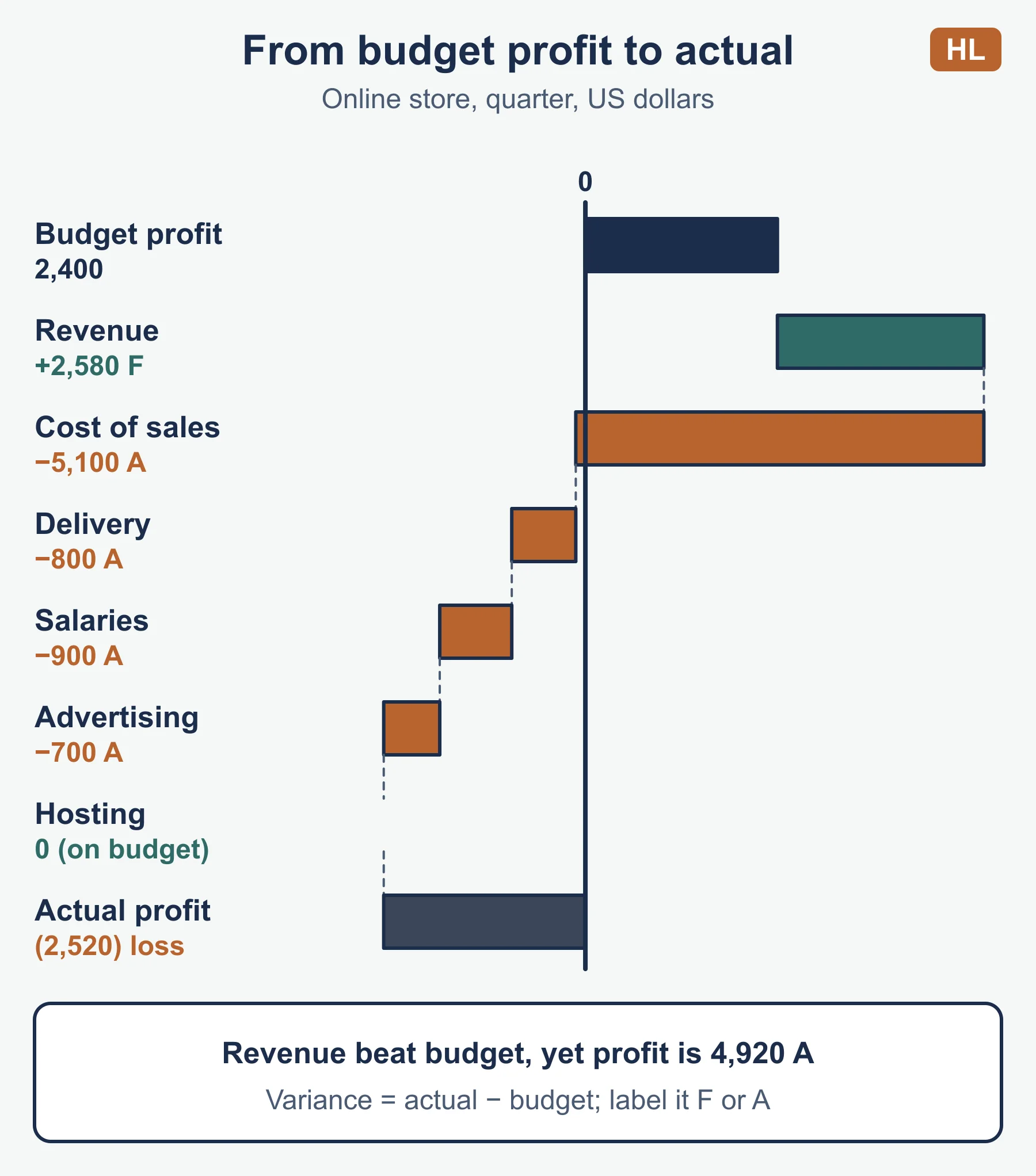
| Sales revenue | 121,500 | 124,080 | +2,580 | +2.1 | F |
| Cost of sales | 72,900 | 78,000 | +5,100 | +7.0 | A |
| Gross profit | 48,600 | 46,080 | −2,520 | −5.2 | A |
| Delivery | 8,100 | 8,900 | +800 | +9.9 | A |
| Hosting | 3,600 | 3,600 | 0 | 0.0 | none |
| Salaries | 27,000 | 27,900 | +900 | +3.3 | A |
| Advertising | 7,500 | 8,200 | +700 | +9.3 | A |
| Total expenses | 46,200 | 48,600 | +2,400 | +5.2 | A |
| Profit or (loss) | 2,400 | (2,520) | −4,920 | −205.0 | A |
The favorable revenue variance hides a large problem. Sales volume beat the budget by 120 units (4.4%), but the average price was a dollar lower than planned. The profit moved from a planned gain of 2,400 to a loss of 2,520, so it is 4,920 adverse.
A deeper reading is possible. If the store had sold 2,820 units at the planned 27 dollars of cost each, cost of sales would have been 76,140. The actual cost of 78,000 is still 1,860 above that figure. This adjustment is our own analytical step, not a named technique in the guide. It shows that part of the adverse cost variance came from higher volume and part from higher cost per unit.
Possible causes
Do not stop at calculating the variance. Give a reason that fits the case, such as:
- Revenue: price discounts, a competitor’s promotion, a change in demand, or a poor forecast.
- Cost of sales: supplier price rises, waste, a weaker exchange rate for imports, or buying smaller batches.
- Labour: overtime, extra staff, or a pay rise.
- Advertising: a late decision to promote harder.
Link the cause to the data. In the example, a lower price plus extra advertising together suggest a sales push that increased volume but damaged profit.
Worked example: a cost centre
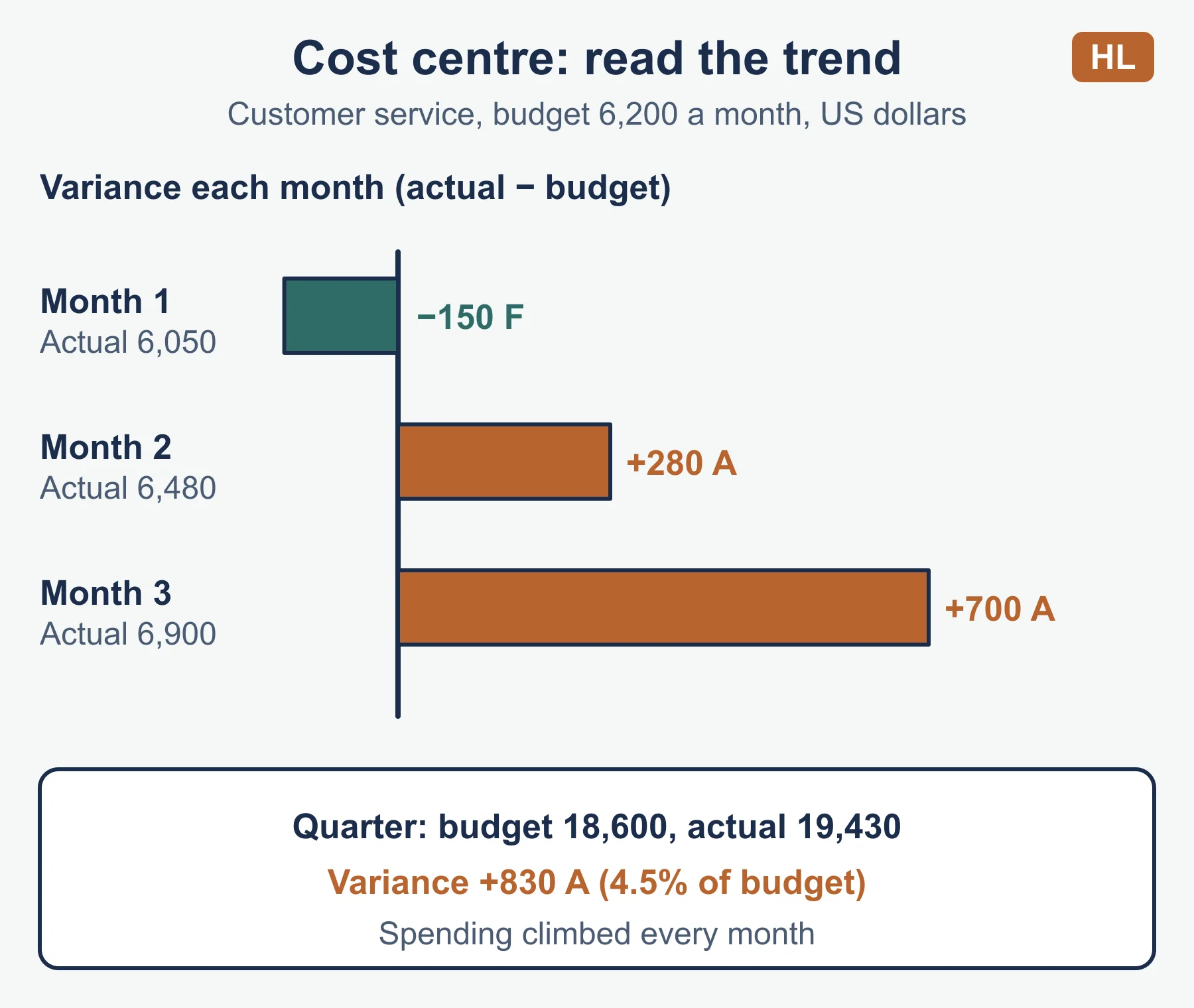
The customer service team at Ruddock is a cost centre with a budget of 6,200 dollars each month. Actual spending was 6,050, 6,480 and 6,900. The monthly variances are −150 (favorable), +280 (adverse) and +700 (adverse). Over the quarter the budget is 18,600 and the actual is 19,430, so the variance is +830 adverse, or 4.5% of budget. The trend matters as well as the total. Spending climbed each month, so a manager reading only the quarter total would miss the worsening position.
Budgets and decision-making
The guide asks for the importance of budgets and variances in decision-making. Organize your answer around what a budget does and what variances tell managers.
How budgets help:
- Planning: they turn the objectives into figures for a period.
- Coordination: sales, production and purchasing plans must fit together.
- Resource allocation: limited funds are shared between centres.
- Control: managers know their spending limit.
- Responsibility: each centre manager answers for a defined set of figures.
- Motivation and appraisal: a target can encourage effort, and results can be compared with the plan.
How variances help: they show where results differ from plan, so managers can focus attention on significant gaps rather than checking every item. They prompt questions, and the answers lead to action: change a price, switch a supplier, redirect advertising, revise the next budget, or reward a team. Reviewing variances also improves later forecasts.
Limits to weigh:
- A budget is only as good as its assumptions and forecasts. In a changing market the plan may be out of date within weeks.
- A rigid budget can discourage sensible spending that was not foreseen.
- Managers may pad costs or understate sales so that they meet their target easily.
- A variance shows what happened, not why. Someone has to investigate.
- A favorable cost variance may come from cutting quality or delaying maintenance, which could harm the business later.
- Too much focus on short-term variances can lead to short-term decisions.
For an “evaluate” or “justify” question, a good answer gives points on both sides, uses the case data, and ends with a reasoned judgment. A typical judgment is that budgets are valuable when assumptions are realistic, variances are investigated, and managers take part in setting the targets.
Common errors
- Treating a positive variance as favorable without checking whether the item is revenue or cost.
- Dividing by the actual figure when working out the percentage. The standard method divides by the budget.
- Leaving out the F or A label.
- Giving a cost centre a profit figure. It records costs only.
Frequently asked questions
Why are budgets important for decision-making? Budgets help with planning, coordination, resource allocation, control, responsibility and motivation. Variances show where results differ from plan, so managers can focus on significant gaps.
What are the limitations of budgets? A budget is only as good as its forecasts, a rigid budget can discourage sensible spending, managers may pad costs, and a variance shows what happened but not why.
Can a favorable cost variance be bad for a business? Yes. A favorable cost variance may come from cutting quality or delaying maintenance, which could harm the business later.
What are the roles of a profit centre? Profit centres let an organization judge how much each part earns, give managers responsibility for revenue as well as cost, help owners decide where to invest and can motivate managers. Managers may chase their own centre’s profit at the expense of the whole business.
Official syllabus
IB Diploma Programme Business management guide, first assessment 2024, published by the International Baccalaureate Organization. This page covers section 3.9, Budgets (HL only).
Get free revision emails (optional)
Occasional emails with practice questions, worked explanations and links to free resources for the qualification and subjects you choose. No spam, and you can unsubscribe from any email. The free tools on this site never need an email.
Related resources
-
Practice questions
IB DP Business Management: Budgets (HL only) – Practice Questions
Original practice questions with worked answers on IB DP Business Management 3.9 (HL only): centres, budgets, variances and decisions.
Business · International Baccalaureate · IB
Try questions -
Revision notes
IB DP Business Management: Budgets (HL only) – Revision Notes
Condensed revision notes for IB DP Business Management 3.9 (HL only): centres, budget layout, variance rules, F and A labels, and decisions.
Business · International Baccalaureate · IB
Revise topic -
Study guides
IB DP Business Management: Cash flow
Study guide to section 3.7 of IB DP Business Management: profit versus cash flow, working capital, liquidity, cash flow forecasts and strategies.
Business · International Baccalaureate · IB
Read guide
Related articles
-
teaching
A Level tuition in Dubai: Cambridge or Pearson Edexcel International A Level?
Schools in Dubai and Abu Dhabi teach either Cambridge International AS & A Level or Pearson Edexcel International A Level. How the two are structured, why it matters for tuition, and how online classes from Lahore work.
9 October 2026
-
curriculum guides
Choosing subjects at IGCSE and A Level
How subject choices at 14 and 16 affect university options later, and how to keep pathways open without overloading a timetable.
28 July 2026
Studying this with a teacher
Working through Business IB?
This page is free and stays free. If you would rather be taught it, Marlbridge runs Business classes one-to-one, online in your own time zone. The first trial class is free. WhatsApp replies within an hour (8am–11pm Pakistan time, every day); email the same day.
IB Business teachers at Marlbridge

