
Study Guides
IB DP Business Management: Final accounts
Study guide to section 3.4 of IB DP Business Management: purpose of accounts, profit and loss account, balance sheet, intangible assets, HL depreciation.
- Subject
- Business
- Level
- IB
- Topic
- Unit 3: Finance and accounts
- Author
- Marlbridge Academic Team
- Updated
- Reviewed by
- Salman Ahmad (what this means)
Aligned to International Baccalaureate IB Diploma Programme Business (DP Business Management), First assessment 2024. Official specification .
Syllabus page (what it covers and how it is assessed): IB Diploma Programme Business.
Syllabus points this page covers
DP Business Management
- 3.4 Final accounts
Found an error? Report a correction.
Need help with this topic? Request a free trial class for IB Diploma Programme Business (DP Business Management).
This guide covers section 3.4 (Final accounts) of Unit 3 in the IB Business management guide, first assessment 2024. Most of the section applies at both SL and HL. The two depreciation methods and the choice between them are marked “HL only” in the guide, and this page labels them the same way. Use it with the course hub, the printable checklist, the revision notes and the practice questions. For the wider unit, see the Unit 3 overview. To test yourself on Unit 3 as a whole, try the diagnostics.
What 3.4 asks you to do
| Content point in the guide | What you must be able to do | Level |
|---|---|---|
| The purpose of accounts to different stakeholders | Explain why each stakeholder group reads the accounts | SL and HL |
| Final accounts: profit and loss account, balance sheet | Describe both, and prepare or complete them from given data | SL and HL |
| Different types of intangible assets | Identify and explain intangible assets | SL and HL |
| Depreciation: straight line method, units of production method | Calculate depreciation by each method | HL only |
| Appropriateness of each depreciation method | Judge which method suits a given asset | HL only |
The guide gives these points a mix of AO2 and AO4 demands, and the appropriateness of depreciation methods an AO3 demand. The guide describes Paper 2 as based on unseen stimulus material with a quantitative focus, so expect to calculate as well as describe. The guide does not name the intangible assets you need, so the examples below are standard ones.
The purpose of accounts to different stakeholders
A business records its transactions and summarizes them into final accounts at the end of a trading period. The guide names two: the profit and loss account and the balance sheet. Different stakeholders read the same figures for different reasons. Link this to the stakeholders guide.
| Stakeholder | What they look for | Why |
|---|---|---|
| Owners and shareholders | Profit, retained profit, dividends, value of equity | Judge the return on their investment and whether to invest more or sell |
| Managers | Costs, profit, asset levels | Judge performance against targets and plan the next period |
| Employees and trade unions | Profit and the ability to pay | Judge job security and the scope for pay rises |
| Lenders such as banks | Existing loans, assets, profit | Judge whether the business can repay and what it could offer as security |
| Suppliers | Amounts owed, cash and short-term assets | Decide whether to offer credit |
| Government and tax authorities | Profit before tax | Work out the tax due |
| Potential investors and competitors | Profit and asset strength | Compare the business with alternatives |
| Local community | Profit, size, signs of growth or decline | Judge the business’s future as an employer |
Accounts show the past. A shareholder who wants to know whether next year looks good has to combine them with other information. Say this when you evaluate how useful accounts are.
The profit and loss account
The profit and loss account shows the profit or loss a business made over a period. It runs from sales revenue down to the profit left for the owners. The guide does not set out a layout, so the form below is the standard one.
Sales revenue
- Cost of sales   (opening inventory + purchases - closing inventory)
= Gross profit
- Expenses        (wages, rent, marketing, other overheads)
= Operating profit
- Interest paid
= Profit before tax
- Tax
= Profit after tax (net profit)
- Dividends
= Retained profit for the year
Inventory is also called stock. Retained profit is the part of profit kept in the business. It is also one of the internal sources of finance in 3.2.
Worked example: Fenrow Ceramics
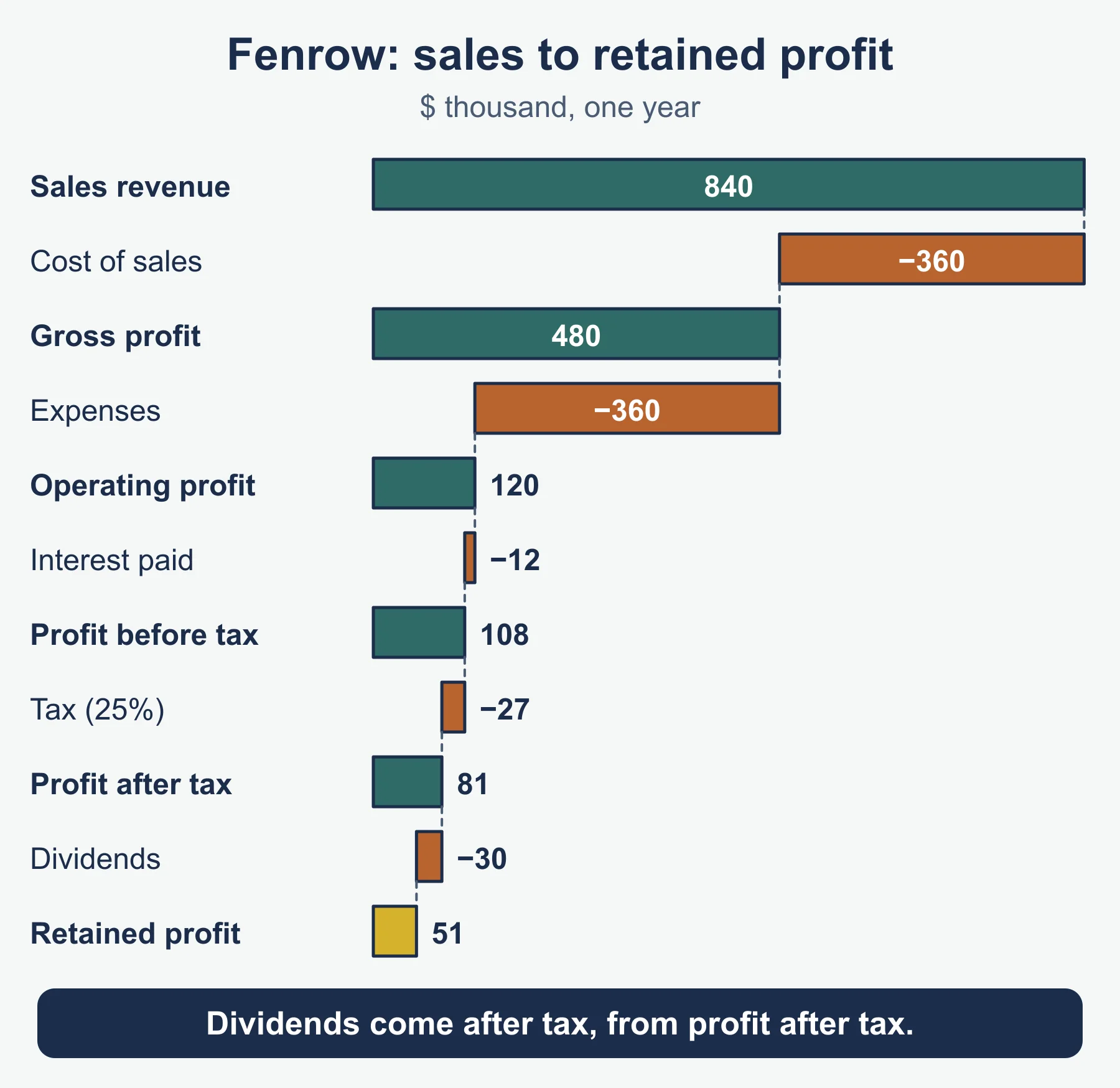
Fenrow Ceramics makes dinner sets. For its latest year, all figures are in thousands of dollars. Sales revenue was 840. Opening inventory was 60, purchases were 372 and closing inventory was 72. Wages were 190, rent and utilities 84, marketing 46 and other overheads 40. Interest paid was 12. Tax is charged at 25% of profit before tax. Dividends were 30.
| Line | Working | Amount |
|---|---|---|
| Cost of sales | 60 + 372 - 72 | 360 |
| Gross profit | 840 - 360 | 480 |
| Total expenses | 190 + 84 + 46 + 40 | 360 |
| Operating profit | 480 - 360 | 120 |
| Profit before tax | 120 - 12 | 108 |
| Tax | 25% of 108 | 27 |
| Profit after tax | 108 - 27 | 81 |
| Retained profit | 81 - 30 | 51 |
Unit check: all lines share the same unit. Write “thousand dollars” or state it in the heading. Dropping the unit costs the clarity that the command term calculate asks for (“obtain a numerical answer showing the relevant stages in the working”).
The balance sheet
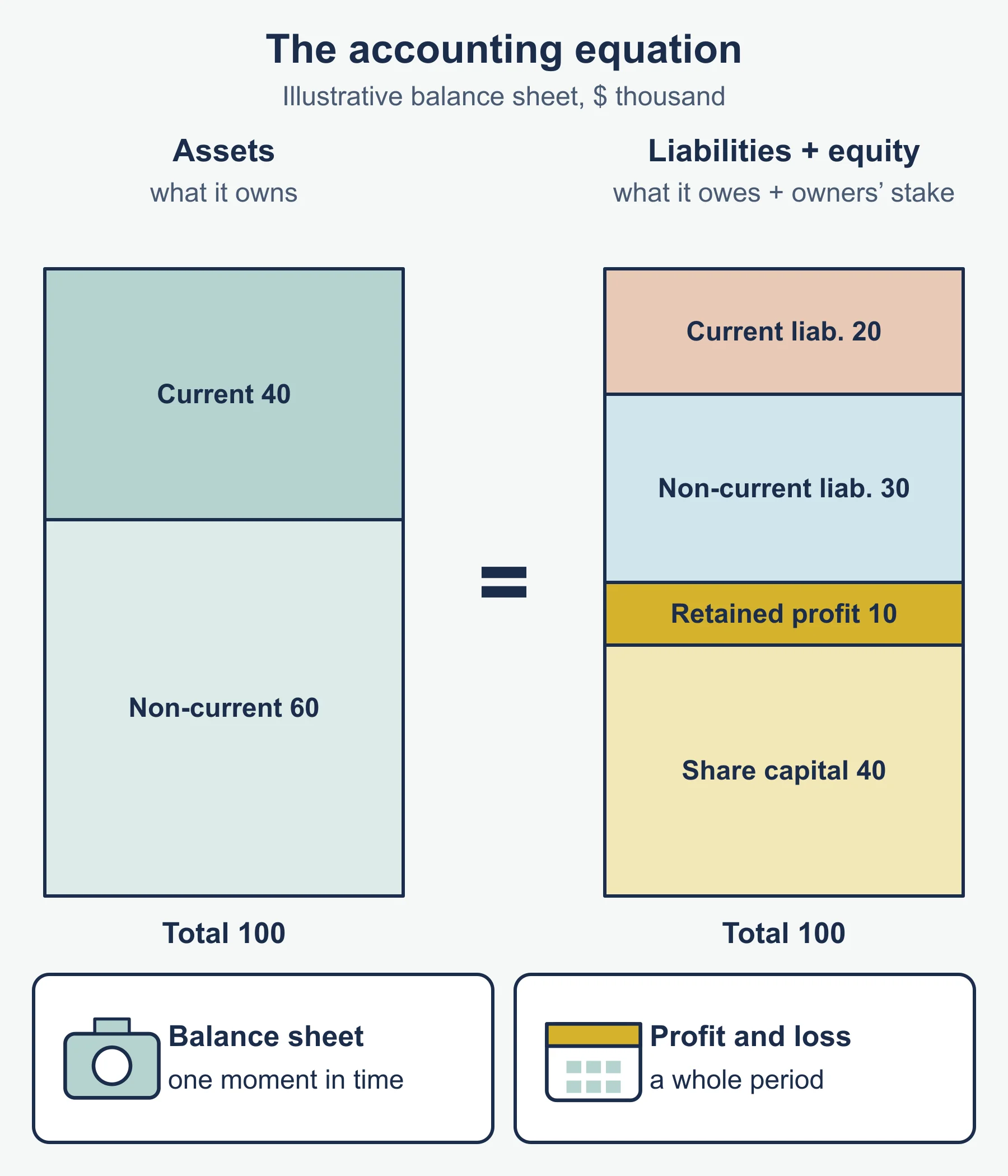
The balance sheet shows what a business owns, owes and is worth at a single point in time. It rests on the accounting equation:
assets = liabilities + equity
| Section | What it contains |
|---|---|
| Non-current assets | Items kept for more than a year: premises, equipment, vehicles, and intangible assets |
| Current assets | Items likely to become cash within a year: inventory, trade receivables (debtors), cash |
| Current liabilities | Debts due within a year: trade payables (creditors), overdraft, tax owed |
| Non-current liabilities | Debts due after more than a year: long-term bank loans |
| Equity | Share capital and retained profit built up over the years |
Two figures follow from the layout. Working capital is current assets minus current liabilities. Net assets are total assets minus total liabilities, and they equal equity.
Worked example: Fenrow Ceramics continued
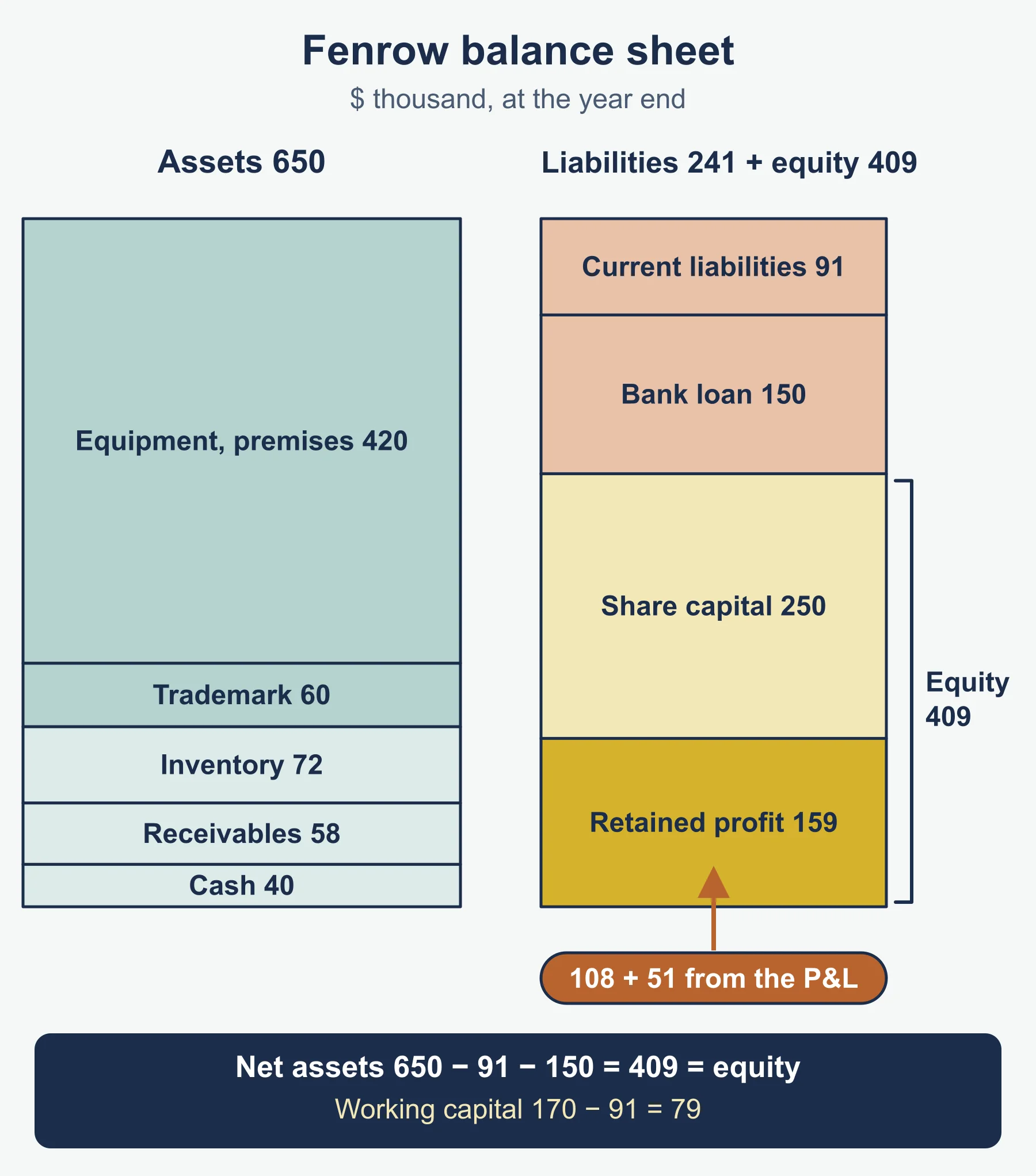
At the year end the balance sheet showed, in thousands of dollars: equipment and premises 420; a registered trademark 60; inventory 72; trade receivables 58; cash 40; trade payables 64; tax owed 27; a bank loan repayable in six years 150; share capital 250. Opening retained profit was 108.
| Line | Working | Amount |
|---|---|---|
| Non-current assets | 420 + 60 | 480 |
| Current assets | 72 + 58 + 40 | 170 |
| Total assets | 480 + 170 | 650 |
| Current liabilities | 64 + 27 | 91 |
| Working capital | 170 - 91 | 79 |
| Non-current liabilities | bank loan | 150 |
| Net assets | 650 - 91 - 150 | 409 |
| Retained profit at year end | 108 + 51 | 159 |
| Equity | 250 + 159 | 409 |
Net assets equal equity, so the balance sheet balances. The link between the two accounts is the 51: the retained profit from the profit and loss account is added to the retained profit in equity. If your balance sheet does not balance, an error exists, and the missing figure is often a retained profit you forgot to carry across.
How to read it: working capital of 79 is positive, so the current assets exceed the debts due soon. The loan sits in non-current liabilities, so repayment pressure is spread over years. A bank would compare these with the profit figures before lending more. The guide deals with ratios in 3.5, so only the plain figures are needed here.
Intangible assets
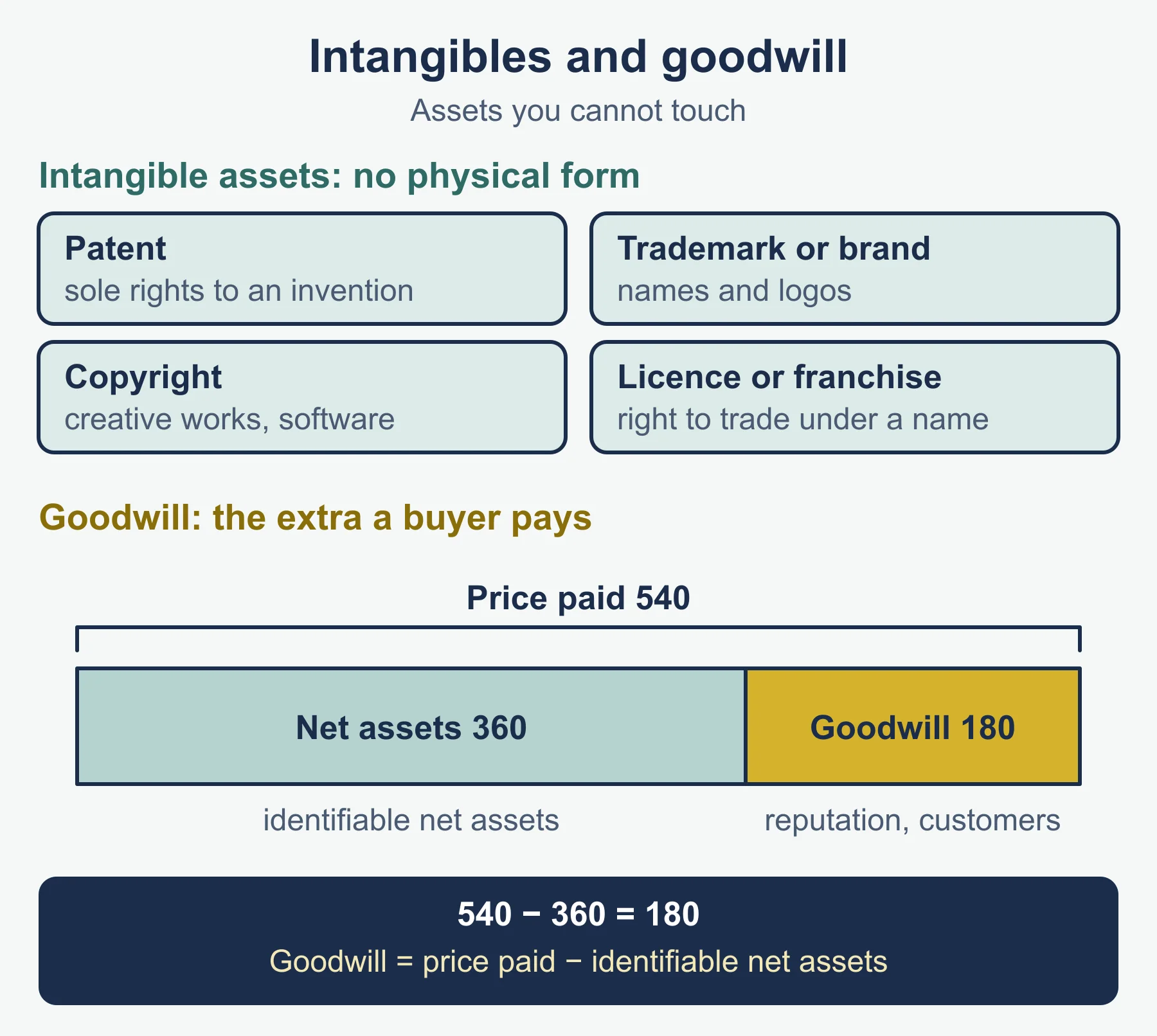
An intangible asset is an asset with no physical form that is expected to bring benefit over more than one year. The guide lists “different types of intangible assets” without naming them, so learn these standard ones:
- Patents: legal protection for an invention, giving the owner sole rights to use or license it.
- Trademarks and brand names: signs, names or logos that identify the business’s products.
- Copyrights: protection for written, musical, artistic or software creations.
- Licences and franchise rights: permission to produce or trade under another party’s name or rules.
- Goodwill: the extra amount a buyer pays for a business above the value of its identifiable net assets, reflecting its reputation and customer base. For example, if a buyer pays 540 for a business whose identifiable net assets are worth 360, goodwill is 180.
Intangible assets appear in non-current assets. They are harder to value than physical items because there is nothing to inspect, and their worth can fall suddenly if a brand is damaged or a patent expires. A business may also hold valuable assets that never reach its balance sheet, so the balance sheet can understate its real worth.
Depreciation (HL only)
Depreciation spreads the cost of a non-current asset over its useful life. Each year’s charge is an expense in the profit and loss account. It also lowers the asset’s value on the balance sheet, which is called its net book value:
net book value = cost - accumulated depreciation
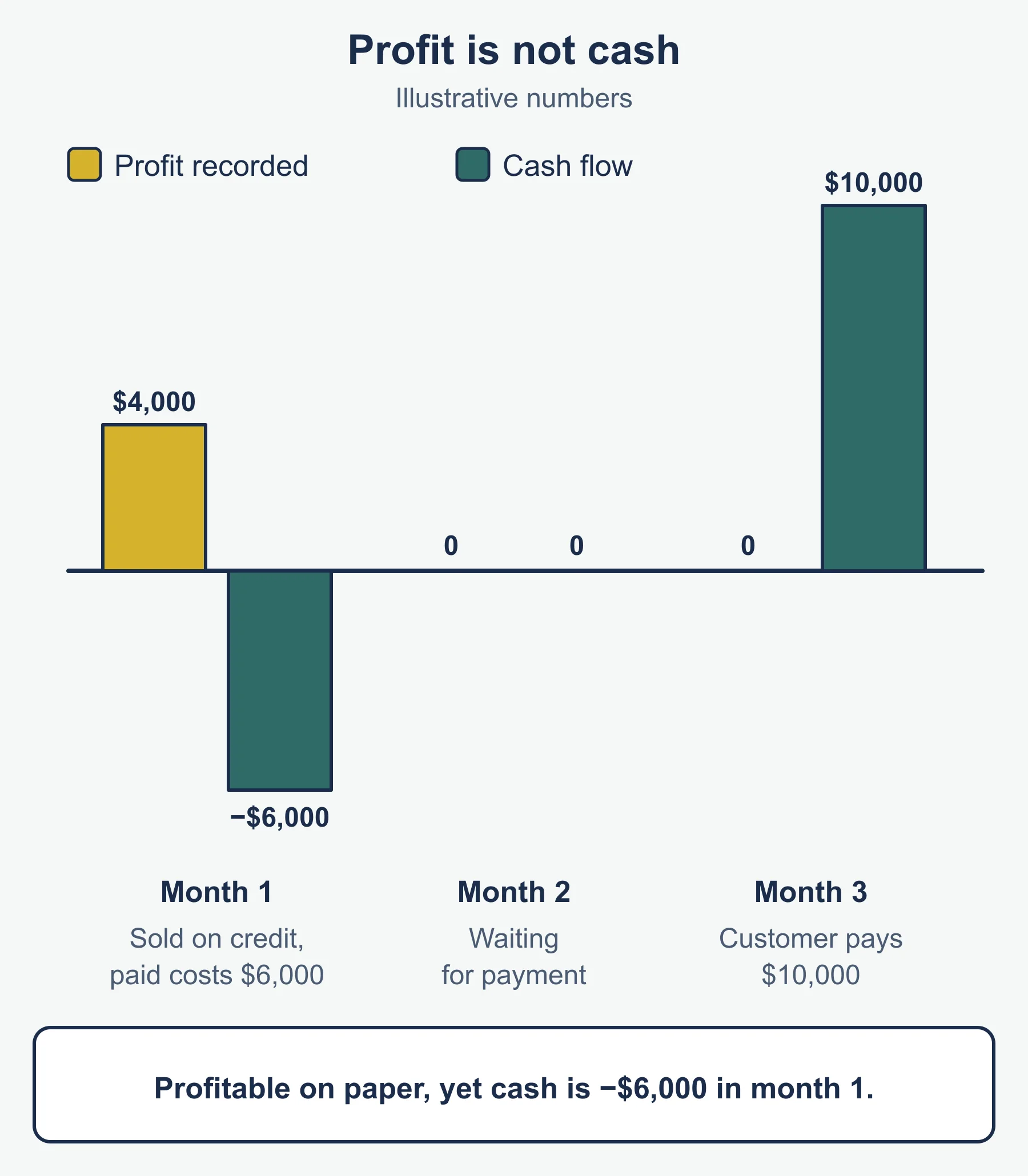
Depreciation is a book entry. It lowers profit without any cash leaving the business that year. The cash left when the asset was bought. Note the reasoning, because it links to the profit-versus-cash distinction in 3.7.
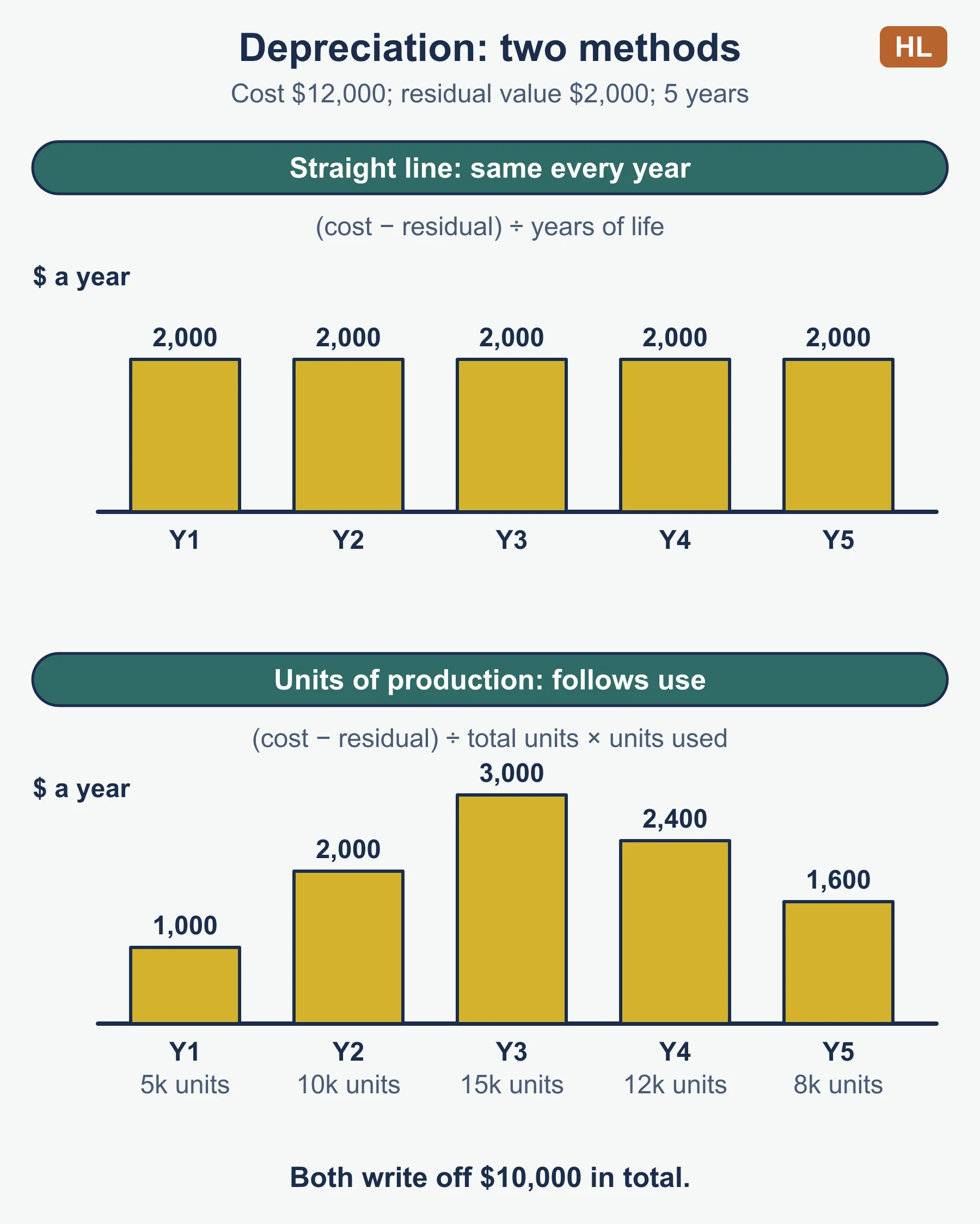
Straight line method
Straight line writes off an equal amount each year. This is the standard form:
annual depreciation = (cost - residual value) / useful life
The residual value is the estimated worth of the asset at the end of its life.
Units of production method
This method ties the charge to how much the asset is used. This is the standard form:
depreciation per unit = (cost - residual value) / total expected units
annual depreciation = depreciation per unit x units produced that year
Worked example: a kiln
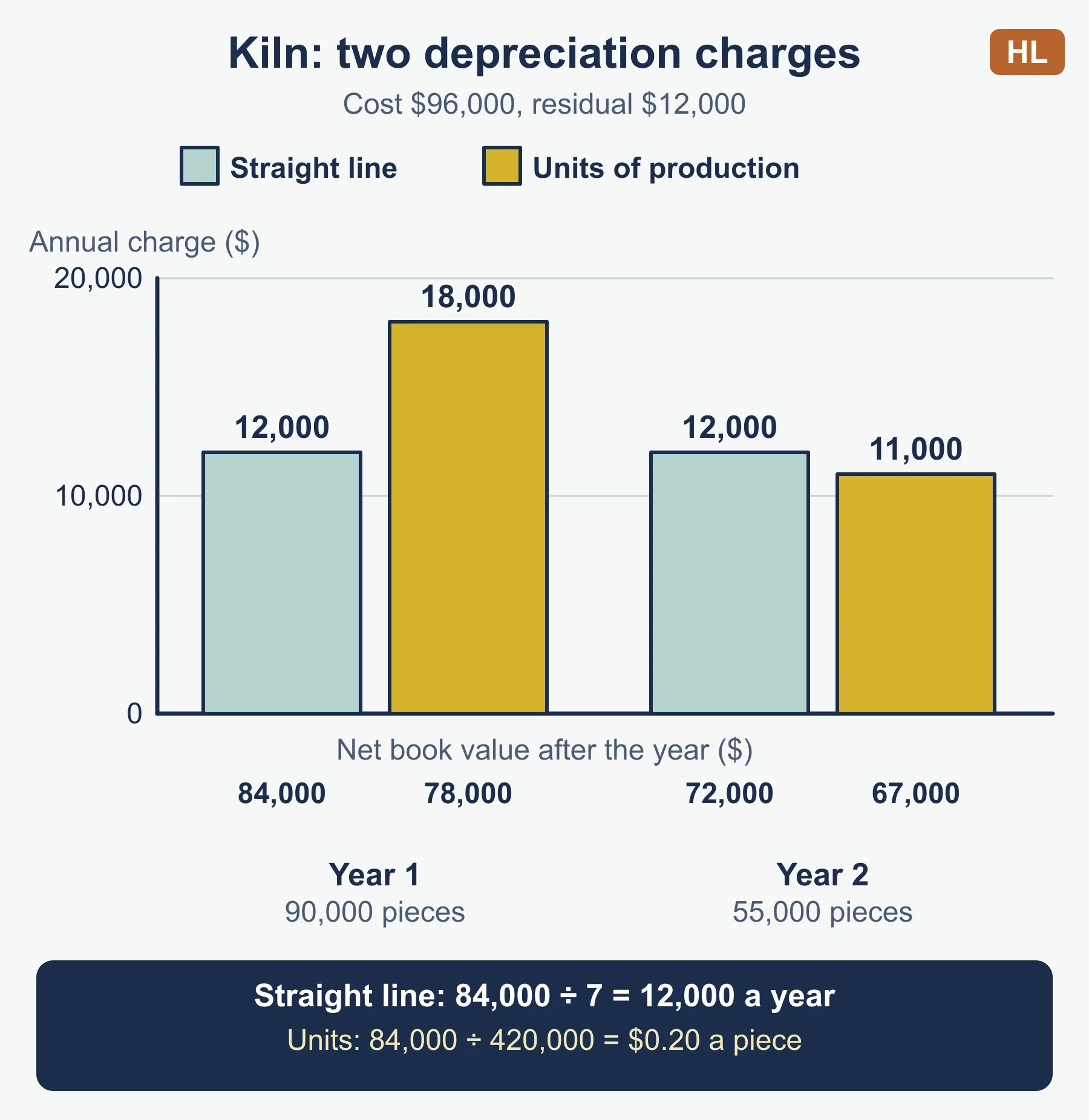
Fenrow buys a kiln for 96,000 dollars with a residual value of 12,000 dollars, a useful life of 7 years and an expected total output of 420,000 pieces.
Straight line: (96,000 - 12,000) / 7 = 12,000 dollars a year. After one year the net book value is 84,000 dollars.
Units of production: (96,000 - 12,000) / 420,000 = 0.20 dollars per piece. In year 1 the kiln fires 90,000 pieces, so depreciation is 18,000 dollars and the net book value is 78,000 dollars. In year 2 it fires 55,000 pieces, so depreciation is 11,000 dollars and the net book value is 67,000 dollars.
Choosing a method
This is an AO3 point, so give a reason tied to the asset.
- Straight line suits assets that lose value mainly with time, such as a building, office furniture or a software licence. It is simple and predictable, but it ignores how hard the asset works.
- Units of production suits assets worn out by use, such as a machine whose output varies or a vehicle measured by distance. It matches the charge to the wear, but you must be able to estimate lifetime output, and charges swing between years.
A strong answer uses the case: if output is stable, the two methods give similar charges and simplicity favours straight line. If output swings with demand, units of production matches cost to benefit better.
Common errors
- Writing expenses into cost of sales, or leaving out opening inventory when building cost of sales.
- Treating dividends as an expense. They come after tax, from profit after tax.
- Putting a long-term loan in current liabilities, or the overdraft in non-current liabilities.
- Forgetting that net assets must equal equity, and not checking.
- Calling depreciation a cash payment. It is not.
- Ignoring the residual value when calculating depreciation.
- Giving a generic list when asked why accounts matter to a stakeholder. Name the group and the figure that group uses.
Frequently asked questions
What is the difference between the profit and loss account and the balance sheet? The profit and loss account shows the profit or loss a business made over a period. The balance sheet shows what the business owns, owes and is worth at a single point in time, based on the accounting equation assets = liabilities + equity.
What is goodwill? Goodwill is the extra amount a buyer pays for a business above the value of its identifiable net assets, reflecting things such as its reputation and customer base. It is an intangible asset.
Does depreciation reduce cash? No. Depreciation is a book entry that spreads the cost of a non-current asset over its useful life, so it lowers profit without any cash leaving the business that year; the cash left when the asset was bought.
When should a business use the units of production method instead of straight line? Units of production suits assets worn out by use, such as a machine whose output varies or a vehicle measured by distance. Straight line suits assets that lose value mainly with time, such as a building or office furniture, and is simpler and more predictable.
How are the profit and loss account and the balance sheet linked? The retained profit for the year from the profit and loss account is added to retained profit in equity on the balance sheet.
Official syllabus
International Baccalaureate Organization, Business management guide, first assessment 2024: section 3.4 Final accounts and the Glossary of command terms.
Get free revision emails (optional)
Occasional emails with practice questions, worked explanations and links to free resources for the qualification and subjects you choose. No spam, and you can unsubscribe from any email. The free tools on this site never need an email.
Related resources
-
Practice questions
IB DP Business Management: Final accounts – Practice Questions
Original practice questions with worked answers on IB DP Business Management section 3.4 Final accounts, including HL-only depreciation.
Business · International Baccalaureate · IB
Try questions -
Revision notes
IB DP Business Management: Final accounts – Revision Notes
Condensed revision notes for IB DP Business Management section 3.4 Final accounts, with formulas, layouts and a self-test.
Business · International Baccalaureate · IB
Revise topic -
Study guides
IB DP Business Management: Introduction to finance and Sources of finance
Study guide to IB DP Business Management 3.1 and 3.2: capital and revenue expenditure, internal and external sources of finance, and choosing between them.
Business · International Baccalaureate · IB
Read guide
Related articles
-
teaching
A Level tuition in Dubai: Cambridge or Pearson Edexcel International A Level?
Schools in Dubai and Abu Dhabi teach either Cambridge International AS & A Level or Pearson Edexcel International A Level. How the two are structured, why it matters for tuition, and how online classes from Lahore work.
9 October 2026
-
curriculum guides
Choosing subjects at IGCSE and A Level
How subject choices at 14 and 16 affect university options later, and how to keep pathways open without overloading a timetable.
28 July 2026
Studying this with a teacher
Working through Business IB?
This page is free and stays free. If you would rather be taught it, Marlbridge runs Business classes one-to-one, online in your own time zone. The first trial class is free. WhatsApp replies within an hour (8am–11pm Pakistan time, every day); email the same day.
IB Business teachers at Marlbridge

