
Revision Notes
IB DP Business Management: Final accounts – Revision Notes
Condensed revision notes for IB DP Business Management section 3.4 Final accounts, with formulas, layouts and a self-test.
- Subject
- Business
- Level
- IB
- Topic
- Unit 3: Finance and accounts
- Author
- Marlbridge Academic Team
- Updated
- Reviewed by
- Salman Ahmad (what this means)
Aligned to International Baccalaureate IB Diploma Programme Business (DP Business Management), First assessment 2024. Official specification .
Syllabus page (what it covers and how it is assessed): IB Diploma Programme Business.
Syllabus points this page covers
DP Business Management
- 3.4 Final accounts
Found an error? Report a correction.
Need help with this topic? Request a free trial class for IB Diploma Programme Business (DP Business Management).
These are condensed notes for section 3.4 (Final accounts) of the IB Business management guide, first assessment 2024. For full explanations and longer worked examples, read the study guide. Then test yourself with the practice questions, tick off the checklist and use the course hub. The wider unit is in the Unit 3 notes. Depreciation and its methods are HL only; everything else applies at SL and HL. Check what you know with the diagnostics.
The five points in the guide
- The purpose of accounts to different stakeholders.
- Final accounts: the profit and loss account and the balance sheet.
- Different types of intangible assets.
- Depreciation by the straight line method and the units of production method (HL only).
- The appropriateness of each depreciation method (HL only).
Key definitions
| Term | Meaning |
|---|---|
| Final accounts | The profit and loss account and the balance sheet, produced at the end of a period |
| Profit and loss account | Shows profit or loss over a period |
| Balance sheet | Shows assets, liabilities and equity at one point in time |
| Retained profit | Profit kept in the business after tax and dividends |
| Non-current asset | An asset kept for more than a year |
| Current asset | An asset likely to turn into cash within a year |
| Working capital | Current assets minus current liabilities |
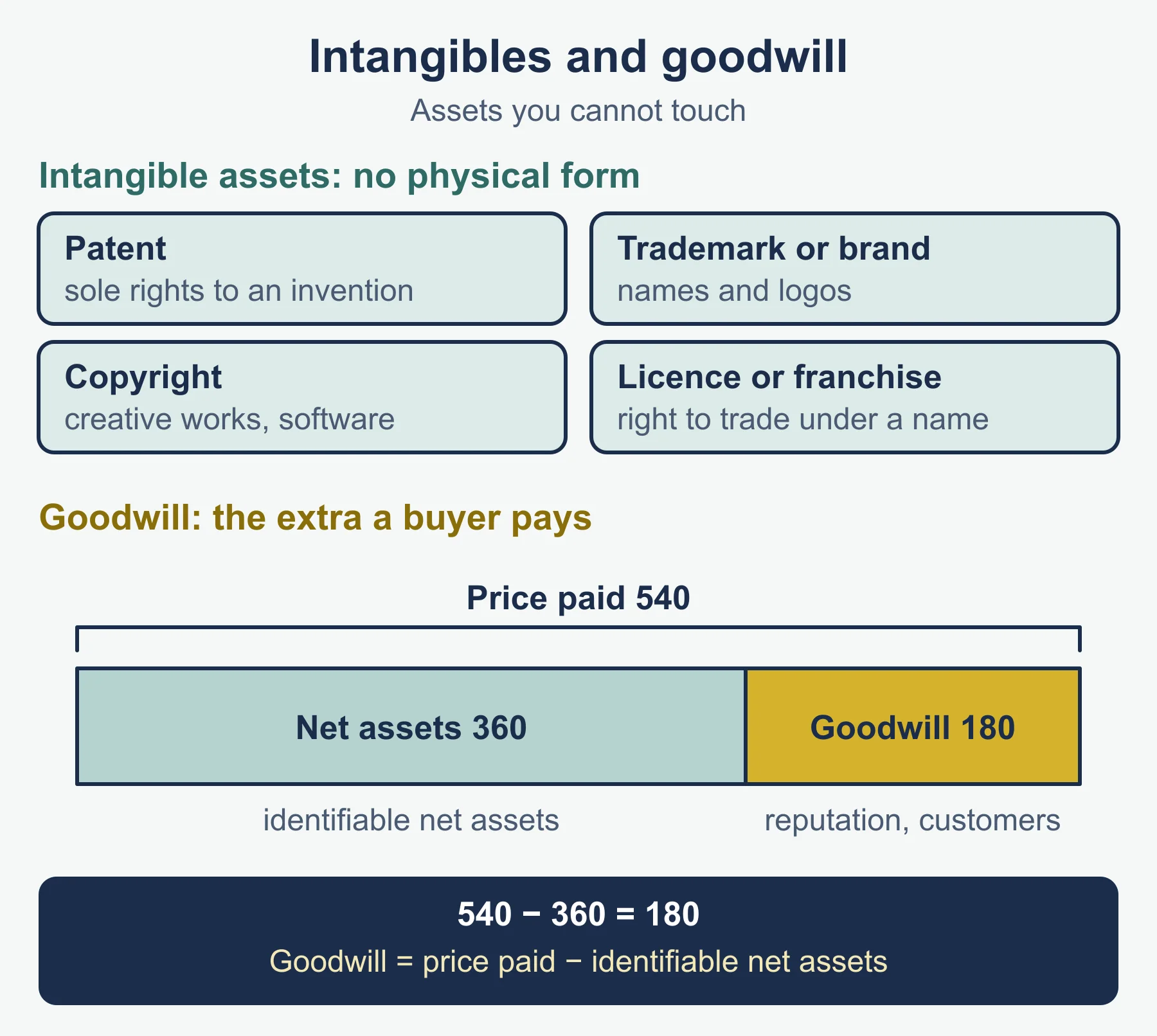
| Intangible asset | An asset with no physical form |
| Goodwill | The amount paid for a business above the value of its identifiable net assets |
| Depreciation (HL only) | The cost of a non-current asset spread across its useful life |
| Net book value (HL only) | Cost minus accumulated depreciation |
Who uses the accounts and why
- Shareholders and owners: return on investment, dividends, retained profit.
- Managers: performance against targets, planning.
- Employees: job security, pay prospects.
- Lenders: ability to repay, assets that could be security.
- Suppliers: whether to give credit.
- Government: tax due.
- Competitors and investors: comparison with rivals and alternatives.
- Community: whether the business will keep employing local people.
The accounts look backwards and rely on estimates, so no stakeholder should decide on them alone.
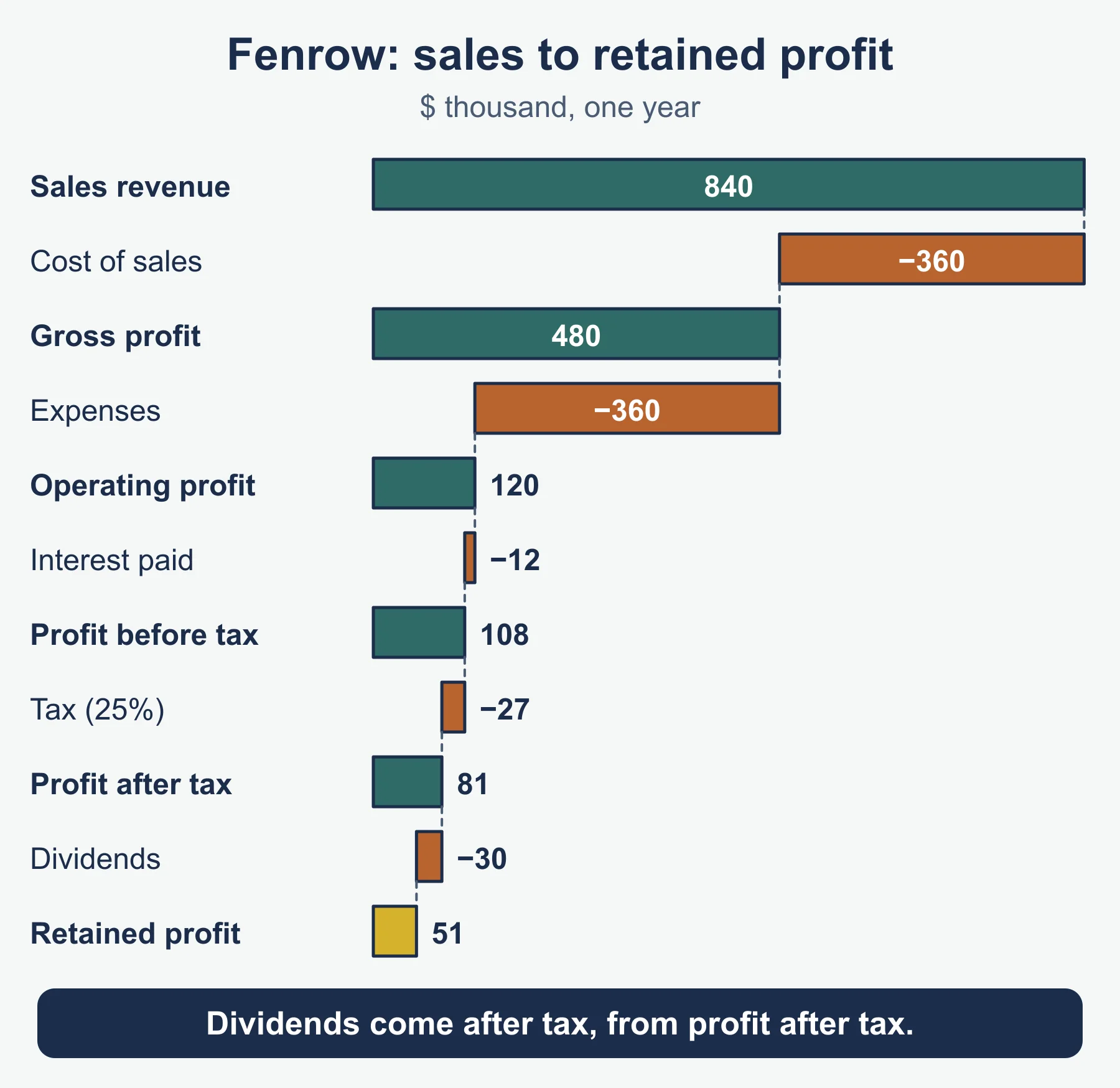
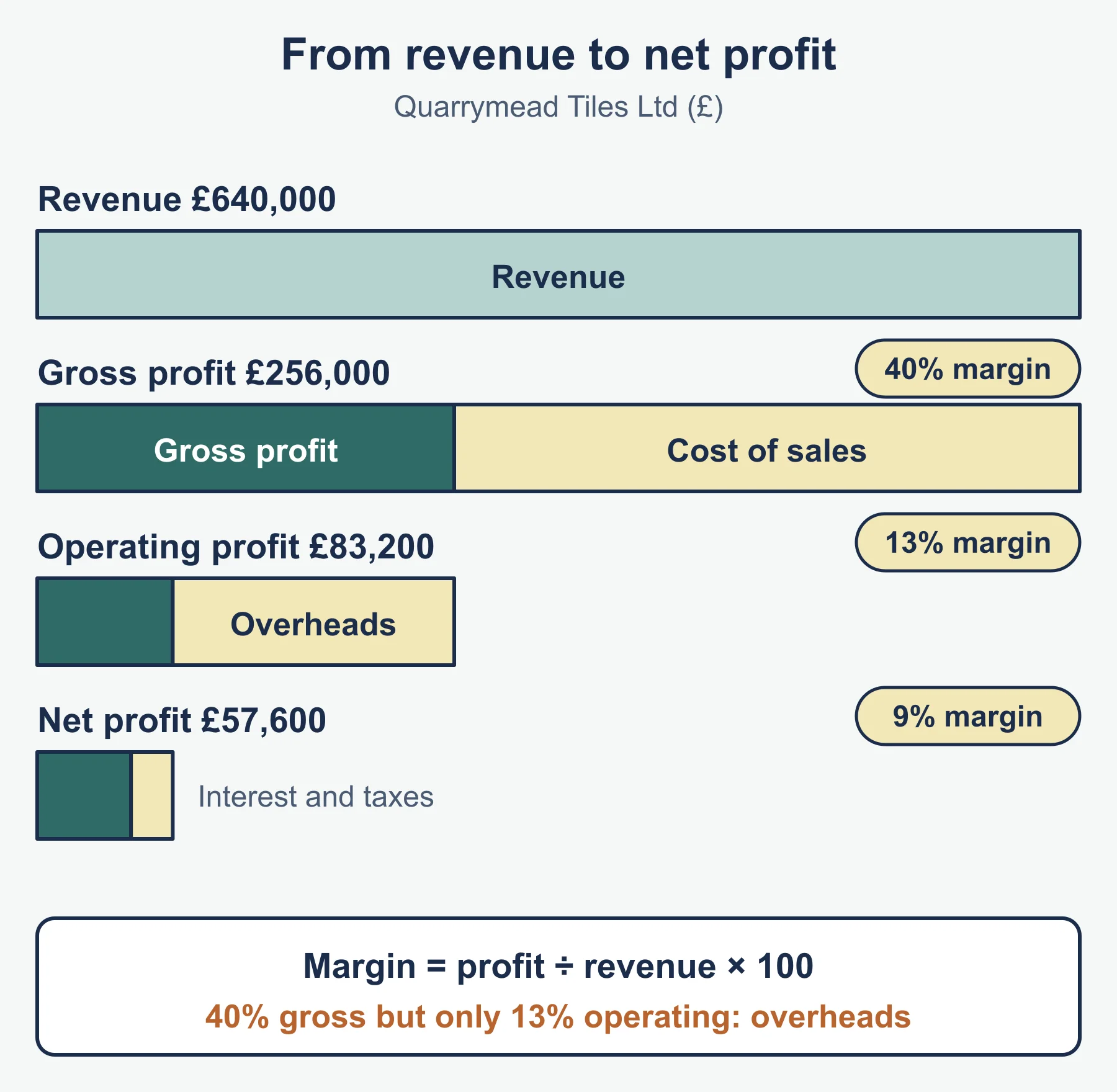
Profit and loss account layout (standard form)
| Line | How to get it |
|---|---|
| Sales revenue | Given |
| Cost of sales | Opening inventory + purchases - closing inventory |
| Gross profit | Sales revenue - cost of sales |
| Operating profit | Gross profit - expenses |
| Profit before tax | Operating profit - interest |
| Profit after tax | Profit before tax - tax |
| Retained profit | Profit after tax - dividends |
Reminder: Maplestrand Bakery
All figures are in thousands of dollars. Sales revenue is 520, opening inventory 25, purchases 210, closing inventory 30. Expenses are wages 150, rent 50 and other 40. Interest is 5. Tax is 20% of profit before tax. Dividends are 20.
Cost of sales        25 + 210 - 30   = 205
Gross profit         520 - 205       = 315
Expenses             150 + 50 + 40   = 240
Operating profit     315 - 240       = 75
Profit before tax    75 - 5          = 70
Tax                  20% of 70       = 14
Profit after tax     70 - 14         = 56
Retained profit      56 - 20         = 36
Method in steps:
- Work out cost of sales first, using opening inventory, purchases and closing inventory.
- Subtract to get gross profit.
- Add up all expenses before subtracting them.
- Take off interest, then tax, then dividends, in that order.
- Keep the unit on every line.
Balance sheet layout
| Section | Typical items | Check |
|---|---|---|
| Non-current assets | Premises, equipment, vehicles, intangible assets | Held more than a year |
| Current assets | Inventory, trade receivables, cash | Cash within a year |
| Current liabilities | Trade payables, overdraft, tax owed | Due within a year |
| Non-current liabilities | Long-term loans | Due after a year |
| Equity | Share capital, retained profit | Equals net assets |
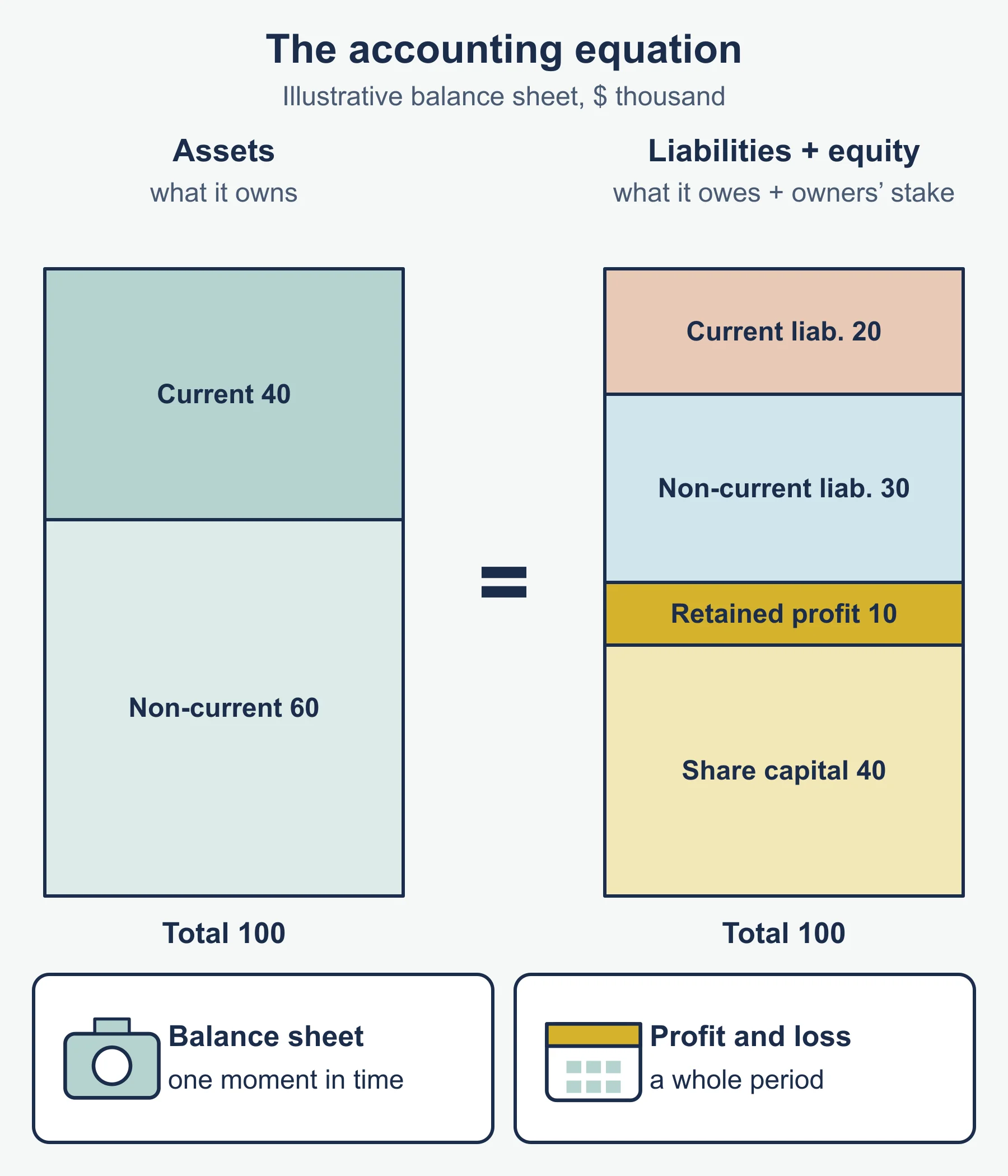
Accounting equation: assets = liabilities + equity.
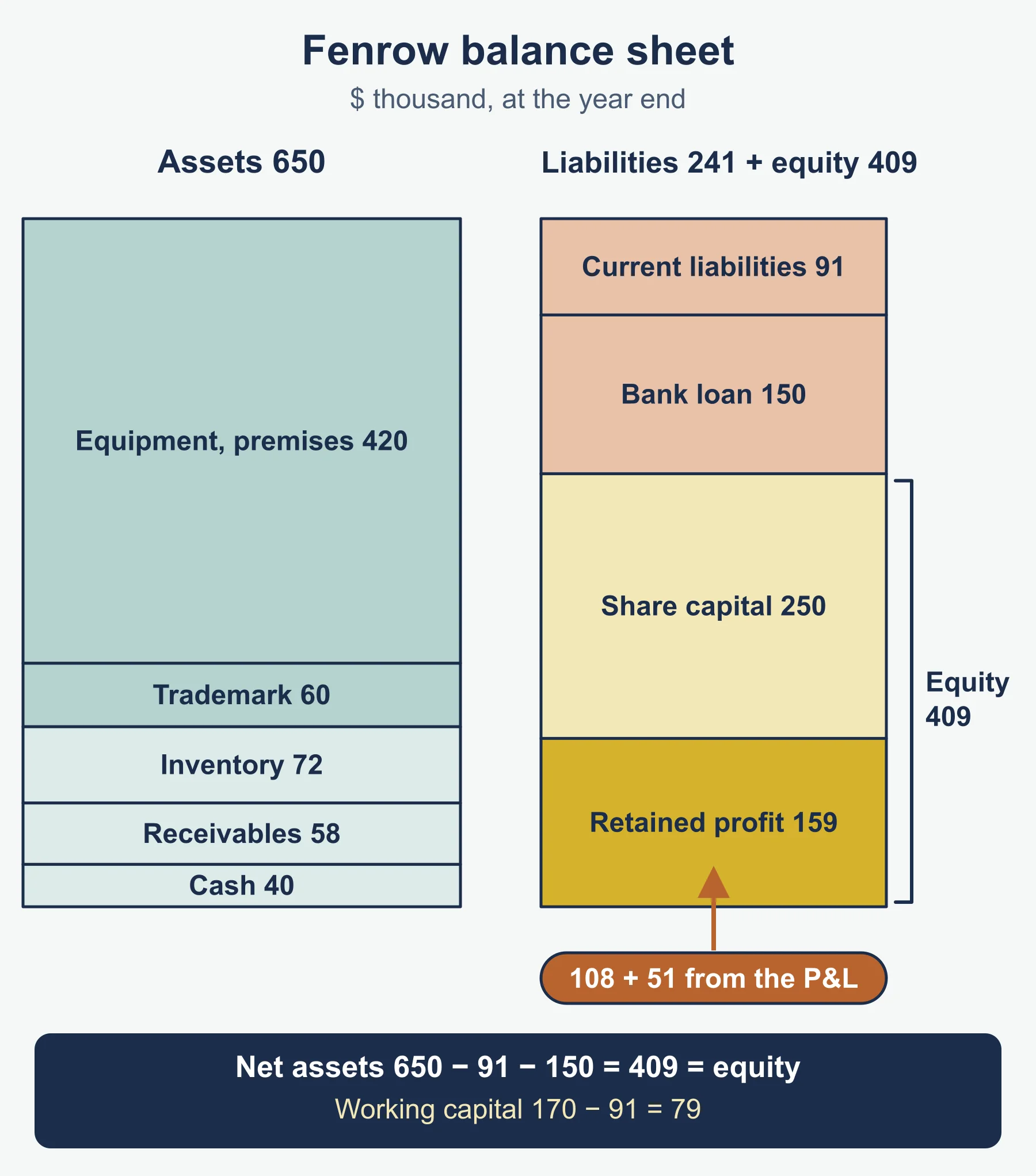
Net assets = total assets - total liabilities = equity.
Working capital = current assets - current liabilities.
Link between the accounts: this year’s retained profit from the profit and loss account is added to retained profit in equity.
Method in steps:
- Sort each item into the right section.
- Total non-current and current assets.
- Total current liabilities and non-current liabilities.
- Calculate net assets.
- Build equity from share capital plus retained profit, and check that it equals net assets.
Intangible assets
| Type | One-line description |
|---|---|
| Patent | Legal protection for an invention |
| Trademark or brand name | Identifies the products or business |
| Copyright | Protection for written, musical, artistic or software work |
| Licence or franchise right | Permission to operate under another party’s name or rules |
| Goodwill | Reputation and customer base, shown when a business is bought for more than its identifiable net assets |
The guide does not name the types, so treat these as the standard examples. All sit in non-current assets. They are hard to value and can lose worth quickly, so the balance sheet may not show a business’s full value.
Depreciation (HL only)
| Method | Formula (standard form) |
|---|---|
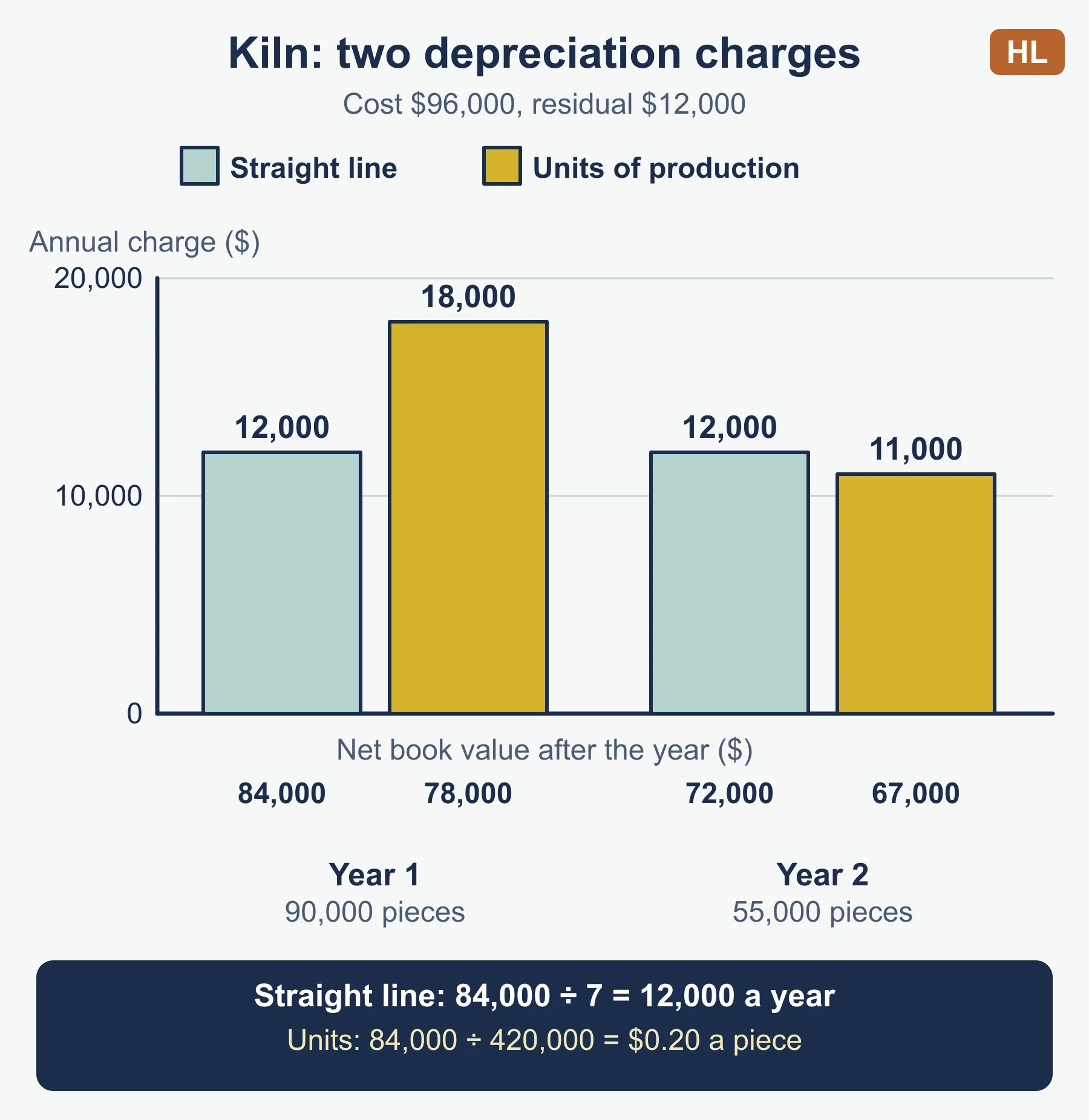
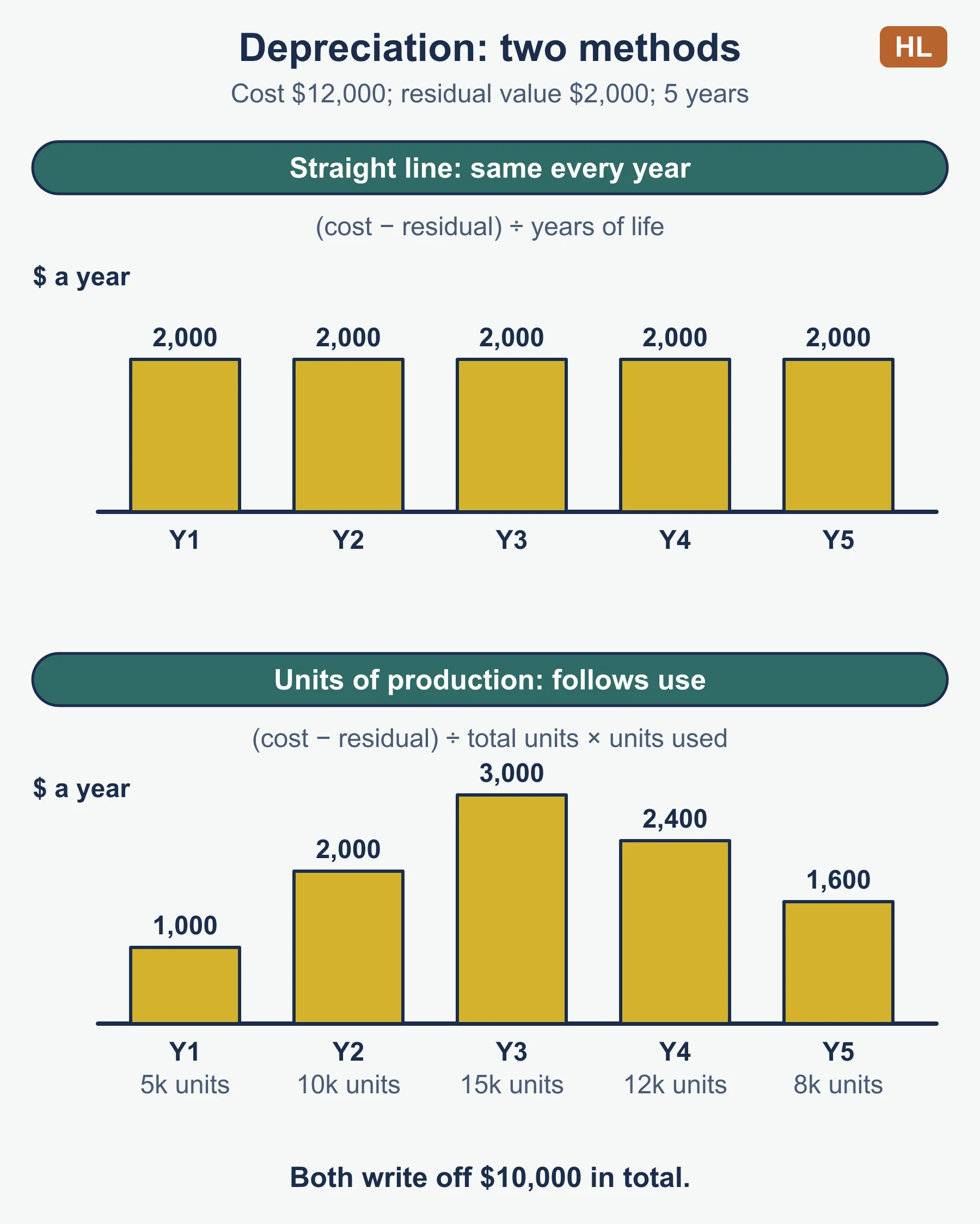
| Straight line | (cost - residual value) / useful life |
| Units of production | (cost - residual value) / total expected units, multiplied by the units produced in the year |
Net book value = cost - accumulated depreciation.
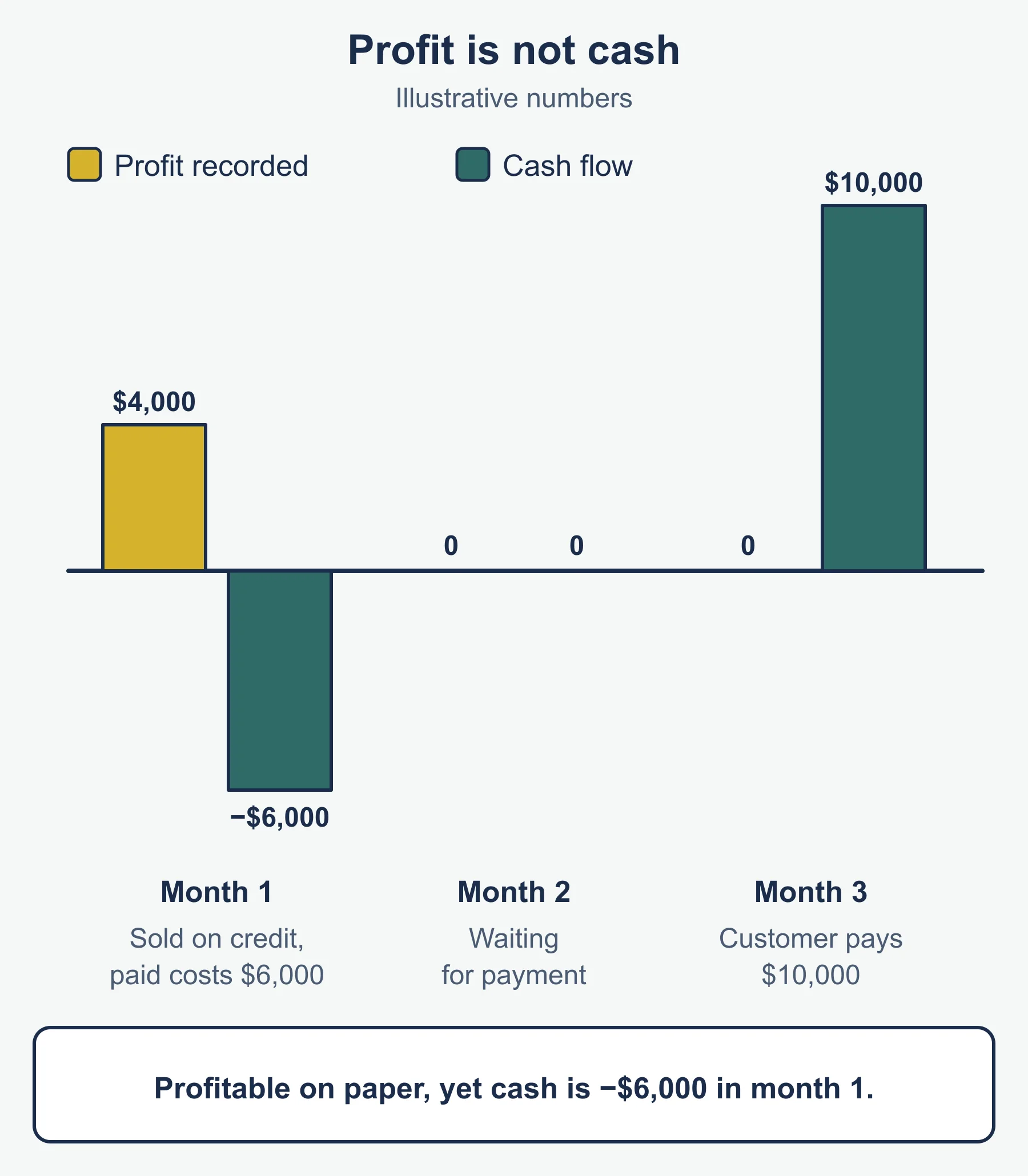
Depreciation is an expense in the profit and loss account, so it lowers profit. It reduces the asset’s value on the balance sheet. It is not a cash payment.
Reminder: a delivery van
The van costs 38,000 dollars, has a residual value of 8,000 dollars and a useful life of 5 years. It is expected to cover 300,000 km in total.
- Straight line: (38,000 - 8,000) / 5 = 6,000 dollars a year. Net book value after 2 years: 38,000 - 12,000 = 26,000 dollars.
- Units of production: 30,000 / 300,000 = 0.10 dollars per km. A year with 72,000 km gives 7,200 dollars.
Choosing between them
| Feature | Straight line | Units of production |
|---|---|---|
| Best for | Assets that age with time: buildings, furniture, licences | Assets worn by use: machines, vehicles |
| Strength | Simple and predictable | Matches cost to use |
| Limitation | Ignores how hard the asset works | Needs a lifetime estimate; charges vary |
For an AO3 question, name the asset, say which method fits and why, then give one limitation.
Must-know distinctions
- Profit and loss account versus balance sheet: a period versus a point in time.
- Gross profit versus operating profit: the second is after expenses.
- Operating profit versus profit after tax: interest and tax come between them.
- Profit after tax versus retained profit: dividends come between them.
- Current versus non-current: the one-year dividing line.
- Net assets versus working capital: the first uses all assets and liabilities, the second only the current ones.
- Depreciation versus a cash payment: depreciation is a spread of an earlier purchase.
Quick self-test
- State the accounting equation.
- Opening inventory is 18, purchases are 140 and closing inventory is 22. Calculate cost of sales.
- Sales revenue is 300. Using your answer to question 2, calculate gross profit.
- Expenses are 110. Calculate operating profit.
- Which final account shows the position of a business at one point in time?
- Current assets are 95 and current liabilities are 70. Calculate working capital.
- Total assets are 260 and total liabilities are 110. What is equity?
- (HL only) A machine costs 52,000, has a residual value of 4,000 and lasts 6 years. Calculate annual straight line depreciation, then its net book value after 3 years.
- (HL only) An asset costs 72,000 and has a residual value of 12,000. It is expected to make 400,000 units in total. Calculate depreciation in a year when it makes 60,000 units.
- Identify two intangible assets.
- Explain why a supplier might read a customer’s accounts.
- (HL only) State one reason why units of production might suit a delivery fleet.
Answers
- Assets = liabilities + equity.
- 18 + 140 - 22 = 136.
- 300 - 136 = 164.
- 164 - 110 = 54.
- The balance sheet.
- 95 - 70 = 25.
- 260 - 110 = 150.
- (52,000 - 4,000) / 6 = 8,000 a year. Net book value: 52,000 - 3 x 8,000 = 28,000.
- (72,000 - 12,000) / 400,000 = 0.15 per unit. Then 60,000 x 0.15 = 9,000.
- Any two of: patent, trademark or brand name, copyright, licence or franchise right, goodwill.
- It shows amounts owed and cash and short-term assets, which indicate whether the customer can pay, so the supplier can decide whether to offer credit.
- Wear on vehicles depends on distance driven, and the charge follows distance, so it matches cost to use.
Where marks are usually lost
- Starting from the wrong line, such as leaving out opening inventory in cost of sales.
- Subtracting dividends before tax.
- Putting a long-term loan among current liabilities.
- Giving a balance sheet that does not balance and not checking.
- Treating depreciation as cash going out.
- Leaving out the residual value in a depreciation formula.
- Giving a stakeholder answer without naming a figure from the accounts.
- Writing a bare number with no unit or working when the command term is calculate.
- Giving a choice of depreciation method with no link to the asset in the question.
Frequently asked questions
How do you calculate cost of sales? Cost of sales is opening inventory plus purchases minus closing inventory. Work it out first, then subtract it from sales revenue to get gross profit.
In what order do interest, tax and dividends come off profit? Take off interest to get profit before tax, then tax to get profit after tax, then dividends to get retained profit for the year. Subtracting dividends before tax is a common error.
What is the difference between net assets and working capital? Net assets are total assets minus total liabilities, and they equal equity. Working capital uses only current items: current assets minus current liabilities.
What are examples of intangible assets? Standard examples are patents, trademarks or brand names, copyrights, licences or franchise rights, and goodwill. They all sit in non-current assets on the balance sheet.
Official syllabus
International Baccalaureate Organization, Business management guide, first assessment 2024: section 3.4 Final accounts and the Glossary of command terms.
Get free revision emails (optional)
Occasional emails with practice questions, worked explanations and links to free resources for the qualification and subjects you choose. No spam, and you can unsubscribe from any email. The free tools on this site never need an email.
Related resources
-
Study guides
IB DP Business Management: Introduction to finance and Sources of finance
Study guide to IB DP Business Management 3.1 and 3.2: capital and revenue expenditure, internal and external sources of finance, and choosing between them.
Business · International Baccalaureate · IB
Read guide -
Practice questions
IB DP Business Management: Introduction to finance and Sources of finance – Practice Questions
Original IB DP Business Management practice questions with worked answers on 3.1 and 3.2: expenditure types and sources of finance.
Business · International Baccalaureate · IB
Try questions -
Revision notes
IB DP Business Management: Introduction to finance and Sources of finance – Revision Notes
Condensed revision notes for IB DP Business Management 3.1 and 3.2: expenditure types, each source of finance compared, and a quick self-test.
Business · International Baccalaureate · IB
Revise topic
Related articles
-
teaching
A Level tuition in Dubai: Cambridge or Pearson Edexcel International A Level?
Schools in Dubai and Abu Dhabi teach either Cambridge International AS & A Level or Pearson Edexcel International A Level. How the two are structured, why it matters for tuition, and how online classes from Lahore work.
9 October 2026
-
curriculum guides
Choosing subjects at IGCSE and A Level
How subject choices at 14 and 16 affect university options later, and how to keep pathways open without overloading a timetable.
28 July 2026
Studying this with a teacher
Working through Business IB?
This page is free and stays free. If you would rather be taught it, Marlbridge runs Business classes one-to-one, online in your own time zone. The first trial class is free. WhatsApp replies within an hour (8am–11pm Pakistan time, every day); email the same day.
IB Business teachers at Marlbridge

