
Revision Notes
IB DP Business Management: Costs and revenues – Revision Notes
Condensed IB DP Business Management revision notes for section 3.3: cost types, total revenue and revenue streams, with a quick self-test.
- Subject
- Business
- Level
- IB
- Topic
- Unit 3: Finance and accounts
- Author
- Marlbridge Academic Team
- Updated
- Reviewed by
- Salman Ahmad (what this means)
Aligned to International Baccalaureate IB Diploma Programme Business (DP Business Management), First assessment 2024. Official specification .
Syllabus page (what it covers and how it is assessed): IB Diploma Programme Business.
Syllabus points this page covers
DP Business Management
- 3.3 Costs and revenues
Found an error? Report a correction.
Need help with this topic? Request a free trial class for IB Diploma Programme Business (DP Business Management).
These notes condense section 3.3 (Costs and revenues) of the IB Business management guide, first assessment 2024, for revision at SL and HL. The guide marks no part of 3.3 as HL only. For full explanations and a longer worked example, read the 3.3 study guide. Test yourself with the 3.3 practice questions.
Related pages: the Unit 3 study guide, the Unit 3 revision notes, the IB Business Management hub, the checklist and the free diagnostics.
What the guide lists
Four types of cost, each taught using examples: fixed, variable, direct, indirect/overhead. Then total revenue and revenue streams, also using examples. The depth of teaching is AO2, so apply every term to the business in the question.
Definitions to know cold
| Term | One-line definition | Typical example |
|---|---|---|
| Fixed cost | Total does not change when output changes | Rent, insurance, a monthly salary |
| Variable cost | Total changes as output changes | Raw materials, packaging, pay per item |
| Direct cost | Can be traced to a particular product or service | Ingredients for one named product |
| Indirect cost (overhead) | Supports the whole business and cannot be traced to one product | Head-office rent, general admin |
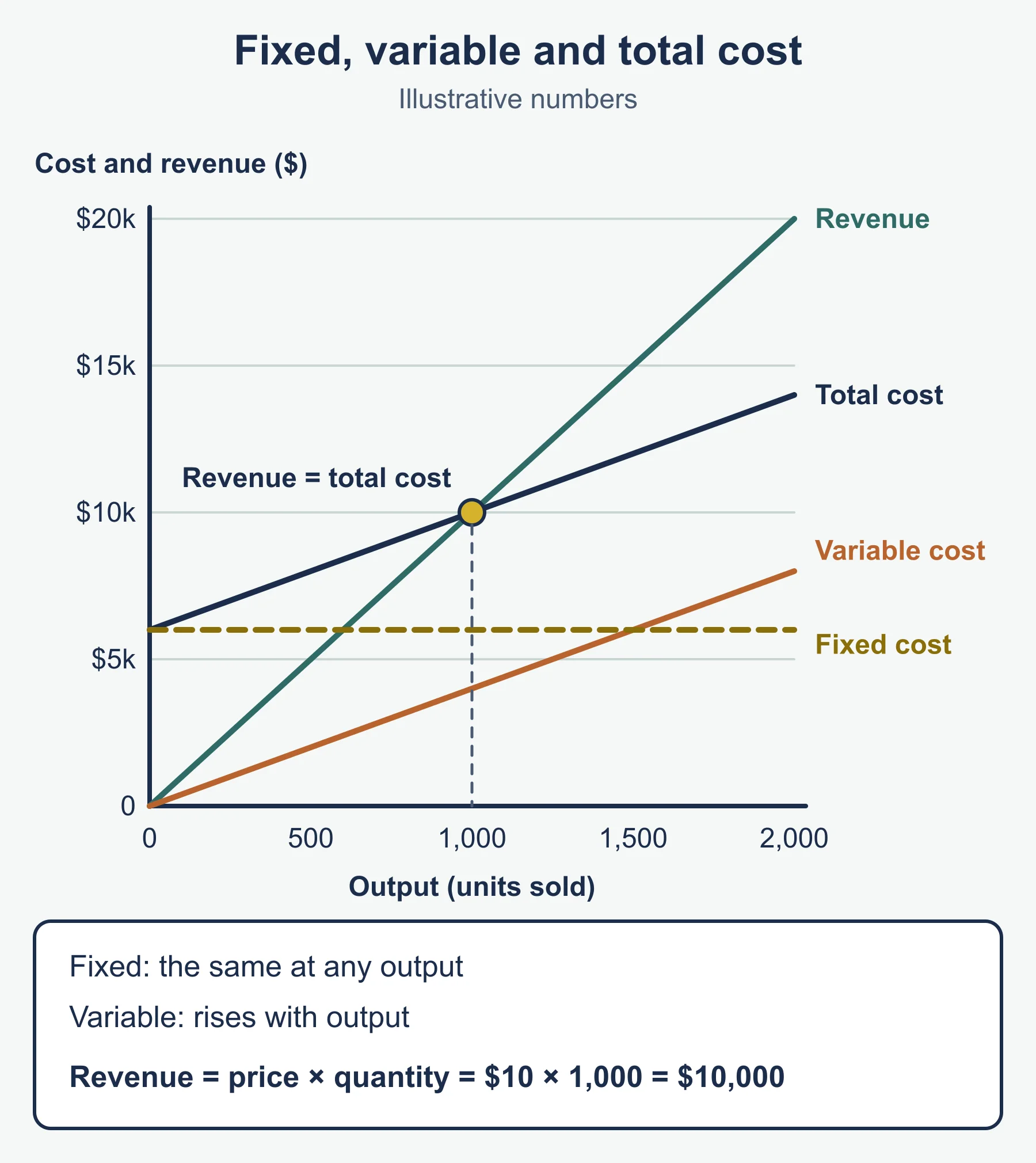
| Total revenue | Money earned from sales before costs are deducted | Price × quantity sold |
| Revenue stream | A distinct source of revenue | Product line, service, fee, membership |
Two questions for every cost
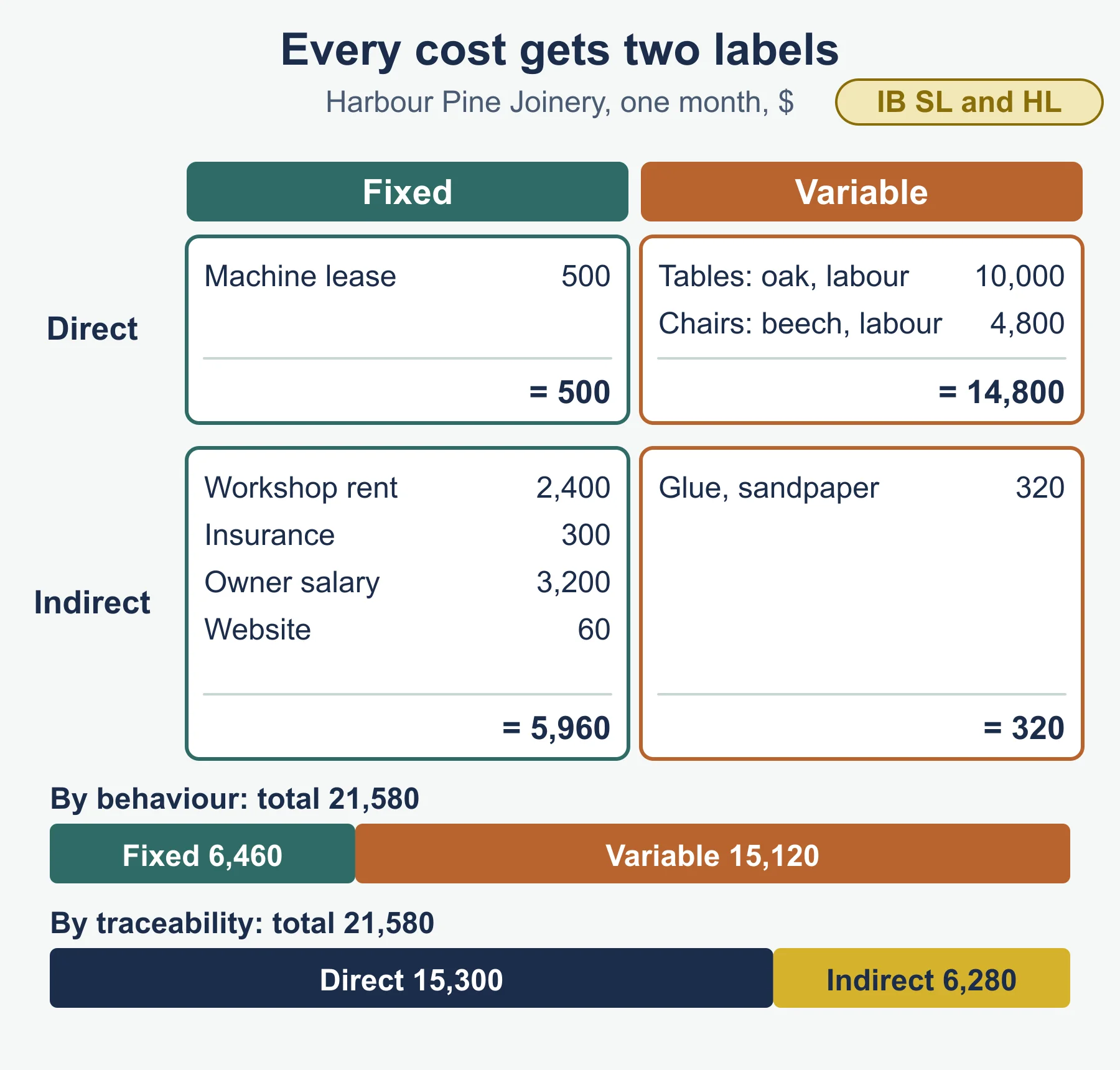
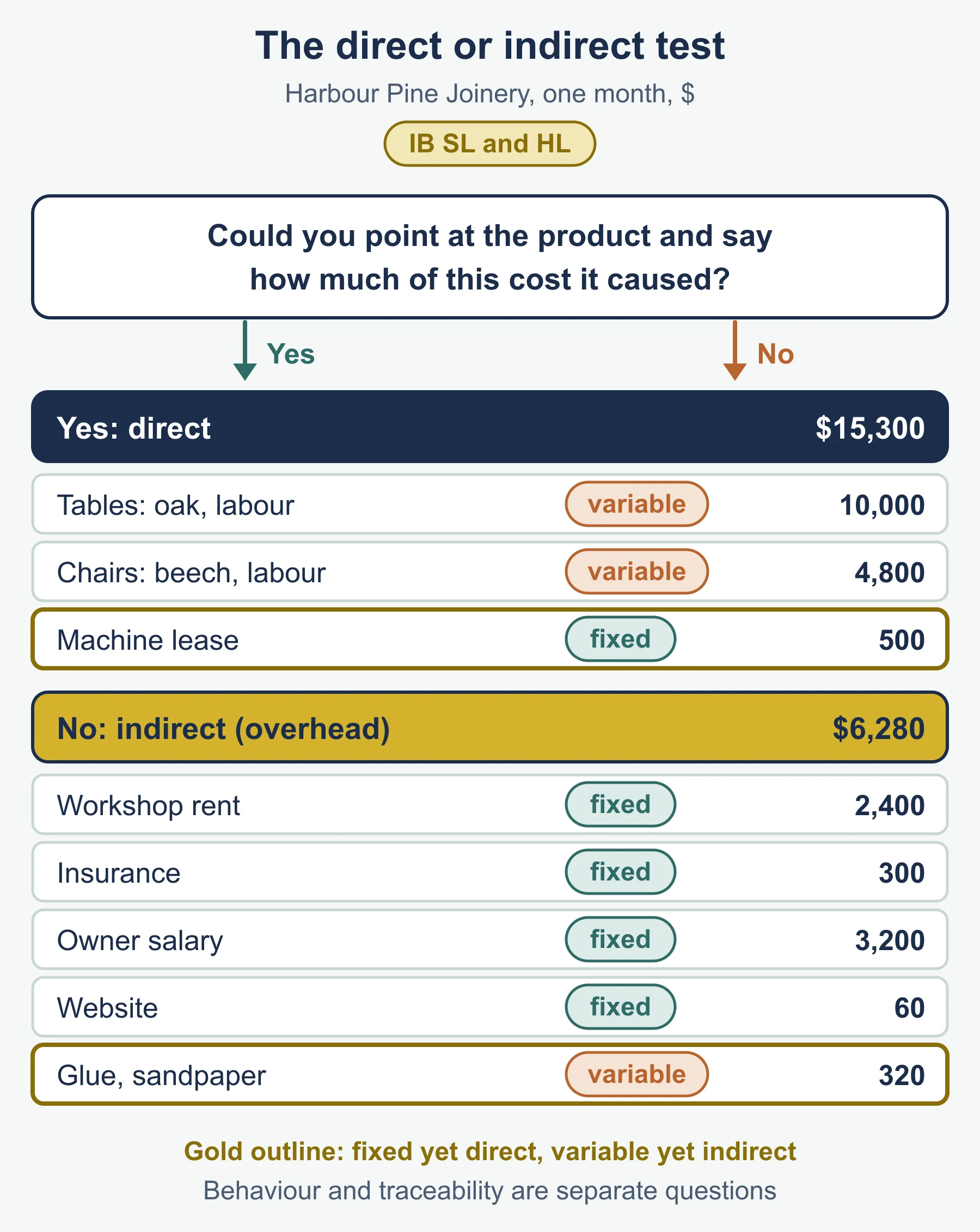
- Behavior: does the total change with output? Fixed or variable.
- Traceability: can it be linked to one product? Direct or indirect.
Four combinations exist, so every cost carries one label from each question.
| Direct | Indirect | |
|---|---|---|
| Fixed | Lease of a machine used for one product | Factory rent shared by all products |
| Variable | Materials for one product | Cleaning supplies used across the whole site, rising with output |
Formulas (standard form)
The guide does not print formulas for 3.3, so these are the standard forms used in teaching.
| Quantity | Formula |
|---|---|
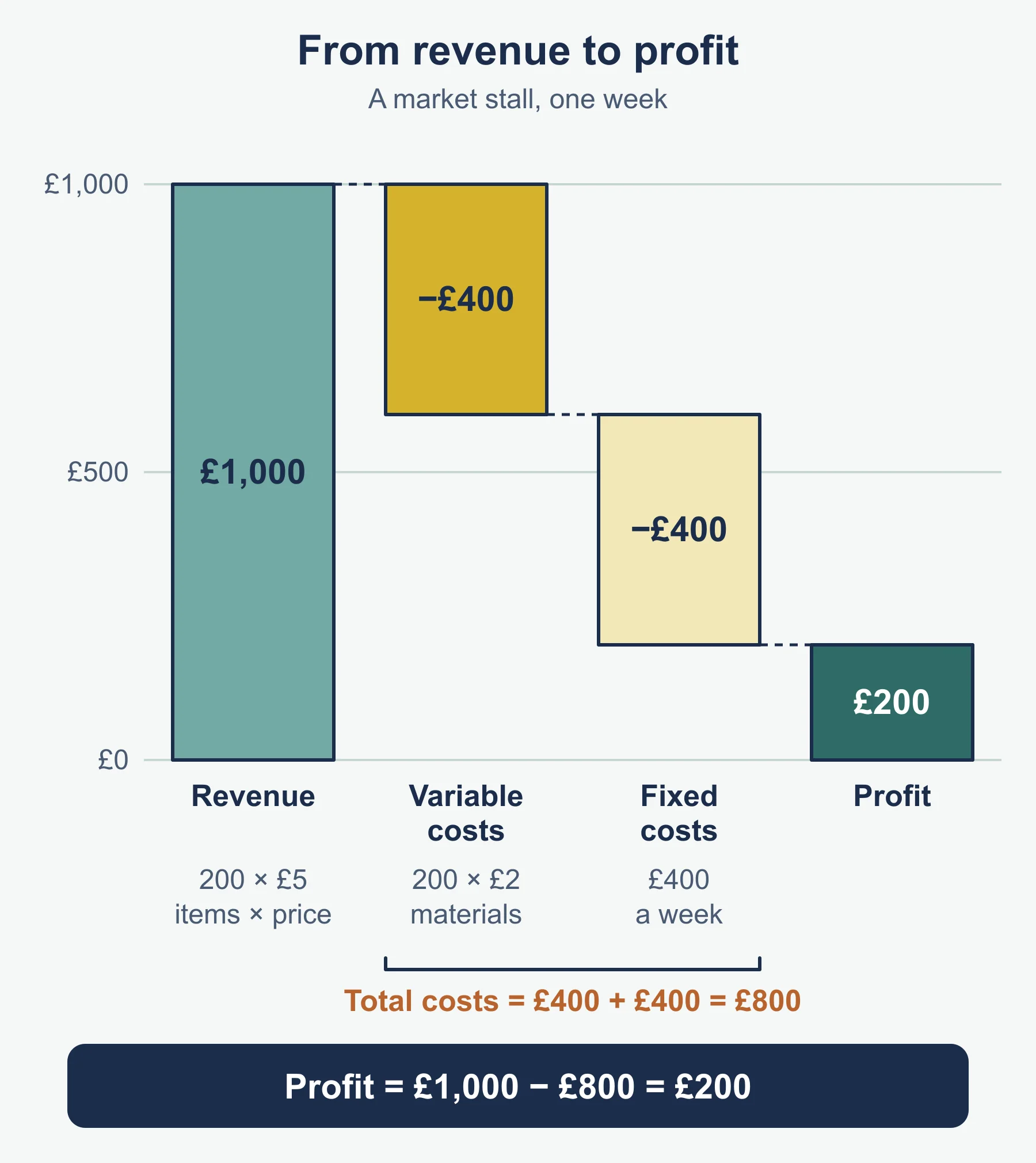
| Total revenue | price × quantity sold |
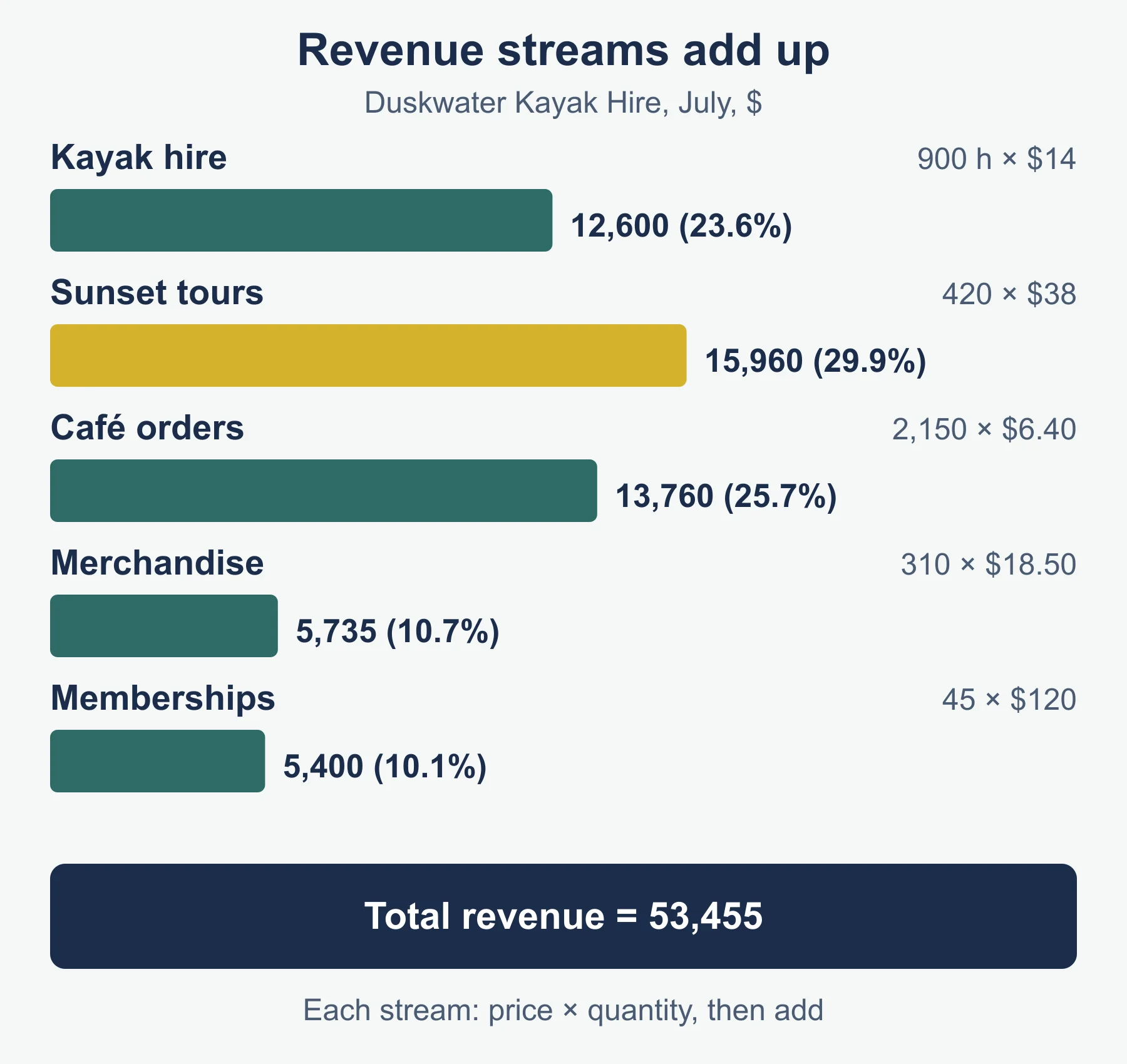
| Total revenue, several streams | sum of (price × quantity) for each stream |
| Total variable cost | variable cost per unit × quantity (plus any variable overheads) |
| Total cost | total fixed costs + total variable costs |
| Profit | total revenue − total costs |
| Fixed cost per unit | total fixed costs ÷ quantity |
| Variable cost per unit | total variable costs ÷ quantity |
Method in steps: a full cost and revenue calculation
- List every cost and label it fixed or variable, then direct or indirect.
- Work out total revenue for each stream, then add.
- Work out total variable costs from per-unit figures and quantities.
- Add total fixed costs.
- Total costs = fixed + variable.
- Profit = total revenue − total costs.
- State the unit (currency) and check that direct plus indirect equals fixed plus variable.
Worked reminder
Ironbridle Print Studio is an invented business that sells 1,500 posters a month at 6 dollars each. Per poster it spends 0.35 on paper, 0.55 on ink and 0.90 on packaging. Monthly rent is 1,800, its printer lease 450 and its design software 120.
- Total revenue = 1,500 × 6 = 9,000
- Variable cost per poster = 0.35 + 0.55 + 0.90 = 1.80, so total variable cost = 1,500 × 1.80 = 2,700
- Fixed costs = 1,800 + 450 + 120 = 2,370
- Total costs = 2,370 + 2,700 = 5,070
- Profit = 9,000 − 5,070 = 3,930
Fixed cost per poster at 1,500 posters = 2,370 ÷ 1,500 = 1.58 dollars. At 2,000 posters it is 2,370 ÷ 2,000 = 1.185 dollars (about 1.19). If output rises to 2,000 and every poster sells at 6, revenue is 12,000, variable cost is 3,600, and profit is 12,000 − 3,600 − 2,370 = 6,030.
Which costs are direct here? Paper, ink and packaging are variable and direct, since they trace to the posters. The printer lease is fixed and direct if the printer produces only posters. The rent and software are fixed and indirect if the studio has other work.
Revenue streams: method and reminder
- Identify each separate source of revenue named in the stem (products, services, fees, memberships, add-on sales).
- For each stream, multiply quantity by price (or by average price where prices vary).
- Add the streams to get total revenue.
- If asked, divide each stream by total revenue and multiply by 100 to get its share.
Hollin Dene Bakery is an invented business with three streams in a month.
| Stream | Quantity | Price (dollars) | Revenue (dollars) | Share |
|---|---|---|---|---|
| Loaves | 800 | 4.50 | 3,600 | 40.9% |
| Cakes made to order | 60 | 28 | 1,680 | 19.1% |
| Café coffee | 1,100 cups | 3.20 | 3,520 | 40.0% |
| Total revenue | 8,800 | 100% |
Two streams give about 81 percent of the total here, so a fall in bread or coffee sales would matter far more than a fall in cake orders. If cake orders rose from 60 to 75 at the same price, that stream would earn 2,100 and total revenue would be 9,220. A new stream only helps profit if it earns more than the extra costs it brings.
Quick classification drill
Label each cost for a delivery bakery: dough ingredients for one product (variable, direct); van insurance (fixed, indirect); a baker paid per tray (variable, direct); a head-office accountant’s salary (fixed, indirect); a lease on an oven used for only one product (fixed, direct). In an exam, give both labels and add a few words of reason taken from the stem, for example “paid per tray, so it rises with output”.
Must-know distinctions
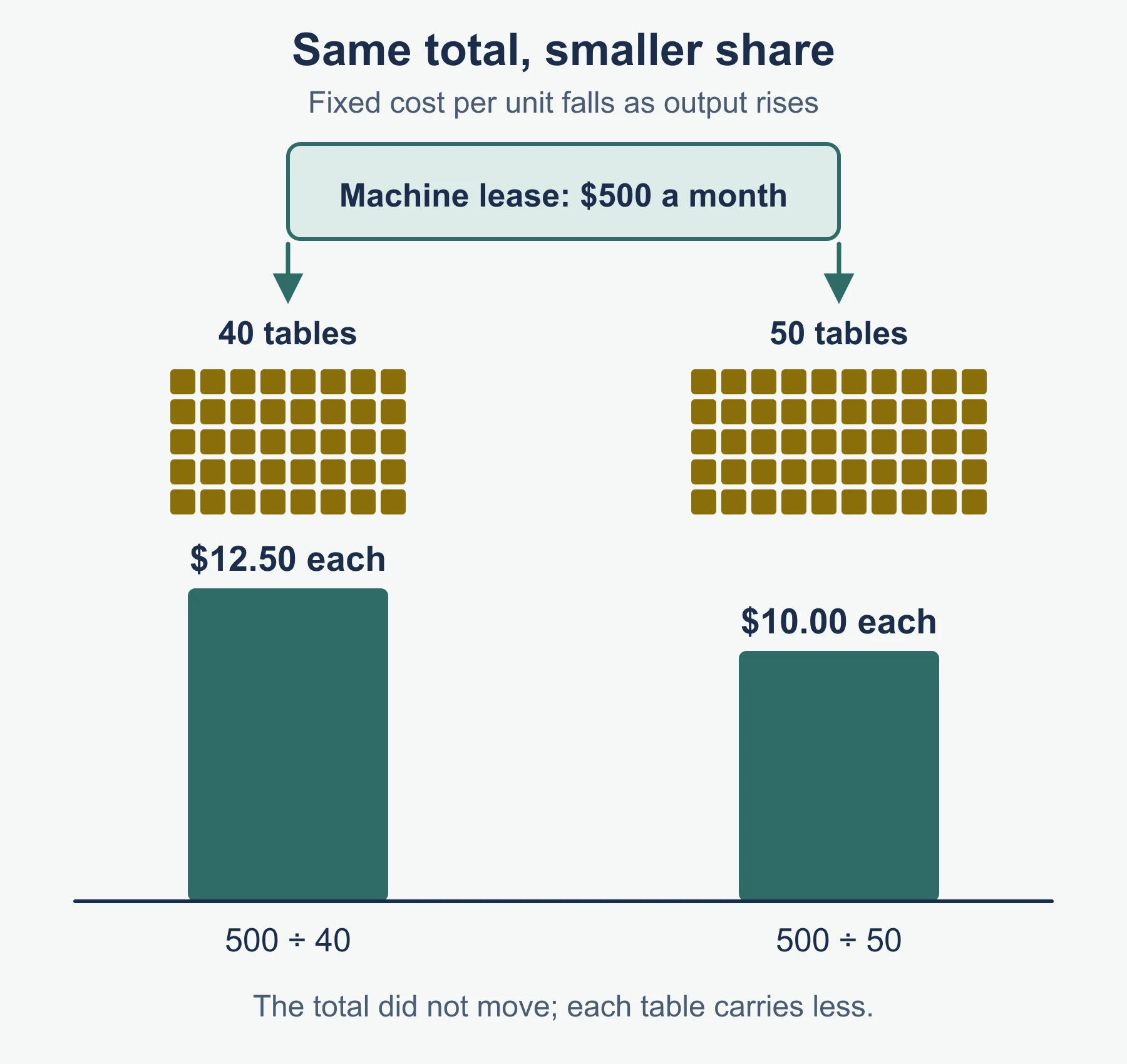
- Fixed total versus fixed per unit: the total stays put, the per-unit figure falls as output rises.
- Variable versus direct: variable describes behavior, direct describes traceability. A cost can be one without the other.
- Revenue versus profit: revenue is before costs. Profit is after.
- Revenue versus cash: a credit sale is revenue now, cash later (see section 3.7).
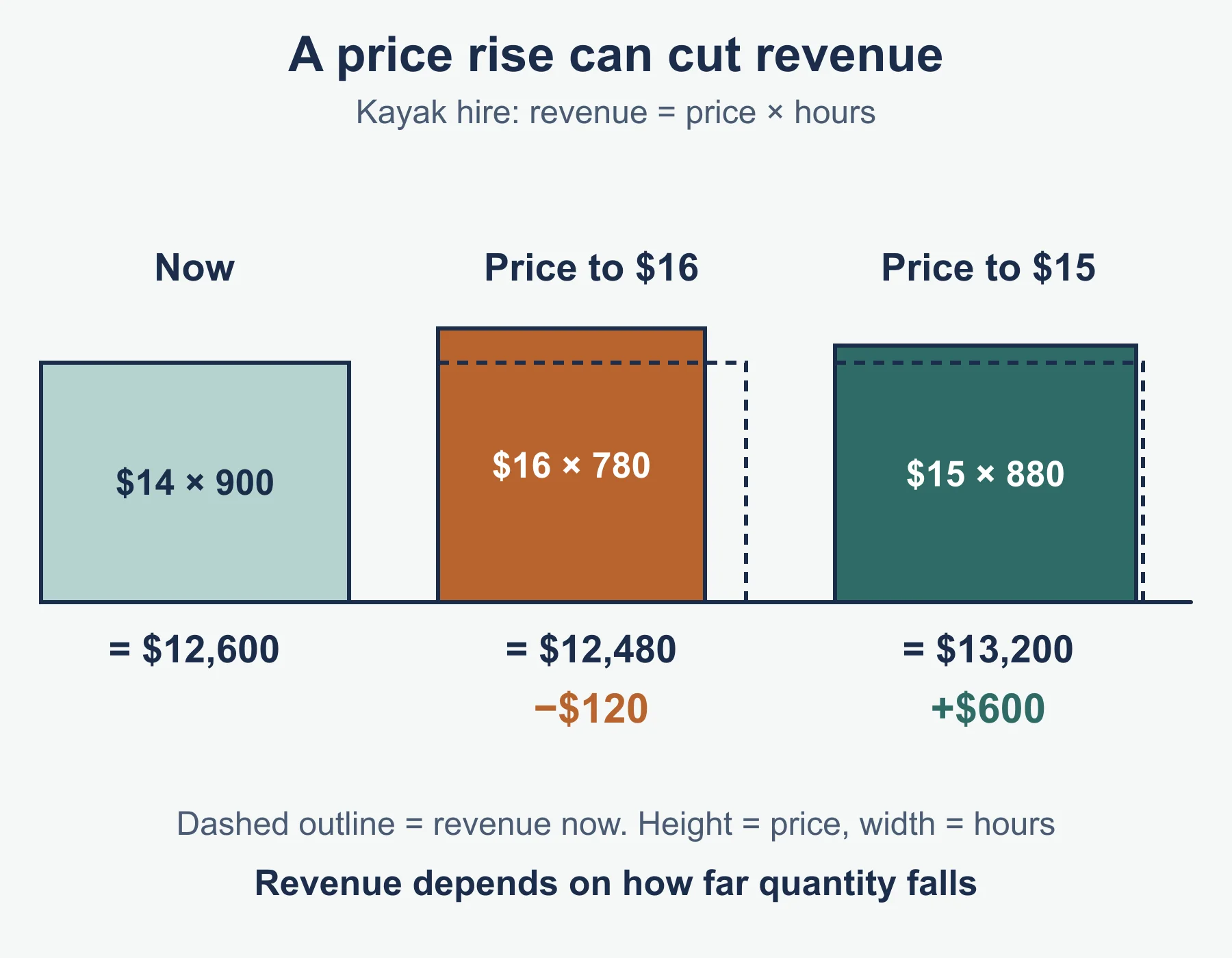
- Price versus total revenue: a price rise can lower total revenue if quantity falls by enough.
- Revenue streams versus products: a stream can also be a service, fee or membership.
Why the types matter (for “explain” and “analyse”)
- Fixed costs must be paid whatever sales are, so a business with high fixed costs is more exposed when demand falls.
- Variable costs track activity, so they fall when output falls and give flexibility.
- Direct costs allow a business to judge a single product.
- Overheads are shared, so cutting one product does not remove them.
- Several revenue streams spread risk, though each stream needs its own costs and management.
Quick self-test
- Define a variable cost.
- A bakery pays a monthly insurance premium. Is it fixed or variable?
- Is cleaning fluid used across a factory and consumed in proportion to output direct or indirect? What is its behavior?
- A business sells 300 units at 8.50 dollars each. Calculate total revenue.
- A business has fixed costs of 1,200 dollars a month. Calculate fixed cost per unit at 400 units and at 600 units.
- State the formula for total cost.
- A gym earns from memberships, personal training and a juice bar. How many revenue streams does it have?
- A business raises its price from 6 to 7 dollars and quantity falls from 1,500 to 1,300. Does total revenue rise or fall, and by how much?
- Give one example of a cost that is both fixed and direct.
- A business has total revenue of 9,000 dollars and total costs of 5,070 dollars. Calculate profit.
Answers
- A cost whose total changes as output changes. [Example: packaging per item.]
- Fixed, because the premium does not change with output.
- Indirect, because it is shared across the whole site. Its behavior is variable, because total use rises with output.
- 300 × 8.50 = 2,550 dollars.
- 1,200 ÷ 400 = 3.00 dollars; 1,200 ÷ 600 = 2.00 dollars.
- Total cost = total fixed costs + total variable costs.
- Three.
- Before: 1,500 × 6 = 9,000. After: 1,300 × 7 = 9,100. It rises by 100 dollars.
- For example, the lease on a machine used only for one product.
- 9,000 − 5,070 = 3,930 dollars.
Where marks are usually lost
- Giving only one label (fixed) when the answer needs both (fixed and direct).
- Calling a cost variable because it is large, rather than because it moves with output.
- Writing “the cost does not change” without saying “with output”.
- Forgetting to multiply price by quantity, or multiplying by the wrong quantity.
- Leaving one revenue stream out of the sum.
- Mixing up total revenue with profit in a follow-up calculation.
- Forgetting the currency or unit in the final answer.
- Giving a generic example when the question asks for one from the business in the stem.
- Treating a price rise as certain to raise revenue, with no thought about quantity.
- Stating fixed cost per unit as constant.
Frequently asked questions
What is the difference between a variable cost and a direct cost? Variable describes behaviour: the total changes as output changes. Direct describes traceability: the cost can be linked to one product. A cost can be one without the other, such as cleaning supplies used across a whole site, which are variable but indirect.
What happens to fixed cost per unit when output rises? The total fixed cost stays the same, but fixed cost per unit falls because it is spread over more units. For example, fixed costs of 1,200 dollars give 3.00 dollars per unit at 400 units and 2.00 dollars per unit at 600 units.
Does a price rise always increase total revenue? No. Total revenue is price × quantity sold, so if quantity falls by enough after a price rise, total revenue can fall.
What is the formula for total cost and profit? In standard form, total cost = total fixed costs + total variable costs, and profit = total revenue − total costs. The IB guide does not print formulas for section 3.3, so these are the standard teaching forms.
Official syllabus
International Baccalaureate Organization, Business management guide, first assessment 2024, section 3.3 Costs and revenues.
Get free revision emails (optional)
Occasional emails with practice questions, worked explanations and links to free resources for the qualification and subjects you choose. No spam, and you can unsubscribe from any email. The free tools on this site never need an email.
Related resources
-
Study guides
IB DP Business Management: Final accounts
Study guide to section 3.4 of IB DP Business Management: purpose of accounts, profit and loss account, balance sheet, intangible assets, HL depreciation.
Business · International Baccalaureate · IB
Read guide -
Practice questions
IB DP Business Management: Final accounts – Practice Questions
Original practice questions with worked answers on IB DP Business Management section 3.4 Final accounts, including HL-only depreciation.
Business · International Baccalaureate · IB
Try questions -
Revision notes
IB DP Business Management: Final accounts – Revision Notes
Condensed revision notes for IB DP Business Management section 3.4 Final accounts, with formulas, layouts and a self-test.
Business · International Baccalaureate · IB
Revise topic
Related articles
-
teaching
A Level tuition in Dubai: Cambridge or Pearson Edexcel International A Level?
Schools in Dubai and Abu Dhabi teach either Cambridge International AS & A Level or Pearson Edexcel International A Level. How the two are structured, why it matters for tuition, and how online classes from Lahore work.
9 October 2026
-
curriculum guides
Choosing subjects at IGCSE and A Level
How subject choices at 14 and 16 affect university options later, and how to keep pathways open without overloading a timetable.
28 July 2026
Studying this with a teacher
Working through Business IB?
This page is free and stays free. If you would rather be taught it, Marlbridge runs Business classes one-to-one, online in your own time zone. The first trial class is free. WhatsApp replies within an hour (8am–11pm Pakistan time, every day); email the same day.
IB Business teachers at Marlbridge

