
Study Guides
IB DP Business Management: Costs and revenues
Study guide to IB DP Business Management section 3.3: fixed, variable, direct and indirect costs, total revenue and revenue streams, with worked examples.
- Subject
- Business
- Level
- IB
- Topic
- Unit 3: Finance and accounts
- Author
- Marlbridge Academic Team
- Updated
- Reviewed by
- Salman Ahmad (what this means)
Aligned to International Baccalaureate IB Diploma Programme Business (DP Business Management), First assessment 2024. Official specification .
Syllabus page (what it covers and how it is assessed): IB Diploma Programme Business.
Syllabus points this page covers
DP Business Management
- 3.3 Costs and revenues
Found an error? Report a correction.
Need help with this topic? Request a free trial class for IB Diploma Programme Business (DP Business Management).
This guide teaches section 3.3 (Costs and revenues) of the IB Business management guide, first assessment 2024. The section sits in Unit 3 (Finance and accounts) and applies to both SL and HL, since the guide marks no part of it as HL only. It lists four types of cost, to be taught “using examples” (fixed, variable, direct and indirect/overhead), and then total revenue and revenue streams, also “using examples”. The guide gives the section an AO2 depth of teaching, so the skill being tested is applying the ideas to a described business, not only defining them.
The Unit 3 overview is in the Unit 3 study guide, and the shorter recall pages are the 3.3 revision notes and the 3.3 practice questions. The Unit 3 revision notes and Unit 3 practice set touch the same ideas more briefly. See the IB Business Management hub, the printable checklist and the free diagnostics to find your weak spots.
What section 3.3 covers
| Guide content | What you should be able to do |
|---|---|
| Fixed costs | Define, give examples, recognize one in a scenario |
| Variable costs | Define, give examples, recognize one in a scenario |
| Direct costs | Define, give examples, recognize one in a scenario |
| Indirect/overhead costs | Define, give examples, recognize one in a scenario |
| Total revenue | Define it and calculate it from price and quantity |
| Revenue streams | Identify the separate sources of a business’s revenue, with examples |
Cost formulas are not printed in the guide’s list for this section, so where this page gives a formula (total cost, total revenue, profit) it is the standard form used in business teaching, not a quotation. Break-even analysis is a separate section (5.5), so it is not taught here, although it builds on these ideas.
Two ways to sort a cost
The most important idea in 3.3 is that the four cost types are not four boxes. They answer two different questions about the same cost.
- How does the cost behave when output changes? It is either fixed or variable.
- Can the cost be traced to one product, service or unit? It is either direct or indirect (also called overhead).
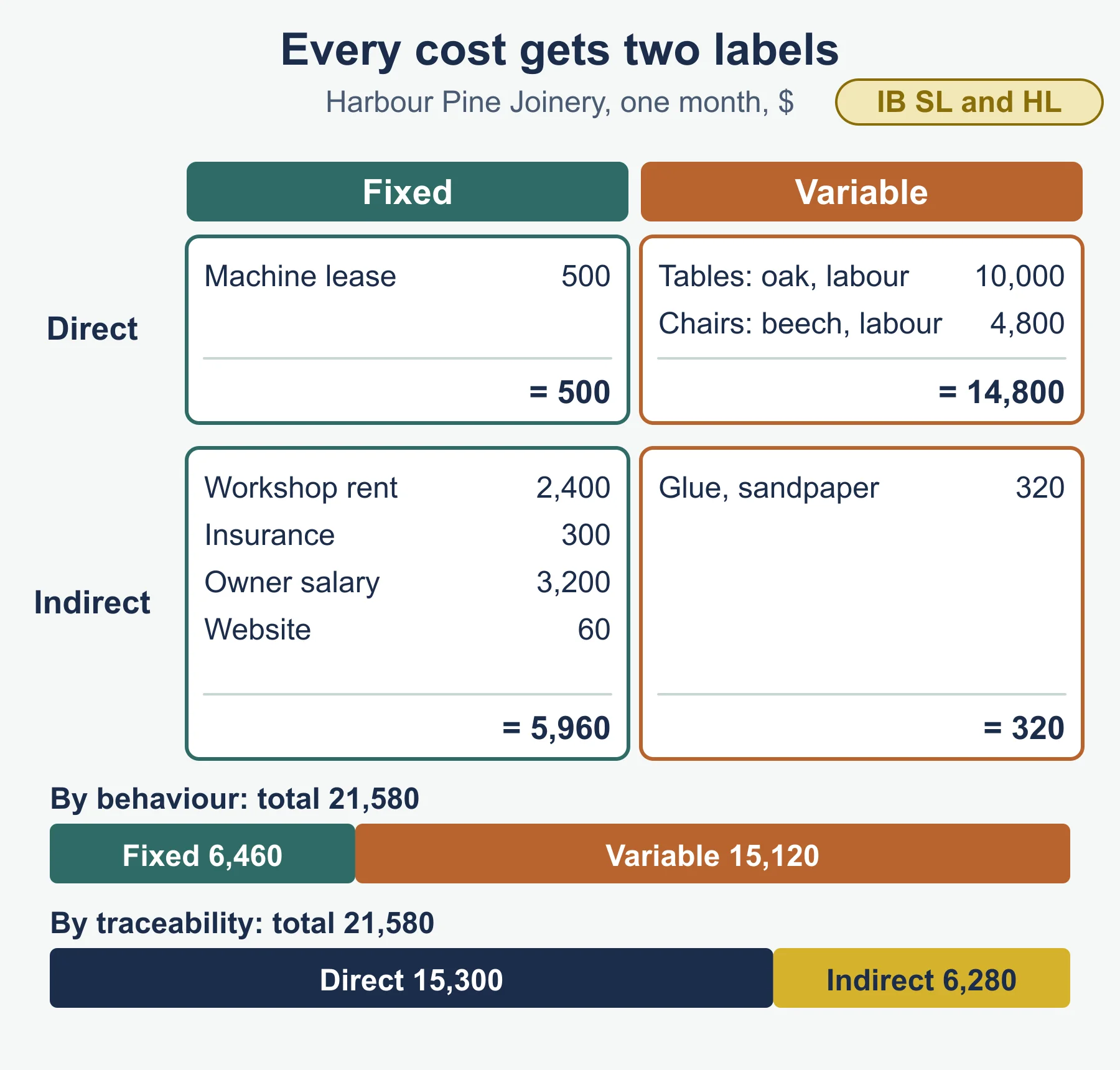
So every cost gets two labels, one from each pair. A cost can be fixed and direct, fixed and indirect, variable and direct, or variable and indirect. An answer that gives both labels and justifies each from the scenario shows the clearest understanding.
Fixed costs
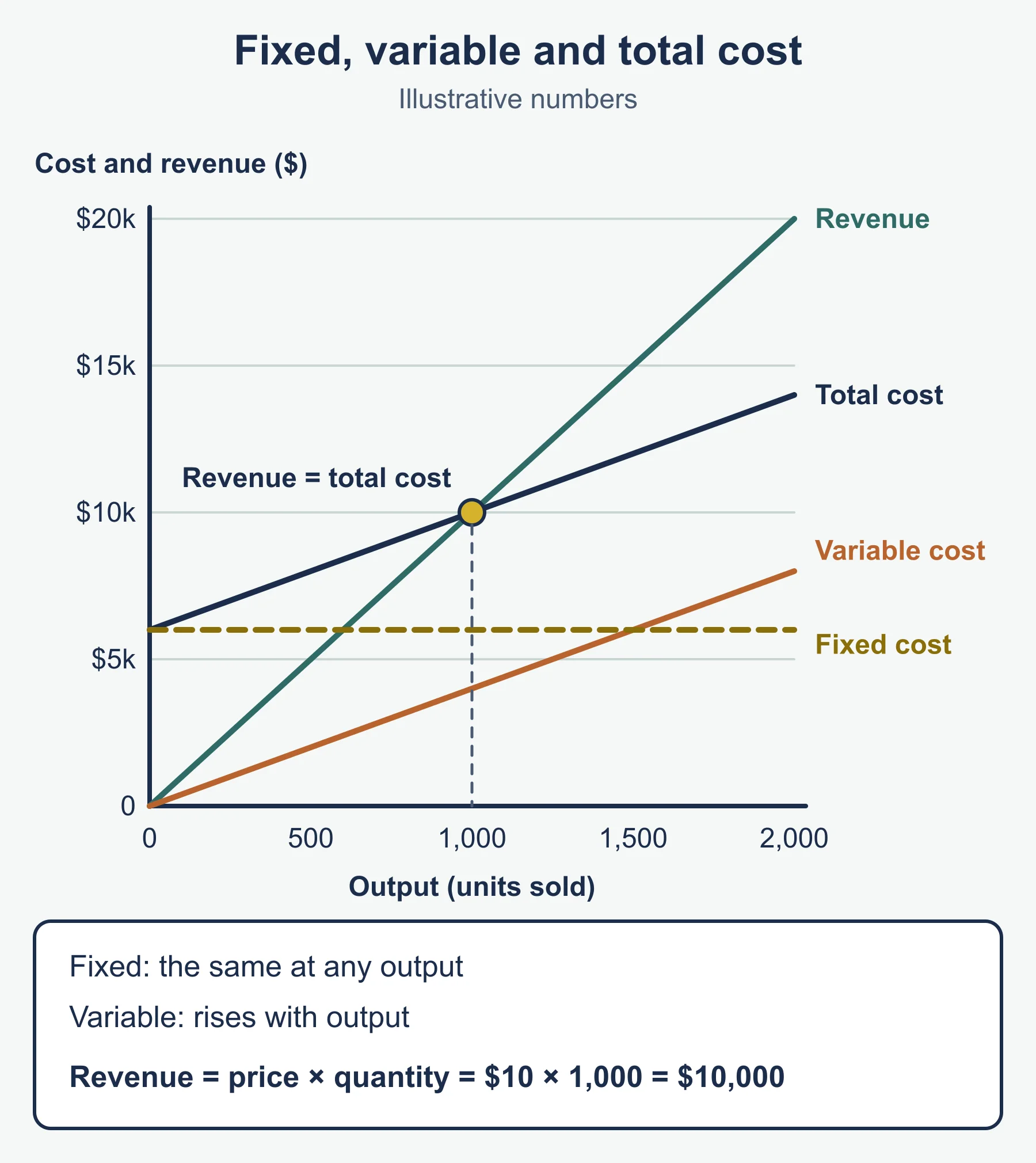
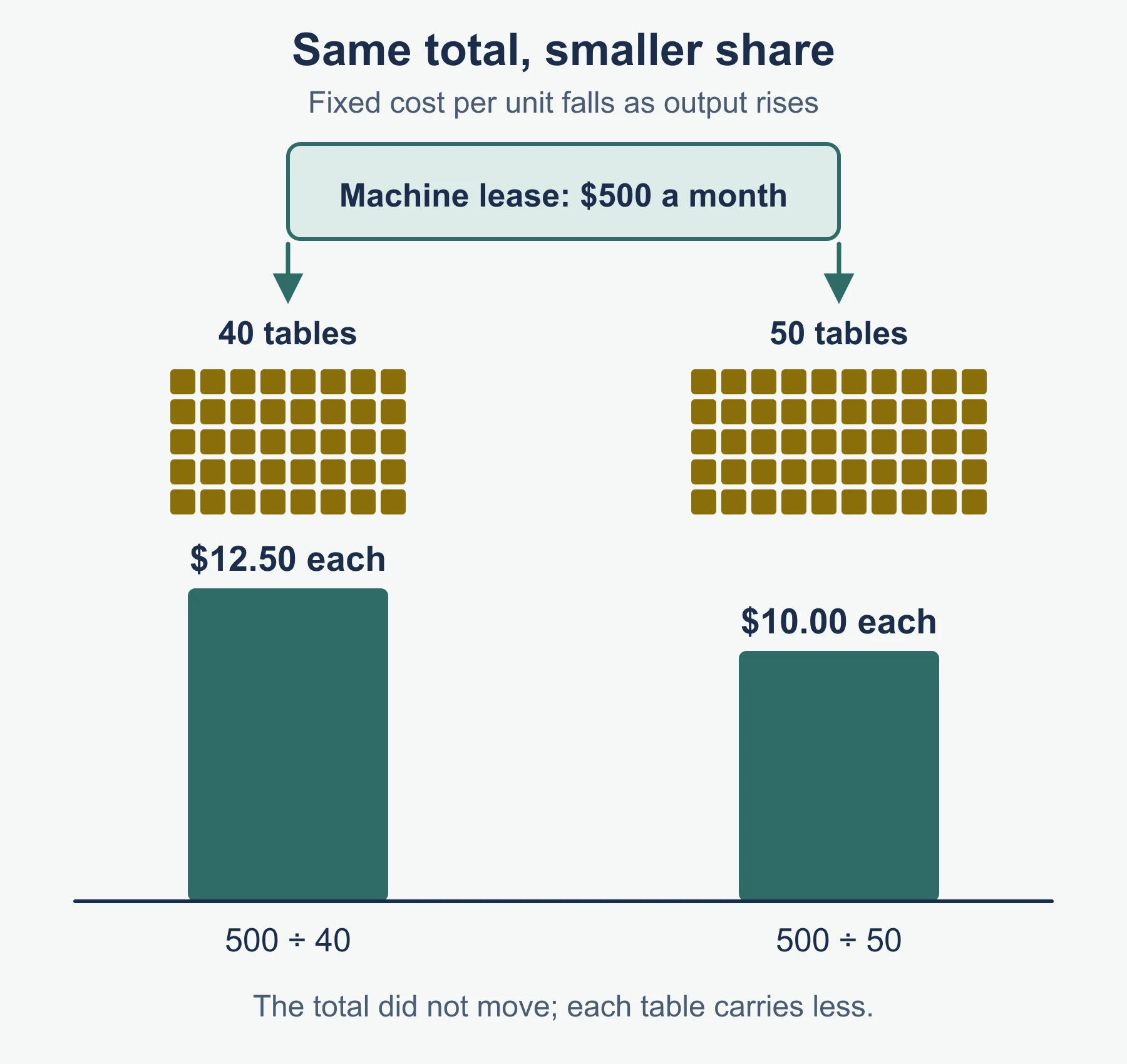
A fixed cost is a cost whose total stays the same when the quantity produced or sold changes, at least over the output range the business is dealing with. Examples are rent on a workshop, insurance, a manager’s salary and a monthly software subscription. The word “fixed” refers to the total. Fixed cost per unit is not fixed: it falls as output rises, because the same total is shared across more units.
Variable costs
A variable cost is a cost whose total changes as output changes. Raw materials, packaging, and wages paid per item made are typical examples. Variable cost per unit stays the same (in the simple model used in school courses), so doubling output doubles total variable cost. Check the scenario wording: wages paid per piece produced are variable, while a salary paid monthly regardless of output is fixed.
Direct costs
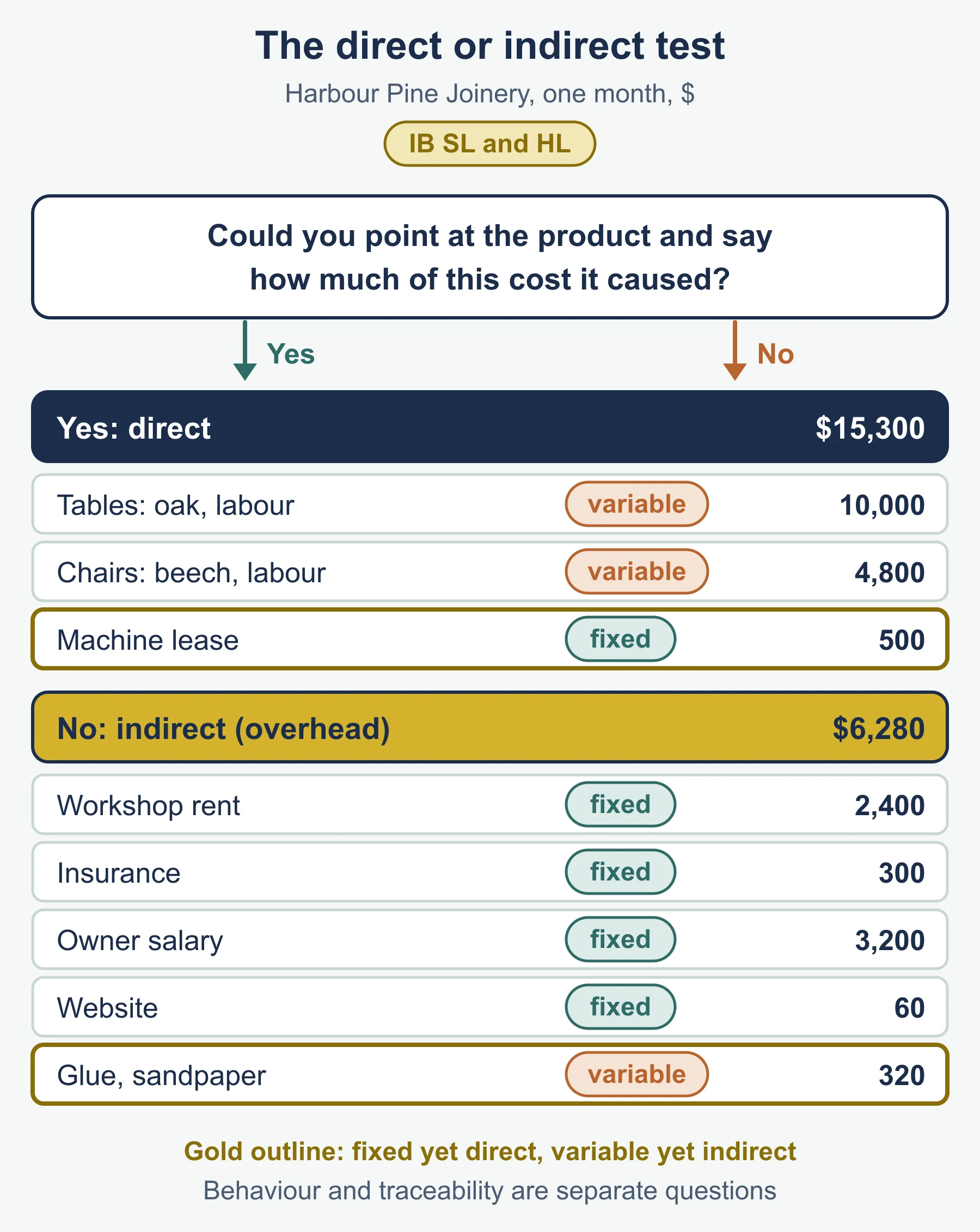
A direct cost can be traced to a particular product, service, department or unit of output. Materials used to make one product and labor paid to make that product are direct costs of that product. The test is traceability: could you point to the product and say how much of this cost it caused?
Indirect costs (overheads)
An indirect cost, or overhead, supports the whole business and cannot sensibly be tied to one product. Head-office rent, general insurance, accounts staff and the website are typical. If a business sells several products, overheads are shared across them, and how to split them is a management judgment.
Worked example: classifying every cost
Harbour Pine Joinery is an invented workshop that makes oak tables and beech chairs. In one month it sells 40 tables at 620 dollars each and 120 chairs at 85 dollars each. All amounts below are in dollars.
| Cost | Amount | Behavior | Traceability |
|---|---|---|---|
| Oak per table | 140 per table | Variable | Direct (tables) |
| Piece-rate labor per table | 110 per table | Variable | Direct (tables) |
| Beech per chair | 18 per chair | Variable | Direct (chairs) |
| Piece-rate labor per chair | 22 per chair | Variable | Direct (chairs) |
| Lease of table-finishing machine | 500 per month | Fixed | Direct (tables) |
| Sandpaper and glue used across all items | 2 per item made | Variable | Indirect |
| Workshop rent | 2,400 per month | Fixed | Indirect |
| Insurance | 300 per month | Fixed | Indirect |
| Owner-manager salary | 3,200 per month | Fixed | Indirect |
| Website hosting | 60 per month | Fixed | Indirect |
Notice two cells that surprise people. The machine lease is fixed and direct: it does not change with output, yet it exists only to finish tables. The sandpaper and glue are variable and indirect: the total rises with output, but no one can say how much belongs to a table and how much to a chair.
Step 1: total revenue. Tables 40 × 620 = 24,800. Chairs 120 × 85 = 10,200. Total revenue = 35,000.
Step 2: total variable costs.
- Tables: 40 × (140 + 110) = 10,000
- Chairs: 120 × (18 + 22) = 4,800
- Sandpaper and glue: (40 + 120) × 2 = 320
- Total variable costs = 15,120
Step 3: total fixed costs. 500 + 2,400 + 300 + 3,200 + 60 = 6,460.
Step 4: total costs. Total costs = fixed costs + variable costs (standard form) = 6,460 + 15,120 = 21,580.
Step 5: profit before tax and interest. Profit = total revenue − total costs (standard form) = 35,000 − 21,580 = 13,420.
Step 6: cross-check with the other classification. Direct costs = 10,000 + 500 + 4,800 = 15,300. Indirect costs = 2,400 + 300 + 3,200 + 60 + 320 = 6,280. Together they make 21,580, the same total, which confirms that each cost was counted once under each pair of labels.
What changes if output changes
Suppose next month the workshop sells 50 tables and still 120 chairs. Table variable costs become 50 × 250 = 12,500, chair costs stay 4,800, and sandpaper and glue become 170 × 2 = 340, so total variable costs are 17,640. Fixed costs stay at 6,460, so total costs are 24,100. Revenue is 50 × 620 + 10,200 = 41,200, so profit is 17,100.
The machine lease per table fell from 500 ÷ 40 = 12.50 to 500 ÷ 50 = 10.00 dollars. The total did not move; the share carried by each table did. This is the fixed-cost-per-unit effect, and it is why business owners often want higher output when fixed costs are heavy.
Why the distinctions matter to a business
- Knowing which costs are variable shows what extra output will add to spending. Knowing which are fixed shows what must be paid even if sales are poor.
- Direct costs let a manager judge one product on its own. A table line that covers its direct costs but not a fair share of overheads is a different case from one that does not even cover its direct costs.
- Overheads are shared, so a decision to drop one product does not make its share of overheads disappear. The shared costs must then be carried by the remaining products.
- A business with high fixed costs is exposed if demand falls, because most of its spending does not fall with it.
These are points you can use in “explain” and “analyse” answers, always tied to the business in the stem.
Total revenue
Total revenue is the money a business earns from selling its goods and services in a period, before any costs are taken off. In standard form, total revenue = price × quantity sold. Where a business has several products or services, calculate each product’s revenue and add them, as in Step 1 above. Total revenue is not profit, and it is not necessarily cash received in the period: a sale made on credit counts as revenue when made, but the cash arrives later.
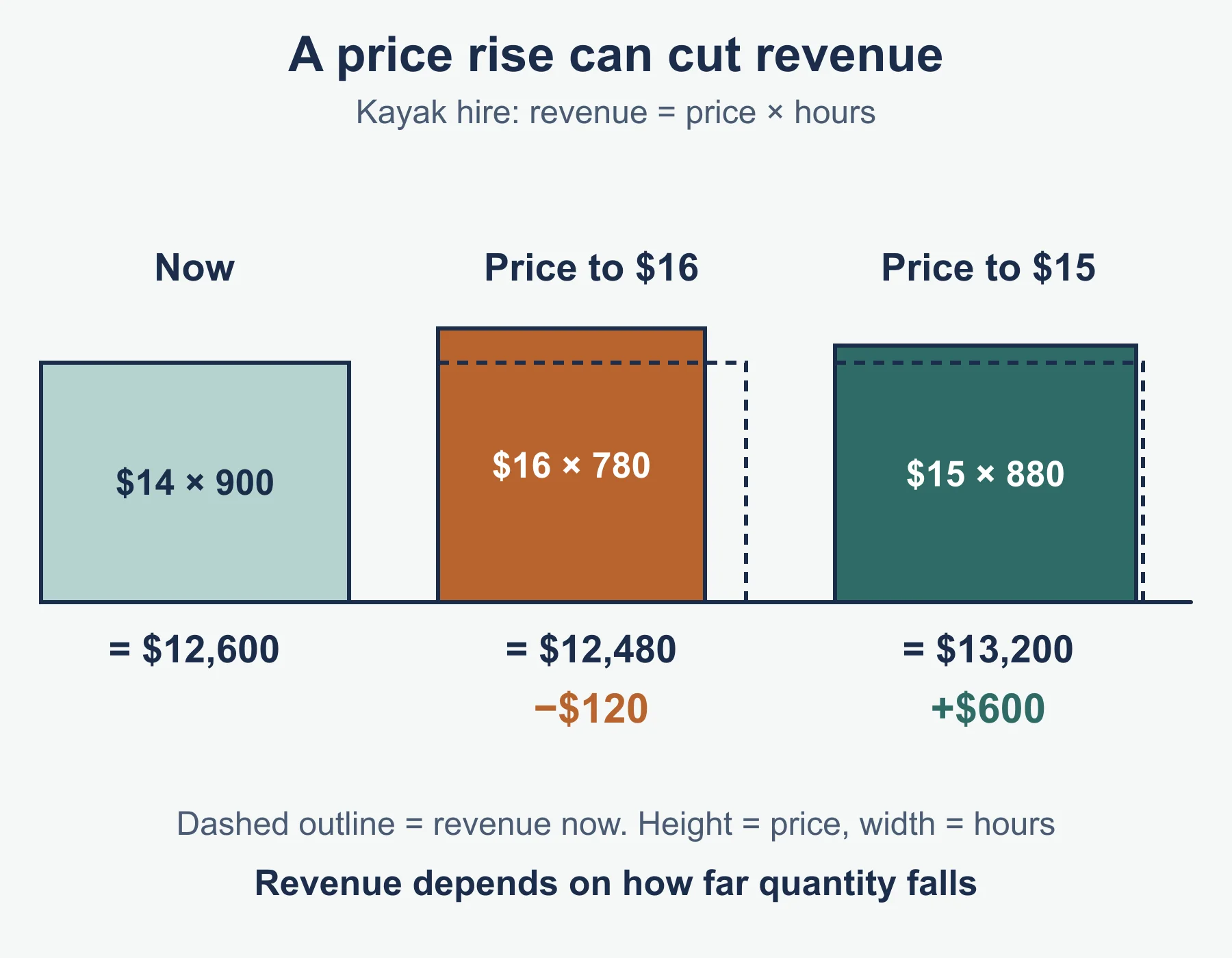
Price changes need care. A higher price does not guarantee higher total revenue, because quantity sold may fall. Whether total revenue rises or falls depends on how far quantity responds.
Revenue streams
A revenue stream is one distinct source of a business’s revenue, such as a particular product line, service or fee. Most businesses have more than one. Total revenue is the sum of all streams, and each stream is calculated as price × quantity (or, where prices differ across sales, number of sales × average price per sale).
Worked example: revenue streams
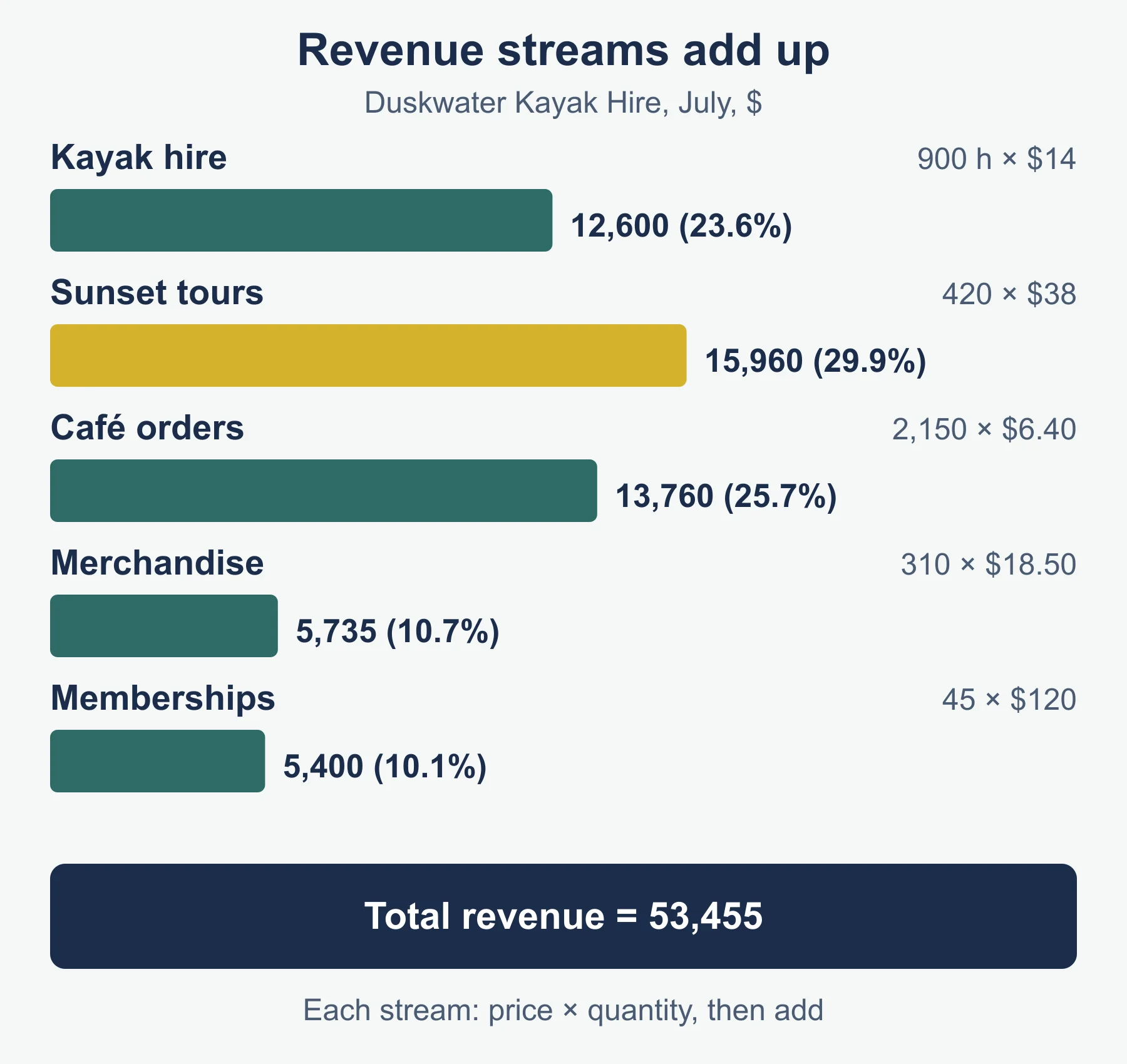
Duskwater Kayak Hire is an invented coastal business. Its July figures, in dollars, are below.
| Revenue stream | Quantity | Price | Revenue | Share of total |
|---|---|---|---|---|
| Kayak hire | 900 hours | 14 per hour | 12,600 | 23.6% |
| Sunset tours | 420 places | 38 per place | 15,960 | 29.9% |
| Café orders | 2,150 orders | 6.40 average | 13,760 | 25.7% |
| Merchandise | 310 items | 18.50 average | 5,735 | 10.7% |
| Annual memberships | 45 sold | 120 each | 5,400 | 10.1% |
| Total revenue | 53,455 | 100% |
Reading the table: the largest stream is the tours, at about 30 percent. No stream is more than a third of the total, so a wet week that cancels tours would hurt, but not destroy, the month. A business that depends on a single stream is more exposed. This is a fair point for a “discuss” or “evaluate” answer, so long as you link it to the figures.
Now test a price rise on one stream. If hire rises from 14 to 16 dollars and hours fall to 780, revenue from hire becomes 16 × 780 = 12,480, which is lower than 12,600. If the rise were to 15 dollars and hours fell only to 880, revenue would be 13,200, which is higher. Same direction of price change, opposite effect on revenue, because the fall in quantity differs.
The membership line deserves a small note. If members pay 120 dollars up front for a year, a business may collect the cash in one month although the service lasts twelve. Treat that as a reminder that revenue and cash flow are different ideas, which section 3.7 covers.
Answering exam questions on this section
- Define: give the key idea in one precise sentence. For “indirect cost”, say it cannot be traced to a single product and supports the whole business.
- Identify or state: name the cost or stream, no explanation needed.
- Calculate: write the formula, substitute, and give the unit (a currency amount).
- Explain: say what it is, then link to the business in the stem using a figure or detail from it.
- Analyse and evaluate: develop a consequence, such as effect on profit, then weigh alternatives and reach a judgment. Raising price, adding a stream, or cutting output all have costs and benefits.
Common errors
- Treating “fixed” as “direct” or “variable” as “indirect”. These are different questions.
- Calling a cost fixed because the stem says it is paid every month, when the stem also says it rises with each item produced.
- Saying fixed cost per unit is fixed.
- Adding unit price and unit cost together instead of multiplying by quantity.
- Calling revenue “profit” or treating revenue as the amount left after costs.
- Listing products as revenue streams but forgetting fees, memberships or other income named in the stem.
- Giving a textbook example with no link to the business described.
Next steps
Work through the 3.3 practice questions, then use the 3.3 revision notes for quick recall. The Unit 3 study guide shows how this section connects to final accounts and ratios.
Frequently asked questions
What is an indirect cost (overhead)? An indirect cost, or overhead, supports the whole business and cannot sensibly be traced to a single product. Examples include head-office rent, general insurance, accounts staff and the website.
What is a revenue stream in IB Business Management? A revenue stream is one distinct source of a business’s revenue, such as a product line, service, fee or membership. Total revenue is the sum of price × quantity for every stream.
Why does the difference between fixed and variable costs matter to a business? Fixed costs must be paid whatever sales are, so a business with high fixed costs is more exposed when demand falls. Variable costs track activity, so they fall when output falls and give the business flexibility.
If a business drops a product, do its overheads disappear? No. Overheads are shared, so dropping one product does not remove its share of them; those costs must then be carried by the remaining products.
Official syllabus
International Baccalaureate Organization, Business management guide, first assessment 2024, section 3.3 Costs and revenues.
Get free revision emails (optional)
Occasional emails with practice questions, worked explanations and links to free resources for the qualification and subjects you choose. No spam, and you can unsubscribe from any email. The free tools on this site never need an email.
Related resources
-
Practice questions
IB DP Business Management: Costs and revenues – Practice Questions
Original IB DP Business Management practice questions on section 3.3 costs and revenues, with fully worked answers and examiner insights.
Business · International Baccalaureate · IB
Try questions -
Revision notes
IB DP Business Management: Costs and revenues – Revision Notes
Condensed IB DP Business Management revision notes for section 3.3: cost types, total revenue and revenue streams, with a quick self-test.
Business · International Baccalaureate · IB
Revise topic -
Study guides
IB DP Business Management: Final accounts
Study guide to section 3.4 of IB DP Business Management: purpose of accounts, profit and loss account, balance sheet, intangible assets, HL depreciation.
Business · International Baccalaureate · IB
Read guide
Related articles
-
teaching
A Level tuition in Dubai: Cambridge or Pearson Edexcel International A Level?
Schools in Dubai and Abu Dhabi teach either Cambridge International AS & A Level or Pearson Edexcel International A Level. How the two are structured, why it matters for tuition, and how online classes from Lahore work.
9 October 2026
-
curriculum guides
Choosing subjects at IGCSE and A Level
How subject choices at 14 and 16 affect university options later, and how to keep pathways open without overloading a timetable.
28 July 2026
Studying this with a teacher
Working through Business IB?
This page is free and stays free. If you would rather be taught it, Marlbridge runs Business classes one-to-one, online in your own time zone. The first trial class is free. WhatsApp replies within an hour (8am–11pm Pakistan time, every day); email the same day.
IB Business teachers at Marlbridge

