
Revision Notes
IB DP Business Management: Budgets (HL only) – Revision Notes
Condensed revision notes for IB DP Business Management 3.9 (HL only): centres, budget layout, variance rules, F and A labels, and decisions.
- Subject
- Business
- Level
- IB
- Topic
- Unit 3: Finance and accounts
- Author
- Marlbridge Academic Team
- Updated
- Reviewed by
- Salman Ahmad (what this means)
Aligned to International Baccalaureate IB Diploma Programme Business (DP Business Management), First assessment 2024. Official specification .
Syllabus page (what it covers and how it is assessed): IB Diploma Programme Business.
Syllabus points this page covers
DP Business Management
- 3.9 Budgets (HL only)
Found an error? Report a correction.
Need help with this topic? Request a free trial class for IB Diploma Programme Business (DP Business Management).
These notes condense section 3.9, Budgets, from Unit 3 of the IB Business management guide, first assessment 2024. The section is HL only. For full explanations and the longer worked examples, read the study guide first, then test yourself with the practice questions.
Other links: the course hub is IB DP Business Management, the printable list is the syllabus checklist, and the free diagnostics show which topics need work. Earlier Unit 3 material is in the Unit 3 overview and its revision summary, and the cost ideas are in costs and revenues.
The five content points
| Guide content point | Depth of teaching | One-line reminder |
|---|---|---|
| Difference between cost and profit centres | AO2 | Cost centres record costs only. Profit centres record costs and revenue. |
| Roles of cost and profit centres | AO2 | Control and accountability. Performance judgment and investment decisions. |
| Constructing a budget | AO2, AO4 | Forecast revenue, cost each item, find profit, total across the period. |
| Variances | AO2, AO4 | Actual minus budget, then label favorable or adverse. |
| Importance of budgets and variances in decision-making | AO2 | Plan, control, coordinate, review, but only as good as the assumptions. |
Definitions to learn
| Term | Meaning (standard working definition) |
|---|---|
| Budget | A financial plan for a future period, stated in money terms |
| Cost centre | A part of a business where costs are collected but no revenue is attributed |
| Profit centre | A part of a business where both costs and revenue are identified, so profit can be found |
| Variance | The difference between the actual figure and the budgeted figure |
| Favorable variance | A variance that increases profit compared with the budget |
| Adverse variance | A variance that reduces profit compared with the budget |
Cost centre or profit centre?
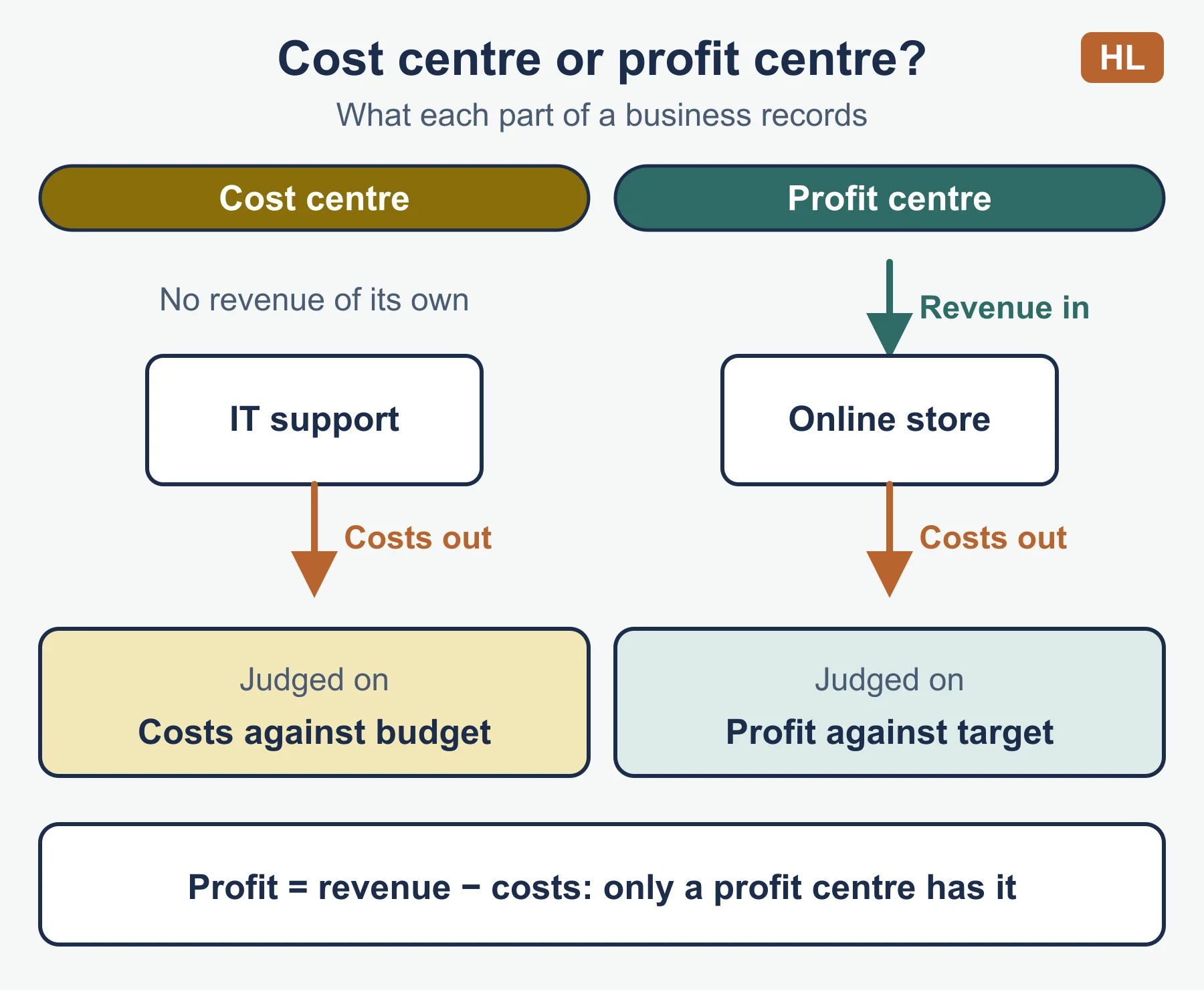
Ask one question: does this part of the business earn revenue that can be traced to it?
- Yes: profit centre. Examples: a shop, an online store, a branch, a product line with its own sales.
- No: cost centre. Examples: human resources, IT support, finance, cleaning, security.
Roles in brief:
| Cost centre | Profit centre | |
|---|---|---|
| Aim of the manager | Keep spending within the budget | Meet revenue, cost and profit targets |
| Main use to owners | Control and accountability | Judge performance, decide where to invest or review |
| Main risk | Cutting cost lowers the service others receive | Managers pursue their own profit and ignore the whole business |
Method: constructing a budget
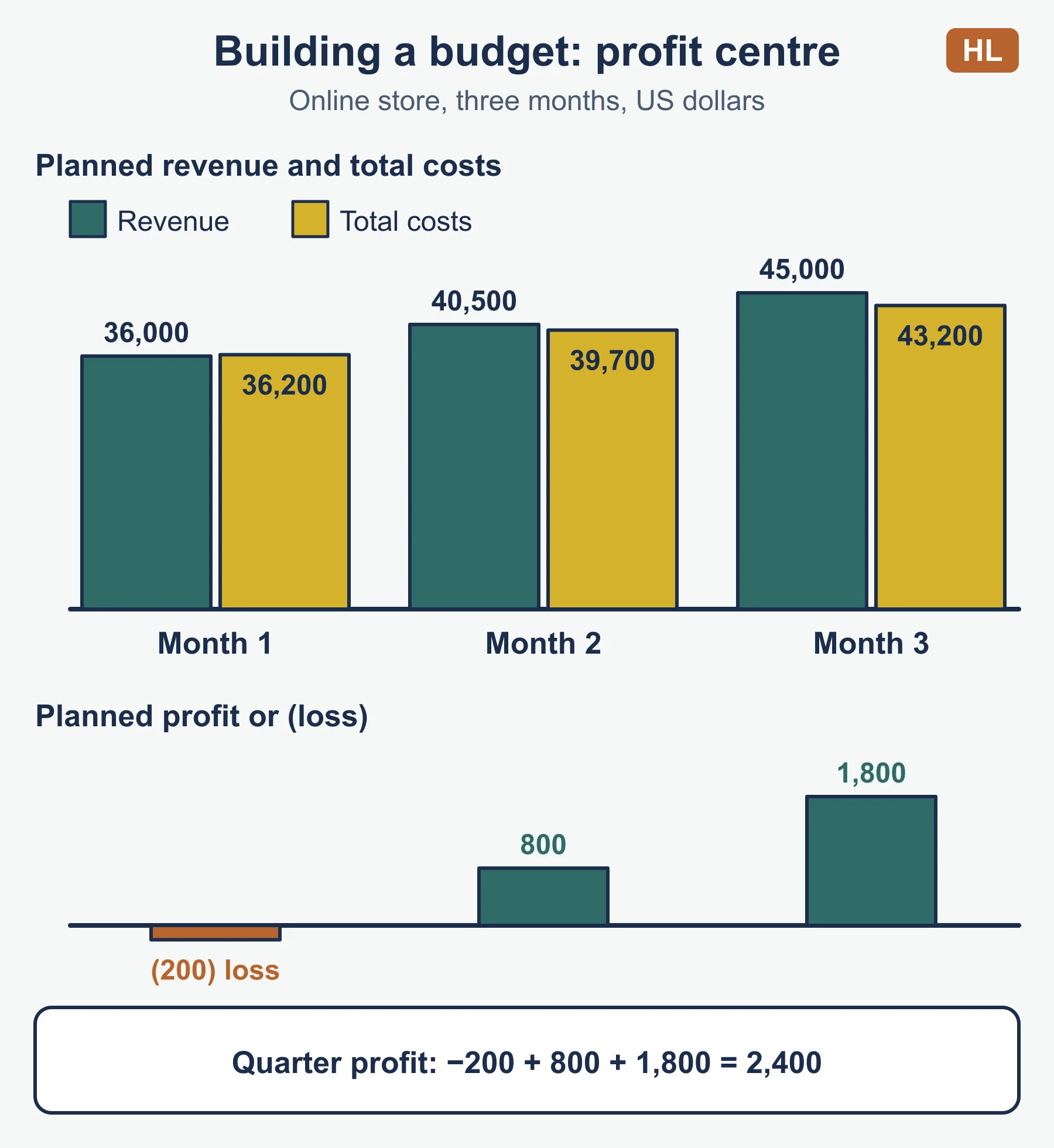
- Choose the period and split it into months.
- Forecast units and price, then work out sales revenue (units × price).
- Calculate variable costs (cost per unit × units) and list fixed costs by month.
- Calculate gross profit (sales revenue − cost of sales), then deduct other expenses.
- Find profit or loss for each month and total each row.
- Cross-check: the monthly totals across must equal the column totals down.
- State your assumptions.
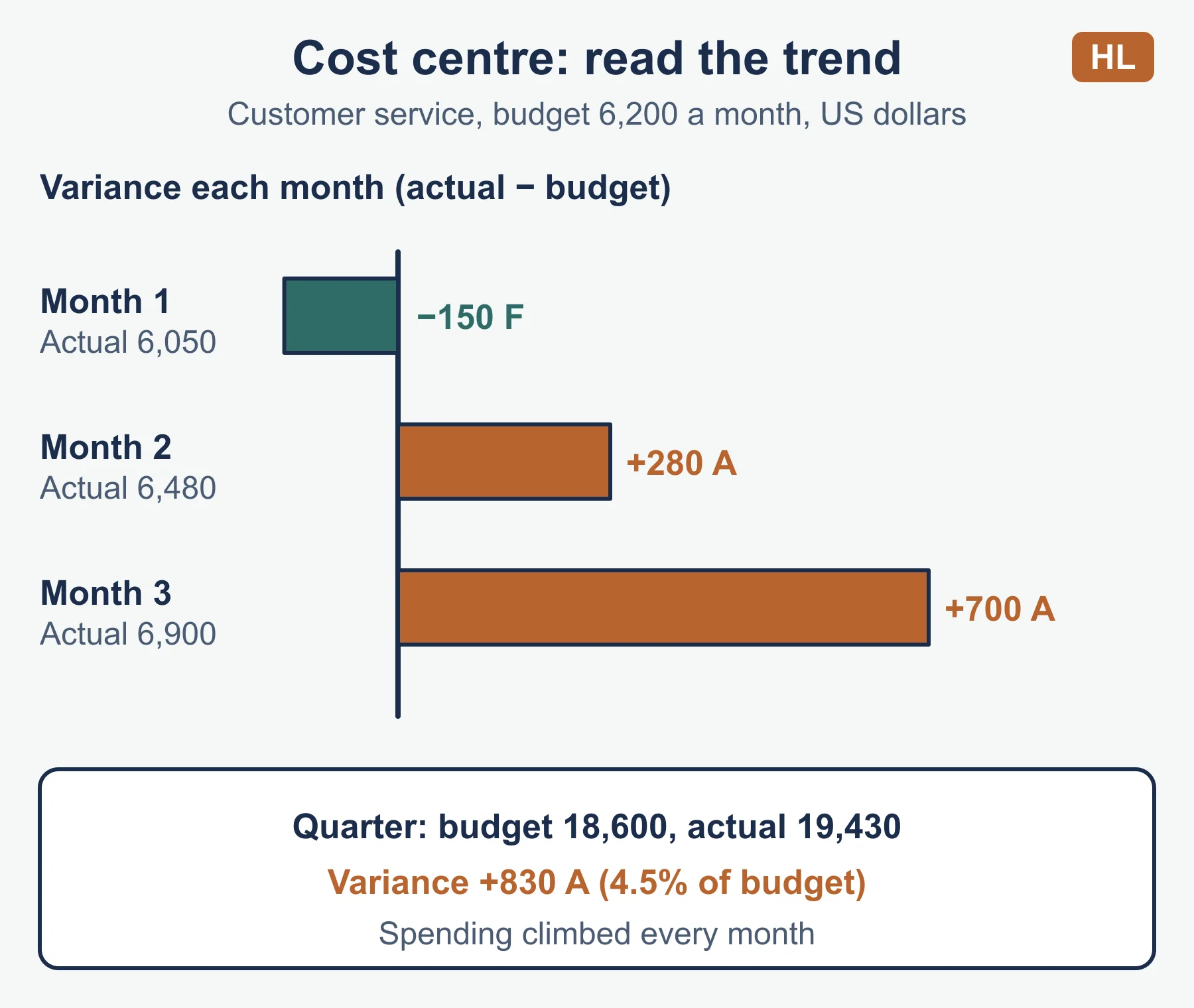
A cost centre budget is the same but stops after the cost lines.
Mini reminder with new numbers: a stall plans 450 units at a price of 14 dollars. Unit cost is 9 dollars and fixed costs are 1,200 dollars. Revenue is 6,300 and variable cost is 4,050. Profit is 6,300 − 4,050 − 1,200 = 1,050.
Method: variances
- Write the budget figure and the actual figure for the same item and period.
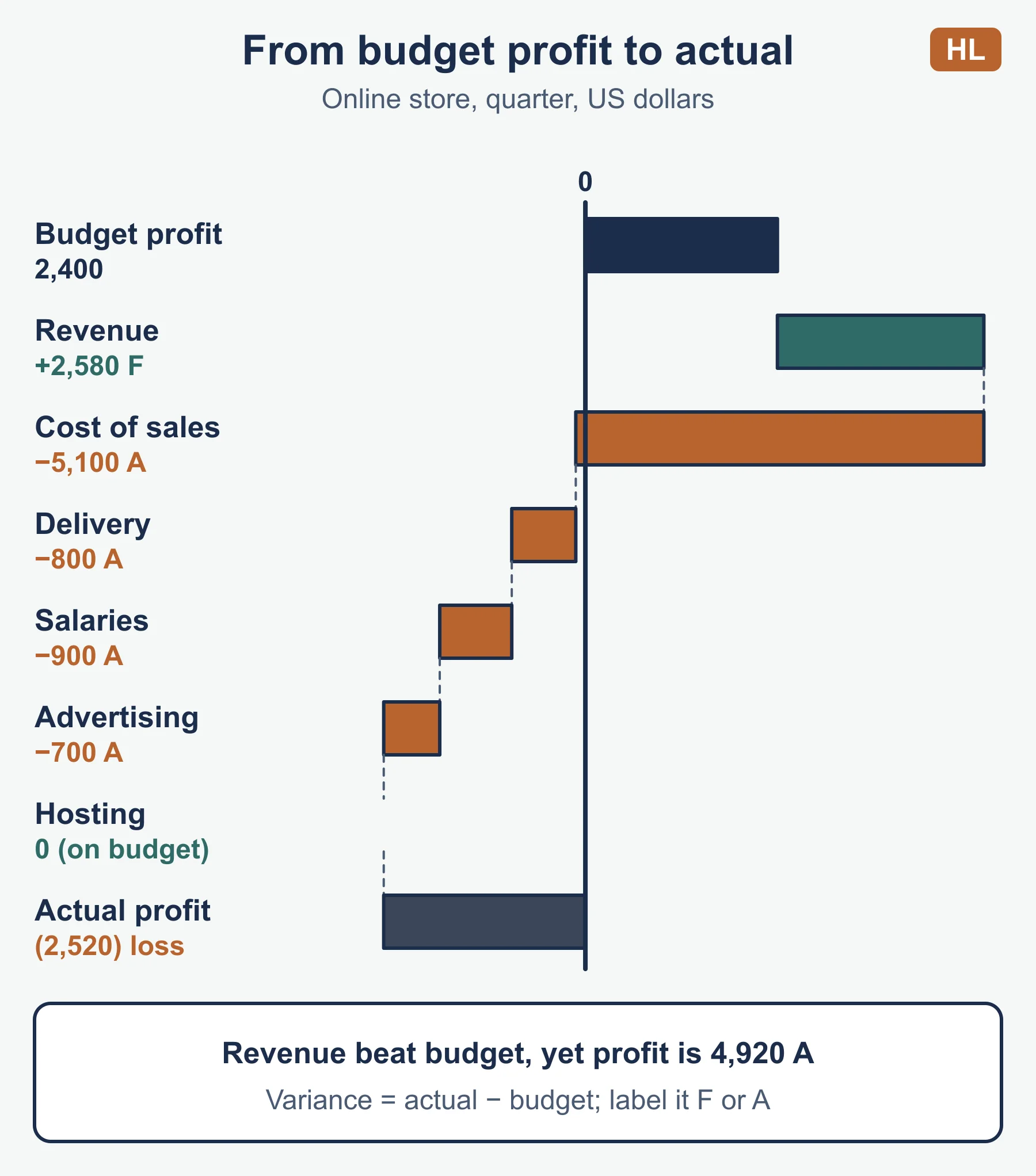
- Variance = actual − budget.
- Percentage = variance ÷ budget × 100. Divide by budget, not actual. This is the standard form, as the guide’s formulae list does not give one.
- Decide F or A using the rule below.
- Suggest a reason that fits the case.
| Item | Actual above budget | Actual below budget |
|---|---|---|
| Revenue | F | A |
| Profit | F | A |
| Cost | A | F |
A memory aid: ask “did this make profit bigger than planned?” If yes, favorable.
Worked reminder: Kowhai Candles
Kowhai Candles budgets one month for its workshop profit centre. The actual figures are alongside.
| US dollars | Budget | Actual | Variance | % of budget | F or A |
|---|---|---|---|---|---|
| Sales revenue | 18,000 | 19,350 | +1,350 | +7.5 | F |
| Wax and materials | 6,400 | 7,040 | +640 | +10.0 | A |
| Rent | 2,500 | 2,500 | 0 | 0.0 | none |
| Wages | 3,100 | 3,380 | +280 | +9.0 | A |
| Profit | 6,000 | 6,430 | +430 | +7.2 | F |
The profit variance is favorable (+430) even though two cost variances are adverse. This is because the revenue gain of 1,350 outweighs the extra costs of 920. Check: 1,350 − 640 − 280 = 430.
Costs rose by 10.0% on materials while revenue rose by only 7.5%, so profit per unit of revenue is under pressure. A manager should ask whether the extra sales needed extra wax, or whether the wax supplier raised its price.
Causes to quote
| Variance | Possible reasons |
|---|---|
| Revenue favorable | Higher demand, successful promotion, price increase, new customers |
| Revenue adverse | Discounts, weak demand, a competitor’s action, a poor forecast |
| Cost adverse | Supplier price rise, waste, overtime, inflation, extra volume |
| Cost favorable | Efficiency gain, supplier discount, lower volume, cuts in quality or maintenance (check these) |
Tie the reason to the case. Quote a figure from the stem.
Budgets and decision-making
For each benefit, add one limit.
| Benefit | Limit |
|---|---|
| Planning and setting targets | Forecasts can be wrong |
| Coordination between departments | Takes time and can become rigid |
| Control of spending | May stop useful, unplanned spending |
| Accountability of centre managers | Managers may pad costs or understate sales |
| Variances direct attention to problems | A variance shows what happened, not why |
| Better later forecasts | Fixing past variances may lead to short-term thinking |
Conclusion template for “evaluate” or “justify” questions: budgets are most useful when assumptions are stated and realistic, variances are investigated rather than just reported, and managers take part in setting the targets. The guide’s theory of knowledge prompt asks what assumptions underlie the techniques used when budgeting, which fits that point well.
Quick self-test
- State what a cost centre is.
- State what a profit centre is.
- Is a company’s IT support team normally a cost centre or a profit centre? Give a reason.
- A budget for materials is 8,000 dollars. Actual spending is 7,600 dollars. Calculate the variance, the percentage, and say whether it is favorable or adverse.
- Budgeted revenue is 25,000 dollars. Actual revenue is 21,750 dollars. Calculate the variance, the percentage, and label it F or A.
- Budgeted profit is 4,000 dollars. Actual profit is 5,200 dollars. Calculate the variance and percentage.
- In the Kowhai table, which two lines show adverse variances?
- Give one reason why a favorable cost variance might be bad news.
- Name two benefits of a budget for decision-making.
- Give one limitation of using variances to judge a manager.
Answers
- A part of a business where costs are identified and collected, but revenue is not attributed to it.
- A part of a business where both costs and revenue are identified, so its profit can be measured.
- A cost centre. It supports other parts of the business and does not earn revenue on its own.
- 7,600 − 8,000 = −400, which is 400 below budget. The percentage is −400 ÷ 8,000 × 100 = −5.0%. It is a cost, so below budget is favorable (F).
- 21,750 − 25,000 = −3,250. The percentage is −3,250 ÷ 25,000 × 100 = −13.0%. Revenue is below budget, so it is adverse (A).
- 5,200 − 4,000 = +1,200, which is +30.0% of budget and favorable.
- Wax and materials (+640), and wages (+280).
- The saving may have come from cutting quality, delaying maintenance or buying fewer inputs than the sales needed, which could damage future sales.
- Any two from: planning, control of spending, coordination, accountability, resource allocation, motivation, appraisal.
- The manager may not control the cause, for example a supplier price rise or a market downturn, so the variance can be unfair as a measure of effort.
Where marks are usually lost
- Writing “favorable” for any positive number, even when the item is a cost.
- Calculating the percentage against the actual figure rather than the budget.
- Dropping the F or A label, or the sign of the variance.
- Defining a cost centre as a department that makes a loss. It is about recording costs only.
- Giving a list of benefits of budgeting with no link to the business in the case.
- Giving a reason for a variance that contradicts the data, such as “higher demand” for a revenue shortfall.
- Stopping an “evaluate” answer after the advantages, with no limits and no judgment.
- Forgetting to state assumptions or to total rows and columns twice.
Frequently asked questions
What is the difference between a cost centre and a profit centre? A cost centre is a part of a business to which costs can be charged but which earns no revenue of its own, such as human resources or IT support. A profit centre records both revenue and costs, so its profit can be measured.
How do you construct a budget in IB Business Management? Divide the period into months, forecast sales volume and price to find revenue, work out variable and fixed costs, subtract cost of sales and other expenses to reach profit or loss, then total each row and check the totals.
What is a variance? A variance is the difference between a budgeted figure and the actual figure for the same item and period, found as actual minus budgeted.
What layout do IB budget questions use? The guide’s appendix says budgets in case studies or examination questions follow the layout in its figure 11, “Budget: Profit and non-profit entity”.
Official syllabus
IB Diploma Programme Business management guide, first assessment 2024, published by the International Baccalaureate Organization. This page covers section 3.9, Budgets (HL only).
Get free revision emails (optional)
Occasional emails with practice questions, worked explanations and links to free resources for the qualification and subjects you choose. No spam, and you can unsubscribe from any email. The free tools on this site never need an email.
Related resources
-
Study guides
IB DP Business Management: Cash flow
Study guide to section 3.7 of IB DP Business Management: profit versus cash flow, working capital, liquidity, cash flow forecasts and strategies.
Business · International Baccalaureate · IB
Read guide -
Practice questions
IB DP Business Management: Cash flow – Practice Questions
Original practice questions with worked answers on IB DP Business Management section 3.7: profit and cash flow, working capital, forecasts and strategies.
Business · International Baccalaureate · IB
Try questions -
Revision notes
IB DP Business Management: Cash flow – Revision Notes
Condensed revision notes for IB DP Business Management section 3.7: cash flow versus profit, working capital, liquidity, forecasts and strategies.
Business · International Baccalaureate · IB
Revise topic
Related articles
-
teaching
A Level tuition in Dubai: Cambridge or Pearson Edexcel International A Level?
Schools in Dubai and Abu Dhabi teach either Cambridge International AS & A Level or Pearson Edexcel International A Level. How the two are structured, why it matters for tuition, and how online classes from Lahore work.
9 October 2026
-
curriculum guides
Choosing subjects at IGCSE and A Level
How subject choices at 14 and 16 affect university options later, and how to keep pathways open without overloading a timetable.
28 July 2026
Studying this with a teacher
Working through Business IB?
This page is free and stays free. If you would rather be taught it, Marlbridge runs Business classes one-to-one, online in your own time zone. The first trial class is free. WhatsApp replies within an hour (8am–11pm Pakistan time, every day); email the same day.
IB Business teachers at Marlbridge

