
Revision Notes
IB DP Business Management: Cash flow – Revision Notes
Condensed revision notes for IB DP Business Management section 3.7: cash flow versus profit, working capital, liquidity, forecasts and strategies.
- Subject
- Business
- Level
- IB
- Topic
- Unit 3: Finance and accounts
- Author
- Marlbridge Academic Team
- Updated
- Reviewed by
- Salman Ahmad (what this means)
Aligned to International Baccalaureate IB Diploma Programme Business (DP Business Management), First assessment 2024. Official specification .
Syllabus page (what it covers and how it is assessed): IB Diploma Programme Business.
Syllabus points this page covers
DP Business Management
- 3.7 Cash flow
Found an error? Report a correction.
Need help with this topic? Request a free trial class for IB Diploma Programme Business (DP Business Management).
These notes condense section 3.7 (Cash flow) of Unit 3 in the IB Business management guide, first assessment 2024. All six content points apply at SL and HL. For fuller explanations and longer worked examples, read the study guide first, then test yourself with the practice questions. Related pages: the Unit 3 revision notes, the course hub, the printable checklist and the free diagnostics.
The six content points at a glance
| Point in 3.7 | One-line summary | Depth |
|---|---|---|
| Difference between profit and cash flow | Profit follows earning and incurring; cash flow follows payment and receipt | AO2 |
| Working capital | Current assets minus current liabilities | AO2, AO4 |
| Liquidity position | Capacity to meet debts due within a year | AO2 |
| Cash flow forecasts | Month-by-month plan of cash in, cash out, closing balance | AO2, AO4 |
| Investment, profit and cash flow | Cash leaves at once; profit falls gradually; returns come later | AO2 |
| Strategies for cash flow problems | Match the fix to the cause and weigh drawbacks | AO3 |
Definitions
| Term | Meaning |
|---|---|
| Cash flow | Money actually received and paid out during a period |
| Profit | Sales revenue minus costs for the period |
| Net cash flow | Cash inflows minus cash outflows in a period |
| Working capital | Funds available for day-to-day operations |
| Liquidity | Ability to pay short-term debts when due |
| Cash flow forecast | Prediction of future cash inflows, outflows and balances |
| Current assets | Stock, trade receivables, cash and similar items due to become cash within a year |
| Current liabilities | Amounts owed that fall due within a year |
| Investment | Spending on assets to earn returns later |
Terms the guide asks you to use in assessment: “statement of profit or loss” (the guide notes the older name profit and loss account, also called an income statement) and “statement of financial position” (the older name is balance sheet).
Formulae
| Measure | Form | Source |
|---|---|---|
| Working capital | current assets - current liabilities | Standard form |
| Current ratio | current assets / current liabilities | Given in the guide’s formulae for 3.5 |
| Acid test (quick) ratio | (current assets - stock) / current liabilities | Given in the guide’s formulae for 3.5 |
| Net cash flow | total inflows - total outflows | Standard form |
| Closing balance | opening balance + net cash flow | Standard form |
Profit versus cash flow: the checklist
Ask these questions about any period.
- Did customers pay in the period, or only receive goods?
- Did the business pay suppliers in the period, or buy on credit?
- Was an asset bought for cash?
- Is there a non-cash charge such as depreciation?
- Were loans repaid or received?
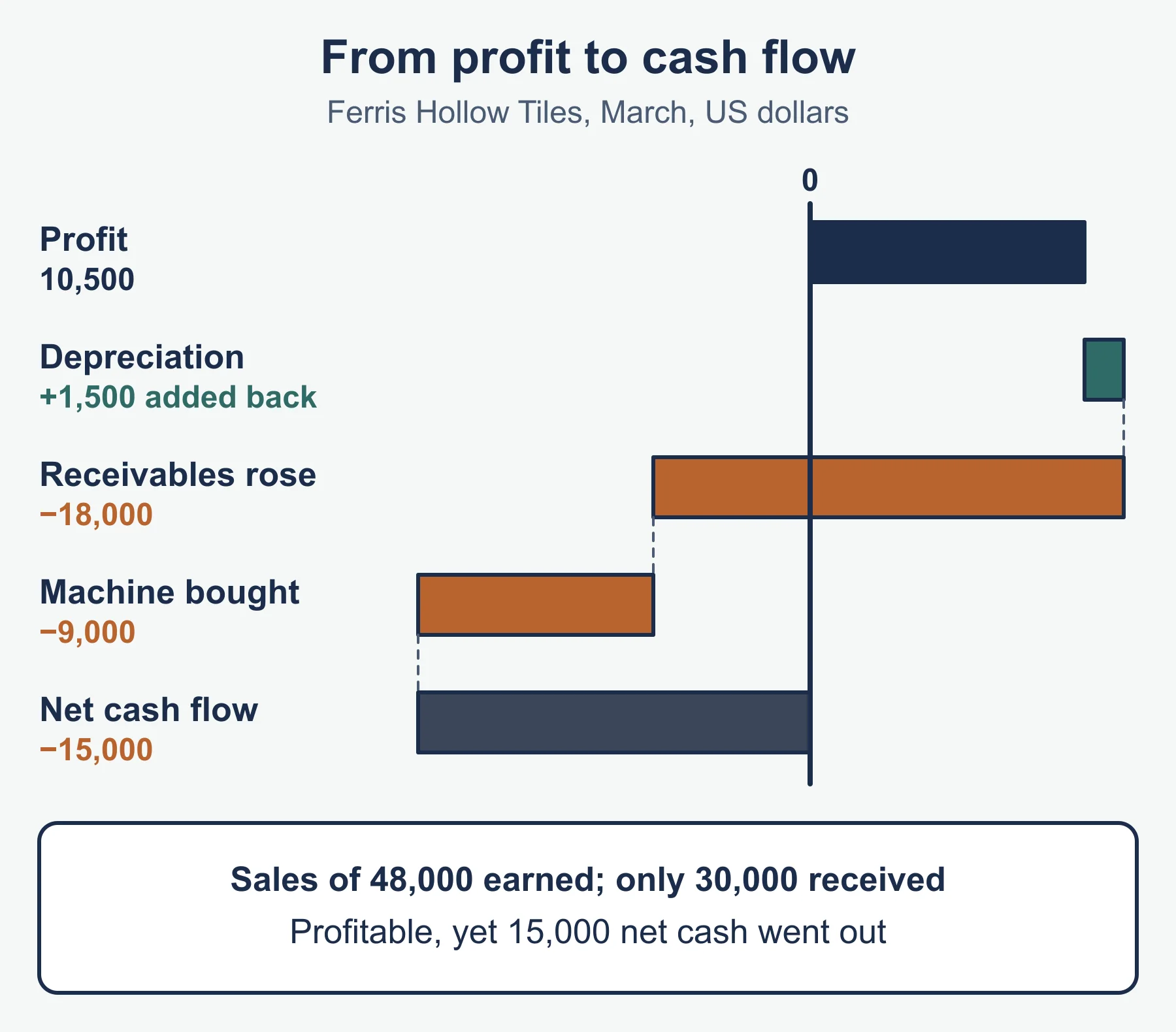
Cash outflow with no effect on profit: equipment bought, loan repayments, stock bought but not yet sold. Profit cost with no cash outflow: depreciation, and costs bought on credit and not yet paid.
Worked reminder: Brindle Row Bakery
Brindle Row Bakery sells through shops and cafes. In one month it sells 9,000 of bread and cakes. Of this, 5,500 is paid in cash on the day and 3,500 is on 30-day credit. Costs paid in cash that month are 6,800. Profit before any non-cash items = 9,000 - 6,800 = 2,200. Cash received = 5,500 and cash paid = 6,800, so net cash flow = -1,300. The 3,500 owed by cafes explains the gap between the two figures: 2,200 profit but 1,300 less cash.
Working capital and liquidity
Method in steps:
- List current assets and add them.
- List current liabilities and add them.
- Working capital = step 1 - step 2.
- Current ratio = step 1 / step 2.
- Acid test ratio = (step 1 - stock) / step 2.
- Comment on the result and on what sits inside it.
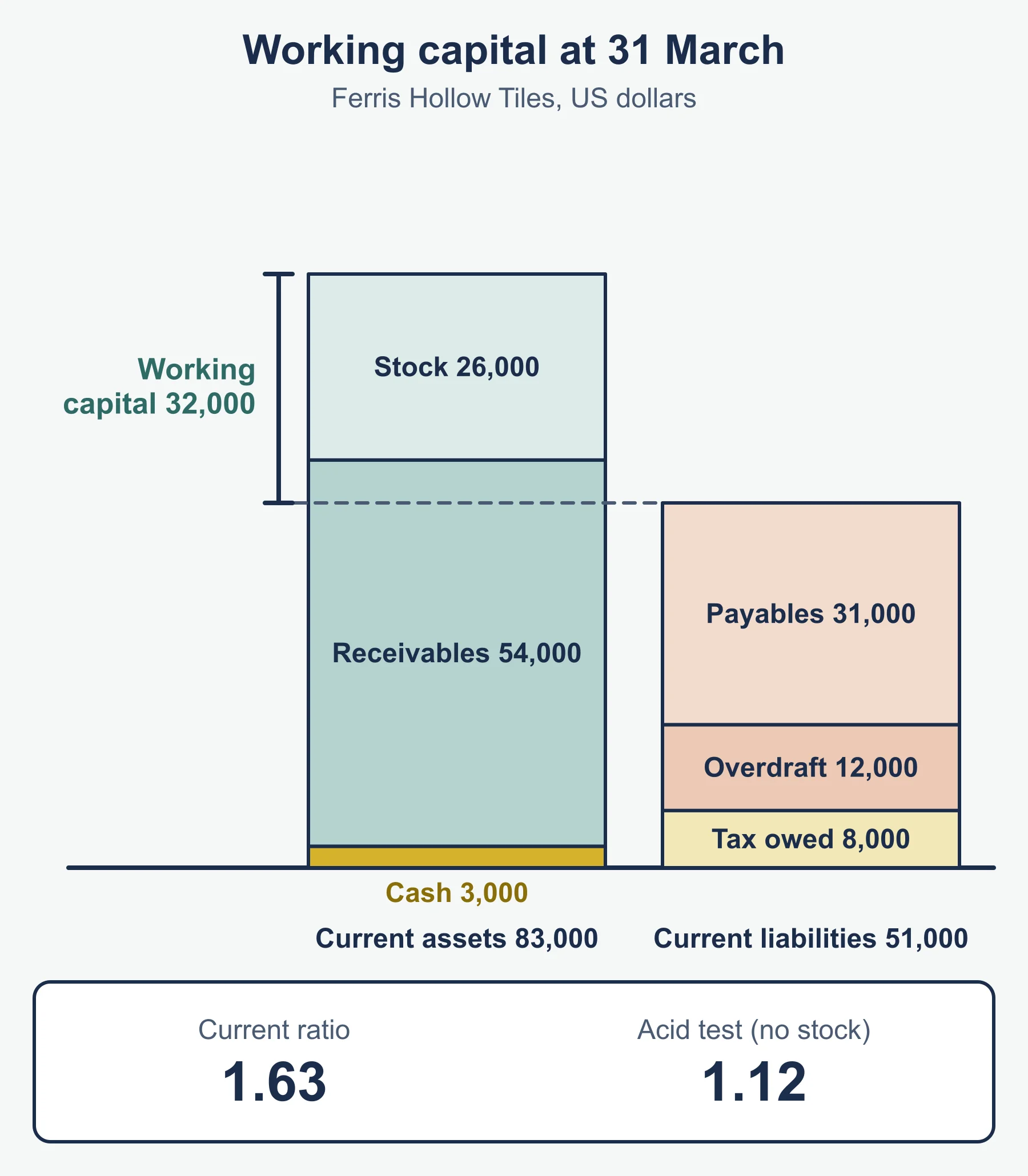
Worked reminder (Brindle Row Bakery, year end): stock 4,000, trade receivables 4,000, cash 2,400; trade payables 5,100, overdraft 2,000, tax owed 900. Current assets are 10,400 and current liabilities are 8,000.
- Working capital = 10,400 - 8,000 = 2,400.
- Current ratio = 10,400 / 8,000 = 1.30.
- Acid test ratio = 6,400 / 8,000 = 0.80.
Comment: working capital is positive, but without stock the business cannot quite cover its short-term debts at once (0.80 is below 1). Stock for a bakery goes off fast, so the acid test ratio is the fairer test.
Must-know distinctions:
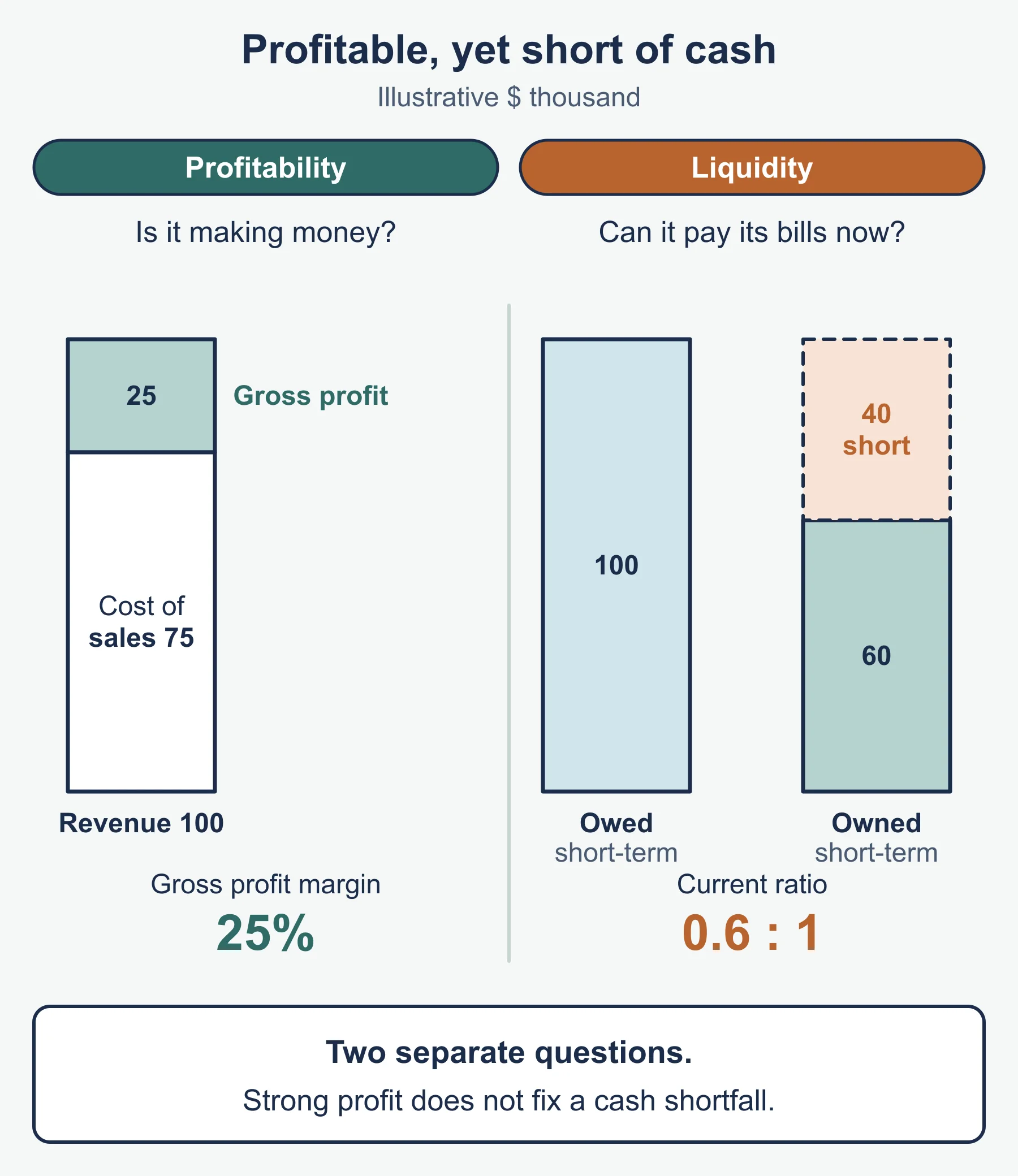
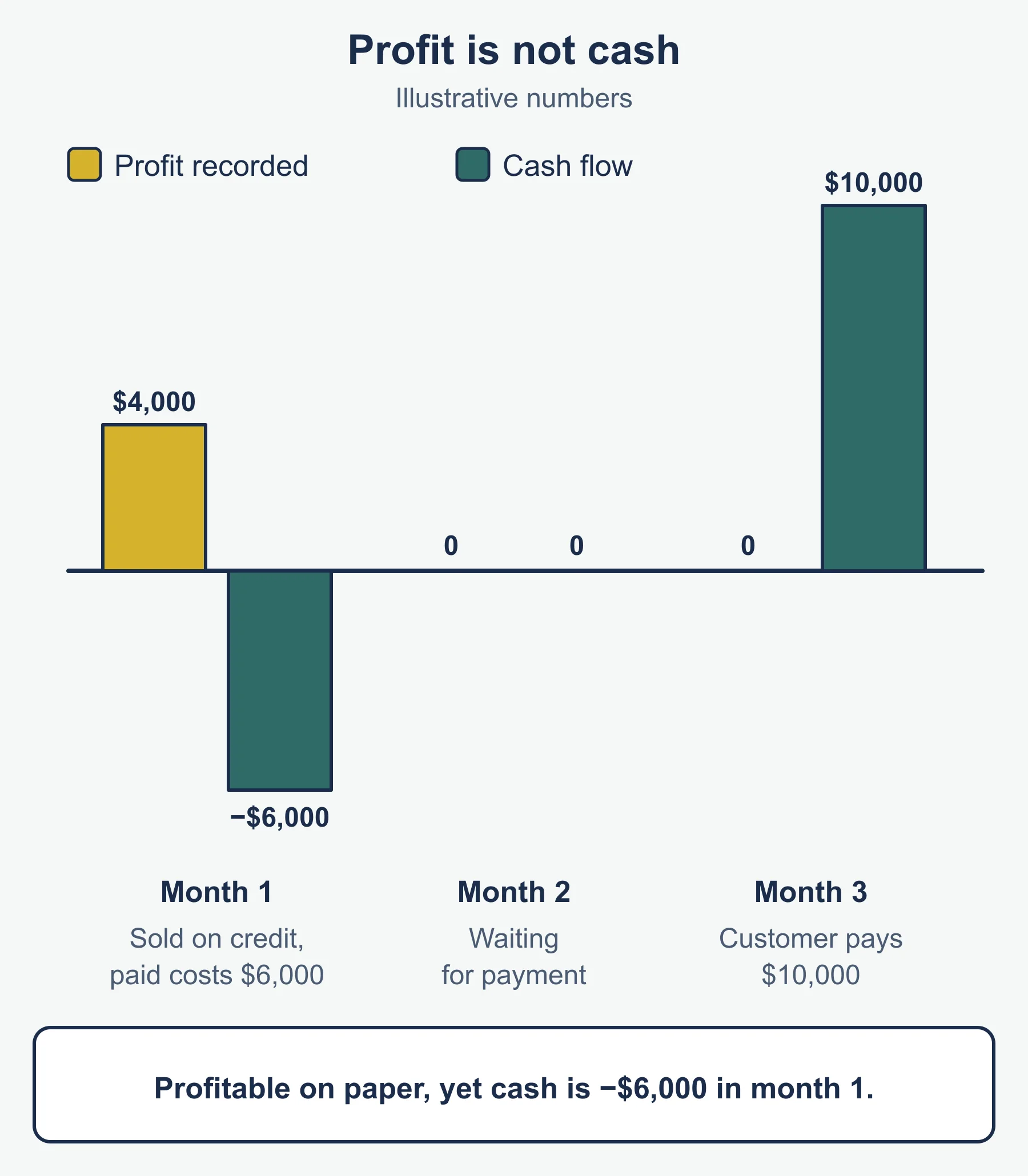
- Liquidity is about the short term. Profitability is about earning over a period. A business can have either without the other.
- Too little working capital risks missed payments. Too much leaves resources idle.
- A high current ratio built on slow receivables or unsold stock is weaker than it looks.
Cash flow forecasts
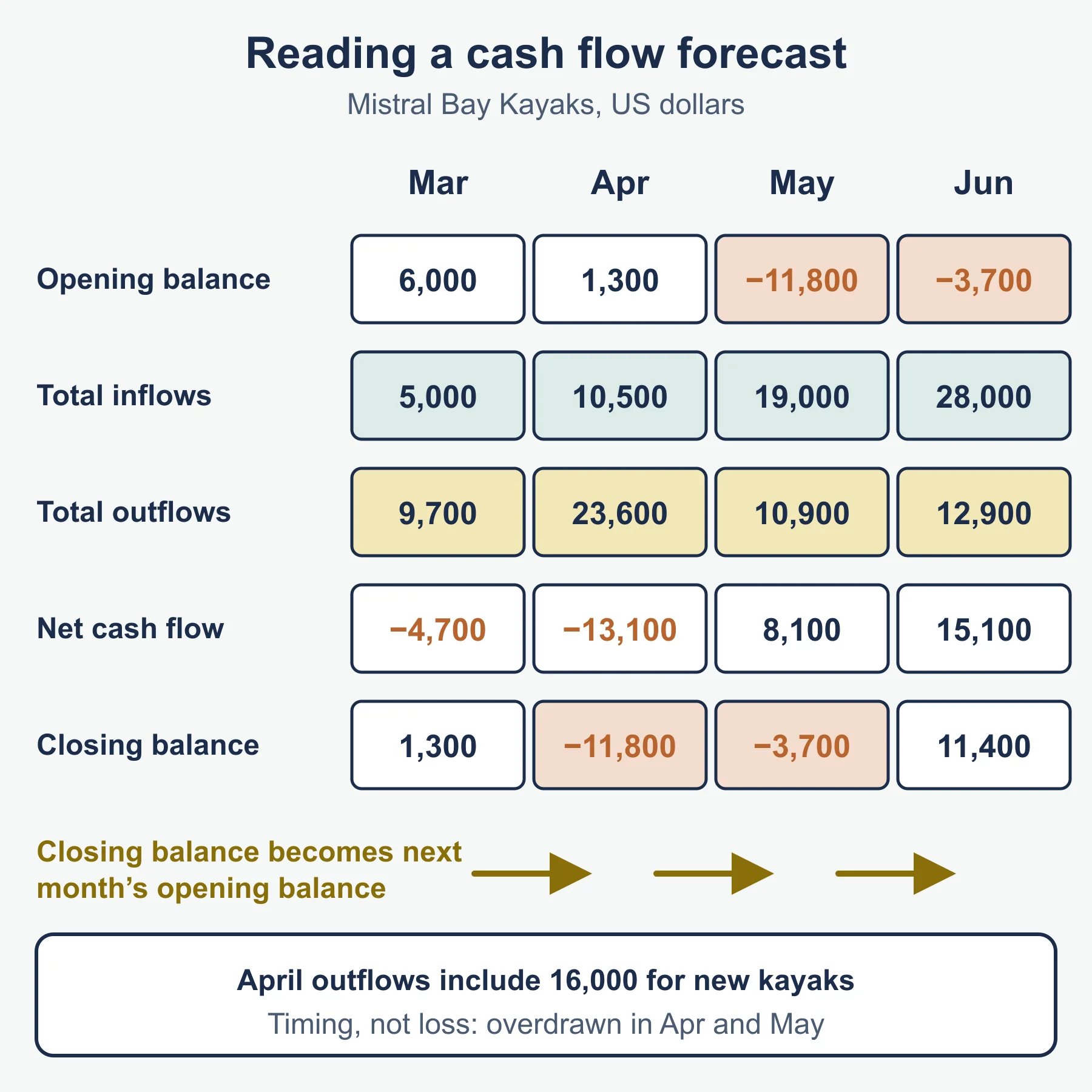
Layout in order: opening balance, cash inflows, cash outflows, net cash flow, closing balance. Last month’s closing balance is next month’s opening balance. The guide says forecasts in case studies will follow its presentation layout, so check your own copy of the guide for the exact rows.
Method in steps:
- Move each sale to the month the customer pays.
- Move each cost to the month the supplier or employee is paid.
- Leave out depreciation.
- Total inflows and outflows for each month.
- Find net cash flow by taking outflows from inflows.
- Add that net figure to the opening balance to get the closing balance.
- Roll the closing balance forward as the next month’s opening figure.
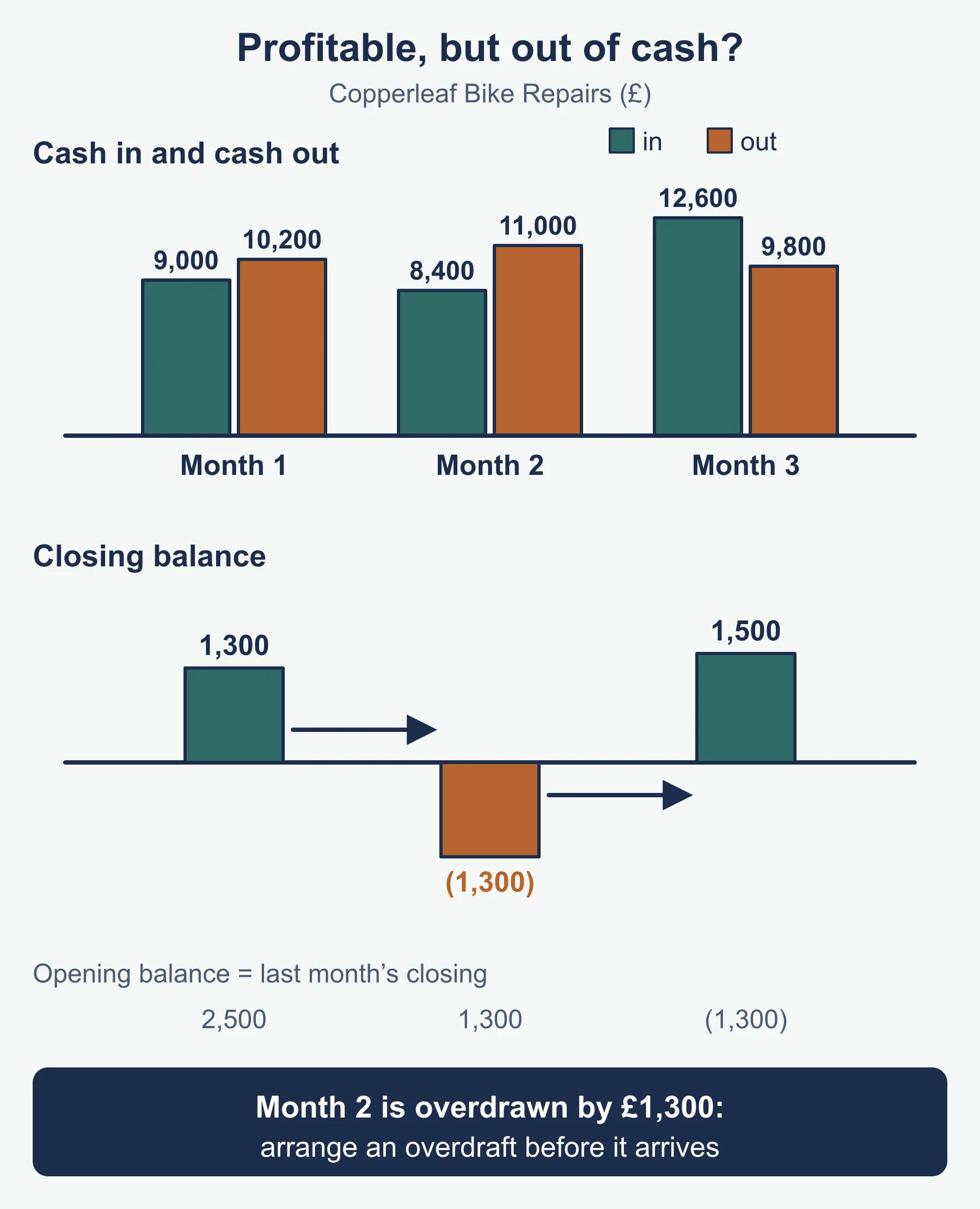
Worked reminder: opening balance 2,000, inflows 9,000, outflows 11,500. Net cash flow = -2,500, closing balance = -500. The business is overdrawn by 500 and needs a short-term source or a delayed payment.
| Use of a forecast | Limitation |
|---|---|
| Shows when shortfalls will occur | Relies on assumptions about sales and payment dates |
| Supports a loan or overdraft request | Unexpected events make it wrong |
| Lets managers test a decision in advance | Accuracy falls the further ahead it looks |
| Helps plan the timing of investment | Takes time and information to prepare |
Investment, profit and cash flow
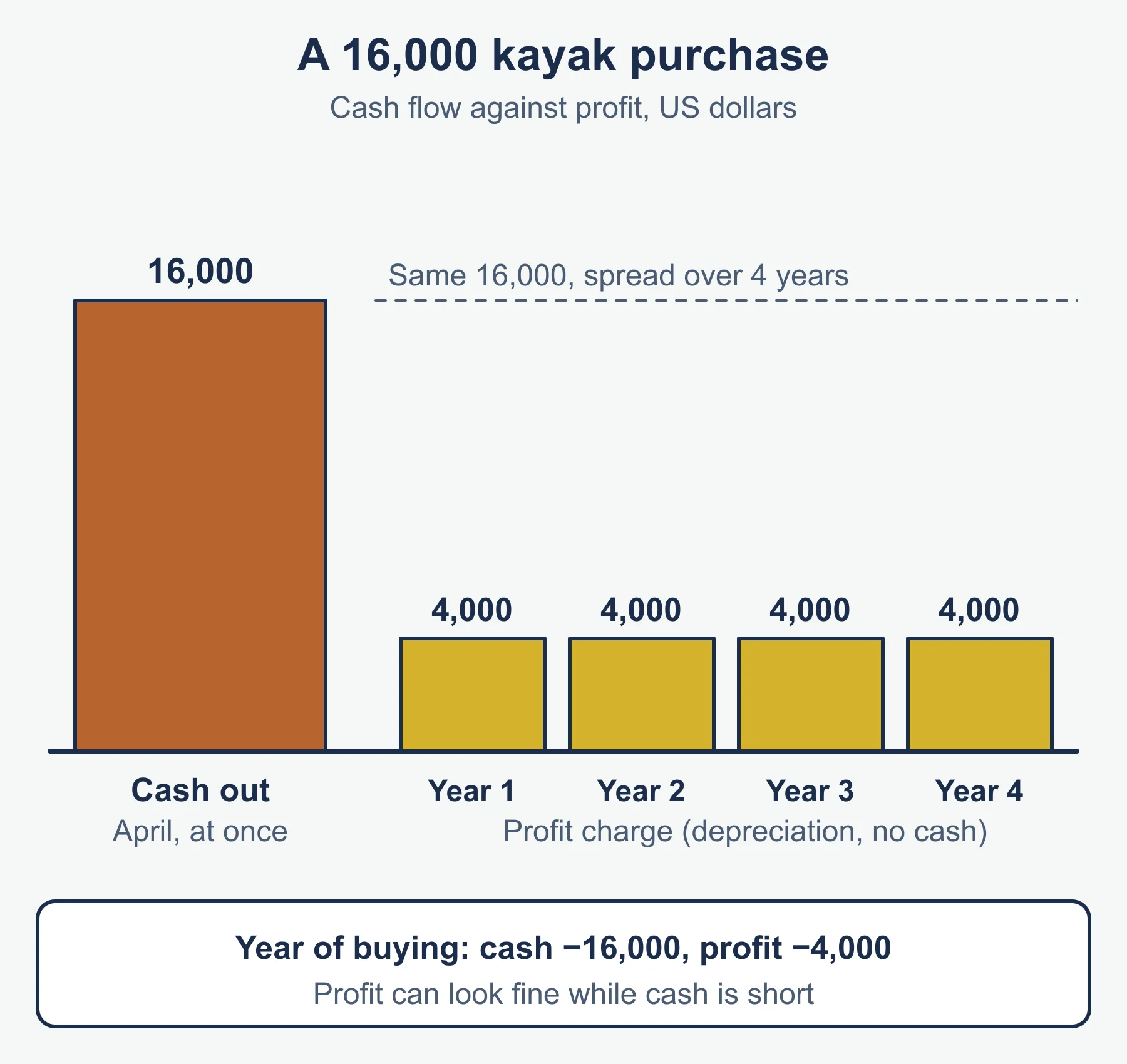
- Day of purchase: cash falls by the full price.
- Each year: profit falls by the depreciation charge only. The calculation methods are HL only in 3.4, so here only remember that the charge is non-cash.
- Later: sales revenue, profit and cash inflows may rise if the investment works.
- Stock investment ties up working capital until the stock is sold.
- Result: a business can look profitable and still run short of cash in the year it invests.
Strategies
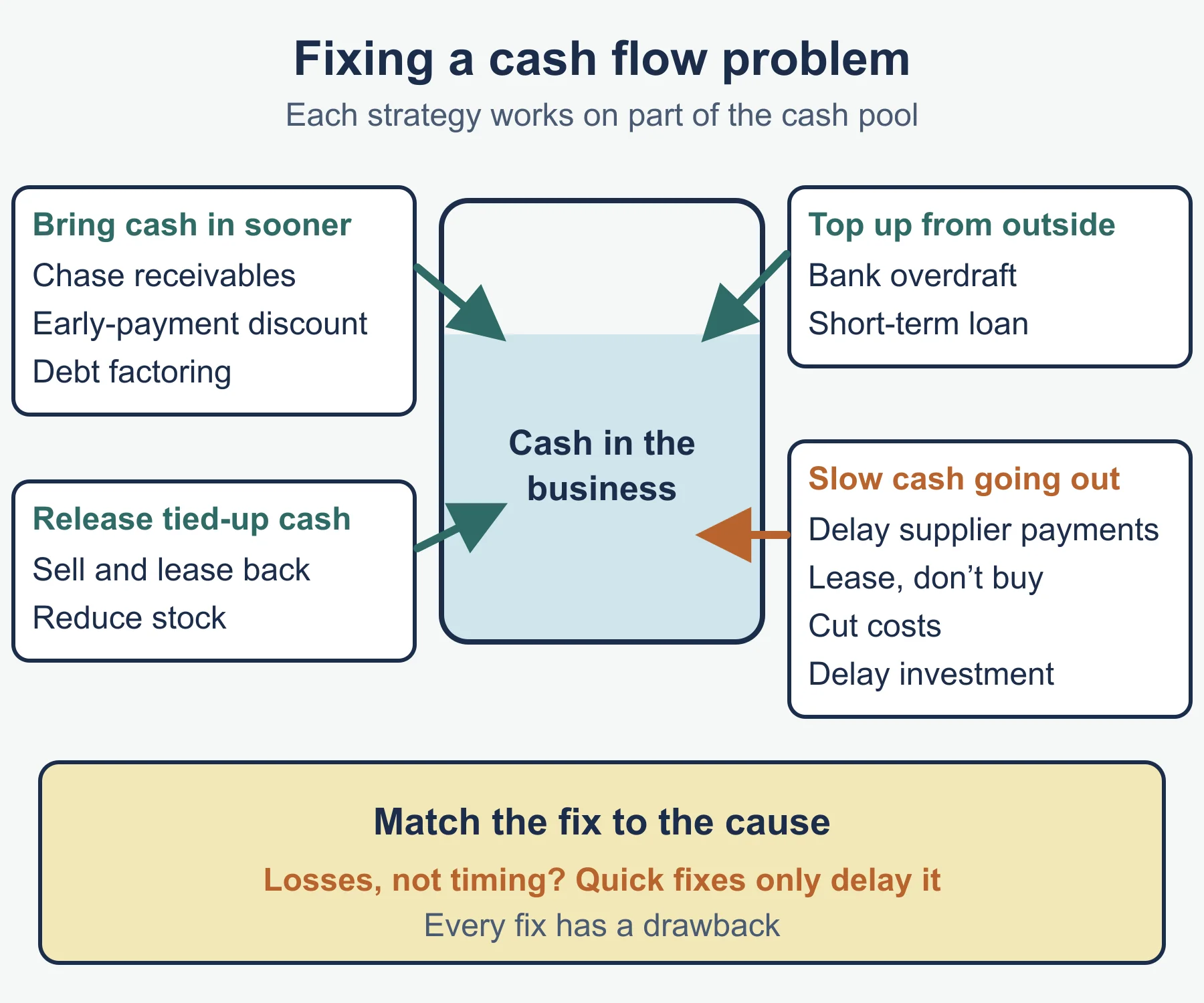
Pick by cause. The guide does not list strategies, so this table is standard teaching content. The AO3 skill is weighing a strategy against alternatives and the context.
| Cause | Sensible strategies | Watch out for |
|---|---|---|
| Short timing gap | Overdraft, delay supplier payments | Interest; strained supplier relations |
| Slow customers | Chase receivables, shorter credit terms, early-payment discount, factoring | Lost customers; lower revenue; fee |
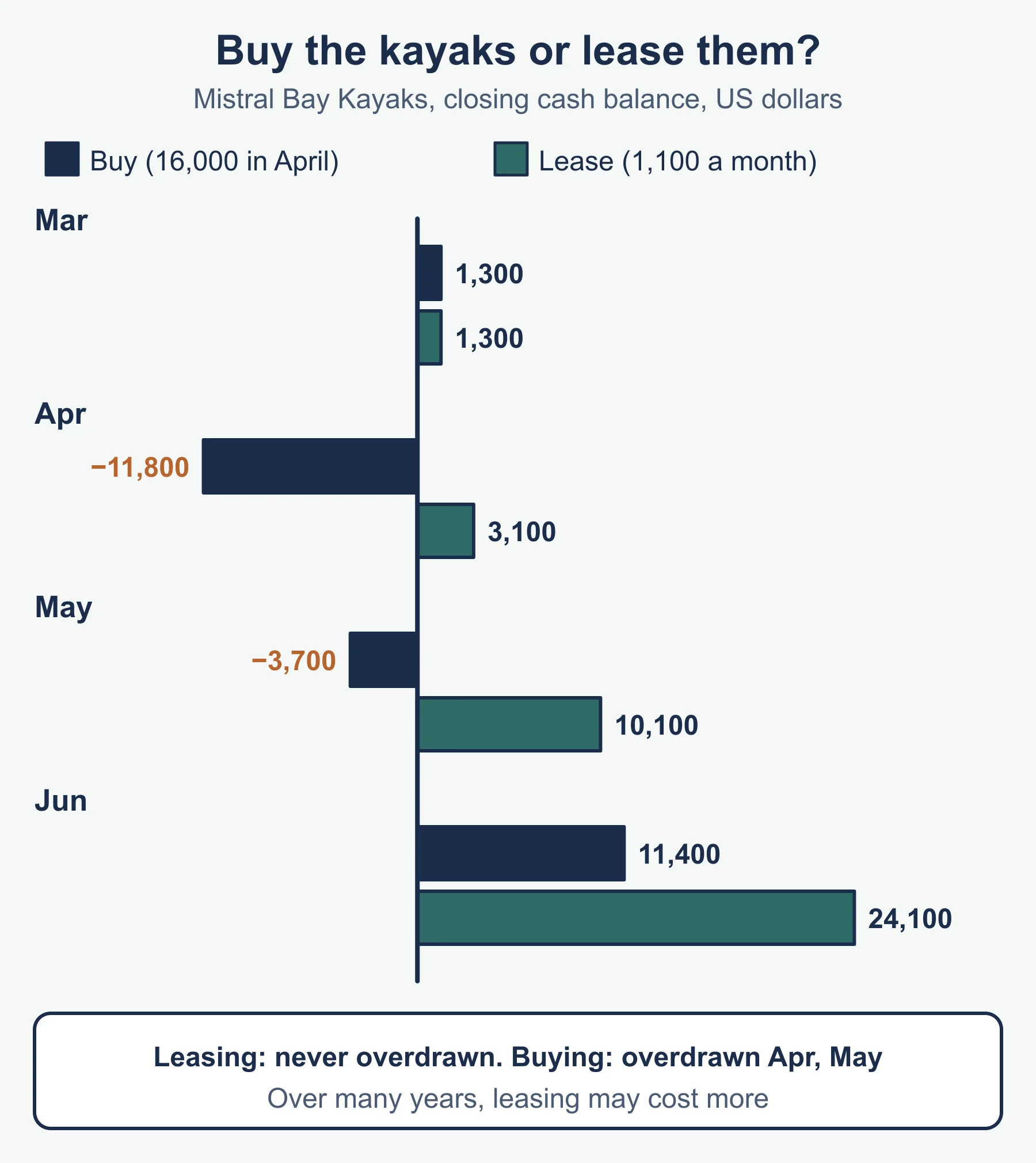
| Large purchase | Lease instead of buy, sale and leaseback, delay the purchase | Higher total cost; lost asset |
| Excess stock | Reduce stock, stricter ordering | Stock-outs |
| Persistent losses | Cut costs, raise prices, restructure | Short-term cash fixes only postpone failure |
Quick self-test
- State the formula for working capital.
- Give two reasons a profitable business can have negative net cash flow.
- A business has current assets of 52,000, stock of 20,000 and current liabilities of 40,000. Calculate the current ratio.
- Using the data in question 3, calculate the acid test ratio.
- Opening balance 4,200, inflows 11,000, outflows 13,600. Calculate the closing balance.
- Does depreciation appear in a cash flow forecast? Explain.
- A firm buys a machine for 30,000 cash. State the immediate effect on cash and the effect on profit that year if depreciation is 6,000.
- Identify two strategies for a business with slow-paying customers.
- State one limitation of a cash flow forecast.
- Explain why a very high working capital figure may not be a good sign.
Answers
- Current assets minus current liabilities.
- Customers have not yet paid for credit sales; cash was spent on equipment, repayments or stock that does not reduce profit now.
- 52,000 / 40,000 = 1.3.
- (52,000 - 20,000) / 40,000 = 32,000 / 40,000 = 0.8.
- Net = 11,000 - 13,600 = -2,600. Closing = 4,200 - 2,600 = 1,600.
- No. Depreciation is a non-cash charge, so no money moves.
- Cash falls by 30,000 at once; profit is reduced by 6,000 for the year.
- Any two: shorter credit terms, chasing overdue invoices, early-payment discount, debt factoring.
- It depends on assumptions that may prove wrong, or events that cannot be foreseen.
- Cash or stock may be sitting idle, not earning a return, or the figure may be inflated by unsold stock or slow-paying customers.
Where marks are usually lost
- Writing a definition of cash flow that is really a definition of profit.
- Leaving out the context. A profit versus cash answer needs the business’s own credit sales, purchase or timing.
- Putting depreciation into a forecast.
- Starting a month with a balance that does not match last month’s closing balance.
- Quoting a ratio but never saying what it implies for this particular firm.
- Offering a strategy with no link to the cause, or with no drawback, in an evaluative answer.
- Reaching no judgement when asked to evaluate, justify or recommend.
- Quoting a figure without units or with the wrong sign when it is negative.
Frequently asked questions
What is the difference between profit and cash flow? Profit is sales revenue minus costs and follows when revenue is earned and costs are incurred. Cash flow is money actually received and paid out, so it follows the timing of payments and receipts.
How do you calculate working capital? Working capital is current assets minus current liabilities. It shows the funds available for day-to-day operations.
Why is the acid test ratio stricter than the current ratio? The acid test ratio removes stock from current assets before dividing by current liabilities. It is a fairer test where stock is slow to sell or perishable.
How does an investment affect cash flow and profit differently? Cash falls by the full price on the day of purchase, while profit falls only by the depreciation charge each year. A business can look profitable and still run short of cash in the year it invests.
Official syllabus
IB Business management guide, first assessment 2024, International Baccalaureate Organization. Section 3.7 Cash flow. Related: sections 3.4 and 3.5.
Get free revision emails (optional)
Occasional emails with practice questions, worked explanations and links to free resources for the qualification and subjects you choose. No spam, and you can unsubscribe from any email. The free tools on this site never need an email.
Related resources
-
Study guides
IB DP Business Management: Costs and revenues
Study guide to IB DP Business Management section 3.3: fixed, variable, direct and indirect costs, total revenue and revenue streams, with worked examples.
Business · International Baccalaureate · IB
Read guide -
Practice questions
IB DP Business Management: Costs and revenues – Practice Questions
Original IB DP Business Management practice questions on section 3.3 costs and revenues, with fully worked answers and examiner insights.
Business · International Baccalaureate · IB
Try questions -
Revision notes
IB DP Business Management: Costs and revenues – Revision Notes
Condensed IB DP Business Management revision notes for section 3.3: cost types, total revenue and revenue streams, with a quick self-test.
Business · International Baccalaureate · IB
Revise topic
Related articles
-
teaching
A Level tuition in Dubai: Cambridge or Pearson Edexcel International A Level?
Schools in Dubai and Abu Dhabi teach either Cambridge International AS & A Level or Pearson Edexcel International A Level. How the two are structured, why it matters for tuition, and how online classes from Lahore work.
9 October 2026
-
curriculum guides
Choosing subjects at IGCSE and A Level
How subject choices at 14 and 16 affect university options later, and how to keep pathways open without overloading a timetable.
28 July 2026
Studying this with a teacher
Working through Business IB?
This page is free and stays free. If you would rather be taught it, Marlbridge runs Business classes one-to-one, online in your own time zone. The first trial class is free. WhatsApp replies within an hour (8am–11pm Pakistan time, every day); email the same day.
IB Business teachers at Marlbridge

