
Study Guides
IB DP Business Management: Cash flow
Study guide to section 3.7 of IB DP Business Management: profit versus cash flow, working capital, liquidity, cash flow forecasts and strategies.
- Subject
- Business
- Level
- IB
- Topic
- Unit 3: Finance and accounts
- Author
- Marlbridge Academic Team
- Updated
- Reviewed by
- Salman Ahmad (what this means)
Aligned to International Baccalaureate IB Diploma Programme Business (DP Business Management), First assessment 2024. Official specification .
Syllabus page (what it covers and how it is assessed): IB Diploma Programme Business.
Syllabus points this page covers
DP Business Management
- 3.7 Cash flow
Found an error? Report a correction.
Need help with this topic? Request a free trial class for IB Diploma Programme Business (DP Business Management).
This guide covers section 3.7 (Cash flow) of Unit 3 in the IB Business management guide, first assessment 2024. None of the six points in 3.7 carries an HL only label, so SL and HL students both study all of them. Use it with the course hub, the printable checklist, the revision notes and the practice questions. For wider Unit 3 context, see the Unit 3 overview and the final accounts guide. To find your weak spots across the unit, take the diagnostics.
What 3.7 asks you to do
| Guide point | Your task | Depth of teaching |
|---|---|---|
| The difference between profit and cash flow | Explain why the two figures differ in a period | AO2 |
| Working capital | Define it, calculate it, explain why it matters | AO2, AO4 |
| Liquidity position | Judge whether a business can meet short-term debts | AO2 |
| Cash flow forecasts | Read, complete and interpret a forecast | AO2, AO4 |
| The relationship between investment, profit and cash flow | Explain how spending on assets affects each | AO2 |
| Strategies for dealing with cash flow problems | Recommend and justify a fix for a given cause | AO3 |
The AO labels tell you how the marks are likely to be earned. AO2 and AO4 points need application and calculation. The strategies point is AO3, so you need to weigh options and reach a judgement. The guide says Paper 2 has a quantitative focus and that cash flow forecasts may be given in case studies in a set layout, so practise reading forecasts as well as building them.
Profit and cash flow are different measures
Cash flow is the money that actually enters and leaves a business during a period. Profit is sales revenue minus costs for the period, recorded when the sale or cost is earned or incurred, not when money moves. The guide says a profit and loss account is also called an income statement, and that assessment uses the term “statement of profit or loss”. For the balance sheet, assessment uses “statement of financial position”.
Profit and cash flow differ for four main reasons.
- Credit sales. The sale is revenue now. The cash arrives later.
- Credit purchases. The cost is in profit now. The cash leaves later.
- Non-current asset purchases. Buying equipment takes cash out at once. Profit only falls by depreciation each year.
- Non-cash costs. Depreciation lowers profit but no money leaves. Loan repayments and some stock purchases move cash without being an expense of the period.
Worked example 1: one month at Ferris Hollow Tiles
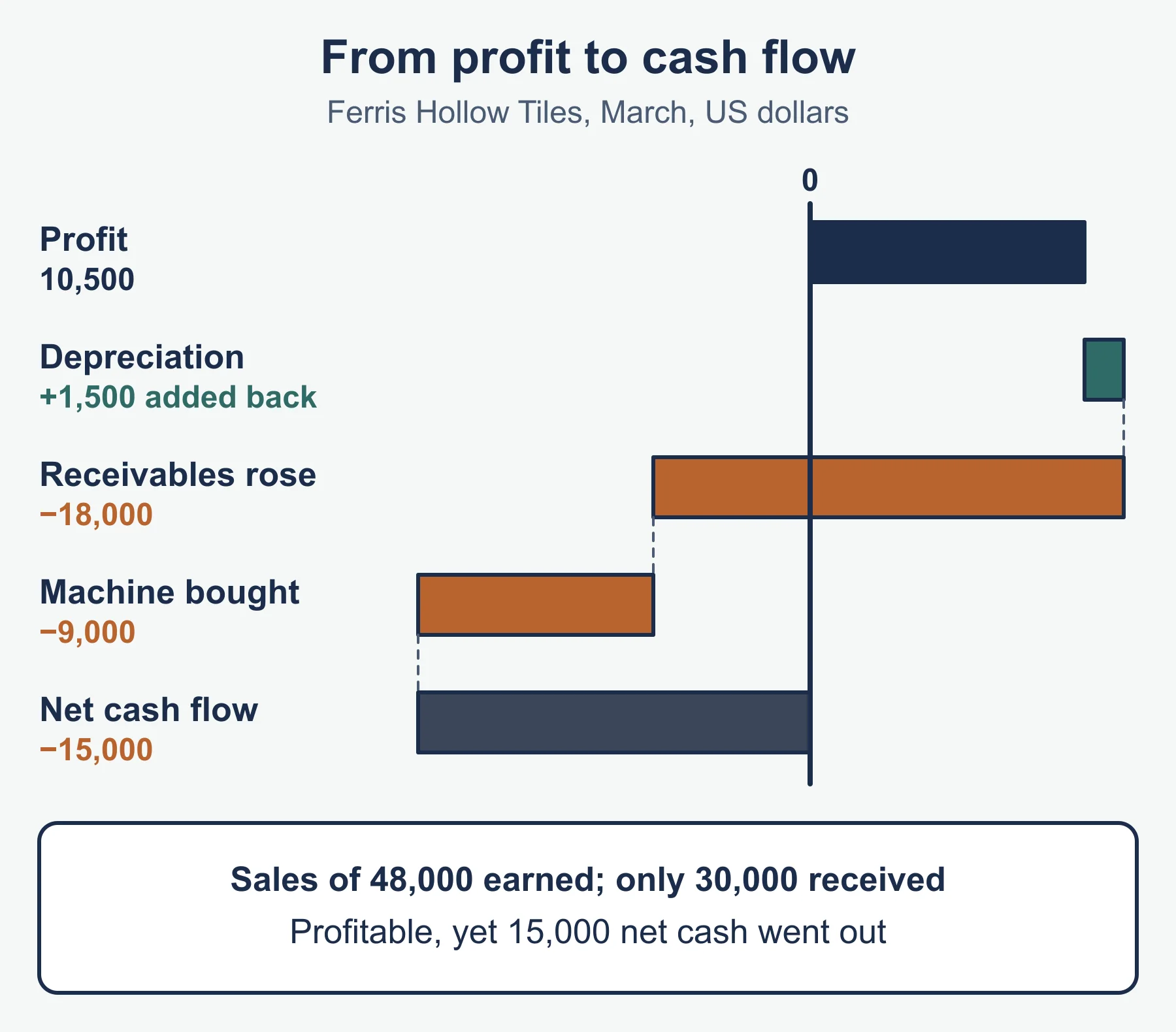
Ferris Hollow Tiles fits floor tiles for homes. Figures for March are in dollars. Sales of 48,000 were all on credit, and customers pay after about two months. Materials used cost 20,000, wages 12,000 and rent and utilities 4,000, all paid in March. Depreciation was 1,500. A tile-cutting machine was bought for 9,000 cash. Customers paid 30,000 in March for jobs done in January.
Profit for March:
48,000 - (20,000 + 12,000 + 4,000 + 1,500) = 10,500
Net cash flow for March:
| Item | Cash in | Cash out |
|---|---|---|
| Receipts from customers | 30,000 | |
| Materials | 20,000 | |
| Wages | 12,000 | |
| Rent and utilities | 4,000 | |
| Machine | 9,000 | |
| Total | 30,000 | 45,000 |
Net cash flow = 30,000 - 45,000 = -15,000.
So a profit of 10,500 sits beside a cash outflow of 15,000. A profit-to-cash bridge (a teaching extension, going a little beyond the guide’s wording) shows why: start with profit 10,500, add back depreciation 1,500 (no cash left), take off 18,000 because receivables rose (48,000 earned but only 30,000 received), and take off the 9,000 machine. That gives -15,000. The business is profitable and still short of cash, which is what the guide’s inquiry statement on profitable businesses facing insolvency points to.
Working capital
Working capital is the pool of funds that keeps day-to-day trading going. The standard form is:
working capital = current assets - current liabilities
The guide’s formulae appendix, as read for this page, gives the current ratio and acid test ratio but no separate working capital formula, so treat this as the standard form. Current assets are items expected to turn into cash within a year (stock, trade receivables, cash). Current liabilities are debts due within a year (trade payables, overdraft, tax owed).
Positive working capital means short-term assets cover short-term debts. Too little risks missing payments. Too much is also a problem, because cash and stock sitting idle earn nothing and could have funded investment or been returned to owners.
Worked example 2: Ferris Hollow Tiles at 31 March
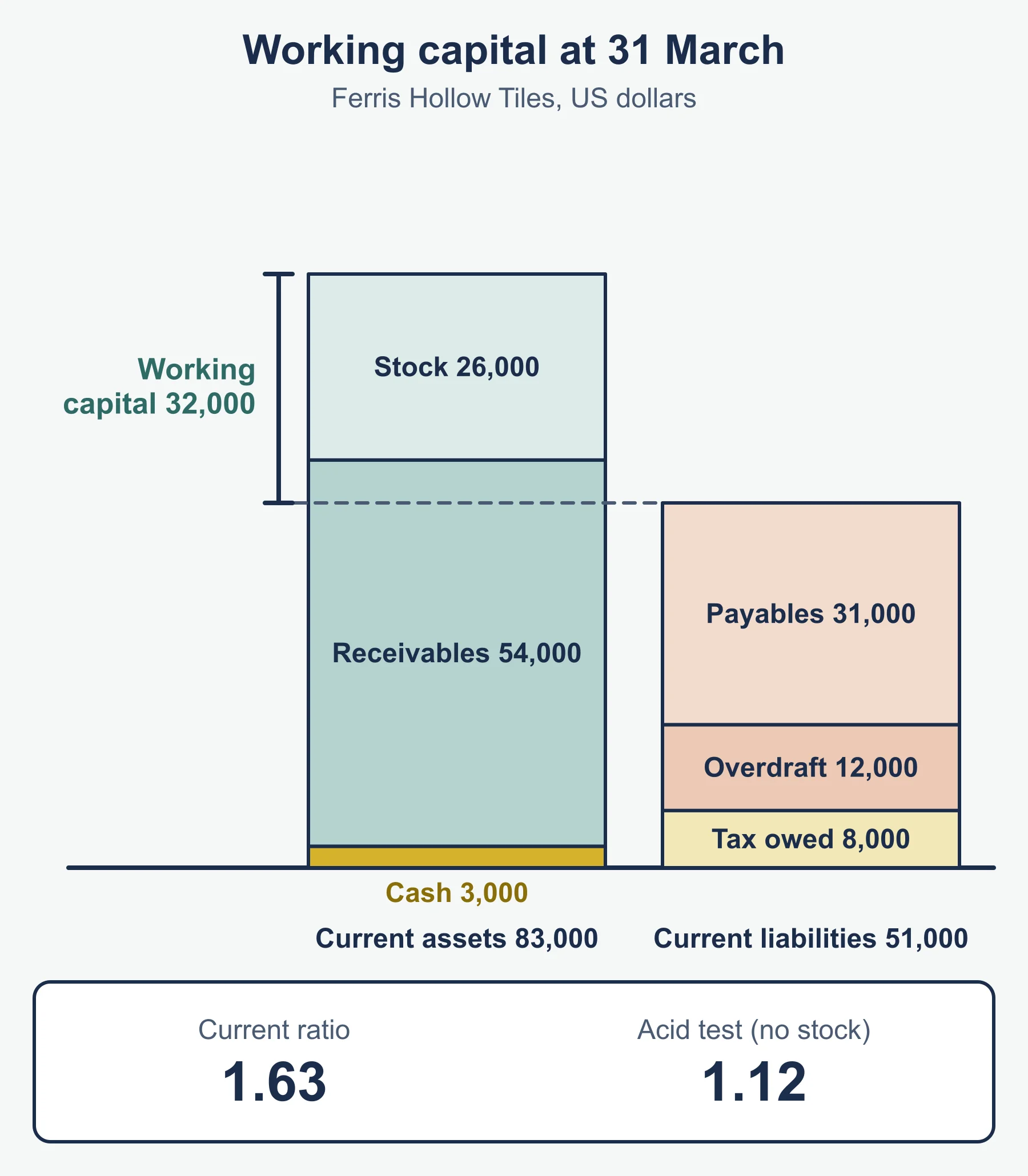
Current assets: stock 26,000; trade receivables 54,000; cash 3,000. Current liabilities: trade payables 31,000; overdraft 12,000; tax owed 8,000.
- Current assets = 83,000 and current liabilities = 51,000.
- Working capital = 83,000 - 51,000 = 32,000.
Working capital is a cash-style cushion on paper, but 54,000 of it is money owed by customers, not money in the bank.
Liquidity position
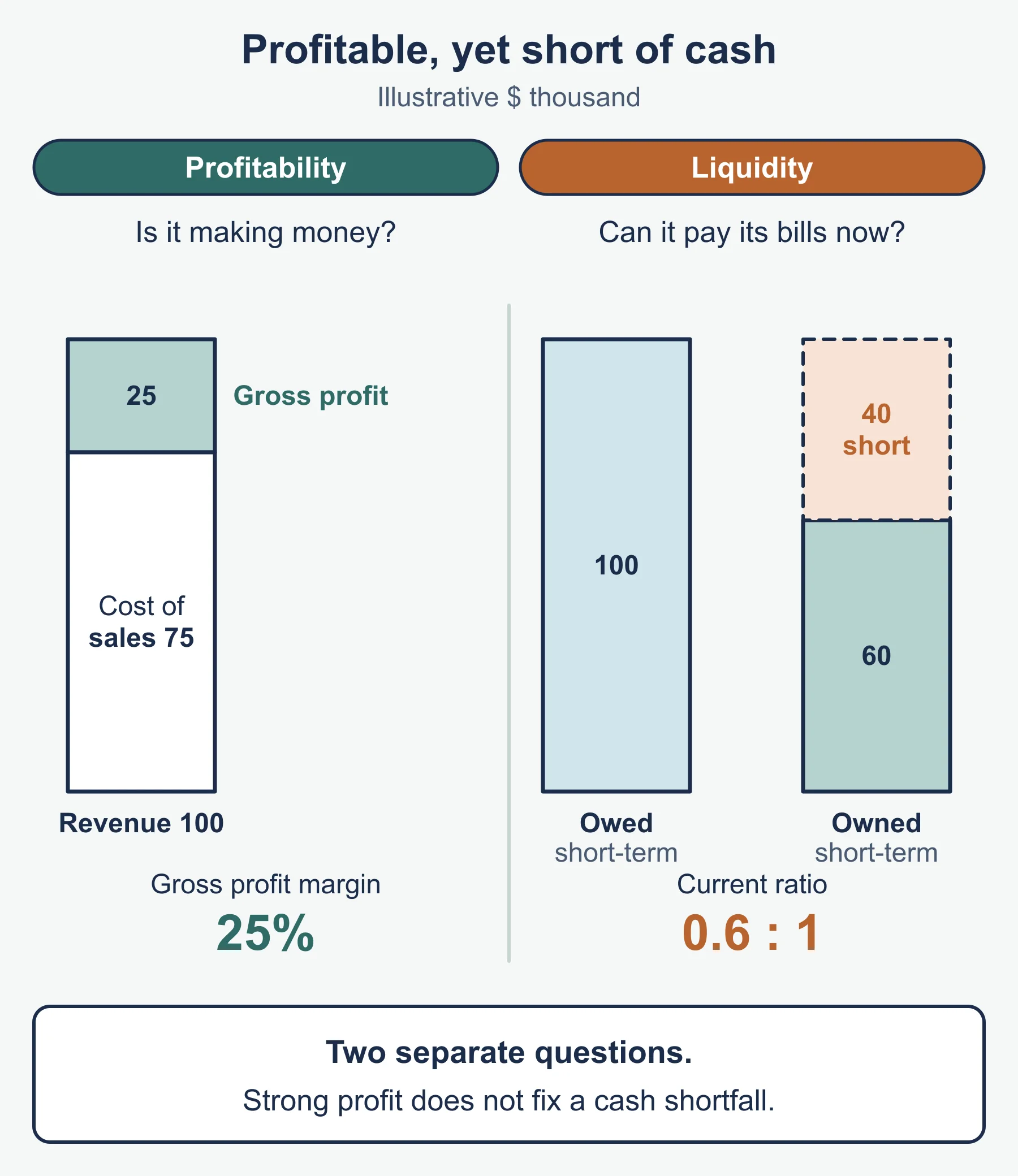
Liquidity is how readily a business can find the cash to settle debts when they come due within the year. A business’s liquidity position is how well placed it is to do that. Three measures help you judge it. Two come from 3.5, where the guide gives the formulae:
current ratio = current assets / current liabilities
The second ratio removes stock, the slowest current asset to turn into cash:
acid test (quick) ratio = (current assets - stock) / current liabilities
Continuing example 2:
- Current ratio = 83,000 / 51,000 = 1.63.
- Acid test ratio = (83,000 - 26,000) / 51,000 = 57,000 / 51,000 = 1.12.
The third measure is the cash balance itself and the forecast. Ferris Hollow has only 3,000 cash against 12,000 overdraft and 31,000 owed to suppliers. The ratios look healthy because receivables are large. If customers pay late, liquidity is weaker than the ratios suggest. A fair judgement says the ratios are acceptable, but the position depends on collecting 54,000 on time.
Cash flow forecasts
A cash flow forecast predicts cash inflows and outflows for future periods, usually month by month. The guide includes a cash flow forecast layout in its presentation of financial statements. The layout is not reproduced in the text used for this page, so the rows below are the standard form. Check them against the figure in your own copy of the guide.
| Row | Meaning |
|---|---|
| Opening balance | Cash at the start of the month (equals last month’s closing balance) |
| Cash inflows | Receipts: cash sales, payments from customers, loans received, assets sold |
| Cash outflows | Payments made: staff pay, suppliers, premises costs, machinery, loan instalments |
| Net cash flow | Inflows less outflows for the month |
| Closing balance | Opening balance with that month’s net cash flow added |
Only cash movements go in. Depreciation never appears. A credit sale is entered only when the customer settles.
Worked example 3: Mistral Bay Kayaks
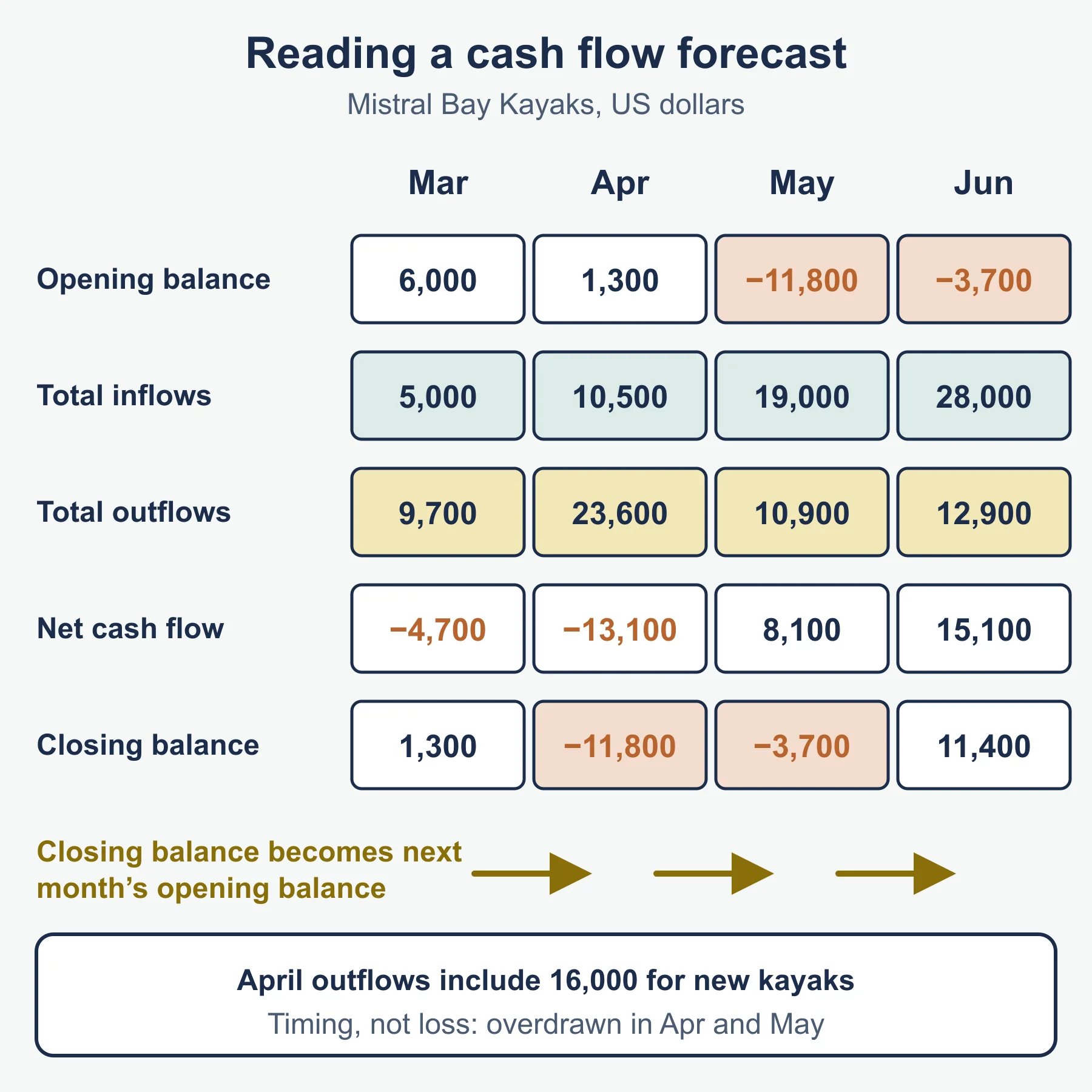
Mistral Bay Kayaks hires kayaks on a coastline. Figures are in dollars. The owner begins March with 6,000 cash.
| Mar | Apr | May | Jun | |
|---|---|---|---|---|
| Opening balance | 6,000 | 1,300 | -11,800 | -3,700 |
| Cash hire receipts | 3,000 | 9,000 | 15,000 | 22,000 |
| Group booking receipts | 2,000 | 1,500 | 4,000 | 6,000 |
| Total inflows | 5,000 | 10,500 | 19,000 | 28,000 |
| Wages | 3,500 | 5,000 | 7,500 | 9,000 |
| New kayaks | 16,000 | |||
| Insurance | 4,200 | |||
| Repairs and fuel | 1,200 | 1,800 | 2,600 | 3,100 |
| Loan repayment | 800 | 800 | 800 | 800 |
| Total outflows | 9,700 | 23,600 | 10,900 | 12,900 |
| Net cash flow | -4,700 | -13,100 | 8,100 | 15,100 |
| Closing balance | 1,300 | -11,800 | -3,700 | 11,400 |
Reading it: the business is overdrawn at the end of April and May, by 11,800 and 3,700. The cause is timing. The kayaks are bought before the busy season produces receipts. Recovery in June is large because summer receipts arrive.
Uses of a forecast: it shows when borrowing is needed, supports a loan application, and lets managers test a change before they make it. Its limits: it rests on assumptions about sales and payment dates, and weather, strikes or a late-paying customer can make it wrong. A forecast is a plan, not a record.
Investment, profit and cash flow
Investment here means spending on assets (equipment, premises, stock) to earn returns later. The three measures move at different times.
- Cash flow falls when the money is paid, often all at once.
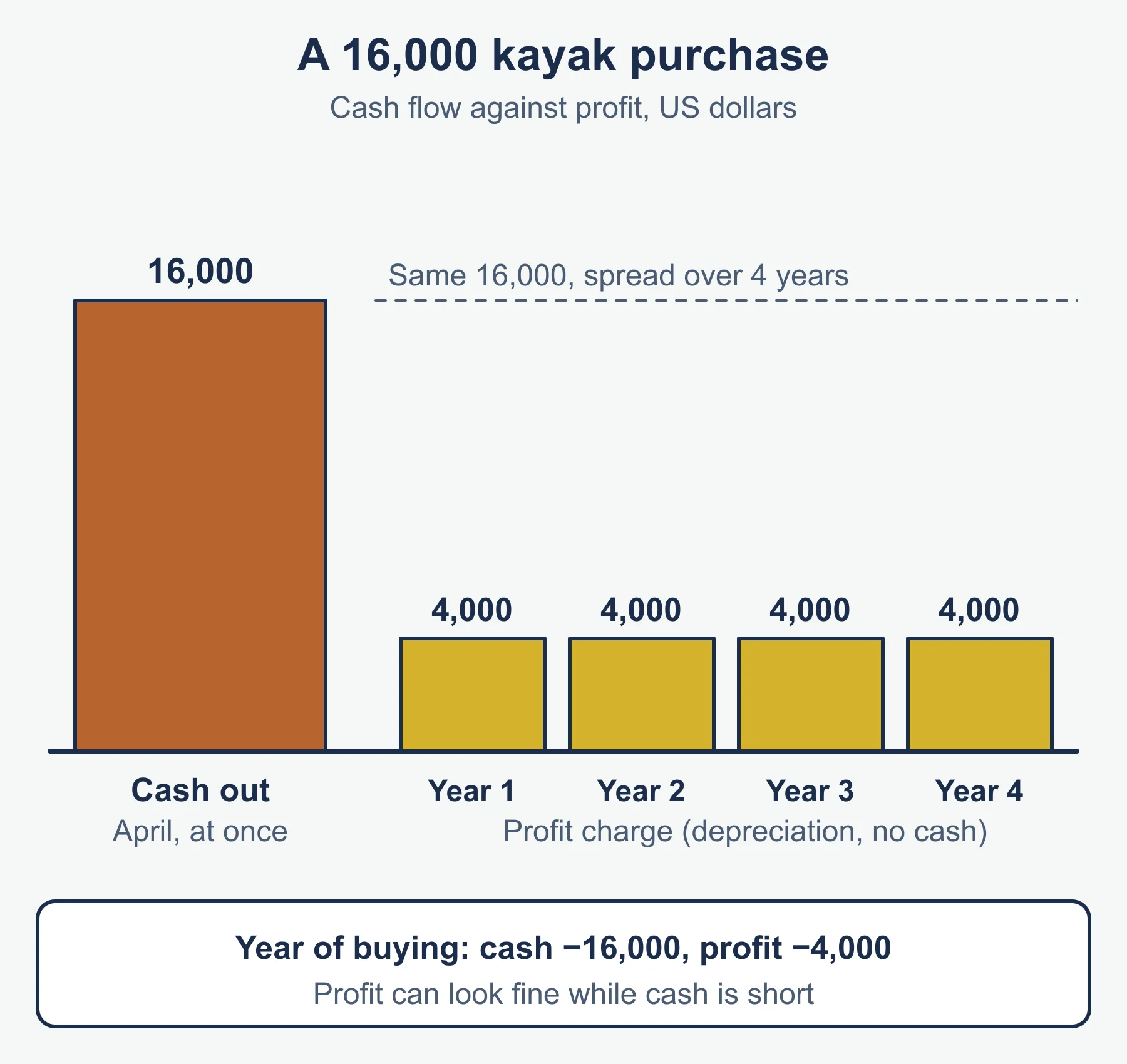
- Profit is hit only by the yearly depreciation charge, so the effect is spread over the asset’s life. The guide covers how depreciation is calculated in 3.4, where the methods are HL only. Here you only need to know that the charge is non-cash.
- Later, if the investment works, it raises sales revenue, profit and cash inflows.
A business can therefore show rising profit and still be short of cash in the year it invests. In example 3, buying the kayaks cost 16,000 of cash in April. If they last four years and the yearly depreciation is 4,000, the profit effect in the year is 4,000, not 16,000. Investment in stock also ties up working capital before anything is sold.
Strategies for dealing with cash flow problems
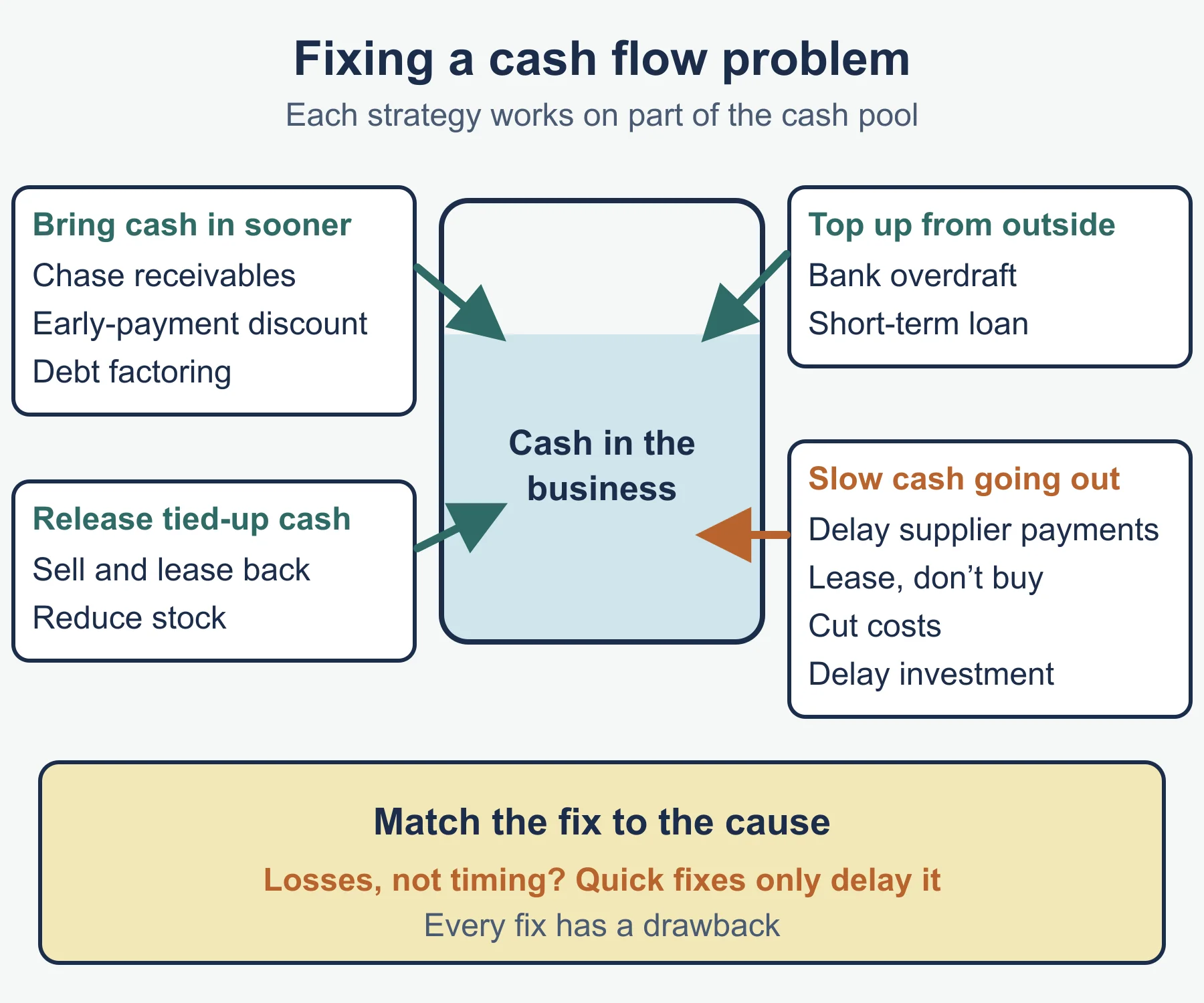
Choose the strategy that fits the cause. This is the AO3 skill. The guide names the point but does not list strategies, so the table below is standard teaching content, not a list taken from the guide. Overdrafts and leasing also appear in 3.2 as sources of finance.
| Strategy | How it helps | Drawback |
|---|---|---|
| Bank overdraft | Covers a short gap quickly | Interest can be high; the bank can withdraw it |
| Short-term loan | Gives a lump of cash with a fixed repayment plan | Interest, and repayments become outflows |
| Delay payments to suppliers | Keeps cash longer | Suppliers may refuse credit or raise prices |
| Chase receivables or shorten credit terms | Brings cash in sooner | Customers may buy elsewhere |
| Discount for early payment | Speeds receipts | Lowers revenue per sale |
| Debt factoring | Sells invoices for immediate cash | Fee; the business receives less than the invoice value |
| Sell and lease back an asset | Releases cash tied up in the asset | Leasing costs continue; ownership is lost |
| Lease instead of buy | Avoids a large up-front payment | Total cost can be higher |
| Reduce stock | Frees cash | Risk of stock-outs |
| Cut costs or delay investment | Lowers outflows | May harm quality or growth |
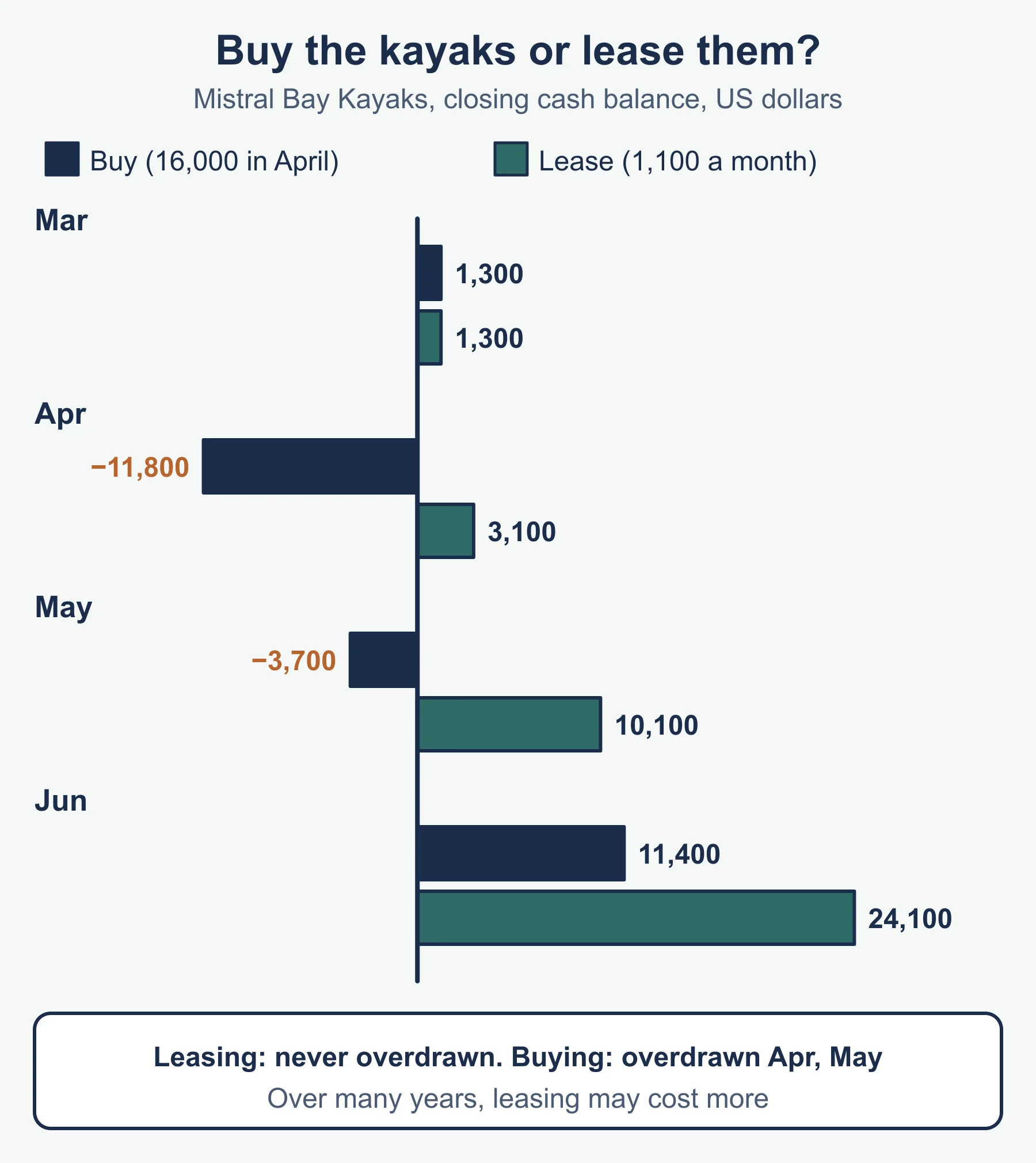
For Mistral Bay, leasing the kayaks at 1,100 a month from April would change the closing balances to 1,300, 3,100, 10,100 and 24,100, so the business is never overdrawn. Over many years the leasing could cost more than buying, and that trade-off is the evaluation point.
If the cause is losses rather than timing, short-term fixes only delay the problem. Say so.
Common errors
- Putting depreciation in a cash flow forecast.
- Entering a credit sale in the month of sale rather than the month of payment.
- Starting a month with the wrong opening balance. It must equal last month’s closing balance.
- Labelling a negative closing balance as a loss, when it signals a shortfall of cash.
- Recommending a long-term loan for a short gap, or an overdraft for a permanent loss.
- Treating a high current ratio as proof of good liquidity when most of it is stock or late-paying receivables.
Frequently asked questions
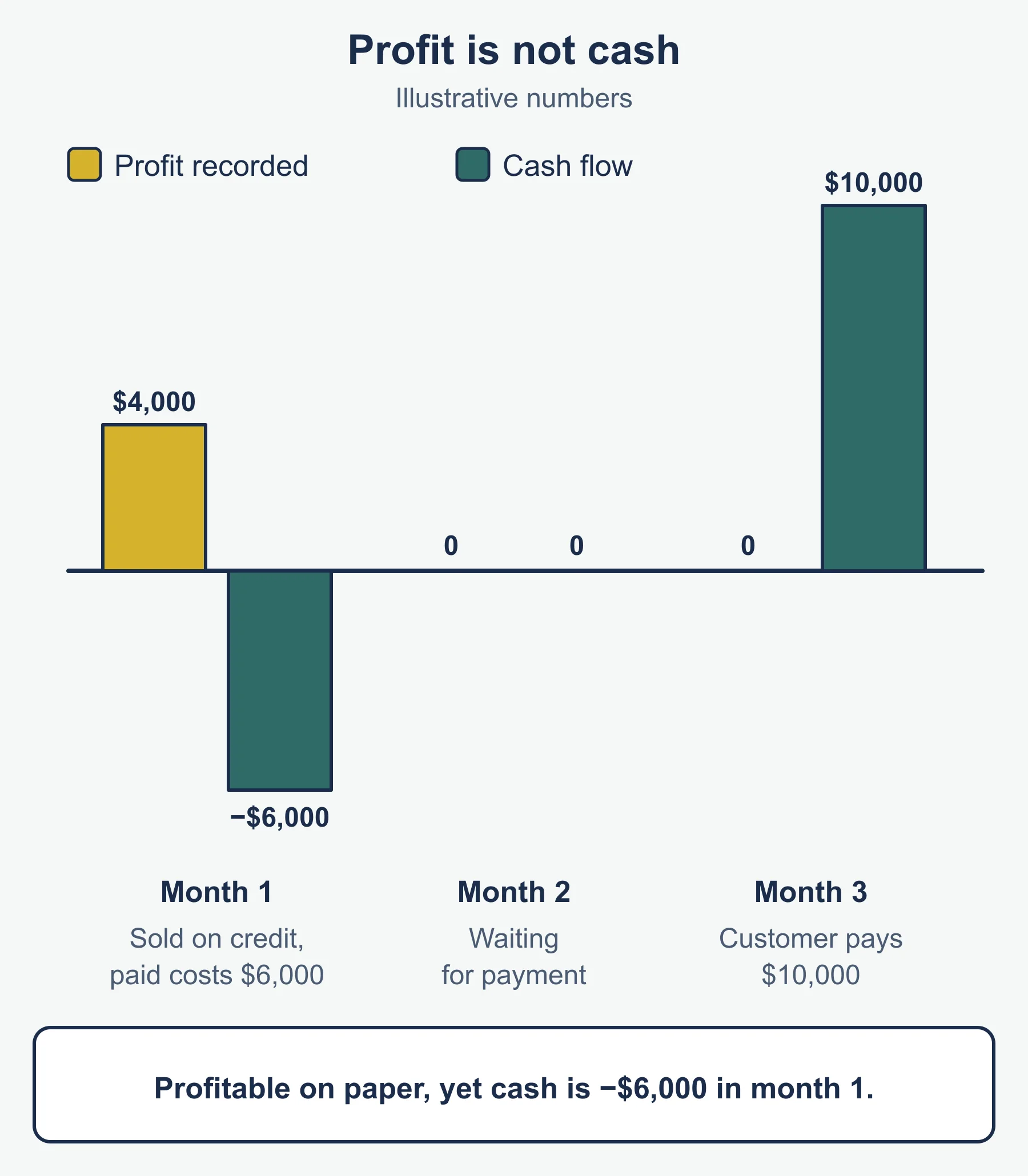
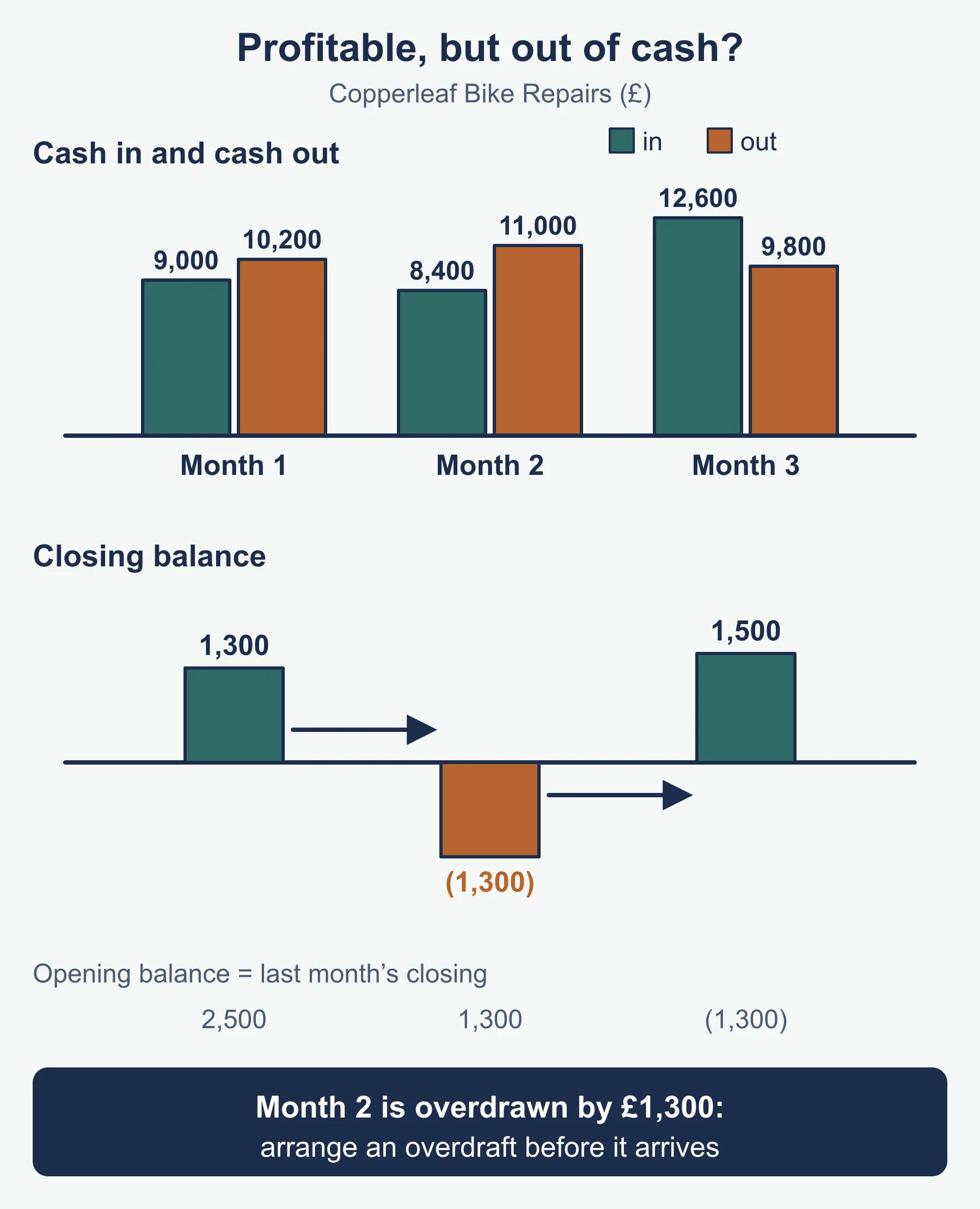
Why can a profitable business run out of cash? Profit records sales and costs when they are earned or incurred, while cash flow records money when it actually moves. Credit sales, buying non-current assets for cash and non-cash costs such as depreciation all make the two figures differ, so a business can show a profit in a month and still have a negative net cash flow.
How do you calculate working capital in IB Business Management? Working capital is current assets minus current liabilities. Current assets include stock, trade receivables and cash; current liabilities include trade payables, an overdraft and tax owed within a year.
Does depreciation go in a cash flow forecast? No. A cash flow forecast includes only cash movements, so depreciation never appears, and a credit sale is entered only in the month the customer actually pays.
How do you choose a strategy for a cash flow problem in an IB answer? Match the strategy to the cause and weigh its drawback: an overdraft suits a short timing gap, while leasing avoids a large up-front payment but can cost more over time. Strategies are an AO3 point in section 3.7, so you need to reach a judgement, and if the cause is losses rather than timing, short-term fixes only delay the problem.
Is cash flow an HL only topic in IB DP Business Management? No. None of the six points in section 3.7 is labelled HL only, so SL and HL students study all of it.
Official syllabus
IB Business management guide, first assessment 2024, International Baccalaureate Organization. Section 3.7 Cash flow. Related: sections 3.4 and 3.5.
Get free revision emails (optional)
Occasional emails with practice questions, worked explanations and links to free resources for the qualification and subjects you choose. No spam, and you can unsubscribe from any email. The free tools on this site never need an email.
Related resources
-
Practice questions
IB DP Business Management: Cash flow – Practice Questions
Original practice questions with worked answers on IB DP Business Management section 3.7: profit and cash flow, working capital, forecasts and strategies.
Business · International Baccalaureate · IB
Try questions -
Revision notes
IB DP Business Management: Cash flow – Revision Notes
Condensed revision notes for IB DP Business Management section 3.7: cash flow versus profit, working capital, liquidity, forecasts and strategies.
Business · International Baccalaureate · IB
Revise topic -
Study guides
IB DP Business Management: Costs and revenues
Study guide to IB DP Business Management section 3.3: fixed, variable, direct and indirect costs, total revenue and revenue streams, with worked examples.
Business · International Baccalaureate · IB
Read guide
Related articles
-
teaching
A Level tuition in Dubai: Cambridge or Pearson Edexcel International A Level?
Schools in Dubai and Abu Dhabi teach either Cambridge International AS & A Level or Pearson Edexcel International A Level. How the two are structured, why it matters for tuition, and how online classes from Lahore work.
9 October 2026
-
curriculum guides
Choosing subjects at IGCSE and A Level
How subject choices at 14 and 16 affect university options later, and how to keep pathways open without overloading a timetable.
28 July 2026
Studying this with a teacher
Working through Business IB?
This page is free and stays free. If you would rather be taught it, Marlbridge runs Business classes one-to-one, online in your own time zone. The first trial class is free. WhatsApp replies within an hour (8am–11pm Pakistan time, every day); email the same day.
IB Business teachers at Marlbridge

