
Revision Notes
IB DP Business Management: Location – Revision Notes
Condensed revision notes for IB DP Business Management section 5.4 Location: location factors, outsourcing, offshoring, insourcing, reshoring.
- Subject
- Business
- Level
- IB
- Topic
- Unit 5: Operations management
- Author
- Marlbridge Academic Team
- Updated
- Reviewed by
- Salman Ahmad (what this means)
Aligned to International Baccalaureate IB Diploma Programme Business (DP Business Management), First assessment 2024. Official specification .
Syllabus page (what it covers and how it is assessed): IB Diploma Programme Business.
Syllabus points this page covers
DP Business Management
- 5.4 Location
Found an error? Report a correction.
Need help with this topic? Request a free trial class for IB Diploma Programme Business (DP Business Management).
These notes condense section 5.4 (Location) of Unit 5 in the IB Business management guide, first assessment 2024, for SL and HL. For full explanations and worked examples, read the study guide. Then test yourself with the practice questions, the course hub, the printable checklist and the free 10-minute diagnostics. The guide lists the terms in 5.4 but does not define them, so the definitions here are standard forms. Figures in the examples are invented.
What the guide lists
| Content point | Depth of teaching |
|---|---|
| The reasons for a specific location of production | AO2 |
| Outsourcing/subcontracting | AO3 |
| Offshoring | AO3 |
| Insourcing | AO3 |
| Reshoring | AO3 |
The last four are listed as ways of reorganizing production, both nationally and internationally. AO3 means you must be ready to evaluate.
Definitions
| Term | Definition (standard form) | Key question it answers |
|---|---|---|
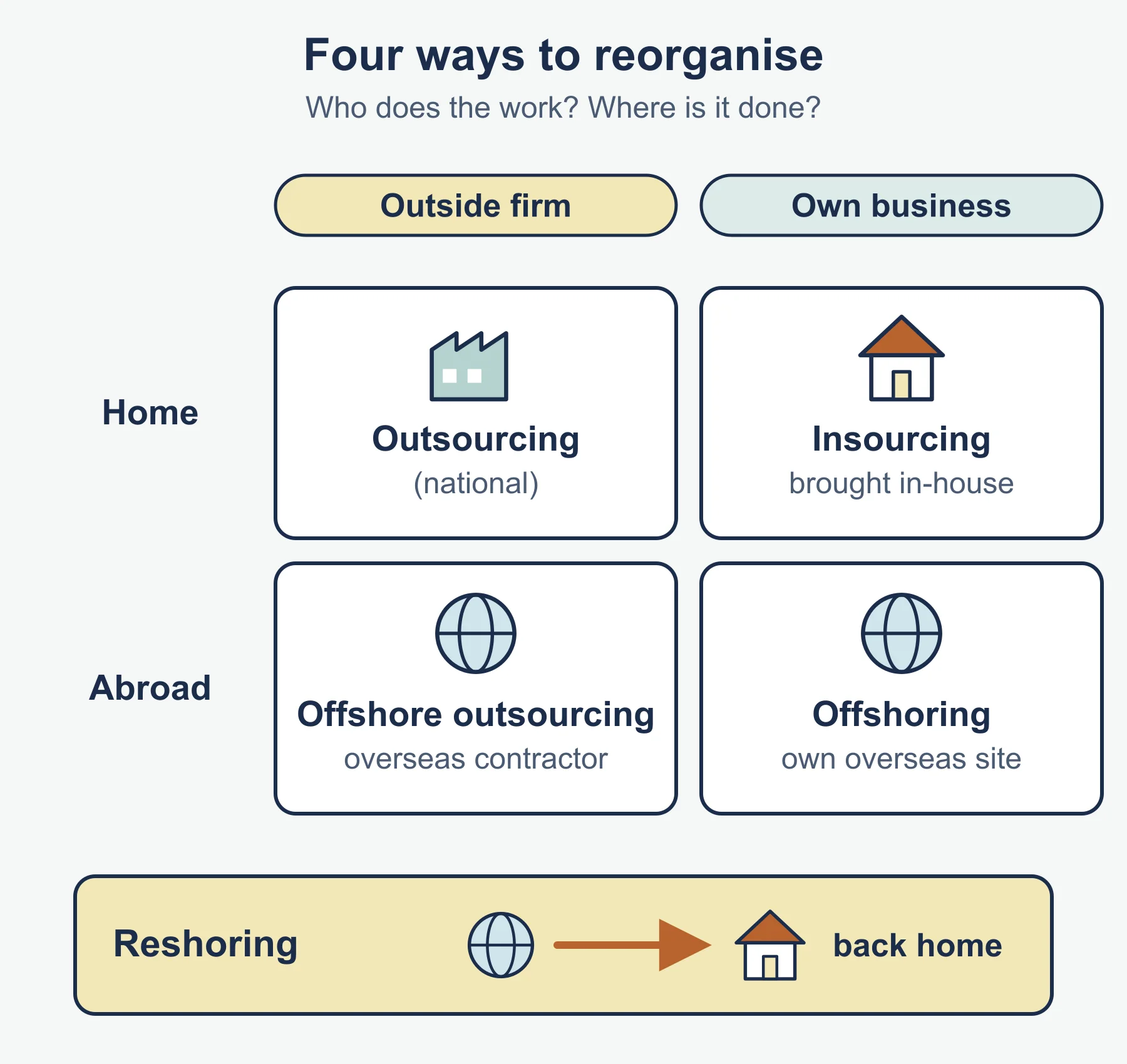
| Outsourcing/subcontracting | Paying an outside firm to carry out part or all of production | Who does the work? |
| Offshoring | Moving production, or part of it, to another country | Where is the work done? |
| Insourcing | Bringing in-house an activity previously done by an outside firm | Who does the work? |
| Reshoring | Moving production back to the home country after it was offshored | Where is the work done? |
Memory aid: outsourcing and insourcing are about who; offshoring and reshoring are about where. A move can combine both, such as handing an overseas contractor the work that used to be done at home.
Reasons for a specific location
The guide does not list the reasons; these groups are a standard set.
| Group | Examples |
|---|---|
| Costs | Rent, land, wages, materials, transport, tax, grants |
| Market | Closeness to customers, to suppliers and to similar firms |
| Labor | Number of workers, skills, training, attitudes to work |
| Infrastructure | Roads, ports, power, water, communications |
| Environment of the country | Political stability, laws, tariffs and quotas, exchange rates |
| Sustainability and ethics | Emissions from transport, working conditions, local community |
| Other | Brand image of a place, room to expand, owner preference |
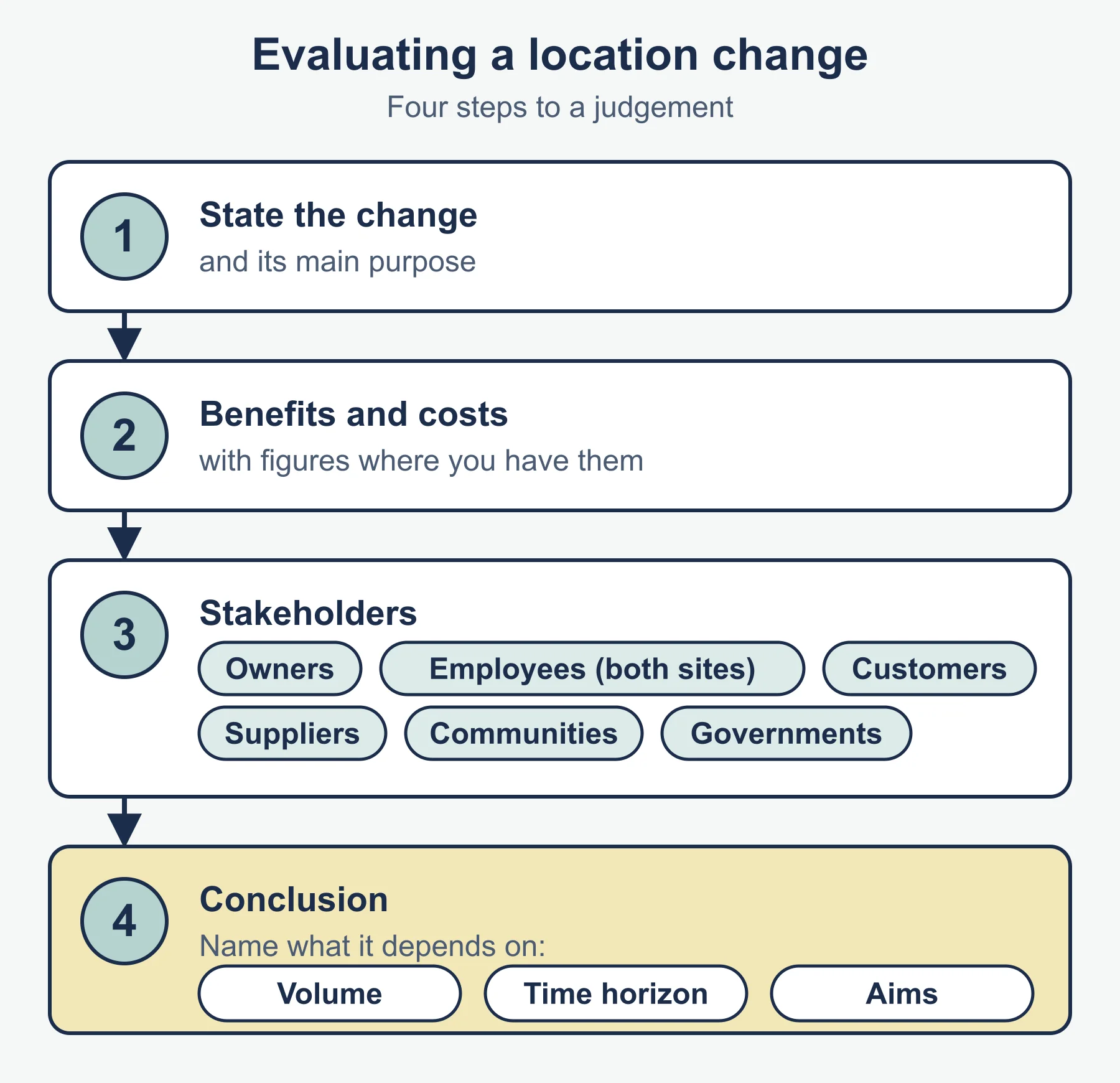
Method for a location question
- Identify the type of production and what it needs most: skilled labor, bulky materials, quick delivery, low wages.
- Choose the two or three factors that count most for the case.
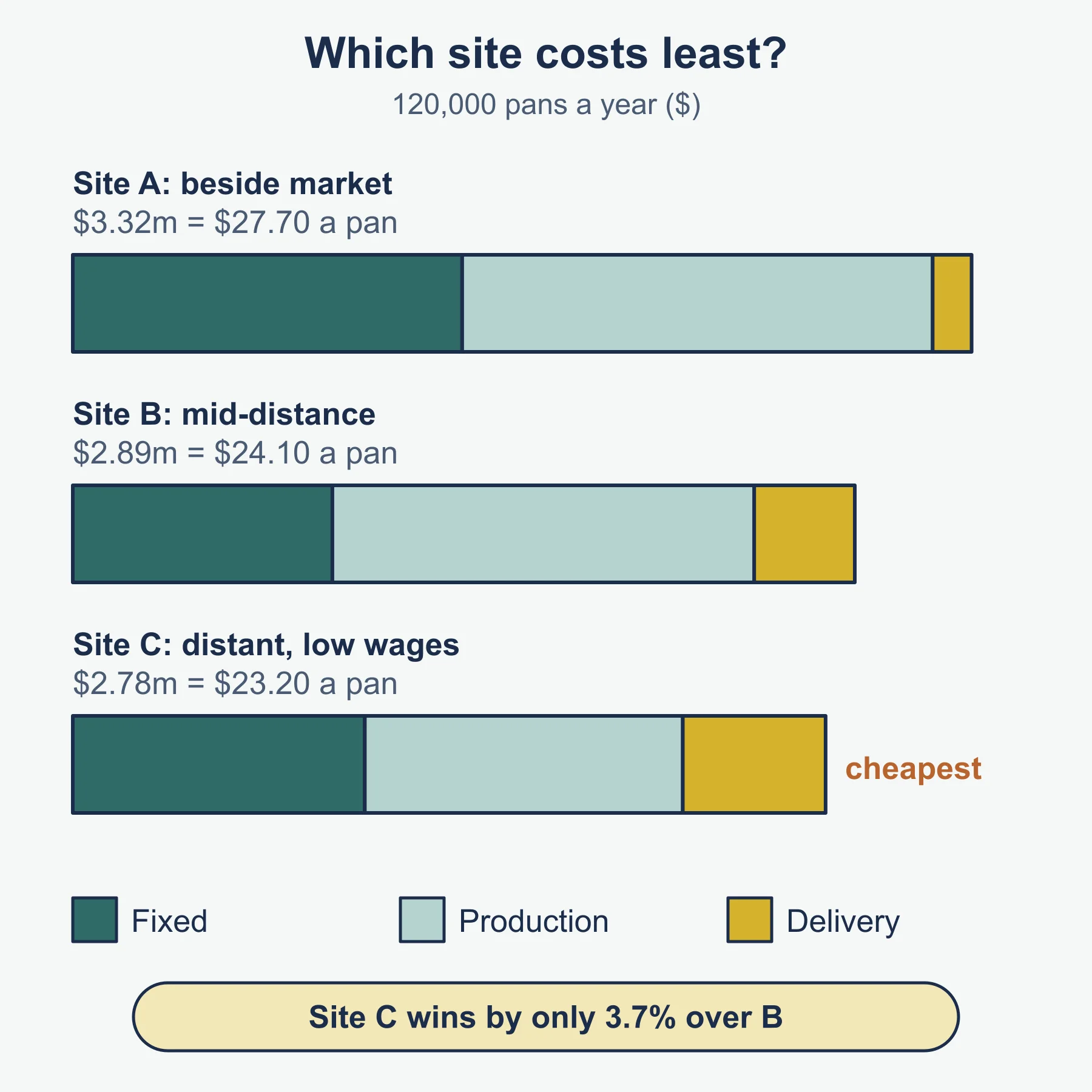
- Use any figures given. Compare total cost, not one part of cost.
- Add one non-financial point such as lead time or brand.
- Conclude with a judgement and the condition it depends on.
Comparing the four ways of reorganizing production
| Method | Possible advantages | Possible disadvantages |
|---|---|---|
| Outsourcing/subcontracting | Lower fixed costs; specialist skills; flexible to demand; management time freed | Less control; dependence on supplier; quality risk; confidentiality |
| Offshoring | Lower unit costs; new markets; skills or materials nearby | Shipping and duty; exchange rate risk; distance and culture; reputation risk |
| Insourcing | Control of quality and design; learning; cost saving at high volume | Fixed costs rise; needs capital and staff; riskier if demand falls |
| Reshoring | Faster response; fewer defects; brand image; less supply-chain risk | Higher unit cost; one-off move cost; possible price rise |
Each can be national or international. Subcontracting to a firm in the same country is still outsourcing.
Calculations to be ready for
| Task | Standard form |
|---|---|
| Total cost of a site | Fixed costs + output x (variable cost per unit + delivery cost per unit) |
| Cost per unit | Total cost / output |
| Landed cost of offshored product | Production cost + shipping + import duty |
| Saving per unit | Home cost per unit - landed cost per unit |
| Annual saving | Saving per unit x annual output |
| Time to recover a one-off cost | One-off cost / annual saving |
| Outsource or make in-house | In-house cost = fixed + variable x output; outsourced cost = price x output |
| Output at which the two options cost the same | Fixed cost / (outsourced price per unit - in-house variable cost per unit) |
Small worked reminder
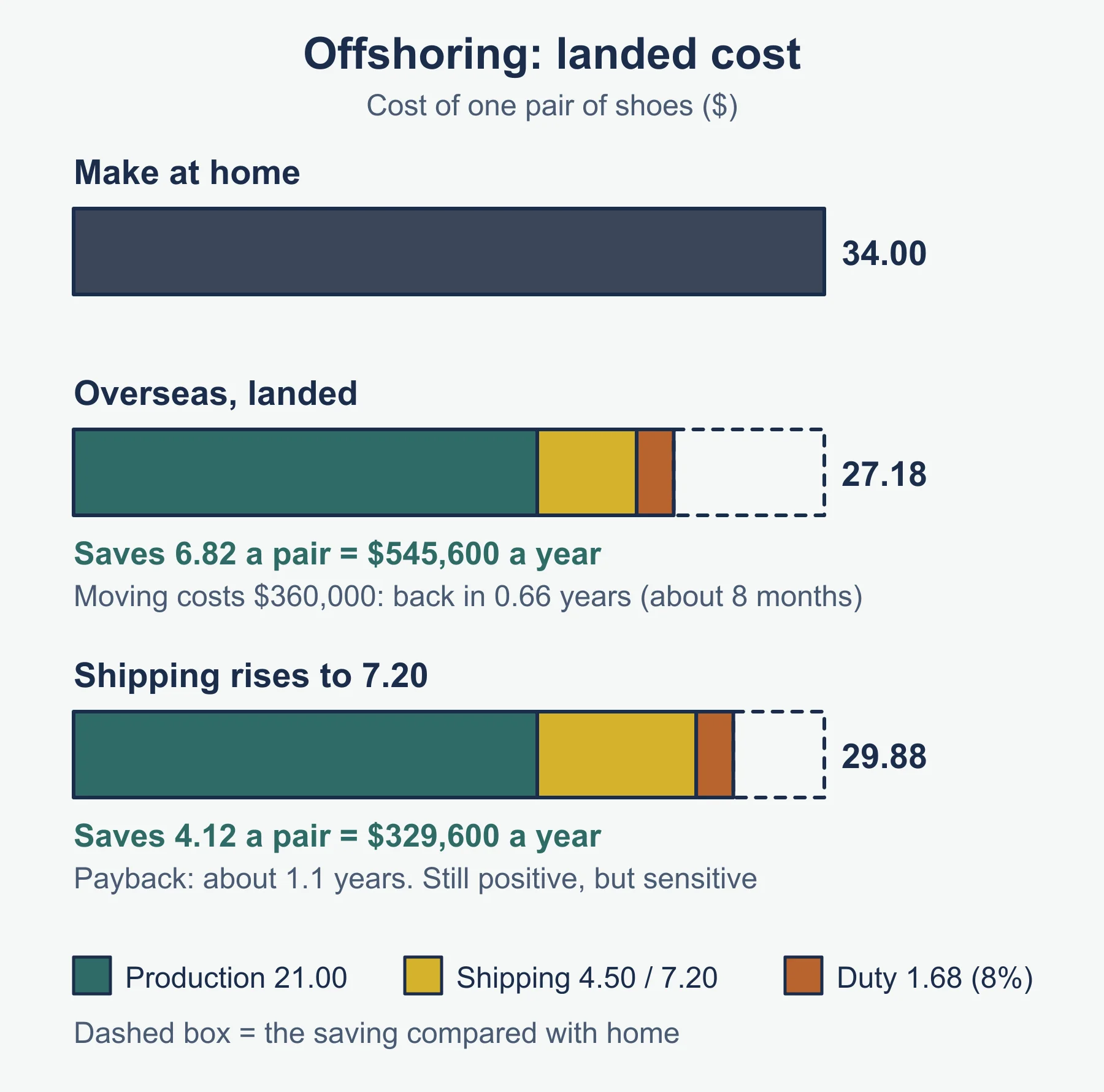
A lamp maker produces 40,000 lamps a year at home for 48.00 each. An overseas plant produces for 30.00, with shipping of 5.00 and duty at 6% of the production cost.
- Duty = 0.06 x 30.00 = 1.80.
- Landed cost = 30.00 + 5.00 + 1.80 = 36.80.
- Saving = 48.00 - 36.80 = 11.20 per lamp.
- Annual saving = 40,000 x 11.20 = 448,000.
- If a one-off move cost 120,000, it is recovered in 120,000 / 448,000 = 0.27 years, about 3 months.
Outsourcing reminder
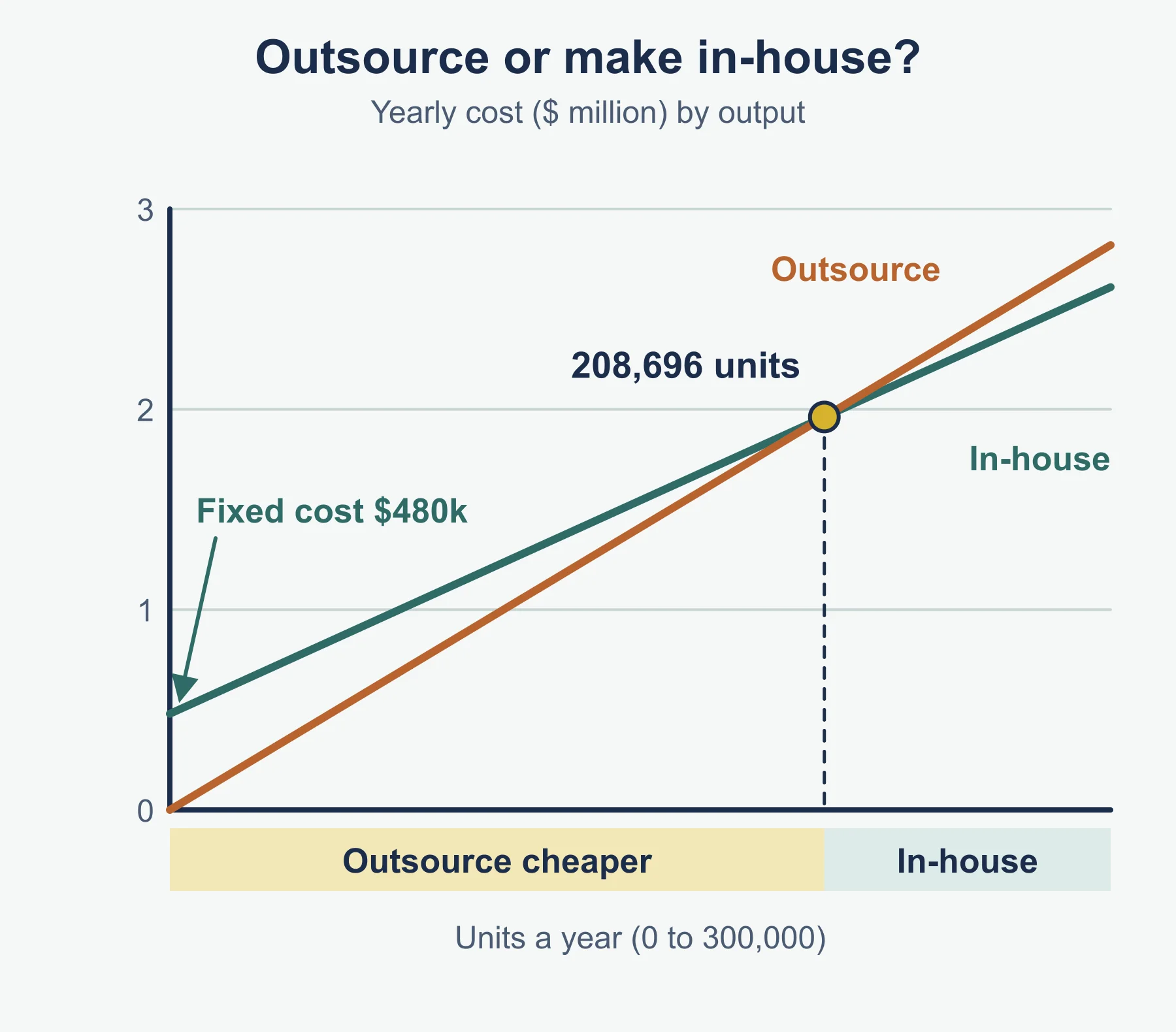
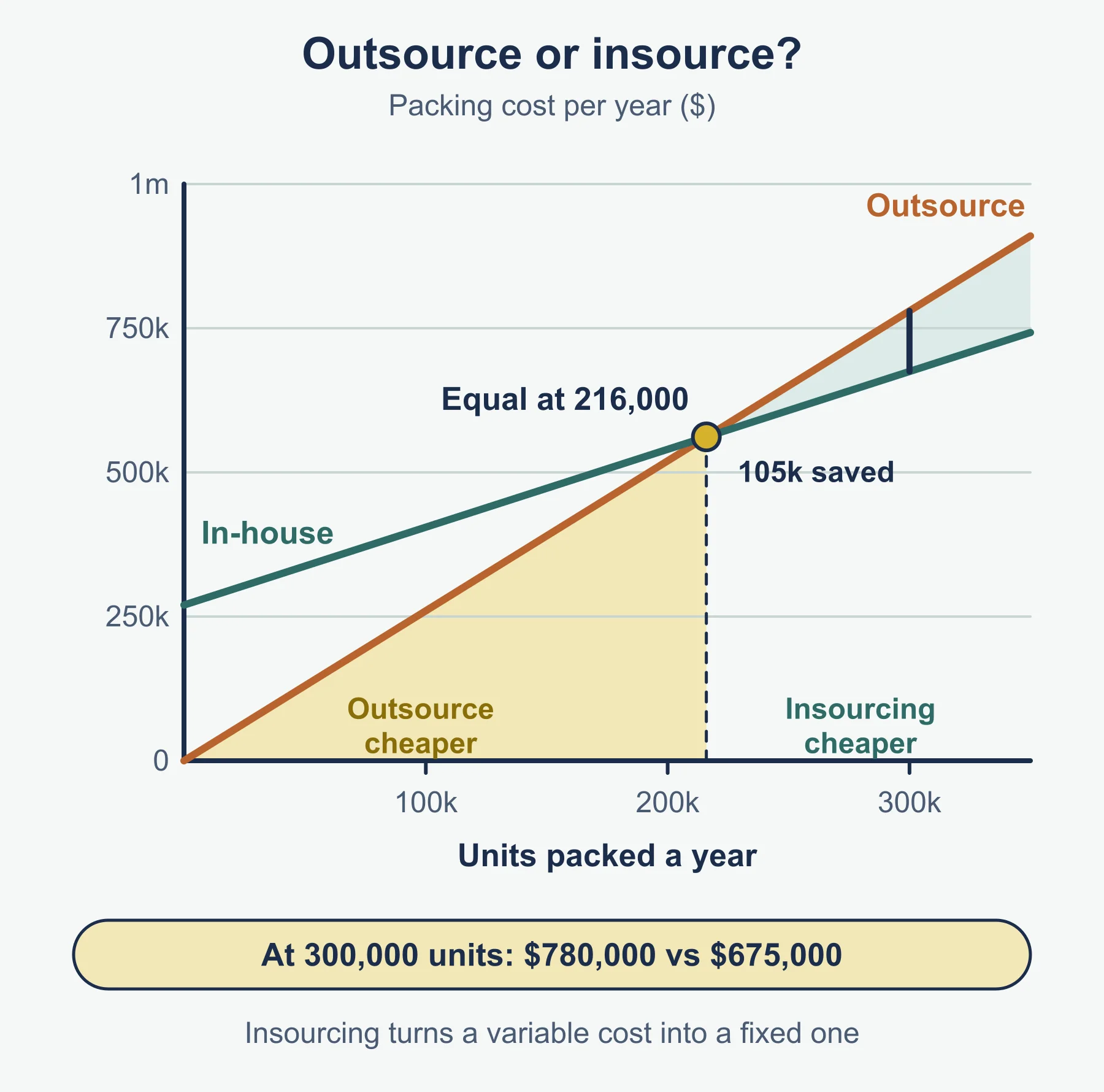
In-house assembly has fixed costs of 90,000 and variable costs of 3.00 per unit. A contractor charges 4.50 per unit.
- The costs are equal where 90,000 + 3.00q = 4.50q, so q = 60,000.
- Below 60,000 units, the contractor is cheaper. Above, in-house is cheaper.
Reshoring reminder
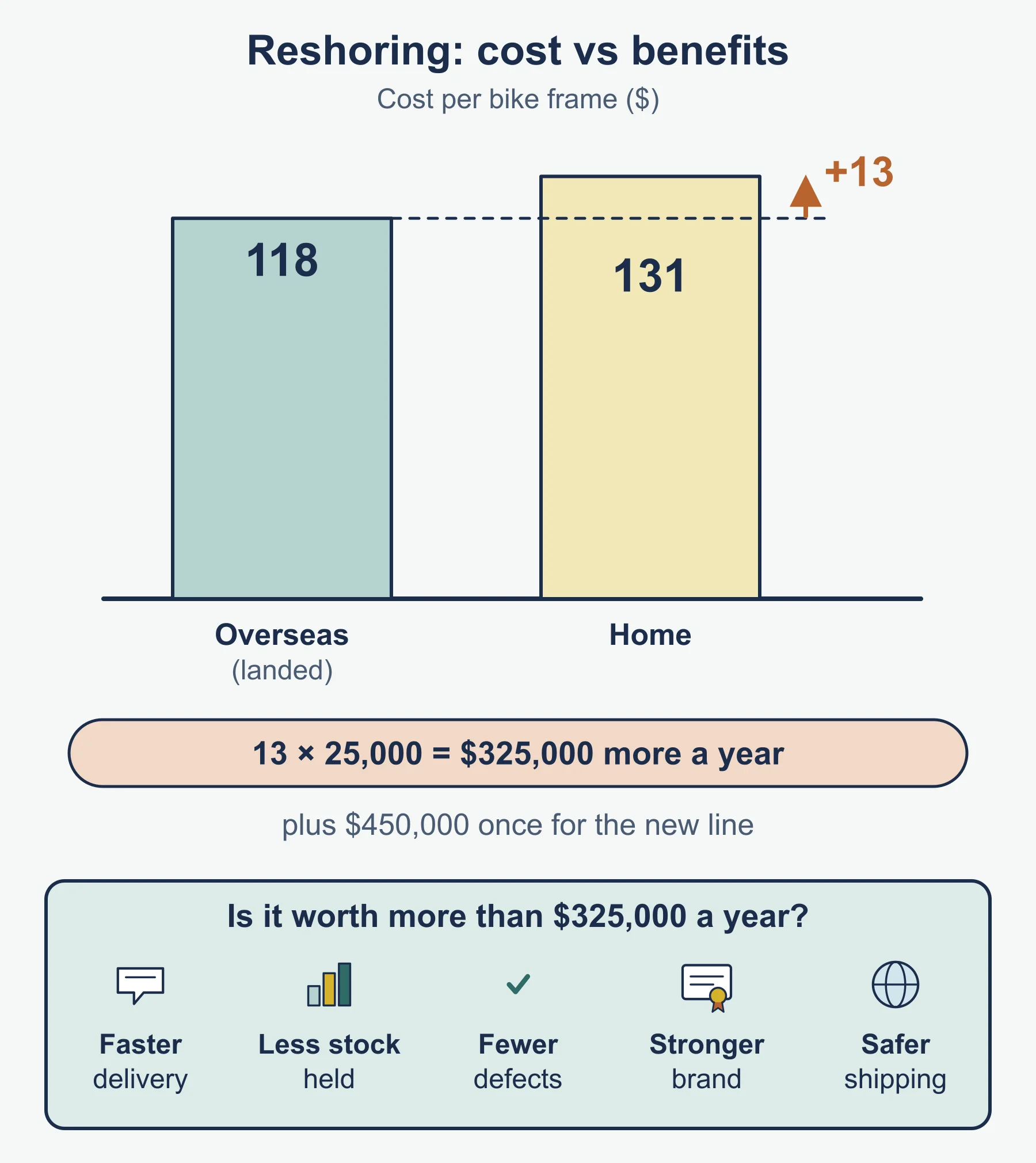
A maker of 10,000 chairs a year pays 22.00 each to produce overseas and 3.50 each to ship them, a landed cost of 25.50. Home production costs 27.00.
- Extra cost of reshoring = (27.00 - 25.50) x 10,000 = 15,000 a year.
- The case for reshoring must then rest on other gains, such as shorter lead times, fewer returns or a stronger brand. State what those gains would need to be worth: more than 15,000 a year.
Matching the factor to the business
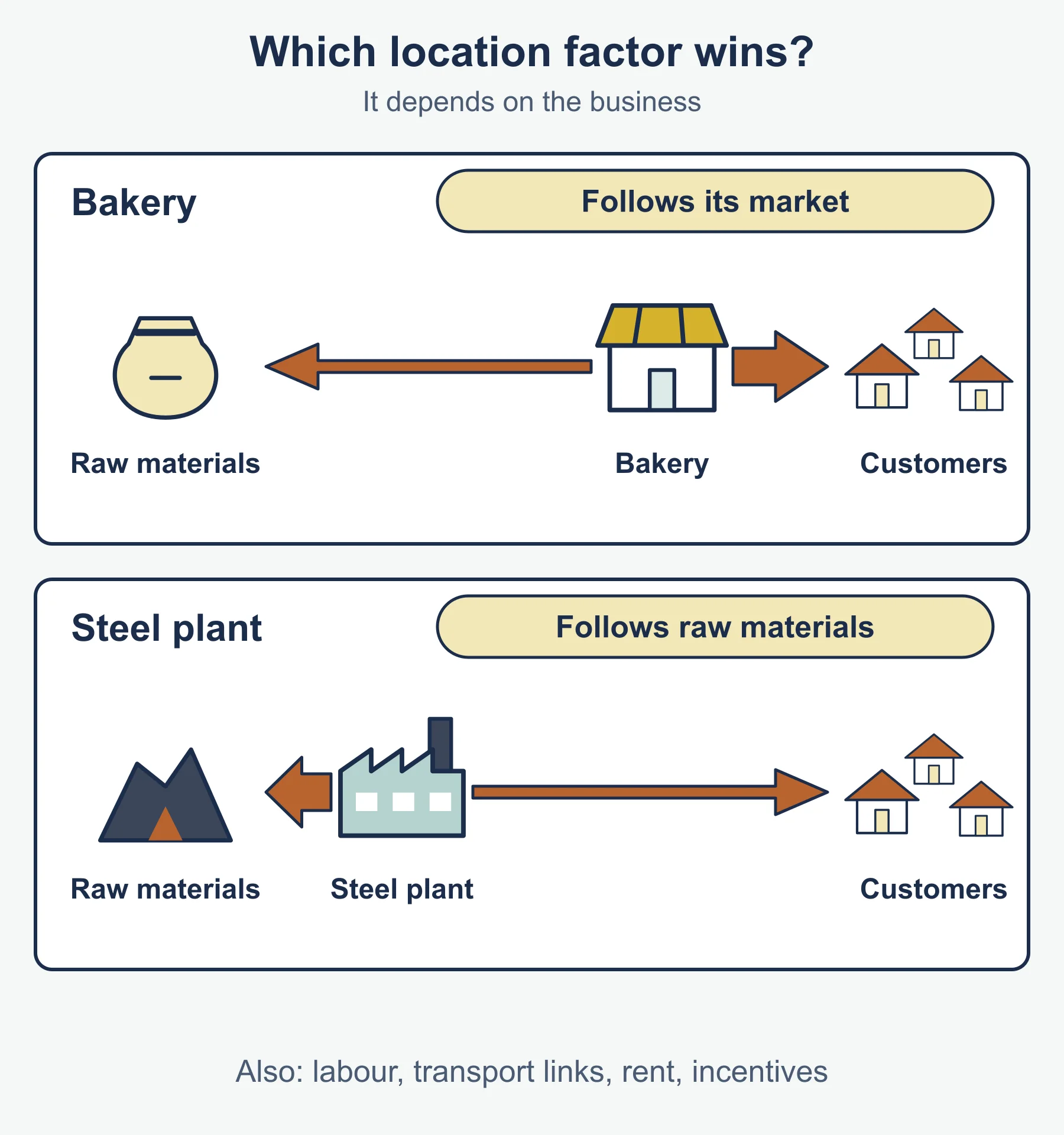
- A business with bulky, heavy materials often gains by locating near its suppliers.
- A business selling fresh or fragile goods often gains by locating near its customers.
- A labor-intensive business is often drawn to places with lower wage costs, but needs workers with the right skills.
- A business with a premium brand may value the image of a particular place above a small cost saving.
- A business expecting growth should check whether the site has room to expand.
Must-know distinctions
- Outsourcing is about who; offshoring is about where.
- Insourcing is the reverse of outsourcing. Reshoring is the reverse of offshoring.
- Landed cost differs from production cost. Landed cost includes shipping and duty.
- Fixed costs are charged whatever the output. Outsourcing turns them into variable costs.
- Lowest cost is not the same as best location. Lead time, quality and risk can outweigh a small cost gap.
- Short-run saving and long-run value are not always the same.
Evaluation prompts
- Does the saving still hold if shipping, wages or exchange rates change?
- Who gains and who loses: owners, workers at each site, customers, suppliers, the local community?
- Does the change fit the business’s aims and its ethical stance? The guide’s Unit 5 conceptual understandings note that operational changes can affect other activities and a business’s ethical position.
- Is the move easy to reverse? Offshoring then reshoring costs money twice.
- Does the time horizon change the answer?
Quick self-test
- Define outsourcing.
- State the difference between outsourcing and offshoring.
- Define insourcing.
- Define reshoring.
- State three factors a business may consider when choosing a production location.
- Production cost abroad is 15.00 per unit, shipping is 2.40 and import duty is 10% of production cost. Calculate the landed cost per unit.
- In-house production has fixed costs of 90,000 and variable costs of 3.00 per unit. A contractor charges 4.50 per unit. Calculate the output at which the costs are equal.
- Home cost is 25.00 per unit and landed cost abroad is 21.50. Calculate the percentage saving from offshoring.
- Explain one reason a business might choose a more expensive location.
- Identify the term for a business that stops using a contractor and does the work itself.
- Explain one ethical issue linked to offshoring.
- State one reason a business might choose to reshore production.
Answers
- Paying an outside firm to carry out part or all of a business’s production.
- Outsourcing is about who does the work (an outside firm). Offshoring is about where it is done (another country).
- Bringing in-house an activity that an outside firm used to do.
- Moving production back to the home country after it was offshored.
- Any three of: labor cost and skills, cost of land, closeness to customers, closeness to suppliers, transport links, tax and incentives, trade barriers, political stability.
- Duty = 1.50. Landed cost = 15.00 + 2.40 + 1.50 = 18.90.
- 90,000 + 3.00q = 4.50q, so q = 60,000 units.
- Saving = 3.50. 3.50 / 25.00 = 14%.
- For example, a site near customers gives faster delivery and fewer lost sales, which can outweigh higher rent.
- Insourcing.
- For example, lower wages may come with poor working conditions at the overseas site, which can harm the brand and raise concern among stakeholders.
- For example, to cut lead times, improve quality control or use a made-at-home selling point.
Where marks are usually lost
- Writing “offshoring” when the case describes using a local contractor.
- Giving a list of location factors with no link to the business.
- Using production cost and leaving out shipping, duty or one-off costs.
- Mixing up fixed and variable costs when comparing in-house with outsourced production.
- Giving only advantages of a move, with no disadvantages.
- Ending an evaluation with a summary and no judgement.
- Ignoring stakeholders, or naming them without saying how they are affected.
- Quoting numbers without units or a statement of what they show.
- Treating reshoring as always better because it supports home jobs.
- Omitting the national forms of outsourcing and insourcing.
Frequently asked questions
What is the difference between insourcing and reshoring? Insourcing is bringing in-house an activity that an outside firm used to do, so it reverses outsourcing. Reshoring is moving production back to the home country after it was offshored, so it reverses offshoring.
How do you calculate landed cost when offshoring? Landed cost is the overseas production cost plus shipping plus import duty. Compare it with the home cost per unit, not the production cost alone, to find the real saving.
Why might a business choose a more expensive location? A higher-cost site can still be the better choice if it gives faster delivery to customers, fewer lost sales, better quality control or a stronger brand image linked to the place. Lowest cost is not the same as best location.
Is reshoring always better because it supports home jobs? No. Reshoring may cut lead times or improve quality, but it can raise costs, so the case must rest on whether those gains outweigh the extra cost for that business.
Official syllabus
IB Business management guide, first assessment 2024, International Baccalaureate Organization. Section 5.4 Location, within Unit 5: Operations management.
Get free revision emails (optional)
Occasional emails with practice questions, worked explanations and links to free resources for the qualification and subjects you choose. No spam, and you can unsubscribe from any email. The free tools on this site never need an email.
Related resources
-
Study guides
IB DP Business Management: Production planning (HL only)
Study guide to IB DP Business Management 5.6 (HL only): supply chains, JIT and JIC, stock control charts, capacity, defects, productivity and CTB or CTM.
Business · International Baccalaureate · IB
Read guide -
Practice questions
IB DP Business Management: Production planning (HL only) – Practice Questions
Original practice questions with worked answers on IB DP Business Management 5.6 (HL only): stock control, capacity, productivity and make or buy.
Business · International Baccalaureate · IB
Try questions -
Revision notes
IB DP Business Management: Production planning (HL only) – Revision Notes
Condensed revision notes for IB DP Business Management 5.6 (HL only): formulas, method steps, distinctions and a self-test on production planning.
Business · International Baccalaureate · IB
Revise topic
Related articles
-
teaching
A Level tuition in Dubai: Cambridge or Pearson Edexcel International A Level?
Schools in Dubai and Abu Dhabi teach either Cambridge International AS & A Level or Pearson Edexcel International A Level. How the two are structured, why it matters for tuition, and how online classes from Lahore work.
9 October 2026
-
curriculum guides
Choosing subjects at IGCSE and A Level
How subject choices at 14 and 16 affect university options later, and how to keep pathways open without overloading a timetable.
28 July 2026
Studying this with a teacher
Working through Business IB?
This page is free and stays free. If you would rather be taught it, Marlbridge runs Business classes one-to-one, online in your own time zone. The first trial class is free. WhatsApp replies within an hour (8am–11pm Pakistan time, every day); email the same day.
IB Business teachers at Marlbridge

