
Study Guides
IB DP Business Management: Location
Study guide to IB DP Business Management section 5.4: reasons for a production location, outsourcing, offshoring, insourcing and reshoring.
- Subject
- Business
- Level
- IB
- Topic
- Unit 5: Operations management
- Author
- Marlbridge Academic Team
- Updated
- Reviewed by
- Salman Ahmad (what this means)
Aligned to International Baccalaureate IB Diploma Programme Business (DP Business Management), First assessment 2024. Official specification .
Syllabus page (what it covers and how it is assessed): IB Diploma Programme Business.
Syllabus points this page covers
DP Business Management
- 5.4 Location
Found an error? Report a correction.
Need help with this topic? Request a free trial class for IB Diploma Programme Business (DP Business Management).
This guide covers section 5.4 (Location) of Unit 5 in the IB Business management guide, first assessment 2024. Every point in 5.4 is taught at both SL and HL; none is marked HL only. Use it with the course hub, the printable checklist, the revision notes and the practice questions. To find your weak spots across the course, try the free 10-minute diagnostics. All businesses and figures below are invented.
What 5.4 asks you to do
| Content point in the guide | What you must be able to do | Depth of teaching |
|---|---|---|
| The reasons for a specific location of production | Explain why a business puts its production where it does | AO2 |
| Outsourcing/subcontracting | Show how production can be reorganized this way, nationally and internationally | AO3 |
| Offshoring | The same, for moving production to another country | AO3 |
| Insourcing | The same, for bringing production inside the business | AO3 |
| Reshoring | The same, for moving production back to the home country | AO3 |
AO2 is application and analysis. AO3 is synthesis and evaluation, so for the four ways of reorganizing production you must be able to weigh advantages against disadvantages and reach a judgement, not just describe them. The guide lists the terms without defining them. The definitions below are the standard forms.
Reasons for a specific location of production
The guide asks for “the reasons” but does not list them, so you need a working set. The groups below are a standard set, not the guide’s own list. Group them so you can recall them under pressure.
Cost factors
- Land, rent and building costs.
- Labor costs and the supply of workers with the right skills.
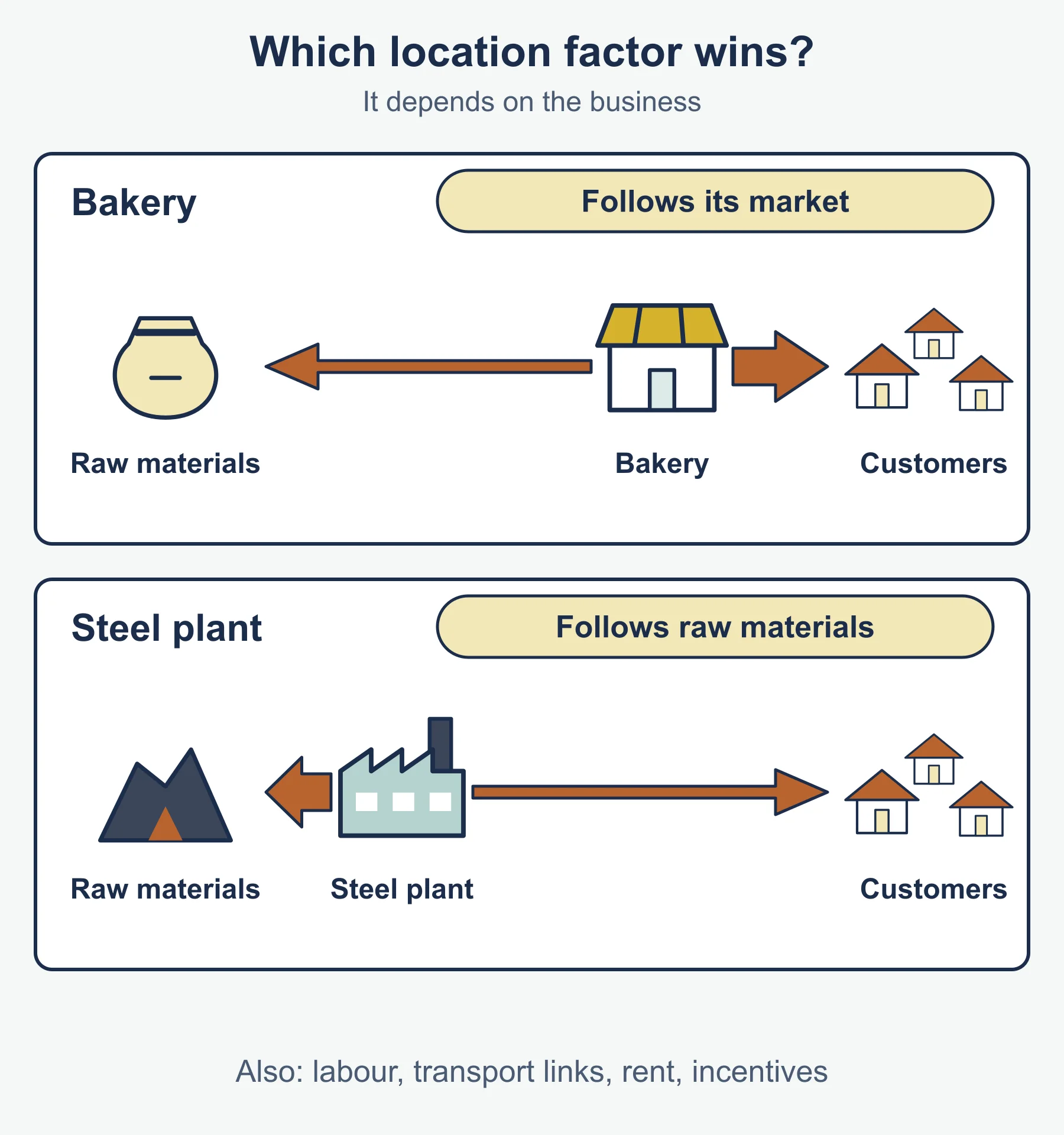
- Cost of raw materials and components, and the cost of moving them.
- Cost of delivering finished goods to customers.
- Tax rates, grants and other government incentives.
Market and supply factors
- Closeness to customers, which shortens delivery times and lets the business respond to changes in demand.
- Closeness to suppliers, which cuts transport costs and delays.
- Closeness to other firms in the same industry, where a supply of skilled workers and specialist services may already exist.
Operating environment
- Quality of roads, ports, power, water and communications.
- Political stability and the legal framework.
- Trade barriers such as tariffs and quotas, and exchange rate movements.
- Environmental rules and the business’s own sustainability aims.
Other reasons
- The brand image linked to a place of origin.
- Room to expand later.
- The personal preference or history of the owners.
Worked example: choosing between three sites
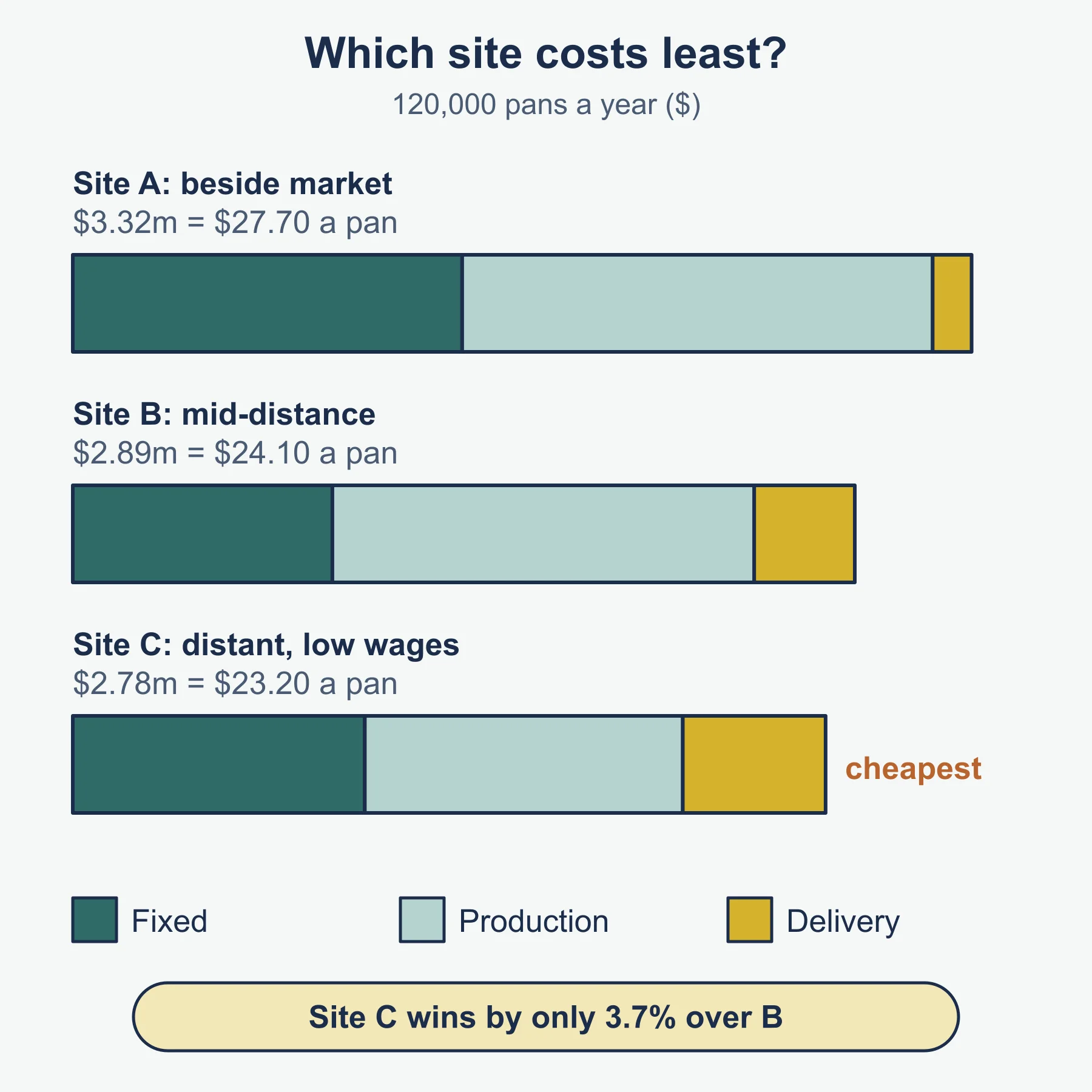
Glasswick Cookware will make 120,000 pans a year at one new site. It has costs for three possible sites.
| Site | Fixed costs per year | Variable cost per pan | Delivery to market per pan |
|---|---|---|---|
| A (beside the main market) | 1,440,000 | 14.50 | 1.20 |
| B (mid-distance) | 960,000 | 13.00 | 3.10 |
| C (distant, low wages) | 1,080,000 | 9.80 | 4.40 |
All figures are in dollars.
Step 1: total cost = fixed costs + output x (variable cost + delivery cost).
- A: 1,440,000 + 120,000 x 15.70 = 3,324,000.
- B: 960,000 + 120,000 x 16.10 = 2,892,000.
- C: 1,080,000 + 120,000 x 14.20 = 2,784,000.
Step 2: cost per pan = total cost / 120,000. A is 27.70, B is 24.10 and C is 23.20.
Step 3: judge. Site C is cheapest by 108,000 a year over B, a gap of about 3.7% of B’s cost. That margin is small. A long delivery distance means longer lead times, more stock in transit and less ability to react to a sudden change in demand. Site A costs 540,000 a year more than C but gives fast delivery. The numbers support C, but the decision depends on how much the business values speed and flexibility.
Notice the pattern. Quantitative data lets you rank the sites. Qualitative factors then test whether the ranking is safe. A strong answer uses both.
Ways of reorganizing production
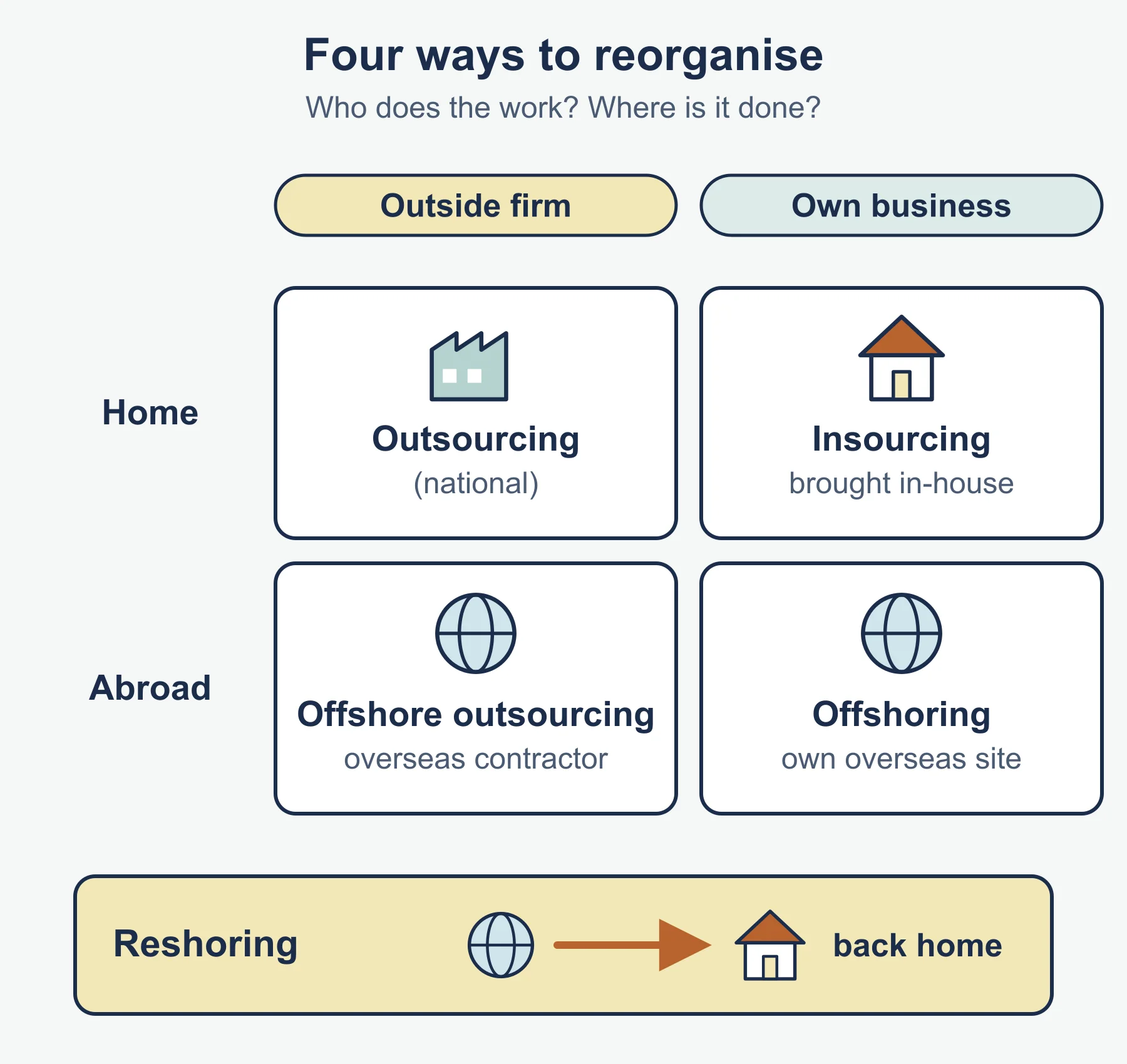
Two questions separate the four terms. Who does the work, the business itself or an outside firm? Where is it done, in the home country or abroad?
| Done by an outside firm | Done by the business itself | |
|---|---|---|
| Home country | Outsourcing/subcontracting (national) | Insourcing |
| Another country | Outsourcing/subcontracting (international), often called offshore outsourcing | Offshoring to the business’s own overseas operation |
Reshoring moves work from another country back to the home country. The work may then be done by the business itself or by a home-based contractor. The guide says all four ways are covered “both nationally and internationally”, so be ready to describe each in a national and an international form.
Outsourcing/subcontracting
The business pays another firm to carry out a part of production, or all of it, instead of doing it internally. Subcontracting usually describes handing a specific job or component to another firm.
Possible advantages: the business pays only for what it uses, avoids buying equipment, gains access to specialist skill and can focus on what it does best.
Possible disadvantages: less control over quality and delivery dates, dependence on the contractor, risk that confidential designs leak, and a contract price that may rise.
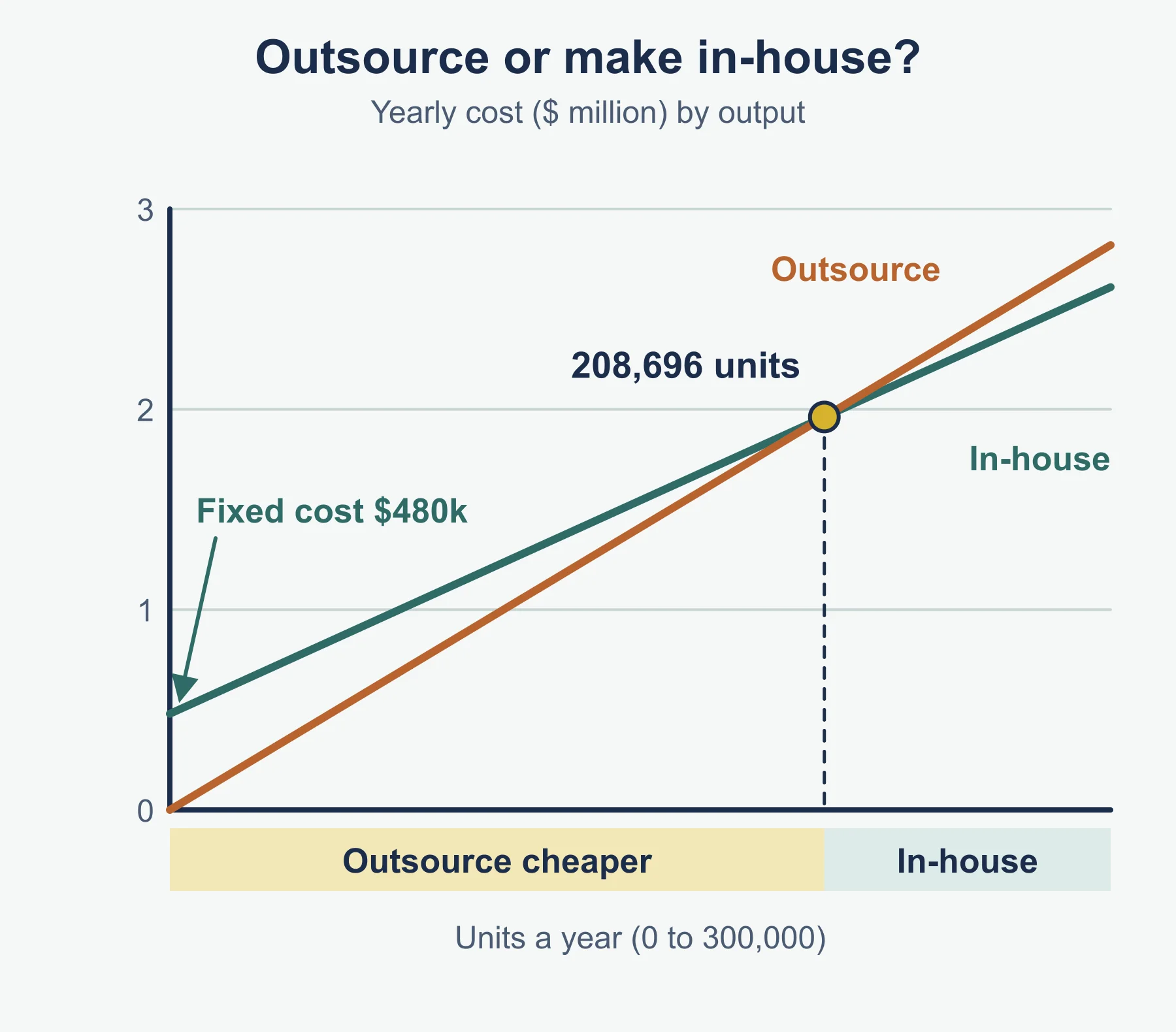
Worked example. Nyrith Audio makes speakers. Its own assembly line has fixed costs of 480,000 a year and variable costs of 7.10 per unit. A contractor will assemble for 9.40 per unit with no fixed cost.
- At 150,000 units: in-house costs 480,000 + 150,000 x 7.10 = 1,545,000. Outsourcing costs 150,000 x 9.40 = 1,410,000. Outsourcing is 135,000 cheaper.
- At 250,000 units: in-house costs 2,255,000. Outsourcing costs 2,350,000. In-house is 95,000 cheaper.
- The two options cost the same where 480,000 = (9.40 - 7.10) x output. That gives 208,696 units (to the nearest unit).
Below about 208,700 units a year, outsourcing is cheaper. Above it, in-house production is cheaper. If Nyrith expects demand to grow past that figure, outsourcing is a short-run saving and a long-run cost. The decision should also weigh quality control and how well the contractor can cope with surges in orders.
Offshoring
Offshoring means moving production, or part of it, to another country. The business may open its own plant there or use a local contractor. The term describes where the work happens. The term outsourcing describes who does it. A business can offshore without outsourcing, and outsource without offshoring.
Typical drivers: lower wages, cheaper land, access to new markets, nearby raw materials and favorable government incentives. Typical problems: transport costs and delays, import duties, exchange rate risk, differences in culture and language, harder quality checks, and public criticism if working conditions are poor.
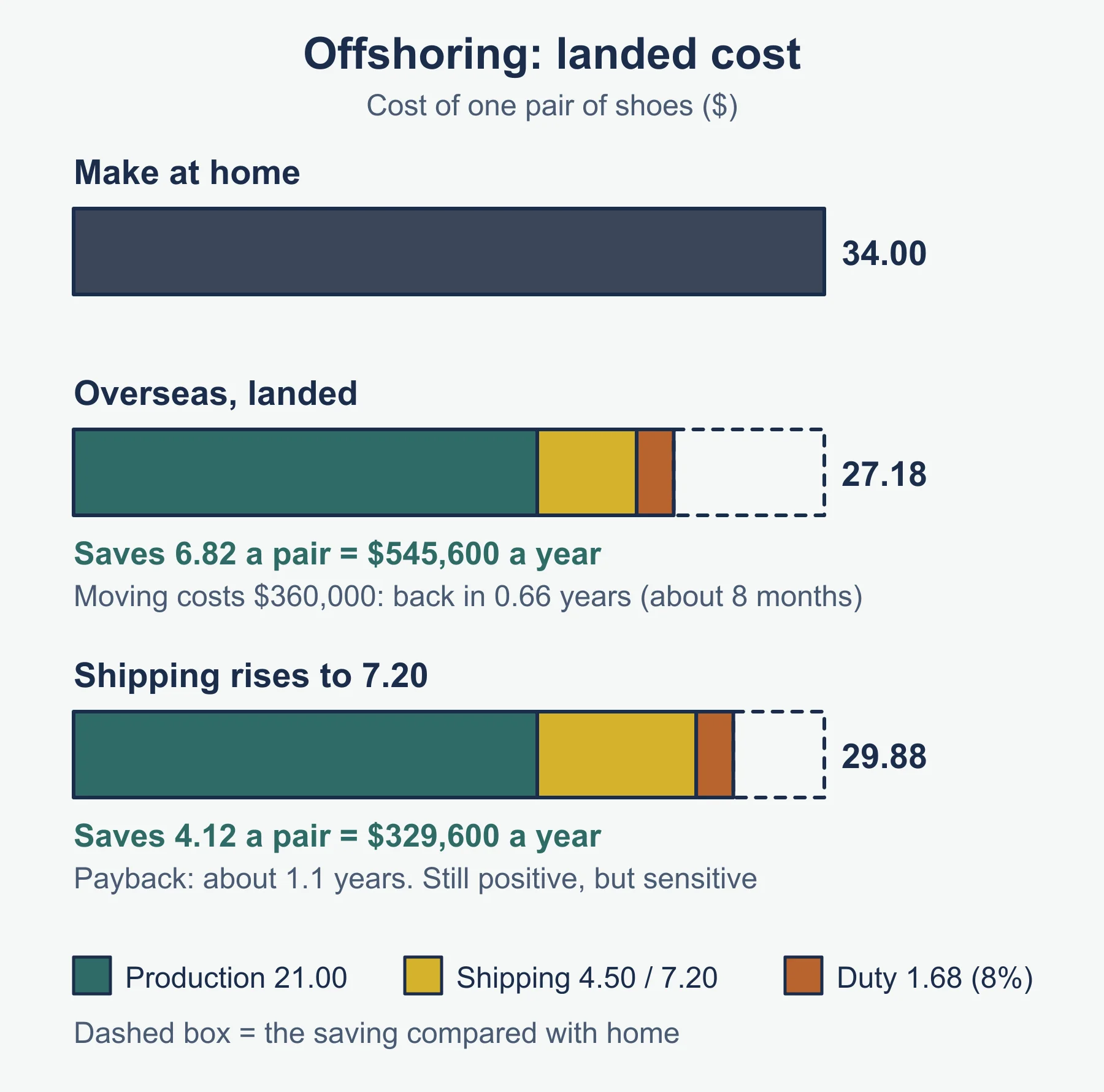
Worked example. Zerrin Footwear makes 80,000 pairs a year at home at a cost of 34.00 per pair. An overseas factory would produce at 21.00 per pair. Shipping adds 4.50 per pair and import duty is 8% of the production cost.
- Duty = 0.08 x 21.00 = 1.68.
- Landed cost = 21.00 + 4.50 + 1.68 = 27.18 per pair.
- Saving = 34.00 - 27.18 = 6.82 per pair, so 80,000 x 6.82 = 545,600 a year.
- Moving costs 360,000 once. The saving covers this in 360,000 / 545,600 = 0.66 years, about 8 months.
Now test the result. If shipping rose to 7.20, landed cost would be 21.00 + 7.20 + 1.68 = 29.88. The saving falls to 4.12 per pair, or 329,600 a year, and recovery of the moving cost takes about 1.1 years. The offshoring case is still positive, but it is sensitive to shipping, duty and exchange rates. Say so in your answer.
Insourcing
Insourcing means bringing in-house an activity that was done by an outside firm. A business might do this to regain control of quality, protect designs, build its own skills or save money once volumes are high.
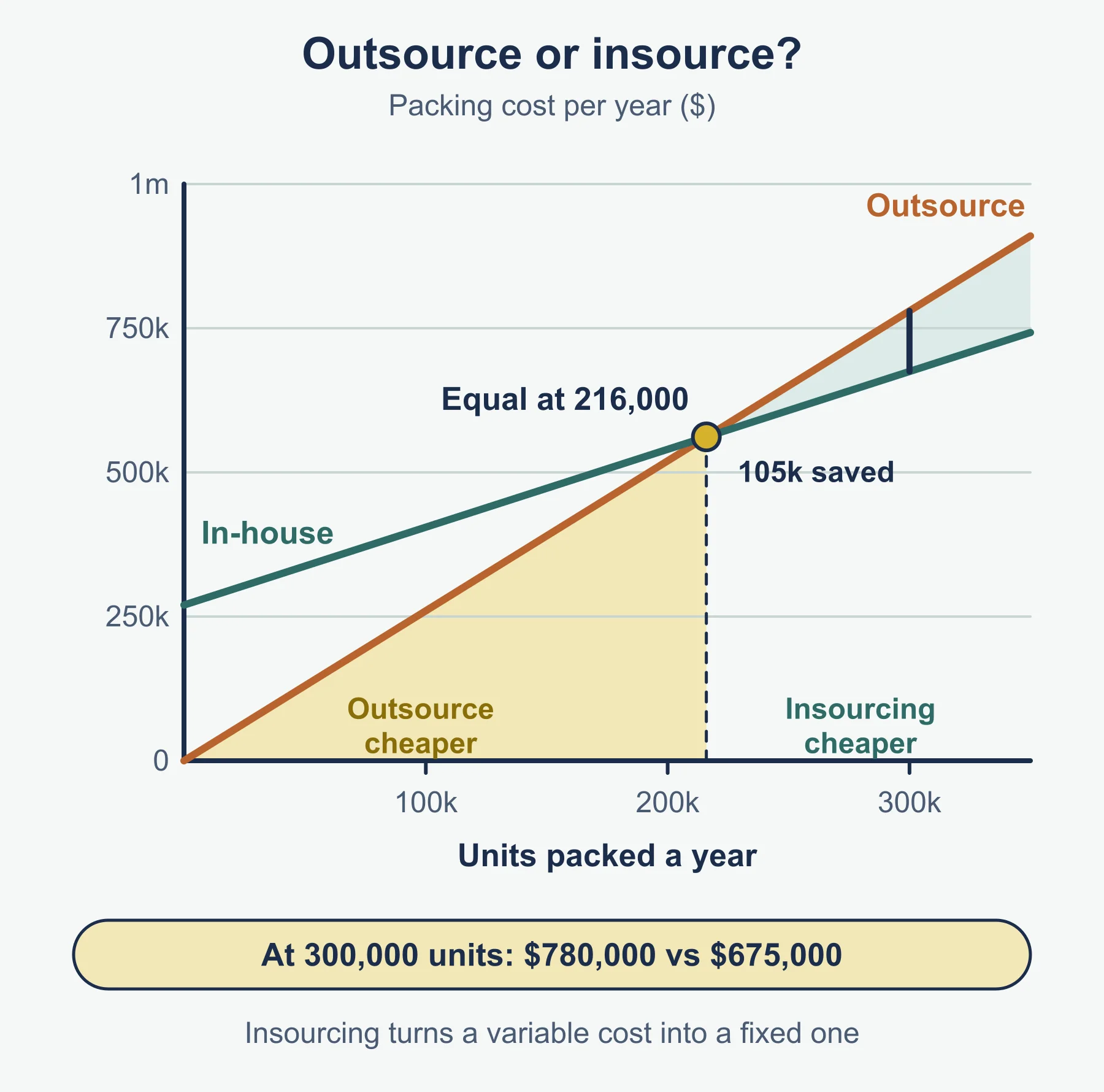
Worked example. Pennaby Foods pays a packing firm 2.60 per unit for 300,000 units a year, which is 780,000. Packing in-house would cost 270,000 fixed plus 1.35 per unit, which is 270,000 + 300,000 x 1.35 = 675,000. Insourcing saves 105,000 a year. The cost is equal at 270,000 / (2.60 - 1.35) = 216,000 units. If sales fell below 216,000, Pennaby would have been better off outsourcing. Insourcing converts a variable cost into a fixed one, which raises risk when demand is uncertain.
Other points: the business needs space, machinery and trained staff, so it must recruit and train. Staff at the former contractor may lose their jobs, which affects that firm as a stakeholder.
Reshoring
Reshoring means moving production that was offshored back to the home country. Reasons include rising overseas wages, long lead times, quality problems, shipping costs or disruption, a wish to use a “made at home” selling point, or pressure from customers and governments.
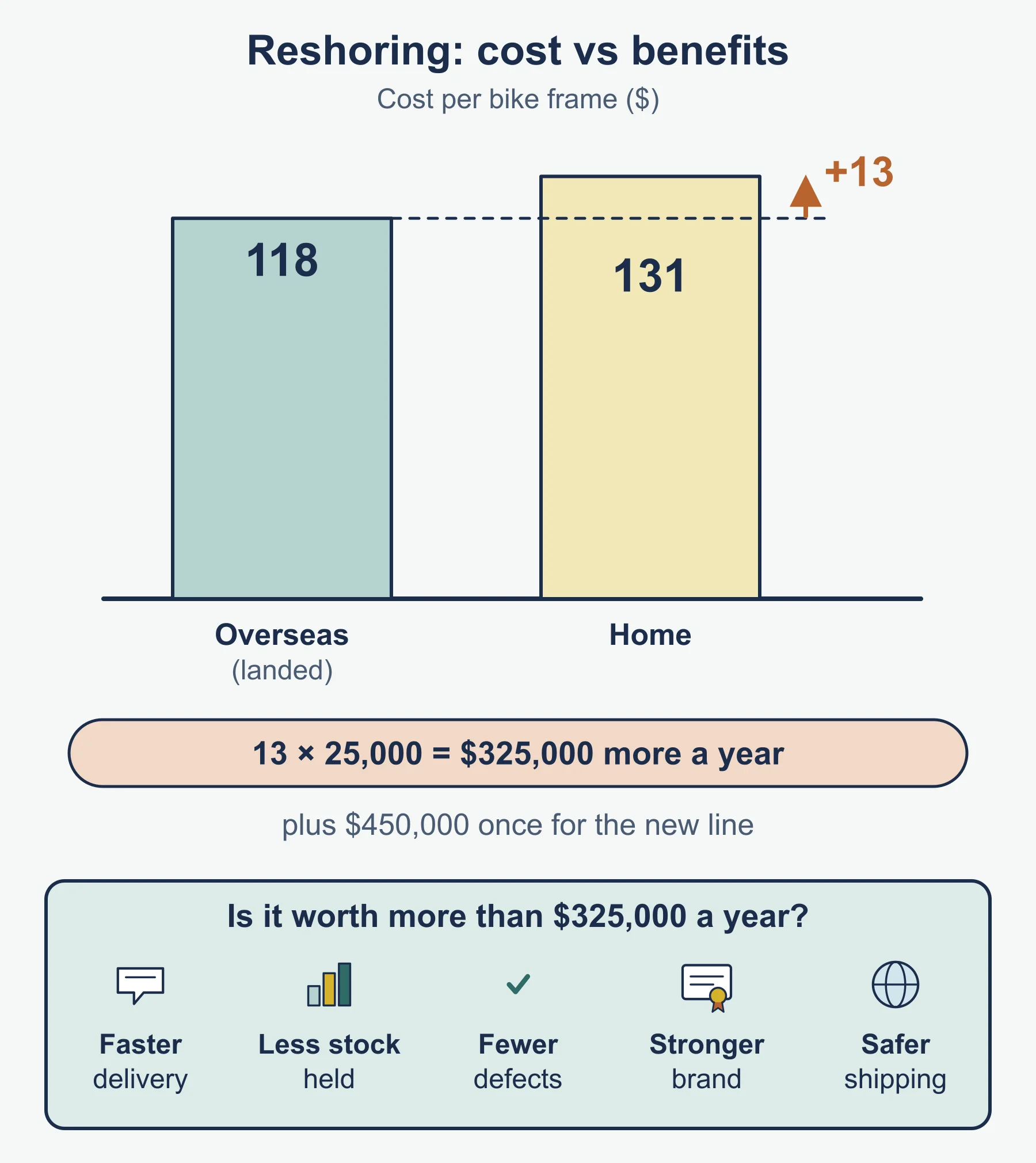
Worked example. Rudhall Bikes makes 25,000 frames a year overseas at a landed cost of 118 per frame. Home production would cost 131. Reshoring adds 13 x 25,000 = 325,000 a year to production cost, plus a one-off 450,000 for the new line. On cost alone, reshoring looks poor. Rudhall’s case must rest on other benefits: faster delivery, less stock held, fewer defects, a stronger brand and less exposure to shipping disruption. If those are worth more than 325,000 a year, reshoring is justified.
Evaluating a location change
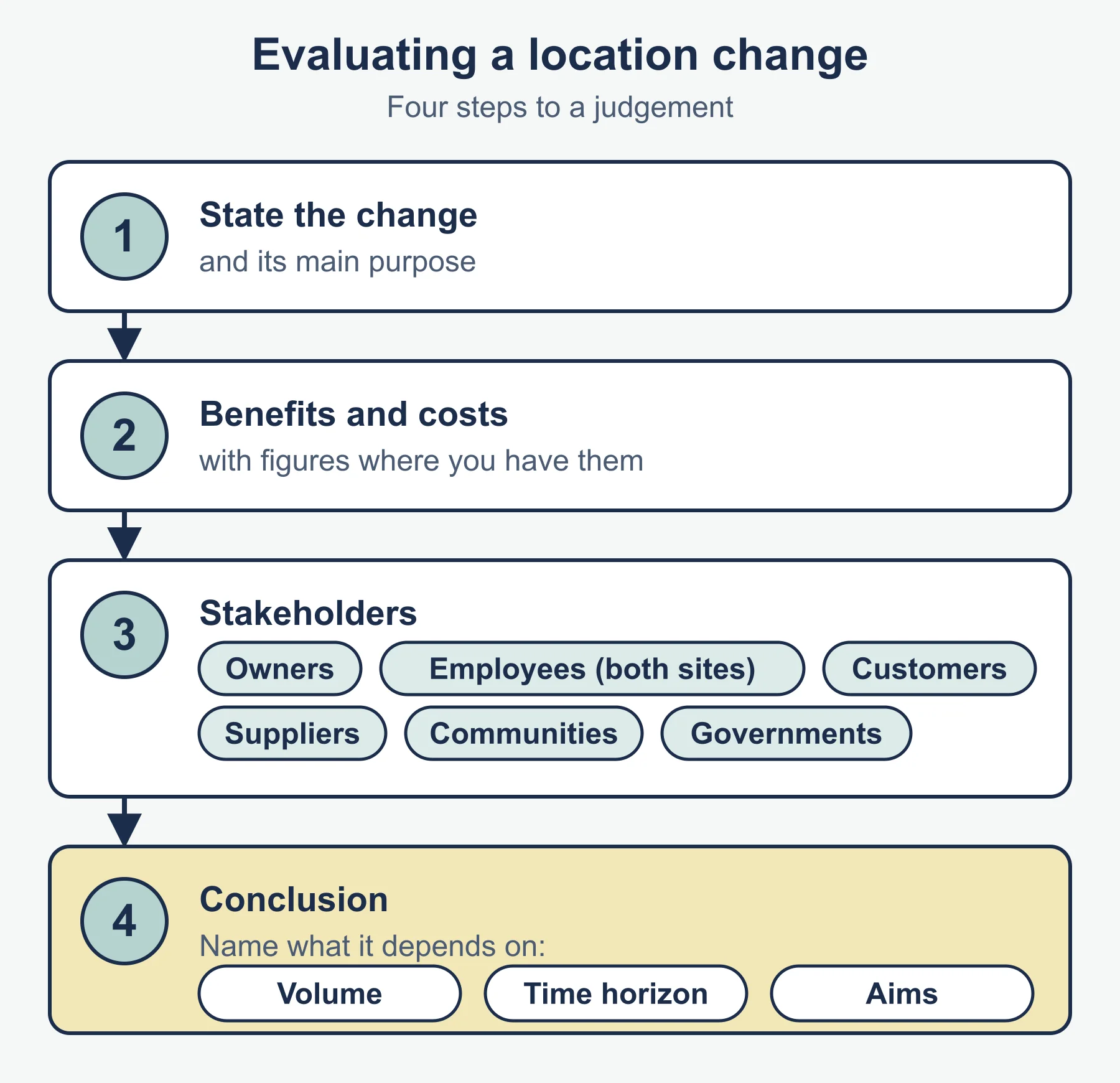
For AO3 questions, build the judgement in four steps.
- State the change and its main purpose.
- Give benefits and costs with figures where you have them.
- Consider stakeholders: owners, employees at both sites, customers, suppliers, communities and governments.
- Reach a conclusion that names what the decision depends on, such as volume, time horizon or the business’s aims.
Remember the Unit 5 conceptual understandings in the guide: operational changes can affect other business activities, and they may affect a business’s ethical stance. Offshoring to cut labor costs can raise questions about working conditions. Reshoring can protect home jobs but raise prices. Sustainability also matters: long shipping routes add emissions, though a more efficient overseas plant may offset some of this.
Common errors
- Treating outsourcing and offshoring as the same thing.
- Calling any move abroad “offshoring” even when the business has simply bought a product from a foreign supplier.
- Listing location factors without linking them to the business in the case study.
- Comparing production cost only and leaving out shipping, duty and one-off costs.
- Stating a conclusion without naming the condition it depends on.
- Forgetting the national forms: subcontracting to a firm in the same country is outsourcing too.
Where to go next
Test yourself with the revision notes and the practice questions, then use the checklist to tick off what you can do.
Frequently asked questions
What factors affect where a business locates production? Standard factors include costs such as land, labour, materials, transport and tax; closeness to customers, suppliers and similar firms; the quality of infrastructure; political stability, trade barriers and exchange rates; and other reasons such as brand image, room to expand and owners’ preferences. The guide asks for “the reasons” but does not list them.
What is offshoring? Offshoring means moving production, or part of it, to another country, either to the business’s own plant there or to an overseas contractor. Typical drivers are lower wages, cheaper land, access to new markets and nearby raw materials.
What are the disadvantages of outsourcing? Outsourcing can mean less control over quality and delivery dates, dependence on the contractor, a risk that confidential designs leak, and a contract price that may rise.
How do you evaluate a location change? State the change and its purpose, give benefits and costs with figures where possible, consider stakeholders at both sites, and conclude by naming what the decision depends on, such as volume, time horizon or the business’s aims. These reorganization methods are taught at AO3 in section 5.4.
Official syllabus
IB Business management guide, first assessment 2024, International Baccalaureate Organization. Section 5.4 Location, within Unit 5: Operations management.
Get free revision emails (optional)
Occasional emails with practice questions, worked explanations and links to free resources for the qualification and subjects you choose. No spam, and you can unsubscribe from any email. The free tools on this site never need an email.
Related resources
-
Practice questions
IB DP Business Management: Location – Practice Questions
Original practice questions with worked answers on IB DP Business Management section 5.4: location, outsourcing, offshoring, insourcing, reshoring.
Business · International Baccalaureate · IB
Try questions -
Revision notes
IB DP Business Management: Location – Revision Notes
Condensed revision notes for IB DP Business Management section 5.4 Location: location factors, outsourcing, offshoring, insourcing, reshoring.
Business · International Baccalaureate · IB
Revise topic -
Study guides
IB DP Business Management: Production planning (HL only)
Study guide to IB DP Business Management 5.6 (HL only): supply chains, JIT and JIC, stock control charts, capacity, defects, productivity and CTB or CTM.
Business · International Baccalaureate · IB
Read guide
Related articles
-
teaching
A Level tuition in Dubai: Cambridge or Pearson Edexcel International A Level?
Schools in Dubai and Abu Dhabi teach either Cambridge International AS & A Level or Pearson Edexcel International A Level. How the two are structured, why it matters for tuition, and how online classes from Lahore work.
9 October 2026
-
curriculum guides
Choosing subjects at IGCSE and A Level
How subject choices at 14 and 16 affect university options later, and how to keep pathways open without overloading a timetable.
28 July 2026
Studying this with a teacher
Working through Business IB?
This page is free and stays free. If you would rather be taught it, Marlbridge runs Business classes one-to-one, online in your own time zone. The first trial class is free. WhatsApp replies within an hour (8am–11pm Pakistan time, every day); email the same day.
IB Business teachers at Marlbridge

