
Study Guides
IB DP Business Management: Research and development (HL only) and Management information systems (HL only)
Study guide to IB DP Business Management 5.8 and 5.9 (HL only): R&D, intellectual property, innovation, data, AI, cybersecurity and ethics.
- Subject
- Business
- Level
- IB
- Topic
- Unit 5: Operations management
- Author
- Marlbridge Academic Team
- Updated
- Reviewed by
- Salman Ahmad (what this means)
Aligned to International Baccalaureate IB Diploma Programme Business (DP Business Management), First assessment 2024. Official specification .
Syllabus page (what it covers and how it is assessed): IB Diploma Programme Business.
Syllabus points this page covers
DP Business Management
- 5.8 Research and development (HL only)
- 5.9 Management information systems (HL only)
Found an error? Report a correction.
Need help with this topic? Request a free trial class for IB Diploma Programme Business (DP Business Management).
This guide covers sections 5.8 (Research and development) and 5.9 (Management information systems) in Unit 5 of the IB Business management guide, first assessment 2024. Both sections are HL only, so SL candidates do not need them.
Use it with the revision notes and the practice questions. The course hub is IB DP Business Management, the printable list is the syllabus checklist, and the free diagnostics show where to start.
The guide lists many of these terms without defining them. The working definitions below are standard ones, written for revision, and the business examples are invented.
What 5.8 and 5.9 ask you to know
| Guide section | Content point | Depth in the guide |
|---|---|---|
| 5.8 | Importance of research and development (R&D) for a business | AO3 |
| 5.8 | Developing goods and services that address customers’ unmet needs | AO2 |
| 5.8 | Intellectual property protection: copyrights, patents, trademarks | AO2 |
| 5.8 | Innovation: incremental and disruptive | AO2 |
| 5.9 | Data analytics; database; cybersecurity and cybercrime | AO1 |
| 5.9 | Critical infrastructures: artificial neural networks, data centres, cloud computing | AO2 |
| 5.9 | Virtual reality; the internet of things; artificial intelligence; big data | AO2 |
| 5.9 | Customer loyalty programmes | AO3 |
| 5.9 | Using data to manage and monitor employees; Digital Taylorism | AO3 |
| 5.9 | Using data mining to inform decision-making | AO3 |
| 5.9 | Benefits, risks and ethical implications of management information systems and technological innovation for decision-making and stakeholders | AO3 |
5.8 Research and development
The importance of R&D for a business
R&D is the work a business does to discover new knowledge and turn it into new or improved goods, services or processes. Research looks for knowledge. Development turns it into something that can be sold or used.
Reasons it matters:
- It feeds the product portfolio, so revenue does not depend on products that are ageing.
- It can create a competitive advantage that rivals find hard to copy, particularly when protected as intellectual property.
- It can lower costs through better processes, which supports operations management.
- It can open new markets.
R&D also has costs. Spending is certain, results are not, and payback can be slow. A common way to compare spending is R&D as a percentage of sales revenue. This is a standard ratio, not one the guide names.
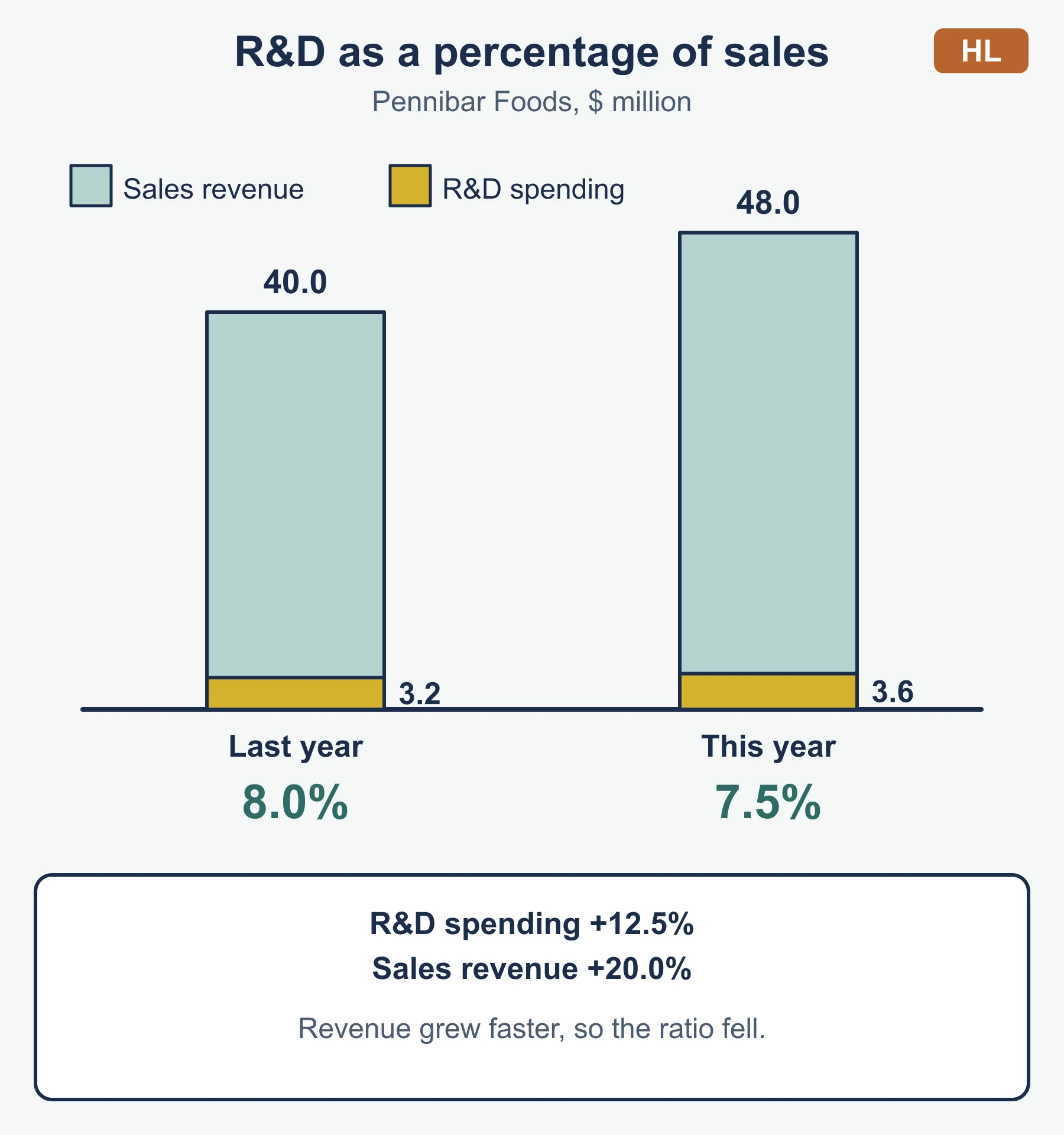
Worked example. Pennibar Foods (an invented snack maker) had sales revenue of 48.0 million dollars and spent 3.6 million on R&D. Last year it had 40.0 million and 3.2 million.
- This year: 3.6 ÷ 48.0 × 100 = 7.5%.
- Last year: 3.2 ÷ 40.0 × 100 = 8.0%.
- R&D spending rose by (3.6 − 3.2) ÷ 3.2 × 100 = 12.5%, while sales revenue rose by 20.0%.
The ratio fell because revenue grew faster than R&D spending. That is not automatically bad or good. A judgement needs the quality of the pipeline, not just the percentage.
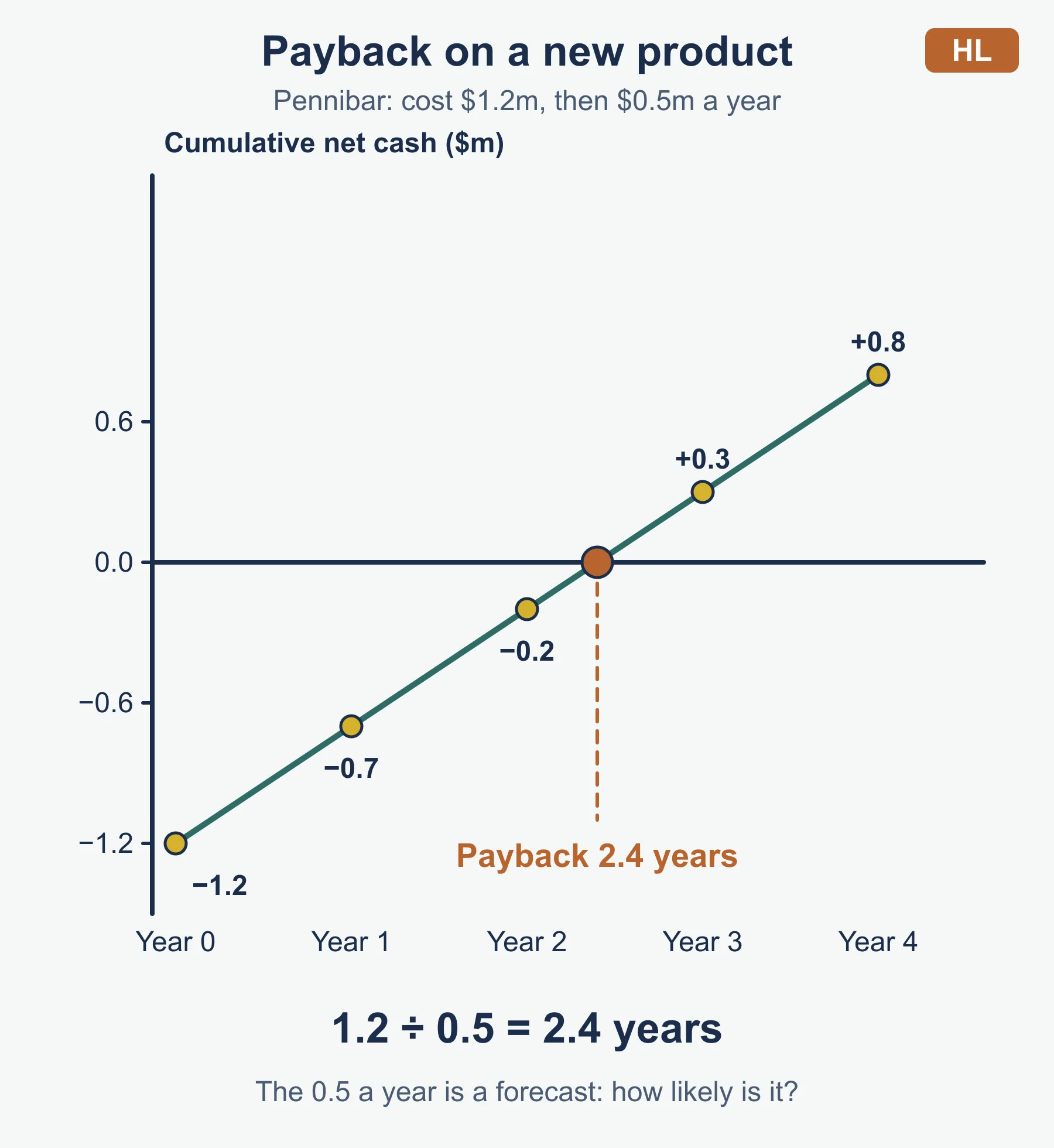
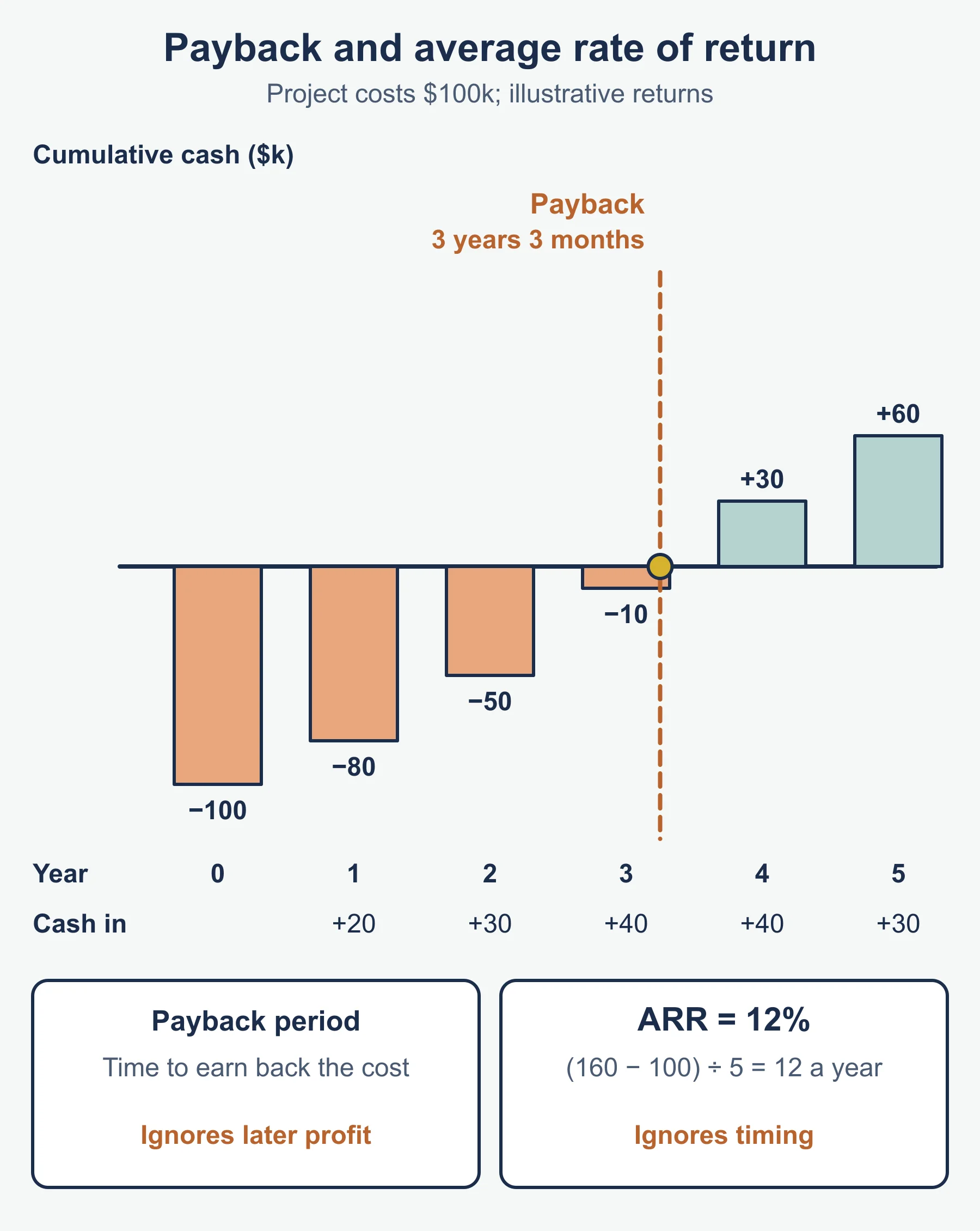
Pennibar’s best new product cost 1.2 million dollars to develop and is expected to add 0.5 million a year in net cash flow. Payback = 1.2 ÷ 0.5 = 2.4 years. The forecast is an estimate, so a manager would also ask how likely it is to be right.
Unmet customer needs
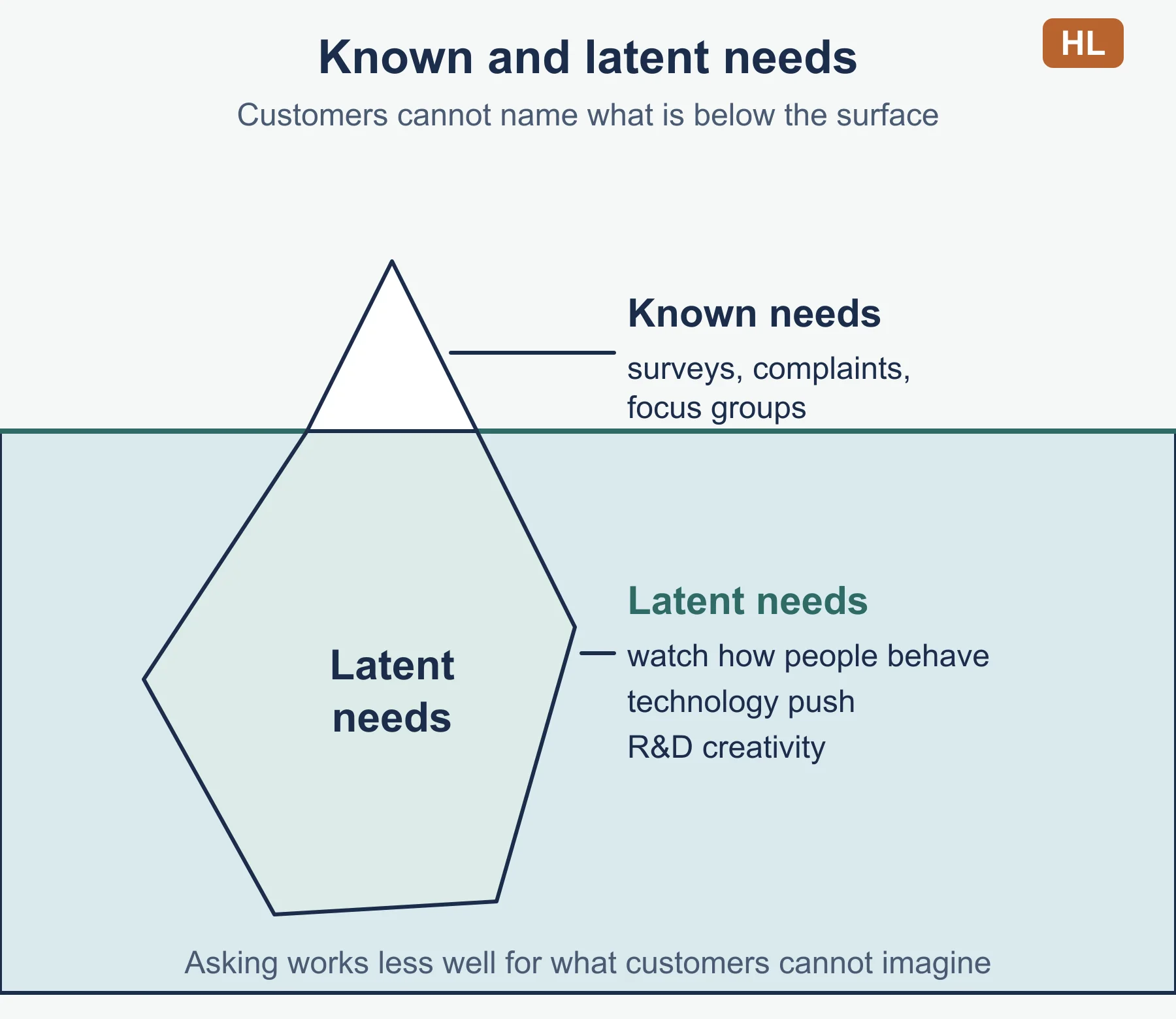
Customers do not always know what they lack. Some unmet needs are known: people complain about a problem and nothing good exists. Others are latent: customers are unaware of the need until a product shows them. A business can find known needs with surveys, complaints and focus groups. Latent needs are harder. They may come from observing how people behave, from technology push (a new capability finds a use) or from the creativity of the R&D team. Asking customers what they want works less well for a product they cannot yet imagine.
The benefit is a product with a clear reason to buy, often with less direct competition. The risk is that a need the business believed in turns out to be small, so development money is lost.
Intellectual property protection
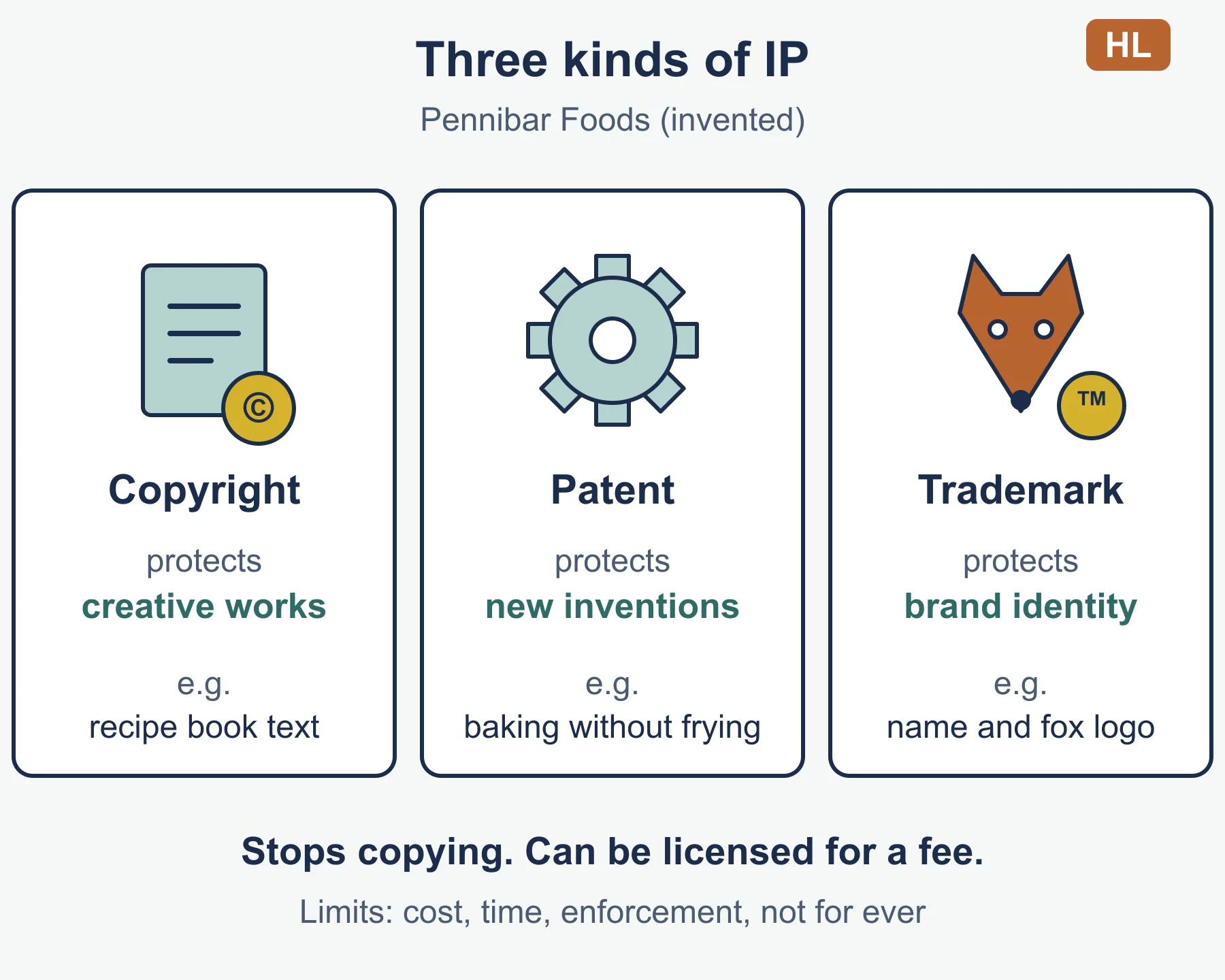
Intellectual property (IP) protects creations of the mind. The guide names three forms. Rules differ between countries, so this guide describes them in general terms only.
| Form | What it generally protects | Example in an invented business |
|---|---|---|
| Copyright | Original creative works such as written text, music, software code, images | The text and illustrations in Pennibar’s recipe book |
| Patent | A new invention, such as a product or process | Pennibar’s new method of baking a crisp without frying |
| Trademark | A sign that identifies the origin of goods or services, such as a name, logo or slogan | The Pennibar name and its fox logo |
Protection stops others copying the work without permission, so the owner can recover its R&D costs. It also lets the owner license the work to others for a fee, which is a source of income. The limits are cost, time and the need to enforce rights, which can be difficult internationally. Protection also does not last for ever.
Innovation: incremental and disruptive
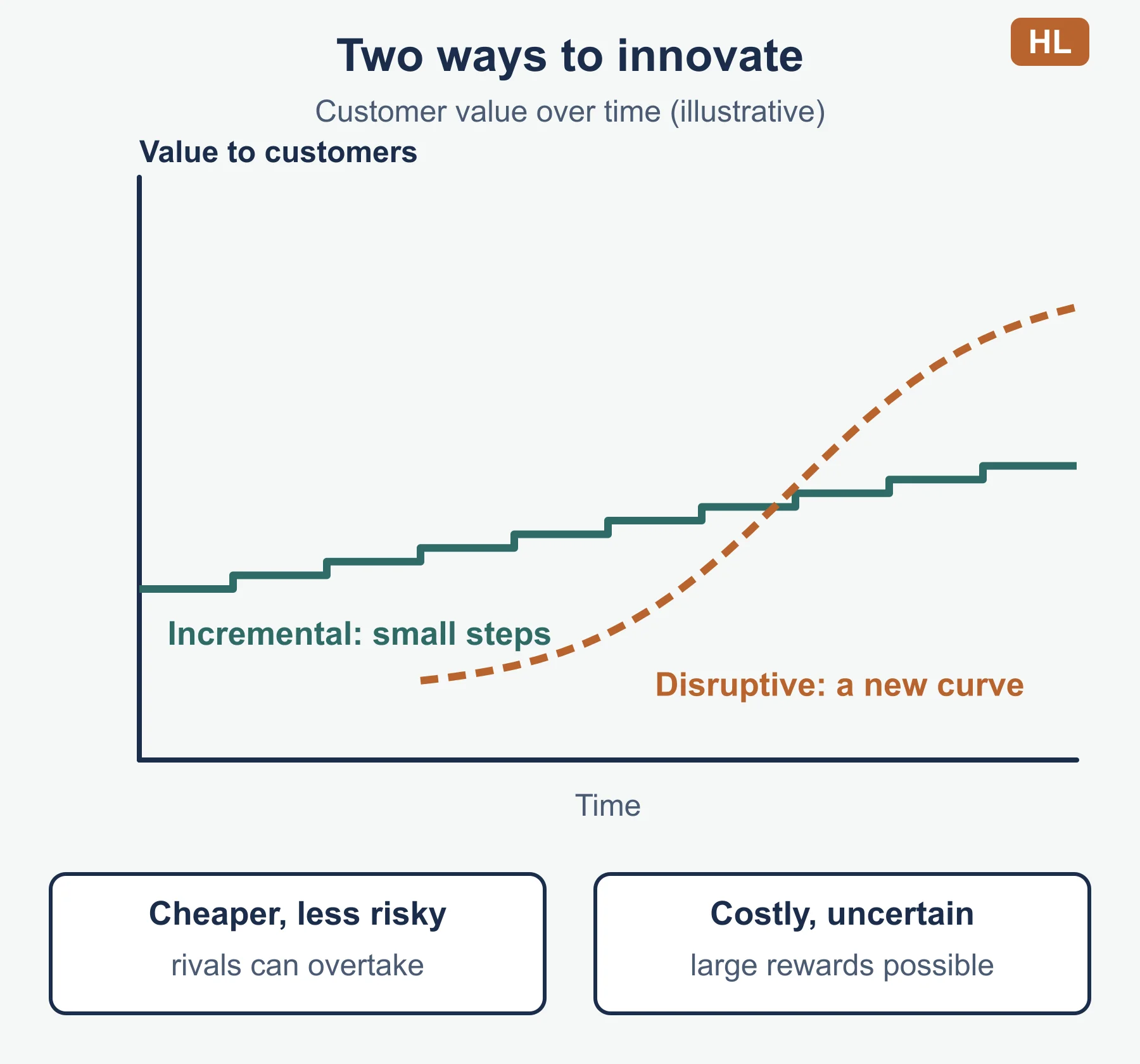
Incremental innovation improves an existing product or process in small steps, for example a faster processor, a lighter pack or a new flavour. It is cheaper and less risky, and customers understand it. It may not protect a business if a rival changes the market.
Disruptive innovation creates a product or business model that changes how a market works and often attracts customers who were ignored or priced out. It can bring large rewards. It is costly, uncertain and may damage the business’s own existing products.
Most firms do both. A sensible judgement links the choice to the firm’s finances, its competitors and how fast its market changes.
5.9 Management information systems
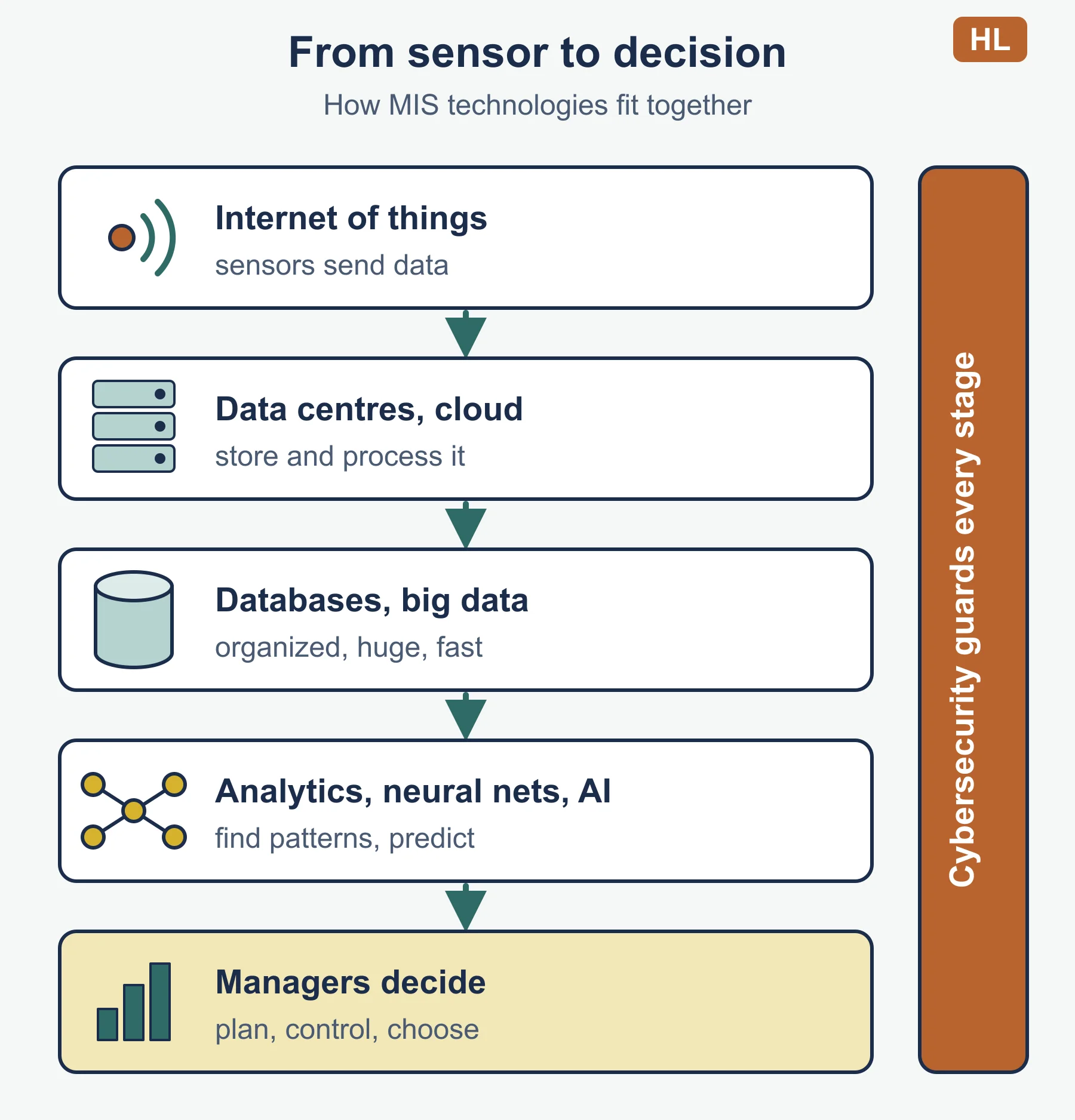
A management information system (MIS) collects, stores, processes and presents information so that managers can plan, control and decide. The guide uses the term “management information systems” to refer collectively to the advanced computer technologies below.
Data analytics, databases and big data
Data analytics is examining data to find patterns, explain results and support decisions. A database is an organized collection of data, usually held electronically, that can be searched and updated: customer records, stock levels and supplier details are typical. Big data is data on such a scale, arriving so fast and in such variety, that ordinary tools struggle with it.
Benefits: faster and better-informed decisions, closer knowledge of customers, and early warning of problems. Risks: poor-quality data produces poor decisions, large stores are attractive to criminals, and too much data can slow people down rather than help them.
Cybersecurity and cybercrime
Cybercrime is crime committed through computers and networks, such as hacking, ransomware, phishing and theft of personal data. Cybersecurity is the set of measures protecting systems and data. Typical measures are staff training, access controls, backups and encryption. The costs of a breach include recovery, lost sales, legal action and damaged reputation. Stakeholders affected include customers whose data is exposed, employees, shareholders and regulators.
Critical infrastructures
- Artificial neural networks are computing systems, loosely modelled on the brain, that learn patterns from examples. They underpin much image recognition and forecasting.
- Data centres are facilities holding the servers and storage that run these systems. They need heavy investment, power and cooling.
- Cloud computing supplies storage and processing over the internet, usually on a pay-for-use basis. A business can avoid buying its own equipment and scale up quickly, but it depends on the supplier and on its internet connection, and security responsibilities have to be agreed.
Virtual reality, the internet of things and artificial intelligence
- Virtual reality (VR) creates an immersive computer-generated environment. Businesses use it for staff training, design reviews and virtual showrooms. Costs and user comfort limit take-up.
- The internet of things (IoT) is the network of physical objects with sensors and connections that send and receive data. A machine that reports its own wear lets a business plan maintenance before it fails.
- Artificial intelligence (AI) is computer systems performing tasks that normally need human intelligence, such as prediction, language use and recognition. It can speed up routine decisions. Concerns include bias in the training data, lack of transparency about how a result was reached, and job losses.
Customer loyalty programmes
A loyalty programme rewards repeat purchases, often through points or member prices, and gathers data on each member’s behaviour.
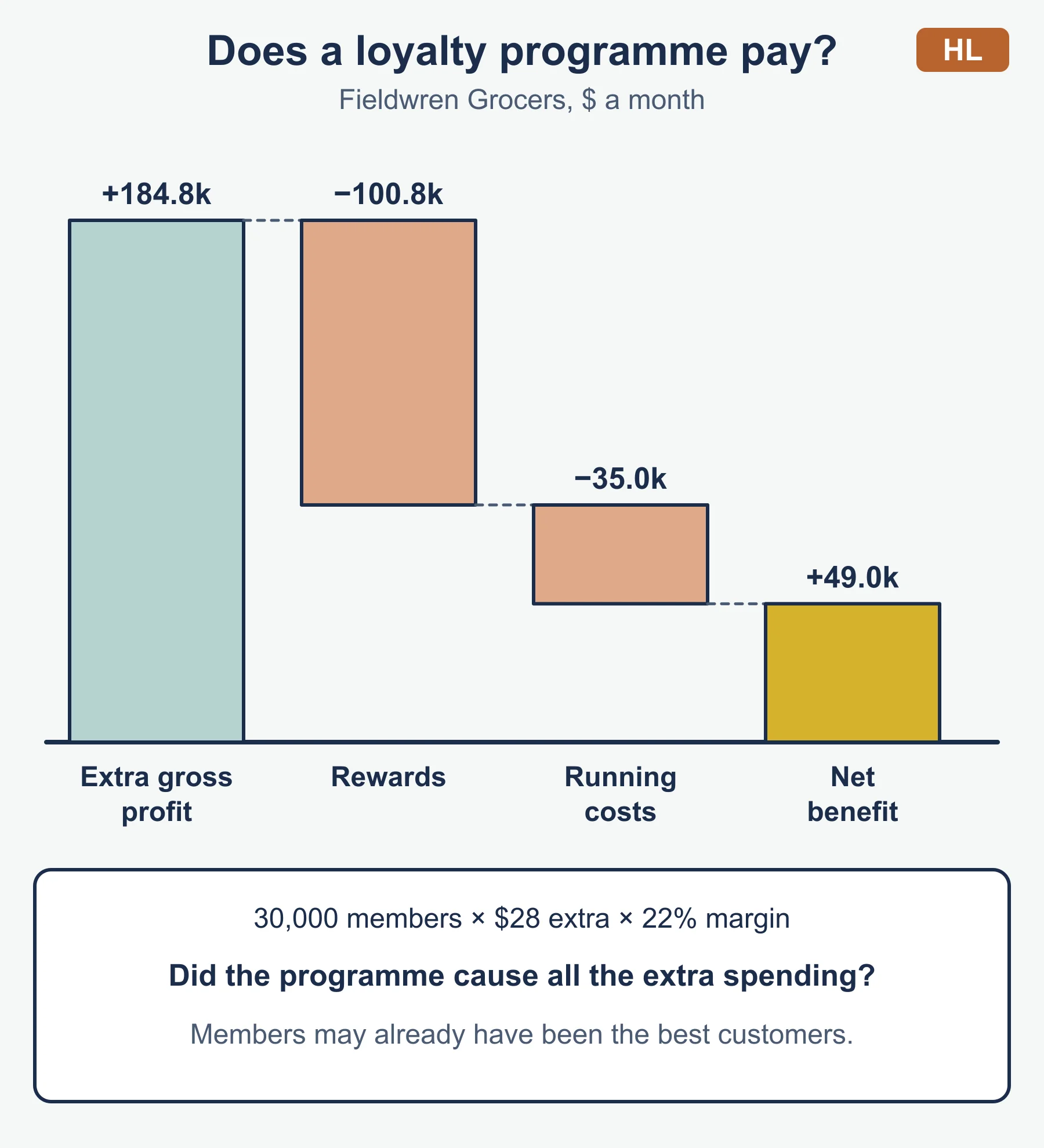
Worked example. Fieldwren Grocers (invented) has 30,000 members. A member spends 168 dollars a month on average and a comparable non-member spends 140.
- Extra spending: (168 − 140) × 30,000 = 840,000 dollars a month.
- At a 22% gross margin, extra gross profit = 184,800 dollars.
- Rewards cost 2% of members’ spending: 168 × 30,000 × 0.02 = 100,800 dollars. Running costs are 35,000.
- Net benefit = 184,800 − 100,800 − 35,000 = 49,000 dollars a month.
Evaluate carefully. Members may already have been the best customers, so the programme may not have caused all of the extra spending. The data also raises privacy questions, and it could treat groups of customers unequally if offers are based on biased patterns.
Using data to manage and monitor employees; Digital Taylorism
Data can set schedules, measure output, track location and flag absence. Benefits are clearer targets, quicker spotting of problems and fairer evidence for decisions. Risks are stress, loss of trust, privacy concerns and a focus on what is easily measured at the expense of quality.
Digital Taylorism is the use of digital tools to apply Taylor’s scientific management ideas: breaking work into small measurable tasks, setting standard times and monitoring output continuously.
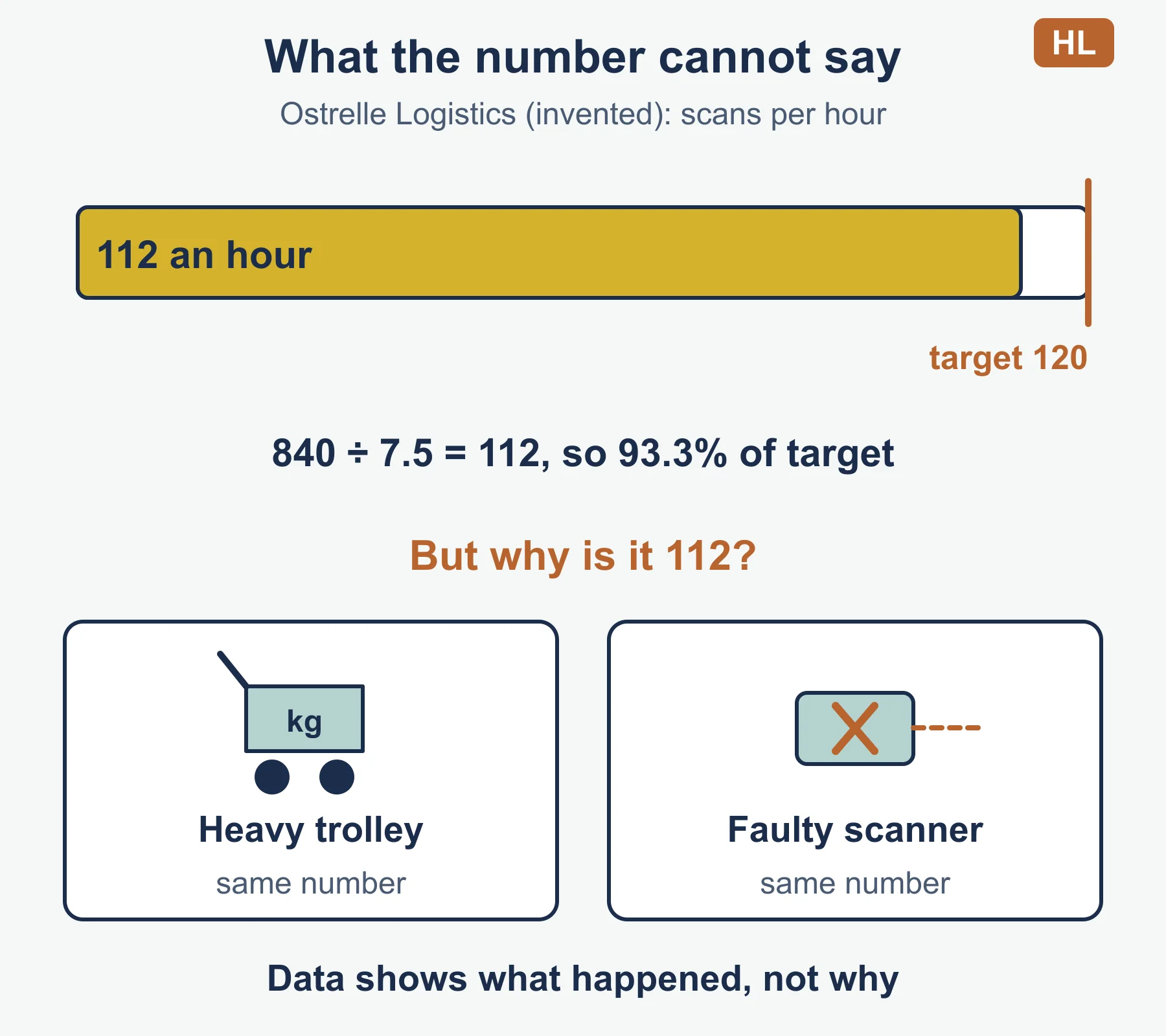
Worked example. At Ostrelle Logistics (invented) the target is 120 scans an hour. A picker scans 840 items in 7.5 working hours: 840 ÷ 7.5 = 112 an hour, which is 93.3% of target. The figure says nothing about why. A heavy trolley or a faulty scanner would show the same number.
Data mining
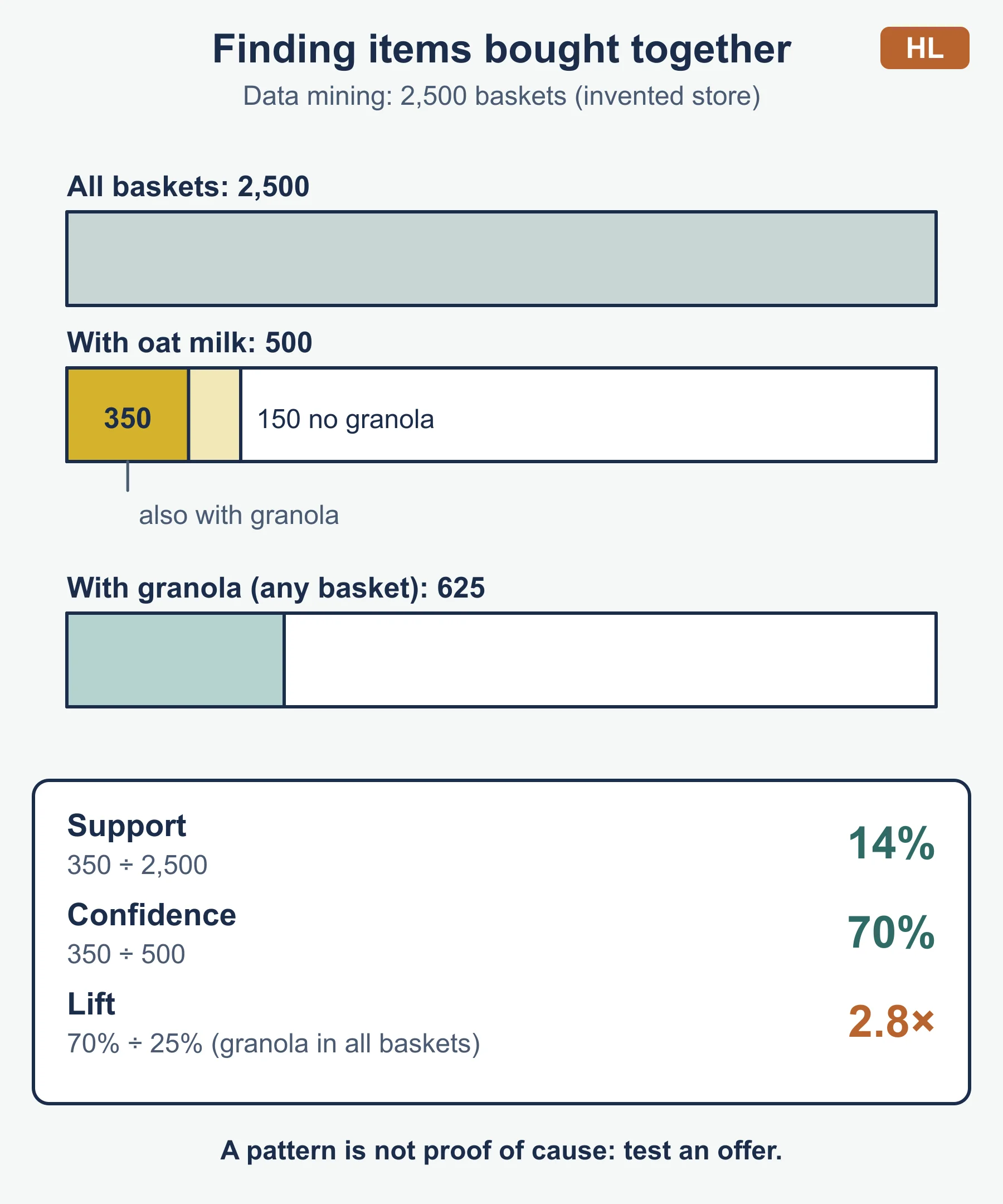
Data mining searches large datasets for patterns, links and unusual cases. In retail, a common use is to find items bought together. Two standard measures are support and confidence. They are standard data-mining measures rather than guide content.
Of 2,500 baskets at an invented store, 500 contain oat milk and 350 contain both oat milk and granola. Support = 350 ÷ 2,500 = 14%. Confidence that an oat-milk basket contains granola = 350 ÷ 500 = 70%. Since 625 of 2,500 baskets (25%) contain granola at all, the pairing is stronger than chance: 70 ÷ 25 = 2.8 times as likely. A pattern is not proof of a cause, so the manager still has to test an offer before acting.
Benefits, risks and ethics for decisions and stakeholders
For decision-making, these technologies bring speed, detail and forecasting. The risks are over-reliance, poor data and results nobody can explain. For stakeholders, think separately:
- Customers: personalized service and convenience, against loss of privacy and possible discrimination.
- Employees: less routine work and safer jobs, against surveillance and job losses.
- Shareholders and owners: efficiency and growth, against high set-up costs and legal or reputational damage.
- Suppliers, society and the environment: smoother supply chains, against energy use and unequal access.
Ethical questions include informed consent, how long data is kept, who is responsible when an automated system makes a harmful decision, and whether using people’s data is fair when they never expected it.
Common errors
- Describing a term without applying it. Link it to the business in the stimulus.
- Treating one type of innovation as always better. Both can suit a business.
- Saying a patent or trademark guarantees profit. It only stops copying.
- Concluding that a loyalty programme caused extra spending without noting other explanations.
- Writing only about benefits of technology. AO3 questions expect risks, ethics and a judgement.
Test yourself with the practice questions.
Frequently asked questions
Why is research and development important for a business? R&D feeds the product portfolio, can create a competitive advantage that rivals find hard to copy, can lower costs through better processes and can open new markets. Its spending is certain while results are not, and payback can be slow.
What is the difference between a known and a latent unmet need? With a known unmet need, customers can describe the problem, so research such as surveys can measure it. With a latent need, customers do not realize it until a product shows them, so the business may have to observe behaviour or test a prototype.
Does a patent guarantee profit? No. A patent, like other intellectual property protection, only stops others copying without permission. It helps the owner recover R&D costs but does not guarantee that the product will sell.
What is a management information system? A management information system collects, stores, processes and presents information so that managers can make decisions. Section 5.9 covers tools such as data analytics, databases, cloud computing, artificial intelligence, loyalty programmes and data mining, along with their risks and ethics.
Official syllabus
IB Diploma Programme Business management guide, first assessment 2024, published by the International Baccalaureate Organization. Sections 5.8 and 5.9 (both HL only).
Get free revision emails (optional)
Occasional emails with practice questions, worked explanations and links to free resources for the qualification and subjects you choose. No spam, and you can unsubscribe from any email. The free tools on this site never need an email.
Related resources
-
Practice questions
IB DP Business Management: R&D (HL only) and Management information systems (HL only) – Practice Questions
Original practice questions with worked answers for IB DP Business Management 5.8 R&D and 5.9 management information systems (HL only).
Business · International Baccalaureate · IB
Try questions -
Revision notes
IB DP Business Management: R&D (HL only) and Management information systems (HL only) – Revision Notes
Condensed IB DP Business Management revision notes for 5.8 R&D and 5.9 management information systems (both HL only), with a self-test.
Business · International Baccalaureate · IB
Revise topic -
Study guides
IB DP Business Management: Break-even analysis
Study guide to IB DP Business Management section 5.5: break-even chart, margin of safety, target profit and price, effects of changes and limitations.
Business · International Baccalaureate · IB
Read guide
Related articles
-
teaching
A Level tuition in Dubai: Cambridge or Pearson Edexcel International A Level?
Schools in Dubai and Abu Dhabi teach either Cambridge International AS & A Level or Pearson Edexcel International A Level. How the two are structured, why it matters for tuition, and how online classes from Lahore work.
9 October 2026
-
curriculum guides
Choosing subjects at IGCSE and A Level
How subject choices at 14 and 16 affect university options later, and how to keep pathways open without overloading a timetable.
28 July 2026
Studying this with a teacher
Working through Business IB?
This page is free and stays free. If you would rather be taught it, Marlbridge runs Business classes one-to-one, online in your own time zone. The first trial class is free. WhatsApp replies within an hour (8am–11pm Pakistan time, every day); email the same day.
IB Business teachers at Marlbridge

