
Revision Notes
IB DP Business Management: Crisis management and contingency planning (HL only) – Revision Notes
Condensed revision notes for IB DP Business Management 5.7 (HL only): definitions, the four factors, the four impacts and a self-test.
- Subject
- Business
- Level
- IB
- Topic
- Unit 5: Operations management
- Author
- Marlbridge Academic Team
- Updated
- Reviewed by
- Salman Ahmad (what this means)
Aligned to International Baccalaureate IB Diploma Programme Business (DP Business Management), First assessment 2024. Official specification .
Syllabus page (what it covers and how it is assessed): IB Diploma Programme Business.
Syllabus points this page covers
DP Business Management
- 5.7 Crisis management and contingency planning (HL only)
Found an error? Report a correction.
Need help with this topic? Request a free trial class for IB Diploma Programme Business (DP Business Management).
These notes condense section 5.7, Crisis management and contingency planning, in Unit 5 of the IB Business management guide, first assessment 2024. The whole section is HL only. Full explanations and worked examples are in the study guide, and exam-style questions are in the practice set. Course pages: the IB DP Business Management hub and the syllabus checklist. To find your weak spots, try the free 10-minute diagnostics.
The three content points
| Guide wording | Depth | Think |
|---|---|---|
| Difference between crisis management and contingency planning | AO2 | Distinguish, then apply to the case |
| Factors affecting effective crisis management: transparency, communication, speed, control | AO2 | Explain each and link to a stakeholder effect |
| Impact of contingency planning for a given organization or situation: cost, time, risks, safety | AO3 | Weigh, then judge for this organization |
Definitions
The guide lists the terms but does not word their definitions. These are the standard forms.
- Crisis: a sudden, serious event that threatens people, operations, finances or reputation and needs a quick response.
- Crisis management: how the organization responds during and after the event, to limit damage and restore normal operations.
- Contingency planning: preparing in advance for possible adverse events, setting out actions, roles and resources.
Must-know distinction
| Contingency planning | Crisis management | |
|---|---|---|
| When | Before | During and after |
| Style | Proactive, planned | Reactive, under pressure |
| Output | Plan, training, spare resources | Decisions and actions on the day |
| Based on | Scenarios and estimates | Real, incomplete facts |
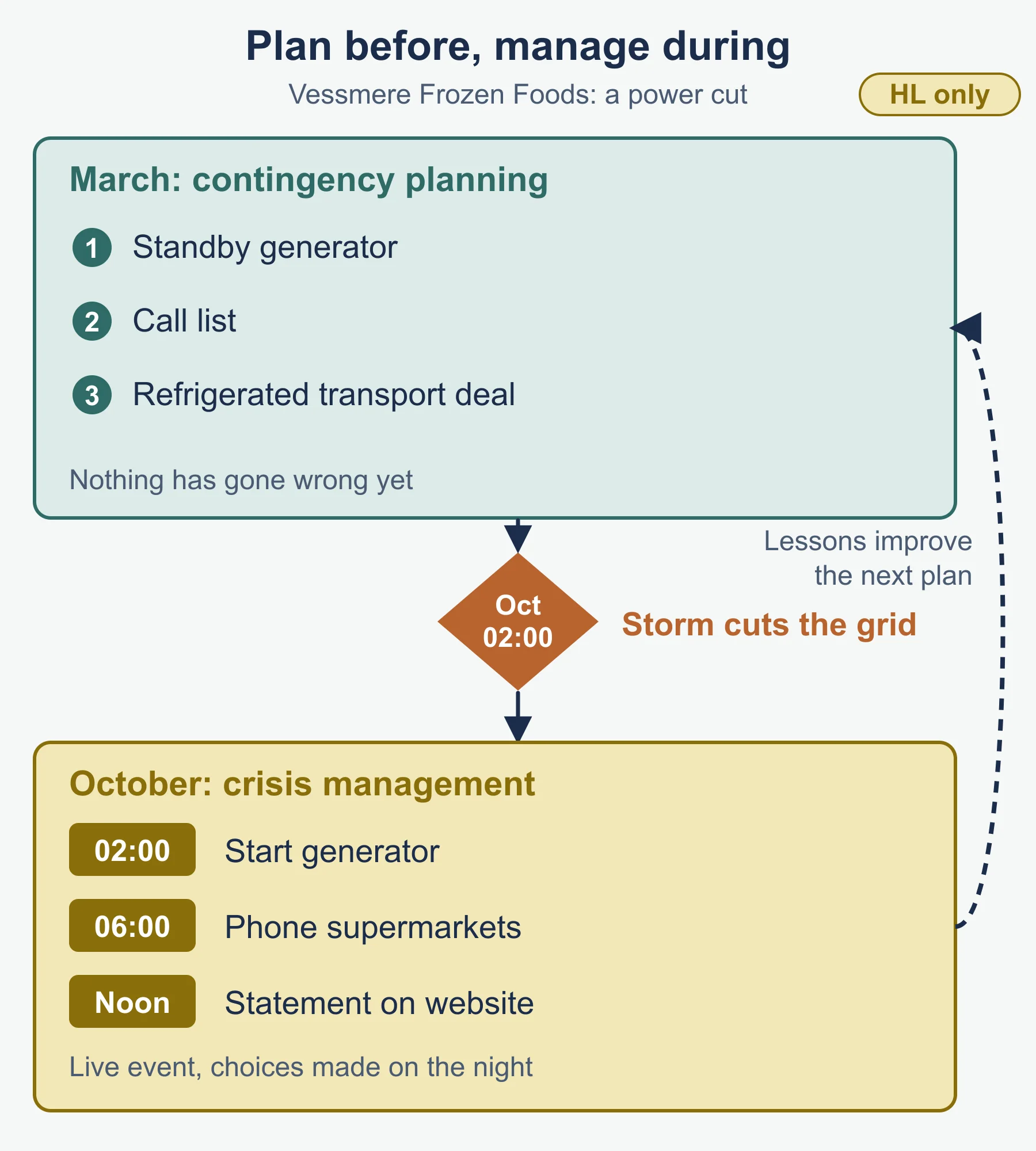
| Link | Gives a starting script | Shows where the plan was weak |
A one-line test: if the bad event has not happened, it is planning; if it is happening, it is management.
The four factors at a glance
| Factor | What it means | Helps when | Can backfire when |
|---|---|---|---|
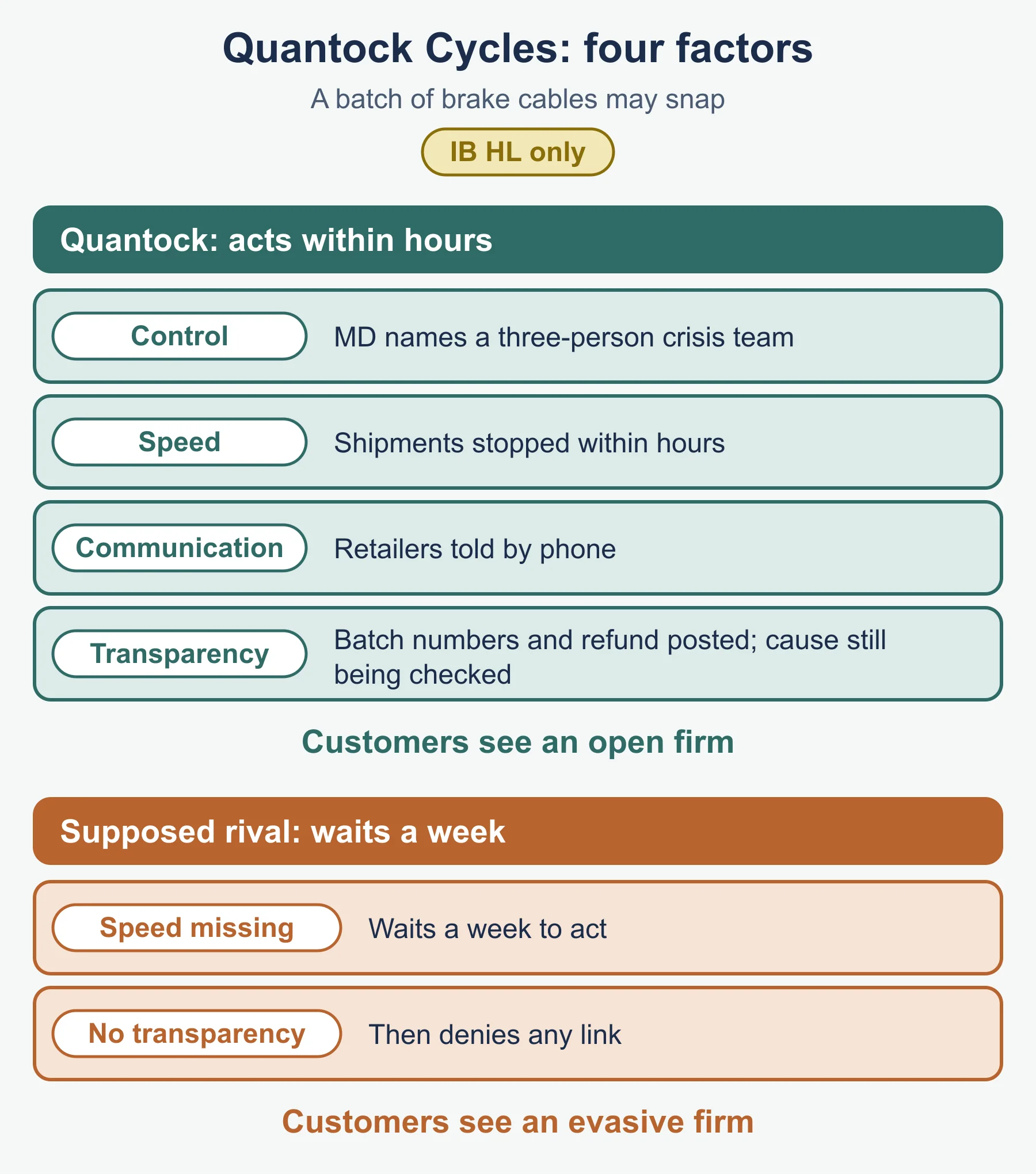
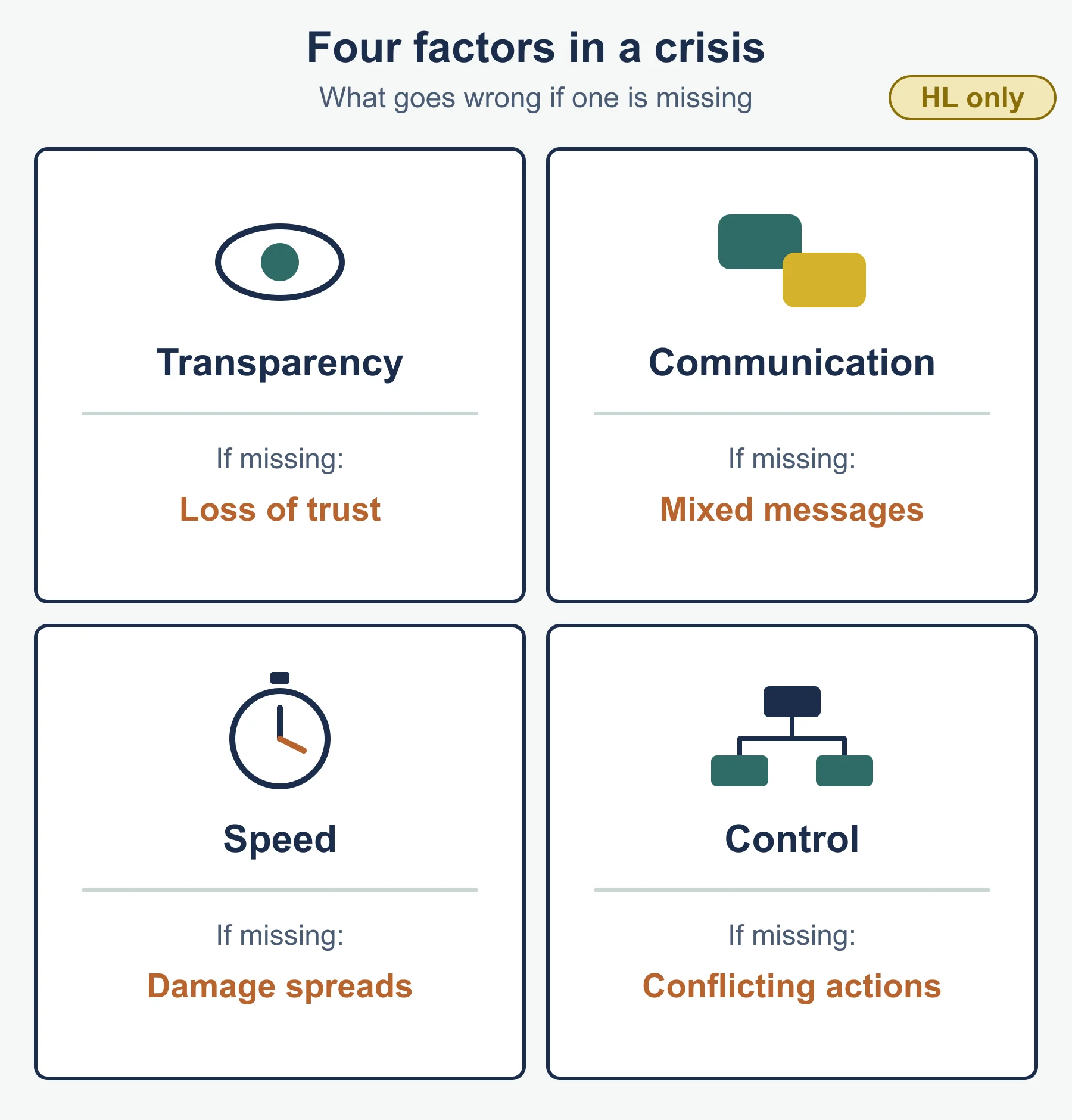
| Transparency | Being open about what happened, what is known and what is being done | Builds trust; stops a cover-up story | Unconfirmed or sensitive facts are released; customers are alarmed |
| Communication | Who is told, by whom, by which channel, how often | One clear, consistent message reaches all stakeholders | Mixed messages; staff hear bad news from the media; wrong channel |
| Speed | How fast the business detects, decides and acts | Limits spread of harm; avoids looking silent | Rushed actions are wrong or skip safety checks |
| Control | Clear authority, named team, defined roles | No duplication; one decision-maker | Rigid structure slows decisions; one leader becomes a bottleneck |
Method: explain a factor in four steps
- Name the factor.
- Say what the business did, or should have done, using the case.
- Say how a named stakeholder (customer, employee, supplier, shareholder, community) is affected.
- State a limit or condition if the question asks you to analyse or evaluate.
Impact of contingency planning
| Impact | For planning | Against planning |
|---|---|---|
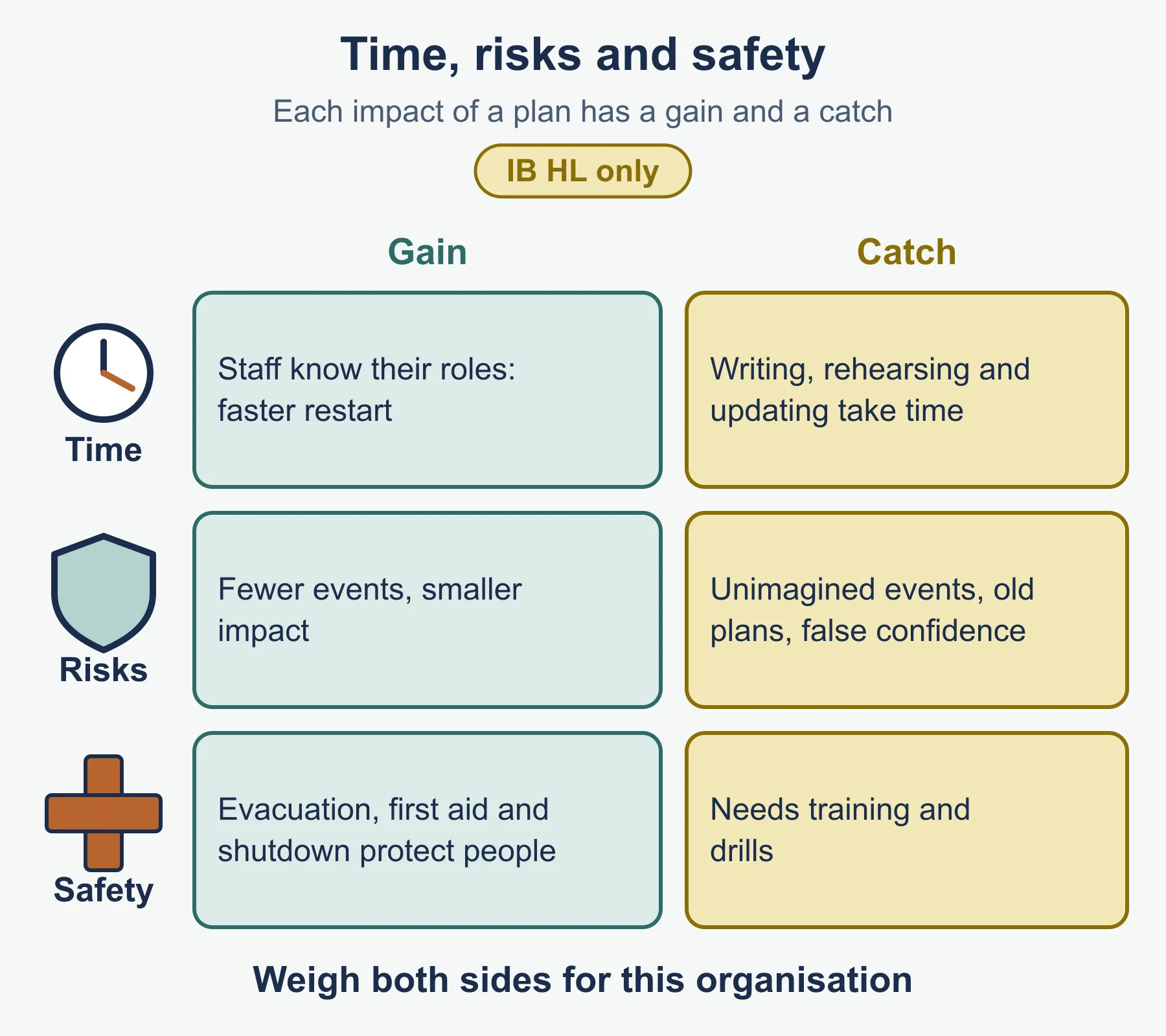
| Cost | Lower losses and faster recovery; fewer compensation costs | Equipment, training, insurance, staff time on rehearsals |
| Time | Roles known, so quicker decisions and restart | Time to write, approve, rehearse and update |
| Risks | Lowers the likelihood or the impact of some events | Cannot cover every event; can give false confidence; out-of-date plans |
| Safety | Protects employees, customers and the public through drills and procedures | Needs regular practice; a plan nobody has rehearsed may fail |
Method: weigh the impact in steps
- Name the organization and the risk it faces.
- Pick the two or three impacts that matter most for this case.
- Give a benefit and a cost or limit for each.
- Say what the judgement depends on: how likely the event is, how severe the loss would be, the size of the business and stakeholder expectations.
- Give a reasoned judgement.
Small calculation reminder
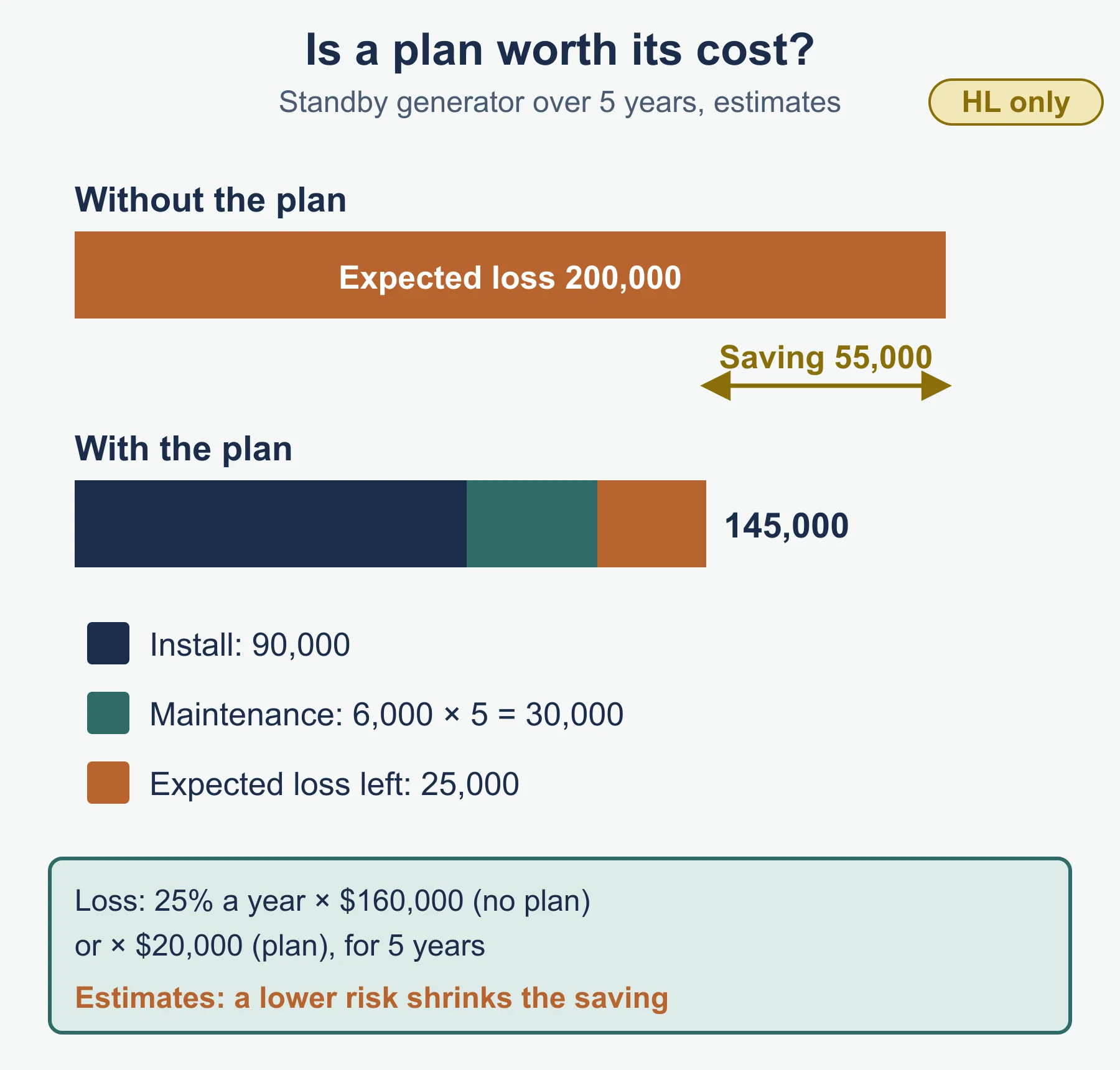
Expected loss = chance of the event × loss if it happens (standard form, not given in the guide). To compare a plan with no plan, add the cost of the plan to the expected loss with the plan, and compare with the expected loss without it.
Worked reminder with invented figures. Lanternhill Resort pays 30,000 over three years for a backup water supply. The chance of a supply failure is 20% a year. A failure costs 90,000 without the backup and 15,000 with it.
- Without: 0.2 × 90,000 × 3 = 54,000.
- With: 30,000 + (0.2 × 15,000 × 3) = 30,000 + 9,000 = 39,000.
- Difference: 54,000 − 39,000 = 15,000 in favour of the backup.
Then add what the numbers miss: the chance is an estimate, guest safety, reputation and whether the backup will be tested.
Command terms for this section
| Command term | AO level | What it asks here |
|---|---|---|
| Distinguish | AO2 | Make clear the differences between crisis management and contingency planning |
| Explain | AO2 | Give a detailed account of a factor with reasons or causes |
| Analyse | AO2 | Break a response into its elements, such as how speed and control interact |
| Evaluate | AO3 | Weigh strengths and limitations of contingency planning for a given organization |
| Justify | AO3 | Give valid reasons or evidence for a conclusion, such as investing in a plan |
| Recommend | AO3 | Present an advisable course of action with supporting reasons |
For evaluate and justify, include both sides and a conclusion. For explain, a reason and an effect are enough.
Three quick scenarios to practise on
These use invented businesses. Cover the right-hand column and try each one.
| Scenario | Planning or management? | Factor most in play |
|---|---|---|
| Gilderoy Toys writes a checklist for a warehouse fire and runs an evacuation drill in spring | Planning | Control (defined roles) and safety |
| A Gilderoy supplier fails on Monday and the buyer phones three alternatives by noon | Management | Speed |
| A Gilderoy product is found to have a small part that can detach; the company publishes the details and a refund route the same day | Management | Transparency and communication |
Connecting the factors
Strong answers show that the four factors support one another.
- Control makes speed possible, because a named team does not wait for permission.
- Speed without communication leaves stakeholders guessing, so people fill the gap with rumours.
- Transparency without control can produce several versions of the facts.
- Communication is the channel through which the other three reach stakeholders.
A useful sentence pattern: “Because the business [did X], stakeholders [reacted Y], which [helped or harmed Z].”
Linking planning to the four impacts
- Cost and time are the price of preparing. Risk and safety are what the preparation protects.
- Planning pays off most where the event is likely, the loss is large, or people could be harmed.
- Planning pays off least where the event is very unlikely and the loss is small.
- The same plan can score well on safety and poorly on cost. The judgement depends on which matters more to this organization, so say that.
Quick self-test
- Distinguish between crisis management and contingency planning.
- List the four factors the guide names as affecting effective crisis management.
- Explain one way in which transparency can harm a business in a crisis.
- A firm learns of a fault and takes two weeks to tell customers. Which factor is weak, and what is a likely effect?
- Give one reason why speed alone does not guarantee an effective response.
- State two costs of contingency planning.
- Explain why contingency planning might not remove risk.
- A plan costs 50,000 over five years. The yearly chance of an event is 10%, the loss is 300,000 without the plan and 60,000 with it. Calculate the total cost with the plan and the expected loss without it over five years.
- Which of the four impacts of contingency planning is hardest to price in money, and why?
- What does the guide ask you to consider contingency planning “for”, in the third content point?
Answers
- Contingency planning is preparing in advance for possible adverse events. Crisis management is the response once an event is happening or has happened.
- Transparency, communication, speed, control.
- Full openness can release facts that are not yet confirmed or that are sensitive, which can alarm customers or give competitors an advantage.
- Speed (and communication). Customers may use the faulty product longer, harm may spread, and trust and reputation fall.
- A rushed action can be wrong, contradict later facts or skip safety checks, so damage grows.
- Any two: equipment, training, insurance, staff time for planning and rehearsals, retaining standby suppliers.
- No plan can foresee every event, plans go out of date, and a plan can give false confidence that leads to bigger risks.
- With the plan: 50,000 + (0.1 × 60,000 × 5) = 50,000 + 30,000 = 80,000. Expected loss without: 0.1 × 300,000 × 5 = 150,000.
- Safety, because the value of protecting people is not fully expressed in money.
- A given organization or situation: so the answer must be applied to the case.
Where marks are usually lost
- Describing the difference only in words like “one is before, one is after” without applying it to the case.
- Naming transparency, communication, speed and control with no result for a stakeholder.
- Treating the four factors as separate when the case shows them working together.
- Saying speed or openness is always good, with no limit.
- Writing only about money and leaving out safety and risk.
- Arguing only one side when asked to evaluate or justify.
- Stopping with no judgement, or a judgement that omits its conditions.
- Using generic examples rather than the organization in the stimulus.
Frequently asked questions
What is the quickest way to tell contingency planning from crisis management? If the bad event has not happened yet, it is contingency planning, which is proactive preparation. If the event is happening or has happened, it is crisis management, which is the reactive response under pressure.
What four factors affect effective crisis management in IB Business Management? The guide names transparency, communication, speed and control. Strong answers show how they support each other, for example control making speed possible.
Can contingency planning remove risk completely? No. No plan can foresee every event, plans go out of date, and a plan can create false confidence that leads managers to take bigger risks.
What are the four impacts of contingency planning you need to consider? Section 5.7 asks you to consider the impact of contingency planning on cost, time, risks and safety for a given organization or situation. Each has a benefit and a cost, and safety is the hardest to price in money.
Official syllabus
IB Diploma Programme Business management guide, first assessment 2024, published by the International Baccalaureate Organization. These notes cover section 5.7, Crisis management and contingency planning (HL only), in Unit 5: Operations management.
Get free revision emails (optional)
Occasional emails with practice questions, worked explanations and links to free resources for the qualification and subjects you choose. No spam, and you can unsubscribe from any email. The free tools on this site never need an email.
Related resources
-
Study guides
IB DP Business Management: Introduction to operations management and Operations methods
Study guide to IB DP Business Management 5.1 and 5.2: the role of operations management and job, batch, mass/flow and mass customization.
Business · International Baccalaureate · IB
Read guide -
Practice questions
IB DP Business Management: Introduction to operations management and Operations methods – Practice Questions
Original IB DP Business Management practice questions with worked answers on 5.1 and 5.2: operations roles and production methods.
Business · International Baccalaureate · IB
Try questions -
Revision notes
IB DP Business Management: Introduction to operations management and Operations methods – Revision Notes
Condensed revision notes for IB DP Business Management 5.1 and 5.2: operations roles, four production methods compared, and a self-test.
Business · International Baccalaureate · IB
Revise topic
Related articles
-
teaching
A Level tuition in Dubai: Cambridge or Pearson Edexcel International A Level?
Schools in Dubai and Abu Dhabi teach either Cambridge International AS & A Level or Pearson Edexcel International A Level. How the two are structured, why it matters for tuition, and how online classes from Lahore work.
9 October 2026
-
curriculum guides
Choosing subjects at IGCSE and A Level
How subject choices at 14 and 16 affect university options later, and how to keep pathways open without overloading a timetable.
28 July 2026
Studying this with a teacher
Working through Business IB?
This page is free and stays free. If you would rather be taught it, Marlbridge runs Business classes one-to-one, online in your own time zone. The first trial class is free. WhatsApp replies within an hour (8am–11pm Pakistan time, every day); email the same day.
IB Business teachers at Marlbridge

