
Revision Notes
IB DP Business Management: Introduction to operations management and Operations methods – Revision Notes
Condensed revision notes for IB DP Business Management 5.1 and 5.2: operations roles, four production methods compared, and a self-test.
- Subject
- Business
- Level
- IB
- Topic
- Unit 5: Operations management
- Author
- Marlbridge Academic Team
- Updated
- Reviewed by
- Salman Ahmad (what this means)
Aligned to International Baccalaureate IB Diploma Programme Business (DP Business Management), First assessment 2024. Official specification .
Syllabus page (what it covers and how it is assessed): IB Diploma Programme Business.
Syllabus points this page covers
DP Business Management
- 5.1 Introduction to operations management
- 5.2 Operations methods
Found an error? Report a correction.
Need help with this topic? Request a free trial class for IB Diploma Programme Business (DP Business Management).
Quick recall for sections 5.1 Introduction to operations management and 5.2 Operations methods in the IB Business management guide (first assessment 2024), SL and HL. For full explanations and worked examples go to the study guide. Test yourself with the practice questions. Course hub: IB DP Business Management. Tick-list: printable checklist. Find gaps with the free diagnostics.
The guide lists one content point under 5.1 (the role of operations management, AO2) and four methods under 5.2 (AO3). Everything below is a condensed version of those five points.
Definitions to know
| Term | Meaning (standard form unless stated) |
|---|---|
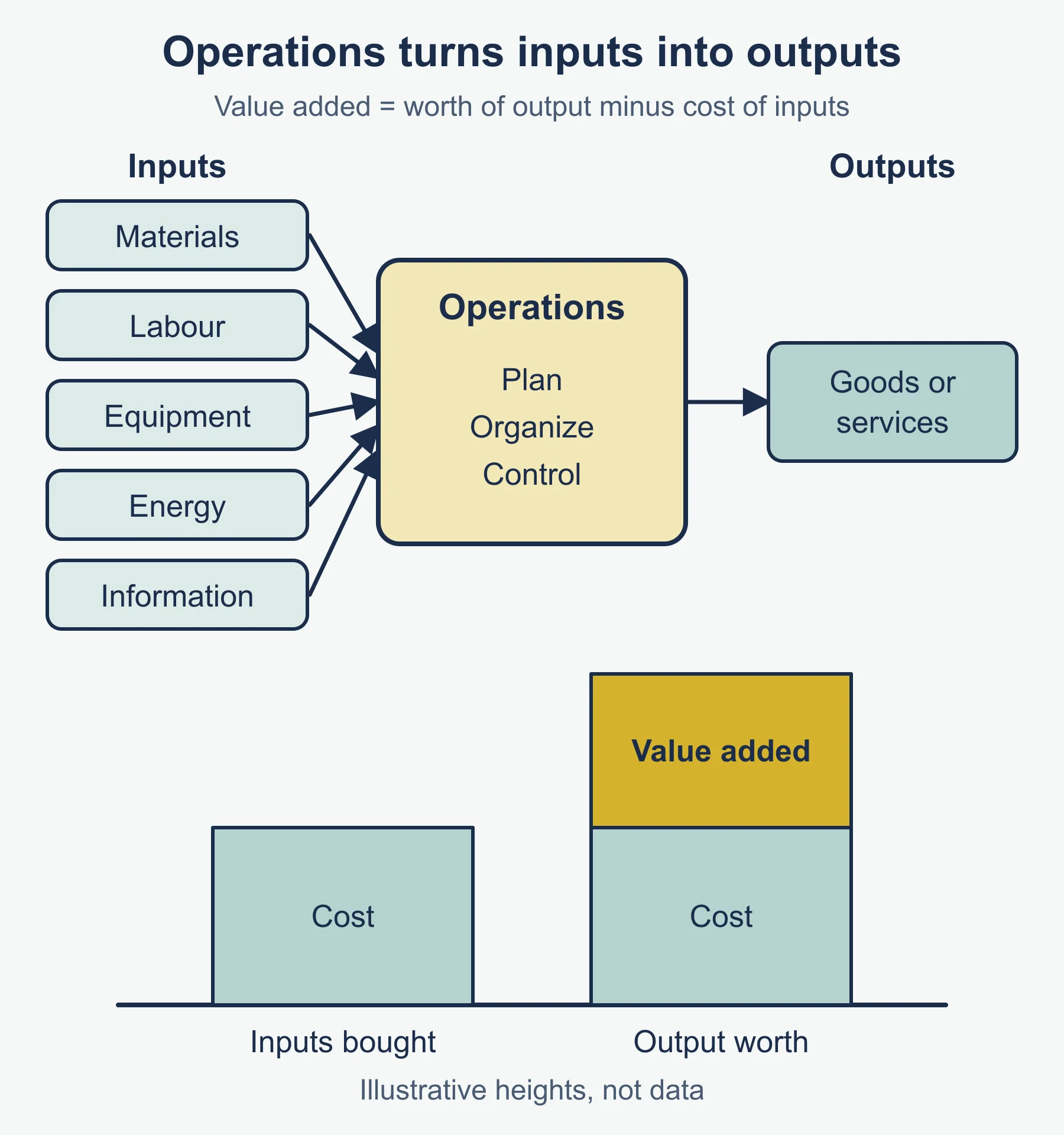
| Operations management | Planning, organizing and controlling the process that turns inputs into outputs |
| Input | A resource used in production: materials, labour, equipment, energy, information |
| Output | The good or service delivered to the customer |
| Value added | Output value minus the cost of the inputs used |
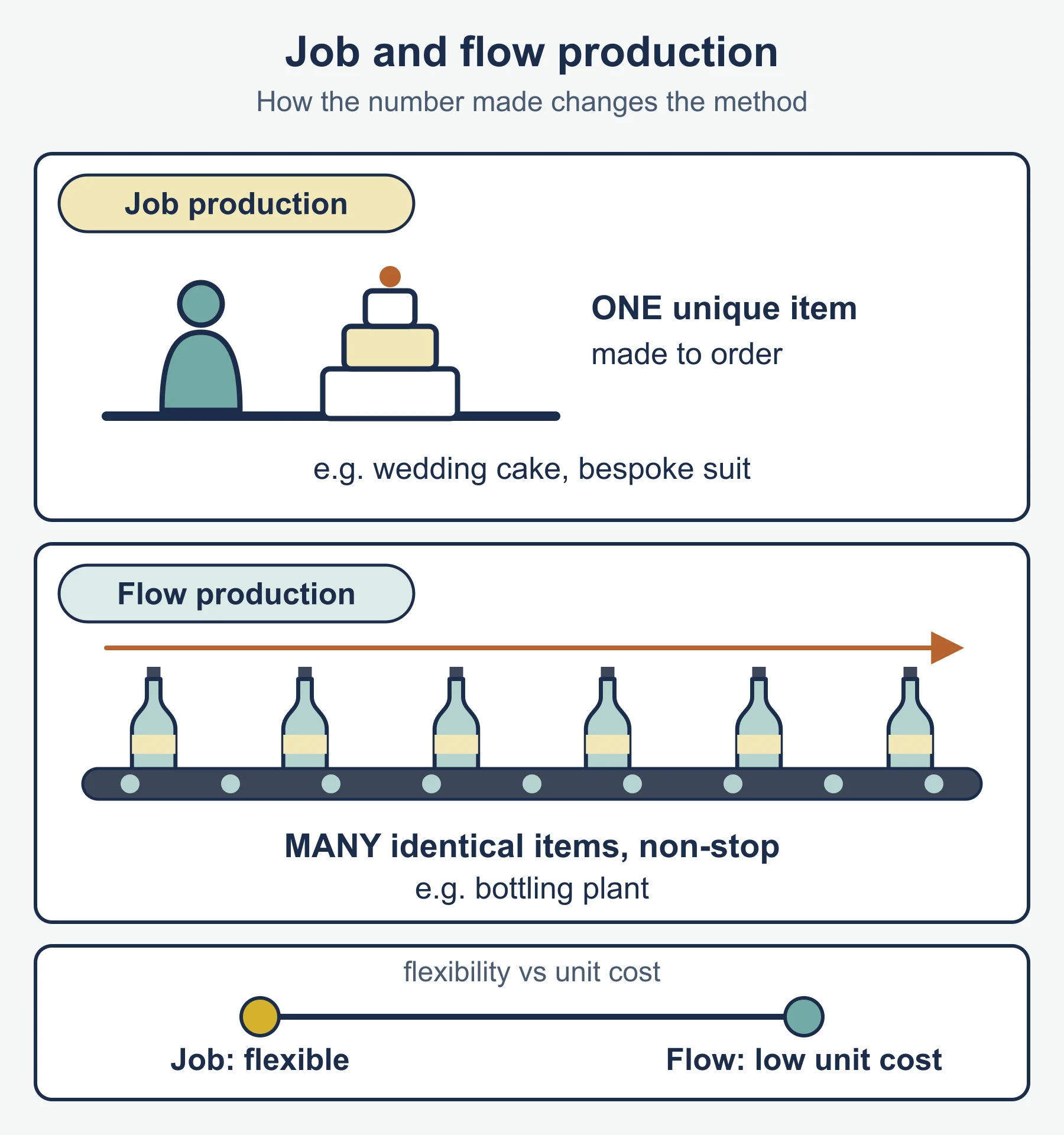
| Job production | A single, one-off product made to a customer’s specification |
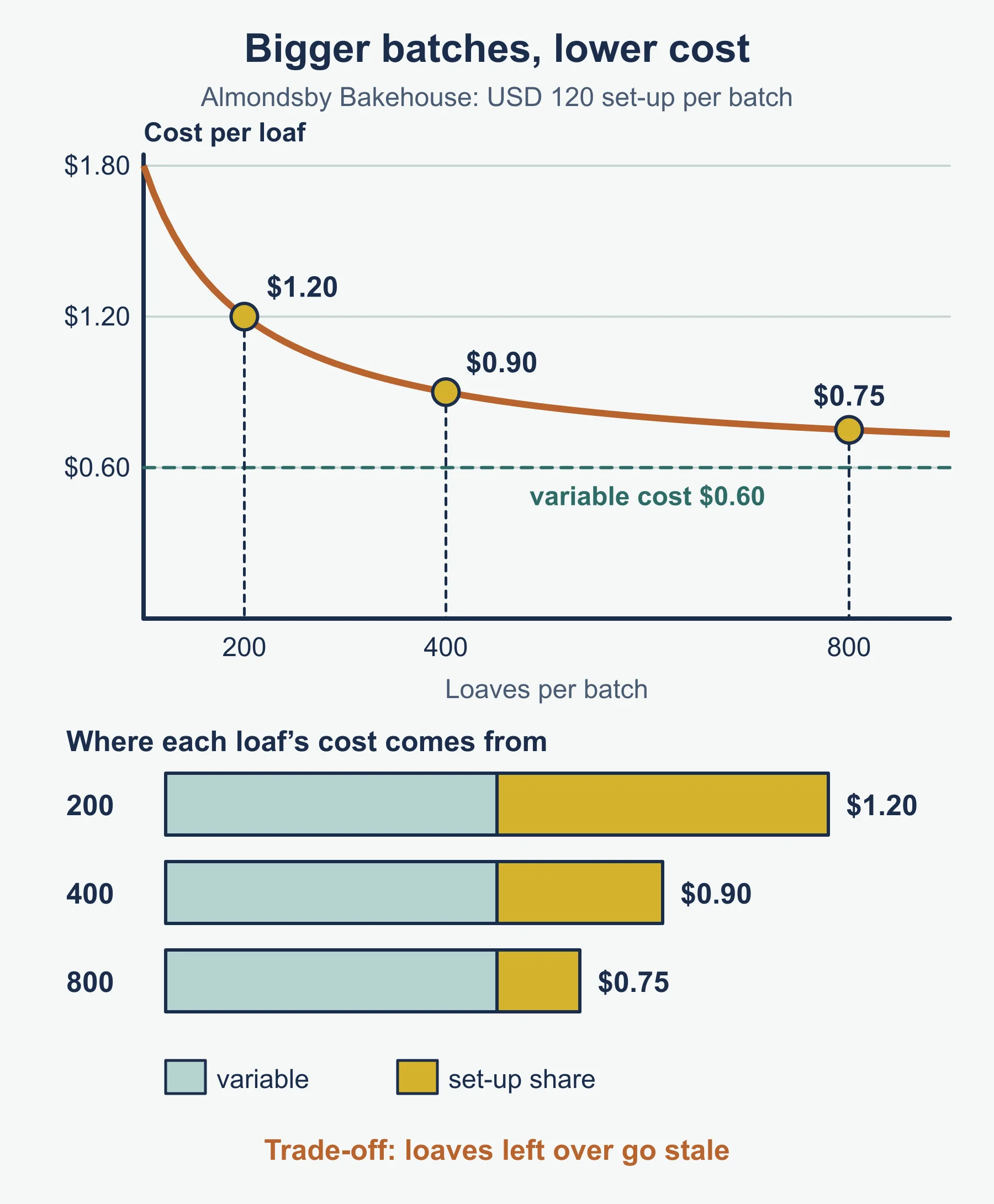
| Batch production | A group of identical items made together before the equipment is reset |
| Mass/flow production | Large numbers of a standardized product on a continuous line |
| Mass customization | Mass-production techniques and standard modules used to personalize each unit |
| Capacity | The most a site or process can produce in a given period |
| Capacity utilization | Output as a percentage of capacity (standard form) |
| Set-up cost | Cost of preparing equipment for a new job or batch |
5.1 The role of operations management
Operations management turns inputs into outputs that customers value, and it does so in every kind of organization, goods or services, for-profit or not.
Typical responsibilities:
- Decide output and manage capacity.
- Keep quality at the level customers expect.
- Control costs and improve efficiency.
- Deliver on time and manage stock.
- Pick the production method.
- Manage suppliers.
- Handle waste, energy and working conditions.
Four conceptual understandings from the guide, each usable as an analysis point:
- Change in operations impacts other business activities (finance, human resources, marketing).
- A creative production process can disrupt the market.
- Operational changes may affect the business’s ethical stance.
- Sustainability ensures efficiency in operations.
Suggested tools for the unit: decision trees, descriptive statistics, circular business models.
5.2 The four methods side by side
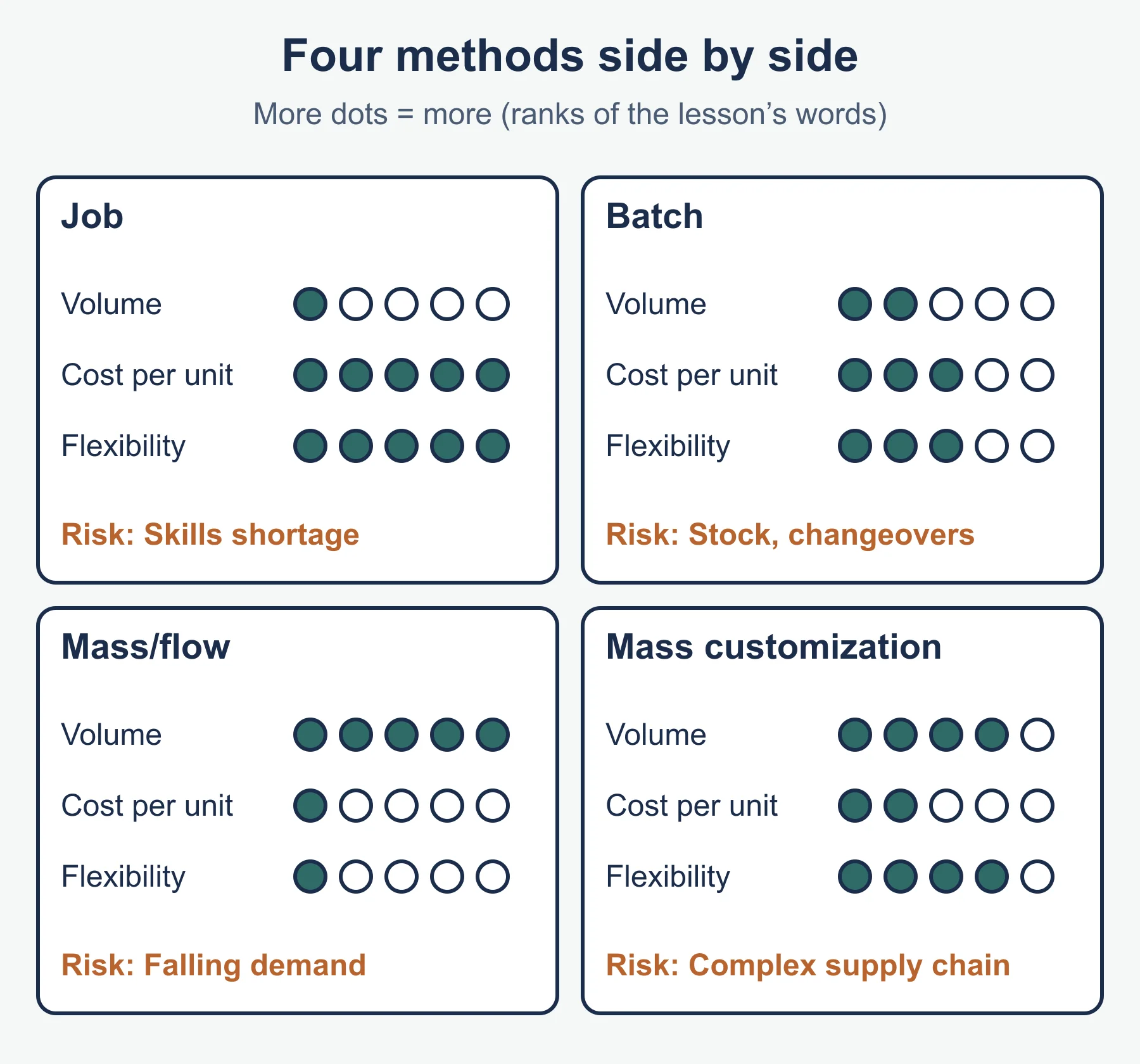
| Feature | Job | Batch | Mass/flow | Mass customization |
|---|---|---|---|---|
| Volume | One unit | A group | Very high | High |
| Variety | Unique | Several lines | Standard | Personalized from modules |
| Cost per unit | Highest | Medium | Lowest at high output | Low to medium |
| Flexibility | Very high | Medium | Low | Medium to high |
| Skill needed | High | Mixed | Often low per task | Mixed, plus technology |
| Main weakness | Slow, costly | Changeovers, stock | Falls apart if demand falls | Complex supply chain |
| Typical fit | Bespoke work | Varied repeat lines | Standard goods, stable demand | Individuality valued by customers |
Must-know distinctions
- Batch versus mass production: batch stops to reset equipment between groups; mass production runs continuously on one standard product.
- Batch versus mass customization: a batch is identical items; mass customization gives each customer a different combination.
- Job versus mass customization: job production builds from scratch; mass customization assembles from standard parts, so cost and time are lower.
- Mass production versus mass customization: both use scale; only the second personalizes.
Strengths and limitations at a glance
| Method | Main strengths | Main limitations |
|---|---|---|
| Job | Exact fit to the customer; high price possible; varied, motivating work | Slow; high cost per unit; relies on scarce skilled labour; no repeat-task savings |
| Batch | Flexible between products; some saving per unit; can respond to varied demand | Idle time at changeovers; stock of finished goods; harder planning |
| Mass/flow | Lowest cost per unit at high output; consistent quality; fast | Large capital outlay; inflexible; repetitive work; breakdown can halt the line |
| Mass customization | Premium price; made to order so less unsold stock; customer data for design | Needs technology and modular design; longer delivery than off the shelf; complexity |
Match each method to a type of demand: one-off orders (job), varied repeat orders (batch), large stable demand for one product (mass/flow), demand for individuality at a reasonable price (mass customization).
Command terms for these sections
The guide sets 5.1 at AO2 and 5.2 at AO3. Questions on these sections can therefore use command terms from AO1, AO2 and AO3, and the AO4 term calculate for numbers. The guide’s glossary gives these meanings:
| Command term | Meaning in the guide |
|---|---|
| Define | Give the precise meaning |
| State | Give a brief answer without explanation or calculation |
| Outline | Give a brief account or summary |
| Explain | Give a detailed account including reasons or causes |
| Distinguish | Make clear the differences between two or more items |
| Calculate | Obtain a numerical answer showing the relevant stages in the working |
| Evaluate | Make an appraisal by weighing up strengths and limitations |
| Justify | Give valid reasons or evidence to support an answer or conclusion |
| Recommend | Present an advisable course of action with supporting evidence in relation to the situation |
For an AO3 answer on method choice, use this frame: name the method, give a strength tied to the case data, give a limitation tied to the case data, then give a reasoned judgement with the condition that would change it.
Method in steps: choosing a production method
- Identify the product, the customer and the likely volume.
- Ask how much variety the customer wants.
- Check capital available for equipment.
- Compare cost per unit at the expected output.
- Consider flexibility, quality, and the effect on employees.
- Consider sustainability and ethics.
- Reach a judgement and say what would change it.
Small worked reminders
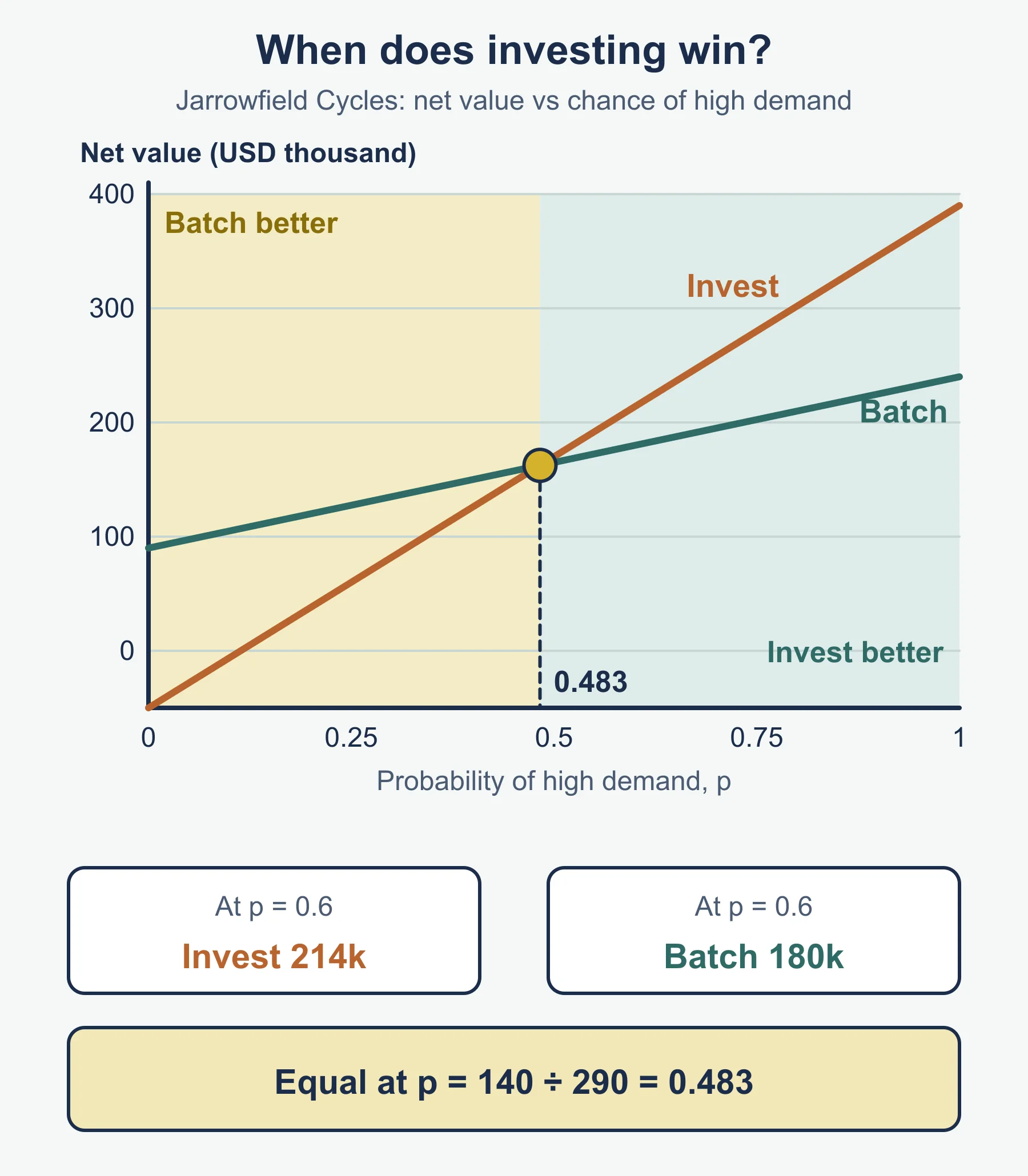
Cost per unit with set-up cost (batch). Cost per unit = variable cost + set-up cost ÷ batch size. Pellick Candles has a set-up cost of USD 300 and a variable cost of USD 4 per candle. A batch of 50 costs 4 + 300 ÷ 50 = USD 10.00 each. A batch of 150 costs 4 + 300 ÷ 150 = USD 6.00 each.
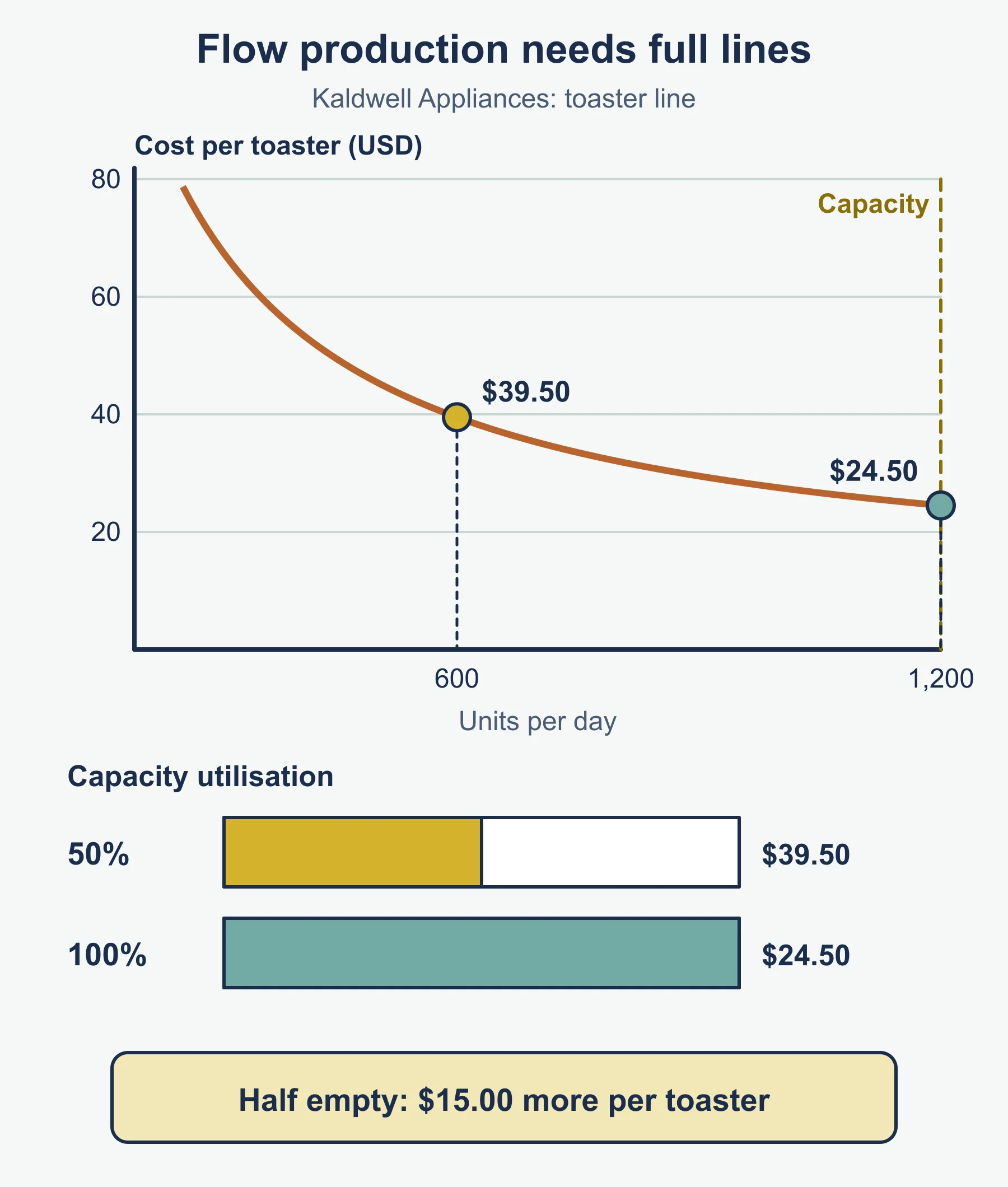
Cost per unit on a line (mass/flow). Cost per unit = fixed cost ÷ output + variable cost. With USD 9,000 fixed and USD 2 variable, 3,000 units cost 9,000 ÷ 3,000 + 2 = USD 5.00 each; 1,500 units cost USD 8.00 each.
Capacity utilization. Output ÷ capacity × 100. For 450 units on a 600-unit line: 75%.
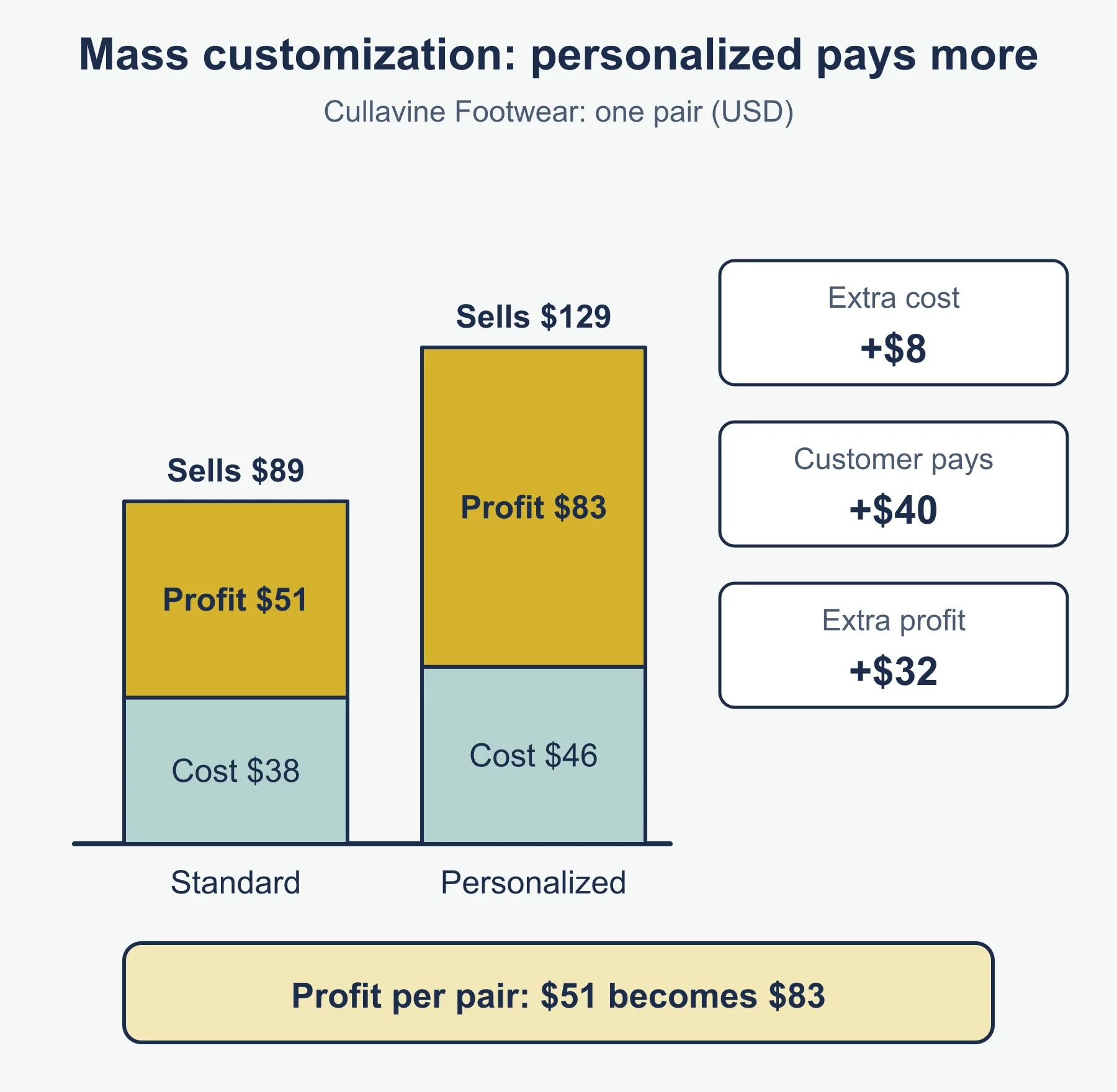
Premium from customization. A product sells at USD 85 standard and USD 120 personalized. Costs are USD 41 and USD 52. Extra profit per unit = (120 − 85) − (52 − 41) = 35 − 11 = USD 24.
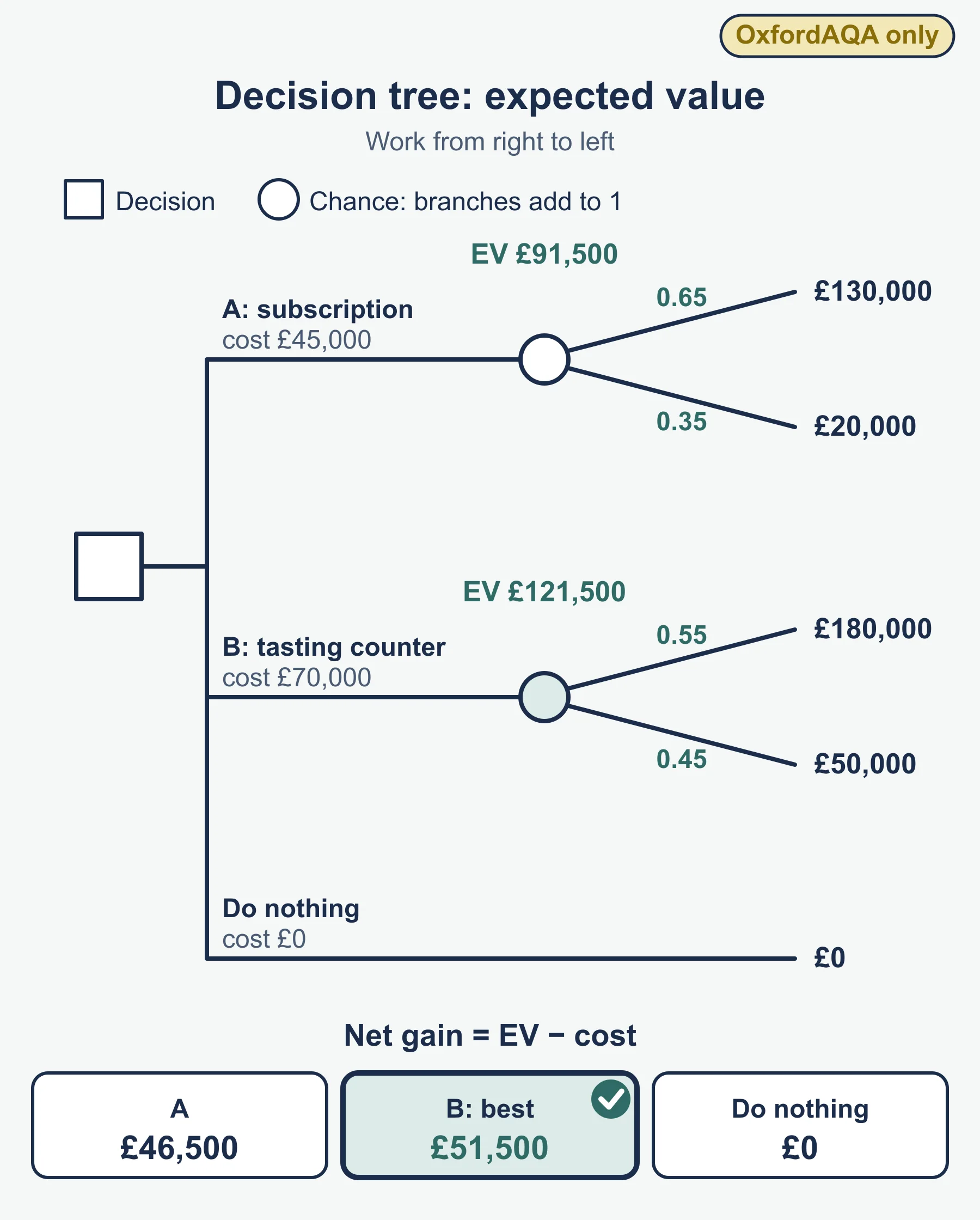
Expected value (decision tree). Multiply each outcome by its probability, add them, then subtract the cost of the option.
Quick self-test
- Define operations management.
- State two inputs that a bakery uses.
- A product costs USD 9.40 in inputs and sells for USD 15. State the value added.
- Which method fits a one-off architect-designed footbridge?
- Give one reason that mass production lowers cost per unit.
- Pellick Candles has set-up cost USD 300 and variable cost USD 4. Calculate the cost per candle for a batch of 100.
- Distinguish mass production from mass customization in one sentence.
- State one limitation of batch production.
- A line with capacity 800 units a day makes 600 units. Calculate capacity utilization.
- Explain one way a change in production method could affect the human resources function.
- Identify one ethical issue linked to operations.
- A decision tree option costs USD 40,000. It has a 0.5 chance of returning USD 120,000 and a 0.5 chance of returning USD 30,000. Calculate the expected net gain.
Answers
- The planning, organizing and controlling of the process that turns inputs into outputs.
- For example flour and labour (equipment, energy and ingredients also count).
- 15 − 9.40 = USD 5.60.
- Job production.
- Fixed costs are spread over a larger number of units.
- 4 + 300 ÷ 100 = USD 7.00.
- Mass production makes identical standard units, while mass customization uses mass-production methods to give each customer a personalized version.
- For example idle time during changeovers, or stock held after each batch.
- 600 ÷ 800 × 100 = 75%.
- For example automation may reduce the number of workers needed but raise the need for training in machine operation.
- For example unsafe working conditions, or sourcing materials from suppliers that harm the environment.
- 0.5 × 120,000 + 0.5 × 30,000 = 75,000; 75,000 − 40,000 = USD 35,000.
Where marks are usually lost
- Writing a definition from the textbook without linking it to the business named in the question.
- Listing advantages and disadvantages of a method without saying which matters more for this business.
- Calling mass production “cheap” without saying it needs high, steady output.
- Confusing batch production with mass customization.
- Missing the set-up cost when working out batch unit cost.
- Giving a decision tree answer without subtracting the cost of the option.
- Stopping an “evaluate” or “justify” answer after the points, with no conclusion.
- Forgetting non-numerical factors such as staff skills, brand image and sustainability.
Frequently asked questions
How do you calculate capacity utilization? Capacity utilization is output divided by capacity, multiplied by 100. For example, 450 units on a 600-unit line is 75%.
What is the difference between batch production and mass production? Batch production makes groups of identical items and stops to reset equipment between groups. Mass production runs continuously on a line making large numbers of a standard product.
How do you use expected value in a decision tree? Multiply each outcome by its probability, add the results, then subtract the cost of the option. Compare the net figures for each option before reaching a judgement.
What are the four conceptual understandings for operations management? The guide states that change in operations impacts other business activities, a creative production process can disrupt the market, operational changes may affect the business’s ethical stance, and sustainability ensures efficiency in operations.
Official syllabus
IB Diploma Programme Business management guide, first assessment 2024, International Baccalaureate Organization: Unit 5, sections 5.1 and 5.2.
Get free revision emails (optional)
Occasional emails with practice questions, worked explanations and links to free resources for the qualification and subjects you choose. No spam, and you can unsubscribe from any email. The free tools on this site never need an email.
Related resources
-
Study guides
IB DP Business Management: Lean production and quality management (HL only)
Study guide to IB DP Business Management 5.3 (HL only): lean production, kaizen, JIT, cradle to cradle, quality methods, TQM and quality standards.
Business · International Baccalaureate · IB
Read guide -
Practice questions
IB DP Business Management: Lean production and quality management (HL only) – Practice Questions
Original IB DP Business Management 5.3 (HL only) practice questions on lean production, JIT, kaizen, TQM and quality standards, with worked answers.
Business · International Baccalaureate · IB
Try questions -
Revision notes
IB DP Business Management: Lean production and quality management (HL only) – Revision Notes
Condensed IB DP Business Management 5.3 (HL only) revision notes: lean production, kaizen, JIT, quality methods, TQM, standards and a self-test.
Business · International Baccalaureate · IB
Revise topic
Related articles
-
teaching
A Level tuition in Dubai: Cambridge or Pearson Edexcel International A Level?
Schools in Dubai and Abu Dhabi teach either Cambridge International AS & A Level or Pearson Edexcel International A Level. How the two are structured, why it matters for tuition, and how online classes from Lahore work.
9 October 2026
-
curriculum guides
Choosing subjects at IGCSE and A Level
How subject choices at 14 and 16 affect university options later, and how to keep pathways open without overloading a timetable.
28 July 2026
Studying this with a teacher
Working through Business IB?
This page is free and stays free. If you would rather be taught it, Marlbridge runs Business classes one-to-one, online in your own time zone. The first trial class is free. WhatsApp replies within an hour (8am–11pm Pakistan time, every day); email the same day.
IB Business teachers at Marlbridge

