
Study Guides
IB DP Business Management: Lean production and quality management (HL only)
Study guide to IB DP Business Management 5.3 (HL only): lean production, kaizen, JIT, cradle to cradle, quality methods, TQM and quality standards.
- Subject
- Business
- Level
- IB
- Topic
- Unit 5: Operations management
- Author
- Marlbridge Academic Team
- Updated
- Reviewed by
- Salman Ahmad (what this means)
Aligned to International Baccalaureate IB Diploma Programme Business (DP Business Management), First assessment 2024. Official specification .
Syllabus page (what it covers and how it is assessed): IB Diploma Programme Business.
Syllabus points this page covers
DP Business Management
- 5.3 Lean production and quality management (HL only)
Found an error? Report a correction.
Need help with this topic? Request a free trial class for IB Diploma Programme Business (DP Business Management).
This guide covers section 5.3, Lean production and quality management, in Unit 5 (Operations management) of the IB Business management guide, first assessment 2024. The whole section is HL only, so SL candidates do not need it. The guide says HL Paper 2 and Paper 3 draw on HL extension topics, while Paper 1 does not.
Use it with the revision notes and the practice questions. The course hub is IB DP Business Management, the printable list is the syllabus checklist, and the free diagnostics show where to start. For the whole course layout see the syllabus guide.
What 5.3 asks you to know
| Content point in the guide | Depth in the guide | Where covered below |
|---|---|---|
| Features of lean production: less waste, greater efficiency | AO1 | Lean production |
| Methods of lean production: continuous improvement (kaizen), just-in-time (JIT) | AO2 | Kaizen; Just-in-time |
| Features of cradle to cradle design and manufacturing | AO2 | Cradle to cradle |
| Features of quality control and quality assurance | AO2 | Quality control and quality assurance |
| Methods of managing quality: quality circle, benchmarking, total quality management (TQM) | AO2 | Three methods |
| Impact of lean production and TQM on an organization | AO3 | Impact |
| Importance of national and international quality standards | AO2 | Quality standards |
The guide titles these objectives knowledge and understanding (AO1), application and analysis (AO2), and synthesis and evaluation (AO3). The guide gives no formulas for this section, so every calculation below uses ordinary arithmetic on cost and rate data. It also gives no definitions for this section, so the definitions and features below are standard business-studies wording, not the guide’s own.
Lean production
Lean production is an approach to operations that tries to get the same or better output from fewer resources. The guide names two features.
Less waste. Waste is any use of materials, time, space or effort that does not add value for the customer. Common sources are scrap, rework, unsold inventory, waiting time, unnecessary movement and overproduction. A lean business hunts for waste in every stage, not only on the factory floor.
Greater efficiency. Efficiency means producing output with fewer inputs. A lean business aims for lower unit costs, shorter production times and fewer defects, which can lift profit or allow lower prices.
Worked example: waste
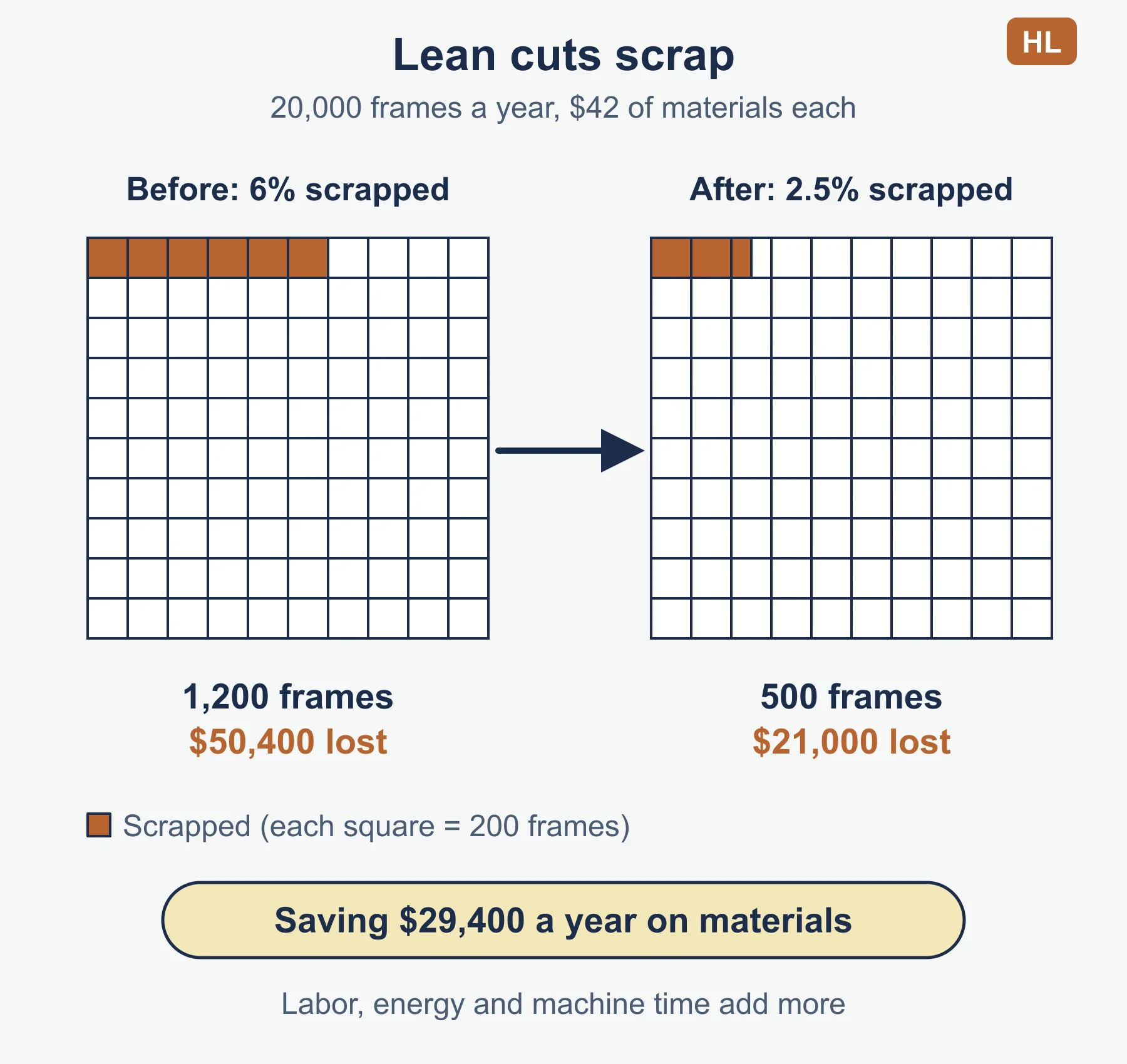
Grenholm Cycles makes 20,000 frames a year. Currently 6% are scrapped, and each frame holds USD 42 of materials. A lean programme cuts scrap to 2.5%.
- Frames scrapped before: 20,000 × 0.06 = 1,200.
- Material cost lost before: 1,200 × 42 = USD 50,400.
- Frames scrapped after: 20,000 × 0.025 = 500.
- Material cost lost after: 500 × 42 = USD 21,000.
- Annual material saving: 50,400 − 21,000 = USD 29,400.
This counts materials only. Labor, energy and machine time spent on scrapped frames add further savings that the data does not show.
Continuous improvement (kaizen)
Kaizen is a Japanese term for continuous improvement. The idea is that many small changes, suggested and made by the people who do the work, add up to large gains over time. It is a standing habit rather than a one-off project.
Features of kaizen:
- Everyone is involved, from operators to managers, not only specialists.
- Changes are small and cheap, so they are quick to test and easy to reverse.
- Progress never ends: once a process improves, it becomes the new base to improve.
- It relies on employees feeling safe to point out problems.
Benefits include lower costs, higher motivation and ideas drawn from people closest to the problem. Limits include slow dramatic change, the time employees spend on suggestions, and fading enthusiasm if managers ignore ideas.
Worked example: kaizen
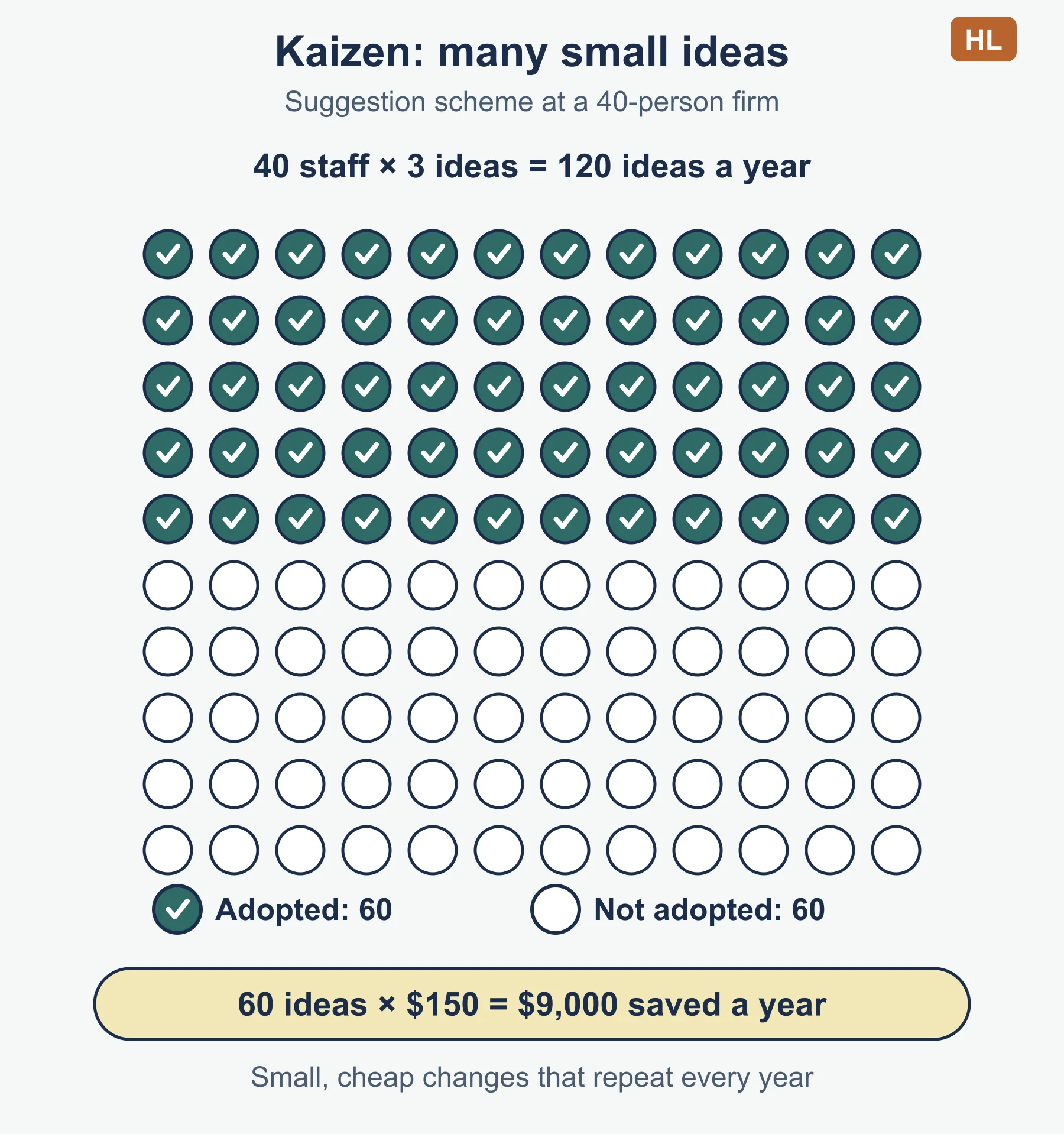
Grenholm Cycles has 40 employees. Each makes an average of 3 suggestions a year, and half are adopted. Each adopted idea saves about USD 150 a year.
- Suggestions: 40 × 3 = 120.
- Adopted: 120 × 0.5 = 60.
- Annual saving: 60 × 150 = USD 9,000.
The saving is small beside the scrap example, but it recurs and it grows as ideas accumulate.
Just-in-time (JIT)
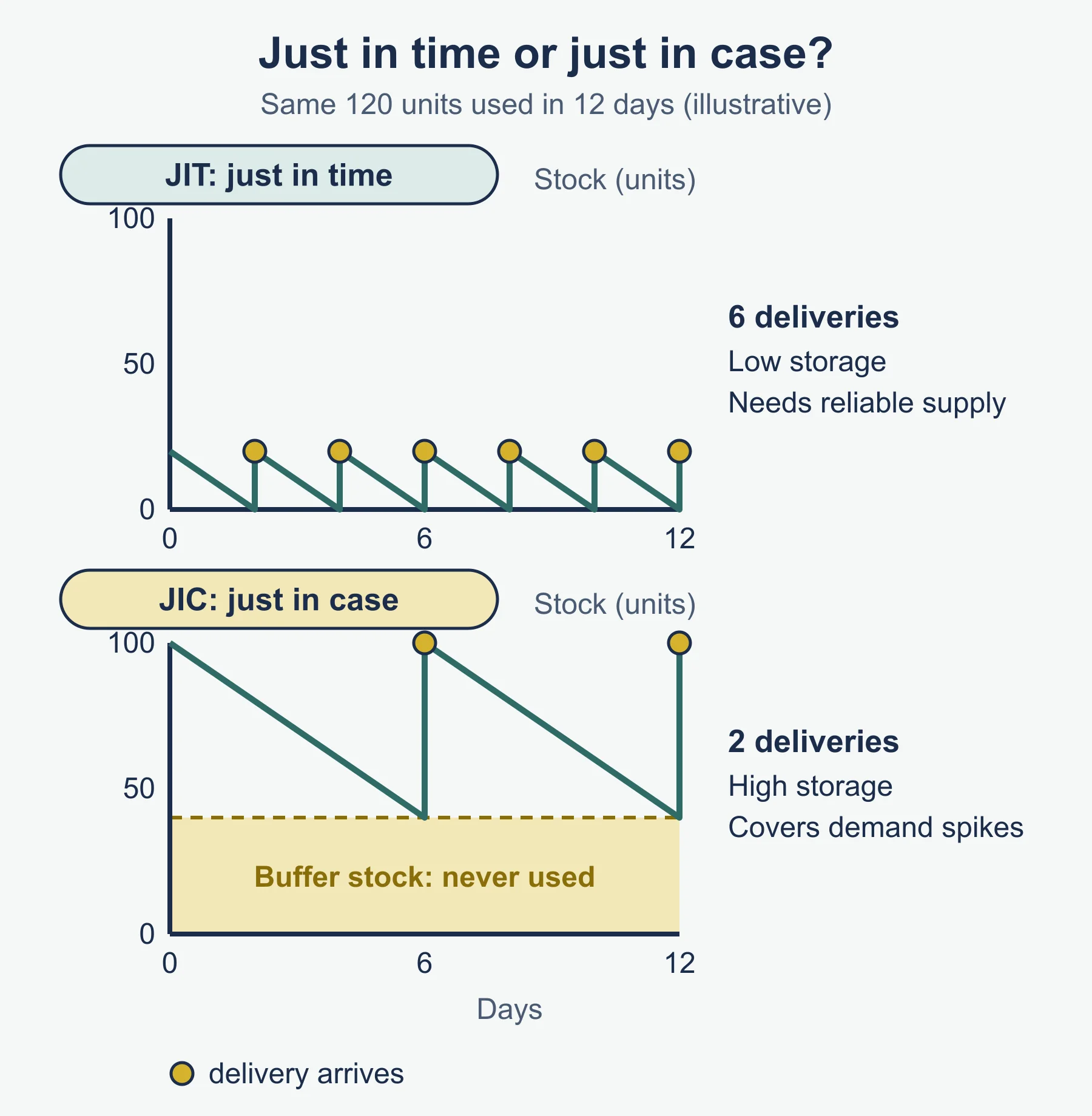
In just-in-time, materials and components arrive only when they are needed for production, and finished goods leave soon after being made. The opposite approach is just-in-case, where a business keeps buffer stocks in case of delays or demand spikes.
Features and requirements of JIT:
- Very low inventory of materials, work in progress and finished goods.
- Frequent small deliveries from suppliers.
- Reliable suppliers, accurate demand forecasts and well-maintained machines, because there is little stock to cover problems.
- Close communication with suppliers, often through shared information systems.
Benefits: lower holding costs, less storage space, less risk of stock becoming obsolete or damaged, and cash freed from inventory. Drawbacks: one late delivery can stop the line, bulk-buying discounts are lost, delivery costs may rise, and the business can struggle to meet a sudden surge in demand.
Worked example: JIT
Rimmick Foods holds average inventory worth USD 240,000. Holding costs (storage, insurance, spoilage and finance) are 12% of inventory value. After moving to JIT, average inventory falls to USD 90,000.
- Holding cost before: 240,000 × 0.12 = USD 28,800.
- Holding cost after: 90,000 × 0.12 = USD 10,800.
- Annual saving: 28,800 − 10,800 = USD 18,000.
- Inventory fall: (240,000 − 90,000) ÷ 240,000 = 62.5%.
Extra delivery costs and the risk of a stock-out would reduce this net benefit.
Cradle to cradle
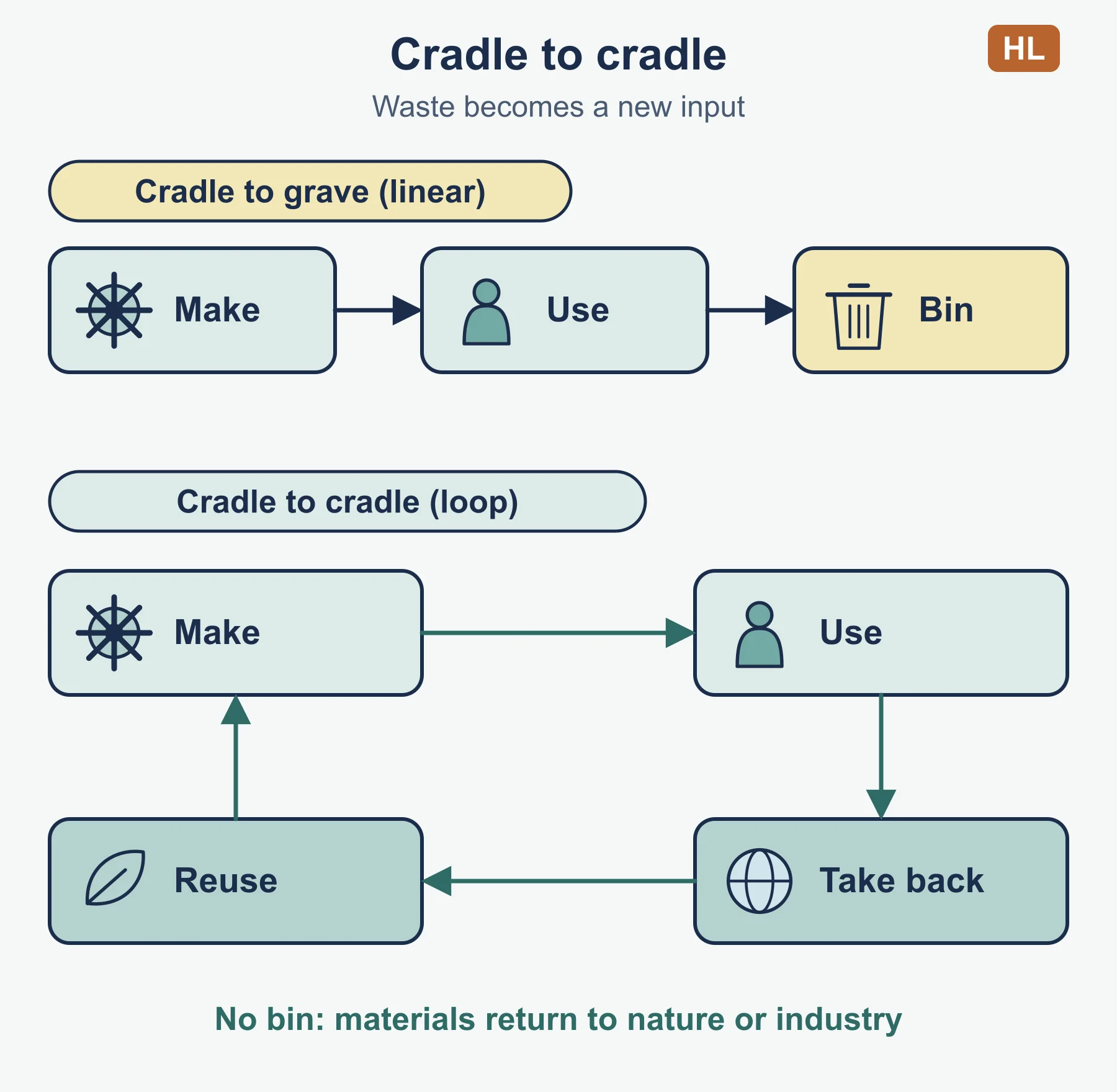
Cradle to cradle is an approach to design and manufacturing that removes the idea of waste. In the traditional linear model, a product is made, used and thrown away (“cradle to grave”). Cradle to cradle designs products so that, at the end of their life, their materials become inputs for something new.
Features:
- Materials are chosen so that they can be safely returned to nature or reused in industry at similar quality.
- Products are designed so they can be taken apart and their parts separated.
- Manufacturing uses renewable energy and aims to avoid harmful substances.
- The business thinks about the whole life of the product, including take-back or recycling schemes.
Benefits include lower raw material demand, a strong environmental reputation and appeal to ethical customers. Challenges include higher design and research costs, the need for supply chain partners to cooperate, and the difficulty of recovering products from customers.
Quality control and quality assurance
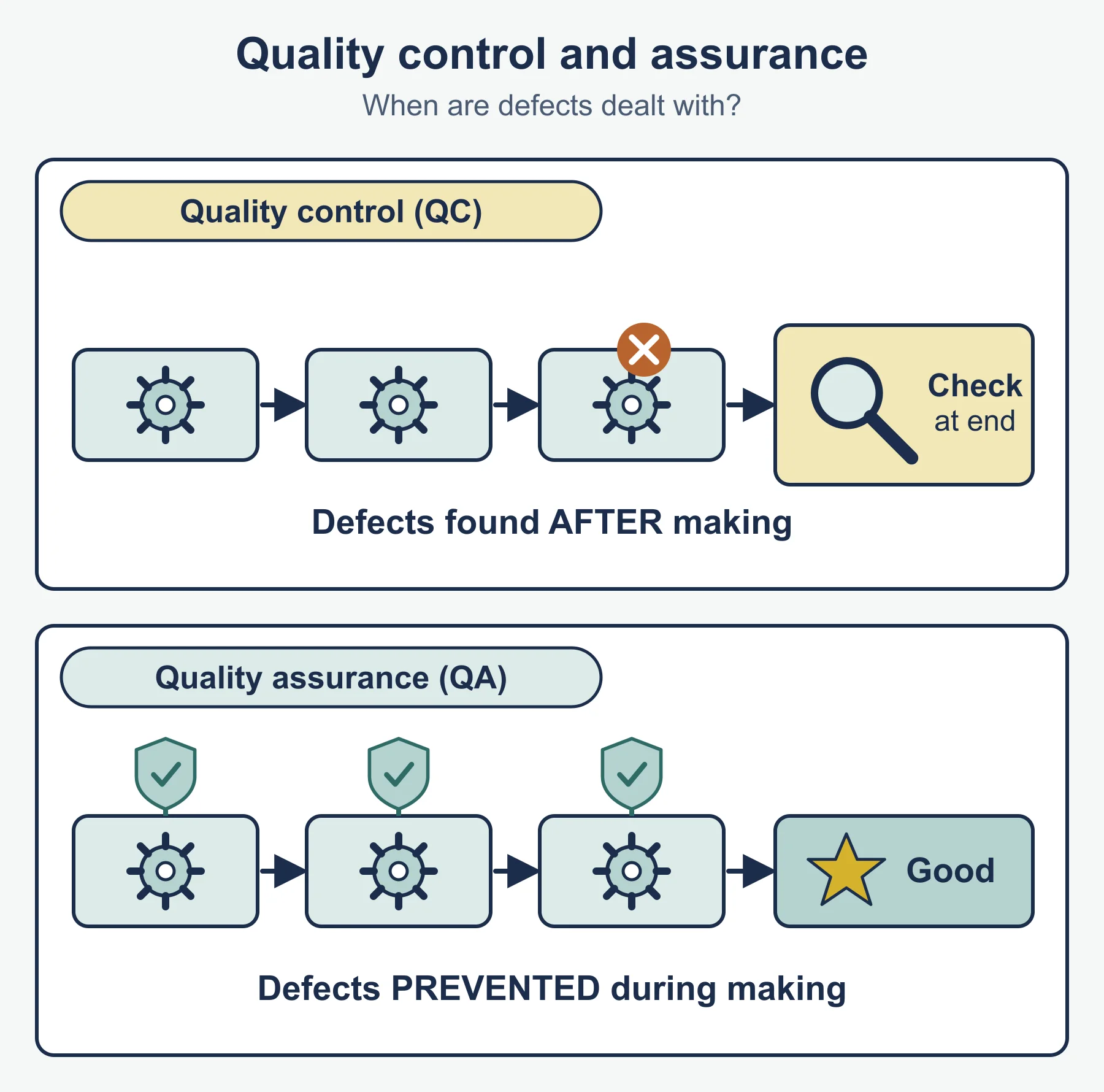
Quality control (QC) checks output against a standard and removes items that fail. Inspectors test samples or every unit, often at the end of production. It finds defects after they have occurred, so it deals with symptoms.
Quality assurance (QA) builds quality into the whole process, so defects are prevented. It covers supplier selection, staff training, clear procedures, equipment maintenance and checks at each stage. It deals with causes.
| Quality control | Quality assurance | |
|---|---|---|
| Focus | Detecting defects in output | Preventing defects in the process |
| Timing | Usually after or during production | Throughout, from design to delivery |
| Who | Inspectors or a quality department | Everyone involved |
| Cost pattern | Costs of inspection and of scrap or rework | Costs of training and system design |
Most businesses use both: QA to reduce defects and QC as a safety check.
Three methods of managing quality
Quality circle
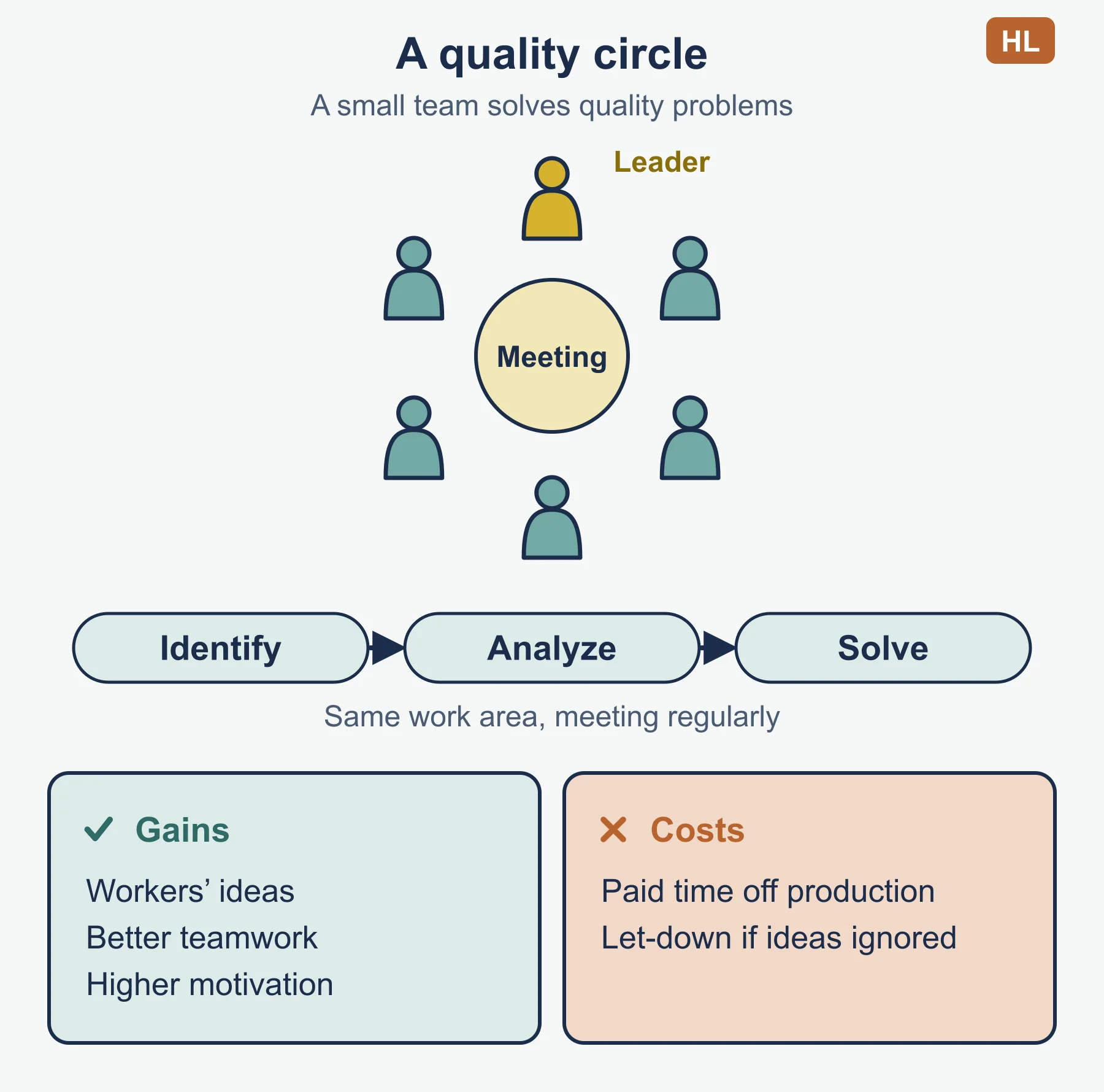
A quality circle is a small group of workers, often from the same work area, who meet regularly to identify, analyze and solve quality problems. A facilitator or supervisor may lead. Benefits: ideas from workers, better teamwork, improved motivation. Costs: paid time away from production and disappointment if suggestions are not acted on.
Benchmarking
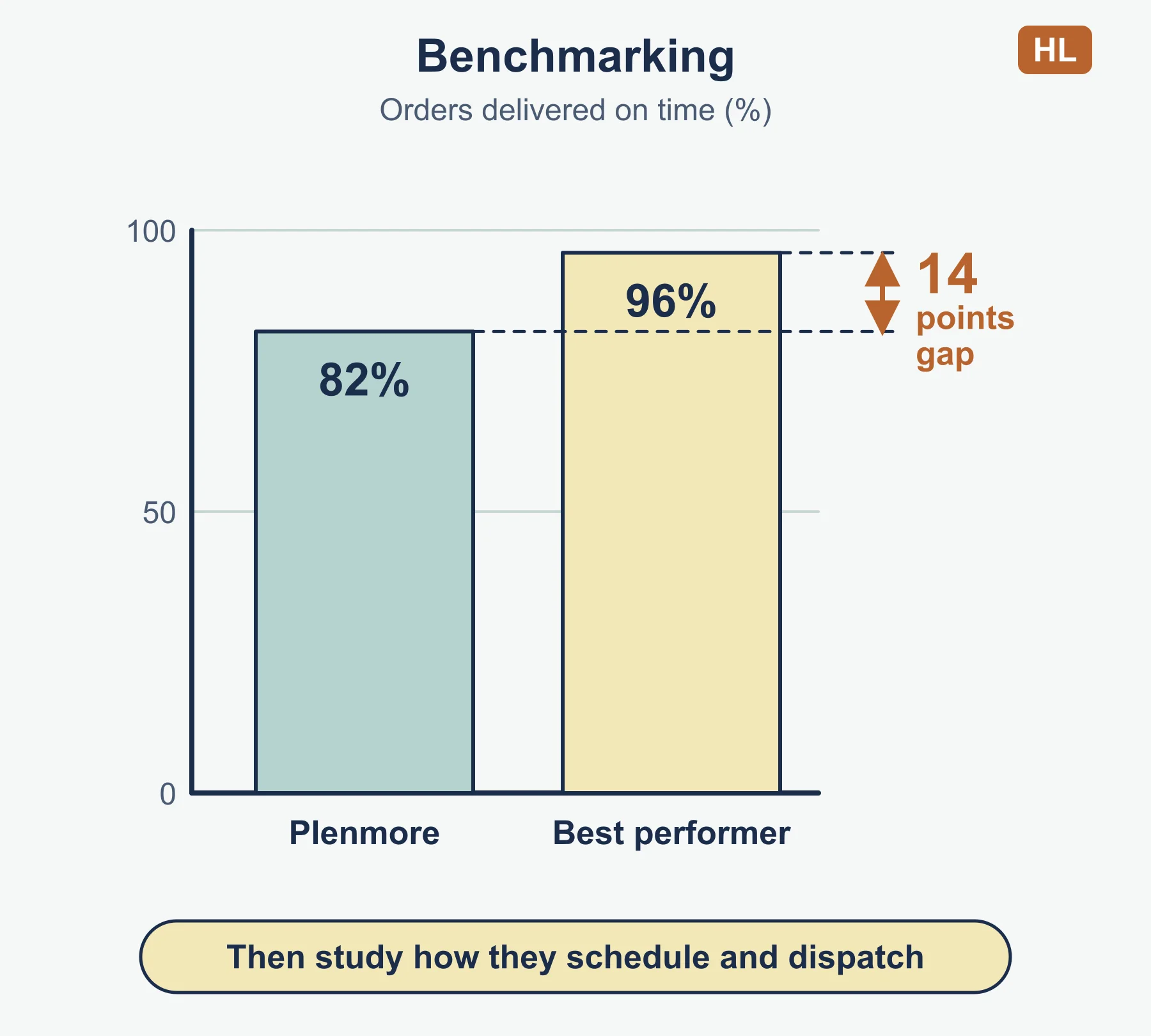
Benchmarking means comparing your processes or performance with those of a best performer and then closing the gap. The comparison can be internal (another branch), competitive (a rival) or functional (a business in another industry that does the same task well). It needs reliable data, and the best performer’s methods may not suit your business.
Worked example: Plenmore Components delivers 82% of orders on time. The best performer it studies delivers 96%. The gap is 96 − 82 = 14 percentage points. Plenmore then examines how that business schedules and dispatches orders.
Total quality management (TQM)
TQM is a business-wide approach in which every employee is responsible for quality and the aim is to meet or exceed customer needs, with zero defects as the target. It combines customer focus, employee empowerment, continuous improvement, training and quality at every stage, including suppliers. It differs from QC because quality is not left to inspectors. It has strong links to kaizen and quality circles, which are often tools within a TQM culture.
Worked example: TQM
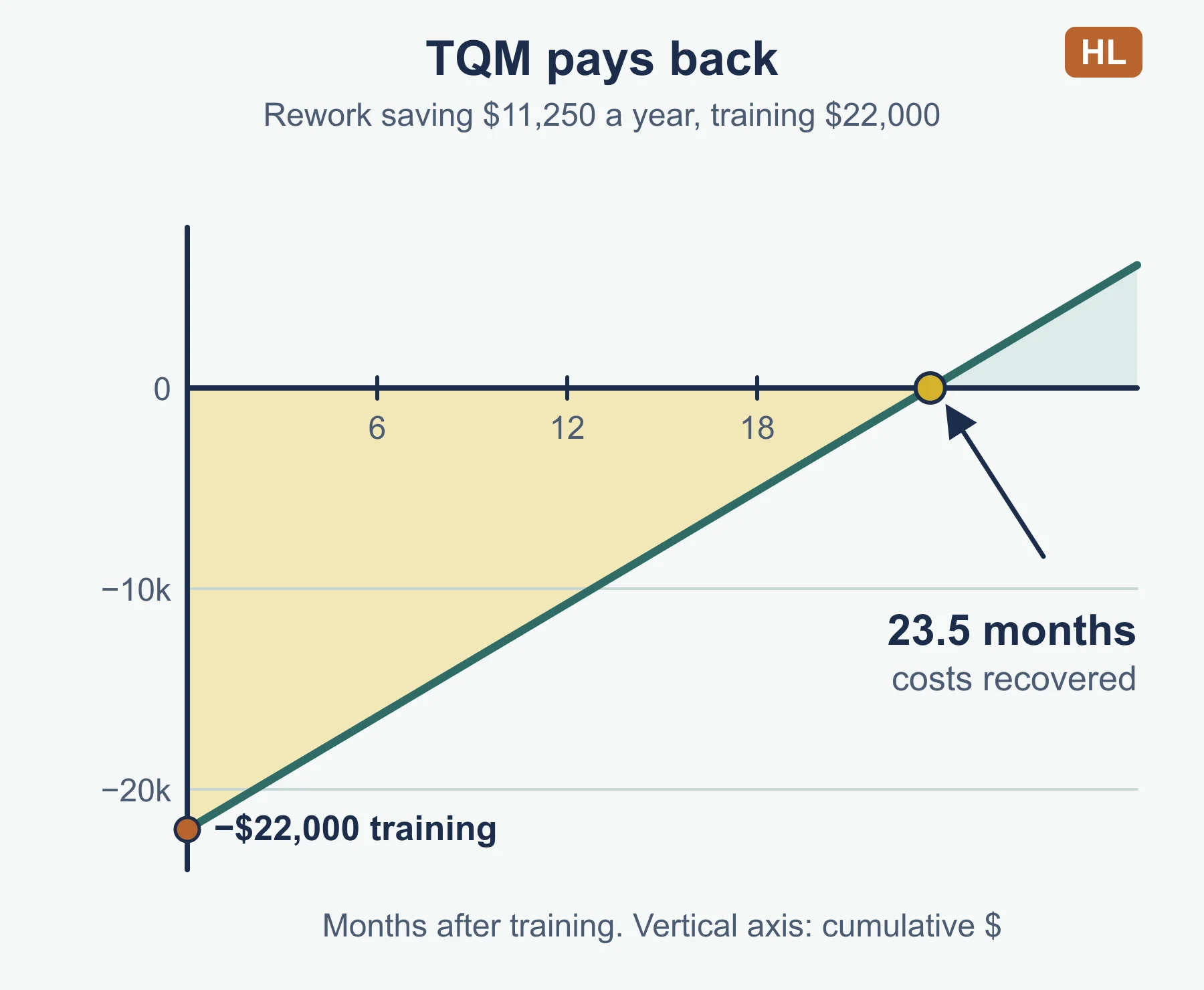
Plenmore Components makes 50,000 units a year. Its defect rate is 4%, and each defect costs USD 9 to rework. TQM cuts the rate to 1.5%. Training costs USD 22,000.
- Defects before: 50,000 × 0.04 = 2,000, costing 2,000 × 9 = USD 18,000.
- Defects after: 50,000 × 0.015 = 750, costing 750 × 9 = USD 6,750.
- Annual saving: 18,000 − 6,750 = USD 11,250.
- Payback on training: 22,000 ÷ 11,250 = 1.96 years, about 23.5 months.
The saving ignores gains from fewer returns, better reputation and lower inspection costs.
Impact of lean production and TQM on an organization
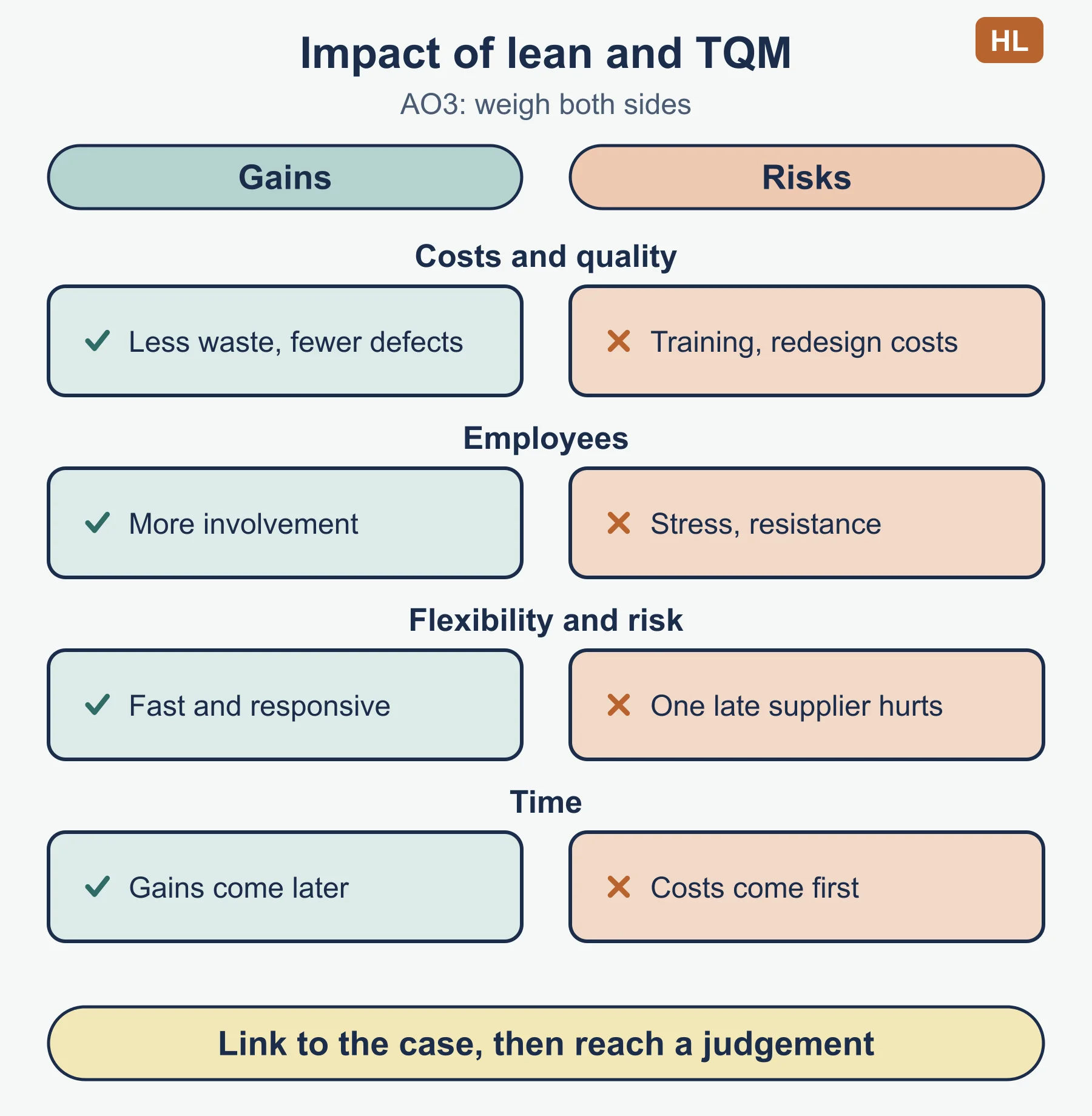
AO3 means you must weigh the effects, not list them. Think about these areas.
- Costs: lower waste, inventory and rework costs, but upfront training, redesign and supplier costs.
- Quality and customers: fewer defects, better reliability and higher satisfaction, which supports reputation and repeat sales.
- Employees: more involvement and motivation, but possible stress, because JIT and zero-defect targets leave little slack, and resistance to change.
- Flexibility and risk: lean systems are fast and responsive, yet a supplier failure hurts more.
- Time: benefits often arrive slowly, while costs come first.
A good evaluation links the effects to the organization in the case study (its size, product, workforce and suppliers) and reaches a judgement.
National and international quality standards
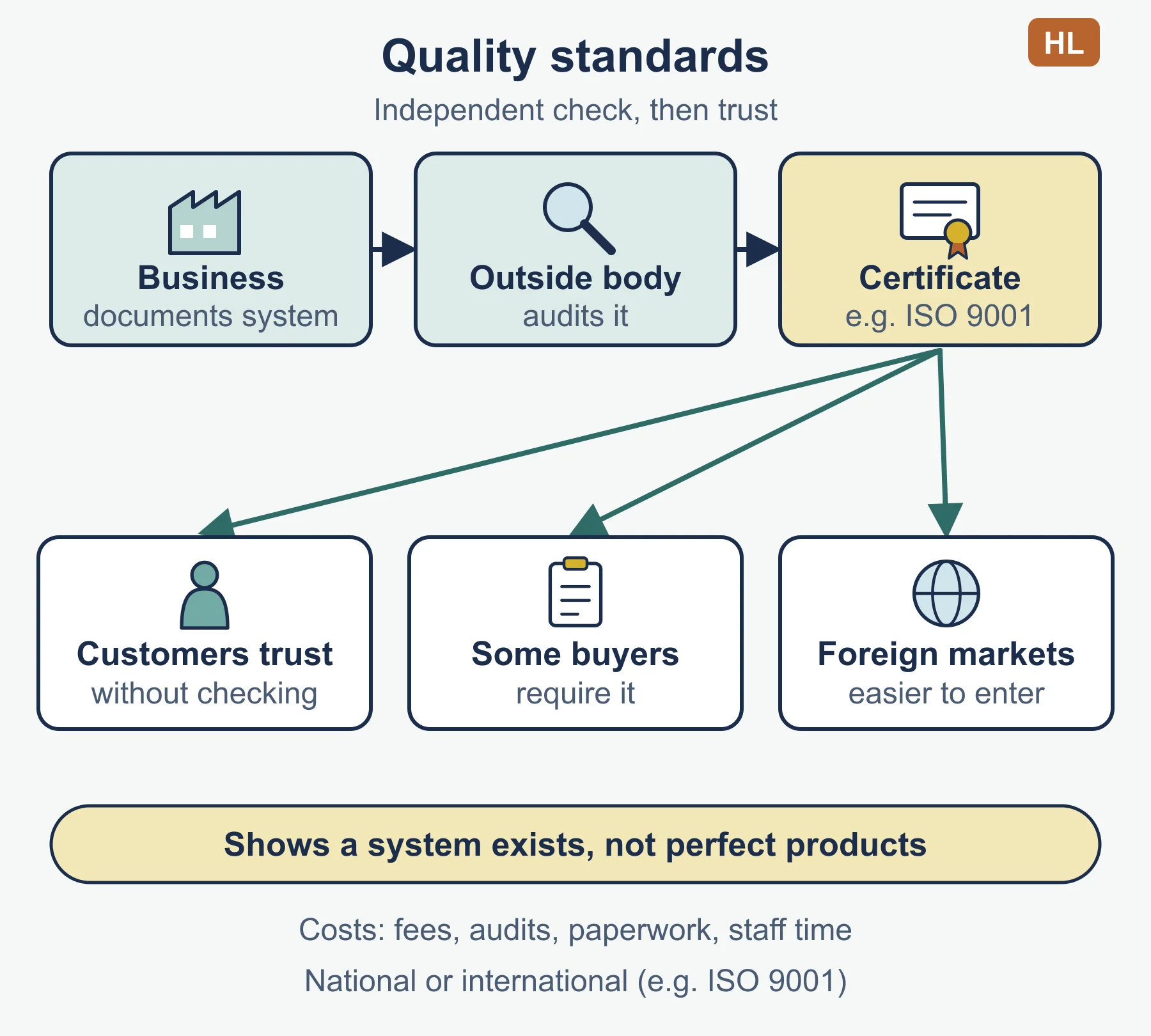
A quality standard is a published set of requirements that an organization can be independently checked against. National standards are set by a country’s standards body, and international standards, such as the ISO 9001 standard for quality management systems, apply across countries. Certification involves an audit by an outside body.
Why they matter:
- Customers trust a certified supplier without checking it themselves.
- Some buyers, including large firms and public bodies, require certification before they will trade.
- Following a standard forces a business to document and improve processes.
- International standards ease entry to foreign markets.
Costs and limits: fees, audits, paperwork and staff time. A standard shows that a system exists, not that every product is perfect, so it supports rather than replaces QA.
Common errors
- Describing lean production as simply cutting staff or costs. The focus is waste and value.
- Treating JIT as only low inventory. Reliable suppliers and forecasts are what make it work.
- Mixing up QC (detect) and QA (prevent).
- Writing TQM as another name for inspection.
- Listing benefits only. Evaluate with costs, timing and context.
Frequently asked questions
What is lean production? Lean production is an approach to operations that tries to get the same or better output from fewer resources. Its features in the IB guide are less waste and greater efficiency.
What are the drawbacks of just-in-time production? Because there is little stock to cover a gap, a late delivery or machine breakdown can stop production. JIT depends on reliable suppliers, accurate demand forecasts and well-maintained machines, and extra delivery costs can reduce its savings.
What is cradle to cradle design? Cradle to cradle is an approach to design and manufacturing that removes the idea of waste: materials are chosen to be reused or safely returned to nature, and products are designed to be taken apart. It contrasts with the linear cradle-to-grave model that ends in disposal.
What is the difference between quality control and quality assurance? Quality control checks output against a standard to detect defects, usually after or during production. Quality assurance builds quality into the whole process, from design to delivery, to prevent defects.
Official syllabus
IB Diploma Programme Business management guide, first assessment 2024, International Baccalaureate Organization, section 5.3, Lean production and quality management (HL only). Marlbridge is not affiliated with the IB.
Get free revision emails (optional)
Occasional emails with practice questions, worked explanations and links to free resources for the qualification and subjects you choose. No spam, and you can unsubscribe from any email. The free tools on this site never need an email.
Related resources
-
Practice questions
IB DP Business Management: Lean production and quality management (HL only) – Practice Questions
Original IB DP Business Management 5.3 (HL only) practice questions on lean production, JIT, kaizen, TQM and quality standards, with worked answers.
Business · International Baccalaureate · IB
Try questions -
Revision notes
IB DP Business Management: Lean production and quality management (HL only) – Revision Notes
Condensed IB DP Business Management 5.3 (HL only) revision notes: lean production, kaizen, JIT, quality methods, TQM, standards and a self-test.
Business · International Baccalaureate · IB
Revise topic -
Study guides
IB DP Business Management: Location
Study guide to IB DP Business Management section 5.4: reasons for a production location, outsourcing, offshoring, insourcing and reshoring.
Business · International Baccalaureate · IB
Read guide
Related articles
-
teaching
A Level tuition in Dubai: Cambridge or Pearson Edexcel International A Level?
Schools in Dubai and Abu Dhabi teach either Cambridge International AS & A Level or Pearson Edexcel International A Level. How the two are structured, why it matters for tuition, and how online classes from Lahore work.
9 October 2026
-
curriculum guides
Choosing subjects at IGCSE and A Level
How subject choices at 14 and 16 affect university options later, and how to keep pathways open without overloading a timetable.
28 July 2026
Studying this with a teacher
Working through Business IB?
This page is free and stays free. If you would rather be taught it, Marlbridge runs Business classes one-to-one, online in your own time zone. The first trial class is free. WhatsApp replies within an hour (8am–11pm Pakistan time, every day); email the same day.
IB Business teachers at Marlbridge

