
Study Guides
IB DP Business Management: Crisis management and contingency planning (HL only)
Study guide to IB DP Business Management 5.7 (HL only): crisis management, contingency planning, four success factors and their impact.
- Subject
- Business
- Level
- IB
- Topic
- Unit 5: Operations management
- Author
- Marlbridge Academic Team
- Updated
- Reviewed by
- Salman Ahmad (what this means)
Aligned to International Baccalaureate IB Diploma Programme Business (DP Business Management), First assessment 2024. Official specification .
Syllabus page (what it covers and how it is assessed): IB Diploma Programme Business.
Syllabus points this page covers
DP Business Management
- 5.7 Crisis management and contingency planning (HL only)
Found an error? Report a correction.
Need help with this topic? Request a free trial class for IB Diploma Programme Business (DP Business Management).
This study guide covers section 5.7, Crisis management and contingency planning, in Unit 5 of the IB Business management guide, first assessment 2024. The whole section is HL only, so it is HL extension content that SL students do not study. The guide gives the section three content points and a depth of teaching for each. Businesses and figures below are invented. The guide does not define the two key terms, so the definitions here are standard ones, and they are marked as such.
- Condensed version: revision notes.
- Exam-style questions with worked answers: practice questions.
- Course pages: IB DP Business Management hub and the syllabus checklist.
- Check what you know with the free 10-minute diagnostics.
What the section asks of you
| Content point in the guide | Depth of teaching | What you need to be able to do |
|---|---|---|
| The difference between crisis management and contingency planning | AO2 | Distinguish the two and apply the difference to a case |
| The factors that affect effective crisis management: transparency, communication, speed, control | AO2 | Explain each factor and show how it helps or harms a response |
| The impact of contingency planning for a given organization or situation in terms of cost, time, risks, safety | AO3 | Weigh the four impacts for a named organization and reach a judgement |
AO2 means you apply and analyse. AO3 means you weigh up and judge, so expect command terms such as evaluate, justify, recommend and to what extent for the third point.
Crisis management versus contingency planning
A crisis is a sudden, serious event that threatens the organization’s people, operations, finances or reputation and that needs a fast response. Examples of types are a product fault, a factory fire, a data loss, a supplier collapse or an accident.
Crisis management is the way the organization responds once a crisis is under way: the decisions, communication and actions taken to limit damage and restore normal operations. It happens during and just after the event. (Standard definition; the guide does not word it.)
Contingency planning is preparing in advance for events that could happen. Managers identify possible adverse events, set out what would be done, who would do it and what resources are needed, and often rehearse the plan. It happens before the event. (Standard definition; the guide does not word it.)
| Feature | Contingency planning | Crisis management |
|---|---|---|
| Timing | Before anything has gone wrong | During and after the event |
| Nature | Proactive, calm, planned | Reactive, pressured, often improvised |
| Information | Estimates and scenarios | Real events and incomplete facts |
| Output | A written plan, trained staff, spare resources | Decisions, statements, actions on the day |
| Link | A good plan gives crisis managers a starting script | Crisis experience feeds back into better plans |
The two connect. A business with a rehearsed plan still has to manage the crisis, because real events never match the plan exactly. A business with no plan has to invent its response under stress.
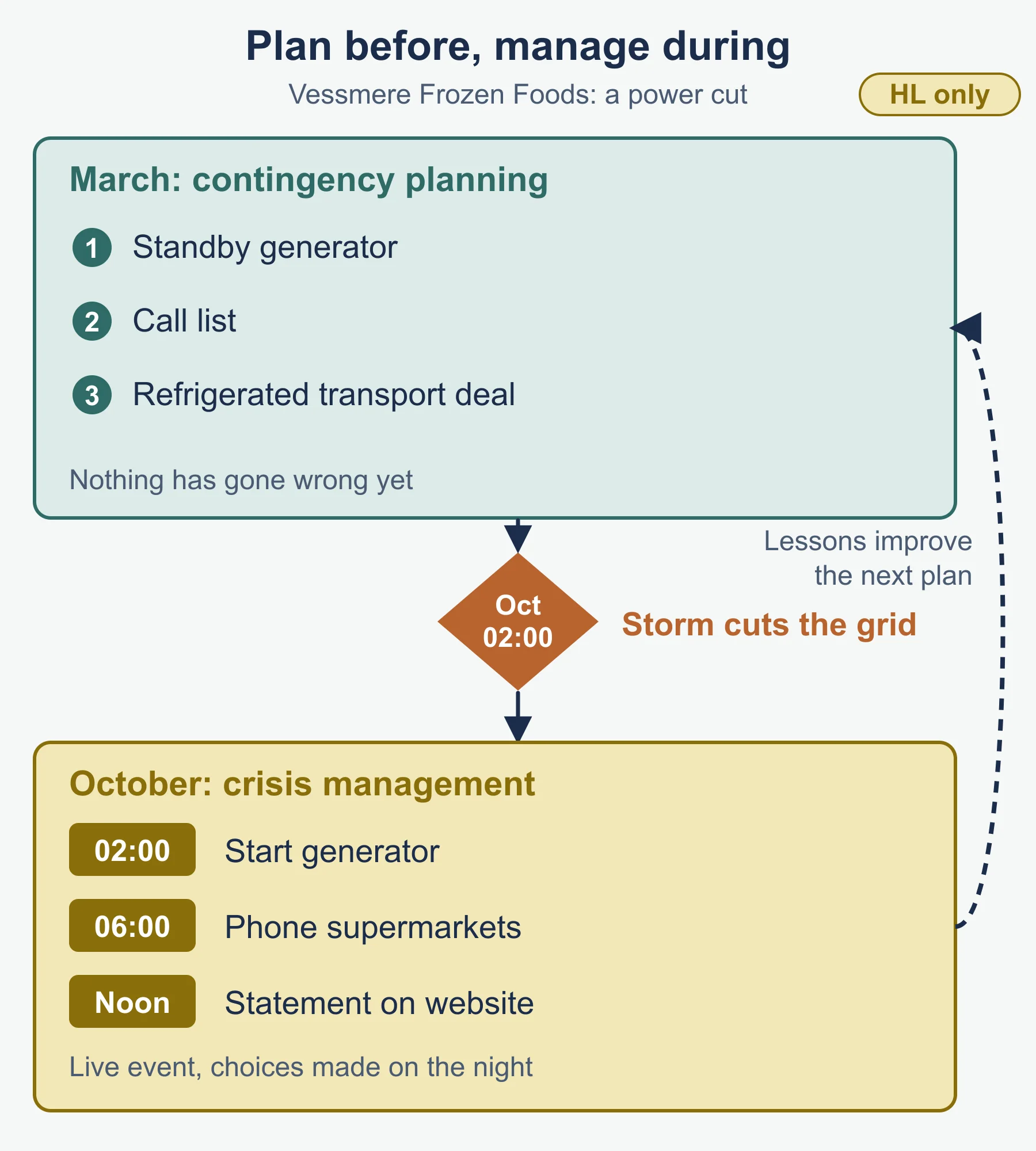
Worked example: telling them apart. Vessmere Frozen Foods runs a cold store holding frozen meals for supermarkets. In March the managers write a procedure for a power cut: a standby generator, a call list and a contract with a refrigerated transport firm. That is contingency planning, because no outage has happened. In October a storm cuts the grid at 02:00. The night manager starts the generator, the operations director phones the supermarkets by 06:00 and a statement goes on the website by noon. That is crisis management, because the event is live. The plan shaped the response, yet the choices about which pallets to move first were made on the night.
Factors that affect effective crisis management
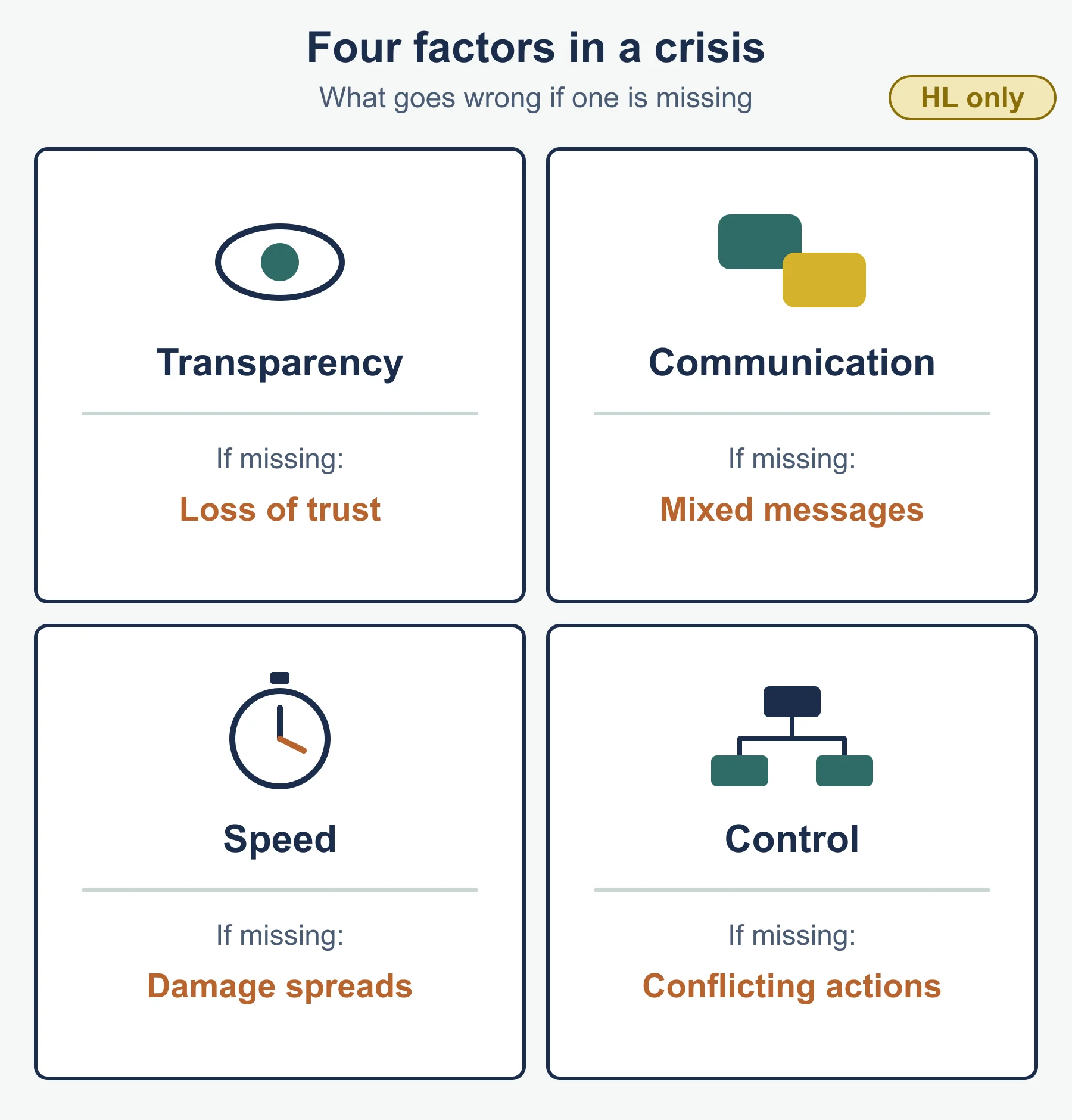
The guide lists four factors: transparency, communication, speed and control. They interact, so a strong answer rarely treats one in isolation.
Transparency
Transparency means being open about what has happened, what is known, what is not yet known and what is being done. Admitting a fault early can protect trust with customers, employees and regulators. Hiding facts is risky because facts tend to emerge, and the cover-up can do more harm than the original event.
Limits: full openness can release unconfirmed or legally sensitive information, can alarm customers unnecessarily and can help competitors. Managers usually balance openness against accuracy.
Communication
Communication covers who is told, by whom, through which channel and how often. Internal communication keeps employees consistent and calm. External communication reaches customers, suppliers, shareholders, local communities and the media. Effective crisis communication is clear, consistent (one agreed message) and two-way, since stakeholders need a route to ask questions.
Problems arise when different managers give different accounts, when staff learn bad news from the media first, or when the channel does not reach the affected group, such as an app notice sent to people without the app.
Speed
Speed is how quickly the organization detects the problem, decides and acts. A fast response limits spread, whether of a faulty product, a fire or a rumour. Social media can make a delay in comment look like silence or denial.
Limits: a hasty response can be wrong, contradict later facts or ignore safety checks. Speed is useful only when the first actions are the right ones, which is where a contingency plan helps.
Control
Control means the organization keeps authority over decisions and events. A clear chain of command, a named crisis team and defined roles stop people duplicating work or acting against each other. Control also means managing information flows and resources, such as who may speak to the media and who may authorize spending.
Limits: too rigid a structure slows decisions, and a leader who holds every decision becomes a bottleneck when the situation changes.
How the four fit together
| If this is missing | Likely effect |
|---|---|
| Transparency | Loss of trust; accusations of concealment |
| Communication | Confusion, rumours, mixed messages |
| Speed | Damage spreads; reputation suffers while the business stays silent |
| Control | Duplicated or conflicting actions; no clear decision-maker |
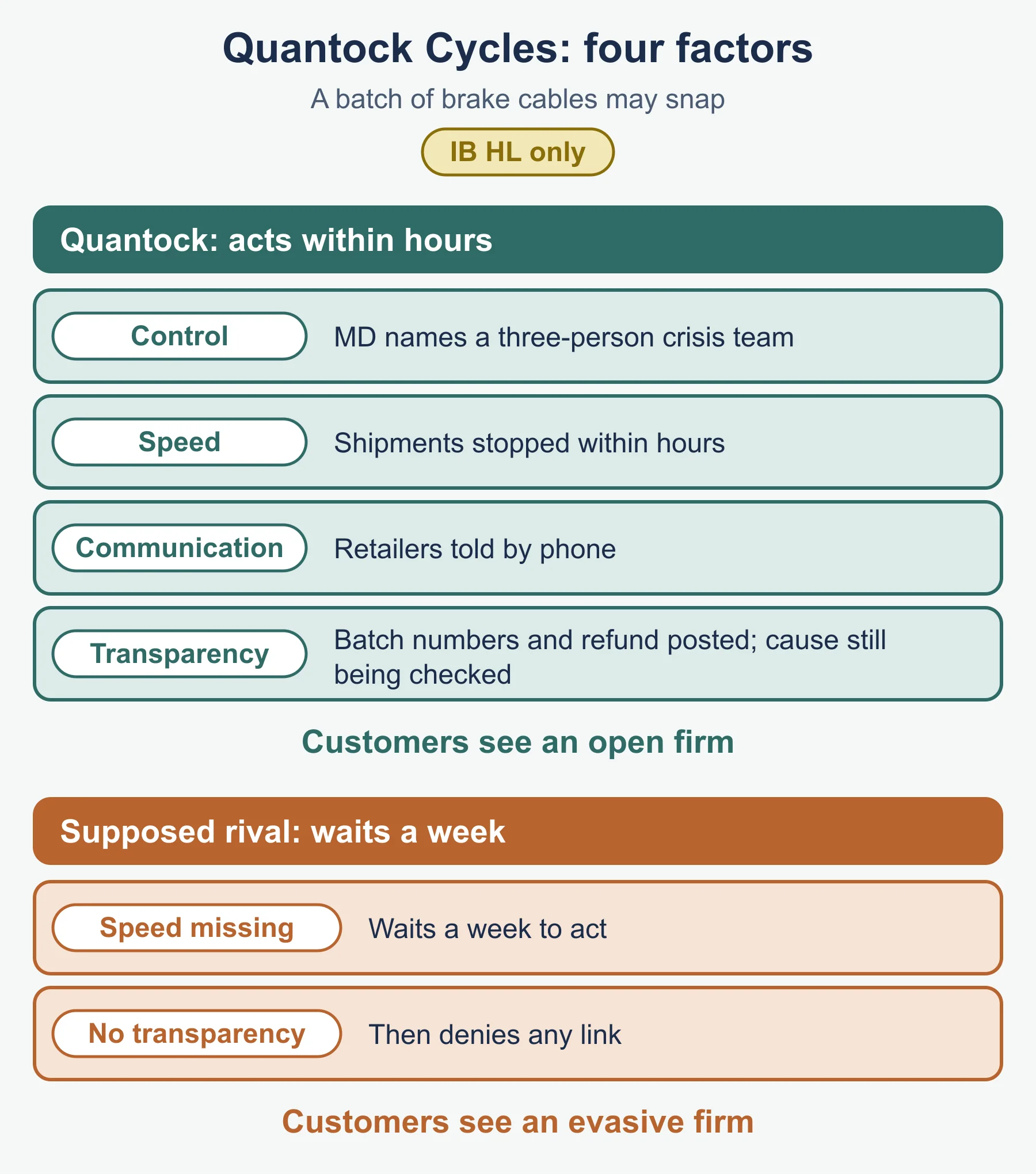
Worked example: applying the factors. Quantock Cycles finds that a batch of brake cables may snap. Within hours the managing director names a three-person crisis team (control), stops shipments and tells retailers by phone (speed and communication), and posts the batch numbers and a refund offer online, including that the cause is still being investigated (transparency). Suppose a rival waited a week and then denied any link. Customers judge the first firm as open and the second as evasive. Your explanation should name the factor, say what the business did, and state the effect on a stakeholder.
The impact of contingency planning: cost, time, risks, safety
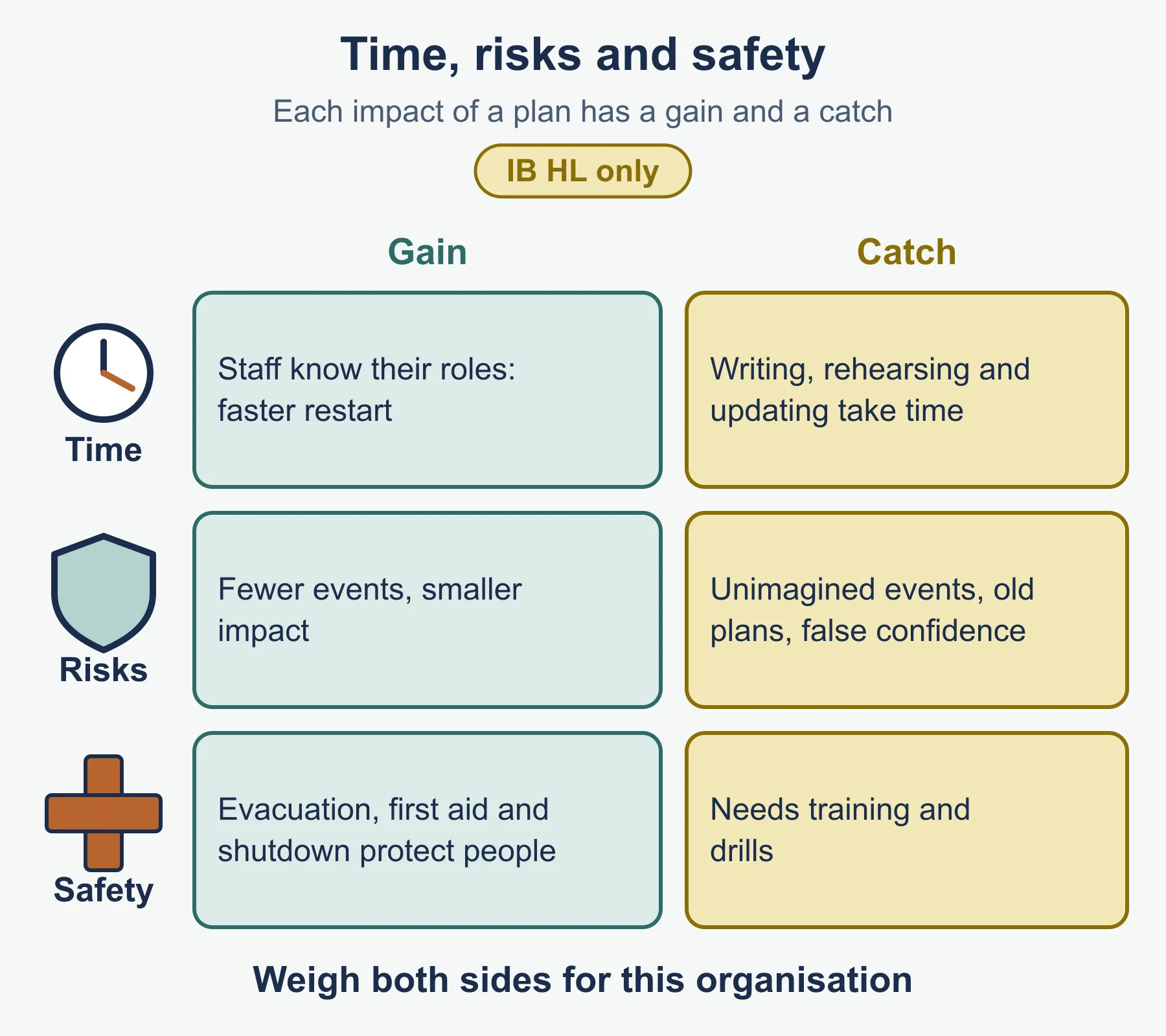
The guide asks you to consider the impact for a given organization or situation, so each point has a positive and a negative side that depends on context.
Cost
- Costs of planning: managers’ time, equipment (a backup generator, spare servers), training, insurance premiums, retaining a standby supplier, and the cost of rehearsals that take staff off normal work.
- Possible savings: lower losses if an event happens, faster recovery, fewer legal and compensation costs, a more stable image.
- Judgement: spending is easier to justify when the event is likely or would be very costly. It is harder to justify for unlikely, minor events.
Time
- Time to plan: writing, approving and rehearsing a plan takes management and staff time, which could be used elsewhere. Plans also need regular updating.
- Time saved in a crisis: staff know their roles, so decisions are faster and the business restarts sooner.
Risks
- A plan reduces the likelihood of some events, through checks and backups, and reduces the impact of others.
- A plan cannot remove all risk. An event nobody imagined, or a plan that is out of date, can leave the business exposed.
- A plan can create false confidence, so that managers take bigger risks because they feel covered.
Safety
- Plans for evacuation, first aid, emergency shutdown and clear reporting protect employees, customers and the public. This is often the strongest argument for planning, and it is hard to price in money.
- Safety plans need training and drills; a plan nobody has practised may fail when it matters.
Worked example: costing a plan. Vessmere Frozen Foods considers a standby generator for its cold store. The figures are the managers’ estimates.
| Item | Figure |
|---|---|
| Installation | 90,000 US dollars |
| Maintenance | 6,000 US dollars a year for 5 years |
| Estimated chance of a serious power cut in any year | 25% |
| Loss from one cut without the generator | 160,000 US dollars |
| Loss from one cut with the generator | 20,000 US dollars |
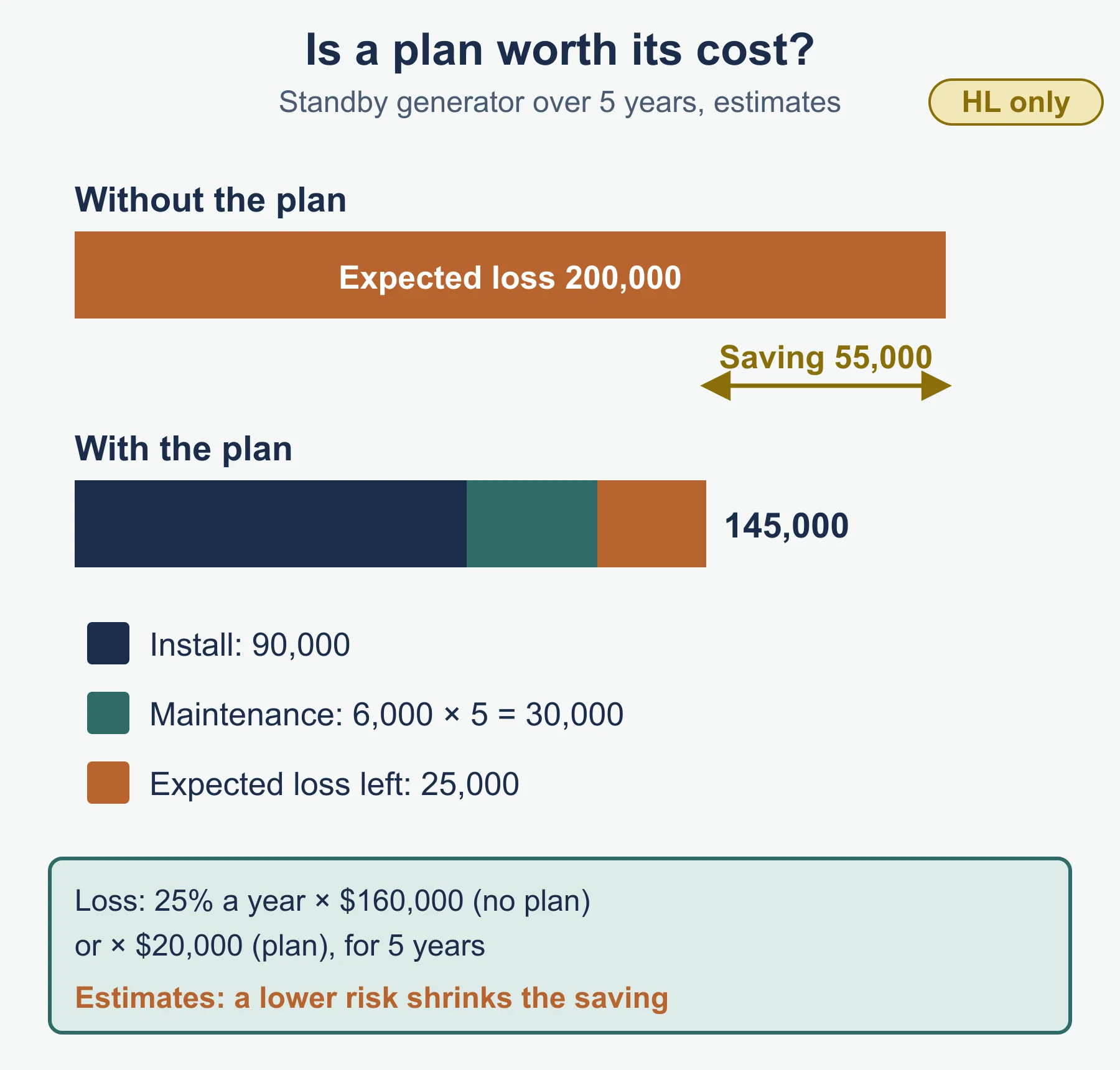
Cost of the plan over 5 years = 90,000 + (6,000 × 5) = 120,000.
Expected loss without the plan = 0.25 × 160,000 × 5 = 200,000.
Expected loss with the plan = 0.25 × 20,000 × 5 = 25,000.
Total cost with the plan = 120,000 + 25,000 = 145,000, which is 55,000 less than 200,000.
On the numbers alone the generator is worth buying. A balanced answer then adds what the numbers leave out. The 25% is an estimate, so a lower real chance would shrink the saving. Spoiled stock, lost customers and the safety of staff in a dark building are not fully priced. The generator also needs testing, or it may fail when needed. The judgement: invest, as long as maintenance and testing really happen. Expected-loss working is a standard way to compare options, not a formula given in the guide.
Writing AO3 answers on this section
- Name the organization and the situation from the case, and use its details.
- Take the four impacts (cost, time, risks, safety) as a checklist, then choose the two or three that matter most here.
- Give both sides for each one chosen.
- Say what the answer depends on, such as how likely the event is, how severe it would be, how large the business is and what stakeholders expect.
- Finish with a reasoned judgement that answers the command term.
Common errors
- Describing a plan as “dealing with a crisis”. A plan is made before; crisis management is what happens during.
- Listing transparency, communication, speed and control without linking each to a result for a stakeholder.
- Treating speed as always good. A fast wrong action can add to the damage.
- Treating contingency planning as always worth the cost, with no mention of likelihood or size of the possible loss.
- Writing only about money and ignoring safety.
- Assuming a plan removes risk instead of reducing it.
Frequently asked questions
What is a crisis in business? A crisis is a sudden, serious event that threatens an organization’s people, operations, finances or reputation and needs a fast response.
Why can transparency harm a business during a crisis? Full openness can release unconfirmed or legally sensitive information, alarm customers unnecessarily and help competitors. Managers therefore have to judge what to share and when, while avoiding the appearance of a cover-up.
Is a fast response always best in crisis management? No. Speed limits the spread of damage only when the first actions are the right ones; a hasty response can be wrong, contradict later facts or skip safety checks.
Why does a business with a contingency plan still need crisis management? Real events never match a plan exactly, so even a rehearsed plan has to be adapted and managed once the crisis is under way.
Official syllabus
IB Diploma Programme Business management guide, first assessment 2024, published by the International Baccalaureate Organization. This page covers section 5.7, Crisis management and contingency planning (HL only), in Unit 5: Operations management.
Get free revision emails (optional)
Occasional emails with practice questions, worked explanations and links to free resources for the qualification and subjects you choose. No spam, and you can unsubscribe from any email. The free tools on this site never need an email.
Related resources
-
Practice questions
IB DP Business Management: Crisis management and contingency planning (HL only) – Practice Questions
Original practice questions with worked answers on IB DP Business Management 5.7 (HL only): crisis management and contingency planning.
Business · International Baccalaureate · IB
Try questions -
Revision notes
IB DP Business Management: Crisis management and contingency planning (HL only) – Revision Notes
Condensed revision notes for IB DP Business Management 5.7 (HL only): definitions, the four factors, the four impacts and a self-test.
Business · International Baccalaureate · IB
Revise topic -
Study guides
IB DP Business Management: Introduction to operations management and Operations methods
Study guide to IB DP Business Management 5.1 and 5.2: the role of operations management and job, batch, mass/flow and mass customization.
Business · International Baccalaureate · IB
Read guide
Related articles
-
teaching
A Level tuition in Dubai: Cambridge or Pearson Edexcel International A Level?
Schools in Dubai and Abu Dhabi teach either Cambridge International AS & A Level or Pearson Edexcel International A Level. How the two are structured, why it matters for tuition, and how online classes from Lahore work.
9 October 2026
-
curriculum guides
Choosing subjects at IGCSE and A Level
How subject choices at 14 and 16 affect university options later, and how to keep pathways open without overloading a timetable.
28 July 2026
Studying this with a teacher
Working through Business IB?
This page is free and stays free. If you would rather be taught it, Marlbridge runs Business classes one-to-one, online in your own time zone. The first trial class is free. WhatsApp replies within an hour (8am–11pm Pakistan time, every day); email the same day.
IB Business teachers at Marlbridge

