
Revision Notes
IB DP Geography: 7.2 Changing urban systems – Revision Notes
Condensed IB DP Geography notes on 7.2: cities as systems, migration, deindustrialisation, suburbanisation, globalisation and growth calculations, with a self-test.
- Subject
- Geography
- Level
- IB
- Topic
- Topic 7: Option G: Urban environments
- Author
- Marlbridge Academic Team
- Updated
- Reviewed by
- Azam Siddique (what this means)
Aligned to International Baccalaureate IB Diploma Programme Geography (DP Geography), First assessments 2019. Official specification .
Syllabus page (what it covers and how it is assessed): IB Diploma Programme Geography.
Syllabus points this page covers
DP Geography
- 7.2 Changing urban systems
Condensed recall for 7.2 Changing urban systems (Option G: Urban environments). For the full explanation, read the Urban environments study guide.
The city as a system
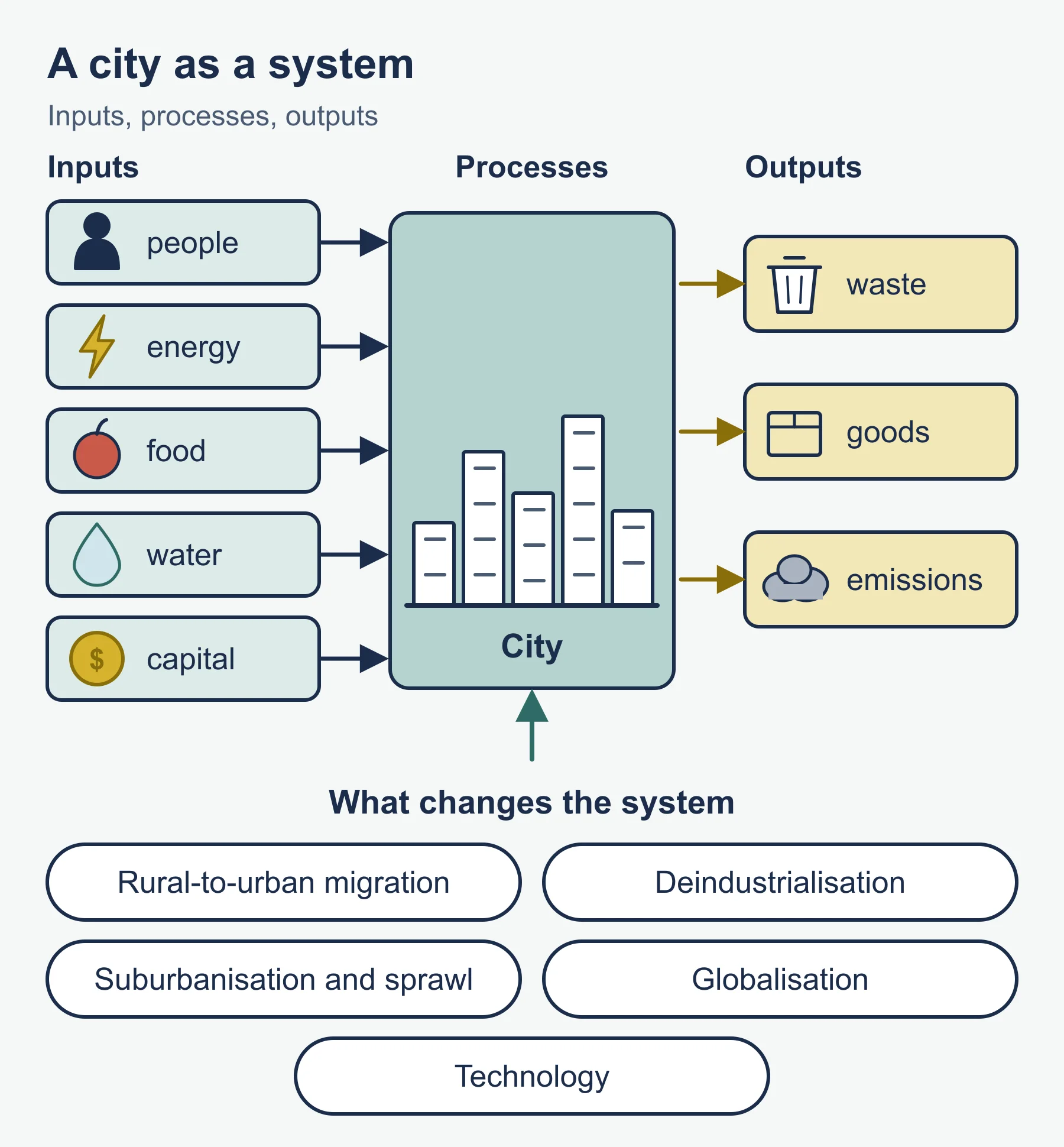
- Inputs: people, energy, food, water, capital.
- Processes: the activities of the city that transform inputs.
- Outputs: waste, goods, emissions.
Cities change through demographic, economic and political processes.
Thinking of a city as a system helps explain knock-on effects: a change in one input (for example a surge of migrants) alters processes (housing construction, informal work) and outputs (waste, congestion). Cities are open systems, depending on a hinterland far beyond their boundary.
Processes of change
| Process | Key idea |
|---|---|
| Rural-urban migration | Push factors (lack of jobs) and pull factors (perceived opportunity), plus natural increase |
| Deindustrialisation | Decline of older industry; growth of services; regeneration and, in some districts, gentrification |
| Suburbanisation | Growth at the edge of the city, with consequences for transport and land use |
| Counter-urbanisation | Movement of people out of cities to smaller settlements |
| Urban sprawl | Unplanned outward spread of built-up land |
| Globalisation | Cities compete for investment and connect through trade, finance and migration |
| Technology | Digital connectivity and the move toward smart cities |
Gentrification: wealthier residents move into a formerly lower-income area, raising property prices and sometimes displacing existing residents.
Why each process happens
- Rural-urban migration: push factors include falling farm incomes, land shortage, conflict and climate stress; pull factors include wages, schools and health care. In many fast-growing cities, natural increase among the young migrant population now adds as many people as new migration, or more.
- Suburbanisation: driven by car ownership, mortgages, new roads and a wish for space and quieter neighbourhoods. It can lead to “edge cities” (Joel Garreau’s term), office and retail centres that grow at motorway junctions on the urban fringe.
- Counter-urbanisation: people leave large cities for small towns and villages, helped by better transport, remote working and retirement migration.
- Re-urbanisation: people return to live in city centres after regeneration, as in Manchester, where city-centre apartments grew rapidly from the 1990s onwards.
- Deindustrialisation: factories close as production moves to cheaper locations abroad, or as automation replaces workers. Jobs, population and tax income are lost, leaving derelict land and social problems.
Case studies to know
- Detroit, USA (decline). Once the centre of the US car industry, Detroit’s population fell from more than 1.8 million in 1950 to fewer than 700,000 by the 2020 census, as car-making jobs declined and many residents moved to the suburbs. Falling tax revenue left services stretched, and in 2013 the city became the largest US municipality to file for bankruptcy. Since then regeneration has focused on the downtown area, but many outer neighbourhoods still have vacant housing.
- London Docklands, UK (regeneration). After the docks closed in the 1960s to 1980s, the London Docklands Development Corporation (1981 to 1998) used public investment and private development to create the Canary Wharf financial district and new transport links such as the Docklands Light Railway (opened 1987). The area gained jobs and population, but many new jobs needed skills that existing residents lacked, and rising housing costs led to criticism of gentrification.
- A fast-growing city in a lower-income country (for example Lagos or Dhaka): rapid growth from migration and natural increase, a large informal economy and informal housing, and infrastructure that struggles to keep pace.
Contrasting change
- A city in a lower-income country may absorb migrants faster than services and housing expand.
- A post-industrial city may face population loss and the need to reinvent its economy.
Consider planning, government policy and how different groups are affected differently.
Growth calculations
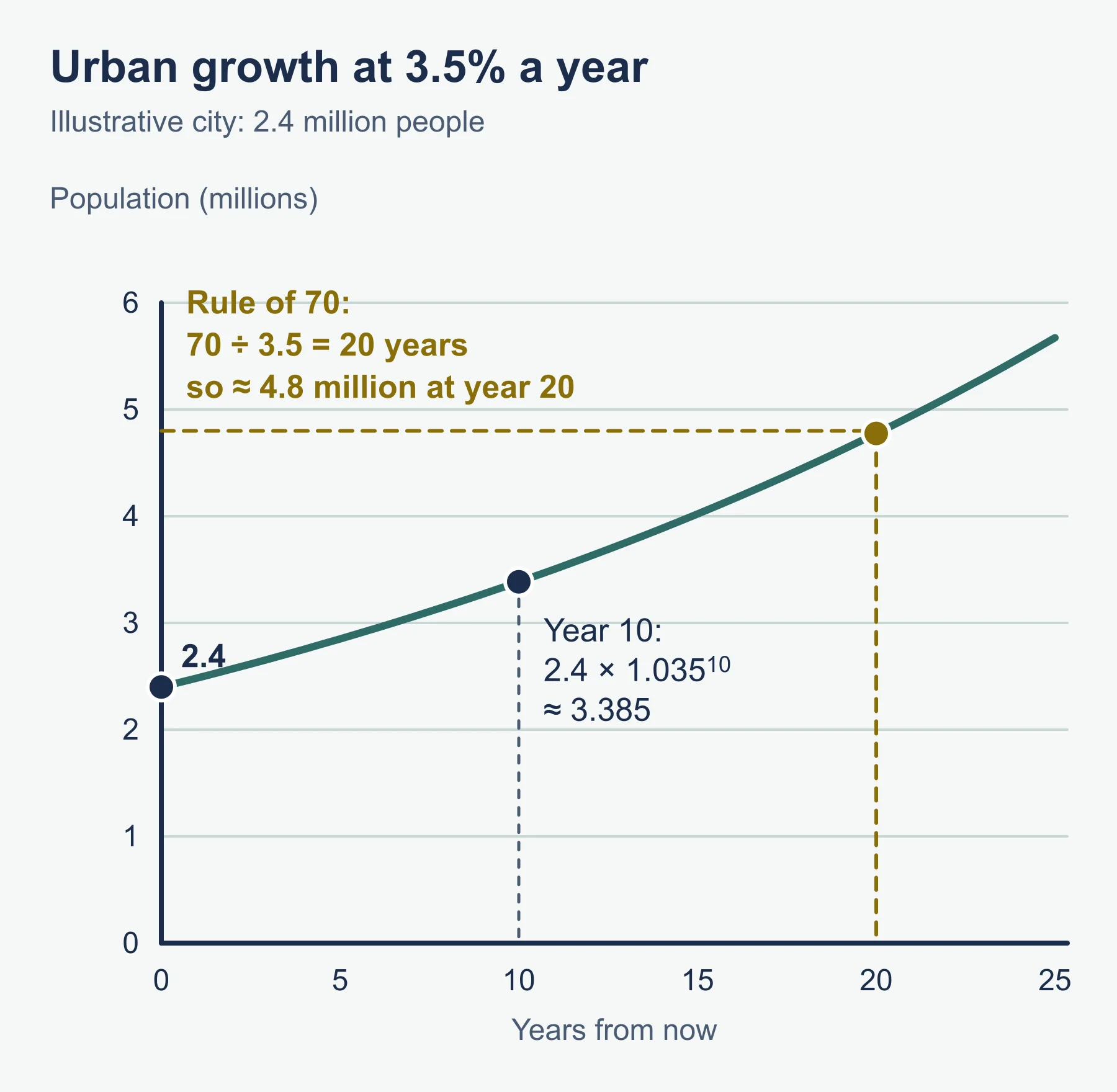
Illustrative city: 2.4 million people, growing at 3.5 per cent a year.
- After 10 years: 2.4 x (1.035)^10, about 2.4 x 1.4106 = 3.385 million.
- Rule of 70: doubling time = 70 / 3.5 = 20 years, so about 4.8 million after 20 years.
- Treat this as a projection, not a forecast, because real growth rates change.
Finding a growth rate from two census figures (invented): a city grows from 2.0 million to 2.6 million in 10 years.
- Annual rate = (2.6 / 2.0)^(1/10) - 1 = (1.3)^0.1 - 1.
- (1.3)^0.1 is about 1.0266, so the rate is about 2.7 per cent a year.
- Rule of 70: doubling time about 70 / 2.7, roughly 26 years.
Note that 30 per cent growth over ten years is not 3 per cent a year, because growth compounds.
Model paragraph (examine)
“Detroit shows how deindustrialisation and suburbanisation can reinforce each other: as car-making jobs declined, wealthier residents left for the suburbs, the city’s tax base shrank and services worsened, which encouraged further out-migration. Recent regeneration has revived the downtown core, yet outer neighbourhoods remain largely untouched, so change has been uneven within the city.”
Exam traps
- Presenting one process as if it affected every city in the same way.
- Forgetting that natural increase, not only migration, drives urban growth.
- Quoting a projection as a certain future.
- Treating regeneration and gentrification as the same thing; regeneration is the investment, gentrification is one possible social outcome.
- Dividing total growth by the number of years instead of compounding.
Self-test
- Name two inputs and two outputs of an urban system.
- Give one push and one pull factor in rural-urban migration.
- Define gentrification.
- A city of 1.5 million grows 2 per cent a year. Approximate doubling time?
- Why might a post-industrial city differ from a fast-growing one?
- Distinguish counter-urbanisation from re-urbanisation.
- Give two causes of suburbanisation.
- Why did Detroit’s tax base shrink?
- Give one benefit and one criticism of the London Docklands regeneration.
- A city grows from 1.0 to 1.21 million in two years. What is the annual growth rate?
- What is an edge city?
Answers: 1. Inputs such as people and energy; outputs such as waste and emissions. 2. Push: lack of jobs; pull: perceived opportunity. 3. Wealthier residents moving into a lower-income area, raising prices and sometimes displacing residents. 4. 70 / 2 = 35 years. 5. It may be losing population and reinventing its economy, whereas a fast-growing city struggles to expand services. 6. Counter-urbanisation is movement out of cities to smaller settlements; re-urbanisation is movement back into city centres. 7. For example car ownership and new roads, or demand for space. 8. Industrial jobs were lost and many residents moved to the suburbs. 9. Benefit: new jobs and transport; criticism: jobs and housing did not suit many existing residents. 10. 10 per cent, because 1.1 x 1.1 = 1.21. 11. An office and retail centre that grows on the urban fringe, often near motorway junctions.
More resources on this topic
Related resources
-
Subject guides
IB Diploma Programme Geography: Subject Overview
An overview of IB Diploma Programme Geography – interactions between individuals, societies and physical processes across time and space.
Geography · International Baccalaureate · IB
Read course guide -
Revision notes
IB DP Geography: 7.1 The variety of urban environments – Revision Notes
Condensed IB DP Geography notes on 7.1: urbanisation versus urban growth, megacities, urban structure models, the rank-size rule and informal settlements, with a self-test.
Geography · International Baccalaureate · IB
Revise topic -
Revision notes
IB DP Geography: 7.3 Urban environmental and social stresses – Revision Notes
Condensed IB DP Geography notes on 7.3: urban heat island, pollution, flooding, housing and inequality stresses, and how to evaluate responses, with a self-test.
Geography · International Baccalaureate · IB
Revise topic
Studying Geography?
This page is free and stays free. Marlbridge is not offering Geography classes at the moment, so there is no tuition to book for it. The free study resources stay open to everyone.
Get free revision emails (optional)
Occasional emails with practice questions, worked explanations and links to free resources for the qualification and subjects you choose. No spam, and you can unsubscribe from any email. The free tools on this site never need an email.