
Revision Notes
IB DP Geography: 7.3 Urban environmental and social stresses – Revision Notes
Condensed IB DP Geography notes on 7.3: urban heat island, pollution, flooding, housing and inequality stresses, and how to evaluate responses, with a self-test.
- Subject
- Geography
- Level
- IB
- Topic
- Topic 7: Option G: Urban environments
- Author
- Marlbridge Academic Team
- Updated
- Reviewed by
- Azam Siddique (what this means)
Aligned to International Baccalaureate IB Diploma Programme Geography (DP Geography), First assessments 2019. Official specification .
Syllabus page (what it covers and how it is assessed): IB Diploma Programme Geography.
Syllabus points this page covers
DP Geography
- 7.3 Urban environmental and social stresses
Condensed recall for 7.3 Urban environmental and social stresses (Option G: Urban environments). For the full explanation, read the Urban environments study guide.
Environmental stresses
- Air pollution from transport, industry and heating.
- Waste generation, and water supply and wastewater treatment.
- Loss of green space.
- Flooding where impermeable surfaces overload drainage: most rain runs off rather than soaking in.
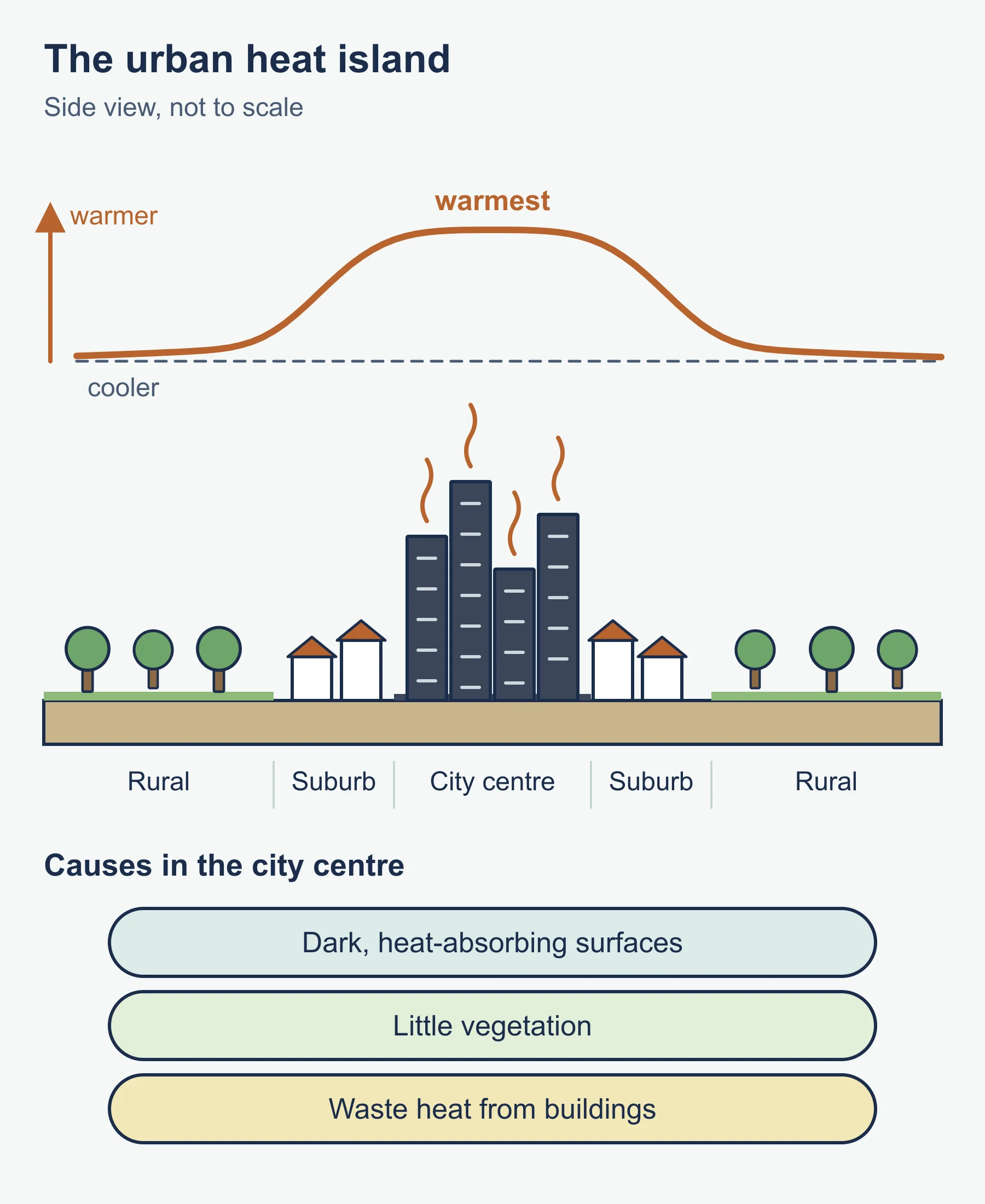
- Urban heat island: built-up areas are warmer than their surroundings because of heat-absorbing materials, reduced vegetation and waste heat.
- Ecological footprint: often far exceeds the city’s own area, because cities draw on resources from a wide hinterland.
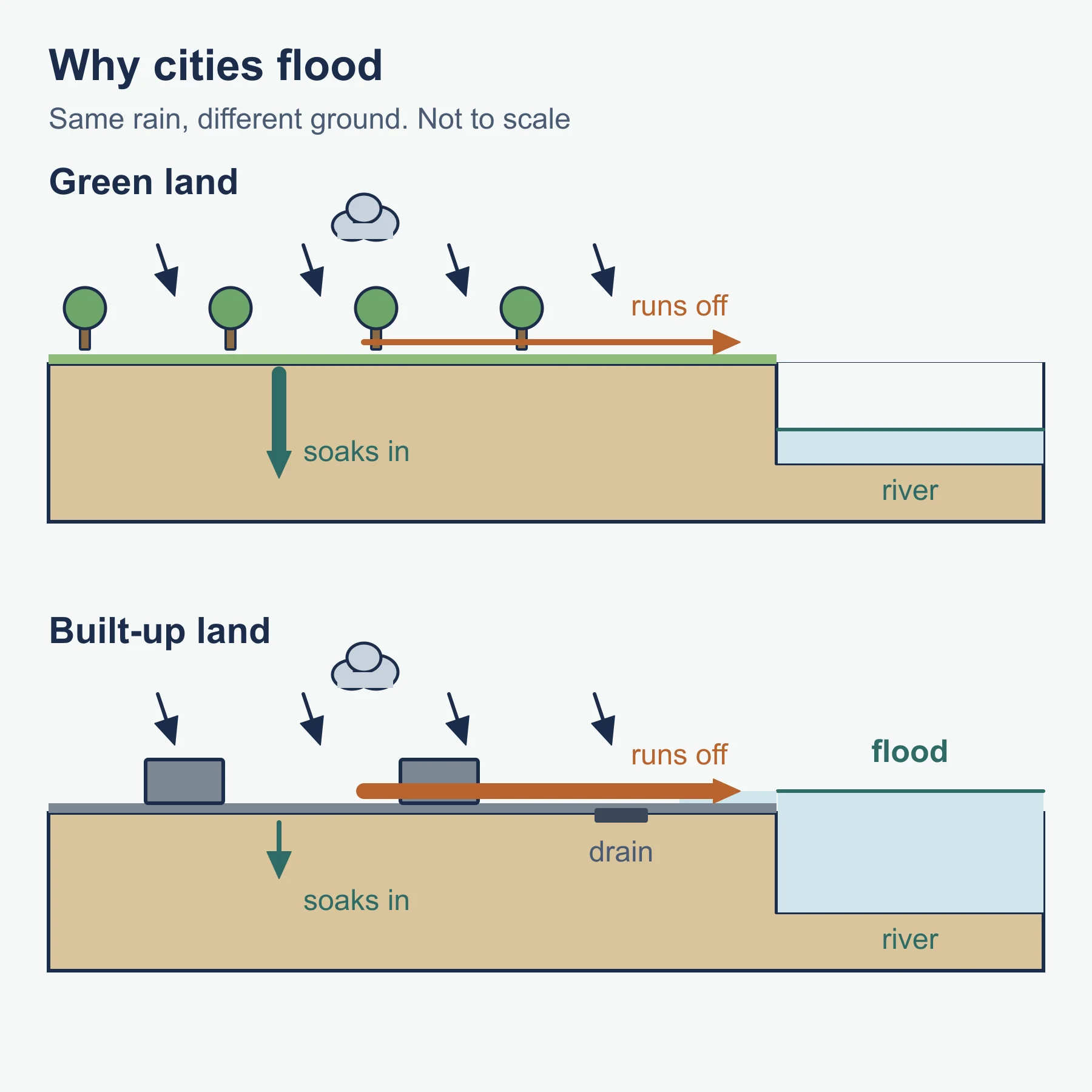
Explaining the stresses
- Urban heat island in detail: concrete, asphalt and brick absorb heat by day and release it at night, so the difference from the countryside is often greatest after dark and in calm, clear weather. Tall buildings trap radiation and reduce wind; less vegetation means less cooling by evaporation; vehicles, air conditioning and industry add waste heat. Heatwaves are more deadly in cities, especially for older people in poorly ventilated homes.
- Air pollution: primary pollutants are emitted directly (particulates, nitrogen oxides, sulphur dioxide); secondary pollutants form in the air, such as ground-level ozone in photochemical smog, created when sunlight acts on vehicle exhaust. A temperature inversion, where warm air sits above cooler air, traps pollution close to the ground; basin cities such as Mexico City are especially prone. Fine particulates (PM2.5) are the most harmful to health.
- Flooding and subsidence: Jakarta combines heavy monsoon rain, blocked drains and land subsidence caused by groundwater pumping; Indonesia’s government announced in 2019 that it would move the capital to a new city, Nusantara, on Borneo.
- Waste: rapid growth can outpace collection, so rubbish blocks drains and is burned in the open. E-waste processing sites such as Agbogbloshie in Accra, Ghana, became known for toxic burning of cables to recover metal.
Social stresses
- Inadequate or unaffordable housing.
- Inequality and segregation.
- Unemployment and informal work.
- Crime.
- Health problems linked to pollution or overcrowding.
- Uneven access to transport, education and health care.
- Congestion, which imposes economic and personal costs.
Vulnerability to hazards is higher where people live in informal housing on unsafe land.
Cycle of deprivation: low income leads to poor housing and diet, which harm health and school attendance, which limit qualifications and jobs, which keep income low. Breaking the cycle needs action at several points at once. Multiple deprivation indices, such as the English Index of Multiple Deprivation, combine income, employment, health, education, crime, housing and environment data to map where deprivation is concentrated.
Segregation can be voluntary or forced: gated communities in cities such as São Paulo separate wealthy residents from surrounding neighbourhoods, while poorer migrants cluster where rents are lowest.
Evaluating responses
| Response | Question to ask |
|---|---|
| Improved public transport | Who can afford and reach it? |
| Low emission zones | Does it cut pollution or only move it? |
| Upgrading informal settlements (rather than demolishing) | Are residents involved and kept in place? |
| Affordable housing programmes | Does supply match demand? |
| Recycling and green infrastructure | Is it lasting and scaled up? |
For every response ask three things: who benefits, how long it lasts, and whether it addresses root causes or only symptoms.
Pollution and congestion management: examples
| City | Response | Evaluation |
|---|---|---|
| London | Congestion Charge (2003); Ultra Low Emission Zone (2019), later extended to cover all of Greater London (2023) | Cut traffic and nitrogen dioxide in central areas; criticised by some outer-London drivers for its cost |
| Singapore | Electronic Road Pricing (from 1998) and strict quotas on car ownership | Very effective at controlling congestion; possible because of strong central government and excellent public transport |
| Beijing | After severe smog in 2013, an air pollution action plan switched heating from coal to gas, closed or moved polluting factories and restricted vehicles | Fine particulate levels fell substantially in the following years, though some pollution was displaced to surrounding regions |
| Mexico City | “Hoy No Circula” (from 1989), banning each car from driving one weekday by number plate | Studies found many households bought an extra, often older and more polluting, car, so air quality gains were limited |
| Delhi | Trial “odd-even” number-plate rationing (2016) | Short-term; much winter smog comes from crop-stubble burning in neighbouring states, beyond the city’s control |
Mexico City is a good example of a response that treated a symptom (number of cars on a given day) and was undermined by human behaviour.
Model paragraph (evaluate)
“Beijing’s switch from coal to gas heating tackled a root cause of winter smog and produced a measurable fall in fine particulates, so it was more effective than Delhi’s short odd-even trials, which addressed only traffic. However, Beijing’s success relied on powerful central government able to close factories quickly, and some poor rural households were left without heating during the switch, so the policy’s speed came with social costs.”
Exam traps
- Listing stresses without linking them (for example, informal housing, hazard risk and health).
- Naming a response without evaluating it.
- Treating informal settlements only as problems; they also reflect resourcefulness and need upgrading with residents.
- Explaining the urban heat island with only one cause.
- Assuming a pollution policy works because it was introduced; ask for evidence of impact.
Self-test
- Give three causes of the urban heat island.
- Why do impermeable surfaces increase flood risk?
- Name two social stresses in cities.
- What does it mean that a city’s ecological footprint exceeds its area?
- State the three questions for evaluating a response.
- Why is the urban heat island often strongest at night?
- Distinguish primary from secondary pollutants.
- How does a temperature inversion worsen air pollution?
- Why did Mexico City’s driving ban have limited success?
- What is the cycle of deprivation?
- Why has Jakarta’s flood risk increased?
Answers: 1. Heat-absorbing materials, reduced vegetation and waste heat. 2. Rain runs off instead of soaking in, overloading drains and sending more water to rivers. 3. For example unaffordable housing and inequality. 4. It relies on resources drawn from a much wider area. 5. Who benefits, how long it lasts, and whether it tackles causes or symptoms. 6. Building materials release heat stored during the day. 7. Primary pollutants are emitted directly; secondary pollutants form in the air, such as ozone. 8. Warm air above cooler air stops pollution rising and dispersing. 9. Many households bought an extra car. 10. A chain in which low income, poor housing, poor health and low qualifications reinforce each other. 11. Groundwater pumping has caused subsidence, adding to heavy rain and blocked drains.
More resources on this topic
Related resources
-
Subject guides
IB Diploma Programme Geography: Subject Overview
An overview of IB Diploma Programme Geography – interactions between individuals, societies and physical processes across time and space.
Geography · International Baccalaureate · IB
Read course guide -
Study guides
IB DP Geography: Option G: Urban environments – Study Guide
A study guide to the Urban environments option in IB DP Geography: variety of cities, changing urban systems, stresses and sustainable urban futures.
Geography · International Baccalaureate · IB
Read guide -
Study guides
IB DP Geography (DP Geography): The variety of urban environments
IB DP Geography Urban environments 7.1 in depth: how urban areas are defined, gross and net density, density gradients, the CBD and land value, and megalopolis.
Geography · International Baccalaureate · IB
Read guide
Studying Geography?
This page is free and stays free. Marlbridge is not offering Geography classes at the moment, so there is no tuition to book for it. The free study resources stay open to everyone.
Get free revision emails (optional)
Occasional emails with practice questions, worked explanations and links to free resources for the qualification and subjects you choose. No spam, and you can unsubscribe from any email. The free tools on this site never need an email.