
Revision Notes
IB DP Geography: 7.4 Building sustainable urban systems for the future – Revision Notes
Condensed IB DP Geography notes on 7.4: features of sustainable cities, planning approaches, stakeholders, participation and urban resilience, with a self-test.
- Subject
- Geography
- Level
- IB
- Topic
- Topic 7: Option G: Urban environments
- Author
- Marlbridge Academic Team
- Updated
- Reviewed by
- Azam Siddique (what this means)
Aligned to International Baccalaureate IB Diploma Programme Geography (DP Geography), First assessments 2019. Official specification .
Syllabus page (what it covers and how it is assessed): IB Diploma Programme Geography.
Syllabus points this page covers
DP Geography
- 7.4 Building sustainable urban systems for the future
Condensed recall for 7.4 Building sustainable urban systems for the future (Option G: Urban environments). For the full explanation, read the Urban environments study guide.
Definition
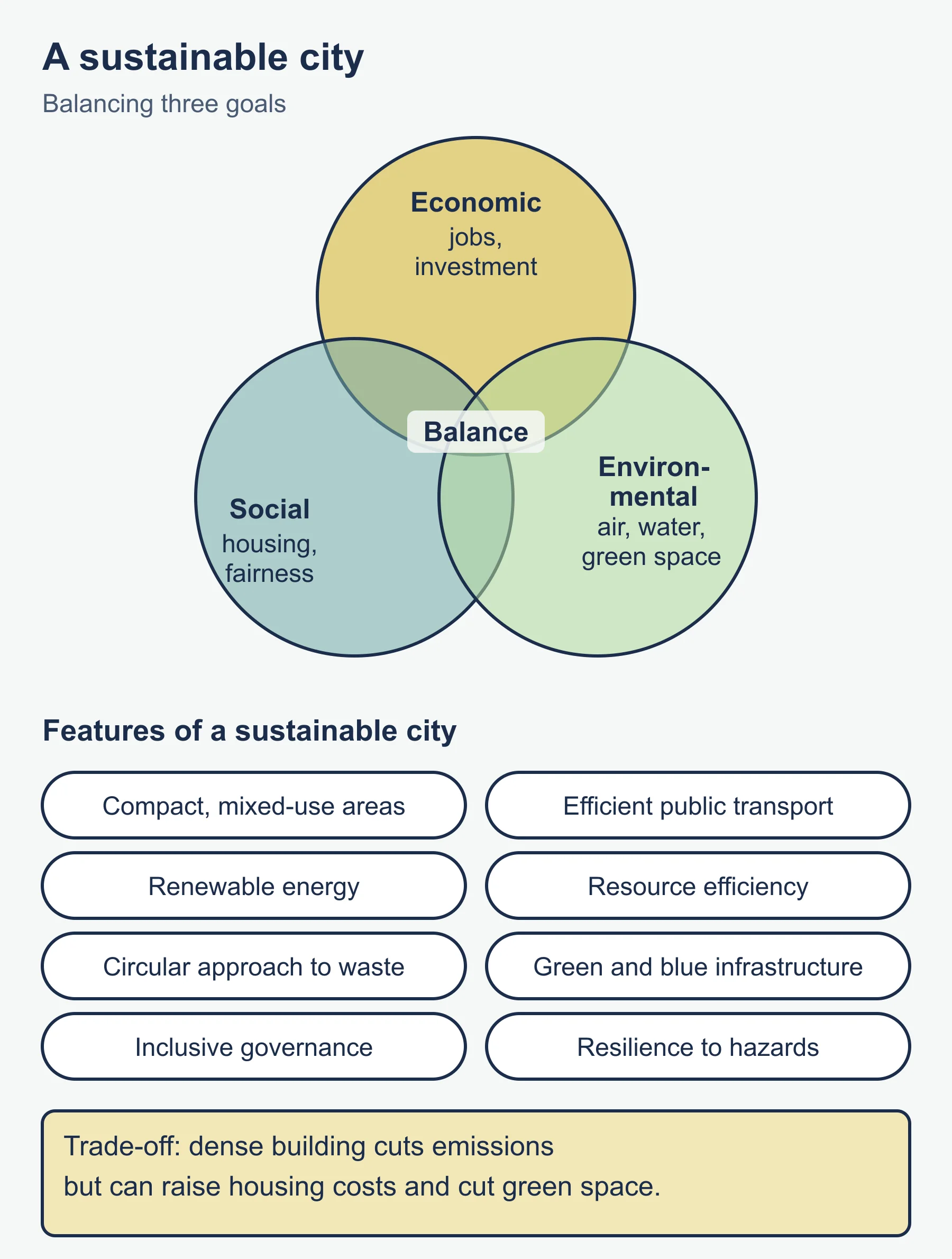
A sustainable city aims to meet present needs without harming the ability of future generations to do so, balancing economic, social and environmental goals.
The three goals pull against each other. A plan that is environmentally strong but unaffordable fails the social test; a plan that creates jobs but locks in car dependence fails the environmental test. Sustainability is therefore a balance and a direction of travel, not a finished state. At the global scale, Sustainable Development Goal 11 (adopted in 2015) commits countries to make cities “inclusive, safe, resilient and sustainable”, and the New Urban Agenda agreed at the Habitat III conference in Quito (2016) set out how national and city governments should plan for this.
Features of a sustainable city
- Compact, mixed-use development.
- Efficient public transport.
- Renewable energy and resource efficiency.
- Circular approaches to waste.
- Green and blue infrastructure.
- Inclusive governance.
- Resilience to climate and other hazards.
| Feature | Why it matters |
|---|---|
| Compact, mixed-use development | Shorter journeys, less land taken from the rural fringe, cheaper per-person services |
| Efficient public transport | Cuts congestion, emissions and household transport costs |
| Renewable energy and efficiency | Reduces the city’s carbon footprint and exposure to fuel price shocks |
| Circular waste systems | Turns waste into a resource and reduces landfill and pollution |
| Green and blue infrastructure | Parks, street trees, wetlands and rivers cool the city, absorb floodwater and support well-being |
| Inclusive governance | Plans fit local needs and gain the support needed to last |
| Resilience | The city keeps functioning when shocks arrive |
Green infrastructure is the network of vegetated spaces (parks, green roofs, street trees); blue infrastructure is the water network (rivers, canals, ponds, wetlands) managed for flood control and amenity.
Ideas to compare
| Idea | Core point |
|---|---|
| New urbanism | Walkable, mixed-use neighbourhoods |
| Transit-oriented development | Dense development clustered around public transport |
| Eco-cities | Cities designed around environmental goals |
| Smart-city technologies | Data and digital systems to improve efficiency |
Be critical: technology can improve efficiency but raises concerns such as privacy and who has access to it.
| Idea | Evaluation point |
|---|---|
| New urbanism | Attractive streets, but new developments can become expensive enclaves |
| Transit-oriented development | Works best when land-use zoning and transport are planned together over decades |
| Eco-cities | Often new-build showcases; hard to copy in existing, unequal cities |
| Smart cities | Real-time data can manage traffic and energy, but raises surveillance concerns and can exclude people without digital access |
Case studies to know
- Curitiba, Brazil. From the 1970s, under mayor Jaime Lerner, the city built a bus rapid transit network on dedicated lanes, later adding raised tube stations where passengers pay before boarding. Zoning concentrated dense development along the main bus axes, an early form of transit-oriented development. A “green exchange” scheme let residents trade recyclable waste for food or bus tickets. Limits: the wider metropolitan region has grown beyond the planned axes, car ownership has risen and buses can be overcrowded.
- Medellín, Colombia. Cable-car lines (Metrocable, first opened in 2004) and outdoor escalators in Comuna 13 link steep, low-income hillside neighbourhoods to the metro, alongside “library parks” and other public buildings. This approach, often called social urbanism, shows that sustainability includes access and safety, not only emissions.
- Masdar City, Abu Dhabi. Announced in 2006 as a showcase low-carbon city with renewable energy and car-free design. It has been built far more slowly and on a smaller scale than first promised, and critics describe it as an exclusive enclave in a country with very high per-capita energy use.
- Songdo, South Korea. A planned smart city on reclaimed land near Incheon, with sensors, extensive green space and a pneumatic waste-collection system. It took years to attract residents and is often cited as an example of top-down, technology-led planning.
- Rotterdam, Netherlands. Climate adaptation through green roofs and “water squares” such as Benthemplein, public spaces that double as stormwater storage during heavy rain.
Stakeholders and participation
- Stakeholders: national and city governments, planners, developers, businesses, community groups and residents.
- Participation matters: top-down plans that ignore residents often fail.
- International goals recognise the importance of inclusive, safe, resilient and sustainable cities.
| Stakeholder | Typical interest |
|---|---|
| National government | Growth, national targets, infrastructure funding |
| City government | Services, tax base, liveability, re-election |
| Developers | Profitable land and housing |
| Businesses | Accessible workforce and customers |
| Community groups and residents | Affordable homes, safety, green space, a voice in decisions |
| NGOs | Environmental protection, rights of informal residents |
Participation can range from simple consultation to participatory budgeting, in which residents vote on how part of a city budget is spent; Porto Alegre in Brazil is the best-known early example.
Resilience and trade-offs
Urban resilience is how a city copes with shocks such as extreme heat, floods or economic change. Strong answers weigh trade-offs, for example dense development that cuts emissions but raises housing costs or reduces green space.
Other trade-offs to use:
- Green gentrification: new parks or riverside improvements raise property values and can push out the lower-income residents they were meant to help.
- Cost versus speed: large rail systems cut emissions for decades but take years and huge budgets; bus rapid transit is cheaper and quicker but carries fewer passengers.
- Retrofitting versus new-build: most people will live in cities that already exist, so improving existing buildings and transport often matters more than flagship new cities.
Resilience planning also considers future scenarios: hotter summers, sea-level rise for coastal cities, ageing populations and changes in the economy.
Model paragraph (evaluate)
“Curitiba shows that cheap, bus-based transit linked to zoning can shape a city’s growth for decades: dense corridors grew along the bus axes rather than as unplanned sprawl. However, its success depended on unusually long political continuity, and growth in the wider metropolitan area has outrun the original plan. Masdar, by contrast, had large funding but little existing population, so it shows technology more than lived sustainability. Overall, Curitiba is the more transferable model because it works within an existing city and budget.”
The paragraph names two cities, gives a strength and a limit, compares them and reaches a judgement.
Exam traps
- Presenting smart or green technology as a complete solution.
- Describing a sustainable city with no named example or no evaluation.
- Ignoring who is excluded from a plan.
- Treating a flagship new-build city as typical of how most urban residents live.
- Covering only the environmental pillar and forgetting economic and social sustainability.
Self-test
- Define a sustainable city.
- Name three features of a sustainable city.
- Why do top-down plans often fail?
- Give one trade-off of dense development.
- What is urban resilience?
- Distinguish green from blue infrastructure.
- What is transit-oriented development, and which city is an early example?
- What is social urbanism? Name a city associated with it.
- Give one criticism of smart-city projects.
- What is green gentrification?
- What is participatory budgeting?
Answers: 1. One that meets present needs without harming future generations, balancing economic, social and environmental goals. 2. For example efficient public transport, renewable energy and green infrastructure. 3. They may ignore residents’ needs, lack local support or fail to address inequality. 4. It can cut emissions but raise housing costs or reduce green space. 5. How a city copes with shocks such as extreme heat, floods or economic change. 6. Green infrastructure is vegetated space such as parks and green roofs; blue infrastructure is the water network managed for floods and amenity. 7. Dense development clustered around public transport; Curitiba. 8. Using public investment such as cable cars, escalators and libraries to connect and improve poor neighbourhoods; Medellín. 9. For example surveillance and privacy concerns, or excluding people without digital access. 10. Environmental improvements raising property values and displacing lower-income residents. 11. Residents voting on how part of a city’s budget is spent, as in Porto Alegre.
More resources on this topic
Related resources
-
Subject guides
IB Diploma Programme Geography: Subject Overview
An overview of IB Diploma Programme Geography – interactions between individuals, societies and physical processes across time and space.
Geography · International Baccalaureate · IB
Read course guide -
Revision notes
IB DP Geography: 7.2 Changing urban systems – Revision Notes
Condensed IB DP Geography notes on 7.2: cities as systems, migration, deindustrialisation, suburbanisation, globalisation and growth calculations, with a self-test.
Geography · International Baccalaureate · IB
Revise topic -
Revision notes
IB DP Geography: 7.1 The variety of urban environments – Revision Notes
Condensed IB DP Geography notes on 7.1: urbanisation versus urban growth, megacities, urban structure models, the rank-size rule and informal settlements, with a self-test.
Geography · International Baccalaureate · IB
Revise topic
Studying Geography?
This page is free and stays free. Marlbridge is not offering Geography classes at the moment, so there is no tuition to book for it. The free study resources stay open to everyone.
Get free revision emails (optional)
Occasional emails with practice questions, worked explanations and links to free resources for the qualification and subjects you choose. No spam, and you can unsubscribe from any email. The free tools on this site never need an email.