
Revision Notes
IB DP Geography: 6.2 Food systems and spread of diseases – Revision Notes
Condensed IB DP Geography notes on 6.2 Food and health: food systems, disease diffusion types, vector- and water-borne disease, food-disease links and the epidemiological transition, with a self-test.
- Subject
- Geography
- Level
- IB
- Topic
- Topic 6: Option F: Food and health
- Author
- Marlbridge Academic Team
- Updated
- Reviewed by
- Azam Siddique (what this means)
Aligned to International Baccalaureate IB Diploma Programme Geography (DP Geography), First assessments 2019. Official specification .
Syllabus page (what it covers and how it is assessed): IB Diploma Programme Geography.
Syllabus points this page covers
DP Geography
- 6.2 Food systems and spread of diseases
Condensed recall for 6.2 Food systems and spread of diseases (IB DP Geography, Option F: Food and health). See the Food and health study guide.
Food systems
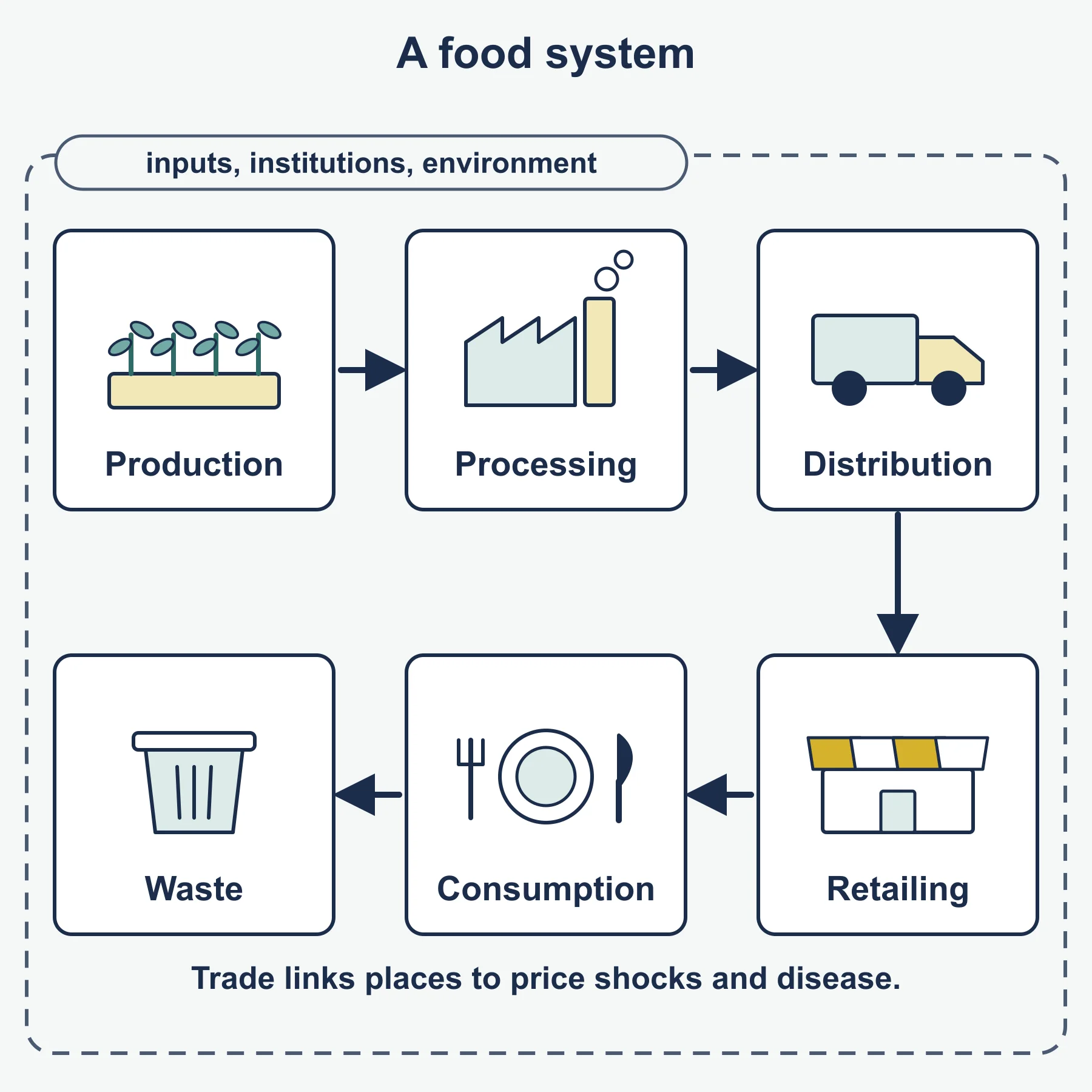
Production, processing, distribution, retailing, consumption and waste, plus the inputs, institutions and environment around them. Types: subsistence farming, commercial agriculture, industrialised livestock production, globalised supply chains. Trade links places in vulnerability to price shocks and disease.
| System | Key features | Vulnerability |
|---|---|---|
| Subsistence | Food grown mainly for the household; few purchased inputs | A failed harvest hits consumption directly |
| Commercial | Crops or livestock sold for profit; specialisation | Exposure to market prices and input costs |
| Industrialised (agribusiness) | Large firms, high inputs, mechanisation, often vertical integration (one company controls several stages from seed to shelf) | Disease spreads quickly among dense livestock; concentration of power |
| Globalised supply chains | Long-distance trade, cold chains, supermarkets | A shock in one region (harvest failure, export ban, conflict) raises prices worldwide |
Food miles measure how far food travels, but distance alone is a weak guide to environmental impact because transport mode and production method also matter.
Types of disease
Communicable (infectious) and non-communicable.
- Communicable: caused by pathogens (bacteria, viruses, parasites) and passed between people or from animals or the environment. Examples: malaria, cholera, tuberculosis.
- Non-communicable: not passed between people; linked to lifestyle, genetics, age and environment. Examples: heart disease, type 2 diabetes, many cancers.
Diffusion of infectious disease
| Type | How it spreads |
|---|---|
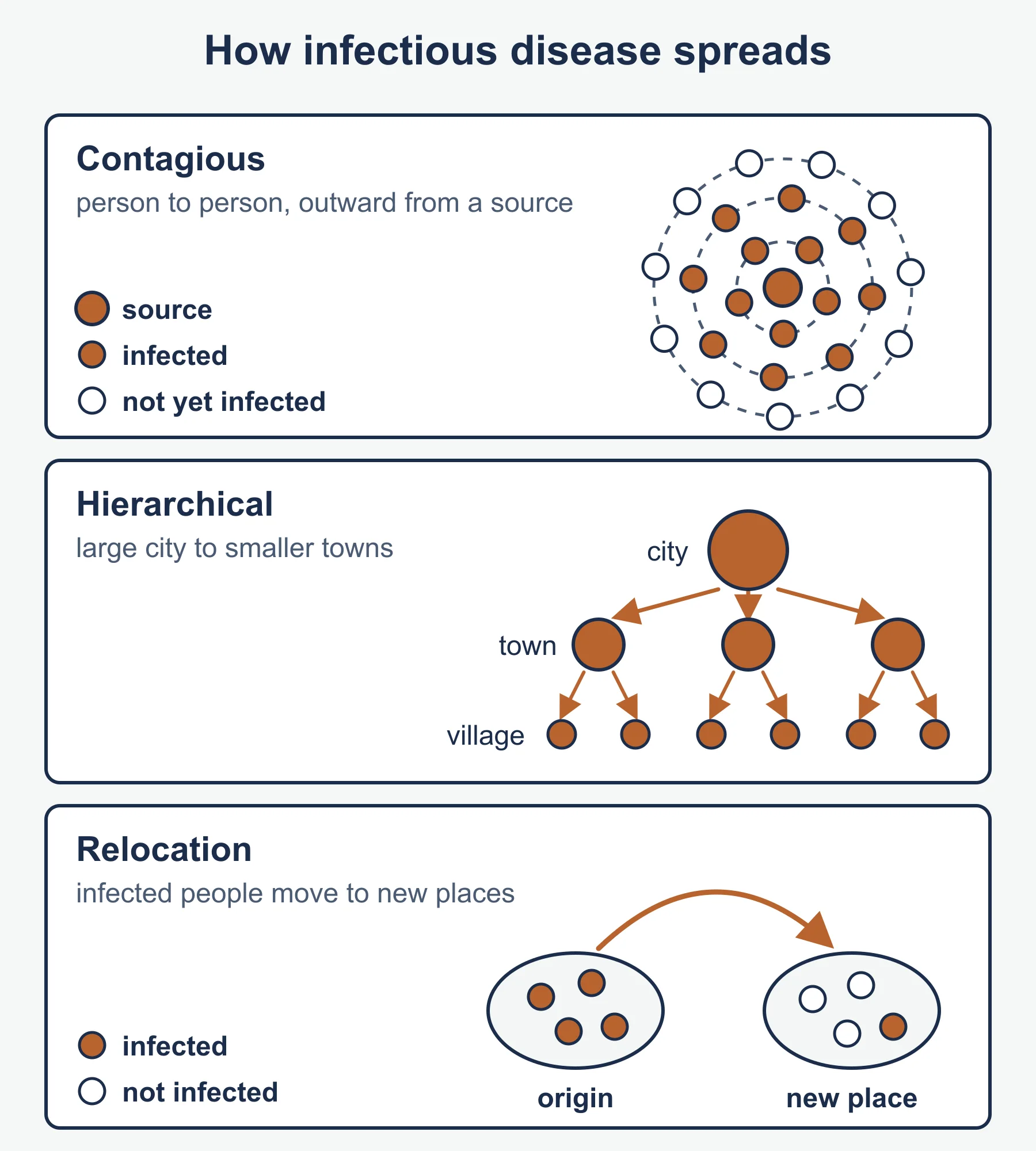
| Contagious | Person to person through contact, outward from a source |
| Hierarchical | Through settlement networks, for example large cities to smaller towns |
| Relocation | Movement of infected people to new places |
Air travel can accelerate spread.
Contagious and hierarchical spread are both forms of expansion diffusion: the number of cases grows while the original area stays affected. In relocation diffusion the disease is carried to a new place. Spread usually shows distance decay, becoming weaker with distance from the source, and can be slowed by barriers such as mountains, seas, quarantine or vaccination. A barrier is absorbing if it stops spread completely and permeable if some cases get through.
Environment and disease
- Vector-borne (for example malaria): depends on conditions supporting the vector, so climate and land use matter.
- Water-borne (for example cholera): linked to sanitation and safe drinking water.
Malaria is caused by a parasite carried by Anopheles mosquitoes, which breed in standing water and need warm conditions. Irrigation, dams and forest clearance can create breeding sites; warming can allow mosquitoes to survive at higher altitudes, which is why highland areas in East Africa are watched closely.
Case studies
Cholera in London, 1854
The physician John Snow mapped deaths around the Broad Street water pump in Soho and showed that cases clustered around it. Removing the pump handle is famously associated with the end of the outbreak. It is an early example of geographical thinking about disease and showed that cholera was water-borne rather than spread by “bad air”.
Cholera in Haiti, from 2010
After the 2010 earthquake, cholera appeared in Haiti for the first time in many decades. It was traced to sewage from a United Nations peacekeeping base reaching a tributary of the Artibonite River, and the UN later acknowledged a role in the outbreak. The disease then spread along the river and through crowded camps with poor sanitation. This shows relocation diffusion (introduction from outside) followed by spread through a water network and contact, made worse by damaged infrastructure.
Ebola in West Africa, 2014 to 2016
The outbreak began in rural Guinea and spread to Sierra Leone and Liberia, reaching capital cities and causing more than 11,000 deaths. Movement across porous borders and into dense urban areas, together with weak health systems and burial practices involving contact with bodies, allowed contagious diffusion. Ebola is zoonotic: an animal reservoir is suspected.
Food-disease links (both ways)
- Poor nutrition weakens immunity, so infection is more severe.
- Livestock and wildlife contact can produce zoonotic disease.
- Contaminated food causes illness; intensive farming raises concern about antimicrobial resistance.
- Diet-related non-communicable disease (type 2 diabetes, heart disease) is growing in many countries.
The link also runs from disease to food: diarrhoeal infections stop the body absorbing nutrients, so repeated illness can cause undernutrition even when food is available. In the United Kingdom, bovine spongiform encephalopathy (BSE) in cattle in the 1980s and 1990s was linked to feeding cattle meat-and-bone meal, and to a fatal human disease, which led to export bans and changes in animal feed rules.
Epidemiological transition
Main causes of death shift from infectious towards chronic disease as development proceeds, though many countries experience both at once.
Abdel Omran’s original 1971 model described three stages: an age of pestilence and famine, an age of receding pandemics, and an age of degenerative and human-made diseases. Later writers added a stage of delayed degenerative disease as people live longer with chronic conditions. Criticisms: it was based mainly on the history of richer countries, and the emergence of new infections such as HIV and the return of others show that the sequence can reverse.
Model paragraph
Explain how a pandemic can spread at the global scale. “A new infection often spreads first by relocation diffusion, as infected travellers carry it from the source region through international air hubs. It then moves down the urban hierarchy, appearing in major cities before smaller towns. Within each city, contagious diffusion through close contact in homes, workplaces and transport causes local outbreaks. Barriers such as border controls and vaccination can slow, but rarely stop, spread once a disease is established in several hubs.”
Exam traps
- Describing disease spread without naming the diffusion type.
- Treating food and health as separate rather than linked.
- Assuming the transition is a neat sequence in every country.
- Inventing outbreak figures.
- Calling relocation diffusion a type of expansion diffusion.
- Saying malaria is caused by mosquitoes: the cause is a parasite carried by them.
Self-test
- Name the stages of a food system.
- Distinguish contagious from hierarchical diffusion.
- Why do vector-borne diseases depend on climate?
- Give one way poor nutrition affects infection.
- What is a zoonotic disease?
- What does the epidemiological transition describe?
- What is vertical integration in a food system?
- Which two diffusion types are forms of expansion diffusion?
- Distinguish an absorbing from a permeable barrier.
- What did John Snow’s 1854 map show?
- Which diffusion type explains the arrival of cholera in Haiti in 2010?
- Give one criticism of the epidemiological transition model.
Answers: 1. Production, processing, distribution, retailing, consumption, waste. 2. Contagious spreads by contact outward from a source; hierarchical spreads down a ranked network such as city to town. 3. The vector survives only where conditions suit it. 4. It weakens immunity, so infection is more severe. 5. One passed from animals to people. 6. A shift in main causes of death from infectious to chronic disease as development proceeds. 7. One company controlling several stages of the chain, such as production, processing and retail. 8. Contagious and hierarchical. 9. An absorbing barrier stops spread completely; a permeable barrier lets some cases through. 10. Cholera deaths clustered around one water pump, suggesting a water-borne cause. 11. Relocation diffusion, as the disease was introduced from outside. 12. It is based mainly on richer countries’ history and does not allow for new or returning infections.
More resources on this topic
Related resources
-
Subject guides
IB Diploma Programme Geography: Subject Overview
An overview of IB Diploma Programme Geography – interactions between individuals, societies and physical processes across time and space.
Geography · International Baccalaureate · IB
Read course guide -
Revision notes
IB DP Geography: 6.4 Future health and food security and sustainability – Revision Notes
Condensed IB DP Geography notes on 6.4 Food and health: future pressures on food and health, sustainable options, resilience and governance, with a self-test.
Geography · International Baccalaureate · IB
Revise topic -
Revision notes
IB DP Geography: 6.1 Measuring food and health – Revision Notes
Condensed IB DP Geography notes on 6.1 Food and health: food security dimensions, measures of nutrition and health, BMI and DALYs, the nutrition transition and data limits, with a self-test.
Geography · International Baccalaureate · IB
Revise topic
Studying Geography?
This page is free and stays free. Marlbridge is not offering Geography classes at the moment, so there is no tuition to book for it. The free study resources stay open to everyone.
Get free revision emails (optional)
Occasional emails with practice questions, worked explanations and links to free resources for the qualification and subjects you choose. No spam, and you can unsubscribe from any email. The free tools on this site never need an email.