
Revision Notes
IB DP Geography: 6.4 Future health and food security and sustainability – Revision Notes
Condensed IB DP Geography notes on 6.4 Food and health: future pressures on food and health, sustainable options, resilience and governance, with a self-test.
- Subject
- Geography
- Level
- IB
- Topic
- Topic 6: Option F: Food and health
- Author
- Marlbridge Academic Team
- Updated
- Reviewed by
- Azam Siddique (what this means)
Aligned to International Baccalaureate IB Diploma Programme Geography (DP Geography), First assessments 2019. Official specification .
Syllabus page (what it covers and how it is assessed): IB Diploma Programme Geography.
Syllabus points this page covers
DP Geography
- 6.4 Future health and food security and sustainability
Condensed recall for 6.4 Future health and food security and sustainability (IB DP Geography, Option F: Food and health). Fuller explanation is in the Food and health study guide.
Pressures ahead
| Food | Health |
|---|---|
| Population growth | Emerging and re-emerging disease |
| Rising demand for animal products | Antimicrobial resistance |
| Climate change affecting yields and water | Ageing populations |
| Soil degradation | Burden of non-communicable disease |
| Biofuel competition for land | |
| Conflict and price volatility |
How the pressures work
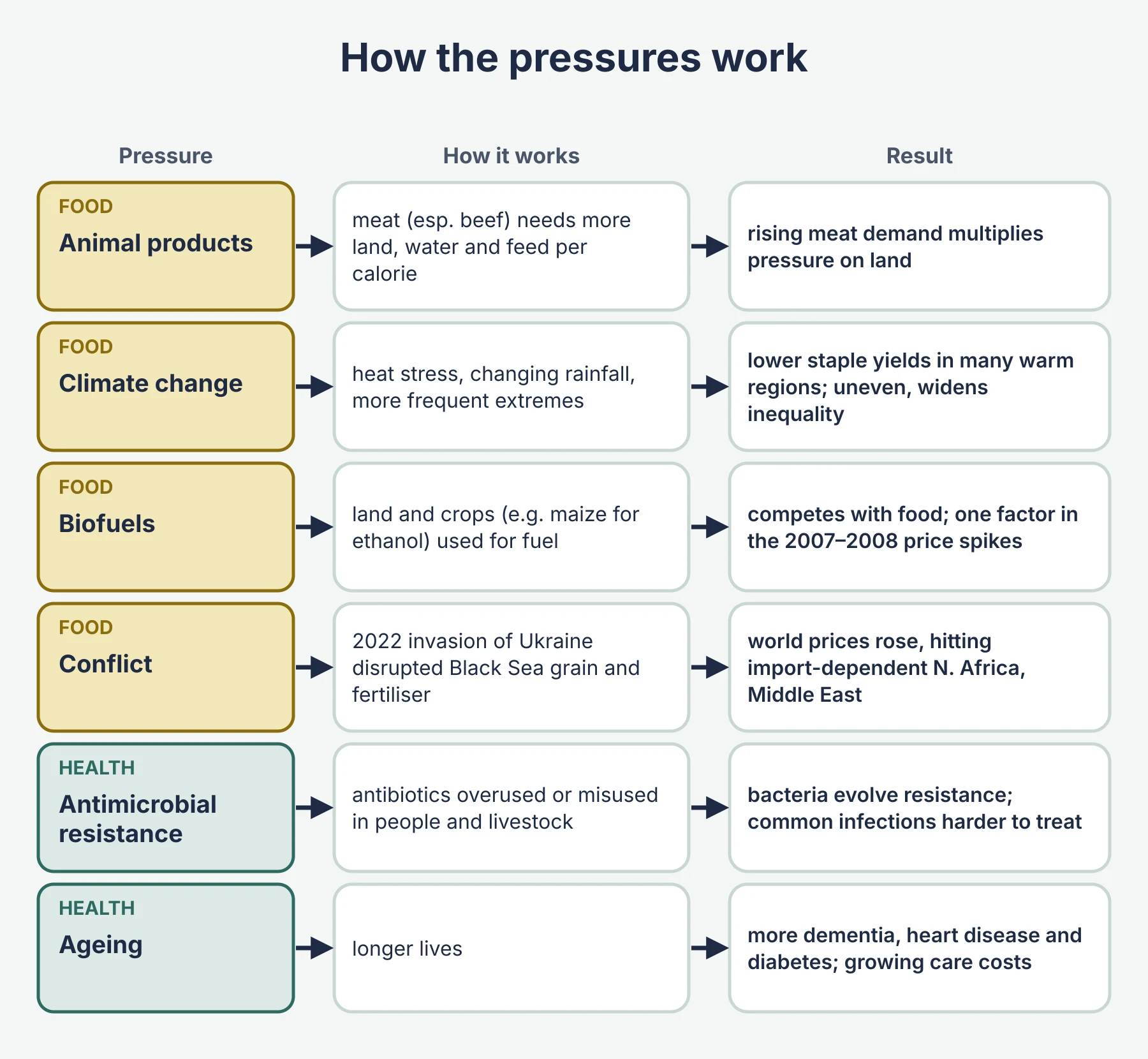
- Animal products: producing meat, especially beef, needs much more land, water and feed per calorie than producing crops for people to eat directly, so rising meat demand multiplies pressure on land.
- Climate change: heat stress, changing rainfall and more frequent extremes can reduce yields of staple crops in many warmer regions, while some higher-latitude areas may gain longer growing seasons. Effects are uneven, which can widen inequality.
- Biofuels: land and crops used for fuel, such as maize for ethanol, compete with food. Biofuel demand was one of several factors, with high oil prices and export bans, blamed for the food price spikes of 2007 to 2008.
- Conflict and price volatility: after Russia’s full-scale invasion of Ukraine in 2022, grain and fertiliser exports from the Black Sea region were disrupted and world prices rose, hitting import-dependent countries in North Africa and the Middle East. A UN-brokered grain export deal operated for about a year before Russia withdrew.
- Antimicrobial resistance (AMR): bacteria evolve resistance when antibiotics are overused or misused in people and livestock, so common infections may become harder to treat.
- Ageing: longer lives raise the burden of chronic conditions such as dementia, heart disease and diabetes, with growing care costs, as seen in Japan and much of Europe.
Sustainable options
- Sustainable intensification
- Agroecology
- Reducing food waste
- Changing diets
- Protecting soils and water
- Improving crop resilience
- Strengthening local and regional food systems
Key terms
| Term | Meaning |
|---|---|
| Sustainable intensification | Raising yields from existing farmland without further environmental damage or new land clearance |
| Agroecology | Farming that applies ecological principles, such as crop diversity, natural pest control and recycling nutrients |
| Food sovereignty | The right of peoples to define their own food and farming systems, a concept promoted by the peasant movement La Via Campesina |
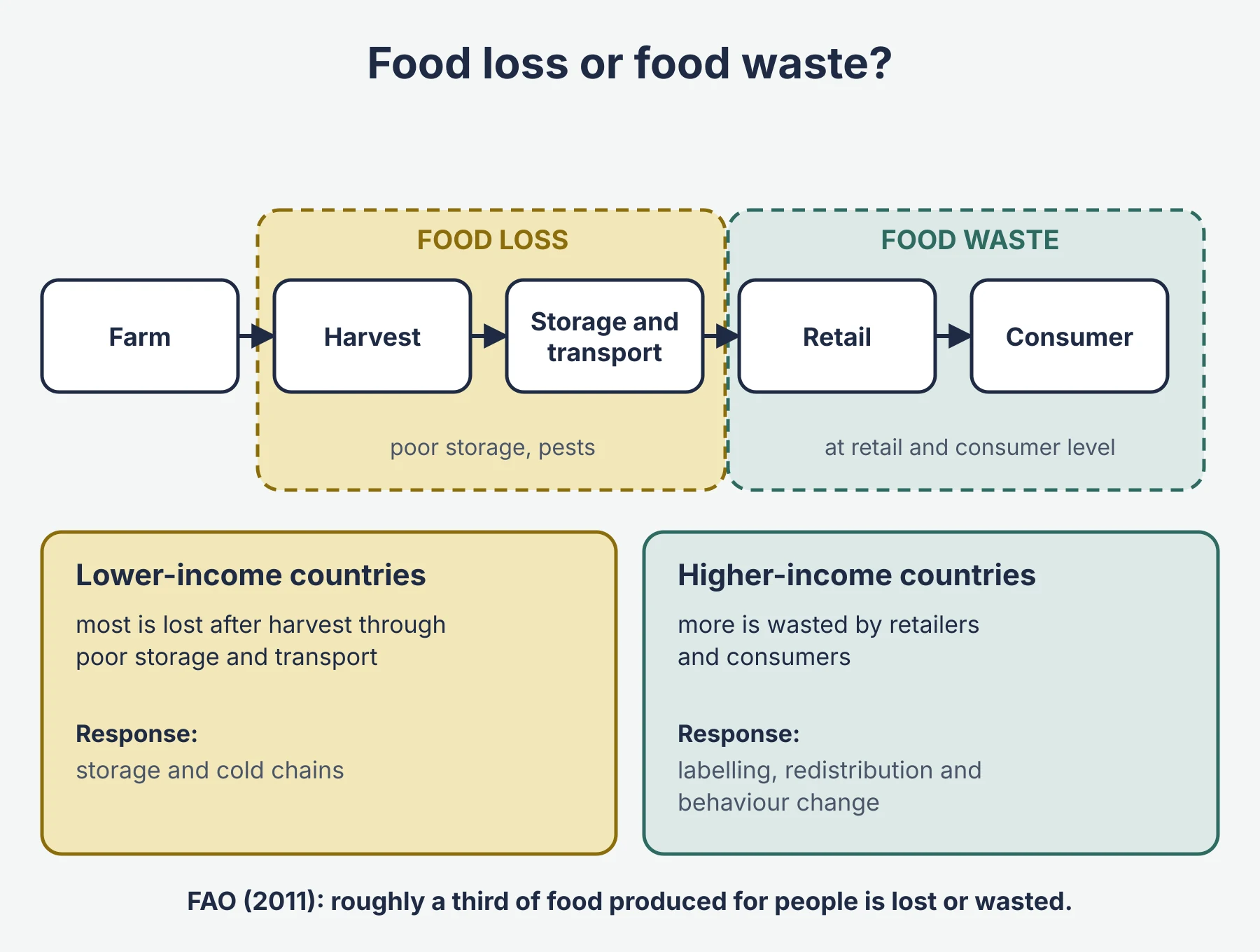
| Food loss and food waste | Loss occurs between harvest and retail (poor storage, pests); waste occurs at retail and consumer level |
| One Health | An approach that treats human, animal and environmental health as linked, important for zoonoses and AMR |
An FAO study from 2011 estimated that roughly a third of food produced for people is lost or wasted. In lower-income countries most is lost after harvest through poor storage and transport; in higher-income countries more is wasted by retailers and consumers. The response differs: storage and cold chains in one case, labelling, redistribution and behaviour change in the other.
Technology options to evaluate
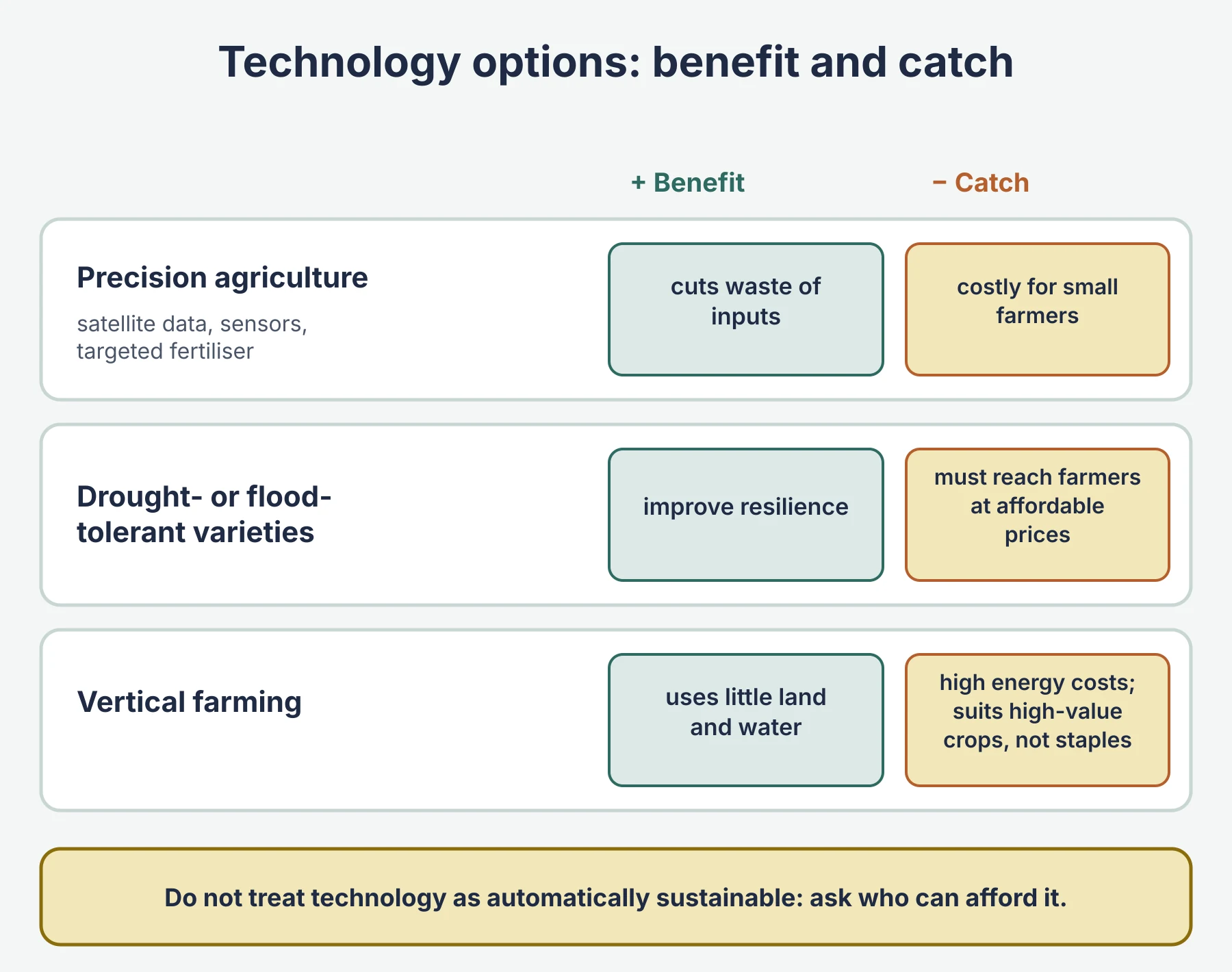
- Precision agriculture (satellite data, sensors, targeted fertiliser) can cut waste of inputs but is costly for small farmers.
- Drought- or flood-tolerant varieties improve resilience but must reach farmers at affordable prices.
- Vertical farming uses little land and water but has high energy costs and suits high-value crops rather than staples.
Resilience and governance
- Resilience: can systems absorb shocks such as drought or a pandemic?
- Governance: international agreements, trade rules and investment priorities shape outcomes.
The Sustainable Development Goals include Goal 2 (zero hunger) and Goal 3 (good health and well-being), with targets for 2030. They set shared direction but depend on national action and funding.
Case study: Ethiopia’s Productive Safety Net Programme
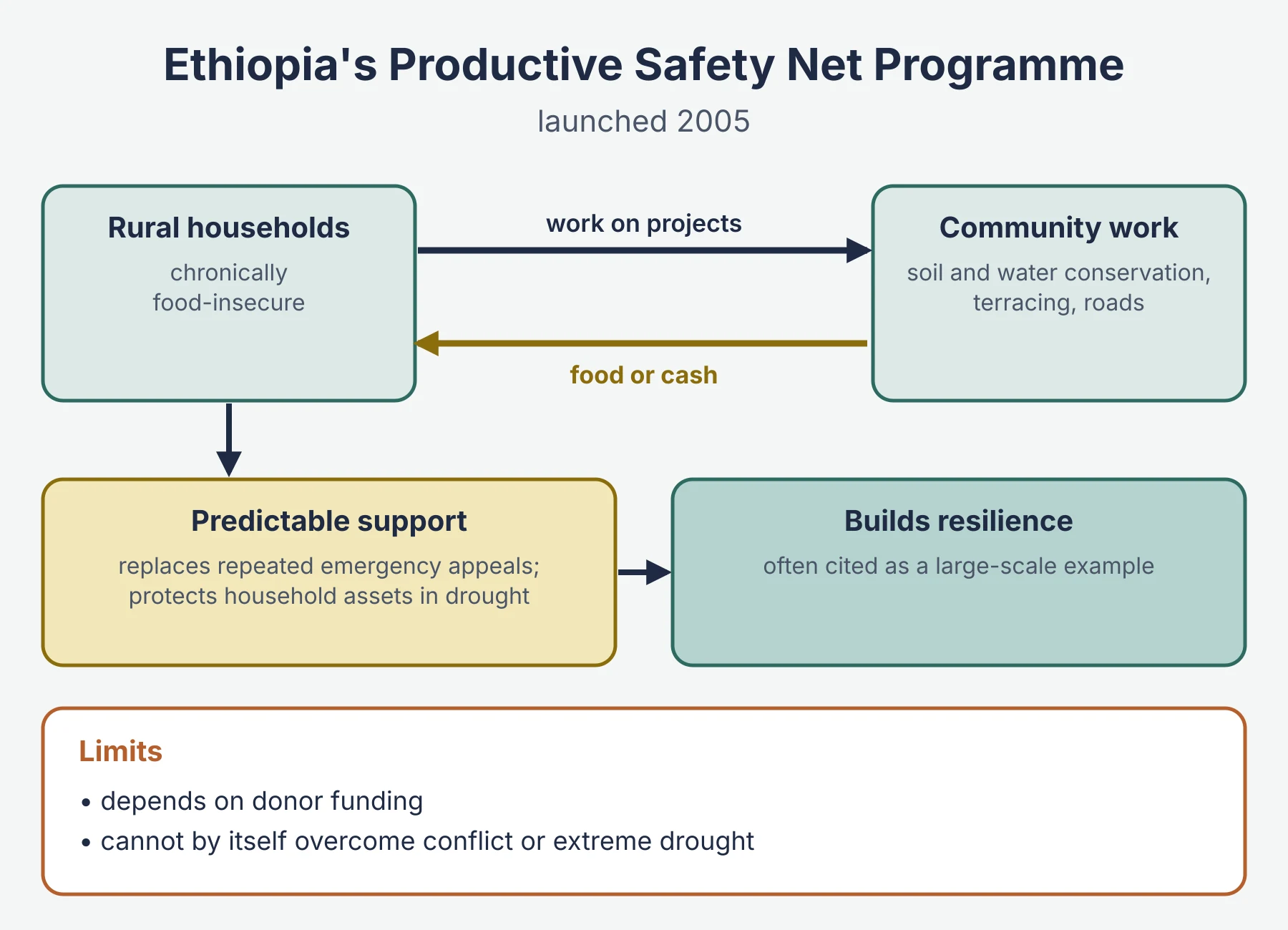
Launched in 2005, the programme gives food or cash to chronically food-insecure rural households, mostly in return for work on community projects such as soil and water conservation, terracing and roads. It aims to replace repeated emergency appeals with predictable support, protecting household assets during drought. Evaluation: it is often cited as a large-scale example of building resilience, but it depends on donor funding and cannot by itself overcome conflict or extreme drought.
Evaluating futures
- State the pressure and the response.
- Weigh effectiveness, cost, equity and sustainability.
- Recognise uncertainty: solutions differ by context.
- Conclude with a justified judgement.
Link to earlier subtopics
Use measures from 6.1 to judge progress, diffusion ideas from 6.2 to explain risk, and stakeholders from 6.3 to say who must act.
Model paragraph
To what extent can reducing food waste improve future food security? “Reducing waste increases availability without new land or water, and because much loss in lower-income countries happens in storage, better silos and cold chains can raise farm incomes as well. However, food security also depends on access: saving food in wealthy countries does not automatically reach poor households elsewhere. Waste reduction is therefore an important and low-cost contribution, but only a partial one, and it works best alongside measures that raise incomes and stabilise prices.”
Exam traps
- Offering a single solution as if it fits every place.
- Ignoring uncertainty in climate and disease projections.
- Treating food and health futures separately.
- Quoting projected figures from memory.
- Confusing food loss with food waste.
- Treating new technology as automatically sustainable without asking who can afford it.
Self-test
- Give three pressures on future food security.
- Name two health challenges.
- List three sustainable food options.
- What does resilience mean for a food system?
- Why do solutions depend on context?
- Why does rising meat consumption increase pressure on land?
- How can biofuels affect food prices?
- What is antimicrobial resistance and why is it increasing?
- Distinguish food loss from food waste.
- What is food sovereignty?
- How does Ethiopia’s Productive Safety Net Programme build resilience?
- Why is the One Health approach useful for future disease risk?
Answers: 1. For example population growth, climate change, soil degradation. 2. For example antimicrobial resistance and non-communicable disease. 3. For example reducing food waste, agroecology, changing diets. 4. Its ability to absorb shocks such as drought or a pandemic. 5. Places differ in resources, climate, governance and culture. 6. Meat needs more land, water and feed per calorie than crops eaten directly. 7. Crops and land used for fuel compete with food, raising demand and prices. 8. Bacteria evolving to survive antibiotics, increased by overuse in people and livestock. 9. Loss happens between harvest and retail; waste happens at retail and consumer level. 10. The right of peoples to define their own food and farming systems. 11. Predictable food or cash for work on conservation projects protects assets during drought. 12. It links human, animal and environmental health, which matters for zoonoses and resistance.
More resources on this topic
Related resources
-
Subject guides
IB Diploma Programme Geography: Subject Overview
An overview of IB Diploma Programme Geography – interactions between individuals, societies and physical processes across time and space.
Geography · International Baccalaureate · IB
Read course guide -
Revision notes
IB DP Geography: 6.1 Measuring food and health – Revision Notes
Condensed IB DP Geography notes on 6.1 Food and health: food security dimensions, measures of nutrition and health, BMI and DALYs, the nutrition transition and data limits, with a self-test.
Geography · International Baccalaureate · IB
Revise topic -
Revision notes
IB DP Geography: 6.3 Stakeholders in food and health – Revision Notes
Condensed IB DP Geography notes on 6.3 Food and health: stakeholders from household to global scale, agricultural and health strategies and their trade-offs, with a self-test.
Geography · International Baccalaureate · IB
Revise topic
Studying Geography?
This page is free and stays free. Marlbridge is not offering Geography classes at the moment, so there is no tuition to book for it. The free study resources stay open to everyone.
Get free revision emails (optional)
Occasional emails with practice questions, worked explanations and links to free resources for the qualification and subjects you choose. No spam, and you can unsubscribe from any email. The free tools on this site never need an email.