
Revision Notes
IB DP Geography: 1.4 Water management futures – Revision Notes
Condensed IB DP Geography notes on 1.4 Freshwater: supply-side and demand-side strategies, integrated water resources management and sustainability, with a self-test.
- Subject
- Geography
- Level
- IB
- Topic
- Topic 1: Option A: Freshwater
- Author
- Marlbridge Academic Team
- Updated
- Reviewed by
- Azam Siddique (what this means)
Aligned to International Baccalaureate IB Diploma Programme Geography (DP Geography), First assessments 2019. Official specification .
Syllabus page (what it covers and how it is assessed): IB Diploma Programme Geography.
Syllabus points this page covers
DP Geography
- 1.4 Water management futures
Condensed recall for 1.4 Water management futures (IB DP Geography, Option A: Freshwater). The Freshwater study guide has the longer version.
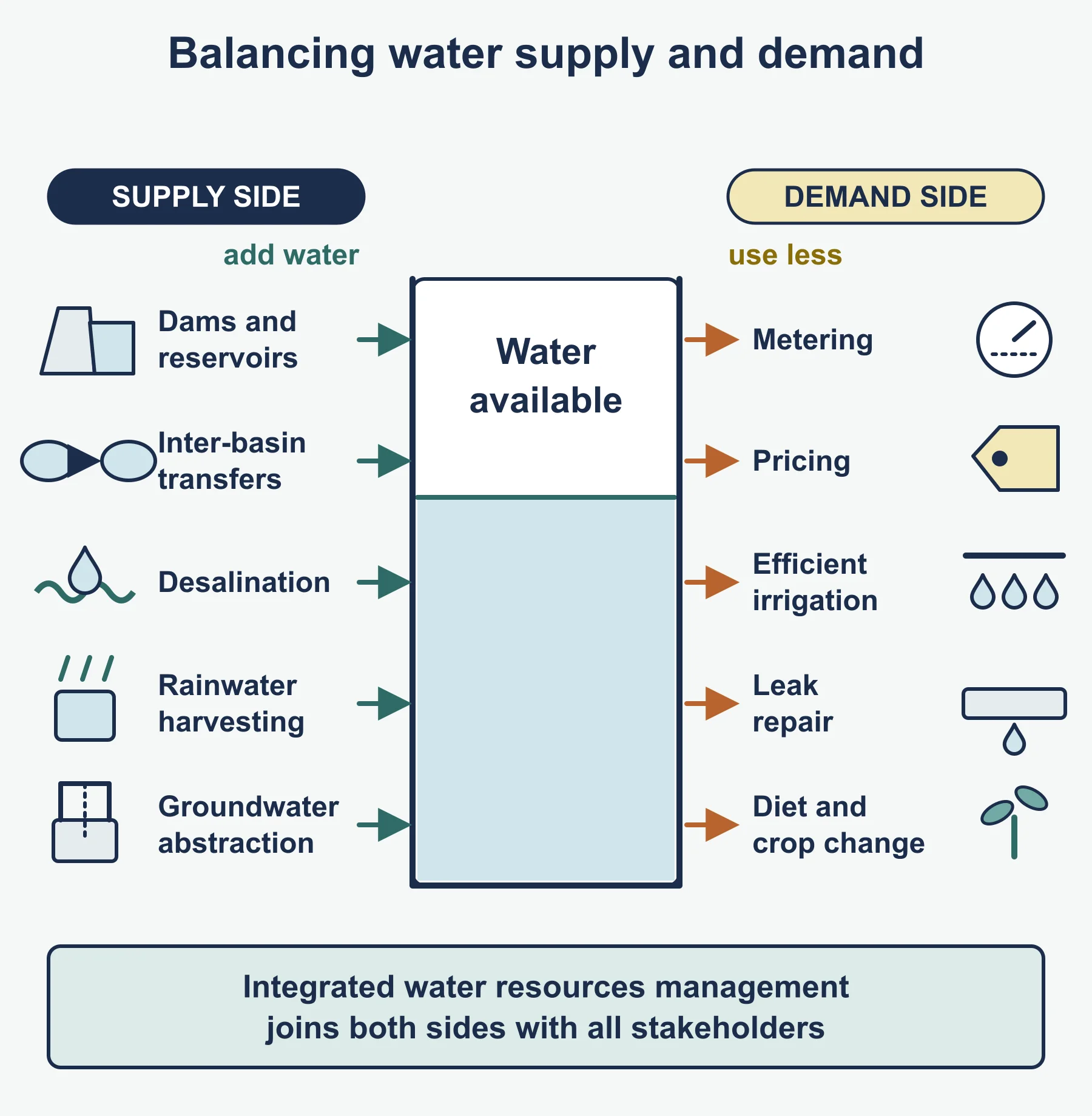
Two families of strategy
| Supply-side (add water) | Demand-side (reduce use) |
|---|---|
| Dams and reservoirs | Metering |
| Inter-basin transfers | Pricing |
| Desalination | Efficient irrigation |
| Rainwater harvesting | Leak repair |
| Groundwater abstraction | Changing diets and crops |
Integrated water resources management (IWRM) joins both sides and involves stakeholders: governments, farmers, industries, communities, non-governmental organisations and international bodies.
What makes management “integrated”
Principles agreed at an international water conference in Dublin in 1992 are often used to sum up IWRM:
- Freshwater is finite and vulnerable, so land and water use should be managed together across a whole catchment, with upstream and downstream uses considered together.
- Users, planners and policy makers at all levels should participate in decisions.
- Women play a central part in providing and managing water and should be involved.
- Water has an economic value in its competing uses, as well as being a basic need.
Integrated drainage basin management applies these ideas to one river basin, balancing water supply, flood control, energy, farming, navigation and ecosystems rather than managing each separately.
Multipurpose schemes: weighing a large dam
| Benefits | Costs |
|---|---|
| Hydroelectric power | Displacement of communities and loss of farmland and heritage |
| Flood control | Sediment trapped behind the dam, so downstream channels, deltas and coasts are starved |
| Reliable irrigation and urban supply | Changed river flow and temperature harms fish and wetlands |
| Navigation and recreation | Evaporation losses from large reservoirs in hot climates |
| Risk of reservoir-induced landslides and, rarely, earthquakes |
Three Gorges Dam, China: a very large multipurpose scheme on the Yangtze providing hydroelectric power, flood control and improved navigation. More than a million people were relocated, archaeological and cultural sites were flooded, and sediment trapping and slope instability around the reservoir have caused concern. It is a strong example for evaluating whether benefits at the national scale justify local costs.
Sustainability tests
Ask of any strategy:
- Does it meet today’s needs without compromising future supply?
- Does it share costs and benefits fairly?
- Does it damage ecosystems or deplete a store faster than it recharges?
- Can it cope with an uncertain climate?
Climate uncertainty
Climate change adds uncertainty through shifts in rainfall, loss of glaciers and snowpack, and more intense extremes. This weakens plans that assume past river flows will continue.
Case studies
The Colorado River, USA and Mexico
A 1922 agreement divided the river’s water among US states using flows from an unusually wet period, so more water was allocated than the river reliably carries. Big cities and irrigated farms now depend on it, the large reservoirs of Lake Mead and Lake Powell have fallen to low levels during long droughts, and the river rarely reaches its delta in the Gulf of California. Recent agreements to cut use show demand management being forced by a shrinking supply.
The Murray-Darling Basin, Australia
After a prolonged drought in the 2000s exposed over-allocation, a basin-wide plan agreed in 2012 set limits on how much water can be taken and returned water to the environment, partly by the government buying water entitlements from farmers and funding more efficient irrigation. Water can be traded between users. Evaluation: it is a leading example of basin-scale management, but it has been controversial with farming communities and has faced criticism over how much environmental water has actually been recovered.
Singapore’s “Four National Taps”
With little land to collect rain, Singapore combines four sources: water from local catchments and reservoirs, water imported from Malaysia, NEWater (highly treated recycled wastewater) and desalination. Pricing and public campaigns reduce demand. Evaluation: diversity of sources gives security and reduces dependence on imports, but recycling and desalination are energy-intensive and need high investment that few countries can afford.
Wetlands, lakes and aquifers
- Wetlands store flood water, filter pollutants, recharge groundwater and support biodiversity. The Ramsar Convention (1971) is an international agreement for the conservation and wise use of wetlands of international importance.
- Aquifers can be protected by limiting abstraction to recharge, monitoring water tables and managed aquifer recharge, which deliberately puts surplus water back underground for later use.
Trade-offs to quote
- A reservoir can secure supply but displace communities and change downstream ecology.
- Groundwater abstraction is quick but can lower water tables if it exceeds recharge.
- Desalination gives a reliable source but is typically energy-intensive.
- Demand measures such as pricing can save water but raise fairness questions for poorer households.
Building an evaluative answer
- Define the strategy and say which side it acts on.
- Give a located example you know well.
- Weigh benefits and costs for different stakeholders.
- Judge sustainability and fairness.
- Conclude with a supported view and note the limits of your evidence.
Model paragraph
Evaluate the importance of integrated drainage basin management for future water security. “Integrated management treats the basin as one system, so it can address problems such as over-allocation that single-purpose schemes created on rivers like the Colorado. In the Murray-Darling Basin, a basin-wide cap and environmental water recovery have begun to rebalance use. However, integration is politically difficult: it requires upstream and downstream users, and sometimes different states or countries, to accept limits. Its importance is therefore high, but its success depends on governance and trust as much as on technical planning.”
Exam traps
- Listing strategies with no evaluation of who gains and who loses.
- Treating one technology as a complete answer: IWRM combines approaches.
- Confusing supply-side and demand-side.
- Quoting invented cost or volume figures for a named scheme.
- Forgetting the downstream effects of dams on sediment and deltas.
- Treating wetlands only as habitats and missing their flood and filtering roles.
Self-test
- Give two supply-side and two demand-side approaches.
- What does IWRM bring together?
- State two questions that test whether a strategy is sustainable.
- How does climate change complicate water planning?
- Give one trade-off of building a reservoir.
- Why is the drainage basin the natural unit for water planning?
- Give two benefits and two costs of the Three Gorges Dam.
- Why was the Colorado River over-allocated?
- How has the Murray-Darling Basin Plan tried to return water to the environment?
- Name Singapore’s four national taps.
- What is managed aquifer recharge?
- Give two services that wetlands provide.
Answers: 1. Supply: dams, desalination; demand: metering, leak repair. 2. Supply and demand measures, with all stakeholders. 3. Does it protect future supply? Does it share costs and benefits fairly? 4. It changes rainfall, snowpack and extremes, so past flows are a poor guide. 5. Secures supply but may displace communities and alter downstream ecology. 6. Upstream use affects downstream users, so the whole basin must be considered together. 7. Benefits: hydropower, flood control (also navigation); costs: relocation of over a million people, sediment trapping (also flooded heritage). 8. Shares were set using flows from an unusually wet period. 9. By capping use and buying water entitlements from farmers, and funding efficient irrigation. 10. Local catchment water, imported water, NEWater and desalinated water. 11. Deliberately putting surplus water back into an aquifer for later use. 12. For example storing flood water and filtering pollutants.
More resources on this topic
Related resources
-
Subject guides
IB Diploma Programme Geography: Subject Overview
An overview of IB Diploma Programme Geography – interactions between individuals, societies and physical processes across time and space.
Geography · International Baccalaureate · IB
Read course guide -
Revision notes
IB DP Geography: 1.3 Water scarcity and water quality – Revision Notes
Condensed IB DP Geography notes on 1.3 Freshwater: physical and economic scarcity, water stress, virtual water, pollutants and eutrophication, with a self-test.
Geography · International Baccalaureate · IB
Revise topic -
Study guides
IB DP Geography (DP Geography): Drainage basin hydrology and geomorphology
IB DP Geography Freshwater 1.1 in depth: how precipitation shapes basin flows, soil water budgets, channel efficiency, load, and landform answers.
Geography · International Baccalaureate · IB
Read guide
Studying Geography?
This page is free and stays free. Marlbridge is not offering Geography classes at the moment, so there is no tuition to book for it. The free study resources stay open to everyone.
Get free revision emails (optional)
Occasional emails with practice questions, worked explanations and links to free resources for the qualification and subjects you choose. No spam, and you can unsubscribe from any email. The free tools on this site never need an email.