
Revision Notes
IB DP Geography: 5.1 Changing leisure patterns – Revision Notes
Condensed IB DP Geography notes on 5.1 Leisure, tourism and sport: leisure and recreation, influences on changing patterns, inequality in participation and commercialisation, with a self-test.
- Subject
- Geography
- Level
- IB
- Topic
- Topic 5: Option E: Leisure, tourism and sport
- Author
- Marlbridge Academic Team
- Updated
- Reviewed by
- Azam Siddique (what this means)
Aligned to International Baccalaureate IB Diploma Programme Geography (DP Geography), First assessments 2019. Official specification .
Syllabus page (what it covers and how it is assessed): IB Diploma Programme Geography.
Syllabus points this page covers
DP Geography
- 5.1 Changing leisure patterns
Condensed recall for 5.1 Changing leisure patterns (IB DP Geography, Option E: Leisure, tourism and sport). Fuller explanation is in the Leisure, tourism and sport study guide.
Key terms
- Leisure: time free from work and obligations.
- Recreation: what people do with that time.
- Tourism: travel and temporary stay away from a person’s usual environment for leisure, business or other purposes; standard international definitions count stays of less than a year.
- Sport: physical activity involving skill or exertion, usually organised by rules and often competitive.
- Domestic tourism happens within a person’s own country; international tourism crosses a border.
Leisure activities can also be classified as active or passive (playing football versus watching it), formal or informal (a club league versus a kick-about in the park) and home-based or away from home (gaming versus a day trip). Many activities overlap categories, so say which classification you are using.
Influences on changing patterns
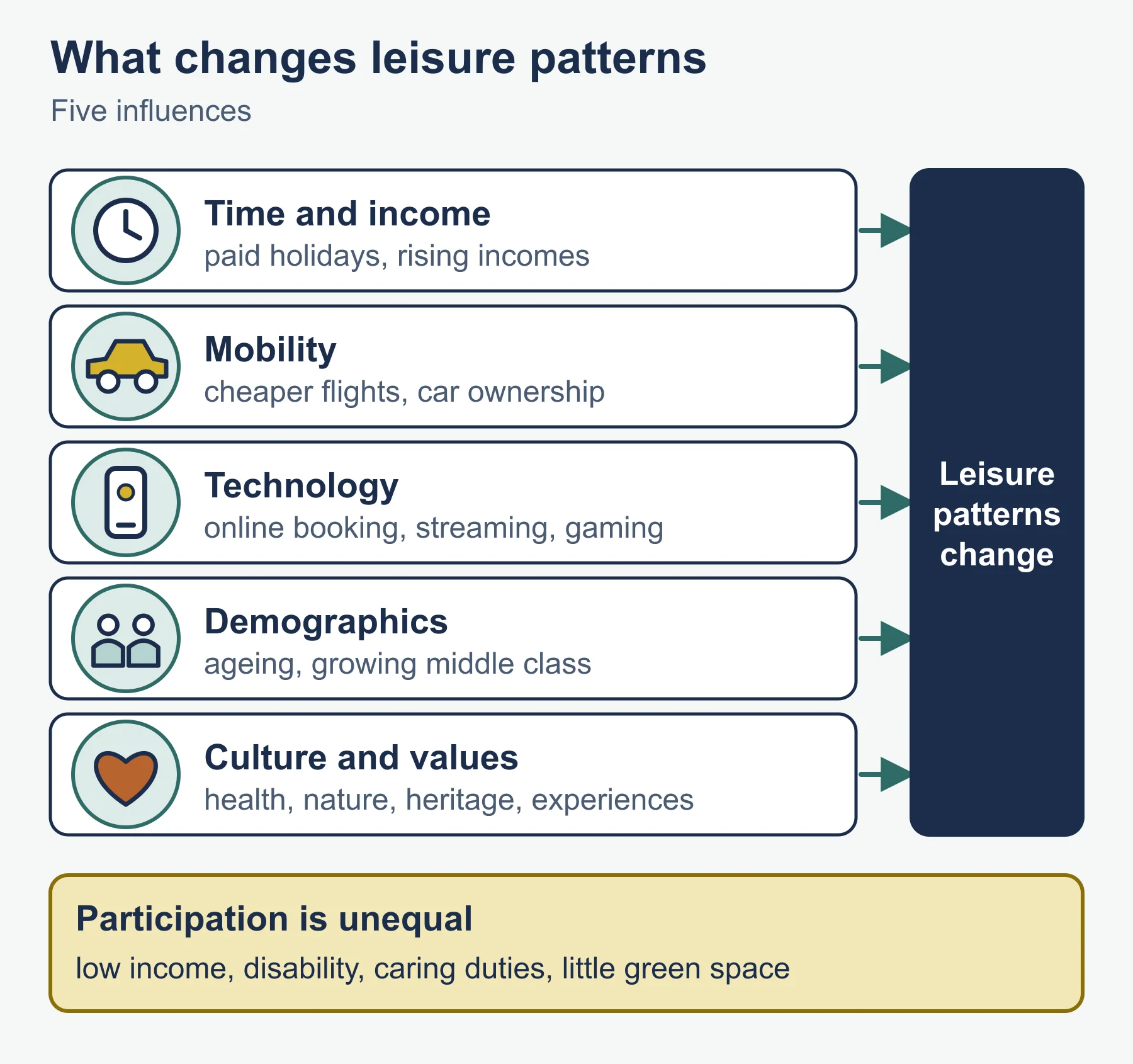
| Influence | Effect |
|---|---|
| Time and income | Shorter working weeks, paid holidays and rising disposable income expand options |
| Mobility | Cheaper air travel, car ownership and better transport extend how far people travel |
| Technology | Internet, online booking, streaming and gaming change what people do and how they plan trips |
| Demographics | Ageing populations, changing households and a growing middle class in emerging economies change demand |
| Culture and values | Health awareness, interest in nature, heritage and experiences |
How the influences work
- Time-space compression: faster, cheaper transport and instant communication make distant places feel closer, so a weekend city break abroad becomes possible for people who once holidayed only nearby.
- Economic development: as incomes rise in emerging economies, new middle classes begin to travel. By the late 2010s China had become one of the largest sources of international tourist spending.
- Technology: online platforms let people book flights and short-term rentals directly, and social media spreads images of attractive sites, sometimes concentrating crowds at a few photogenic places. Home-based leisure through streaming and gaming has also grown.
- Demographics: healthier, wealthier retired people in many high-income countries travel more, creating a “grey” tourism market, while young people often favour adventure and experience-based trips.
- Shocks: the COVID-19 pandemic of 2020 caused international travel to collapse almost overnight and pushed leisure towards local and home-based activities, showing how sensitive patterns are to external events.
Leisure across the life cycle
| Life stage | Typical pattern | Why |
|---|---|---|
| Children and teenagers | High participation in sport, much of it organised through school | Time available; school facilities |
| Young adults | Nightlife, adventure travel, festivals; sport participation often falls | Independence, low family commitments, changing priorities |
| Adults with young children | Home-based and family leisure, theme parks, beach holidays | Time and money constraints |
| Retired people | More travel off-season, cruises, gardening, walking | Free time and, for some, pensions and savings |
These are generalisations: income, health and culture create large differences within each group.
Unequal participation
People with low income, disability, caring responsibilities or little access to green space may have fewer opportunities. A geographer looks for patterns by age, gender, income and location and asks why they exist.
- Gender: in many countries women take part in sport less than men, linked to time spent on unpaid care work, safety concerns, cultural expectations and fewer facilities or role models, though women’s sport has grown rapidly in profile.
- Income: costs of equipment, membership and travel exclude poorer households from some sports and from foreign holidays.
- Location: rural residents may lack facilities; inner-city residents may lack green space; some neighbourhoods have more gyms and parks than others.
- Disability: access depends on transport, building design and adapted activities.
Commercialisation
Leisure has become commercialised: theme parks, shopping as leisure, fitness industries, sporting events.
Sport in particular has become a global business funded by broadcasting rights, sponsorship and merchandising, which can widen the gap between wealthy professional clubs and community sport. Commercial provision increases choice for those who can pay but may displace free public spaces.
Describing and explaining a pattern
- Describe the trend or difference using data if given (quote values and units).
- Link it to one or two influences from the table.
- Say which groups are included or excluded.
- Note a limit of the data, such as who was surveyed.
Worked check: a survey shows 48 per cent of 16 to 24 year olds and 30 per cent of over-65s take part in sport weekly. The difference is 18 percentage points, not 18 per cent. As a relative change, the younger group’s rate is 48 / 30 = 1.6 times the older group’s.
Model paragraph
Explain how changes in technology have affected leisure patterns. “Technology has changed both where and how people spend leisure time. Online booking and low-cost airlines have made short international trips cheaper and easier to organise, increasing city breaks. At the same time, streaming and gaming have increased home-based leisure, especially among younger people. Social media spreads images of popular sites, which can concentrate visitors at a few places. However, access depends on income and digital connection, so the effects are uneven between social groups.”
Exam traps
- Listing influences without explaining how they change behaviour.
- Treating leisure opportunity as equal for everyone.
- Describing holidays rather than geographical patterns and causes.
- Using invented participation statistics.
- Confusing percentage points with percentages when comparing survey results.
- Treating age groups as uniform, ignoring income and health.
Self-test
- Distinguish leisure from recreation.
- Give three influences on changing leisure patterns.
- How has technology changed leisure?
- Name two groups who may have fewer leisure opportunities.
- What does commercialisation of leisure mean?
- Define tourism.
- Give an example of active and passive leisure.
- What is time-space compression and how does it affect tourism?
- Give two reasons women may participate in sport less than men in some countries.
- How did the COVID-19 pandemic change leisure patterns?
- Participation rises from 25 to 35 per cent. State the change in percentage points and as a percentage.
- Why do retired people often travel outside peak season?
Answers: 1. Leisure is free time; recreation is what is done in it. 2. For example income, mobility, technology. 3. It changes activities (streaming, gaming) and how trips are planned (online booking). 4. For example people on low incomes or with disabilities. 5. Leisure becoming organised as paid products and industries. 6. Travel and temporary stay away from a person’s usual environment for leisure, business or other purposes. 7. Active: playing a sport; passive: watching it. 8. Faster, cheaper transport and communication make distant places feel closer, so longer-distance trips become easier. 9. For example unpaid care work and fewer facilities or role models. 10. International travel collapsed and leisure shifted to local and home-based activities. 11. 10 percentage points; a 40 per cent increase (10 / 25 x 100). 12. They are not tied to school holidays and off-peak travel is cheaper.
More resources on this topic
Related resources
-
Subject guides
IB Diploma Programme Geography: Subject Overview
An overview of IB Diploma Programme Geography – interactions between individuals, societies and physical processes across time and space.
Geography · International Baccalaureate · IB
Read course guide -
Revision notes
IB DP Geography: 5.4 Managing tourism and sport for the future – Revision Notes
Condensed IB DP Geography notes on 5.4 Leisure, tourism and sport: sustainability, ecotourism, visitor management, carrying capacity, stakeholders and future scenarios, with a self-test.
Geography · International Baccalaureate · IB
Revise topic -
Study guides
IB DP Geography: Option E: Leisure, tourism and sport – Study Guide
A study guide to the Leisure, tourism and sport option in IB DP Geography: leisure patterns, tourism and sport at different scales, and sustainable management.
Geography · International Baccalaureate · IB
Read guide
Studying Geography?
This page is free and stays free. Marlbridge is not offering Geography classes at the moment, so there is no tuition to book for it. The free study resources stay open to everyone.
Get free revision emails (optional)
Occasional emails with practice questions, worked explanations and links to free resources for the qualification and subjects you choose. No spam, and you can unsubscribe from any email. The free tools on this site never need an email.