
Revision Notes
IB DP Geography: 5.4 Managing tourism and sport for the future – Revision Notes
Condensed IB DP Geography notes on 5.4 Leisure, tourism and sport: sustainability, ecotourism, visitor management, carrying capacity, stakeholders and future scenarios, with a self-test.
- Subject
- Geography
- Level
- IB
- Topic
- Topic 5: Option E: Leisure, tourism and sport
- Author
- Marlbridge Academic Team
- Updated
- Reviewed by
- Azam Siddique (what this means)
Aligned to International Baccalaureate IB Diploma Programme Geography (DP Geography), First assessments 2019. Official specification .
Syllabus page (what it covers and how it is assessed): IB Diploma Programme Geography.
Syllabus points this page covers
DP Geography
- 5.4 Managing tourism and sport for the future
Condensed recall for 5.4 Managing tourism and sport for the future (IB DP Geography, Option E: Leisure, tourism and sport). See the Leisure, tourism and sport study guide.
Core concept
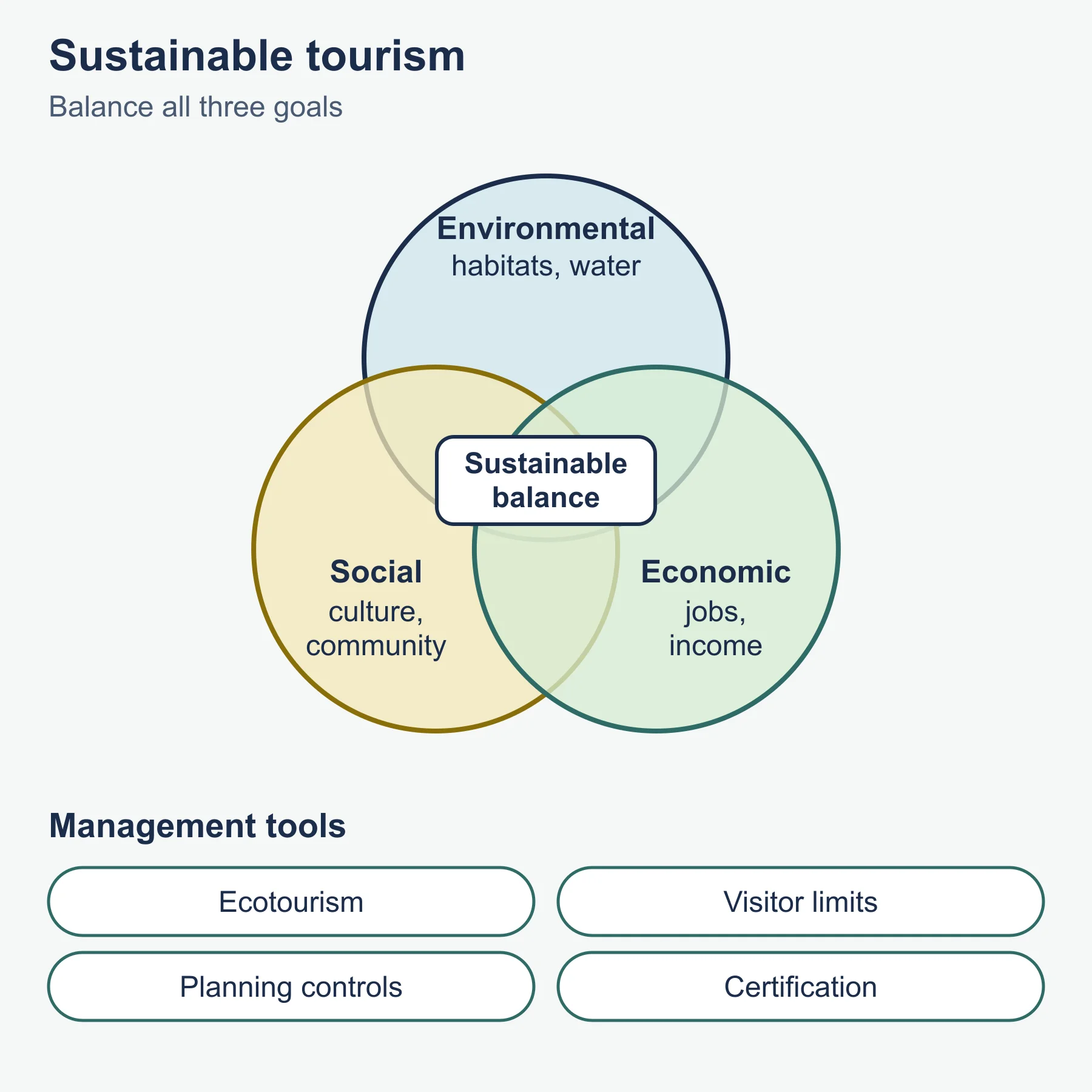
Sustainability: meeting present needs without compromising the ability of future generations to meet theirs. Sustainable tourism balances economic, social and environmental goals. It is not only environmental.
| Pillar | What a sustainable destination aims for |
|---|---|
| Economic | Year-round, decently paid local jobs; low leakage; diverse income |
| Social and cultural | Residents involved in decisions; culture respected rather than commodified; housing kept affordable |
| Environmental | Visitor numbers within ecological limits; low waste, water use and emissions |
Ecotourism is responsible travel to natural areas that conserves the environment, supports the well-being of local people and includes education. Greenwashing is when operators use the label without meeting these standards, which is why certification and enforcement matter.
Approaches
| Approach | Example |
|---|---|
| Ecotourism, community-based tourism | Keeps income local and protects nature |
| Visitor management | Zoning, quotas, pricing, timed entry, education |
| Planning controls | Limits on development; carrying capacity assessments |
| Certification and codes | Responsible operator standards |
| Sport | Sustainable event design, reuse of existing venues, planned legacy |
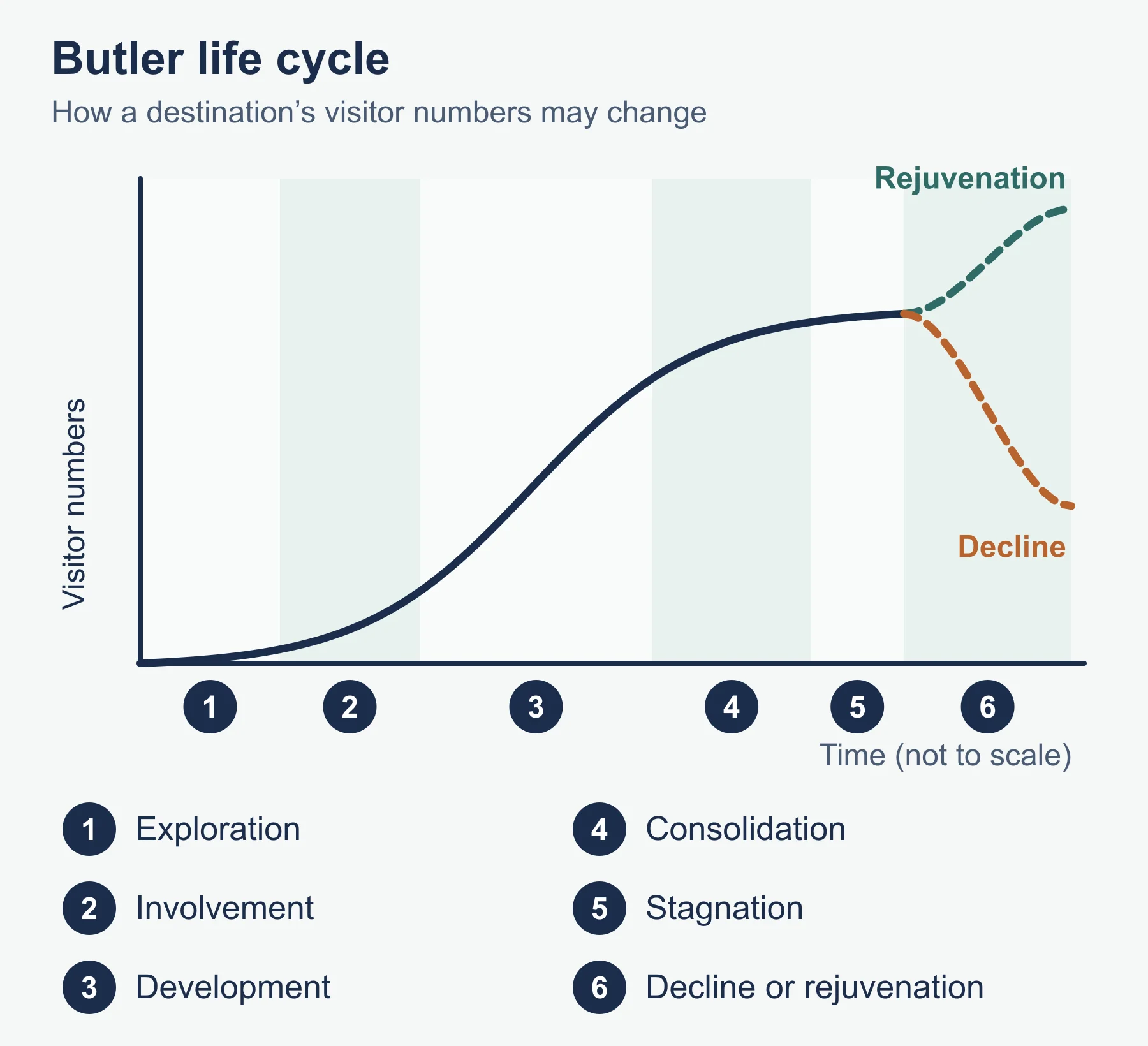
Rejuvenation strategies for a stagnating destination include diversifying products (events, conferences, heritage, wellness), upgrading accommodation, improving the public realm and targeting new markets. They correspond to the rejuvenation branch of Butler’s model.
Case studies
Galapagos Islands, Ecuador
The islands are a national park and marine reserve. Visitors pay a park entry fee, most visitor sites can be reached only with licensed naturalist guides, boats follow approved itineraries, and strict rules control the movement of plants and animals between islands to stop invasive species. Evaluation: the controls protect a unique ecosystem and fund conservation, but growing land-based tourism and the population of the inhabited islands have increased pressure.
Venice, Italy
Venice is a widely cited example of overtourism: large numbers of day visitors crowd a small historic centre while the resident population has fallen. Responses include stopping large cruise ships from sailing past the historic centre in 2021 and trialling an entry fee for day-trippers on peak days in 2024. Evaluation: these measures signal intent, but critics argue they do little to tackle short-term rentals that drive residents out, so the Doxey-style antagonism of residents continues.
Bhutan
Bhutan follows a “high value, low impact” approach, charging international visitors a daily sustainable development fee that funds public services and conservation. Evaluation: it limits mass tourism and protects culture, but it also limits who can afford to visit and how much income tourism brings, and the fee level has been adjusted in response to visitor numbers.
Community-based conservation in Namibia
Communal conservancies allow rural communities to manage wildlife on their land and earn income from tourism and hunting concessions, giving local people a direct stake in conservation. Evaluation: it is often praised for linking wildlife recovery with rural incomes, but benefits can be uneven within communities and depend on stable visitor numbers.
Sport and sustainability
Recent Games organisers have tried to reduce cost and waste by relying mainly on existing and temporary venues, as Paris did in 2024, rather than building new stadiums that may be underused. Sustainable event design also includes public transport access, renewable energy and planned after-use of every new facility.
Stakeholders
Tourists, residents, businesses, governments, conservation bodies, international organisations. They disagree: businesses may want growth while residents want less crowding.
Evaluating
Criteria: who benefits, long-term viability, enforcement. Link back to leakage and carrying capacity.
Looking ahead
- Technology and changing travel habits
- Climate impacts on destinations such as ski resorts and beaches
- Overtourism and its effects on residents
- Scenarios: managed, community-led growth versus unmanaged growth that erodes what visitors came to see
Ski resorts: warming raises the snowline, so lower-altitude resorts in ranges such as the Alps face shorter, less reliable seasons. Responses include artificial snowmaking (which uses water and energy), moving lifts higher and diversifying into year-round activities such as mountain biking and hiking. Beach resorts face sea level rise, coastal erosion and coral bleaching that reduces the attraction of reef destinations.
Worked check
If capacity is fixed and arrivals rise 25 per cent, the destination may approach its carrying capacity, one sign Butler’s consolidation or stagnation stage may be near.
Model paragraph
Evaluate the effectiveness of visitor management in a fragile destination. “In the Galapagos, licensed guides, set itineraries and entry fees have kept visitors on defined paths and funded conservation, so visitor management has protected the most sensitive sites. However, it has not controlled the growth of land-based tourism and the resident population, which increase demand for water, energy and imported goods. Visitor management is therefore effective at site level but must be combined with wider planning controls if a destination is to stay within its carrying capacity.”
Exam traps
- Treating sustainability as only environmental.
- Praising ecotourism without asking about enforcement or leakage.
- Naming schemes without saying who gains.
- Giving visitor-cap numbers for named places from memory.
- Assuming high entry fees are fair: they can exclude lower-income visitors and residents.
- Ignoring that adaptation such as snowmaking can create new environmental costs.
Self-test
- Define sustainable tourism.
- Give three visitor management tools.
- What is a carrying capacity assessment for?
- Name two stakeholders with conflicting interests and explain the conflict.
- How might climate change affect some destinations?
- Define ecotourism.
- What is greenwashing?
- Give two rejuvenation strategies for a declining resort.
- Name two visitor management measures used in the Galapagos.
- Give one strength and one weakness of Bhutan’s daily fee.
- How can ski resorts adapt to warming, and what is one drawback?
- Why do recent Games organisers favour existing and temporary venues?
Answers: 1. Tourism that balances economic, social and environmental goals so future generations are not disadvantaged. 2. For example quotas, zoning, timed entry. 3. To judge how many visitors a place can take without unacceptable damage. 4. For example businesses wanting growth versus residents wanting less crowding. 5. By changing the snow or beach conditions that attract visitors. 6. Responsible travel to natural areas that conserves the environment, supports local people and includes education. 7. Using a sustainable or eco label without meeting its standards. 8. For example new events and upgraded accommodation. 9. For example licensed guides and approved boat itineraries. 10. Strength: limits mass tourism and funds conservation; weakness: excludes less wealthy visitors. 11. Snowmaking or moving lifts higher; snowmaking uses water and energy. 12. To cut costs and avoid underused facilities after the event.
More resources on this topic
Related resources
-
Subject guides
IB Diploma Programme Geography: Subject Overview
An overview of IB Diploma Programme Geography – interactions between individuals, societies and physical processes across time and space.
Geography · International Baccalaureate · IB
Read course guide -
Study guides
IB DP Geography: Option E: Leisure, tourism and sport – Study Guide
A study guide to the Leisure, tourism and sport option in IB DP Geography: leisure patterns, tourism and sport at different scales, and sustainable management.
Geography · International Baccalaureate · IB
Read guide -
Revision notes
IB DP Geography: 5.3 Tourism and sport at the international scale – Revision Notes
Condensed IB DP Geography notes on 5.3 Leisure, tourism and sport: global tourism growth, push and pull factors, transnational corporations, mega-events, leakage and risk, with a self-test.
Geography · International Baccalaureate · IB
Revise topic
Studying Geography?
This page is free and stays free. Marlbridge is not offering Geography classes at the moment, so there is no tuition to book for it. The free study resources stay open to everyone.
Get free revision emails (optional)
Occasional emails with practice questions, worked explanations and links to free resources for the qualification and subjects you choose. No spam, and you can unsubscribe from any email. The free tools on this site never need an email.