
Revision Notes
IB DP Geography: 5.3 Tourism and sport at the international scale – Revision Notes
Condensed IB DP Geography notes on 5.3 Leisure, tourism and sport: global tourism growth, push and pull factors, transnational corporations, mega-events, leakage and risk, with a self-test.
- Subject
- Geography
- Level
- IB
- Topic
- Topic 5: Option E: Leisure, tourism and sport
- Author
- Marlbridge Academic Team
- Updated
- Reviewed by
- Azam Siddique (what this means)
Aligned to International Baccalaureate IB Diploma Programme Geography (DP Geography), First assessments 2019. Official specification .
Syllabus page (what it covers and how it is assessed): IB Diploma Programme Geography.
Syllabus points this page covers
DP Geography
- 5.3 Tourism and sport at the international scale
Condensed recall for 5.3 Tourism and sport at the international scale (IB DP Geography, Option E: Leisure, tourism and sport). Fuller explanation is in the Leisure, tourism and sport study guide.
Growth and its drivers
Global tourism has grown for decades, interrupted by shocks such as health crises, conflict and economic downturns.
Drivers: falling real transport costs, rising incomes, visa liberalisation, digital platforms, low-cost airlines.
Patterns of flow
- Most international trips are intra-regional: people travel to neighbouring countries more than to distant ones, a form of distance decay.
- Europe has long received the largest share of international arrivals, helped by short distances between countries, high incomes and easy border crossing within much of the continent.
- Asia and the Pacific have been the fastest-growing region for both arrivals and outbound travel, driven by rising middle classes.
- Long-haul flows from high-income countries to tropical destinations in the Caribbean, South-East Asia and the Indian Ocean are important for small economies even when their share of the global total is small.
Push and pull factors
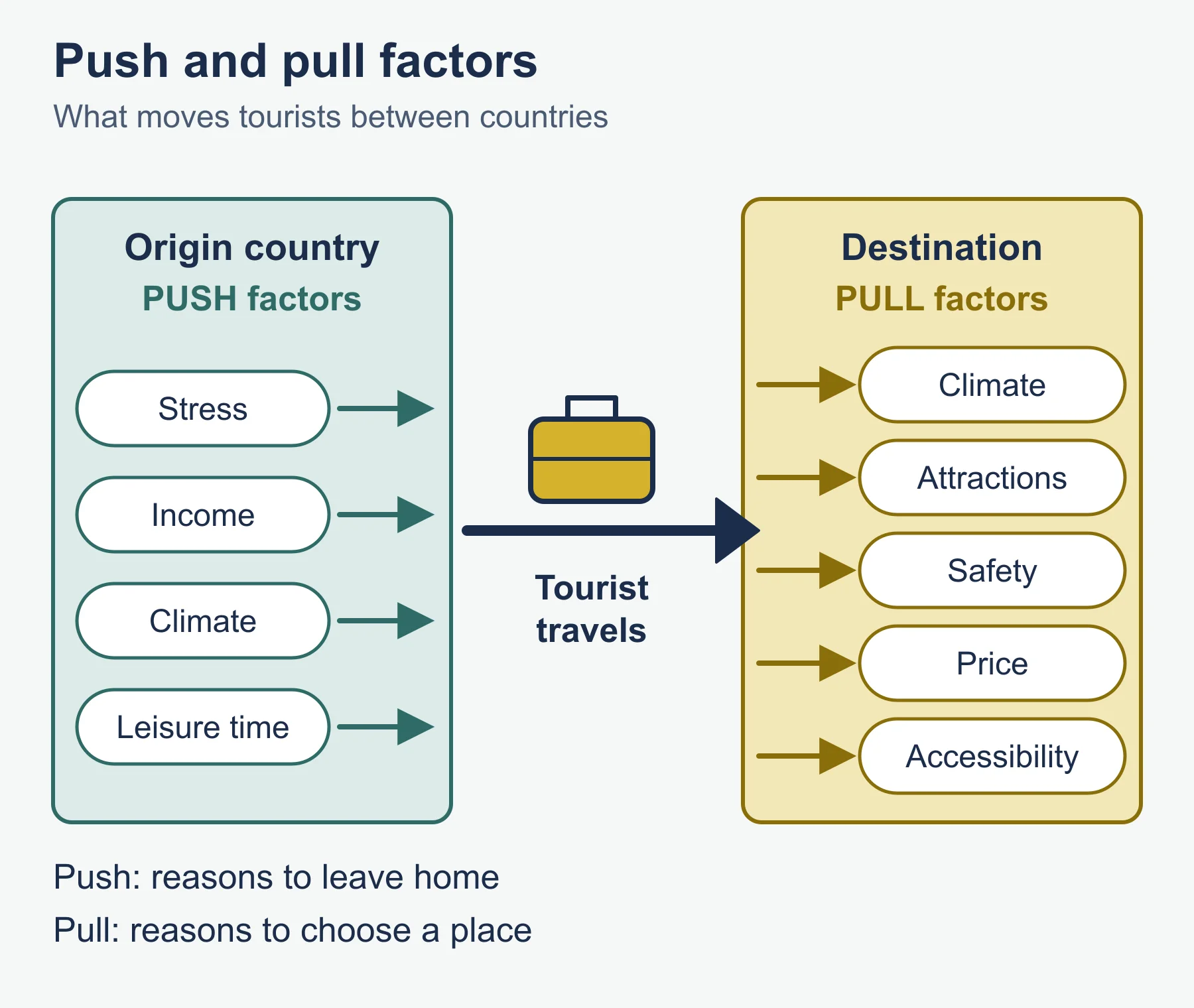
| Push (origin) | Pull (destination) |
|---|---|
| Stress, income, climate, leisure time | Climate, attractions, safety, price, accessibility |
Intervening obstacles reduce flows even when push and pull factors are strong: visa restrictions, cost, distance, conflict or a health scare. Intervening opportunities, such as a cheaper destination on the way, can divert flows.
Key actors
- Transnational corporations in hotels, airlines, cruises and online booking.
- In global sport: federations, broadcasters, sponsors and clubs.
- Sports migration, transfer markets and media coverage show globalisation in action.
Globalisation of sport
- Broadcasting: top football leagues sell television rights worldwide, so clubs have global fan bases and income far beyond their home cities.
- Sports migration: players move to the leagues with the highest wages and status, such as footballers from Africa and South America moving to European clubs. Some argue this creates a “brawn drain” from source countries, though players also send money home and inspire new participation.
- Talent clusters: some places become hubs for one sport, such as the high-altitude training towns of Kenya’s Rift Valley for distance runners, attracting international athletes and coaches.
- Diffusion of sports: cricket and rugby spread through the British Empire, while basketball and other sports have spread globally through television and social media.
Mega-events
World championships and Games are bid for by cities and countries for visibility and development. Critics point to cost overruns, displacement of residents and uneven benefits.
| Event | What it illustrates |
|---|---|
| Montreal 1976 Olympics | Large public debt that took around three decades to repay |
| Beijing 2008 Olympics | Use of an event to project national image, alongside reports of residents displaced by construction |
| Rio de Janeiro 2016 Olympics | Several venues left underused soon after the Games while the host state faced financial crisis |
| Qatar 2022 FIFA World Cup | First men’s World Cup in the Middle East; heavy investment in stadiums and transport, and international criticism of conditions for migrant workers |
Bidding has become less popular in some democracies because of cost concerns, and the International Olympic Committee has encouraged greater use of existing and temporary venues.
Tourism, inequality and development
- Route to income for developing economies.
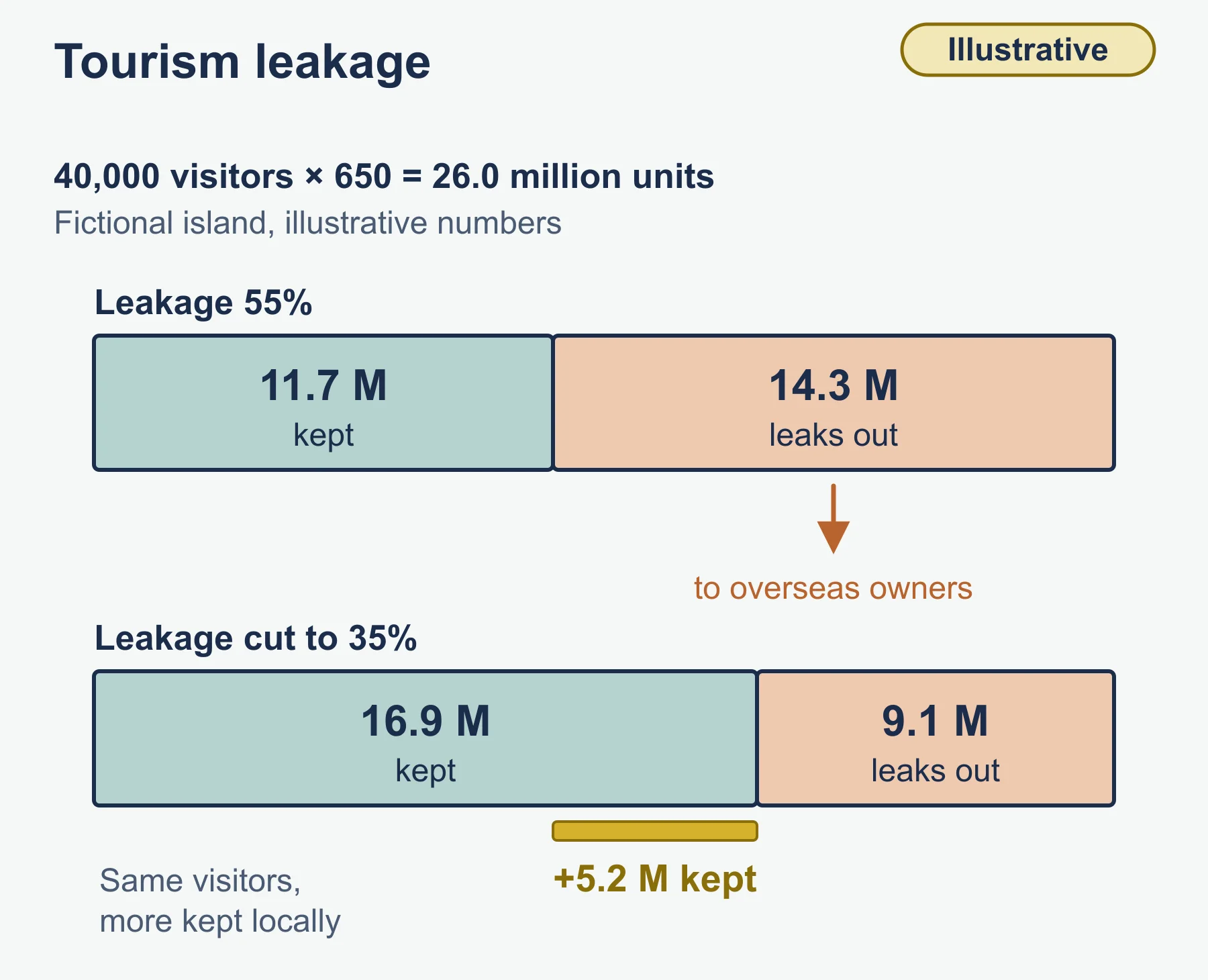
- Leakage: a large share of spending can leave the destination, especially with all-inclusive packages owned by foreign firms.
- Worked check: 40,000 visitors x 650 currency units = 26,000,000; with 55 per cent leakage, 45 per cent is retained = 11,700,000.
Why leakage happens: foreign-owned hotels send profits home, food and drink are imported to meet visitor tastes, international booking platforms and tour operators take commission, and senior jobs may go to expatriate staff. Reducing leakage means buying locally, training local managers and supporting locally owned businesses.
Tourism dependency: small island states with few other industries can earn a large share of national income from tourism, which brings growth but leaves them highly exposed to shocks.
Risk and environment
Tourism is exposed to hazards, political instability and climate change. Concerns include aviation emissions and pressure on fragile places such as coral reefs and polar regions.
Examples of shocks:
- Hazards: the 2010 eruption of Eyjafjallajokull in Iceland sent ash across Europe and closed much of its airspace for days, stranding travellers.
- Terrorism and instability: after attacks on tourists in Tunisia in 2015, international arrivals fell sharply and many tour operators withdrew.
- Pandemics: the COVID-19 pandemic brought international tourism close to a halt in 2020, hitting tourism-dependent economies hardest.
Model paragraph
Discuss the costs and benefits of hosting a sporting mega-event. “Hosting can accelerate investment in transport and urban regeneration and raise a country’s global profile, as Beijing sought in 2008. However, costs frequently exceed budgets, as Montreal’s long-lasting debt shows, and venues may be underused afterwards, as in Rio de Janeiro. Benefits often go to construction firms, sponsors and wealthier districts, while displacement and labour concerns fall on poorer groups. The balance depends on planning: events that reuse existing venues and tie investment to long-term local needs are more likely to leave a positive legacy.”
Exam traps
- Ignoring leakage when judging economic benefit.
- Naming push and pull factors without linking them to a flow.
- Treating mega-events as automatically beneficial.
- Quoting event costs or visitor totals from memory.
- Assuming most international tourism is long-haul: most is intra-regional.
- Describing sports migration only as a loss for source countries, without remittances or role-model effects.
Self-test
- Name three drivers of global tourism growth.
- Distinguish push from pull factors.
- What is leakage and why is it high with all-inclusive packages?
- Give two criticisms of mega-events.
- Name two risks to international tourism.
- Why are most international tourist trips intra-regional?
- What is an intervening obstacle? Give an example.
- How has broadcasting globalised sport?
- What is meant by a “brawn drain”?
- Give three reasons tourism leakage occurs.
- A destination earns 30,000,000 from tourism and keeps 40 per cent. How much leaks away?
- Why are small island states especially vulnerable to tourism shocks?
Answers: 1. For example cheaper transport, higher incomes, digital platforms. 2. Push factors encourage people to leave home; pull factors attract them to a destination. 3. Spending that leaves the destination; foreign-owned firms keep the profits. 4. For example cost overruns and displacement. 5. For example hazards and political instability. 6. Neighbouring countries are cheaper and quicker to reach, so flows show distance decay. 7. Something that reduces a flow despite push and pull factors, such as visa restrictions. 8. Leagues sell television rights worldwide, giving clubs global fans and income. 9. The loss of sporting talent from poorer countries to wealthier leagues. 10. For example foreign-owned hotels, imported food and commission paid to international booking firms. 11. 60 per cent leaks: 0.6 x 30,000,000 = 18,000,000. 12. They often depend heavily on tourism with few other industries to fall back on.
More resources on this topic
Related resources
-
Subject guides
IB Diploma Programme Geography: Subject Overview
An overview of IB Diploma Programme Geography – interactions between individuals, societies and physical processes across time and space.
Geography · International Baccalaureate · IB
Read course guide -
Revision notes
IB DP Geography: 5.2 Tourism and sport at the local and national scale – Revision Notes
Condensed IB DP Geography notes on 5.2 Leisure, tourism and sport: tourism types, Butler, Doxey and Plog models, local and national impacts and sport legacy, with a self-test.
Geography · International Baccalaureate · IB
Revise topic -
Study guides
IB DP Geography (DP Geography): Changing leisure patterns
IB DP Geography Leisure, tourism and sport 5.1 in depth: how leisure is measured, why participation varies between and within countries, and how to read leisure data.
Geography · International Baccalaureate · IB
Read guide
Studying Geography?
This page is free and stays free. Marlbridge is not offering Geography classes at the moment, so there is no tuition to book for it. The free study resources stay open to everyone.
Get free revision emails (optional)
Occasional emails with practice questions, worked explanations and links to free resources for the qualification and subjects you choose. No spam, and you can unsubscribe from any email. The free tools on this site never need an email.