
Study Guides
IB DP History (DP History): Military leaders
Prescribed subject 1 for IB History Paper 1: Genghis Khan and Richard I, their leadership, campaigns and impact, with source advice and a worked answer plan.
- Subject
- World History
- Level
- IB
- Topic
- Topic 1: Prescribed subjects
- Author
- Marlbridge Academic Team
- Updated
- Reviewed by
- Azam Siddique (what this means)
Aligned to International Baccalaureate IB Diploma Programme History (DP History), First assessment 2017. Official specification .
Syllabus page (what it covers and how it is assessed): IB Diploma Programme History.
Syllabus points this page covers
DP History
- 1 Military leaders
Found an error? Report a correction.
Need help with this topic? Request a free trial class for IB Diploma Programme History (DP History / DP History (2028)).
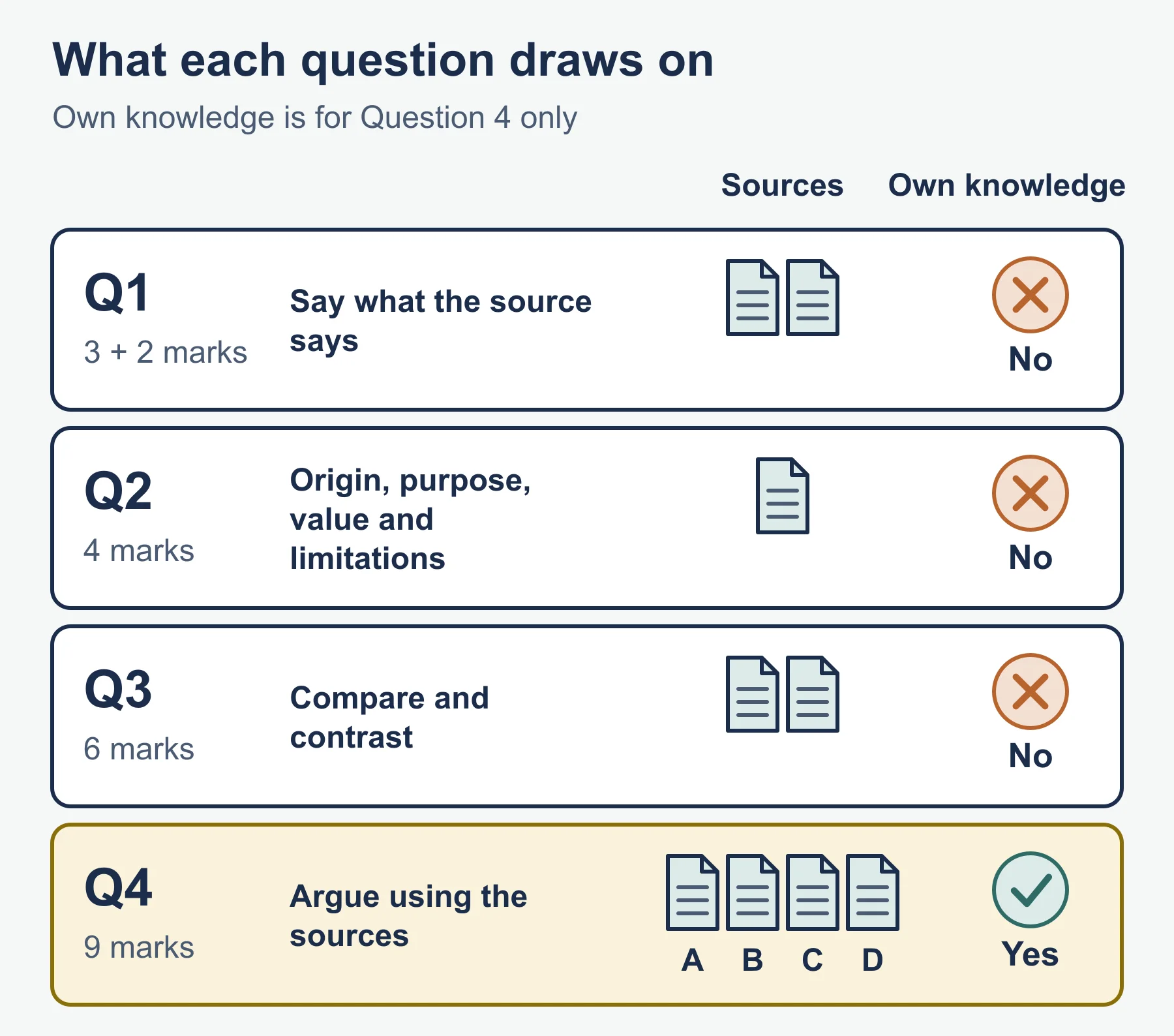
Prescribed subject 1, Military leaders, asks you to study two commanders from different regions: Genghis Khan (c.1200-1227) and Richard I of England (1173-1199). Paper 1 sets four sources on one of the two case studies, so you must be ready for either. This guide goes into the content in more depth than the prescribed subjects overview and shows how that content turns into marks.
What the subject covers
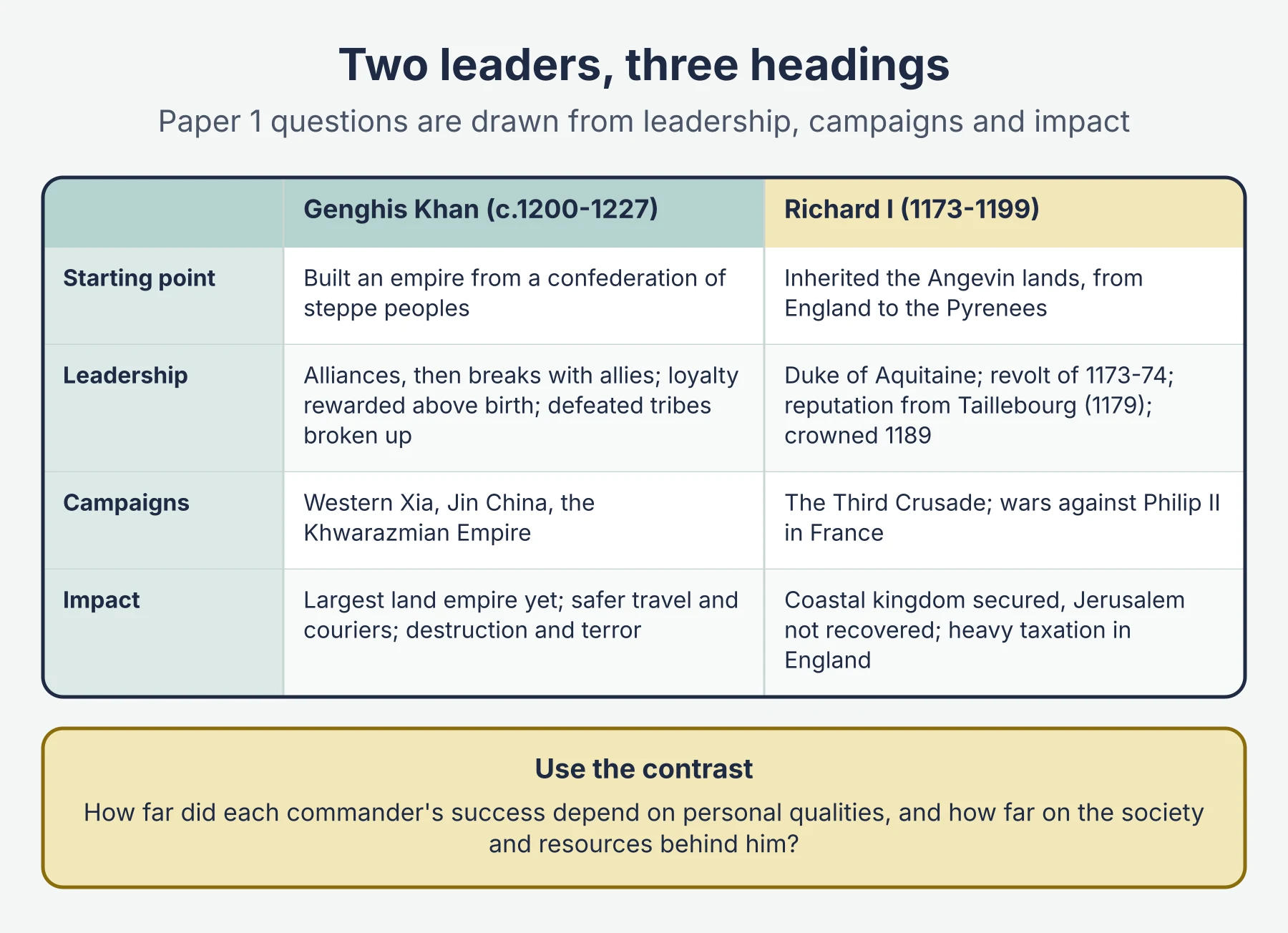
For each leader the IB guide organises the content under three headings, and Paper 1 questions are drawn from them:
- Leadership: how the leader rose to power, his relations with family and rivals, and the qualities and methods of his command.
- Campaigns: the major wars and battles, the organisation and tactics of his armies, and the reasons for success or failure.
- Impact: the political, economic and social consequences of his rule and campaigns, for his own lands and for the lands he fought in.
The two case studies sit in very different worlds. Genghis Khan built an empire from a confederation of steppe peoples; Richard I inherited an empire, the Angevin lands stretching from England to the Pyrenees, and spent most of his reign defending or extending it. That contrast is useful: it lets you ask how far any commander’s success depended on personal qualities and how far on the society and resources behind him.
Case study 1: Genghis Khan
Rise to power
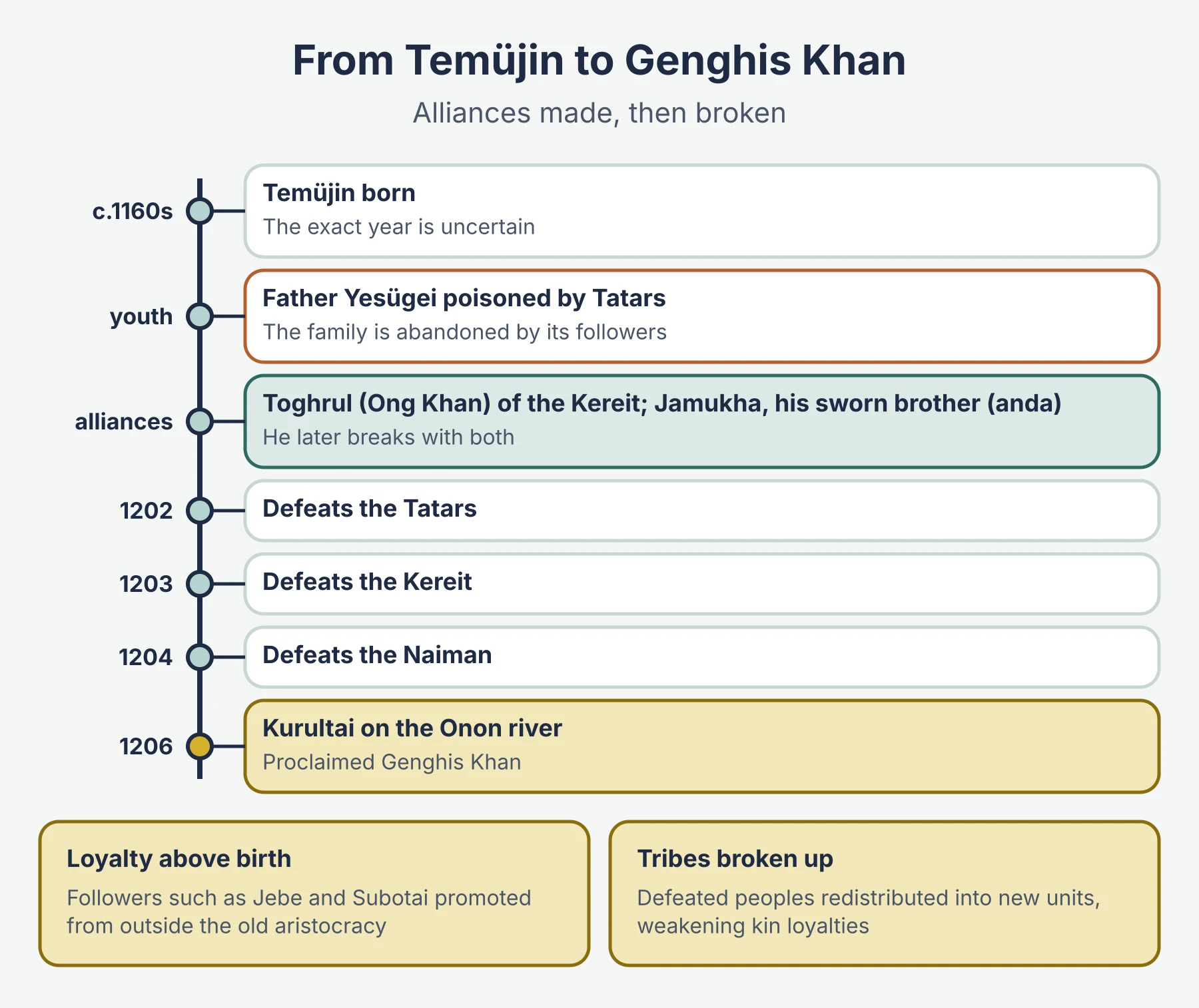
Temüjin was born around the 1160s; the exact year is uncertain. After his father Yesügei was poisoned by Tatars, the family was abandoned by its followers, and Temüjin’s early career depended on alliances: with Toghrul (Ong Khan) of the Kereit and with his sworn brother (anda) Jamukha. He broke with Jamukha and then with Toghrul, defeating the Tatars (1202), the Kereit (1203) and the Naiman (1204). At the kurultai (assembly) of 1206 on the Onon river he was proclaimed Genghis Khan.
Two features of his rise matter for source questions. First, he rewarded loyalty above birth, promoting followers such as Jebe and Subotai who came from outside the old aristocracy. Second, he broke up defeated tribes and redistributed their people among new units, weakening old kin loyalties.
Methods and campaigns
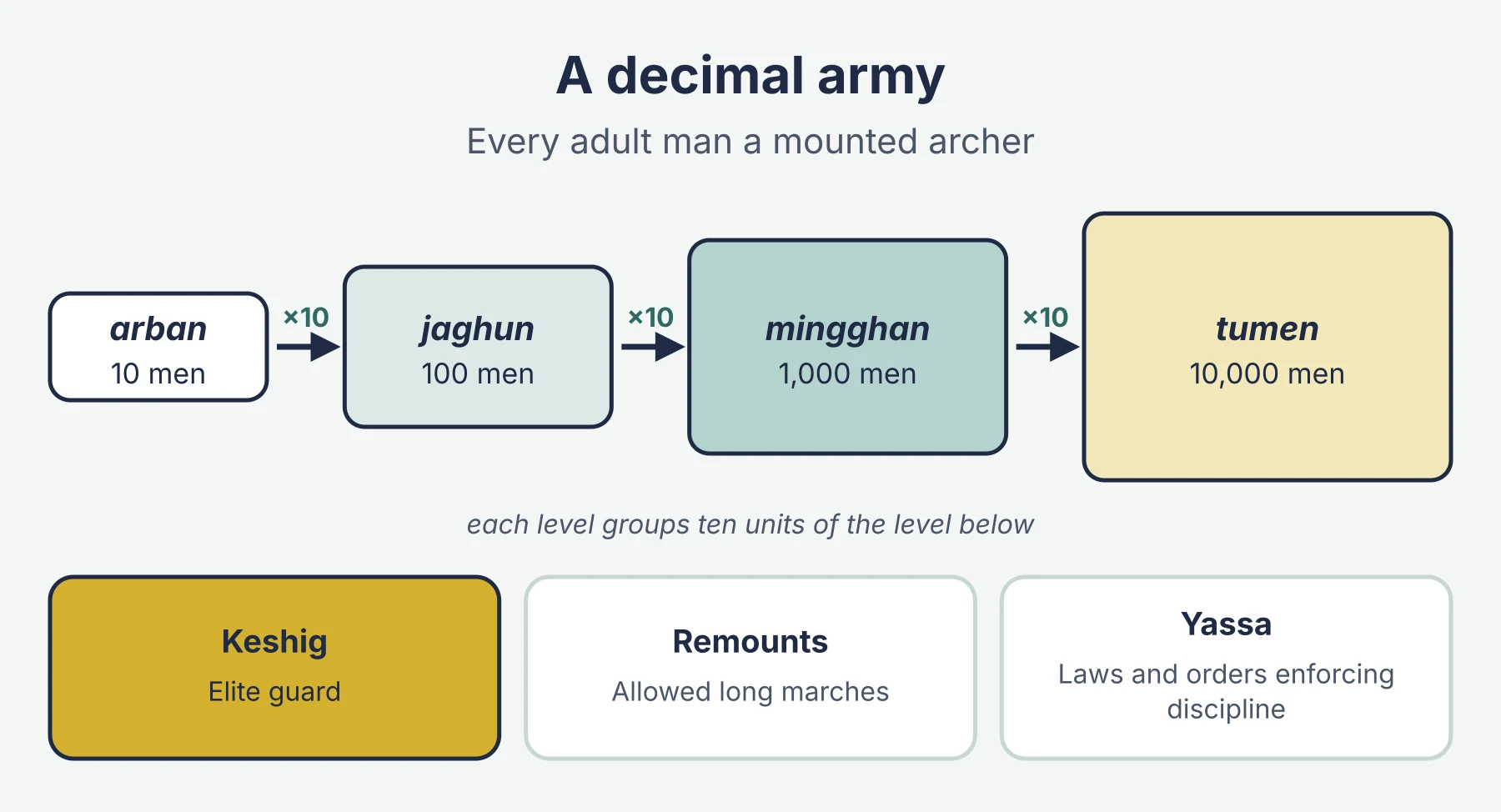
The army was organised in decimal units: arban (10), jaghun (100), mingghan (1,000) and tumen (10,000), with an elite guard, the keshig. Every adult man was a mounted archer, so the army was highly mobile, and remounts allowed long marches. Discipline was enforced under the Yassa, the body of laws and orders associated with him.
The main campaigns were:
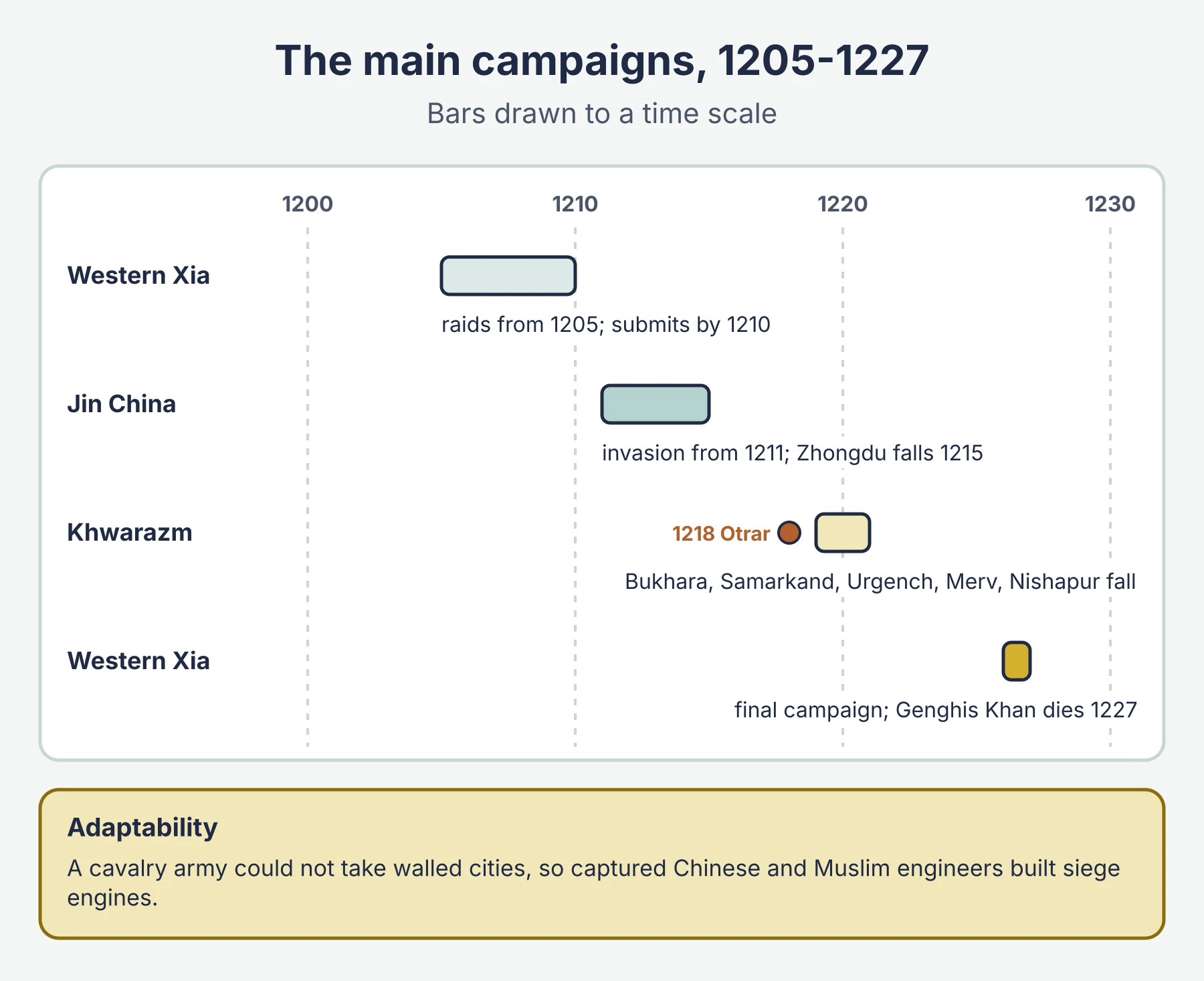
- Western Xia (Tangut kingdom): raids from 1205 and submission by 1210.
- Jin China: invasion from 1211; the Jin moved their court south to Kaifeng and Zhongdu (near modern Beijing) fell in 1215. The Mongols used captured Chinese and Muslim engineers to build siege engines.
- Khwarazmian Empire: after the governor of Otrar killed a Mongol-sponsored caravan in 1218 and the Shah killed an envoy, the Mongols invaded (1219-1221). Bukhara, Samarkand, Urgench, Merv and Nishapur fell, several with mass killing.
- Western Xia again: Genghis Khan died in 1227 during the final campaign against the Tanguts.
Impact
He created the largest land empire yet seen, which his successors extended. Within it, merchants and envoys could travel more safely, a courier system linked distant regions, and religious communities were generally tolerated if they submitted. Against this stand the destruction of cities in Khwarazm and northern China and the deliberate use of terror to induce surrender.
Case study 2: Richard I
Rise to power
Richard, born in 1157, was the third son of Henry II and Eleanor of Aquitaine and was made Duke of Aquitaine as a youth. He joined the great revolt of 1173-1174 against his father, then spent years suppressing rebellious Aquitanian lords, gaining his reputation as a soldier with the capture of Taillebourg (1179). Allied with Philip II of France, he forced Henry II to submit shortly before Henry’s death in July 1189, and was crowned in September 1189.
The Third Crusade
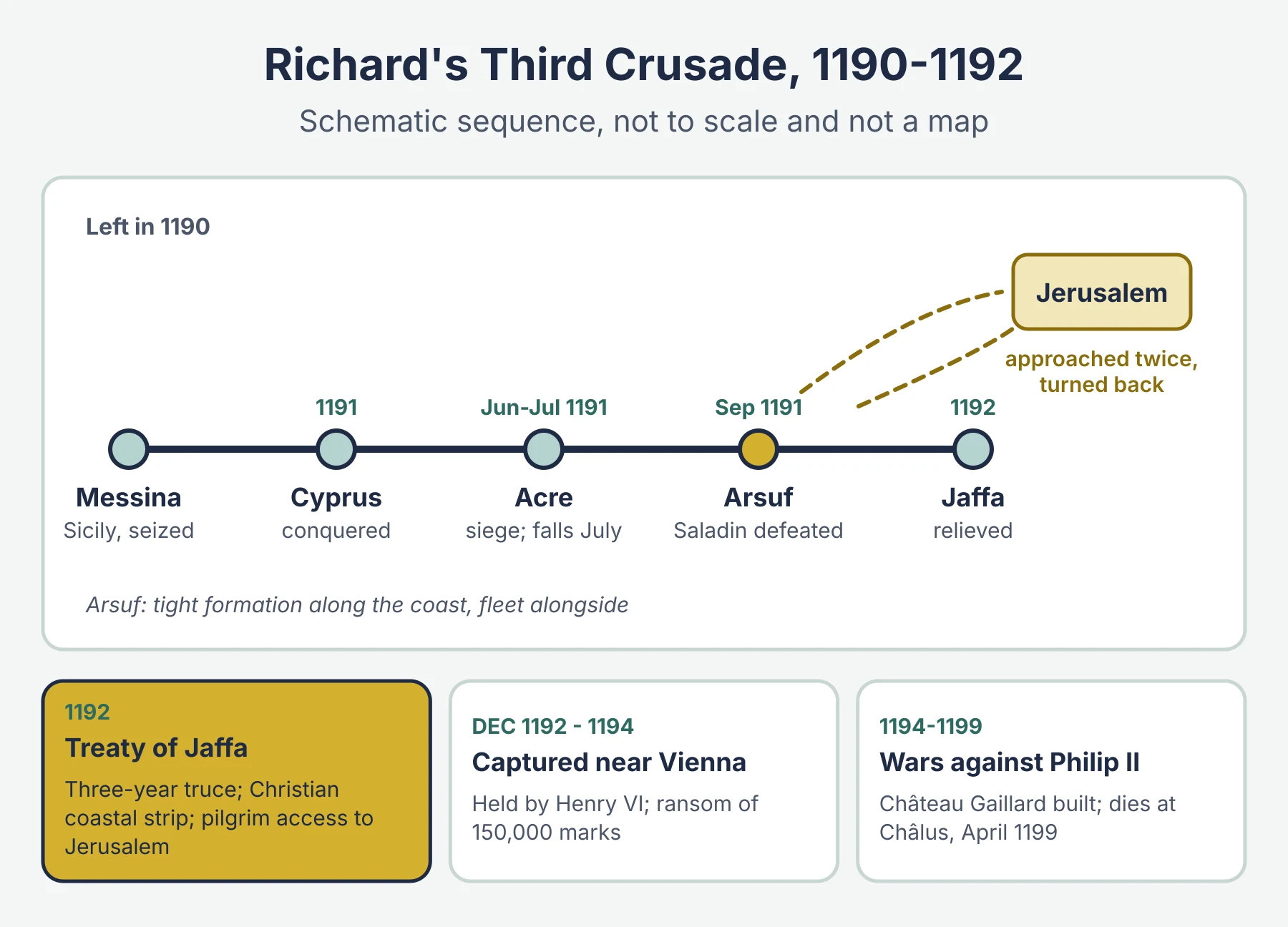
Richard raised money on a huge scale, selling offices and privileges, and left in 1190. On the way he seized Messina in Sicily and conquered Cyprus (1191). He reached the siege of Acre in June 1191; the city surrendered in July. When the exchange of prisoners stalled, he had about 2,700 Muslim prisoners executed in August. On the march south he defeated Saladin at Arsuf (September 1191), keeping his army in tight formation along the coast with the fleet alongside. He twice approached Jerusalem but turned back, judging that the city could be taken but not held once the crusaders left. After relieving Jaffa (1192) he agreed the Treaty of Jaffa with Saladin: a three-year truce, a Christian coastal strip, and access for Christian pilgrims to Jerusalem.
Return, captivity and wars in France
Captured near Vienna by Leopold V of Austria in December 1192, he was handed to the Emperor Henry VI and released in 1194 after a ransom of 150,000 marks was agreed. He then spent five years fighting Philip II, who had seized Angevin lands, and built Château Gaillard to guard Normandy. He died in April 1199 from a crossbow wound at the siege of Châlus.
Impact
The crusade secured the coastal kingdom for another century but did not recover Jerusalem. England bore heavy taxation for the crusade, the ransom and the French wars, while being governed in Richard’s absence by ministers such as Hubert Walter.
Worked example: Question 4-style answer plan
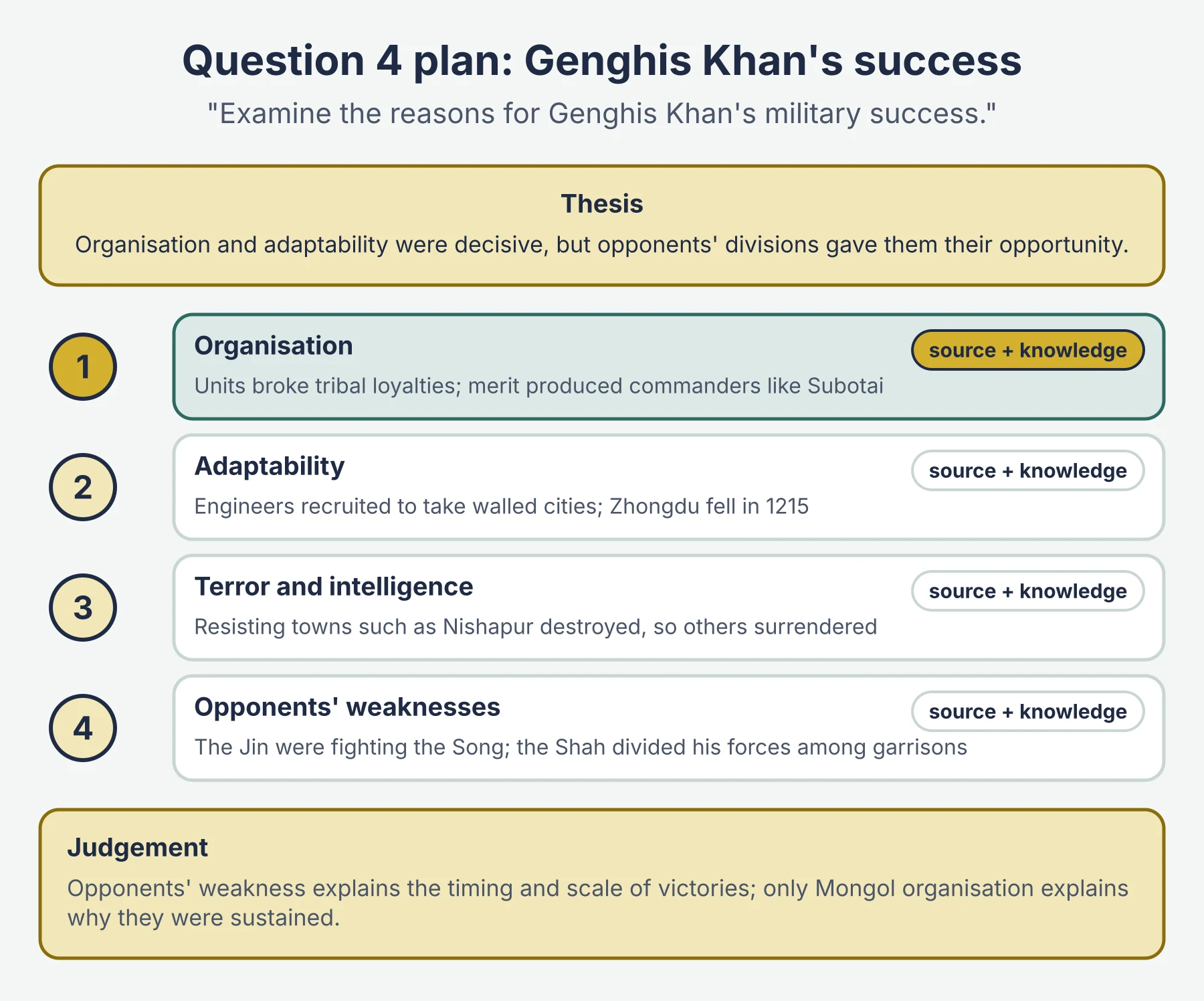
Question: “Using the sources and your own knowledge, examine the reasons for Genghis Khan’s military success.”
Thesis: organisation and adaptability were decisive, but opponents’ divisions gave them their opportunity.
- Organisation (link to any source on the decimal army): units broke tribal loyalties; promotion by merit produced commanders like Subotai.
- Adaptability: the cavalry army could not take walled cities, so it recruited engineers; Zhongdu fell in 1215.
- Terror and intelligence: towns that resisted, such as Nishapur, were destroyed, encouraging others to surrender.
- Opponents’ weaknesses: the Jin were fighting the Song and the Khwarazmian Shah had divided his forces among garrisons.
Judgement: opponents’ weakness explains the timing and scale of victories, but only Mongol organisation explains why they were sustained.
Each paragraph should cite at least one source by letter alongside own knowledge, and evaluate a source where it helps (for example, a later Persian chronicler’s account of a massacre may exaggerate numbers but confirms the policy).
Handling the sources
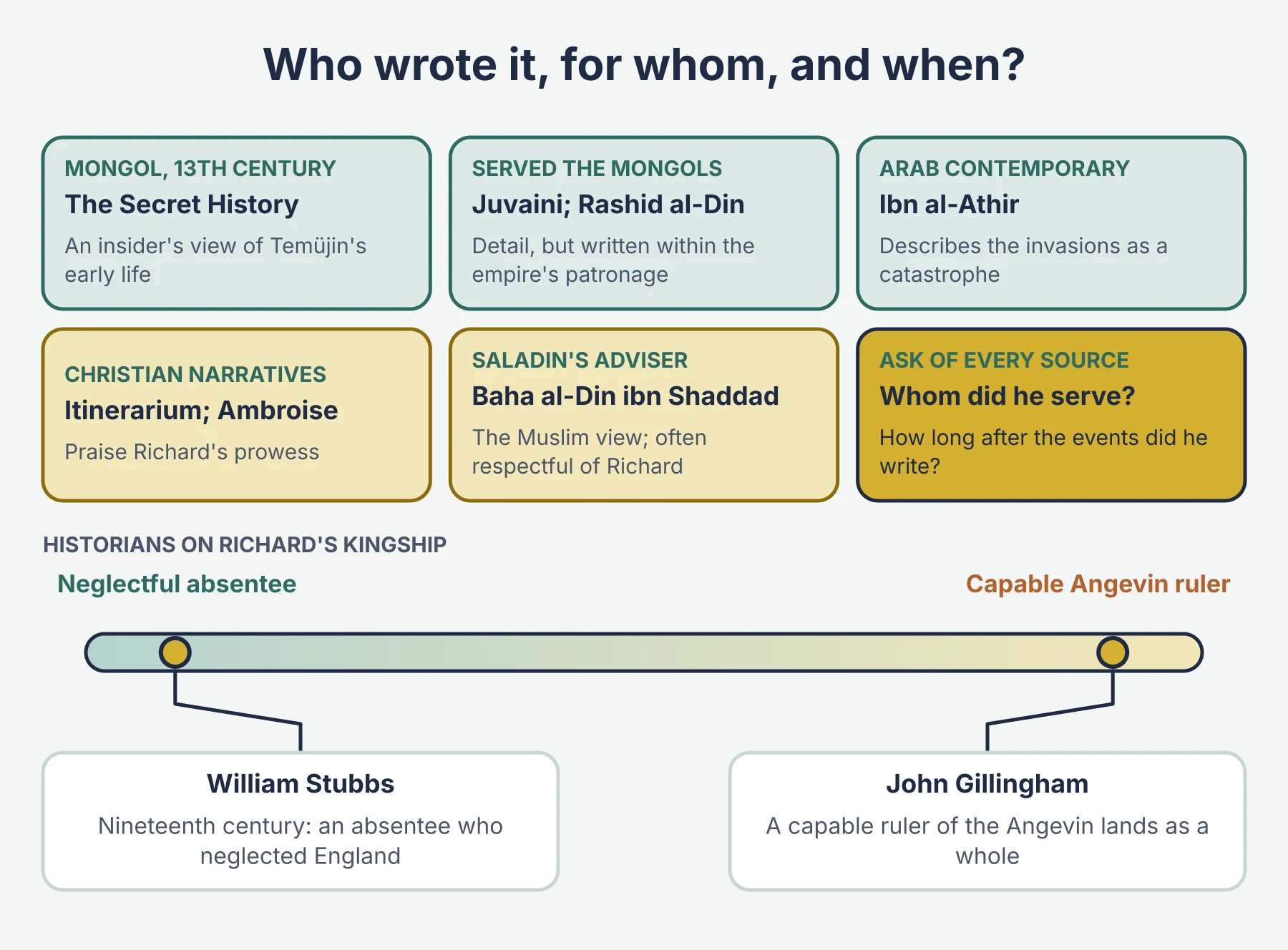
Mongol sources. The Secret History of the Mongols, written in Mongolian in the thirteenth century, gives an insider’s view of Temüjin’s early life. Persian historians such as Juvaini, who served the Mongols, and Rashid al-Din, writing for a later Mongol ruler, offer detail but write within the empire’s patronage. Ibn al-Athir, an Arab contemporary, describes the invasions as a catastrophe. Ask who the writer served and how long after the events he wrote.
Richard I sources. Christian narratives such as the Itinerarium and Ambroise’s verse history praise Richard’s prowess; Baha al-Din ibn Shaddad, Saladin’s adviser, gives the Muslim view and is often respectful of Richard as an opponent. Historians disagree about his kingship: nineteenth-century writers such as William Stubbs judged him an absentee who neglected England, while John Gillingham argues that he was a capable ruler of the Angevin lands as a whole.
Common mistakes
- Treating Genghis Khan’s empire as complete in 1227; much of the later empire was conquered by his successors.
- Calling Arsuf the capture of Jerusalem, or forgetting that Jerusalem stayed in Muslim hands.
- Judging Richard only as king of England when most of his lands and interests were in France.
- Using casualty figures from chronicles as fact: they are often impossibly large.
- Ignoring the provenance of a source written generations after the events.
Exam technique
Analyse and examine ask you to break a claim into factors. Evaluate requires both strengths and limits. To what extent demands a judgement. In Question 2, tie value and limitations to the stated topic: a crusader chronicle may be valuable for how Richard was seen by his army but limited for Saladin’s strategy.
Go on to the Military leaders revision notes for condensed recall and the Military leaders practice questions for a full source set.
Related resources
-
Practice questions
IB DP History (DP History): Military leaders – Practice Questions
Twelve original IB History practice questions on Military leaders: recall on Genghis Khan and Richard I, then a Paper 1-style source set on the Third Crusade.
World History · International Baccalaureate · IB
Try questions -
Revision notes
IB DP History (DP History): Military leaders – Revision Notes
Revision notes for IB History Paper 1 Military leaders: timelines for Genghis Khan and Richard I, key terms, source traps and a twelve-question self-test.
World History · International Baccalaureate · IB
Revise topic -
Study guides
IB DP History (DP History): Conquest and its impact
Prescribed subject 2 for IB History Paper 1: the fall of Nasrid Granada and the Spanish conquest of Mexico and Peru, with source advice and a worked comparison.
World History · International Baccalaureate · IB
Read guide
Get free revision emails (optional)
Occasional emails with practice questions, worked explanations and links to free resources for the qualification and subjects you choose. No spam, and you can unsubscribe from any email. The free tools on this site never need an email.