
Revision Notes
IB DP History (DP History): Military leaders – Revision Notes
Revision notes for IB History Paper 1 Military leaders: timelines for Genghis Khan and Richard I, key terms, source traps and a twelve-question self-test.
- Subject
- World History
- Level
- IB
- Topic
- Topic 1: Prescribed subjects
- Author
- Marlbridge Academic Team
- Updated
- Reviewed by
- Azam Siddique (what this means)
Aligned to International Baccalaureate IB Diploma Programme History (DP History), First assessment 2017. Official specification .
Syllabus page (what it covers and how it is assessed): IB Diploma Programme History.
Syllabus points this page covers
DP History
- 1 Military leaders
Found an error? Report a correction.
Need help with this topic? Request a free trial class for IB Diploma Programme History (DP History / DP History (2028)).
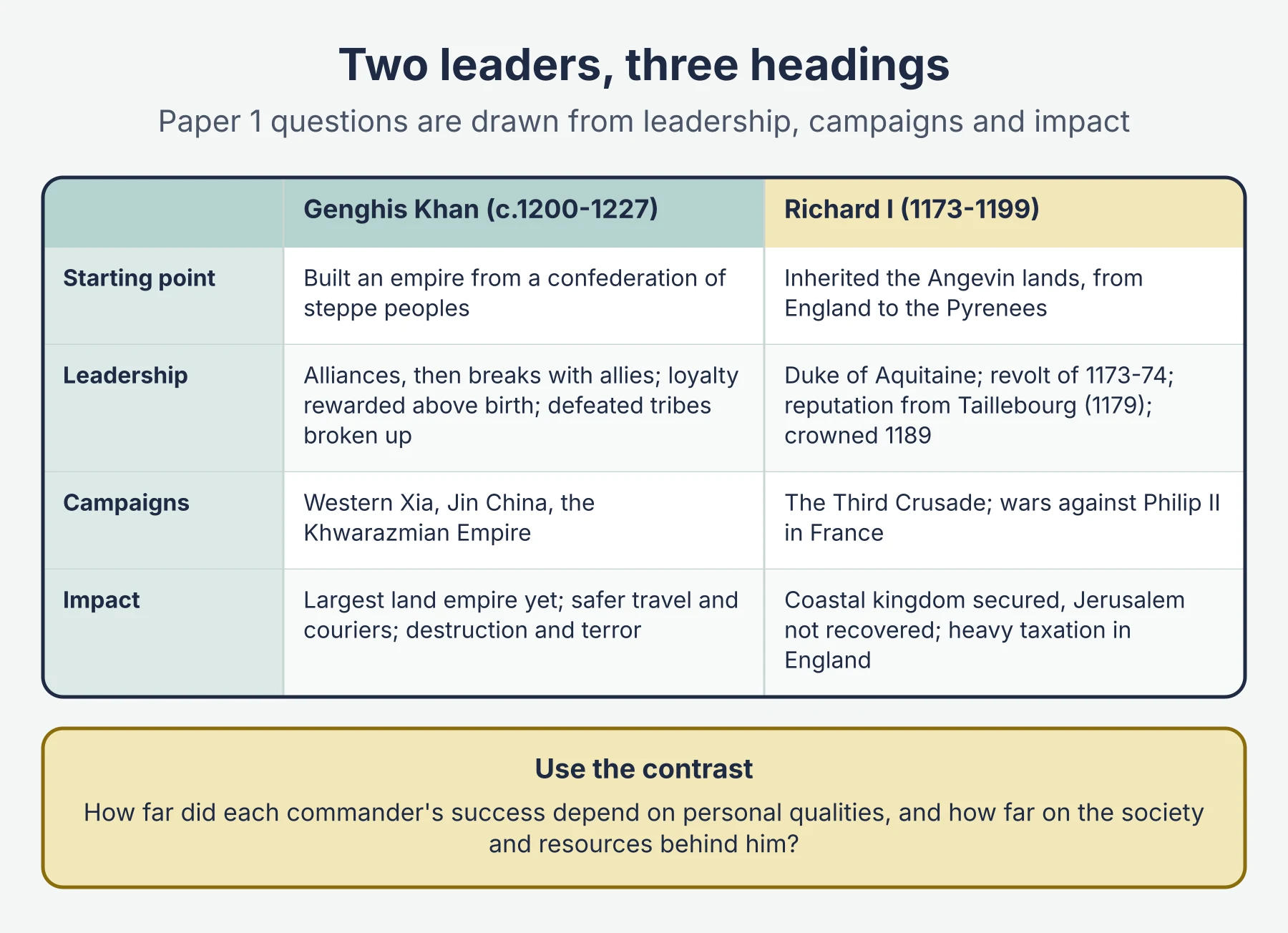
Prescribed subject 1 pairs Genghis Khan (c.1200-1227) with Richard I of England (1173-1199). Paper 1 sources are set on one case study, so revise both under the guide’s three headings: leadership, campaigns and impact.
Related: Military leaders study guide and Military leaders practice questions.
Genghis Khan: timeline
| Date | Event | Why it matters |
|---|---|---|
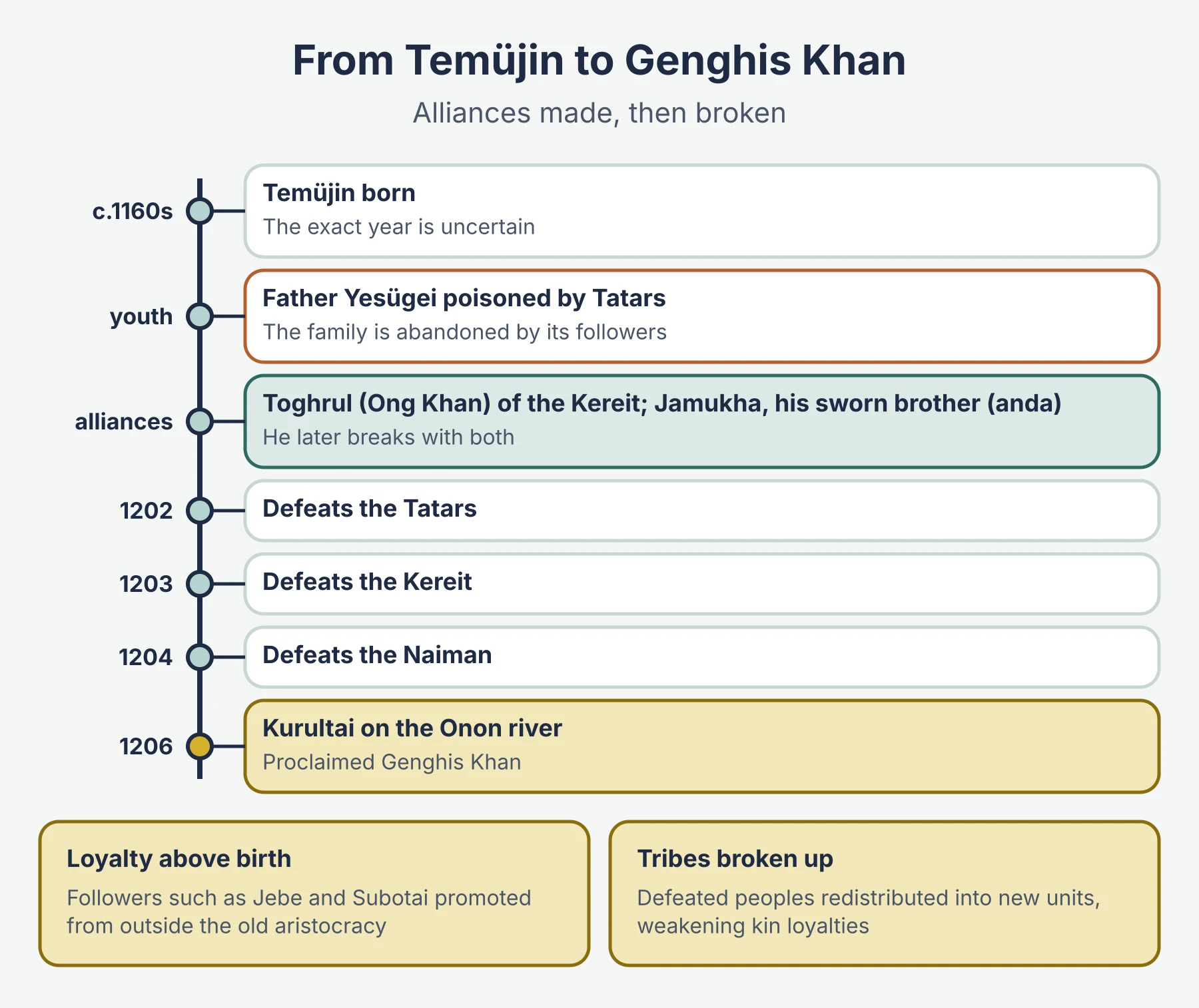
| c.1160s | Temüjin born; father Yesügei later poisoned by Tatars | Early isolation; career built on alliances, not inheritance |
| 1180s-1190s | Alliances with Toghrul (Ong Khan) and Jamukha; break with Jamukha | Shows political skill and willingness to discard allies |
| 1202-1204 | Defeats Tatars, Kereit and Naiman | Steppe unified by conquest |
| 1206 | Kurultai proclaims him Genghis Khan | Legitimacy through assembly; new decimal army created |
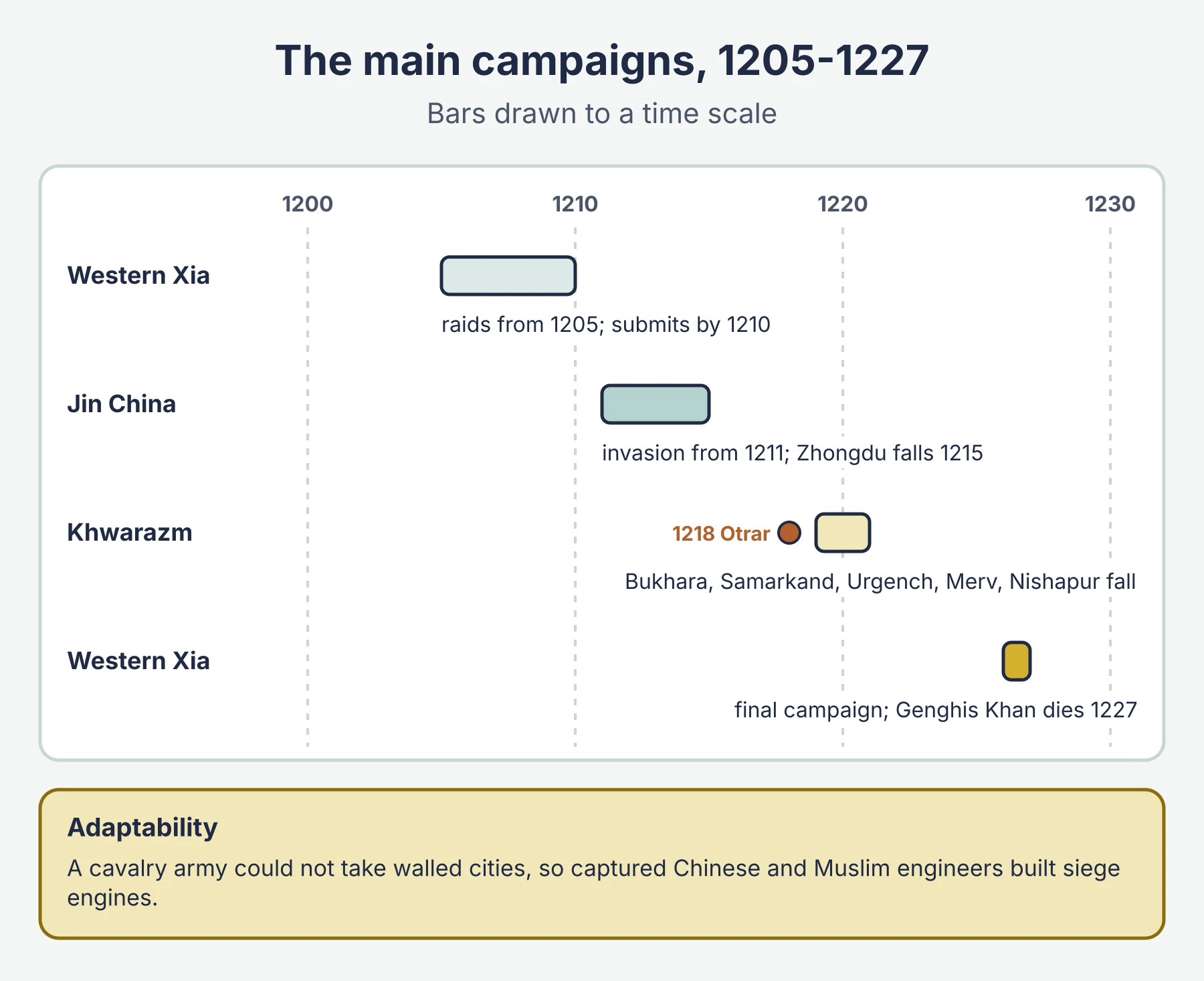
| 1209-1210 | Western Xia submits | First sedentary state brought under tribute |
| 1211-1215 | War on the Jin; Jin court moves to Kaifeng; Zhongdu falls (1215) | Siege engineers recruited; huge plunder |
| 1218 | Otrar incident: caravan killed; envoy executed by the Shah | The trigger for the western campaign |
| 1219-1221 | Conquest of Khwarazm: Bukhara, Samarkand, Urgench, Merv, Nishapur | Terror as policy; destruction of cities |
| 1227 | Dies during the final campaign against Western Xia | Empire passes to his sons; Ögedei elected in 1229 |
Richard I: timeline
| Date | Event | Why it matters |
|---|---|---|
| 1157 | Born, third son of Henry II and Eleanor of Aquitaine | Not expected to inherit England |
| 1173-1174 | Joins the revolt against Henry II | Family rivalry shaped his career |
| 1179 | Takes Taillebourg in Aquitaine | Reputation as a siege commander |
| 1189 | Allies with Philip II against Henry II; crowned in September | Comes to power through rebellion |
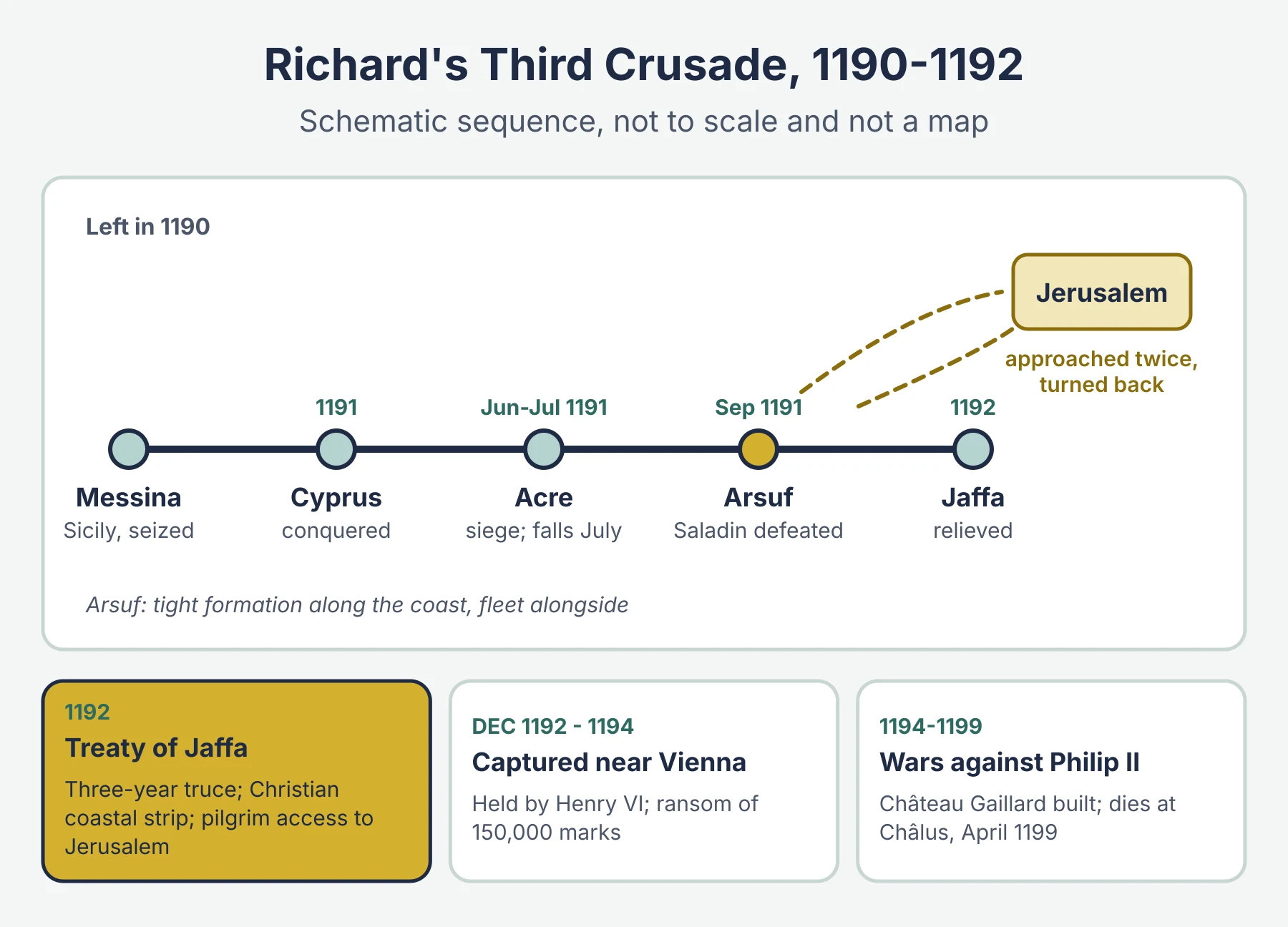
| 1190-1191 | Seizes Messina; conquers Cyprus | Secures bases and money for the crusade |
| July 1191 | Acre surrenders | Main military gain of the crusade |
| August 1191 | Execution of about 2,700 Muslim prisoners | Debated: military necessity or atrocity |
| September 1191 | Victory over Saladin at Arsuf | Discipline on the march; coast secured |
| 1192 | Turns back from Jerusalem; relieves Jaffa; Treaty of Jaffa | Truce, coastal strip, pilgrim access |
| 1192-1194 | Captured by Leopold V; held by Henry VI; ransom of 150,000 marks | Heavy taxation in his lands |
| 1194-1199 | Wars with Philip II; Château Gaillard built | Defence of Normandy |
| 1199 | Dies from a crossbow wound at Châlus | Angevin lands pass to John |
Key terms
| Term | Meaning |
|---|---|
| Kurultai | Mongol assembly of leaders that chose or confirmed a khan |
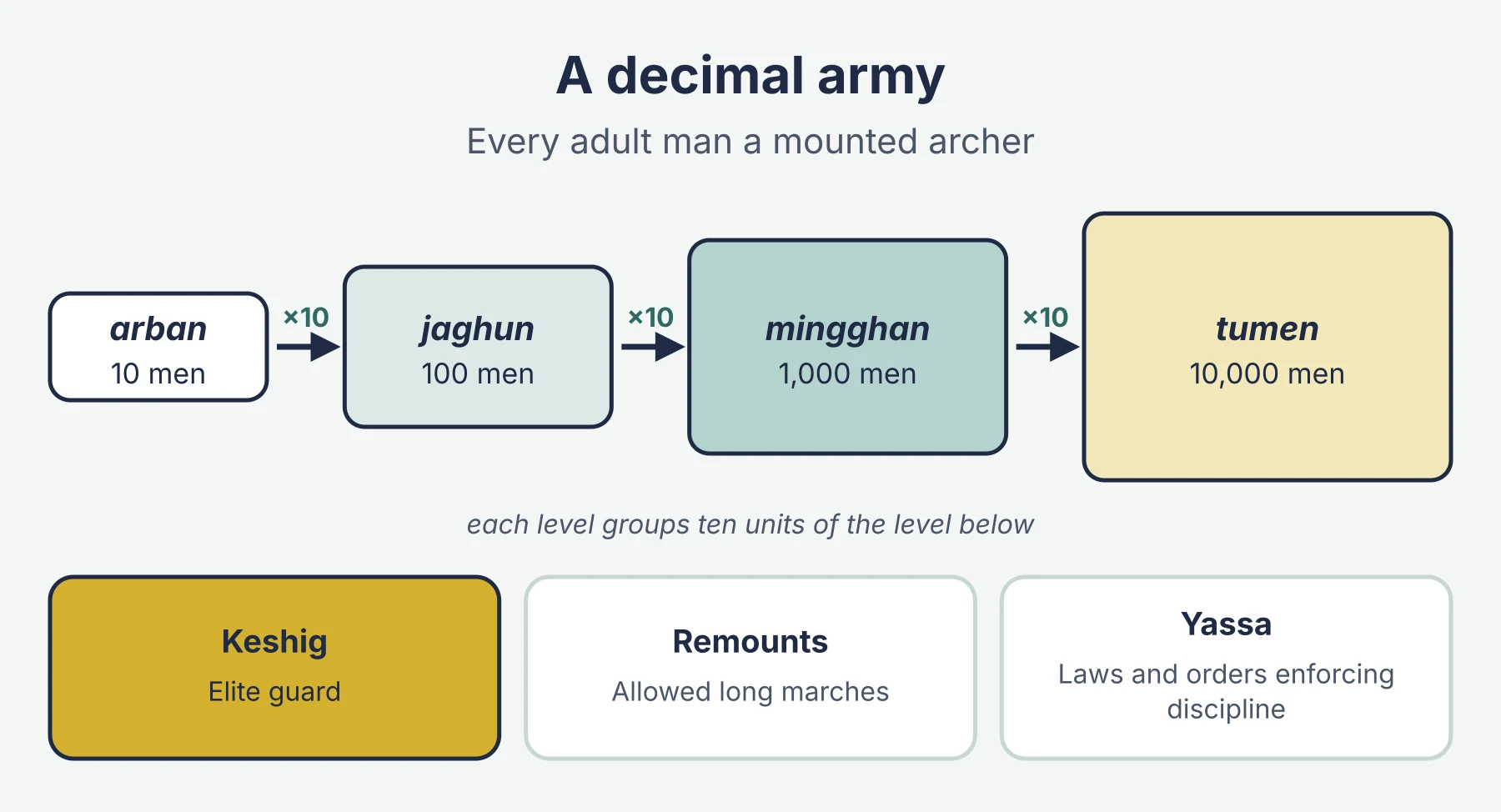
| Tumen | Mongol unit of 10,000; with mingghan (1,000), jaghun (100) and arban (10) |
| Keshig | Genghis Khan’s personal guard, also a training ground for commanders |
| Yassa | Laws and orders associated with Genghis Khan |
| Anda | Sworn brother; Jamukha was Temüjin’s |
| Angevin Empire | The lands of Henry II and his sons: England, Normandy, Anjou, Aquitaine and more |
| Saladin tithe | Tax levied in 1188 to pay for the crusade |
| Treaty of Jaffa | 1192 truce between Richard and Saladin |
| Justiciar | Chief minister governing England in the king’s absence |
Comparison grid
| Theme | Genghis Khan | Richard I |
|---|---|---|
| Route to power | Built a following from almost nothing | Inherited, after rebelling against his father |
| Army | Mass mounted archers, decimal units | Knights, infantry and crossbowmen, often hired |
| Strength | Mobility, scale and adaptation | Tactical discipline, siege skill, logistics by sea |
| Limits | Struggled at first against walled cities | Could not hold Jerusalem without a permanent army |
| Legacy | A new empire and new trade links | A secured coast, but a costly absence from his lands |
Source checklist
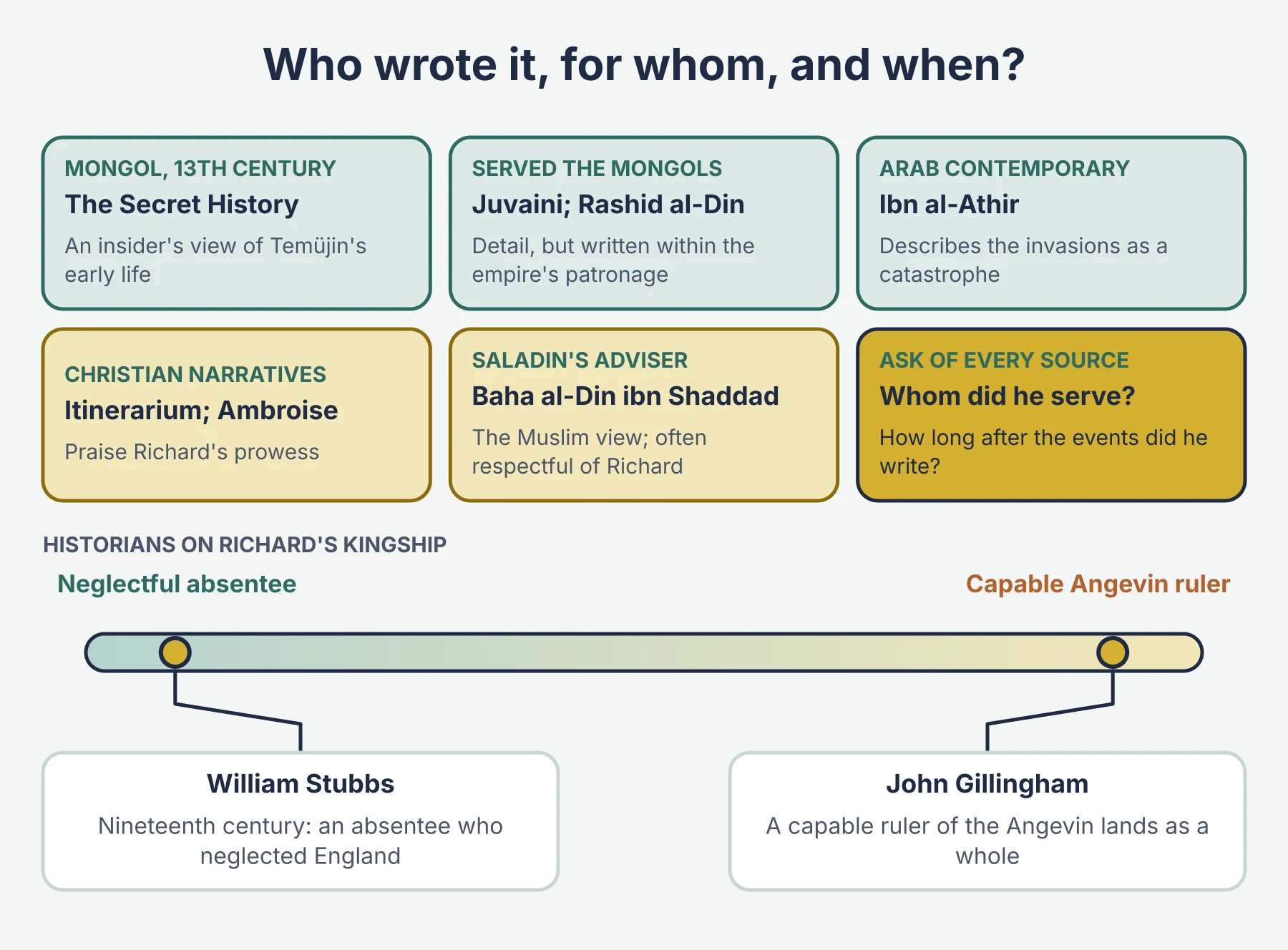
- Who and when? The Secret History of the Mongols (thirteenth century, Mongol insider); Juvaini and Rashid al-Din (Persian historians working for Mongol rulers); Ibn al-Athir (hostile Arab contemporary). For Richard: crusader narratives (Ambroise, the Itinerarium), Baha al-Din ibn Shaddad (Saladin’s side).
- Numbers. Chronicle figures for armies and massacres are often inflated. Treat them as evidence of how events were perceived.
- Purpose. Praise poems and court histories glorify; enemy chronicles condemn. Both can still be valuable for attitudes.
Exam traps
- Ignoring the date limits. Genghis Khan’s case study starts around 1200; do not spend paragraphs on Kublai Khan.
- Personal genius only. A top-band Question 4 answer weighs the leader against wider factors: his army, resources and opponents.
- “Richard neglected England.” This is one historians’ view; present it as a debate, not a fact.
- Confusing Acre and Arsuf. Acre was a siege (surrender in July 1191); Arsuf a battle on the march (September 1191).
- Using own knowledge in Question 1. Comprehension marks come from the source only.
Self-test
- At which assembly, and in which year, was Temüjin proclaimed Genghis Khan? The kurultai of 1206.
- Name the four Mongol decimal units from smallest to largest. Arban, jaghun, mingghan, tumen.
- What event in 1218 triggered the invasion of the Khwarazmian Empire? The killing of a Mongol-sponsored caravan at Otrar and the execution of an envoy.
- Why did the Mongols recruit engineers from conquered peoples? Their cavalry could not take walled cities without siege engines.
- In which year did Zhongdu fall? 1215.
- During which campaign did Genghis Khan die? The final campaign against Western Xia, in 1227.
- What were Richard I’s parents’ names? Henry II and Eleanor of Aquitaine.
- Which island did Richard conquer on his way to the Holy Land? Cyprus.
- What were the main terms of the Treaty of Jaffa? A three-year truce, a Christian-held coastal strip and access for Christian pilgrims to Jerusalem.
- Why did Richard turn back from Jerusalem? He judged that it could not be held once the crusade army left.
- Who captured Richard on his return, and who held him for ransom? Leopold V of Austria captured him; the Emperor Henry VI held him.
- Give one value and one limitation of Baha al-Din ibn Shaddad as a source on Richard. Value: a close adviser of Saladin with direct knowledge of Muslim decisions. Limitation: written to honour Saladin, so it presents his choices favourably.
Related resources
-
Study guides
IB DP History (DP History): Conquest and its impact
Prescribed subject 2 for IB History Paper 1: the fall of Nasrid Granada and the Spanish conquest of Mexico and Peru, with source advice and a worked comparison.
World History · International Baccalaureate · IB
Read guide -
Practice questions
IB DP History (DP History): Conquest and its impact – Practice Questions
Twelve original IB History practice questions on Conquest and its impact: recall on Mexico and Peru, then a Paper 1-style source set on the fall of Granada.
World History · International Baccalaureate · IB
Try questions -
Revision notes
IB DP History (DP History): Conquest and its impact – Revision Notes
Revision notes for IB History Paper 1 Conquest and its impact: Granada 1482-1492 and Mexico and Peru 1519-1551, key terms, traps and a self-test.
World History · International Baccalaureate · IB
Revise topic
Get free revision emails (optional)
Occasional emails with practice questions, worked explanations and links to free resources for the qualification and subjects you choose. No spam, and you can unsubscribe from any email. The free tools on this site never need an email.