
Revision Notes
IB DP History (DP History): Conquest and its impact – Revision Notes
Revision notes for IB History Paper 1 Conquest and its impact: Granada 1482-1492 and Mexico and Peru 1519-1551, key terms, traps and a self-test.
- Subject
- World History
- Level
- IB
- Topic
- Topic 1: Prescribed subjects
- Author
- Marlbridge Academic Team
- Updated
- Reviewed by
- Azam Siddique (what this means)
Aligned to International Baccalaureate IB Diploma Programme History (DP History), First assessment 2017. Official specification .
Syllabus page (what it covers and how it is assessed): IB Diploma Programme History.
Syllabus points this page covers
DP History
- 2 Conquest and its impact
Found an error? Report a correction.
Need help with this topic? Request a free trial class for IB Diploma Programme History (DP History / DP History (2028)).
Prescribed subject 2 has two case studies: the final stages of Muslim rule in Spain (1482-1492) and the conquest of Mexico and Peru (1519-1551). Revise each under context and motives, key events and actors, and impact.
Related: Conquest and its impact study guide and Conquest and its impact practice questions.
Granada: condensed recall
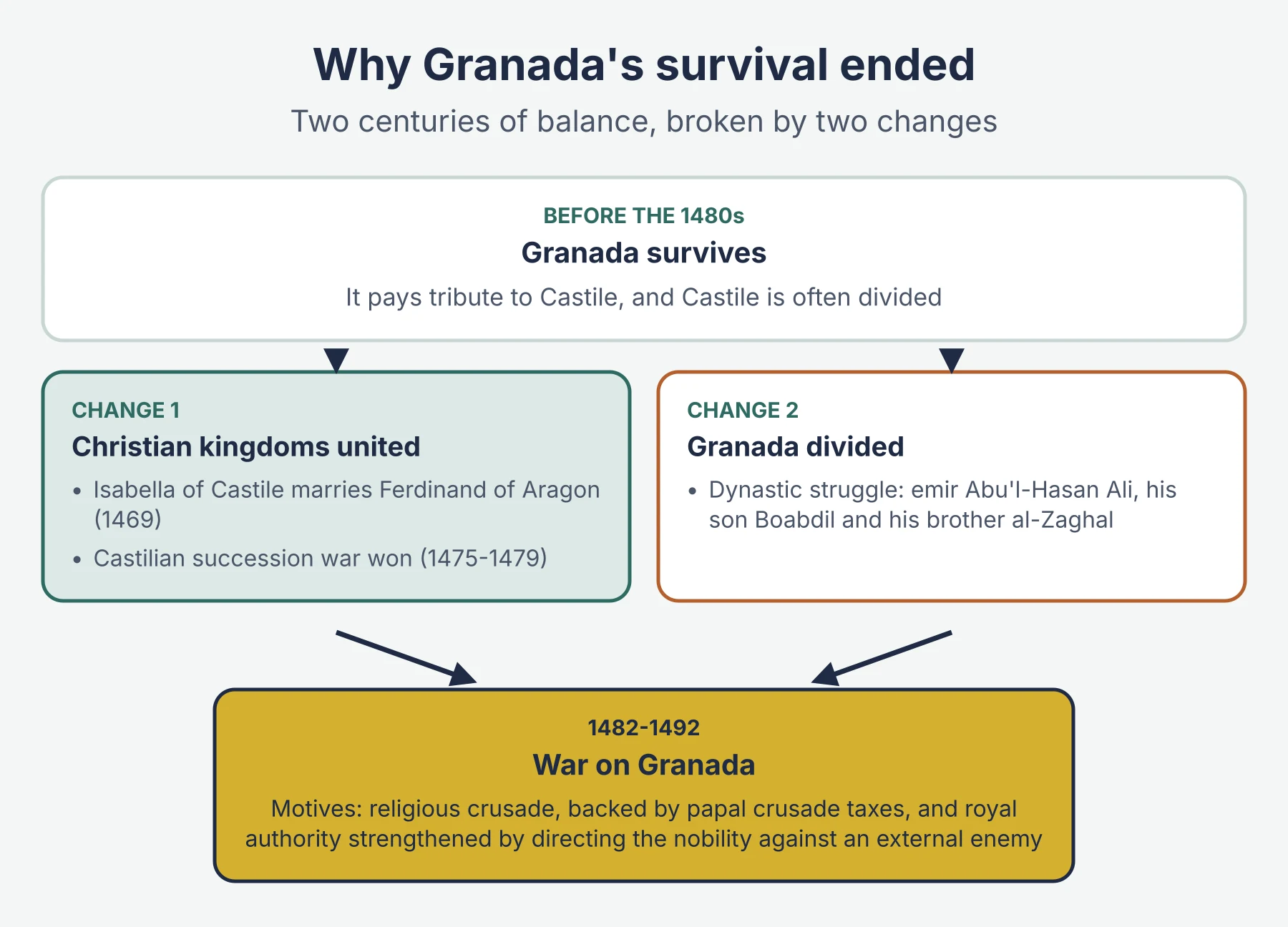
Why Granada fell when it did
- Christian unity: Isabella and Ferdinand married in 1469; Castile and Aragon were ruled jointly after 1479.
- Nasrid division: Abu’l-Hasan Ali, his son Boabdil (Muhammad XII) and his brother al-Zaghal fought each other; Castile exploited this by backing Boabdil.
- Siege warfare: artillery reduced fortresses that had once resisted for years.
- Isolation: little effective help reached Granada from North Africa or the Ottomans.
- Resources: papal crusade taxes and the mobilisation of Castilian towns and nobles.
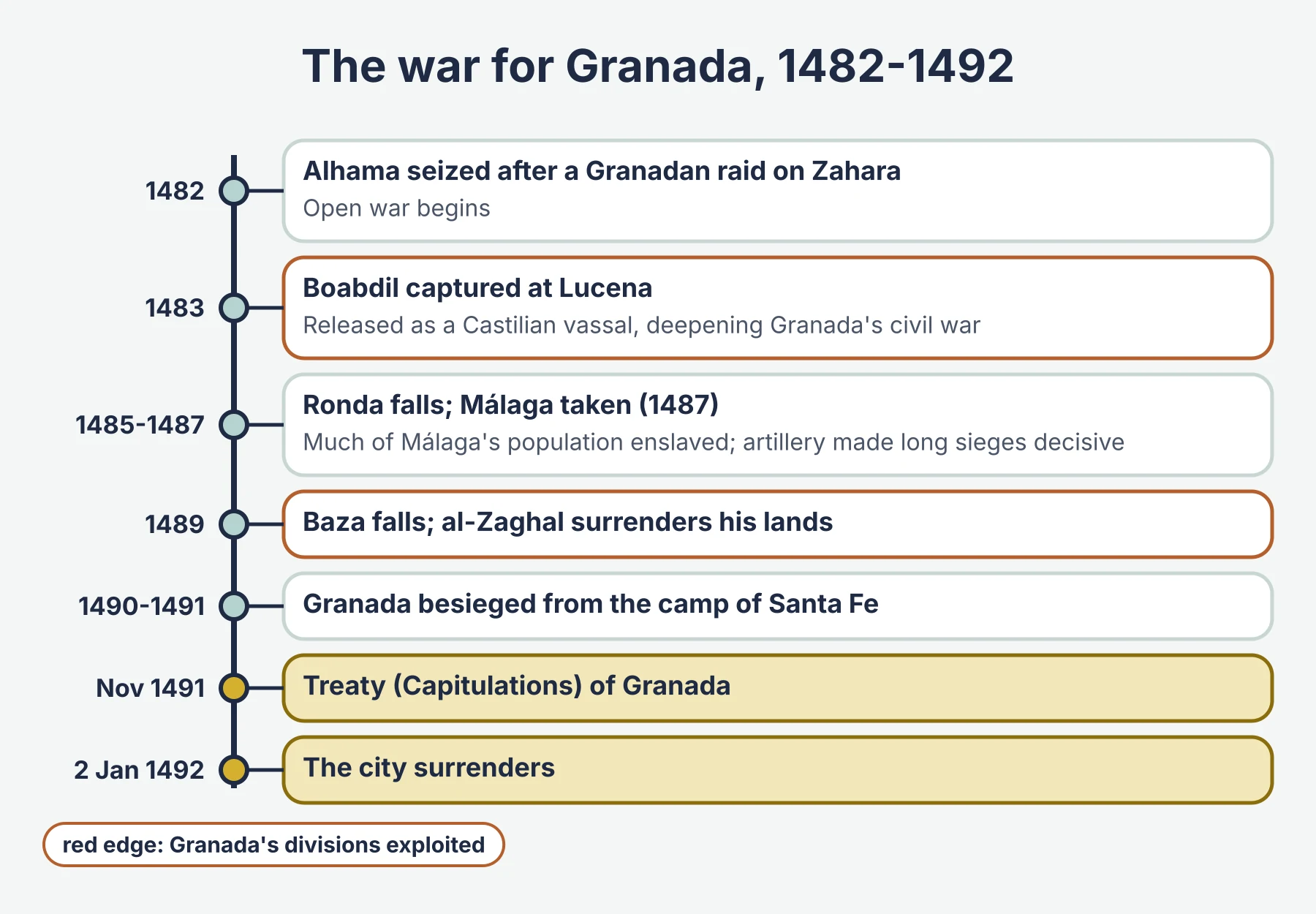
Sequence: Zahara raid (1481) → Alhama (1482) → Boabdil captured at Lucena (1483) → Ronda (1485) → Loja (1486) → Málaga (1487) → Baza; al-Zaghal surrenders (1489) → siege from Santa Fe (1491) → Capitulations (November 1491) → entry into Granada (2 January 1492).
Impact
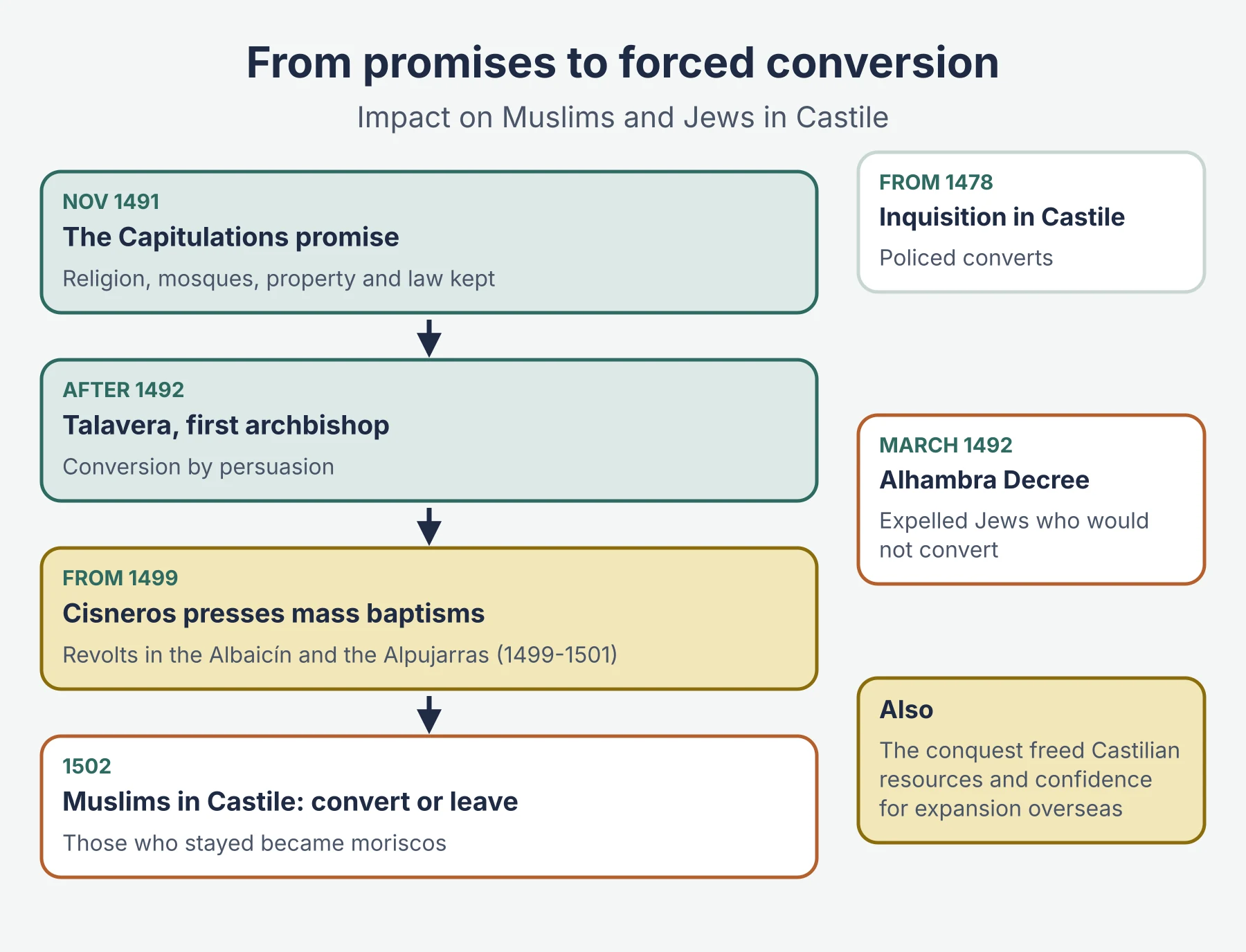
- Generous terms at first; Talavera’s persuasion policy.
- Cisneros’s forced baptisms from 1499; Albaicín and Alpujarras revolts (1499-1501).
- 1502: Castilian Muslims must convert or leave; converts are moriscos.
- Alhambra Decree (March 1492) expels unconverted Jews; the Inquisition watches converts.
- Prestige for the monarchs, named the “Catholic Monarchs” by the Pope in 1496.
Mexico and Peru: condensed recall
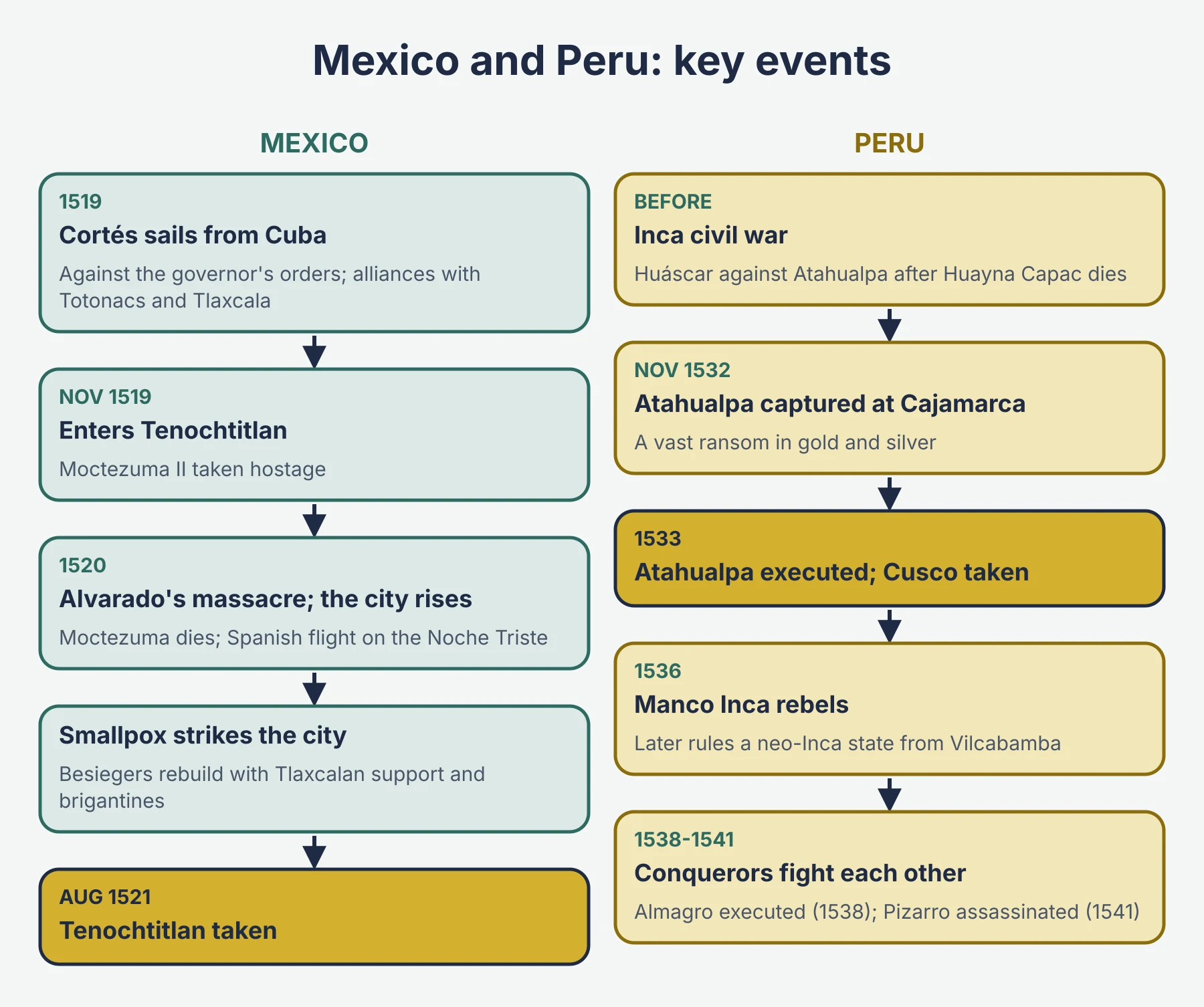
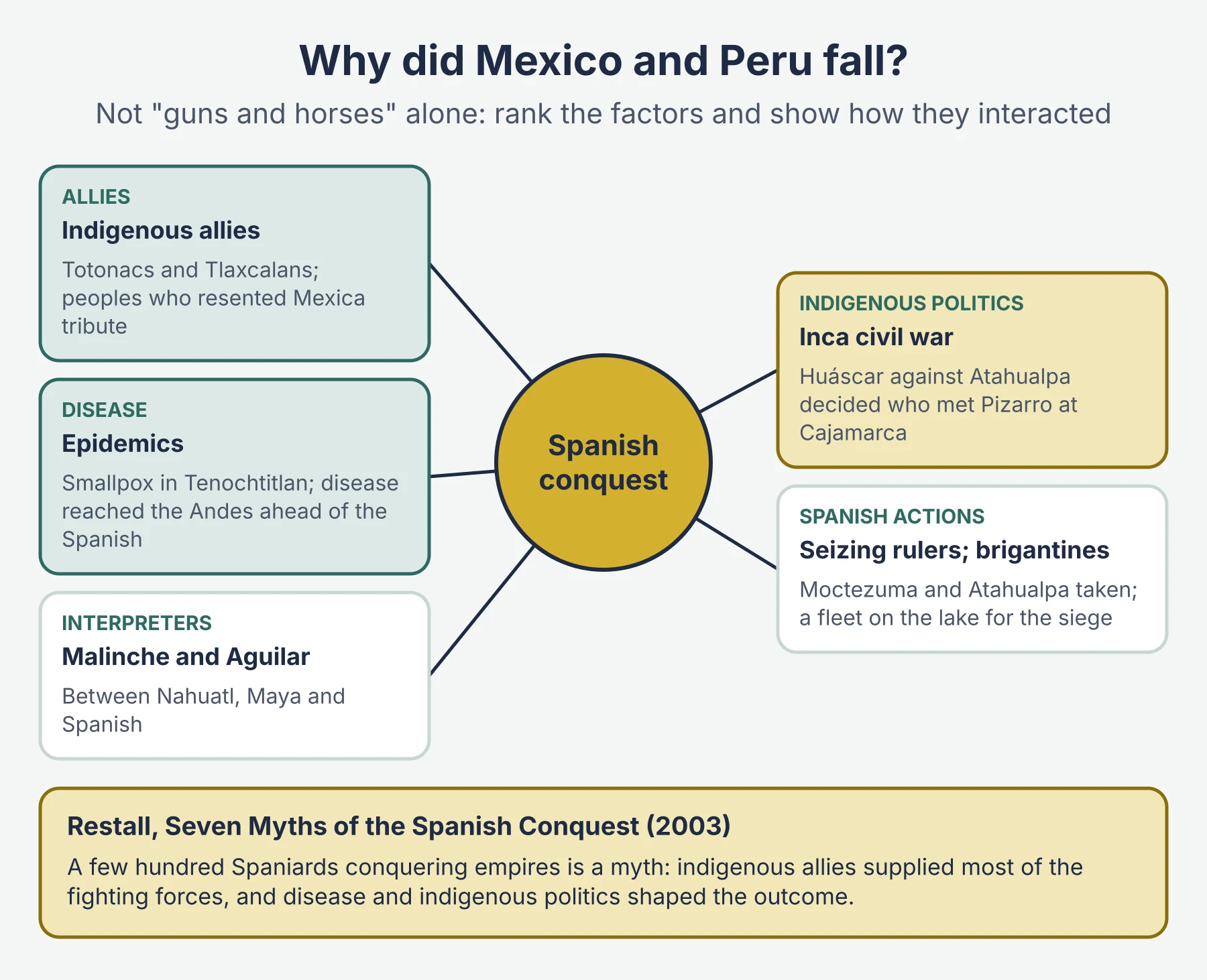
Mexico, 1519-1521: Cortés leaves Cuba (1519) → Malinche and Aguilar as interpreters → Totonac and Tlaxcalan alliances → Cholula massacre → entry to Tenochtitlan (November 1519), Moctezuma held → Alvarado’s festival massacre (1520) → death of Moctezuma; Noche Triste → smallpox in the city → brigantines and siege → fall of Tenochtitlan (August 1521); Cuauhtémoc captured.
Peru, 1532-1551: Inca civil war (Huáscar against Atahualpa) → Cajamarca, capture of Atahualpa (November 1532) → ransom; execution (1533) → Cusco taken (1533) → Manco Inca’s rebellion (1536); Vilcabamba → Almagro executed (1538) → Pizarro assassinated (1541) → New Laws (1542) → Gonzalo Pizarro’s revolt, defeated (1548) → Valladolid debate (1550-1551).
Factors in Spanish success
| Factor | Mexico | Peru |
|---|---|---|
| Indigenous allies | Tlaxcalans and other enemies of the Mexica | Factions opposed to Atahualpa; later, many Andean groups |
| Disease | Smallpox during the 1520 siege | Epidemic before the Spanish arrived, linked to the civil war |
| Political division | Tribute peoples resented Mexica rule | Civil war between brothers |
| Technology | Steel, horses, brigantines on the lake | Steel and horses at Cajamarca |
| Leadership | Cortés’s diplomacy and use of interpreters | Pizarro’s seizure of the ruler |
Key terms
| Term | Meaning |
|---|---|
| Nasrid | The dynasty that ruled the emirate of Granada |
| Capitulations of Granada | The 1491 surrender terms protecting Muslim religion, property and law |
| Mudéjar | Muslim living under Christian rule while keeping his faith |
| Morisco | Muslim convert to Christianity, or a descendant, in Spain |
| Converso | Jewish convert to Christianity |
| Encomienda | Grant of indigenous labour and tribute to a Spaniard in return for protection and instruction |
| New Laws (1542) | Crown laws limiting encomiendas and banning the enslavement of indigenous people |
| Viceroyalty | A territory ruled by a viceroy for the crown: New Spain (1535), Peru (1540s) |
| Requerimiento | A declaration read to indigenous peoples demanding submission to the crown and Church |
| Black Legend | A tradition portraying Spanish rule as uniquely cruel, drawing on Las Casas |
Interpretations to know
- The few conquered the many? Matthew Restall (2003) argues that indigenous allies and disease made the conquests possible and that the “handful of Spaniards” image is a myth.
- Las Casas against Sepúlveda. At Valladolid, Las Casas argued that indigenous peoples were rational and free; Sepúlveda argued that war against them was just.
- Granada as crusade or state-building. It can be read as the last act of the Reconquista or as the monarchs’ use of war to strengthen royal power.
Source types to expect
| Source type | Example | Value | Limitation |
|---|---|---|---|
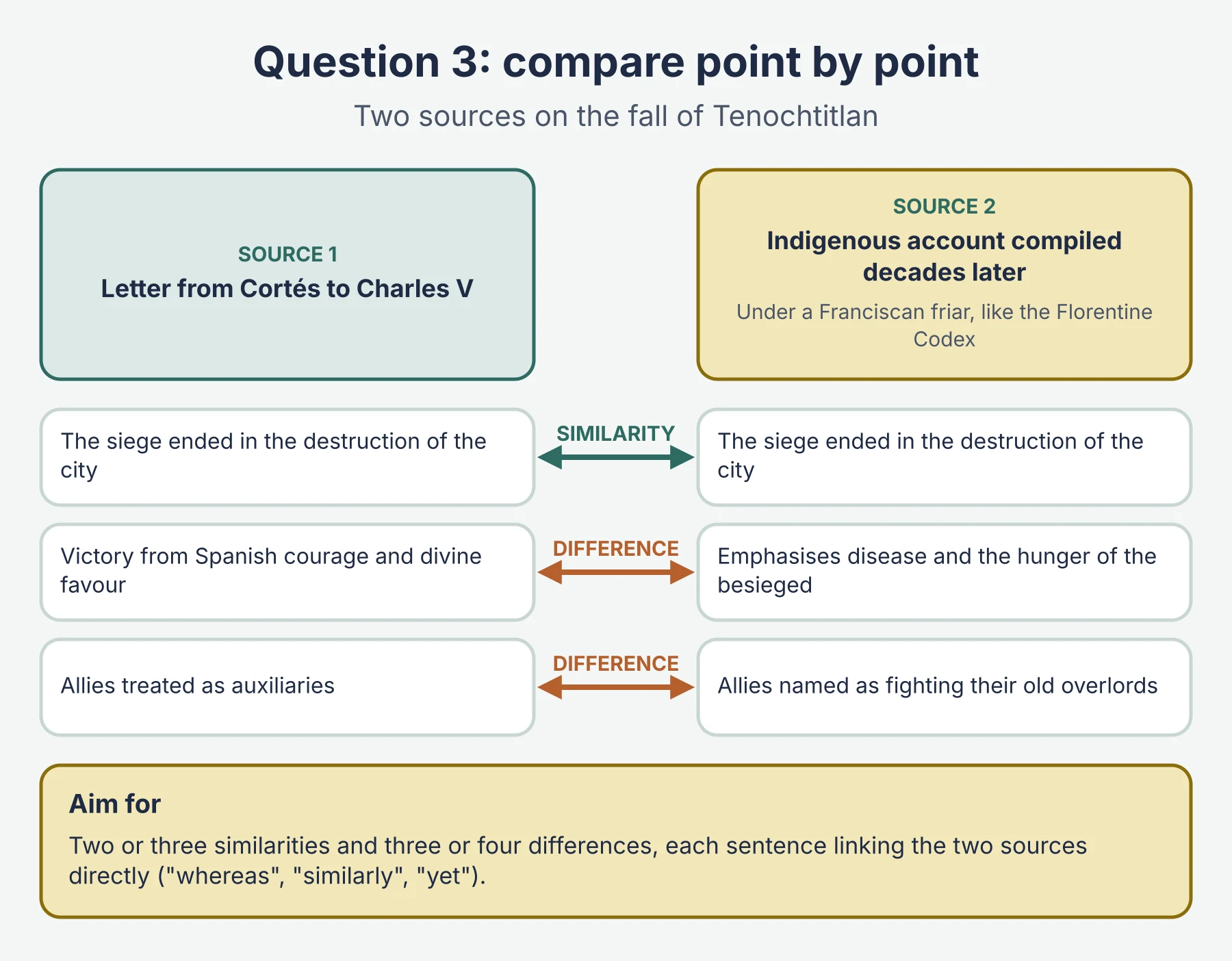
| Conqueror’s report | Cortés’s letters to Charles V | Eyewitness; shows how conquest was justified to the crown | Self-promoting; written to excuse defying the governor |
| Veteran’s memoir | Bernal Díaz del Castillo | Ordinary soldier’s detail | Written decades later; answers rival accounts |
| Indigenous account | Florentine Codex | Nahua perspective on the siege and the epidemic | Compiled a generation later under a friar’s direction |
| Petition or complaint | Granadan Muslims’ grievances | Voice of the conquered | Written to win redress, so stresses wrongs |
Exam traps
- Wrong date range. The Spanish case ends in 1492, so the 1609 expulsion lies outside it. The American case ends in 1551, so do not write about Potosí’s later silver boom.
- Single-cause explanations. “Guns, germs and horses” ignores allies and indigenous politics.
- One-sided impact. Include Spanish debate and law as well as the fate of the conquered.
- Taking a conquistador at his word. Cortés’s letters were written to win royal favour.
- Treating later accounts as eyewitness. Bernal Díaz wrote decades later; the Florentine Codex was compiled in the following generation.
Self-test
- Which marriage united the crowns of Castile and Aragon, and when? Isabella of Castile and Ferdinand of Aragon, 1469.
- Name the three Nasrid rivals whose quarrels weakened Granada. Abu’l-Hasan Ali, Boabdil (Muhammad XII) and al-Zaghal.
- Which siege of 1487 ended with much of the population enslaved? Málaga.
- What did the Capitulations of 1491 promise? Freedom of religion, mosques, property and Islamic law for the Muslims of Granada.
- Which archbishop’s policy of forced baptism provoked revolt in 1499? Cardinal Cisneros.
- What did the Alhambra Decree of 1492 order? The expulsion of Jews who would not convert.
- Who interpreted for Cortés between Nahuatl and Maya? Malinche (Doña Marina).
- What was the Noche Triste? The Spanish flight from Tenochtitlan in 1520, with heavy losses.
- When did Tenochtitlan fall? August 1521.
- Where and when was Atahualpa captured? Cajamarca, November 1532.
- Why did the New Laws provoke revolt in Peru? They restricted encomiendas, threatening the conquerors’ wealth and labour.
- Who debated at Valladolid in 1550-1551, and about what? Las Casas and Sepúlveda, on whether war against the indigenous peoples was just.
Related resources
-
Study guides
IB DP History (DP History): The move to global war
Prescribed subject 3 for IB History Paper 1: causes, events and responses in Japanese expansion 1931-1941 and German and Italian expansion 1933-1940.
World History · International Baccalaureate · IB
Read guide -
Practice questions
IB DP History (DP History): The move to global war – Practice Questions
Twelve original IB History practice questions on The move to global war: recall on Germany and Italy, then a Paper 1-style source set on Japan in Manchuria.
World History · International Baccalaureate · IB
Try questions -
Revision notes
IB DP History (DP History): The move to global war – Revision Notes
Revision notes for IB History Paper 1 The move to global war: Japanese, German and Italian expansion, key terms, factor grids, traps and a self-test.
World History · International Baccalaureate · IB
Revise topic
Get free revision emails (optional)
Occasional emails with practice questions, worked explanations and links to free resources for the qualification and subjects you choose. No spam, and you can unsubscribe from any email. The free tools on this site never need an email.