
Study Guides
IB DP History (DP History): The move to global war
Prescribed subject 3 for IB History Paper 1: causes, events and responses in Japanese expansion 1931-1941 and German and Italian expansion 1933-1940.
- Subject
- World History
- Level
- IB
- Topic
- Topic 1: Prescribed subjects
- Author
- Marlbridge Academic Team
- Updated
- Reviewed by
- Azam Siddique (what this means)
Aligned to International Baccalaureate IB Diploma Programme History (DP History), First assessment 2017. Official specification .
Syllabus page (what it covers and how it is assessed): IB Diploma Programme History.
Syllabus points this page covers
DP History
- 3 The move to global war
Found an error? Report a correction.
Need help with this topic? Request a free trial class for IB Diploma Programme History (DP History / DP History (2028)).
Prescribed subject 3, The move to global war, examines how aggression by Japan, Germany and Italy turned regional crises into world war. Case study 1 is Japanese expansion in East Asia (1931-1941); case study 2 is German and Italian expansion (1933-1940). This guide works through both at the depth Paper 1 Question 4 needs, beyond the summary in the prescribed subjects overview.
What the subject covers
Each case study is organised under three headings:
- Causes of expansion: the ideologies of the expanding states, their domestic political and economic problems, and the international situation that gave them openings.
- Events: the acts of expansion themselves, in sequence, up to the outbreak of wider war.
- Responses: the reactions of the League of Nations, other powers and, for Japan, of China itself.
Paper 1 sources often set these headings against each other, for example an official justification of an invasion beside a foreign cartoon condemning it. Questions frequently ask you to weigh causes (ideology against economics, or aggressor against the failures of others).
Case study 1: Japanese expansion in East Asia, 1931-1941
Causes of expansion
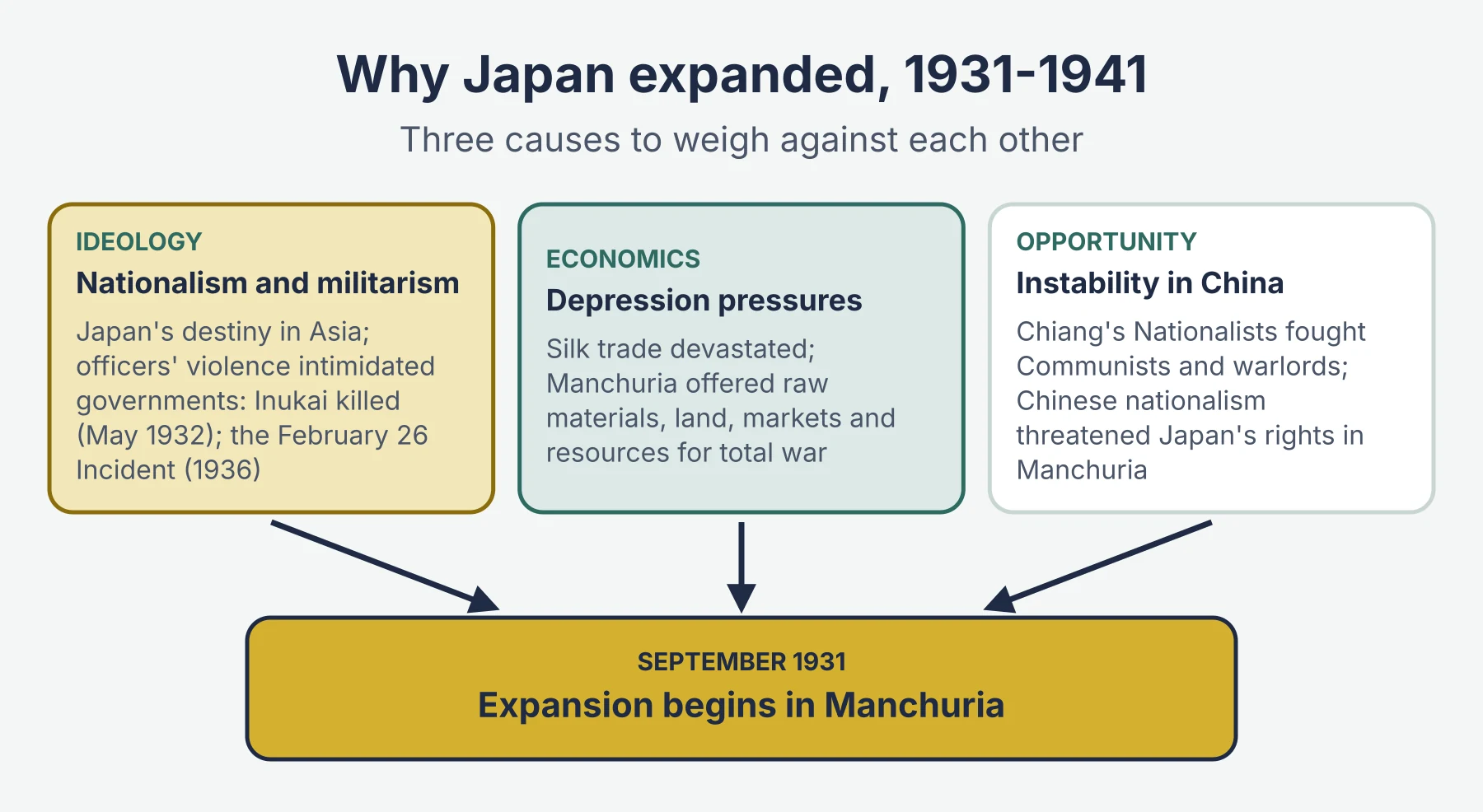
- Nationalism and militarism. Army officers and patriotic societies saw Japan’s destiny in Asia and distrusted party politicians. Junior officers’ violence intimidated governments: Prime Minister Inukai was assassinated in May 1932, and the February 26 Incident (1936) was a failed army coup in Tokyo.
- Economic pressures. The Depression devastated the silk trade, on which many rural families depended. Manchuria offered raw materials, land and markets, and army thinkers wanted resources for a future total war.
- Instability in China. The Nationalist government under Chiang Kai-shek was fighting the Communists and regional warlords, and Chinese nationalism threatened Japan’s rights in Manchuria.
Events
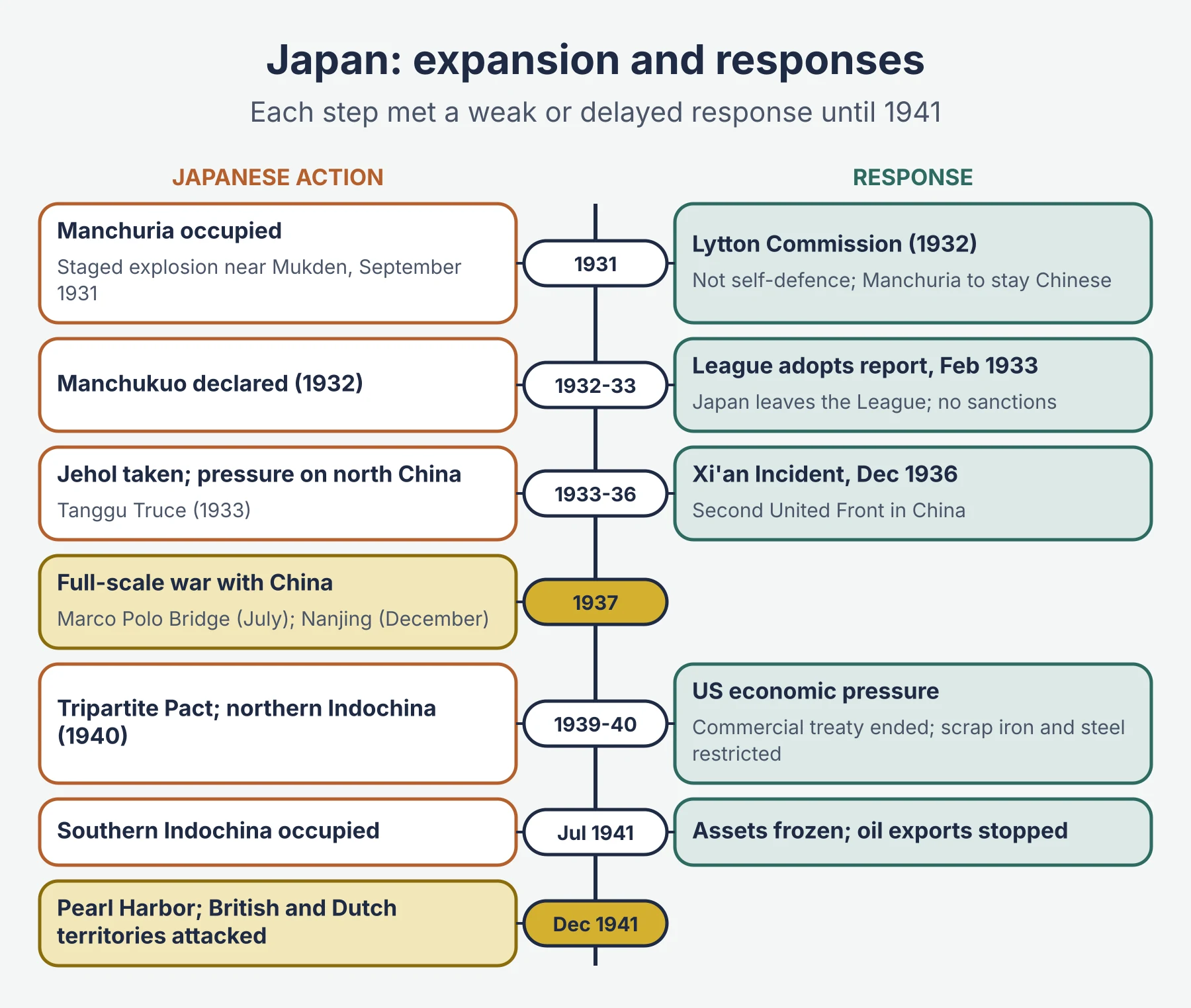
- Manchuria (1931): officers of the Kwantung Army staged an explosion on the South Manchurian Railway near Mukden in September 1931 and used it to occupy Manchuria. The puppet state of Manchukuo was declared in 1932.
- Northern China (1933-1936): Japan took Jehol and pressed into north China; the Tanggu Truce (1933) created a demilitarised zone.
- War with China (from 1937): a clash at the Marco Polo Bridge in July 1937 became full-scale war. Shanghai fell after heavy fighting, and the capture of Nanjing in December 1937 was followed by mass killing and rape.
- Alignment with the Axis: the Anti-Comintern Pact with Germany (1936) and the Tripartite Pact with Germany and Italy (September 1940).
- Southward advance: occupation of northern French Indochina (1940) and southern Indochina (July 1941), leading to the attack on Pearl Harbor and on British and Dutch territories in December 1941.
Responses
- League of Nations: the Lytton Commission reported in 1932 that Japan’s action was not self-defence and recommended that Manchuria remain under Chinese sovereignty with autonomy. The Assembly adopted the report in February 1933 and Japan left the League. No sanctions followed.
- China: the Xi’an Incident (December 1936), when Chiang was detained by his own commanders, led to the Second United Front between Nationalists and Communists against Japan.
- United States: protests at first, then economic pressure: the commercial treaty was ended (1939-1940), exports of scrap iron and steel were restricted (1940), and after the occupation of southern Indochina Japanese assets were frozen and oil exports stopped (1941).
Case study 2: German and Italian expansion, 1933-1940
Causes of expansion
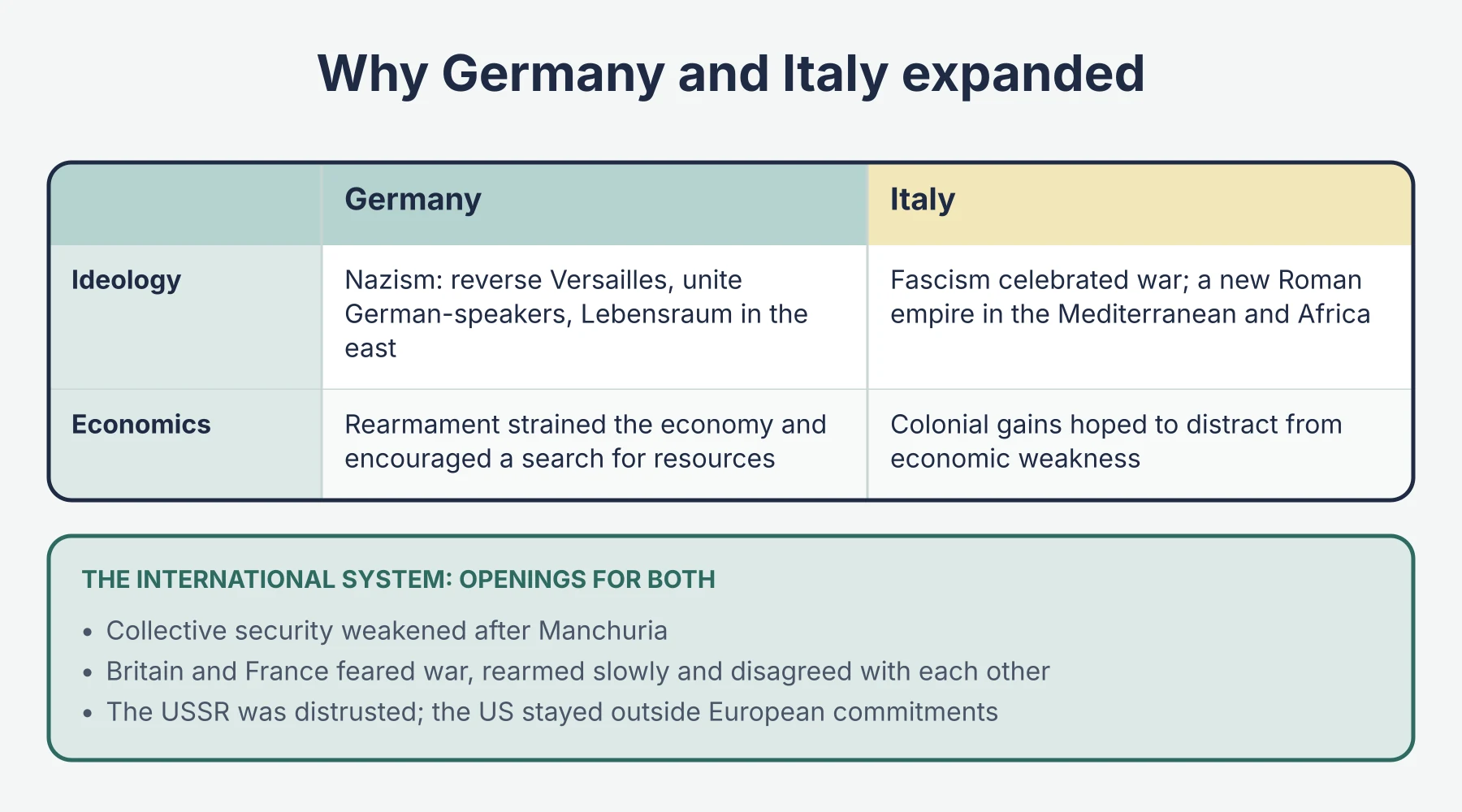
- Ideology. Nazism demanded the reversal of Versailles, the union of German-speakers and Lebensraum in the east. Italian Fascism celebrated war and imagined a new Roman empire in the Mediterranean and Africa.
- Economics. German rearmament strained the economy and encouraged a search for resources; Mussolini hoped colonial gains would distract from economic weakness.
- The international system. Collective security was weakened after Manchuria; Britain and France feared another war, were rearming slowly and disagreed with each other; the USSR was distrusted; the US stayed outside European commitments.
Events
| Year | Germany | Italy |
|---|---|---|
| 1933 | Leaves the Disarmament Conference and the League | |
| 1935 | Saar plebiscite; conscription announced | Invasion of Abyssinia (October) |
| 1936 | Remilitarisation of the Rhineland (March) | Conquest of Abyssinia completed; Rome-Berlin Axis |
| 1936-1939 | Intervention in the Spanish Civil War | Intervention in the Spanish Civil War |
| 1938 | Anschluss with Austria (March); Munich Agreement gives the Sudetenland (September) | |
| 1939 | Occupation of Bohemia and Moravia (March); Pact of Steel (May); Nazi-Soviet Pact (August); invasion of Poland (September) | Invasion of Albania (April); Pact of Steel |
| 1940 | Conquest of Denmark, Norway, the Low Countries and France | Declares war on Britain and France (June) |
Responses
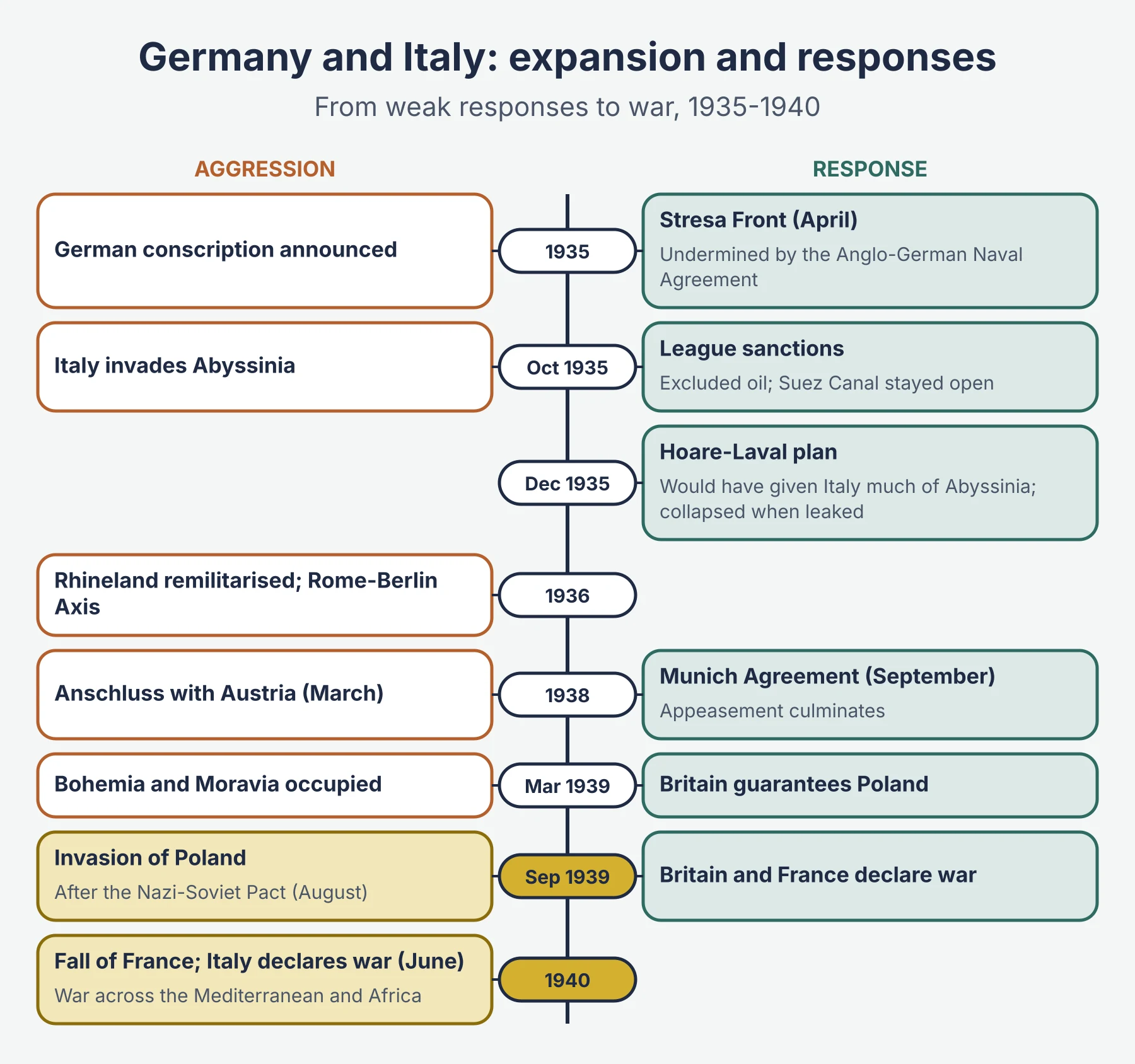
- To Italy: the Stresa Front (April 1935) was undermined by the Anglo-German Naval Agreement; League sanctions over Abyssinia excluded oil and the Suez Canal stayed open; the Hoare-Laval plan (December 1935) would have given Italy much of Abyssinia and collapsed when it leaked.
- To Germany: appeasement culminated at Munich; after the occupation of Prague, Britain guaranteed Poland (March 1939) and declared war with France when Poland was invaded.
- In 1940: the fall of France and Italy’s entry into the war turned a European conflict into a war across the Mediterranean and Africa.
Worked example: reading a cartoon for Question 1(b)
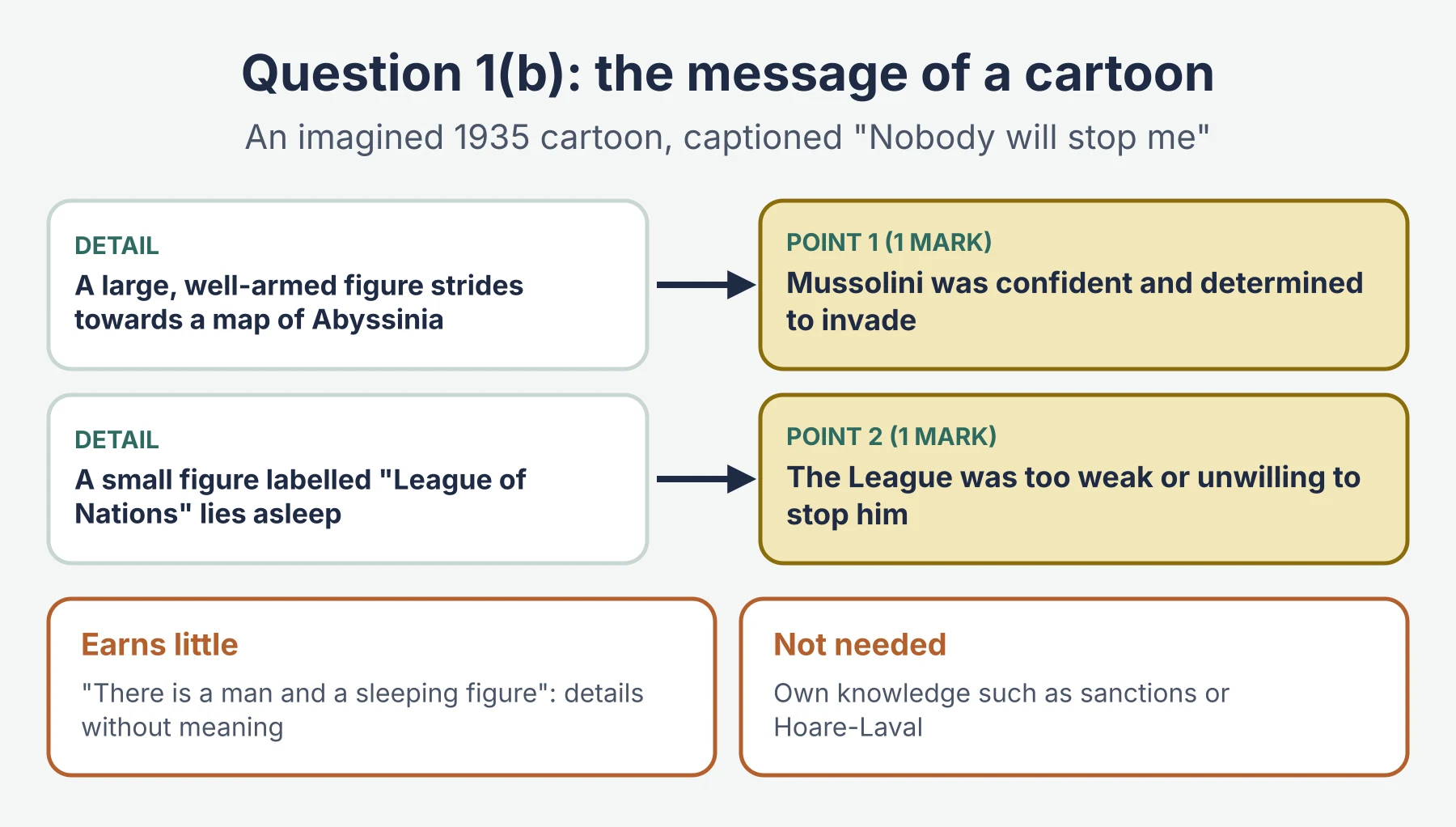
Imagine a 1935 cartoon: a large, well-armed Mussolini strides past a small, sleeping figure labelled “League of Nations”, towards a map of Abyssinia. The caption is “Nobody will stop me”.
A two-mark answer needs two clear points about the message, drawn from detail:
“The cartoon suggests that Mussolini was confident and determined to invade Abyssinia, shown by his size and stride. It also suggests that the League was too weak or unwilling to stop him, as it is shown asleep.”
Describing details without saying what they mean (“there is a man and a sleeping figure”) earns little. Avoid own knowledge: you do not need to mention sanctions or Hoare-Laval in Question 1.
Interpretations
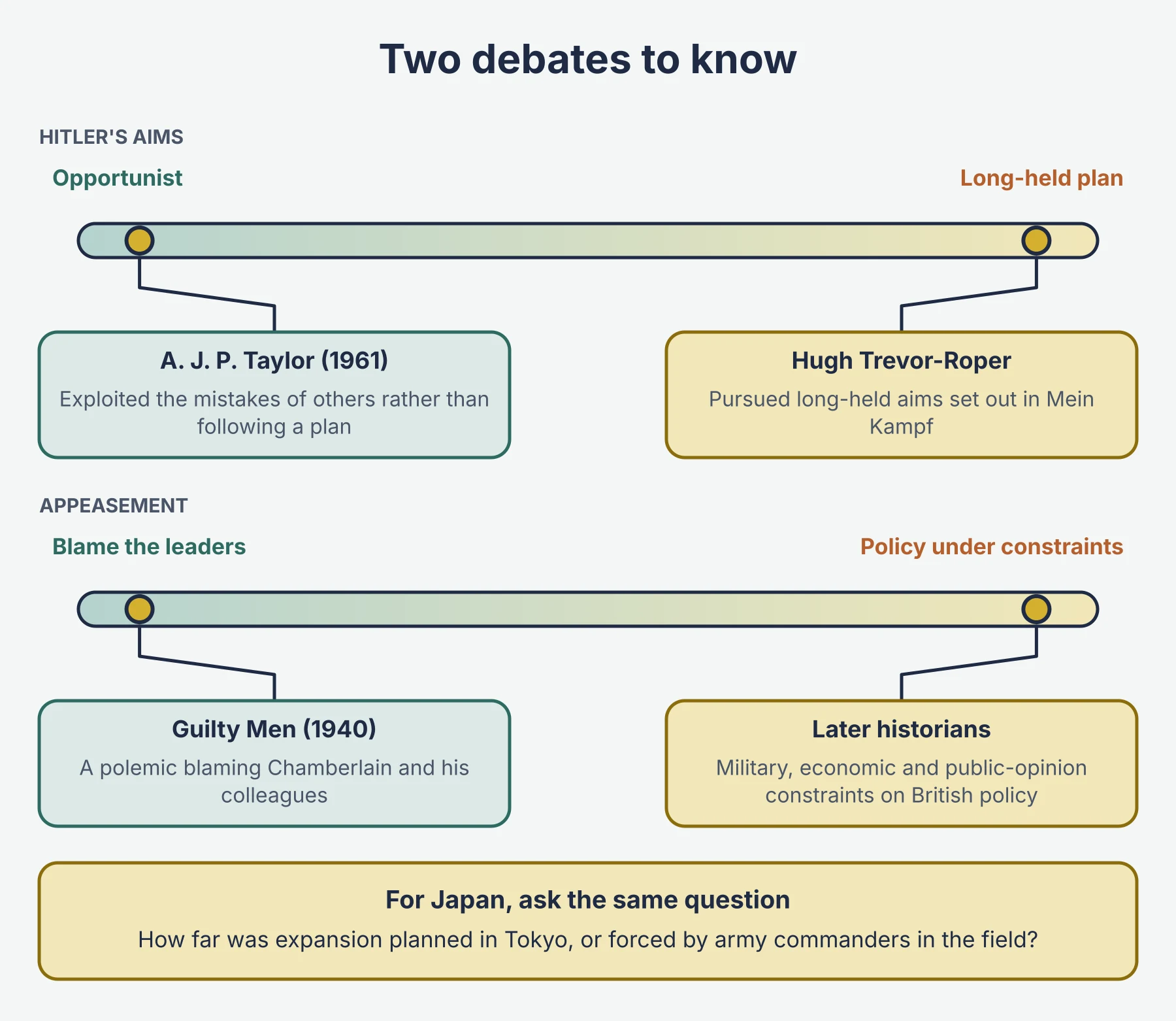
A. J. P. Taylor’s The Origins of the Second World War (1961) argued that Hitler was an opportunist who exploited the mistakes of others rather than following a plan; Hugh Trevor-Roper replied that Hitler pursued long-held aims set out in Mein Kampf. For appeasement, the 1940 polemic Guilty Men blamed Chamberlain and his colleagues; later historians stressed the military, economic and public-opinion constraints on British policy. For Japan, consider how far expansion was planned in Tokyo or forced by army commanders in the field.
Common mistakes
- Starting Japanese expansion with Pearl Harbor; the case study begins in 1931.
- Saying the League imposed sanctions on Japan: it did not.
- Treating appeasement as the only cause of war, without the aggressors’ aims.
- Leaving Italy out of the German and Italian case study.
- Running the end date past 1940 for case study 2 or 1941 for case study 1.
Exam technique
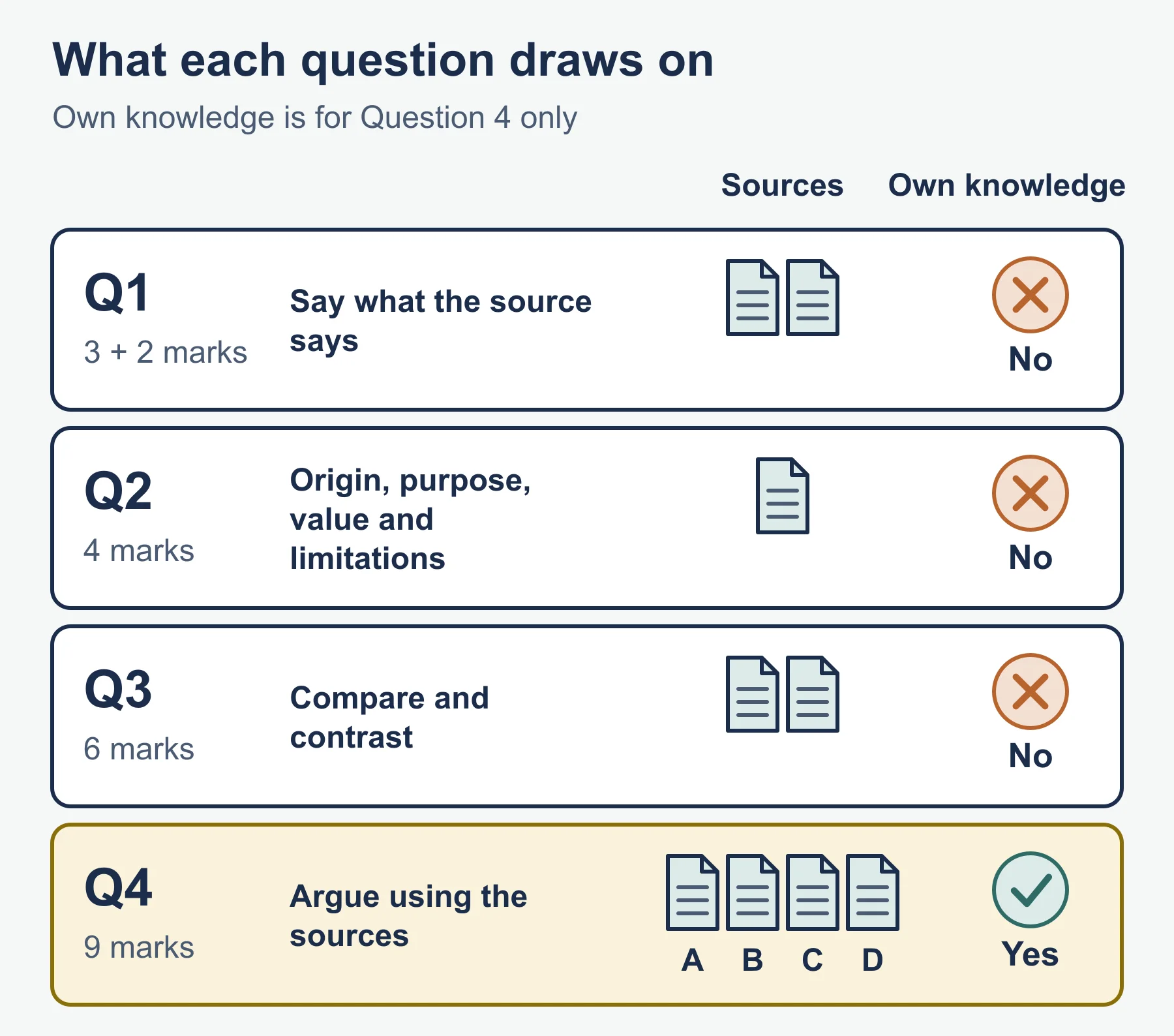
To what extent and evaluate dominate Question 4. Weigh the aggressors’ intentions against the failure of responses, and show how the two interacted. In Question 3, compare what sources say about the same issue, for example two views of the Lytton Report.
Consolidate with the move to global war revision notes and try the move to global war practice questions.
Related resources
-
Practice questions
IB DP History (DP History): The move to global war – Practice Questions
Twelve original IB History practice questions on The move to global war: recall on Germany and Italy, then a Paper 1-style source set on Japan in Manchuria.
World History · International Baccalaureate · IB
Try questions -
Revision notes
IB DP History (DP History): The move to global war – Revision Notes
Revision notes for IB History Paper 1 The move to global war: Japanese, German and Italian expansion, key terms, factor grids, traps and a self-test.
World History · International Baccalaureate · IB
Revise topic -
Study guides
IB DP History (DP History): Rights and protest
Prescribed subject 4 for IB History Paper 1: US civil rights 1954-1965 and apartheid South Africa 1948-1964, discrimination, protest and key actors.
World History · International Baccalaureate · IB
Read guide
Get free revision emails (optional)
Occasional emails with practice questions, worked explanations and links to free resources for the qualification and subjects you choose. No spam, and you can unsubscribe from any email. The free tools on this site never need an email.