
Study Guides
IB DP History (DP History): Rights and protest
Prescribed subject 4 for IB History Paper 1: US civil rights 1954-1965 and apartheid South Africa 1948-1964, discrimination, protest and key actors.
- Subject
- World History
- Level
- IB
- Topic
- Topic 1: Prescribed subjects
- Author
- Marlbridge Academic Team
- Updated
- Reviewed by
- Azam Siddique (what this means)
Aligned to International Baccalaureate IB Diploma Programme History (DP History), First assessment 2017. Official specification .
Syllabus page (what it covers and how it is assessed): IB Diploma Programme History.
Syllabus points this page covers
DP History
- 4 Rights and protest
Found an error? Report a correction.
Need help with this topic? Request a free trial class for IB Diploma Programme History (DP History / DP History (2028)).
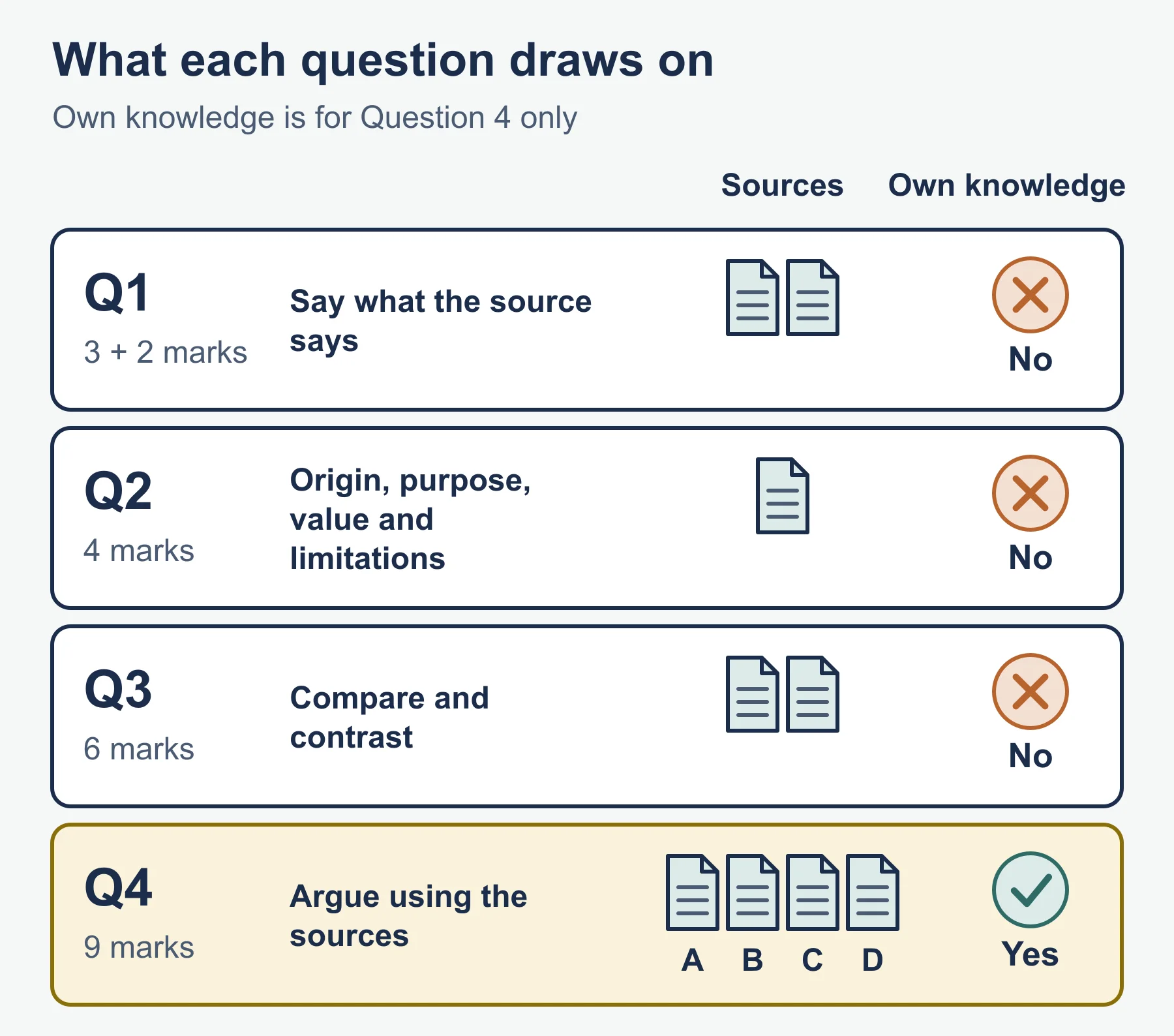
Prescribed subject 4, Rights and protest, compares two struggles against legalised racial discrimination: the civil rights movement in the United States (1954-1965) and protest against apartheid in South Africa (1948-1964). Paper 1 sets its sources on one of them. The prescribed subjects overview introduces both; this guide supplies the detail and the analysis Question 4 rewards.
What the subject covers
Both case studies are arranged under three headings:
- Nature and characteristics of discrimination: the laws, practices and violence that denied rights.
- Protests and action: the campaigns, methods and turning points of the movements, and the legal or legislative changes that followed.
- The role and significance of key actors and groups: named individuals and organisations whose importance you must be able to assess.
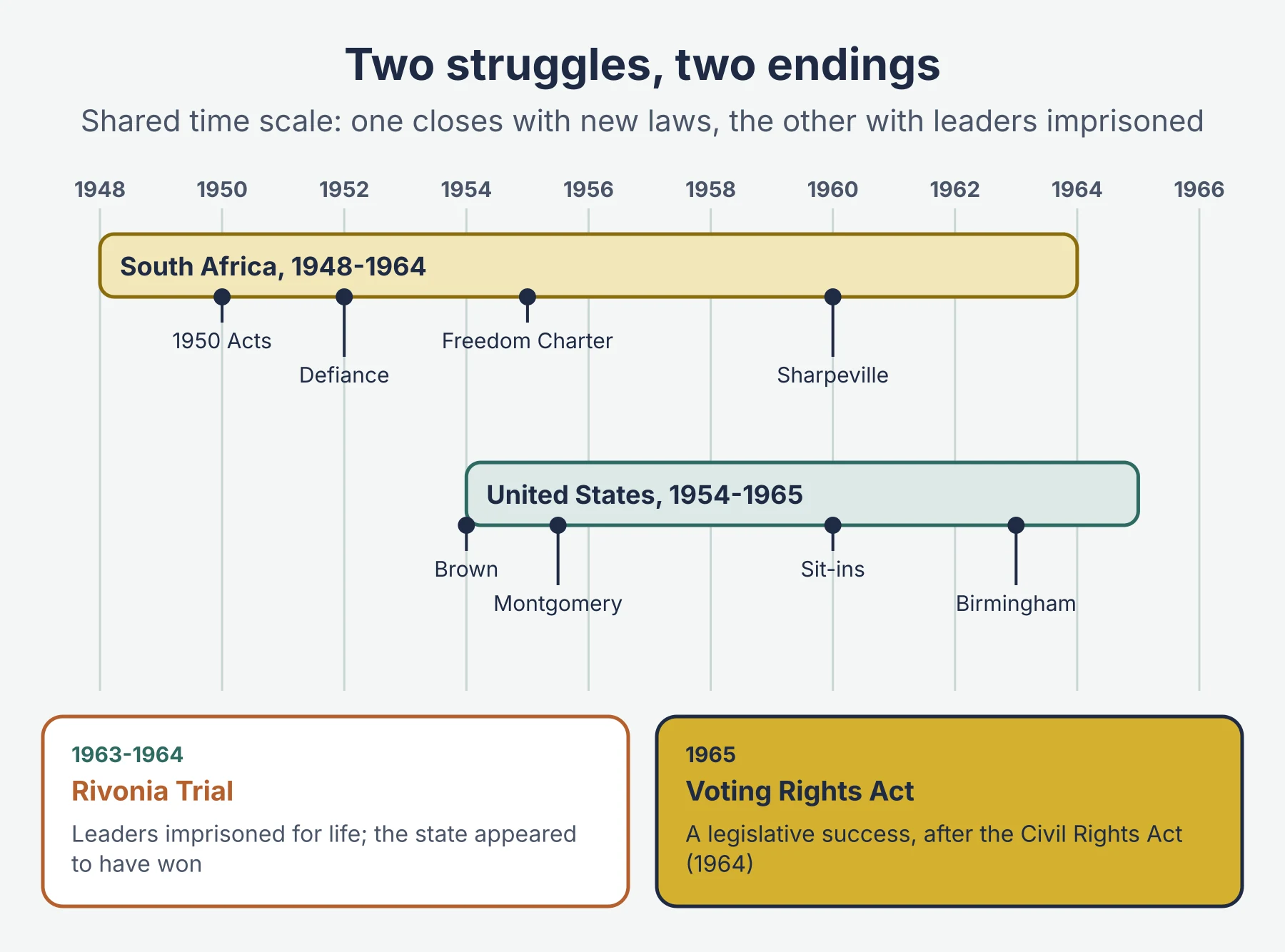
The case studies end at different points for a reason. The US case closes in 1965 with the Voting Rights Act, a legislative success. The South African case closes in 1964 with the Rivonia Trial, when the movement’s leaders were imprisoned and the state appeared to have won. Questions on “success” must reflect that contrast.
Case study 1: The civil rights movement in the United States, 1954-1965
Discrimination
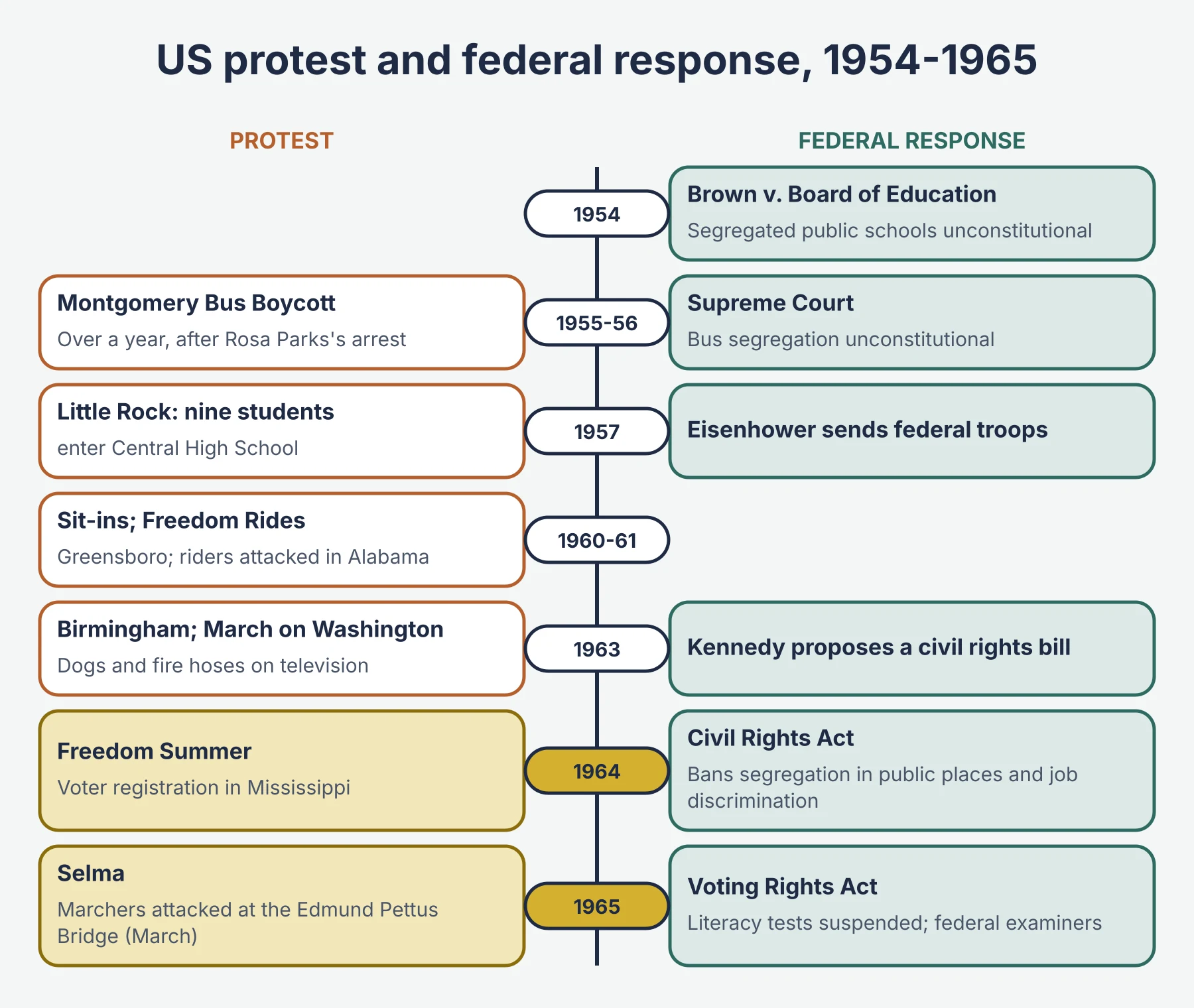
In the South, Jim Crow laws segregated schools, transport, restaurants and public facilities. Literacy tests, poll taxes and intimidation kept most Black citizens from voting. Racial violence went largely unpunished: the murder of 14-year-old Emmett Till in Mississippi (1955), and the acquittal of his killers, drew national attention. Segregation in education was challenged in Brown v. Board of Education (1954), in which the Supreme Court ruled that segregated public schools were unconstitutional, but many Southern states resisted. At Little Rock (1957), President Eisenhower sent federal troops to protect nine Black students entering Central High School.
Protests and action
- Montgomery Bus Boycott (1955-1956): after Rosa Parks’s arrest, the Black community boycotted the buses for over a year until the Supreme Court ruled bus segregation unconstitutional. The boycott brought Martin Luther King Jr to prominence.
- Sit-ins (1960): four students at a Greensboro lunch counter began a wave of sit-ins across the South.
- Freedom Rides (1961): integrated groups rode interstate buses to test desegregation rulings and were attacked, notably in Alabama.
- Birmingham (1963): the use of police dogs and fire hoses on young marchers shocked television audiences and pushed President Kennedy to propose a civil rights bill.
- March on Washington (August 1963): a mass, peaceful demonstration for jobs and freedom.
- Freedom Summer (1964): volunteers registered voters in Mississippi; three civil rights workers were murdered.
- Selma (1965): the attack on marchers at the Edmund Pettus Bridge in March led directly to voting rights legislation.
Legislation: the Civil Rights Act (1964) banned segregation in public places and discrimination in employment; the Voting Rights Act (1965) suspended literacy tests and placed federal examiners in areas with low registration.
Key actors and groups
| Actor or group | Significance |
|---|---|
| Martin Luther King Jr | Leader of the SCLC; non-violent direct action designed to provoke a national response |
| Malcolm X | Spokesman for the Nation of Islam until 1964; rejected integration and non-violence as defined by King; assassinated in 1965 |
| Lyndon B. Johnson | Used his skill with Congress to pass the 1964 and 1965 Acts |
| NAACP | Legal strategy culminating in Brown; lobbying and litigation |
| SCLC | Church-based organisation coordinating non-violent campaigns |
| SNCC | Student-led, grassroots; sit-ins, Freedom Rides, voter registration |
| Nation of Islam | Black separatism and self-reliance |
Case study 2: Apartheid South Africa, 1948-1964
Discrimination
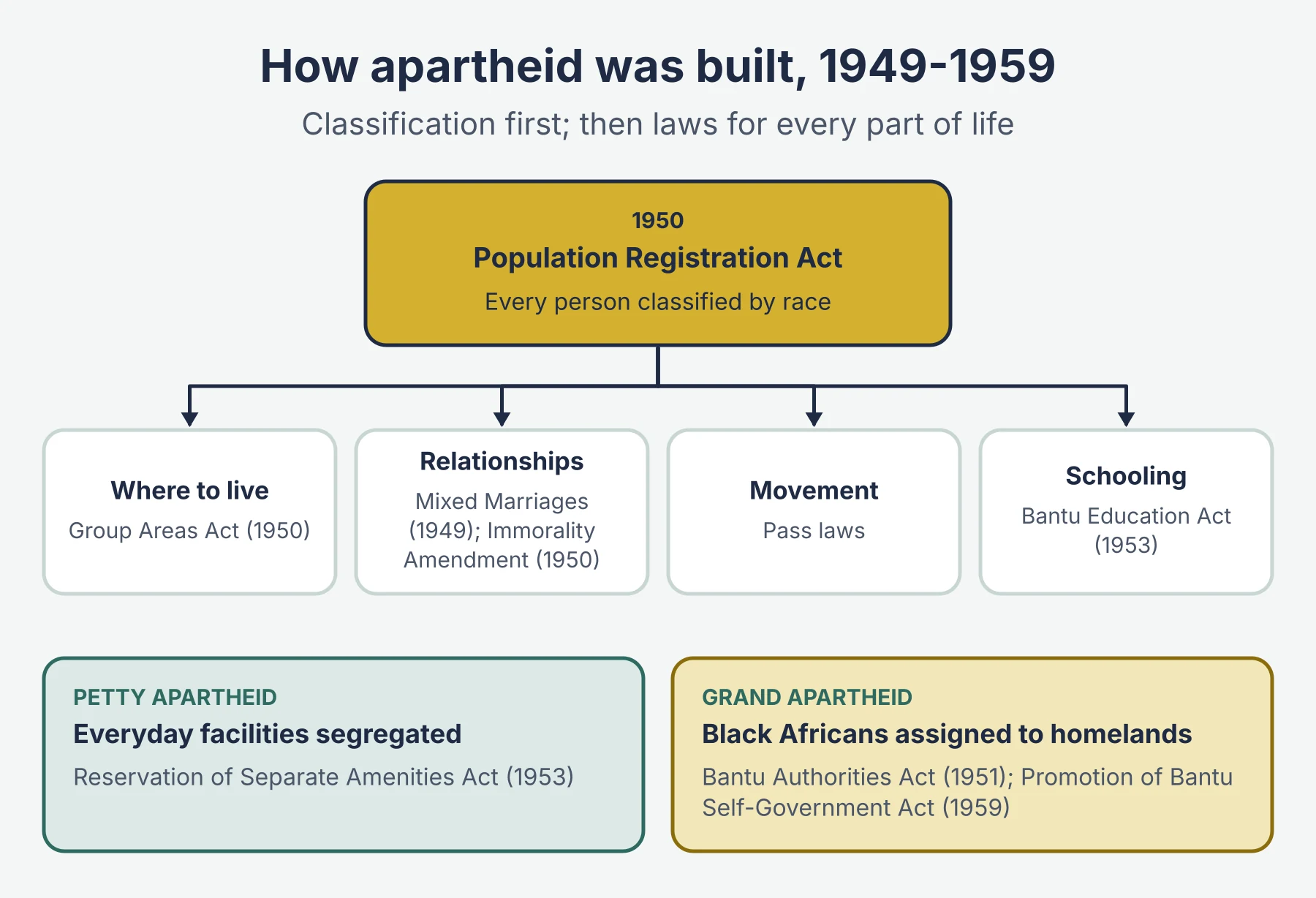
After the National Party’s victory in 1948, apartheid turned existing segregation into a comprehensive system. The Population Registration Act (1950) classified every person by race; the Group Areas Act (1950) assigned residential areas; the Prohibition of Mixed Marriages Act (1949) and Immorality Amendment Act (1950) policed relationships; pass laws controlled movement. Historians distinguish “petty apartheid”, the segregation of everyday facilities (formalised by the Reservation of Separate Amenities Act, 1953), from “grand apartheid”, the territorial plan to assign Black Africans to ethnic homelands (Bantustans) under the Bantu Authorities Act (1951) and the Promotion of Bantu Self-Government Act (1959). The Bantu Education Act (1953) gave the state control of Black schooling.
Protests and action
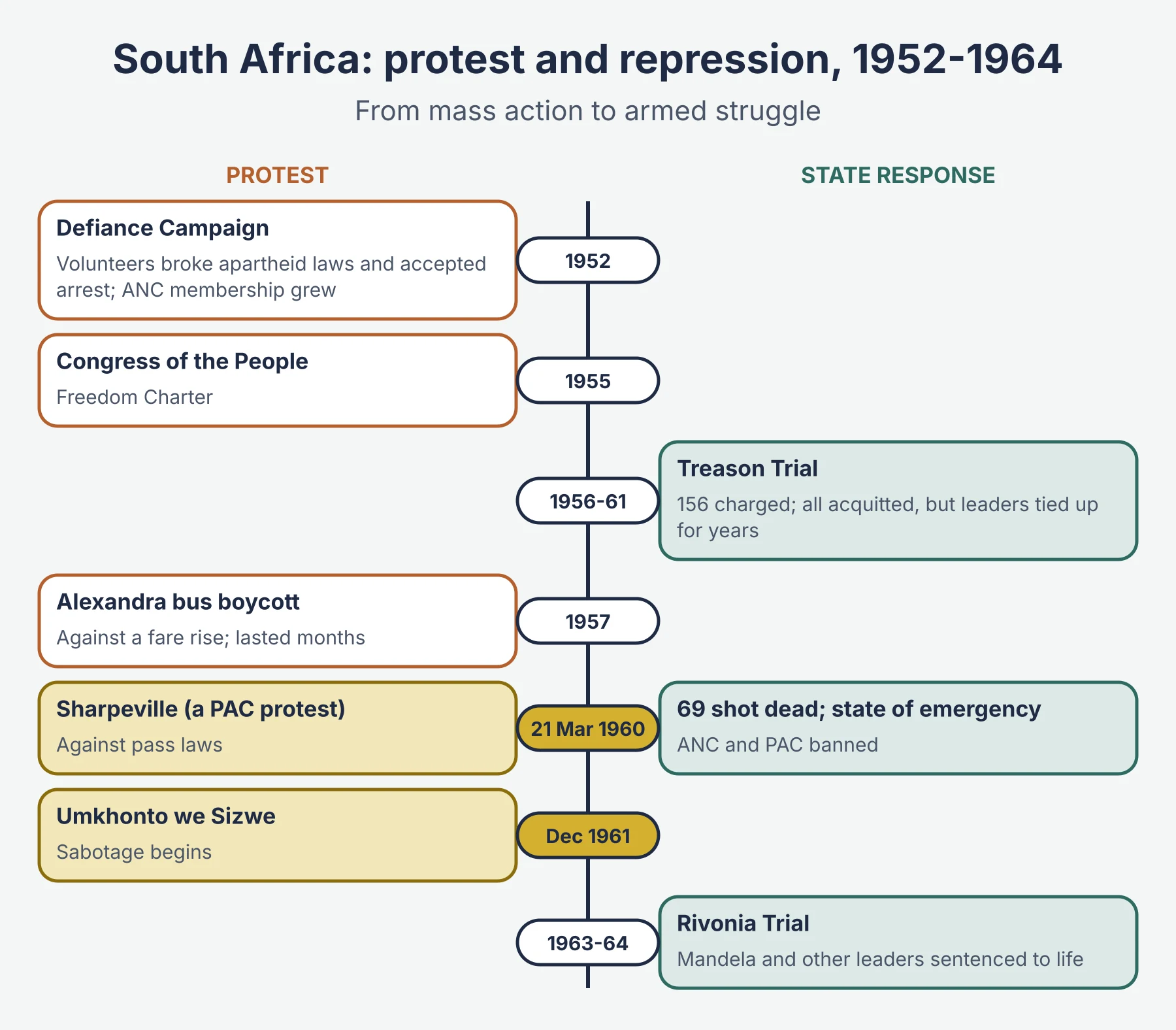
- Defiance Campaign (1952): volunteers deliberately broke apartheid laws and accepted arrest; ANC membership grew sharply.
- Congress of the People (1955): the Freedom Charter declared that “South Africa belongs to all who live in it”.
- Treason Trial (1956-1961): 156 activists were charged; all were eventually acquitted, but the trial tied up the leadership for years.
- Bus boycotts: the Alexandra boycott (1957) against a fare rise lasted months.
- Sharpeville (21 March 1960): police shot dead 69 people at a PAC protest against pass laws. A state of emergency followed and the ANC and PAC were banned.
- Armed struggle: Umkhonto we Sizwe (MK) began sabotage in December 1961.
- Rivonia Trial (1963-1964): Mandela and other leaders were sentenced to life imprisonment.
Key actors and groups
| Actor or group | Significance |
|---|---|
| Nelson Mandela | Youth League leader; volunteer-in-chief of the Defiance Campaign; first commander of MK |
| Albert Luthuli | ANC president from 1952; committed to non-violence; Nobel Peace Prize for 1960 |
| ANC | Main African nationalist organisation; moved from petitions to mass action to armed struggle |
| SACP | Banned in 1950 and reformed underground; worked closely with the ANC and helped found MK |
| MK | The ANC’s armed wing from 1961, targeting installations rather than people at first |
Worked example: Question 4 plan on South Africa
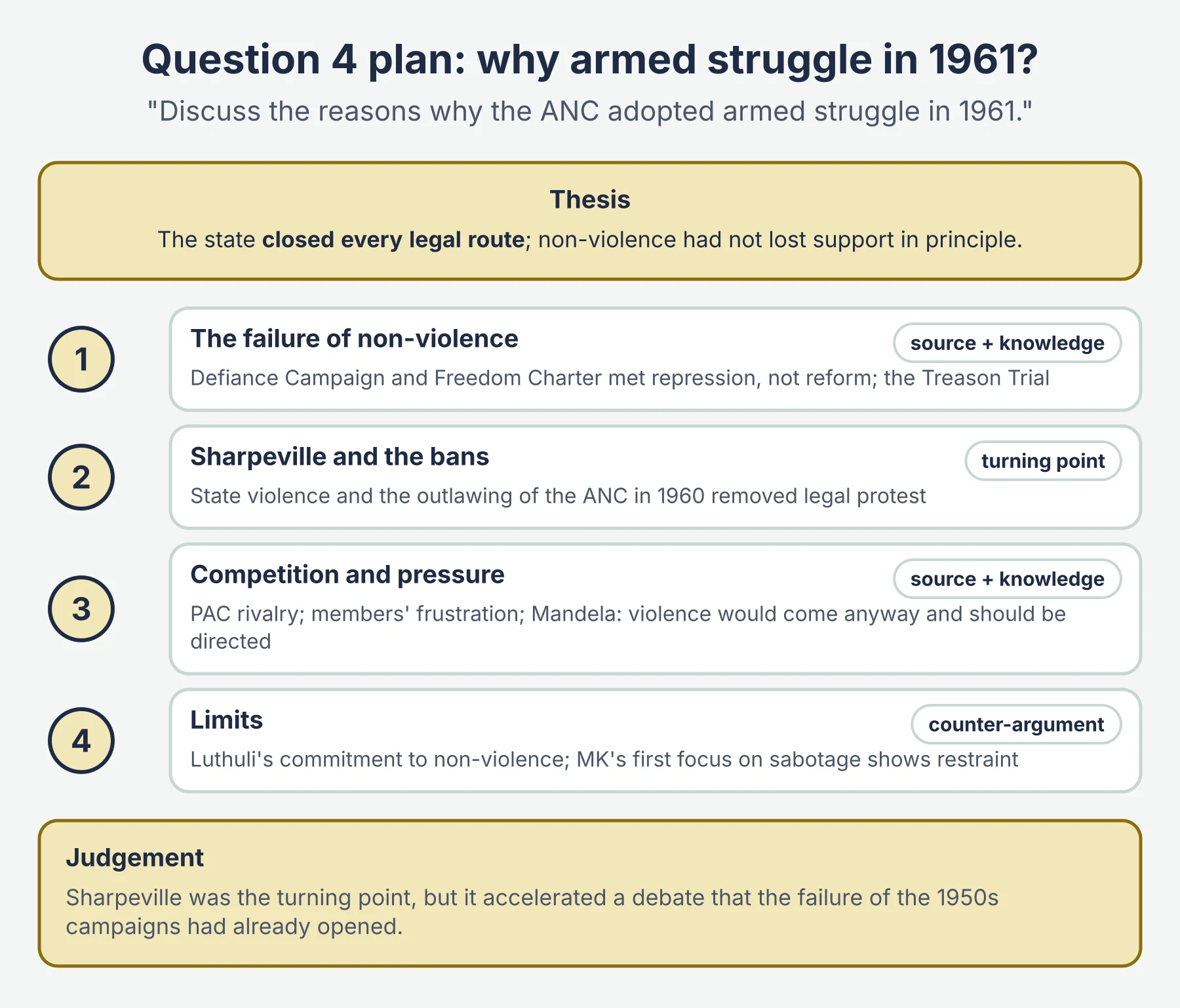
Question: “Using the sources and your own knowledge, discuss the reasons why the ANC adopted armed struggle in 1961.”
- Thesis: the ANC turned to armed struggle because the state closed every legal route, not because non-violence had lost support in principle.
- Paragraph 1, the failure of non-violence: the Defiance Campaign and Freedom Charter produced repression, not reform; the Treason Trial.
- Paragraph 2, Sharpeville and the bans: violence by the state and the outlawing of the ANC in 1960 removed legal protest.
- Paragraph 3, competition and pressure: the PAC’s rivalry and members’ frustration; Mandela’s argument that violence would come anyway and should be directed.
- Paragraph 4, limits: Luthuli’s continuing commitment to non-violence; MK’s initial focus on sabotage shows restraint.
- Judgement: Sharpeville was the turning point, but it accelerated a debate that the failure of the 1950s campaigns had already opened.
Link each paragraph to at least one source by letter, and use own knowledge to explain what the source does not.
Common mistakes
- Running the US story past 1965 into the Black Power era or the riots of later years.
- Calling Sharpeville an ANC protest: it was organised by the PAC.
- Treating King as the whole movement and ignoring local activists and SNCC.
- Presenting Malcolm X only as a foil to King, without assessing his own significance.
- Assessing “success” in South Africa by 1994 standards; the case study ends in 1964.
Exam technique
When a question asks about significance, judge an actor’s contribution against others: what happened because of them that would not have happened otherwise? For compare and contrast, set the two sources against each other on each point. Examine invites you to test a claim, such as “television was decisive”, against other factors.
Use the Rights and protest revision notes to consolidate and the Rights and protest practice questions for a full source set on apartheid.
Related resources
-
Practice questions
IB DP History (DP History): Rights and protest – Practice Questions
Twelve original IB History practice questions on Rights and protest: recall on US civil rights, then a Paper 1-style source set on protest against apartheid.
World History · International Baccalaureate · IB
Try questions -
Revision notes
IB DP History (DP History): Rights and protest – Revision Notes
Revision notes for IB History Paper 1 Rights and protest: US civil rights and apartheid South Africa, laws, campaigns, key actors, traps and a self-test.
World History · International Baccalaureate · IB
Revise topic -
Study guides
IB DP History (DP History): Conflict and intervention
Prescribed subject 5 for IB History Paper 1: causes, course, intervention and impact in Rwanda 1990-1998 and Kosovo 1989-2002, with a worked source answer.
World History · International Baccalaureate · IB
Read guide
Get free revision emails (optional)
Occasional emails with practice questions, worked explanations and links to free resources for the qualification and subjects you choose. No spam, and you can unsubscribe from any email. The free tools on this site never need an email.