
Study Guides
IB DP History (DP History): Conflict and intervention
Prescribed subject 5 for IB History Paper 1: causes, course, intervention and impact in Rwanda 1990-1998 and Kosovo 1989-2002, with a worked source answer.
- Subject
- World History
- Level
- IB
- Topic
- Topic 1: Prescribed subjects
- Author
- Marlbridge Academic Team
- Updated
- Reviewed by
- Azam Siddique (what this means)
Aligned to International Baccalaureate IB Diploma Programme History (DP History), First assessment 2017. Official specification .
Syllabus page (what it covers and how it is assessed): IB Diploma Programme History.
Syllabus points this page covers
DP History
- 5 Conflict and intervention
Found an error? Report a correction.
Need help with this topic? Request a free trial class for IB Diploma Programme History (DP History / DP History (2028)).
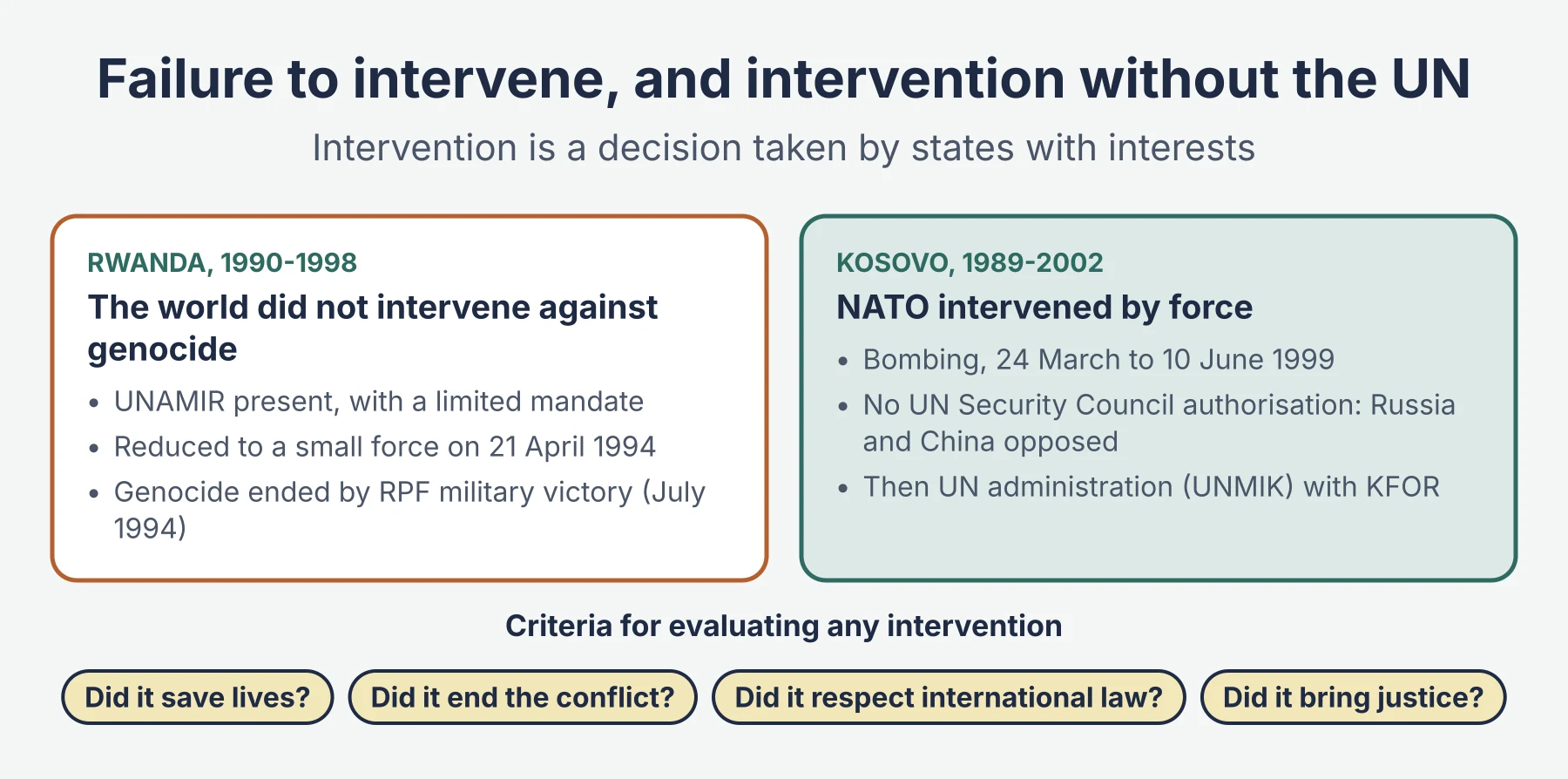
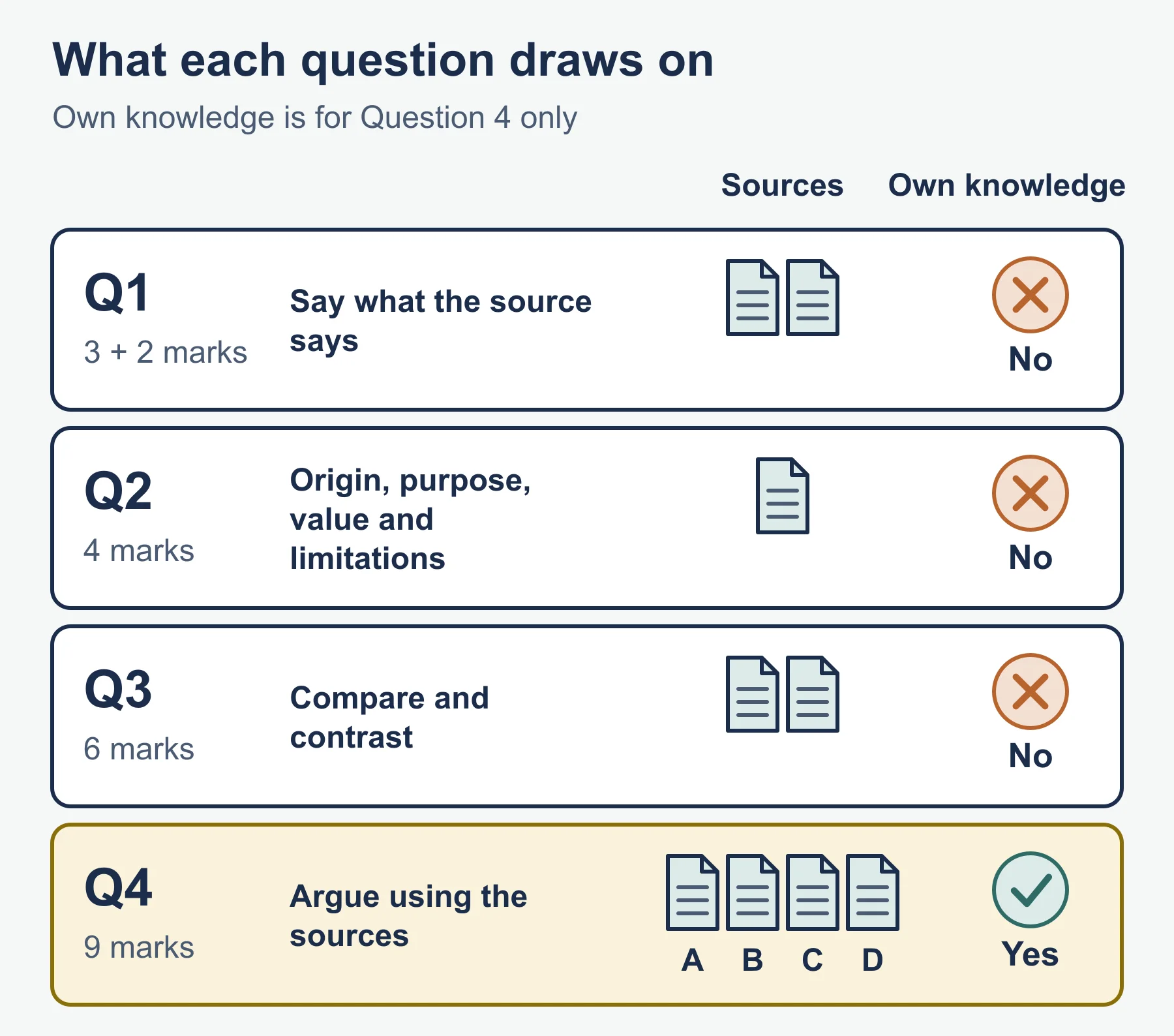
Prescribed subject 5, Conflict and intervention, studies two conflicts of the 1990s in which the response of the outside world became part of the history: Rwanda (1990-1998) and Kosovo (1989-2002). In Rwanda the international community failed to intervene against genocide; in Kosovo NATO intervened by force without the authorisation of the UN Security Council. Paper 1 sources are set on one case study. This guide builds on the prescribed subjects overview with the detail Question 4 needs.
What the subject covers
Each case study is studied under three headings:
- Causes of the conflict: long-term divisions, the role of colonial or state policies, and the short-term triggers.
- Course and interventions: how the conflict unfolded, and the actions or inaction of the UN, regional organisations and individual states.
- Impact: the humanitarian consequences, refugee movements, international justice and the political settlement.
Questions often ask why intervention did or did not happen, how effective it was, and what its consequences were. Treat intervention as a decision taken by states with interests, not as an automatic response to suffering.
Case study 1: Rwanda, 1990-1998
Causes
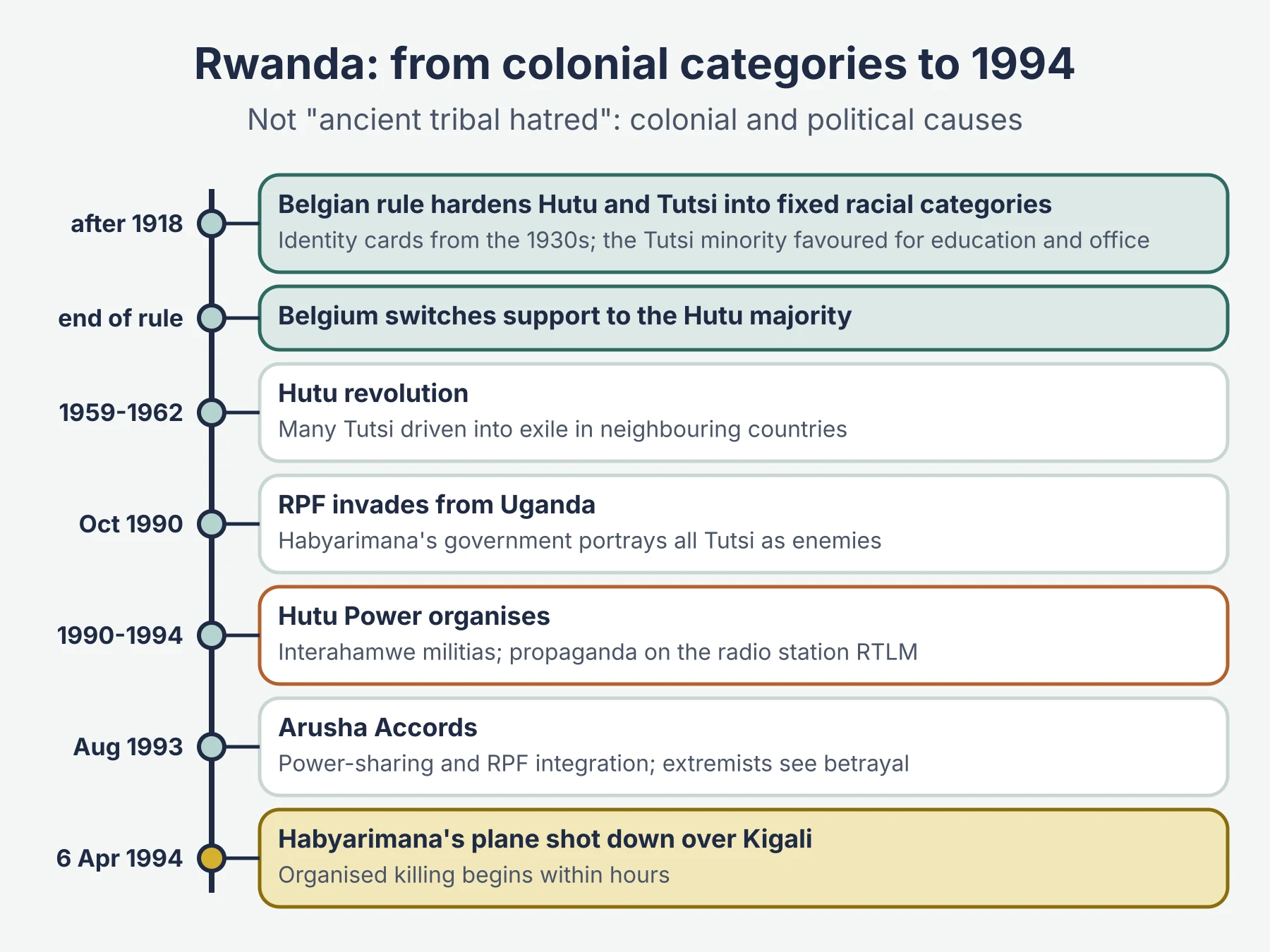
Colonial legacy. Under Belgian rule after the First World War, the distinction between Hutu and Tutsi was hardened into fixed racial categories, recorded on identity cards from the 1930s, and the Tutsi minority was favoured for education and office. At the end of colonial rule Belgium switched support to the Hutu majority. The Hutu revolution of 1959-1962 drove many Tutsi into exile in neighbouring countries.
Civil war. In October 1990 the Rwandan Patriotic Front (RPF), formed mainly by Tutsi exiles in Uganda, invaded. President Habyarimana’s government used the war to portray all Tutsi as enemies. Extremist Hutu Power groups organised militias (the Interahamwe) and propaganda, notably the radio station RTLM.
Peace and its enemies. The Arusha Accords (August 1993) provided for power-sharing and the integration of the RPF into the army. Extremists saw the accords as betrayal.
Course and interventions
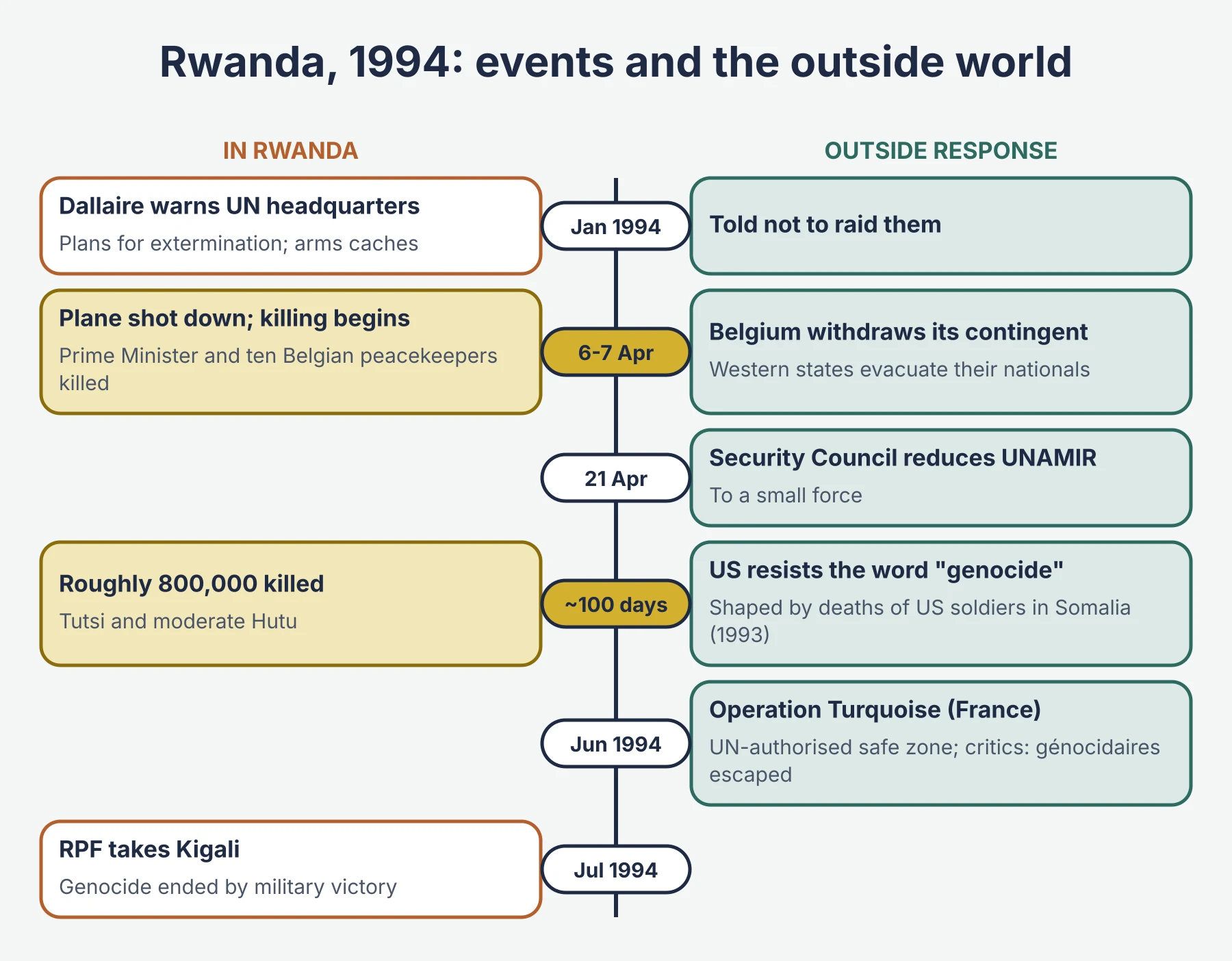
- UNAMIR, the UN mission under General Roméo Dallaire, was sent in late 1993 with a limited peacekeeping mandate. In January 1994 Dallaire warned UN headquarters of plans for extermination and arms caches; he was told not to raid them.
- On 6 April 1994 the plane carrying Habyarimana was shot down over Kigali. Within hours, the Prime Minister, Agathe Uwilingiyimana, and ten Belgian peacekeepers guarding her were killed, and organised killing of Tutsi and moderate Hutu began.
- Belgium withdrew its contingent, and on 21 April the Security Council reduced UNAMIR to a small force. Western states evacuated their nationals. The US, shaped by the deaths of its soldiers in Somalia in 1993, resisted using the word “genocide”, which would have implied a duty to act.
- In about a hundred days roughly 800,000 people were killed.
- France’s Operation Turquoise (from June 1994), authorised by the UN, created a safe zone in the south-west; critics argue it also allowed génocidaires to escape.
- The RPF took Kigali in July 1994 and ended the genocide by military victory.
Impact
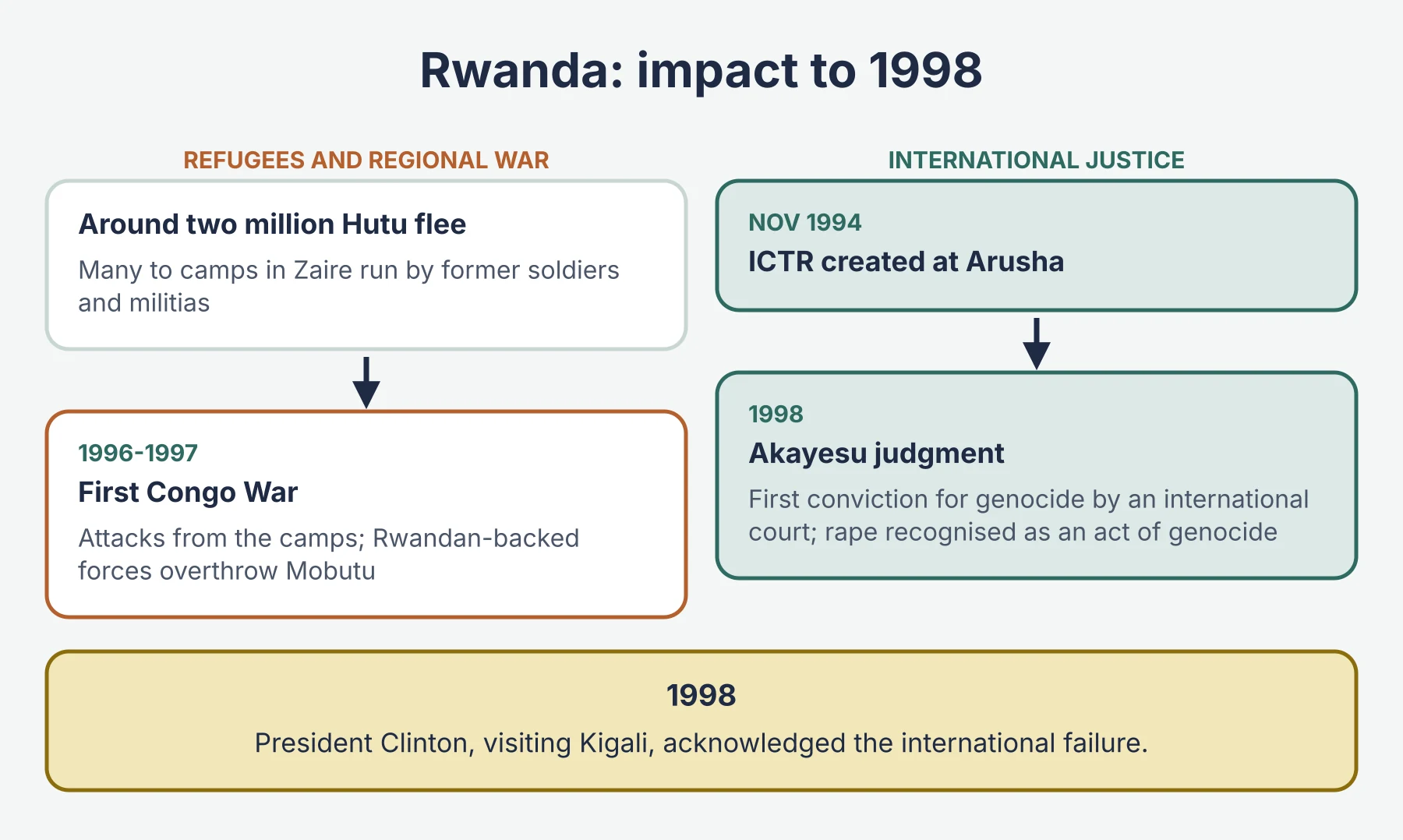
Around two million Hutu fled, many to camps in Zaire controlled by former soldiers and militias. Attacks from the camps contributed to the First Congo War (1996-1997), when Rwandan-backed forces overthrew Mobutu. The UN created the International Criminal Tribunal for Rwanda (ICTR) at Arusha in November 1994; its 1998 judgment against Jean-Paul Akayesu was the first conviction for genocide by an international court and recognised rape as an act of genocide. In 1998 President Clinton, visiting Kigali, acknowledged the international failure.
Case study 2: Kosovo, 1989-2002
Causes
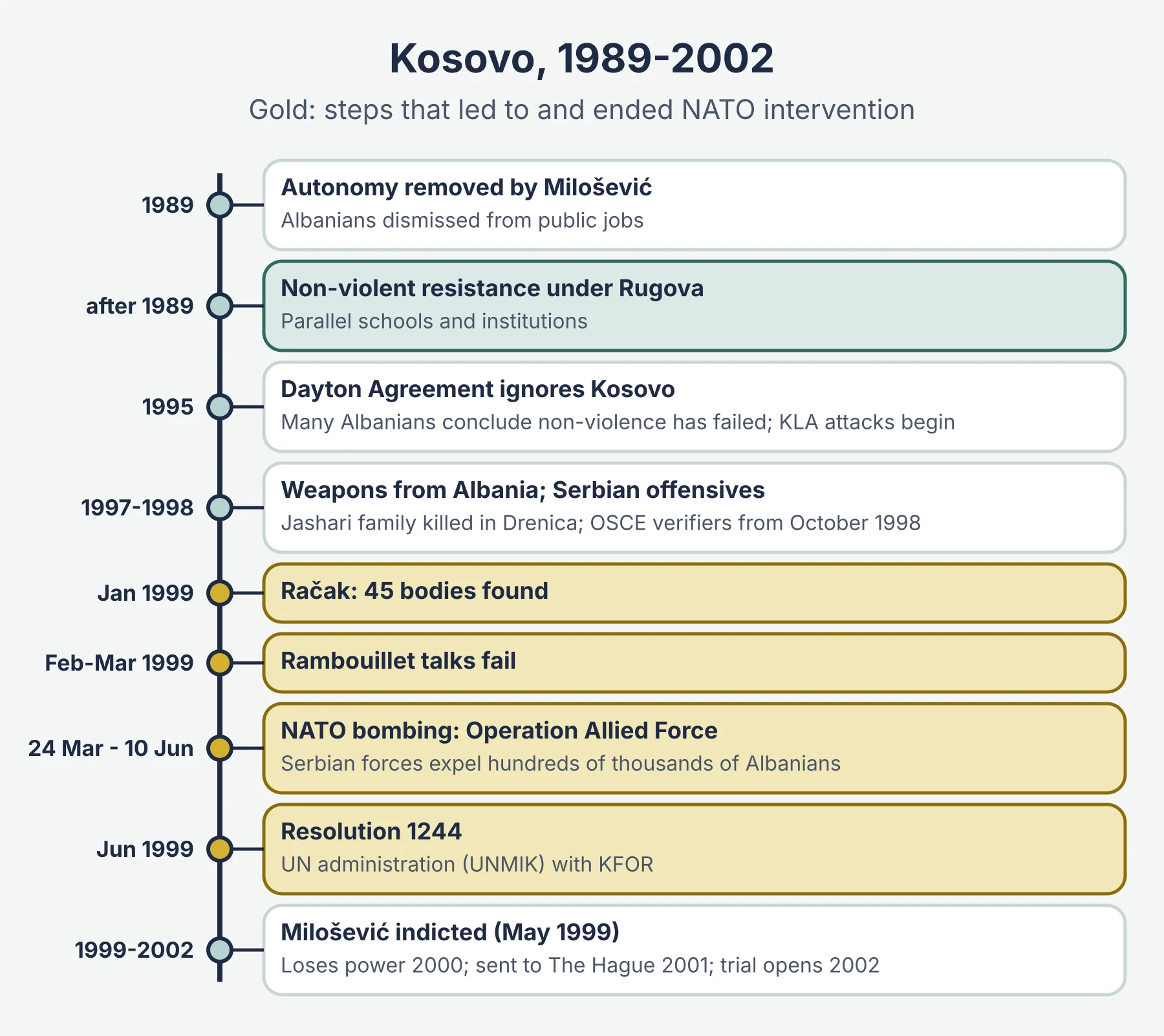
Kosovo was an autonomous province of Serbia within Yugoslavia, with an Albanian majority and a Serb minority, and a place of deep significance in Serbian national history. In 1989 Slobodan Milošević’s government removed its autonomy, and Albanians were dismissed from public jobs. Under Ibrahim Rugova and the Democratic League of Kosovo, Albanians built parallel schools and institutions and pursued non-violent resistance. The Dayton Agreement (1995), which ended the Bosnian war, did not address Kosovo, and many Albanians concluded that non-violence had failed. The Kosovo Liberation Army (KLA) began attacks on Serbian police; the collapse of order in Albania in 1997 made weapons easy to obtain.
Course and interventions
- 1998: Serbian offensives against the KLA, including the killing of the Jashari family in Drenica, displaced many civilians. The UN Security Council demanded a ceasefire; in October an agreement brought in OSCE verifiers.
- January 1999: the bodies of 45 Albanians were found at Račak, and the head of the verification mission called it a massacre.
- Rambouillet talks (February-March 1999) failed when Yugoslavia rejected the proposed agreement.
- 24 March to 10 June 1999: NATO’s bombing campaign, Operation Allied Force, targeted Yugoslav forces and infrastructure. Russia and China opposed it, so it had no Security Council authorisation. Serbian forces expelled hundreds of thousands of Albanians during the campaign.
- June 1999: Yugoslavia withdrew its forces; Security Council Resolution 1244 placed Kosovo under UN administration (UNMIK) with a NATO-led force (KFOR).
Impact
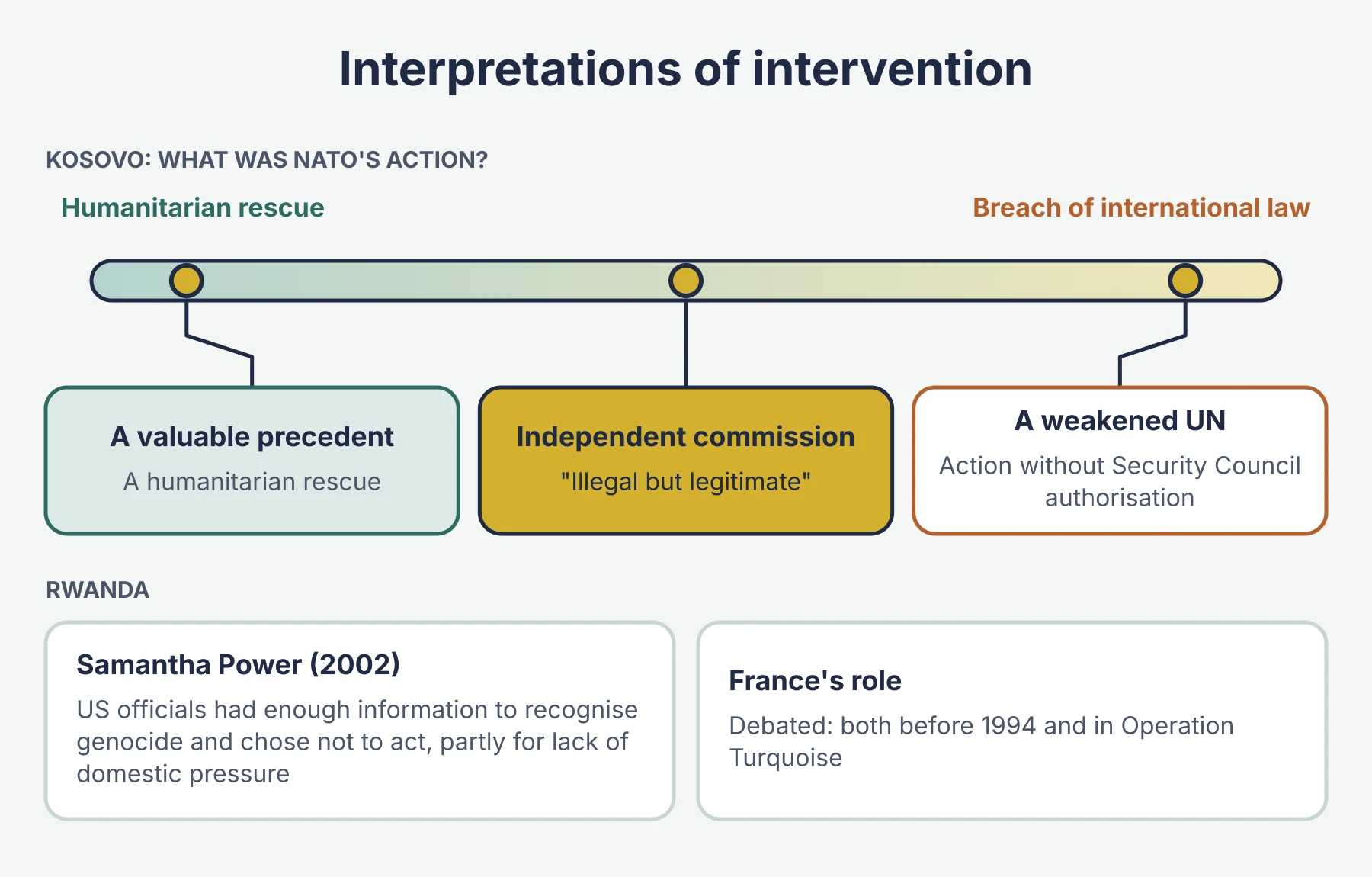
Most refugees returned quickly, but many Serbs and Roma then fled reprisals. The International Criminal Tribunal for the former Yugoslavia (ICTY) indicted Milošević in May 1999; he lost power in 2000, was transferred to The Hague in 2001, and his trial opened in 2002. He died in 2006 before a verdict. The intervention prompted debate about humanitarian intervention: an independent international commission concluded that it was illegal but legitimate.
Worked example: Question 2 on a peacekeeper’s account
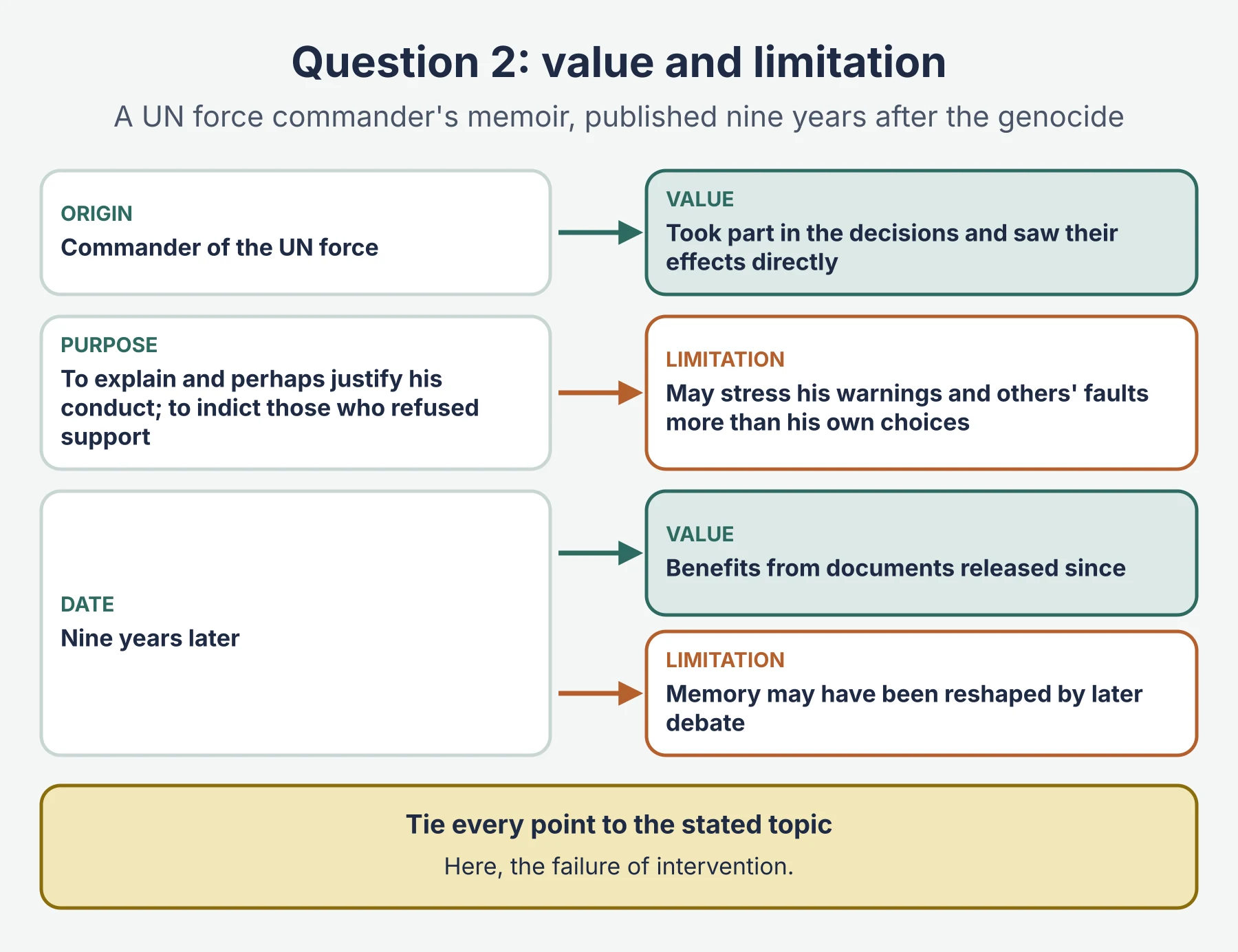
Source: a memoir by a UN force commander in Rwanda, published nine years after the genocide.
“The origin, a memoir by the commander of the UN force, gives it great value for a historian studying the failure of intervention, since he took part in the decisions and saw their effects directly. Its purpose, to explain and perhaps justify his conduct and to indict those who refused him support, is also a limitation: he may stress his warnings and the faults of UN headquarters and Western governments more than his own choices. Written nine years later, it benefits from documents released since, but memory may have been reshaped by later debate.”
Note how every point is tied to the stated topic, the failure of intervention.
Interpretations
Samantha Power’s A Problem from Hell (2002) argued that US officials had enough information to recognise genocide in Rwanda and chose not to act, partly because there was little domestic pressure to do so. Debate continues over France’s role, both before 1994 and in Operation Turquoise. For Kosovo, the central argument is between those who saw NATO’s action as a humanitarian rescue that set a valuable precedent and those who saw it as a breach of international law that weakened the UN. Use these positions to frame Question 4 judgements, and treat a historian’s extract in the sources as an interpretation to evaluate.
Common mistakes
- Treating the genocide as “ancient tribal hatred”; the case study requires the colonial and political causes.
- Saying the UN had no troops in Rwanda; UNAMIR was there, but with a limited mandate and then reduced.
- Calling the Kosovo intervention a UN operation; the bombing was NATO’s, and UN administration came afterwards.
- Leaving out the KLA’s role and presenting the conflict as one-sided before 1999.
- Ignoring date limits: Rwanda ends in 1998, Kosovo in 2002.
Exam technique
Evaluate questions on intervention need criteria: did it save lives, end the conflict, respect international law, and bring justice? To what extent questions need you to weigh the actions of local actors against those of outsiders. In Question 3, compare sources on the same decision, such as the UN reduction of April 1994.
Consolidate with the Conflict and intervention revision notes and try the Conflict and intervention practice questions.
Related resources
-
Practice questions
IB DP History (DP History): Conflict and intervention – Practice Questions
Twelve original IB History practice questions on Conflict and intervention: recall on Rwanda, then a Paper 1-style source set on NATO intervention in Kosovo.
World History · International Baccalaureate · IB
Try questions -
Revision notes
IB DP History (DP History): Conflict and intervention – Revision Notes
Revision notes for IB History Paper 1 Conflict and intervention: Rwanda 1990-1998 and Kosovo 1989-2002, key terms, comparison grid, traps and a self-test.
World History · International Baccalaureate · IB
Revise topic -
Practice questions
IB DP History (DP History): Prescribed subjects – Practice Questions
An original IB DP History Paper 1 source set with markscheme, plus synthesis questions for all five prescribed subjects, with indicative own-knowledge content.
World History · International Baccalaureate · IB
Try questions
Get free revision emails (optional)
Occasional emails with practice questions, worked explanations and links to free resources for the qualification and subjects you choose. No spam, and you can unsubscribe from any email. The free tools on this site never need an email.