
Revision Notes
IB DP History (DP History): Rights and protest – Revision Notes
Revision notes for IB History Paper 1 Rights and protest: US civil rights and apartheid South Africa, laws, campaigns, key actors, traps and a self-test.
- Subject
- World History
- Level
- IB
- Topic
- Topic 1: Prescribed subjects
- Author
- Marlbridge Academic Team
- Updated
- Reviewed by
- Azam Siddique (what this means)
Aligned to International Baccalaureate IB Diploma Programme History (DP History), First assessment 2017. Official specification .
Syllabus page (what it covers and how it is assessed): IB Diploma Programme History.
Syllabus points this page covers
DP History
- 4 Rights and protest
Found an error? Report a correction.
Need help with this topic? Request a free trial class for IB Diploma Programme History (DP History / DP History (2028)).
Prescribed subject 4 covers the civil rights movement in the United States (1954-1965) and apartheid South Africa (1948-1964). For each, revise the nature of discrimination, protests and action, and the role and significance of key actors and groups.
Related: Rights and protest study guide and Rights and protest practice questions.
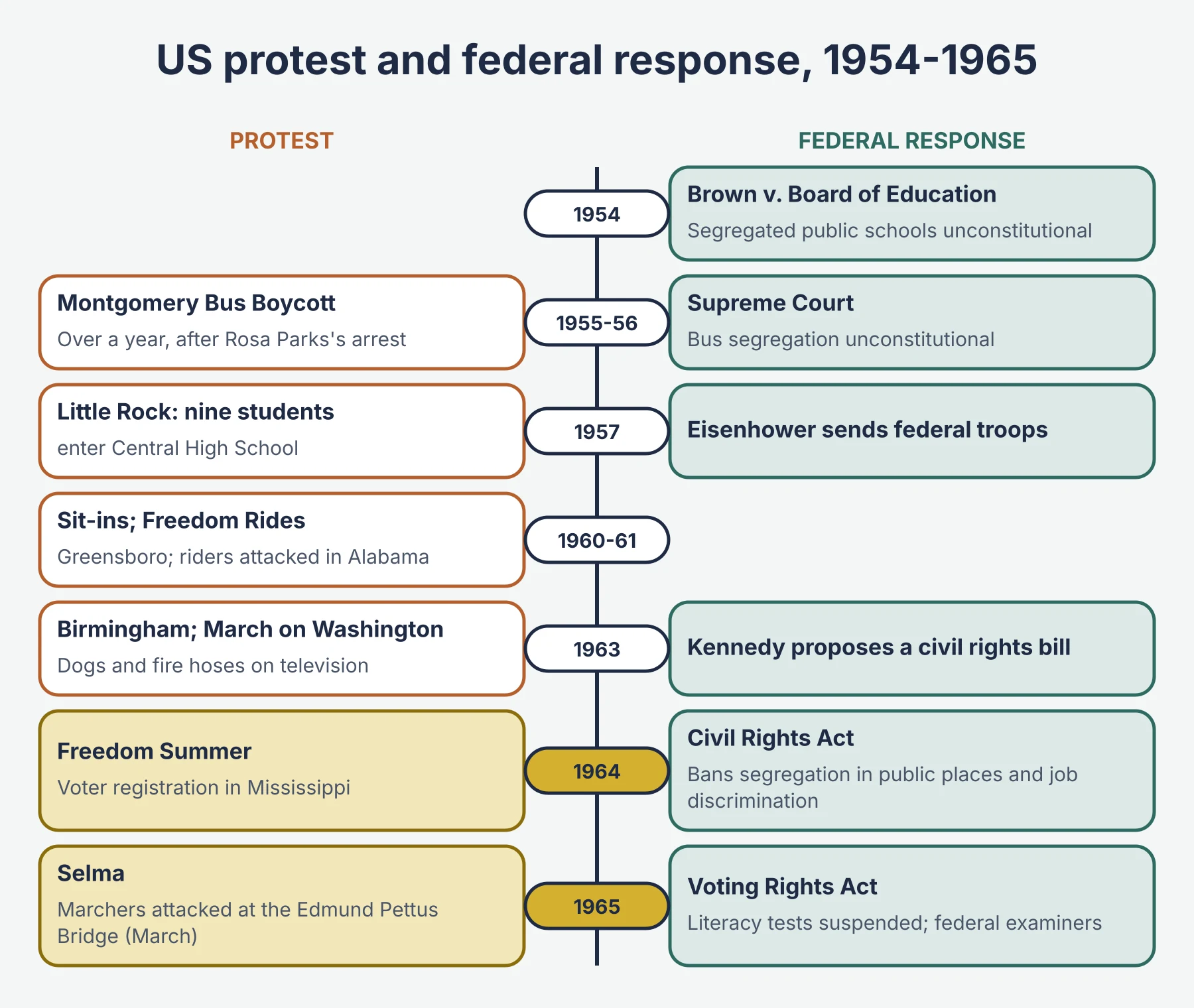
United States: the legal and legislative sequence
| Date | Ruling or law | Effect |
|---|---|---|
| 1954 | Brown v. Board of Education | School segregation unconstitutional |
| 1955 | Brown II | Desegregation “with all deliberate speed”, which allowed delay |
| 1956 | Browder v. Gayle (upheld by the Supreme Court) | Bus segregation in Montgomery unconstitutional |
| 1957 | Civil Rights Act | Civil Rights Commission created; weak on voting |
| 1964 | Twenty-fourth Amendment | Poll taxes banned in federal elections |
| 1964 | Civil Rights Act | Segregation in public places and job discrimination outlawed |
| 1965 | Voting Rights Act | Literacy tests suspended; federal examiners sent to register voters |
United States: campaigns and what each achieved
- Montgomery (1955-1956): community-wide boycott; ended bus segregation; launched King and led to the SCLC (1957).
- Little Rock (1957): federal troops enforced Brown; showed that presidents could be forced to act.
- Greensboro sit-ins (1960): student-led; spread rapidly; led to SNCC’s founding.
- Freedom Rides (1961): tested interstate desegregation; violence in Alabama forced federal intervention.
- Albany (1961-1962): limited success because the police chief avoided public brutality, a lesson for later campaigns.
- Birmingham (1963): police brutality on camera; Kennedy proposed civil rights legislation in June 1963.
- March on Washington (1963): national demonstration of support.
- Freedom Summer (1964): voter registration in Mississippi; murders of three workers; the Mississippi Freedom Democratic Party challenged the official delegation.
- Selma (1965): “Bloody Sunday” (7 March); Voting Rights Act passed in August.
South Africa: the apartheid laws
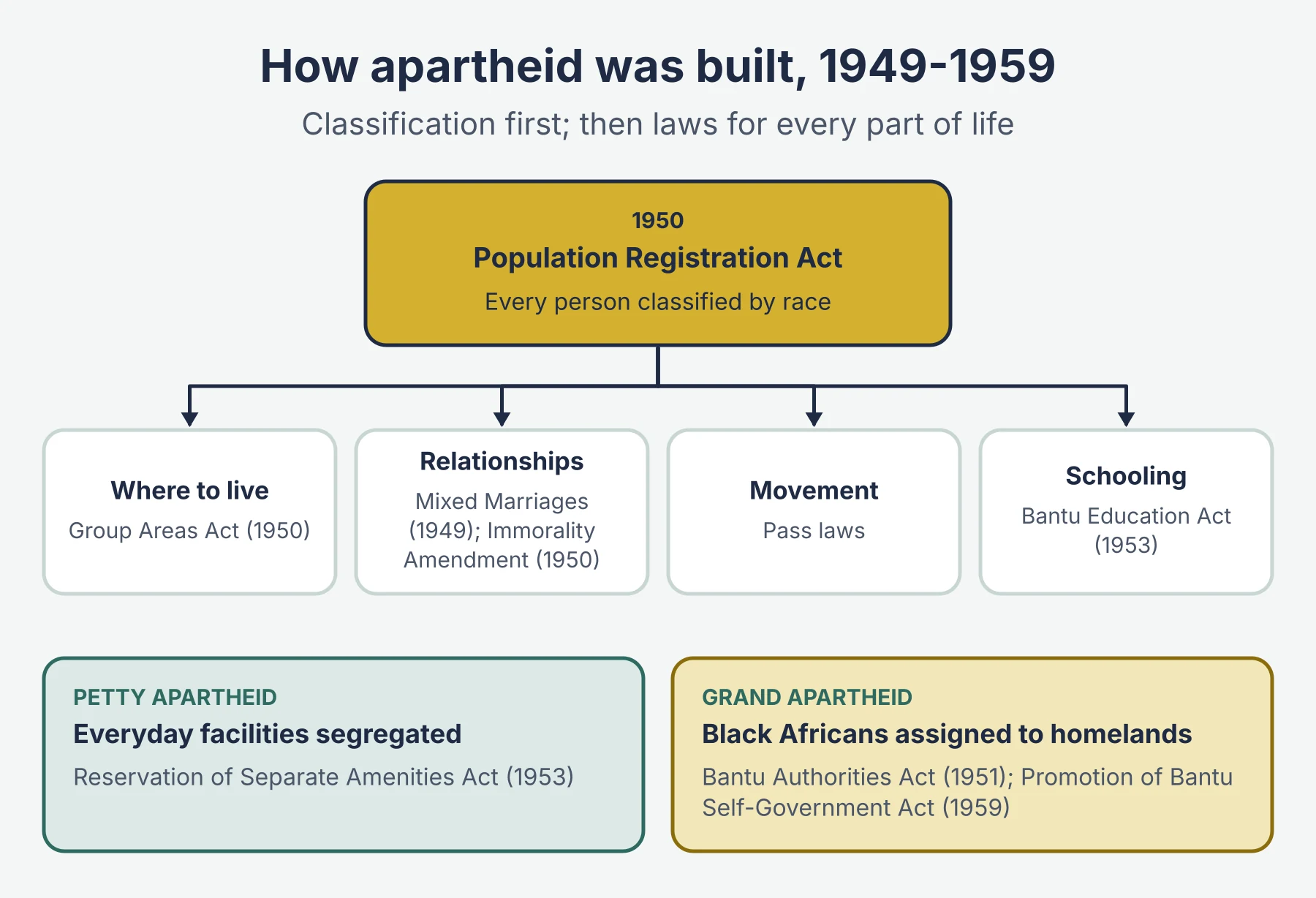
| Law | Year | Purpose |
|---|---|---|
| Prohibition of Mixed Marriages Act | 1949 | Banned marriages across racial categories |
| Population Registration Act | 1950 | Classified every person by race |
| Group Areas Act | 1950 | Allocated residential and business areas by race |
| Suppression of Communism Act | 1950 | Wide powers to ban opponents as “communists” |
| Bantu Authorities Act | 1951 | Tribal authorities; basis for homelands |
| Bantu Education Act | 1953 | State control of Black education |
| Reservation of Separate Amenities Act | 1953 | Segregated public facilities |
| Promotion of Bantu Self-Government Act | 1959 | Planned “self-governing” ethnic homelands |
South Africa: the turn from non-violence
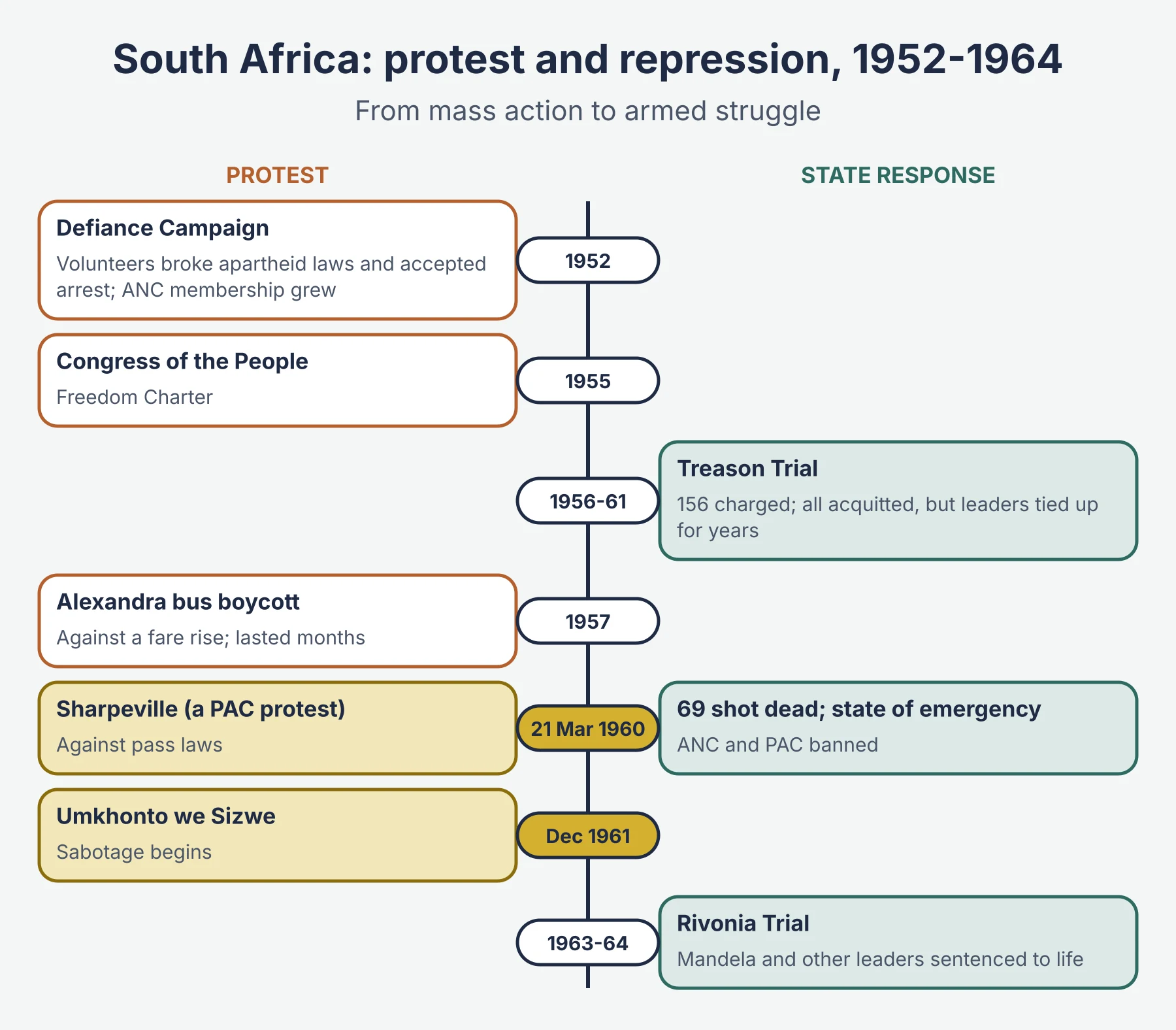
- 1949: ANC adopts the Youth League’s Programme of Action (boycotts, strikes, civil disobedience).
- 1952: Defiance Campaign; thousands arrested; membership grows.
- 1955: Congress of the People adopts the Freedom Charter.
- 1956: women’s march on the Union Buildings in Pretoria against passes; Treason Trial begins.
- 1959: Africanists break away to form the PAC under Robert Sobukwe.
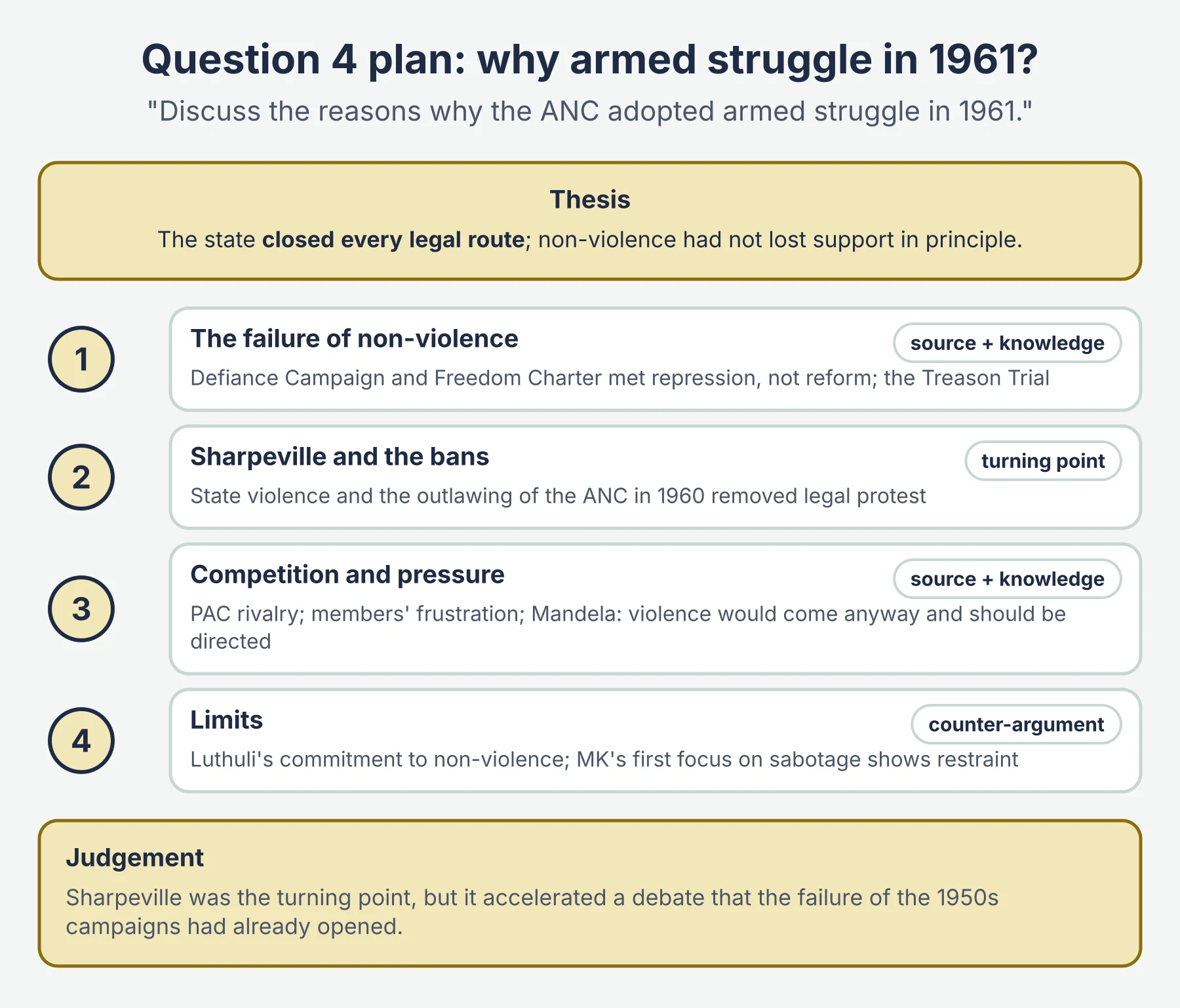
- 1960: Sharpeville (21 March); state of emergency; ANC and PAC banned.
- 1961: South Africa becomes a republic; Treason Trial ends in acquittals; MK sabotage begins (December).
- 1962: Mandela arrested.
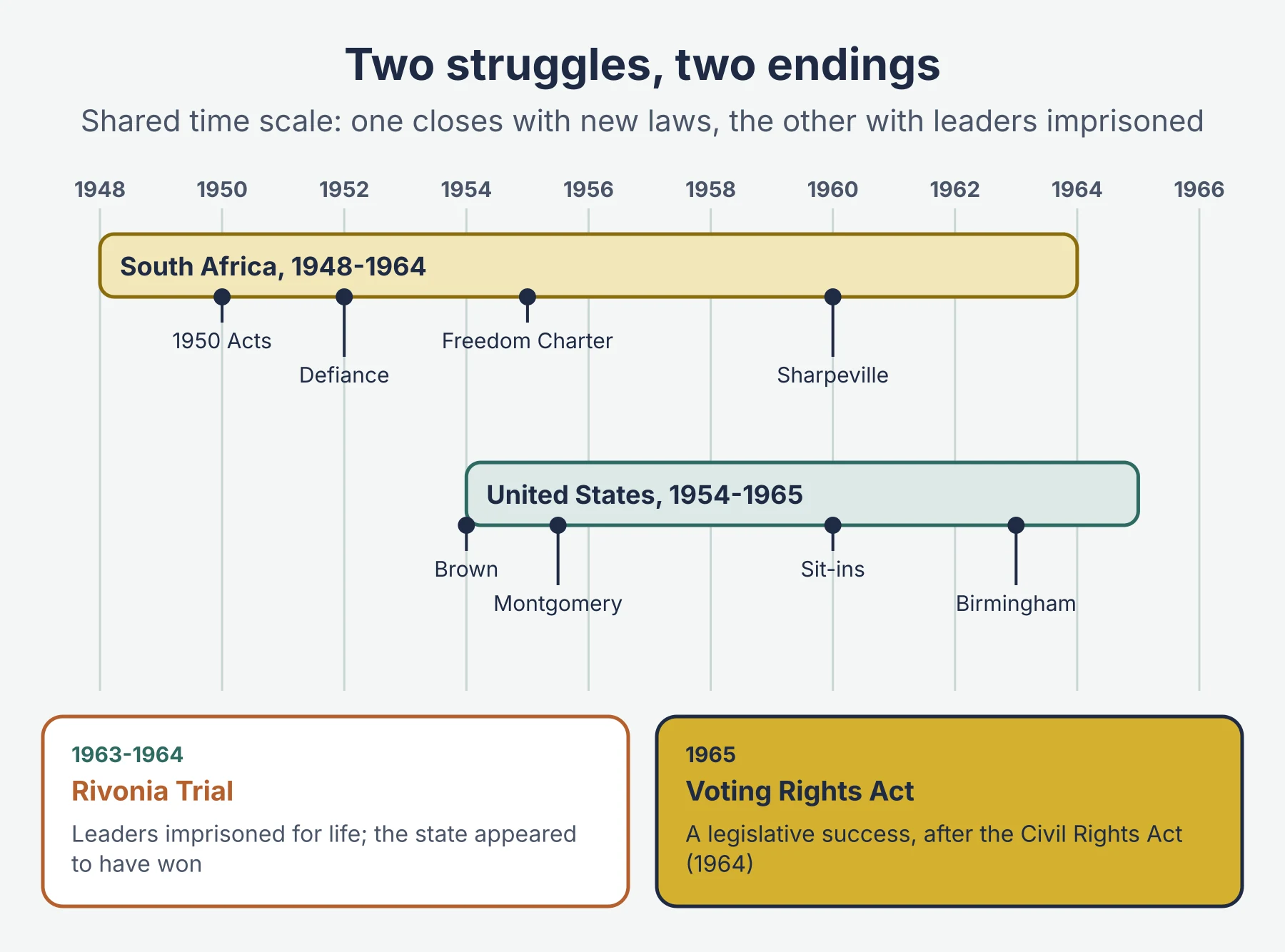
- 1963-1964: Rivonia raid and trial; life sentences.
Comparison grid
| Theme | United States | South Africa |
|---|---|---|
| Legal framework | Federal constitution could be used against state laws | Parliament made discrimination the law; courts offered little redress |
| Methods | Non-violent direct action, litigation, voter registration | Petitions, defiance, boycotts, then sabotage |
| State response | Southern resistance; federal government eventually intervened | Bans, emergency powers, trials and imprisonment |
| Outside opinion | Television and Cold War image mattered to Washington | Growing condemnation after Sharpeville, little immediate effect |
| Outcome by end date | Major legislation in 1964 and 1965 | Leaders imprisoned; movement driven underground |
Key terms
| Term | Meaning |
|---|---|
| Jim Crow | The system of segregation laws in the US South |
| Direct action | Non-violent protest designed to force a response, such as sit-ins and marches |
| De jure / de facto segregation | Segregation by law / segregation in practice without law |
| Petty apartheid | Segregation of everyday facilities |
| Grand apartheid | Territorial separation through homelands |
| Bantustan | An ethnic “homeland” for Black South Africans |
| Pass laws | Laws requiring Black Africans to carry documents controlling movement |
| Freedom Charter | 1955 statement of a non-racial, democratic South Africa |
Exam traps
- Wrong organisation. Sharpeville was a PAC protest; the Freedom Rides were organised by CORE, later joined by SNCC.
- Overlooking the federal government. In the US case, presidents, Congress and the courts are part of the story, not just the protesters.
- Treating law as reality. Brown did not desegregate Southern schools quickly; say how slowly change came.
- Ending too late or too early. US: 1954-1965. South Africa: 1948-1964.
- Ignoring visual sources. Photographs from Birmingham or Sharpeville are common Question 1(b) sources; their message is often about brutality and sympathy.
Self-test
- What did the Supreme Court rule in Brown v. Board of Education? Segregated public schools were unconstitutional.
- Why did Eisenhower send troops to Little Rock in 1957? To enforce the integration of Central High School against state resistance.
- Which organisation grew out of the 1960 sit-ins? SNCC, the Student Non-violent Coordinating Committee.
- Which 1963 campaign led Kennedy to propose a civil rights bill? Birmingham.
- What did the Voting Rights Act of 1965 do? It suspended literacy tests and sent federal examiners to register voters.
- Which organisation did Malcolm X leave in 1964? The Nation of Islam.
- Name the act that classified every South African by race. The Population Registration Act (1950).
- What is the difference between petty and grand apartheid? Petty apartheid segregated everyday facilities; grand apartheid separated territory through homelands.
- Which organisation called the protest at Sharpeville? The PAC, the Pan Africanist Congress.
- What was Umkhonto we Sizwe, and when did it begin operations? The ANC’s armed wing, which began sabotage in December 1961.
- Which ANC president remained committed to non-violence and received the Nobel Peace Prize? Albert Luthuli.
- What was the outcome of the Rivonia Trial? Mandela and other leaders were sentenced to life imprisonment in 1964.
Related resources
-
Study guides
IB DP History (DP History): Conflict and intervention
Prescribed subject 5 for IB History Paper 1: causes, course, intervention and impact in Rwanda 1990-1998 and Kosovo 1989-2002, with a worked source answer.
World History · International Baccalaureate · IB
Read guide -
Practice questions
IB DP History (DP History): Conflict and intervention – Practice Questions
Twelve original IB History practice questions on Conflict and intervention: recall on Rwanda, then a Paper 1-style source set on NATO intervention in Kosovo.
World History · International Baccalaureate · IB
Try questions -
Revision notes
IB DP History (DP History): Conflict and intervention – Revision Notes
Revision notes for IB History Paper 1 Conflict and intervention: Rwanda 1990-1998 and Kosovo 1989-2002, key terms, comparison grid, traps and a self-test.
World History · International Baccalaureate · IB
Revise topic
Get free revision emails (optional)
Occasional emails with practice questions, worked explanations and links to free resources for the qualification and subjects you choose. No spam, and you can unsubscribe from any email. The free tools on this site never need an email.