
Revision Notes
IB DP History (DP History): Conflict and intervention – Revision Notes
Revision notes for IB History Paper 1 Conflict and intervention: Rwanda 1990-1998 and Kosovo 1989-2002, key terms, comparison grid, traps and a self-test.
- Subject
- World History
- Level
- IB
- Topic
- Topic 1: Prescribed subjects
- Author
- Marlbridge Academic Team
- Updated
- Reviewed by
- Azam Siddique (what this means)
Aligned to International Baccalaureate IB Diploma Programme History (DP History), First assessment 2017. Official specification .
Syllabus page (what it covers and how it is assessed): IB Diploma Programme History.
Syllabus points this page covers
DP History
- 5 Conflict and intervention
Found an error? Report a correction.
Need help with this topic? Request a free trial class for IB Diploma Programme History (DP History / DP History (2028)).
Prescribed subject 5 covers Rwanda (1990-1998) and Kosovo (1989-2002). Revise both under causes of the conflict, course and interventions, and impact. The central question running through both is why outsiders did or did not intervene, and with what effect.
Related: Conflict and intervention study guide and Conflict and intervention practice questions.
Rwanda: causes in layers
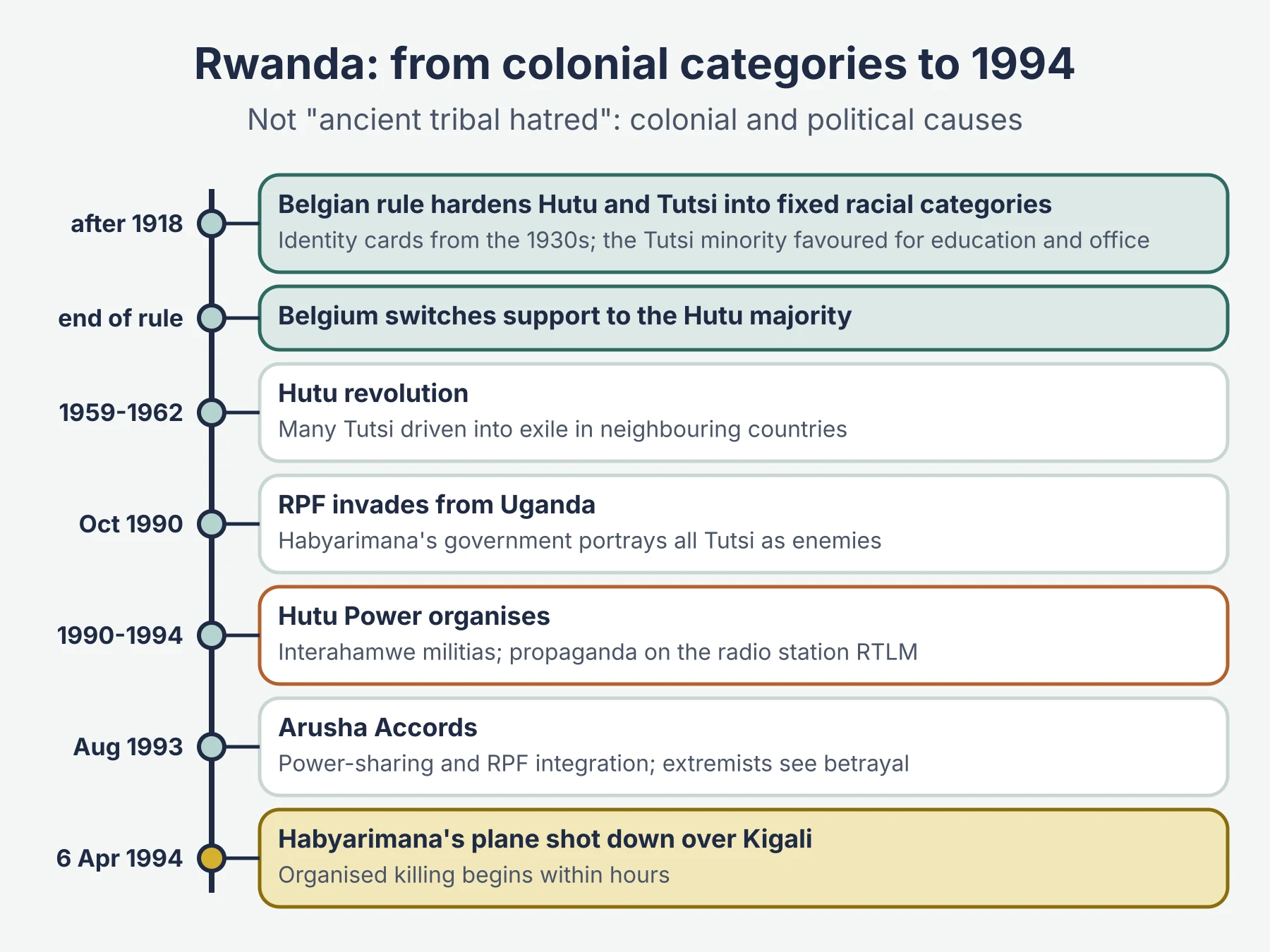
- Long-term: Belgian colonial rule fixed Hutu and Tutsi as racial categories, recorded on identity cards, and favoured Tutsi; the Hutu revolution (1959-1962) and independence (1962) reversed this and sent many Tutsi into exile.
- Medium-term: one-party rule under Habyarimana from 1973; economic crisis as coffee prices fell in the late 1980s; pressure for multi-party politics.
- Short-term: RPF invasion (October 1990); Hutu Power propaganda and militias; the Arusha Accords (August 1993) feared by extremists; the assassination in Burundi of its first Hutu president (October 1993) heightened fear.
- Trigger: the shooting down of Habyarimana’s plane (6 April 1994).
Rwanda: the intervention record
| Actor | Action | Assessment |
|---|---|---|
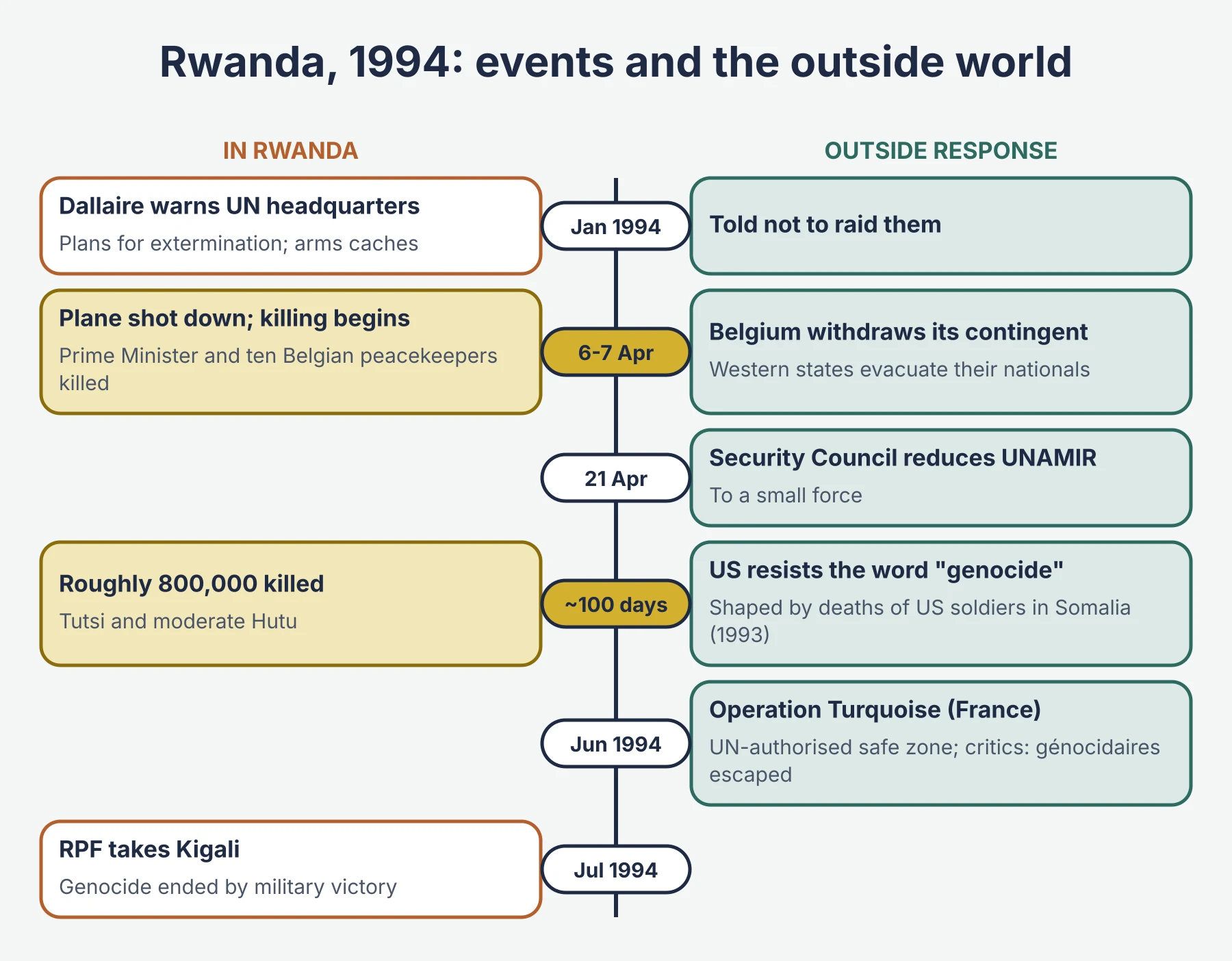
| UN Security Council | Created UNAMIR (October 1993); cut it to a small force (21 April 1994) | Mandate too weak; reduction left civilians unprotected |
| UNAMIR (Dallaire) | Warned of extermination plans (January 1994); protected some civilians in Kigali | Forbidden to seize arms caches; under-equipped |
| Belgium | Withdrew after ten soldiers were killed | Removed UNAMIR’s strongest contingent |
| United States | Avoided the word “genocide”; opposed a stronger mission | Shaped by Somalia (1993) |
| France | Close to the Habyarimana regime; Operation Turquoise (June-August 1994) | Saved some lives; accused of shielding génocidaires |
| RPF | Military campaign; took Kigali (July 1994) | Ended the genocide; later accused of reprisal killings |
Kosovo: causes in layers
- Long-term: competing Serbian and Albanian national claims; Kosovo’s place in Serbian national memory; Albanian majority.
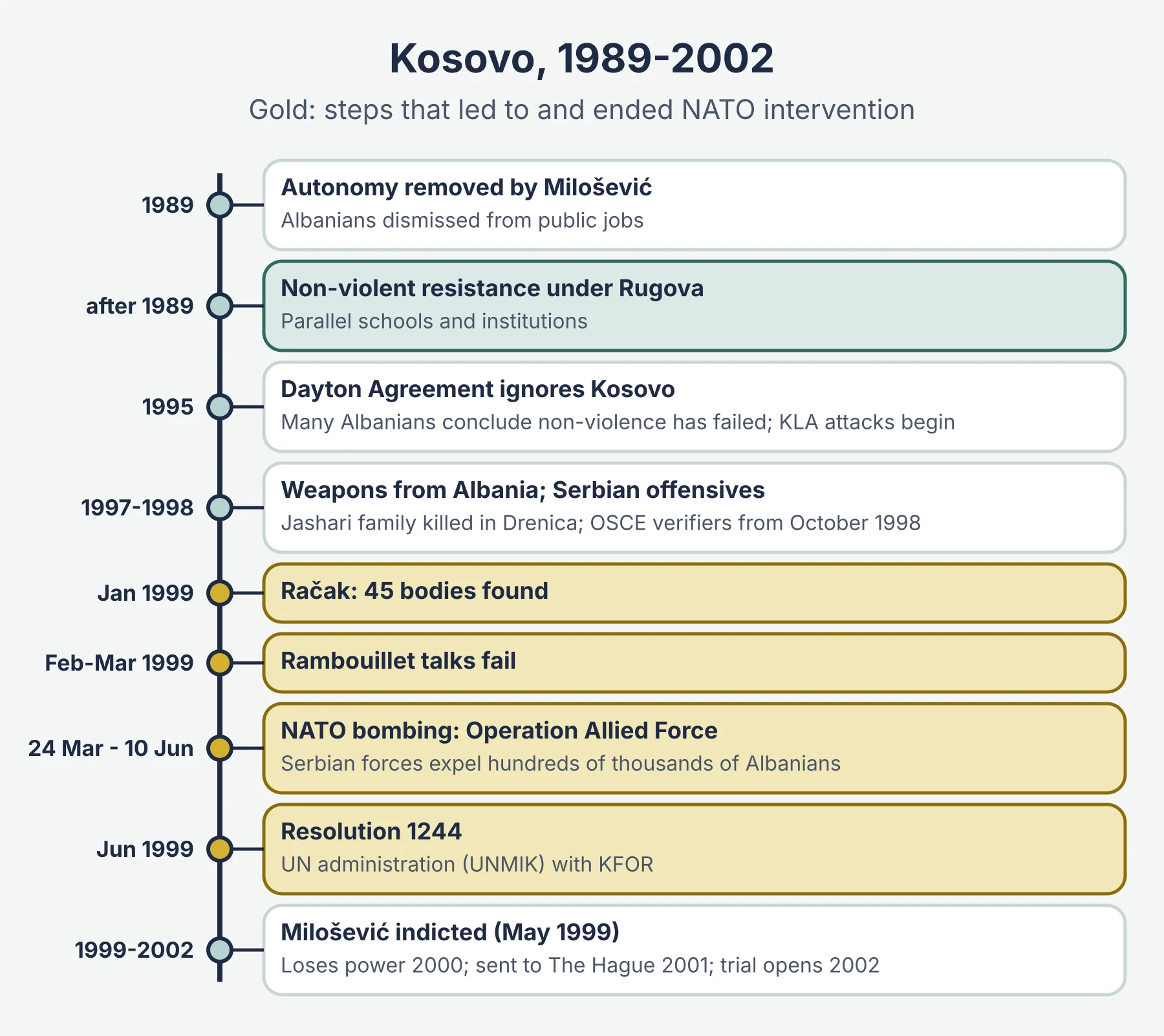
- Medium-term: Milošević’s removal of autonomy (1989); dismissals from public jobs; Albanian parallel institutions under Rugova.
- Short-term: Dayton (1995) ignored Kosovo; the KLA’s armed campaign; weapons from Albania after 1997; Serbian offensives in 1998.
- Trigger for NATO action: Račak (January 1999) and the failure of Rambouillet (March 1999).
Kosovo: the intervention record
| Actor | Action | Assessment |
|---|---|---|
| UN Security Council | Demanded a ceasefire (1998); Resolution 1244 (June 1999) | Could not authorise force because of Russian and Chinese opposition |
| OSCE | Kosovo Verification Mission (from late 1998) | Unarmed; withdrew before the bombing |
| NATO | Operation Allied Force (24 March-10 June 1999) | Forced withdrawal of Yugoslav forces; legality disputed; civilian casualties |
| KFOR and UNMIK | Security and administration after June 1999 | Could not prevent reprisals against Serbs and Roma |
| ICTY | Indicted Milošević (1999); trial from 2002 | First indictment of a serving head of state; no verdict before his death |
Comparison grid
| Theme | Rwanda | Kosovo |
|---|---|---|
| Nature of violence | Genocide organised by the state and militias | Counter-insurgency and mass expulsion |
| Scale of international interest | Low strategic interest for Western powers | Close to NATO members; fear of instability and refugees |
| Recent memory | Somalia discouraged action | Bosnia and Srebrenica encouraged action |
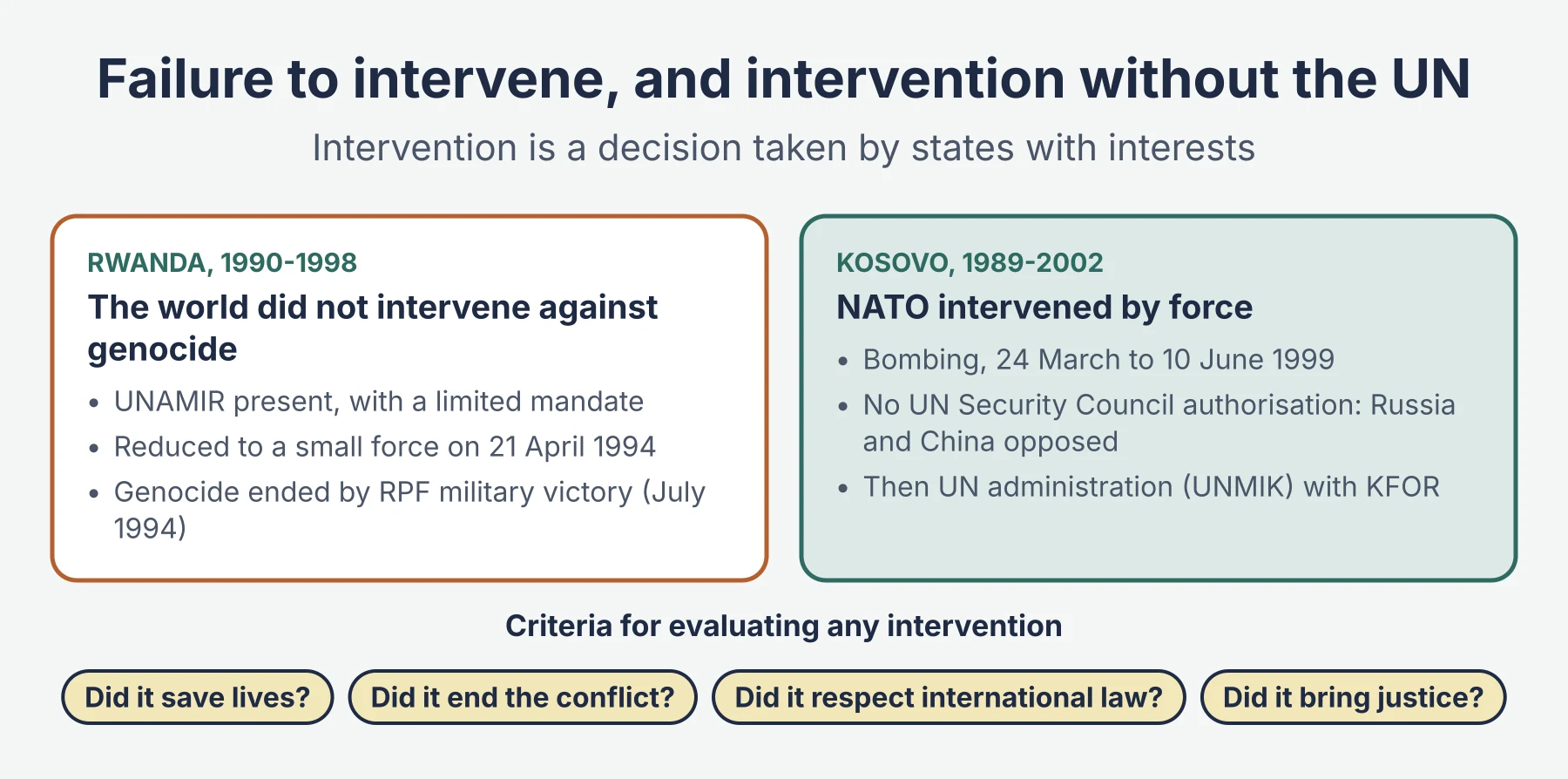
| Authorisation | Security Council acted, but weakly | Force used without Security Council authorisation |
| Outcome | Ended by the RPF’s victory | Ended by Yugoslav withdrawal under NATO pressure |
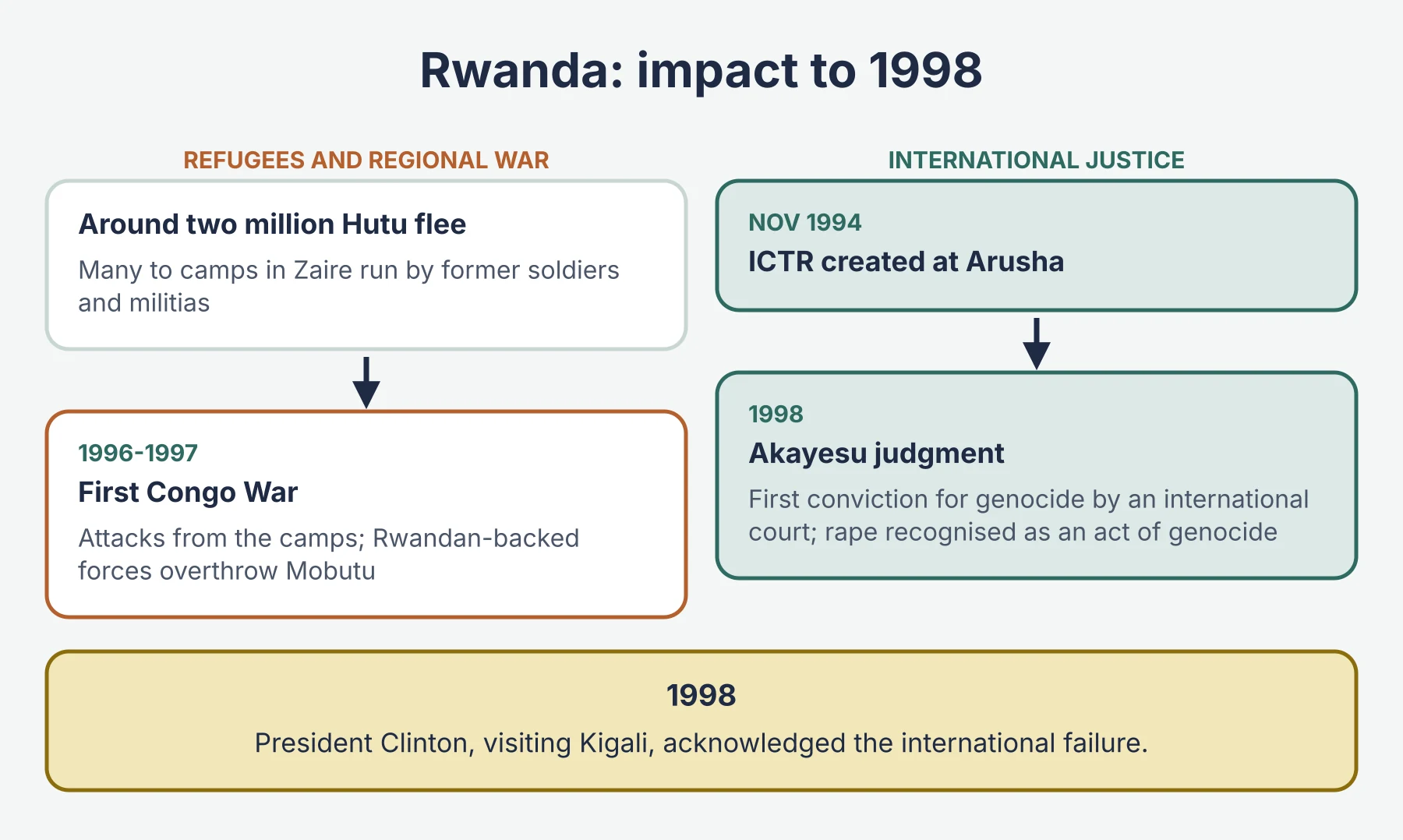
| Justice | ICTR; Akayesu judgment (1998) | ICTY; Milošević trial (2002) |
Key terms
| Term | Meaning |
|---|---|
| Genocide | Acts intended to destroy, in whole or in part, a national, ethnic, racial or religious group (1948 Convention) |
| UNAMIR | UN Assistance Mission for Rwanda |
| Interahamwe | Hutu militias that carried out much of the killing |
| RTLM | Radio station broadcasting anti-Tutsi propaganda |
| RPF | Rwandan Patriotic Front |
| KLA | Kosovo Liberation Army |
| Humanitarian intervention | Use of force across borders to protect people from mass atrocities |
| UNMIK / KFOR | UN administration in Kosovo / NATO-led security force |
| Resolution 1244 | 1999 Security Council resolution establishing the post-war arrangements in Kosovo |
Exam traps
- “The world did nothing in Rwanda.” Be precise: the UN had a force there, then reduced it; France intervened late; the RPF ended the killing.
- Confusing tribunals. ICTR (Rwanda, at Arusha) and ICTY (former Yugoslavia, at The Hague).
- NATO equals UN. The bombing was a NATO operation; the UN role came after it.
- One-sided Kosovo. Include KLA attacks and later reprisals against Serbs.
- Numbers without care. Sources may give very different casualty or refugee figures; use those you are sure of and say “about”.
Self-test
- How did Belgian rule harden ethnic divisions in Rwanda? By recording Hutu or Tutsi on identity cards and favouring Tutsi for education and office.
- What did the Arusha Accords of 1993 provide for? Power-sharing and the integration of the RPF into the army.
- What warning did Dallaire send in January 1994? That there were plans to exterminate Tutsi and hidden arms caches.
- What happened on 6 April 1994? President Habyarimana’s plane was shot down over Kigali.
- Why did Belgium withdraw its troops from UNAMIR? Ten Belgian peacekeepers were killed.
- Why did the US avoid calling the killing genocide? The word implied a duty to act, and after Somalia it did not want to intervene.
- Which court delivered the first international conviction for genocide, and in which case? The ICTR, in the Akayesu case (1998).
- What did Milošević do to Kosovo in 1989? Removed its autonomy within Serbia.
- Why did many Kosovo Albanians turn away from Rugova’s non-violence? The Dayton Agreement of 1995 ignored Kosovo, suggesting non-violence brought no result.
- What was found at Račak in January 1999? The bodies of 45 Albanians, described as a massacre by the head of the verification mission.
- Why did NATO bomb without Security Council authorisation? Russia and China would have vetoed a resolution authorising force.
- What did Resolution 1244 establish? UN administration (UNMIK) and a NATO-led security force (KFOR) in Kosovo.
Related resources
-
Practice questions
IB DP History (DP History): Prescribed subjects – Practice Questions
An original IB DP History Paper 1 source set with markscheme, plus synthesis questions for all five prescribed subjects, with indicative own-knowledge content.
World History · International Baccalaureate · IB
Try questions -
Revision notes
IB DP History (DP History): Prescribed subjects – Revision Notes
Revision notes for IB DP History Paper 1: key facts for all ten prescribed-subject case studies and a checklist for the four source questions, 2017 syllabus.
World History · International Baccalaureate · IB
Revise topic -
Study guides
IB DP History (DP History): Prescribed subjects – Study Guide
How to study the five Paper 1 prescribed subjects in IB DP History: source skills, the four question types, case-study themes and a worked source analysis.
World History · International Baccalaureate · IB
Read guide
Get free revision emails (optional)
Occasional emails with practice questions, worked explanations and links to free resources for the qualification and subjects you choose. No spam, and you can unsubscribe from any email. The free tools on this site never need an email.