
Revision Notes
IB DP History (DP History): The move to global war – Revision Notes
Revision notes for IB History Paper 1 The move to global war: Japanese, German and Italian expansion, key terms, factor grids, traps and a self-test.
- Subject
- World History
- Level
- IB
- Topic
- Topic 1: Prescribed subjects
- Author
- Marlbridge Academic Team
- Updated
- Reviewed by
- Azam Siddique (what this means)
Aligned to International Baccalaureate IB Diploma Programme History (DP History), First assessment 2017. Official specification .
Syllabus page (what it covers and how it is assessed): IB Diploma Programme History.
Syllabus points this page covers
DP History
- 3 The move to global war
Found an error? Report a correction.
Need help with this topic? Request a free trial class for IB Diploma Programme History (DP History / DP History (2028)).
Prescribed subject 3 covers Japanese expansion in East Asia (1931-1941) and German and Italian expansion (1933-1940). For each, revise the causes of expansion, the events and the responses of other states and organisations.
Related: Move to global war study guide and Move to global war practice questions.
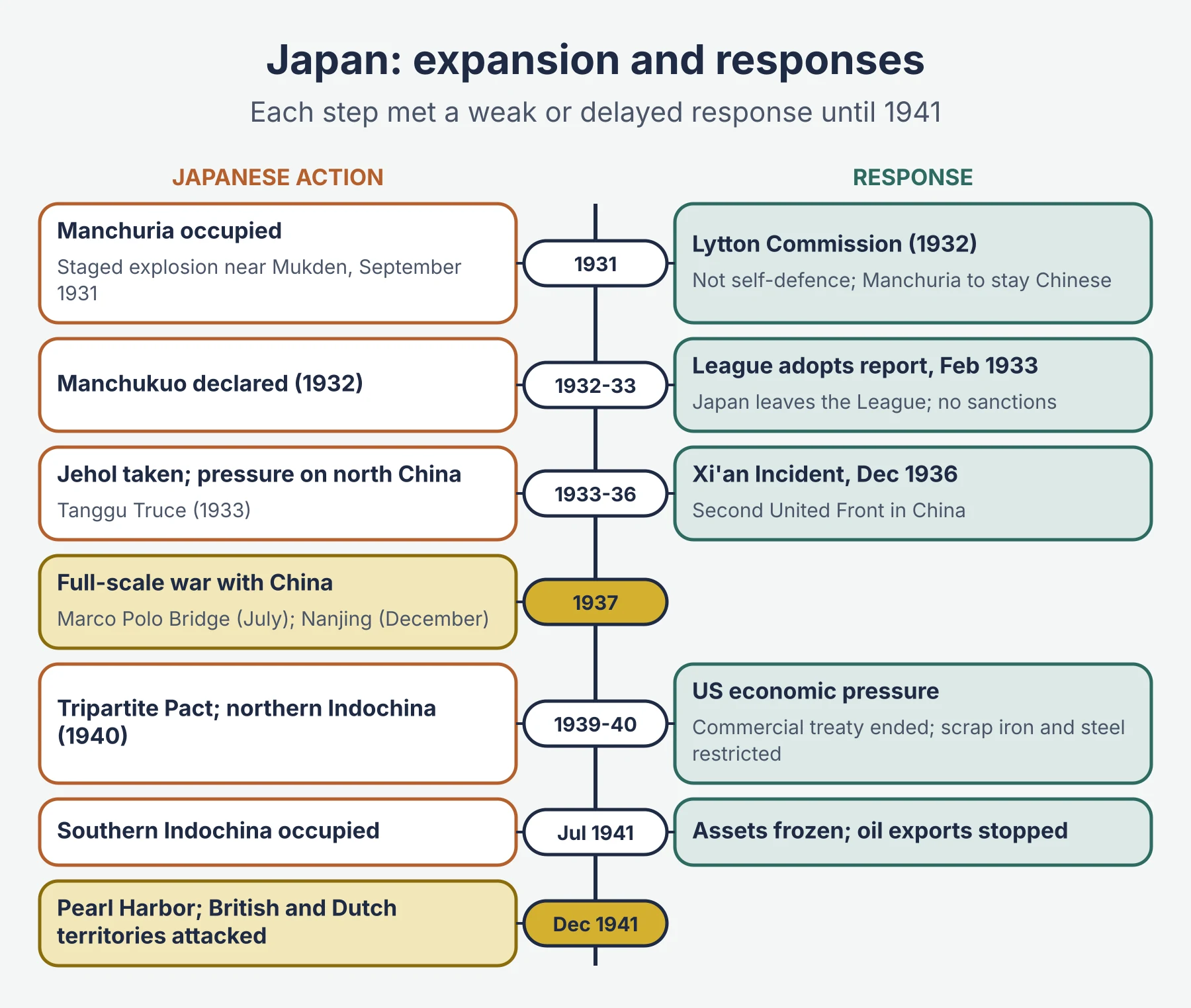
Japan, 1931-1941: chain of events
- September 1931: Mukden Incident; Kwantung Army occupies Manchuria without cabinet approval.
- 1932: Manchukuo proclaimed with Puyi, the last Qing emperor, as figurehead; Prime Minister Inukai assassinated (May).
- 1932-1933: Lytton Report; League Assembly adopts it (February 1933); Japan announces withdrawal (March 1933).
- 1933: Jehol taken; Tanggu Truce.
- 1936: February 26 Incident; Anti-Comintern Pact with Germany; Xi’an Incident leads to the Second United Front.
- 1937: Marco Polo Bridge (July); battle for Shanghai; fall of Nanjing and the Nanjing Massacre (December).
- 1938: Prime Minister Konoe proclaims a “New Order in East Asia”.
- 1939: defeat by Soviet forces at Nomonhan (Khalkhin Gol); US announces the end of the commercial treaty.
- 1940: northern Indochina occupied; Tripartite Pact (September); US restricts scrap iron and steel exports.
- 1941: Neutrality Pact with the USSR (April); southern Indochina occupied (July); US freezes assets and halts oil; Pearl Harbor (7 December).
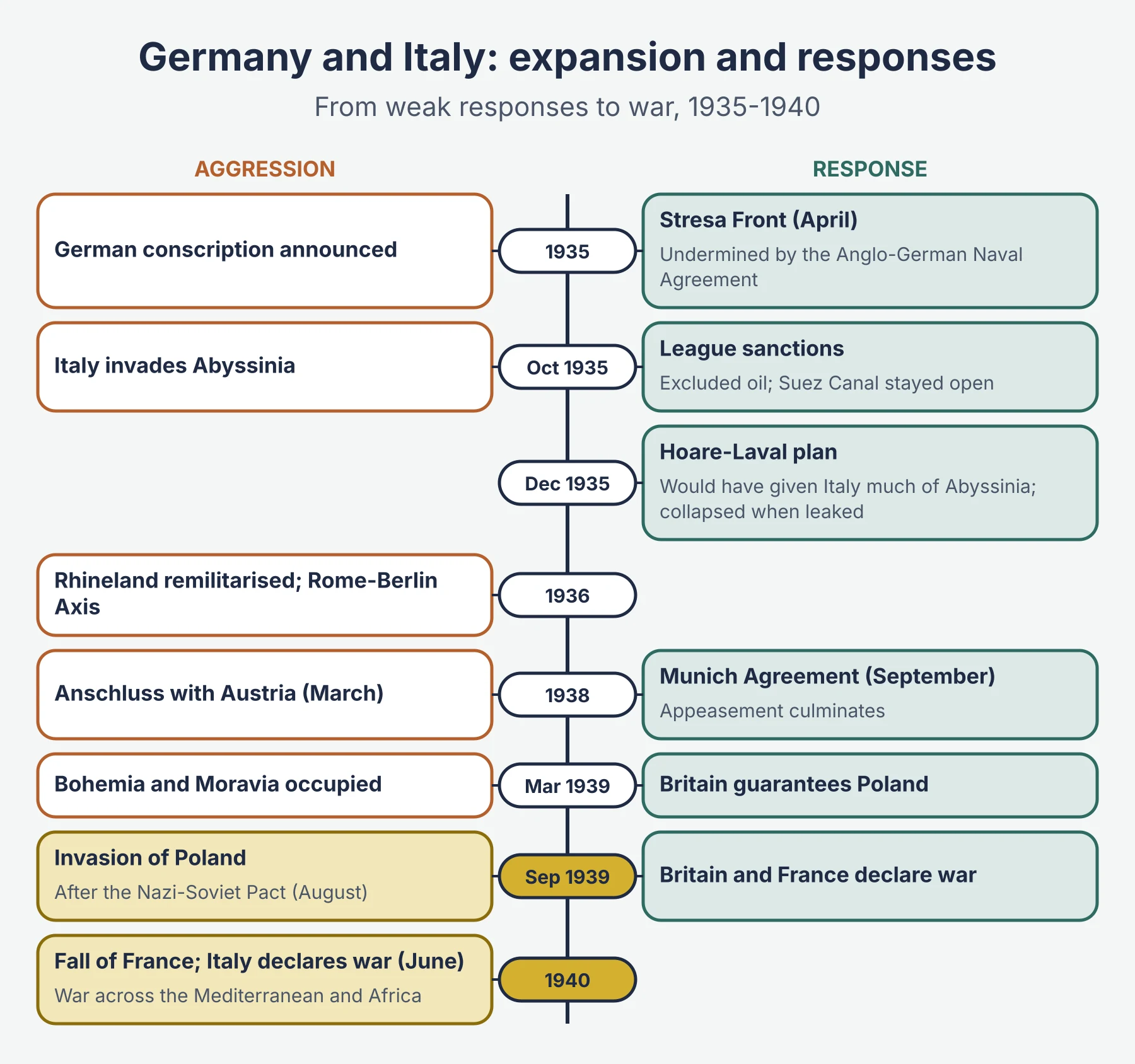
Germany and Italy, 1933-1940: chain of events
- 1933: Germany leaves the Disarmament Conference and the League.
- 1934: Non-aggression pact with Poland; failed Nazi coup in Austria; Mussolini moves troops to the Brenner Pass.
- 1935: Saar returns to Germany by plebiscite; conscription announced; Stresa Front; Anglo-German Naval Agreement; Italy invades Abyssinia; Hoare-Laval plan.
- 1936: Rhineland remilitarised; Abyssinia annexed; Spanish Civil War begins; Rome-Berlin Axis.
- 1937: Italy joins the Anti-Comintern Pact and leaves the League.
- 1938: Anschluss; Sudeten crisis; Munich Agreement (September).
- 1939: Germany occupies Bohemia and Moravia (March); British guarantee to Poland; Italy invades Albania (April); Pact of Steel (May); Nazi-Soviet Pact (August); Poland invaded (1 September); Britain and France declare war (3 September).
- 1940: German offensives in the west; Italy declares war (10 June).
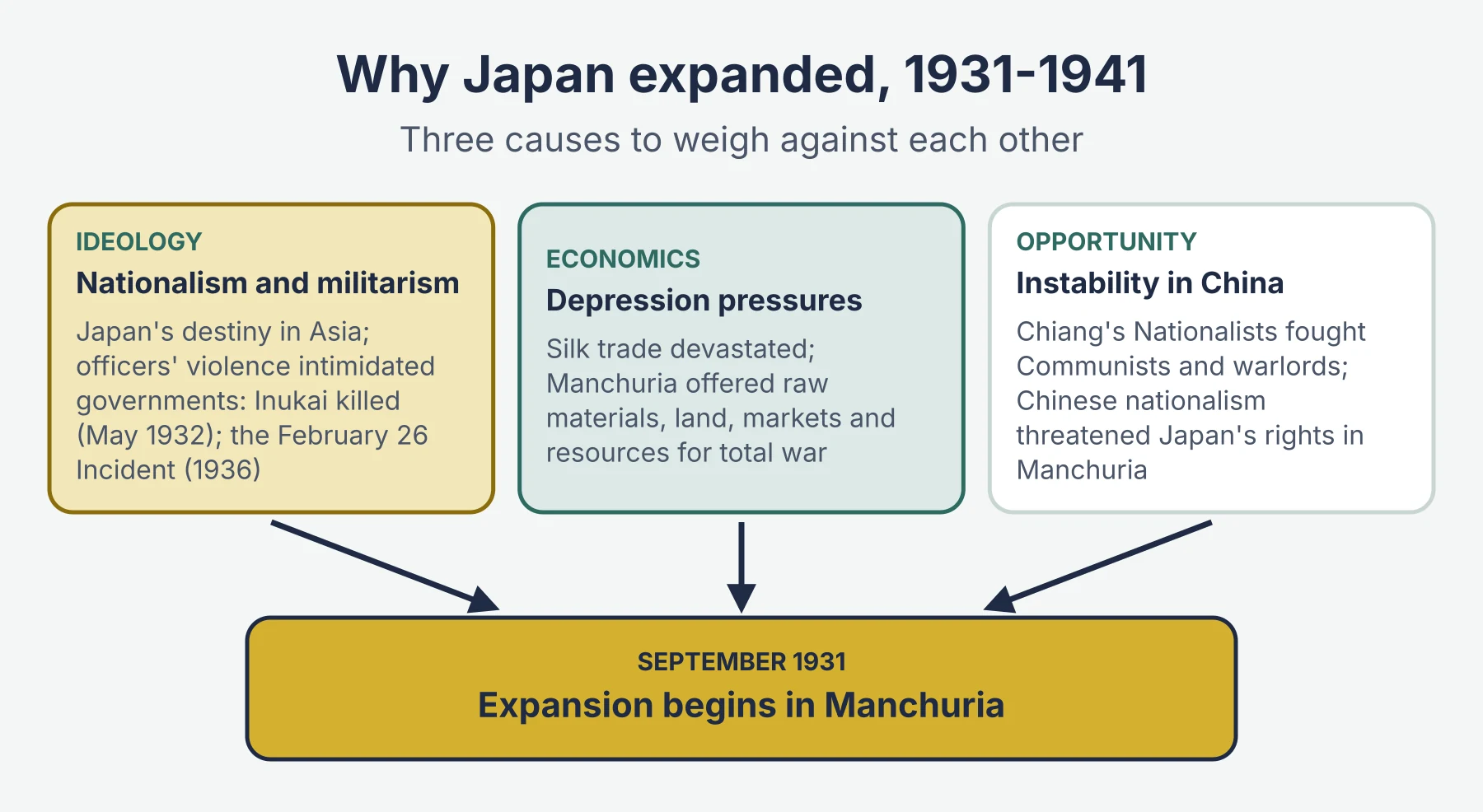
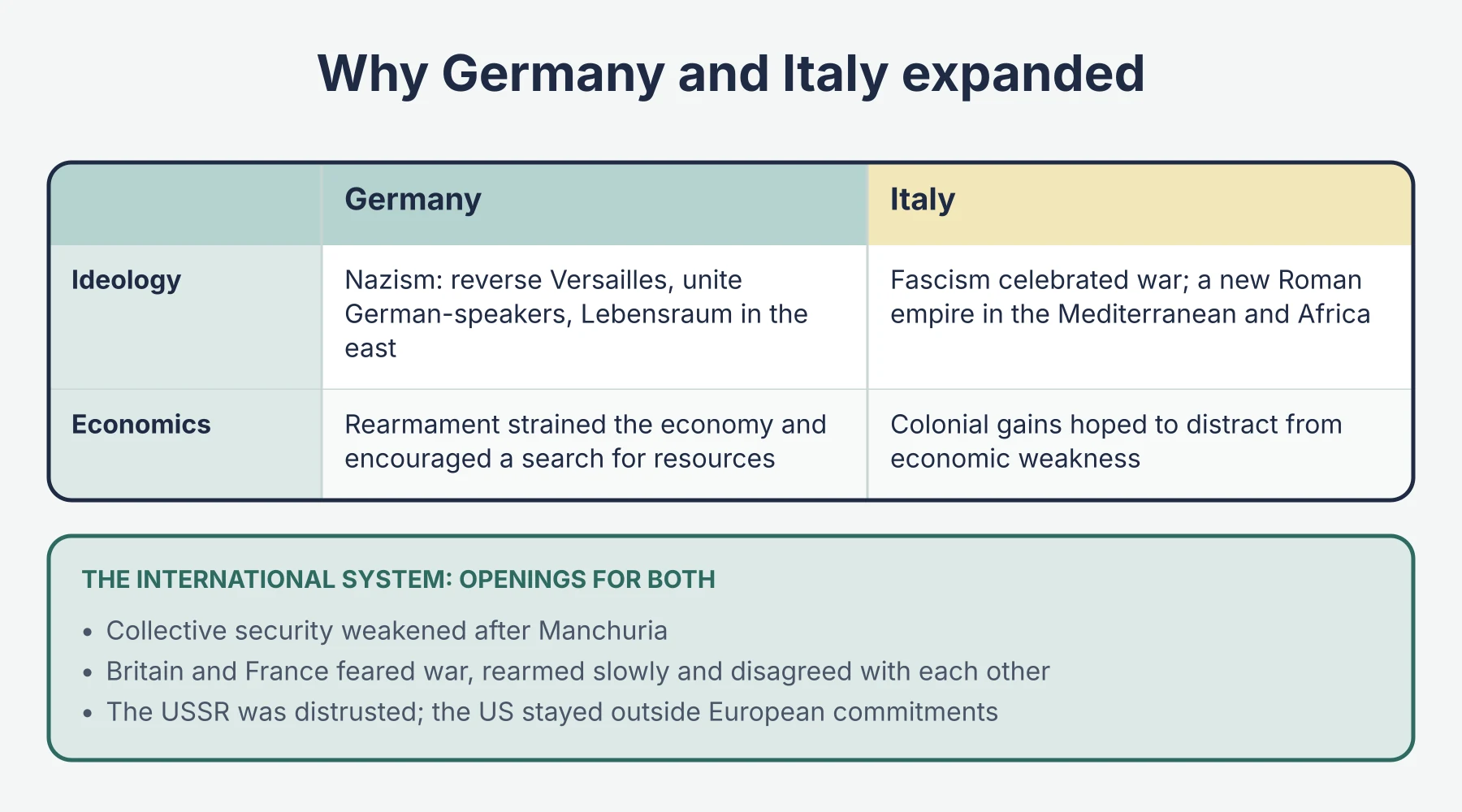
Causes: factor grid
| Factor | Japan | Germany | Italy |
|---|---|---|---|
| Ideology | Emperor-centred nationalism; army’s pan-Asian mission | Reversal of Versailles; Lebensraum; racial ideology | Fascist glorification of war; new Roman empire |
| Economics | Depression and silk collapse; need for raw materials | Rearmament and the search for resources | Economic weakness; colonial prestige |
| Domestic politics | Army independence; assassinations; weak cabinets | Dictatorship from 1933; foreign success built popularity | Mussolini’s need for prestige |
| Opportunity | Chinese disunity; Western powers distracted by the Depression | Divided Britain and France; distrust of the USSR | Anglo-French reluctance to lose Italy as an ally against Germany |
Responses: what was done and why it failed
| Response | Target | Why it failed |
|---|---|---|
| Lytton Report | Japan | No sanctions; Japan simply left the League |
| Brussels Conference (1937) | Japan | Powers would not commit to action |
| League sanctions | Italy | Oil excluded; canal open; non-members still traded |
| Hoare-Laval plan | Italy | Exposed and abandoned, discrediting both Britain and the League |
| Stresa Front | Germany | Undermined by the Anglo-German Naval Agreement and Abyssinia |
| Appeasement and Munich | Germany | Encouraged further demands; broken in March 1939 |
| Guarantee to Poland | Germany | Could not be enforced directly; Nazi-Soviet Pact removed the Soviet threat to Germany |
| US embargoes | Japan | Pushed Japan towards seizing resources in the south |
Key terms
| Term | Meaning |
|---|---|
| Kwantung Army | Japanese army stationed in Manchuria, which acted independently in 1931 |
| Manchukuo | Japanese puppet state in Manchuria from 1932 |
| Second United Front | Nationalist-Communist alliance in China against Japan from 1937 |
| Collective security | Members of the League acting together against an aggressor |
| Appeasement | Meeting reasonable grievances by negotiation to avoid war |
| Lebensraum | “Living space” for Germans in eastern Europe |
| Anschluss | Union of Germany and Austria (March 1938) |
| Axis | The alignment of Germany and Italy, later joined by Japan |
| Tripartite Pact | 1940 agreement of Germany, Italy and Japan |
Exam traps
- Forgetting responses. The case studies include how others reacted; a Question 4 on causes of war often needs them.
- “The League did nothing.” It investigated Manchuria and applied sanctions to Italy; say why these were ineffective.
- Hindsight. Sources from 1938 cannot know about the Holocaust or 1945; judge provenance by what the author could know.
- Mixing up pacts. Anti-Comintern (1936), Pact of Steel (1939), Nazi-Soviet (1939), Tripartite (1940).
- Historians as sources. In Question 2 a historian’s extract is evaluated like any other: consider date, purpose and focus.
Self-test
- What incident in September 1931 began the occupation of Manchuria? The Mukden Incident, an explosion on the South Manchurian Railway staged by Kwantung Army officers.
- What did the Lytton Report conclude? Japan’s action was not self-defence and Manchuria should remain under Chinese sovereignty with autonomy.
- What was the Second United Front, and what led to it? The Nationalist-Communist alliance against Japan, following the Xi’an Incident of December 1936.
- Where did full-scale war between Japan and China begin in July 1937? The Marco Polo Bridge, near Beijing.
- Which American measure of 1941 most threatened Japan’s war in China? The freezing of Japanese assets and the halt to oil exports.
- Why did League sanctions against Italy fail to stop the conquest of Abyssinia? They excluded oil, the Suez Canal stayed open and some states did not apply them.
- What was the Hoare-Laval plan? A 1935 Anglo-French proposal to give Italy much of Abyssinia, abandoned when it leaked.
- Which German action of March 1936 broke both Versailles and Locarno? The remilitarisation of the Rhineland.
- What did the Munich Agreement give Germany? The Sudetenland.
- Which country did Italy invade in April 1939? Albania.
- Why did the Nazi-Soviet Pact matter for the outbreak of war? It removed the threat of a war on two fronts and allowed Germany to invade Poland.
- Summarise the difference between Taylor’s and Trevor-Roper’s views of Hitler. Taylor saw an opportunist exploiting others’ mistakes; Trevor-Roper saw a leader pursuing long-held aims.
Related resources
-
Study guides
IB DP History (DP History): Rights and protest
Prescribed subject 4 for IB History Paper 1: US civil rights 1954-1965 and apartheid South Africa 1948-1964, discrimination, protest and key actors.
World History · International Baccalaureate · IB
Read guide -
Practice questions
IB DP History (DP History): Rights and protest – Practice Questions
Twelve original IB History practice questions on Rights and protest: recall on US civil rights, then a Paper 1-style source set on protest against apartheid.
World History · International Baccalaureate · IB
Try questions -
Revision notes
IB DP History (DP History): Rights and protest – Revision Notes
Revision notes for IB History Paper 1 Rights and protest: US civil rights and apartheid South Africa, laws, campaigns, key actors, traps and a self-test.
World History · International Baccalaureate · IB
Revise topic
Get free revision emails (optional)
Occasional emails with practice questions, worked explanations and links to free resources for the qualification and subjects you choose. No spam, and you can unsubscribe from any email. The free tools on this site never need an email.