
Study Guides
IB DP History (DP History): Conquest and its impact
Prescribed subject 2 for IB History Paper 1: the fall of Nasrid Granada and the Spanish conquest of Mexico and Peru, with source advice and a worked comparison.
- Subject
- World History
- Level
- IB
- Topic
- Topic 1: Prescribed subjects
- Author
- Marlbridge Academic Team
- Updated
- Reviewed by
- Azam Siddique (what this means)
Aligned to International Baccalaureate IB Diploma Programme History (DP History), First assessment 2017. Official specification .
Syllabus page (what it covers and how it is assessed): IB Diploma Programme History.
Syllabus points this page covers
DP History
- 2 Conquest and its impact
Found an error? Report a correction.
Need help with this topic? Request a free trial class for IB Diploma Programme History (DP History / DP History (2028)).
Prescribed subject 2, Conquest and its impact, studies two conquests carried out by the crowns of Castile and Aragon within a single lifetime: the final stages of Muslim rule in Spain (1482-1492) and the conquest of Mexico and Peru (1519-1551). Paper 1 sets its sources on one of them. This guide adds the depth that the prescribed subjects overview leaves out.
What the subject covers
For both case studies the content falls under three headings:
- Context and motives: the situation of conquerors and conquered before the conquest, and why the conquerors acted (religion, wealth, prestige, security).
- Key events and actors: the course of the conquest and the people who shaped it, on both sides.
- Impact: the consequences for the conquered peoples and for the conquerors, including religious, social, economic and political change, and the debates that conquest provoked.
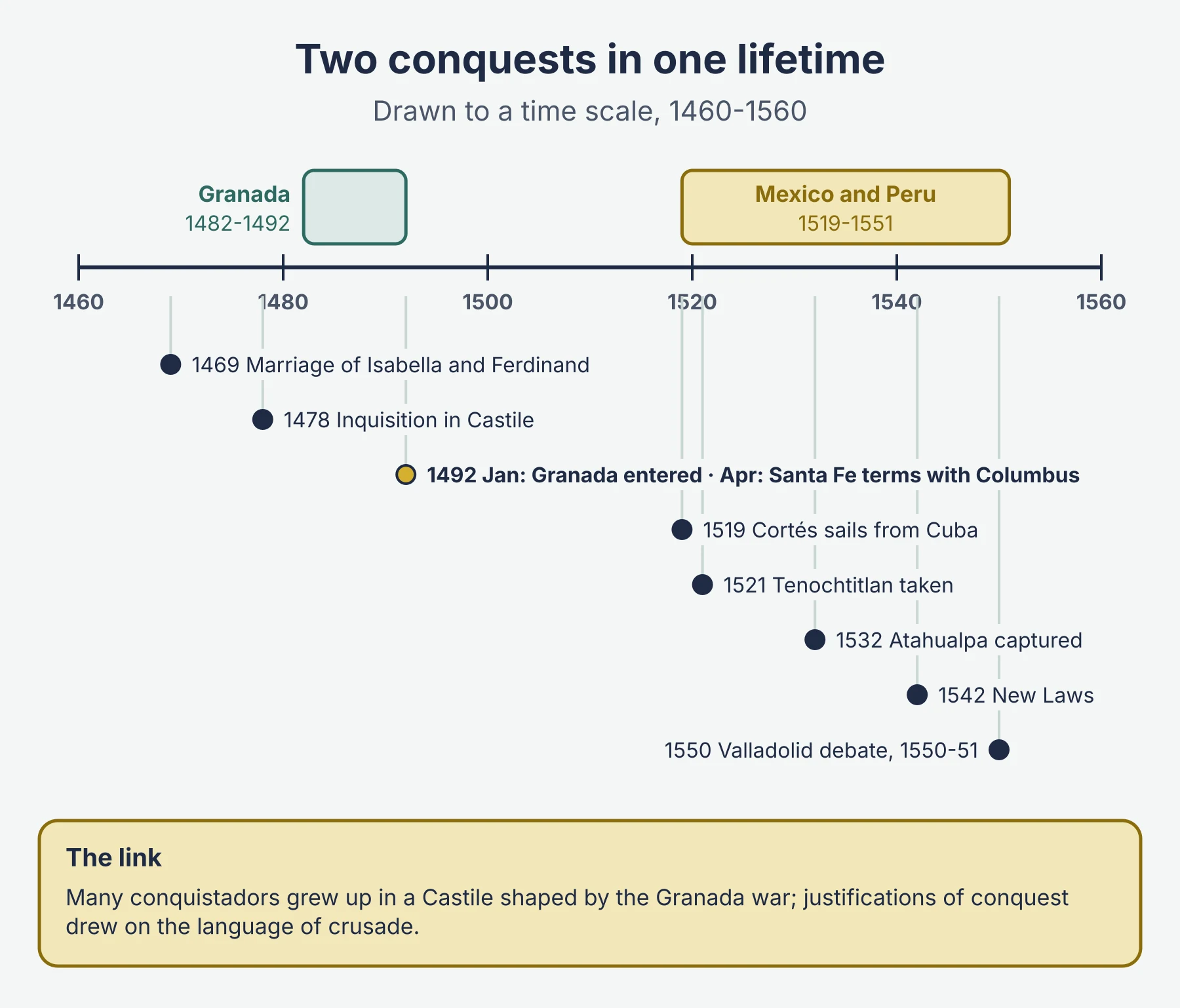
The two cases connect. Ferdinand and Isabella entered Granada in January 1492; in April they agreed terms with Columbus at their camp at Santa Fe. Many conquistadors grew up in a Castile shaped by the war against Granada, and Spanish justifications of conquest in the Americas drew on the language of crusade.
Case study 1: The final stages of Muslim rule in Spain
Context and motives
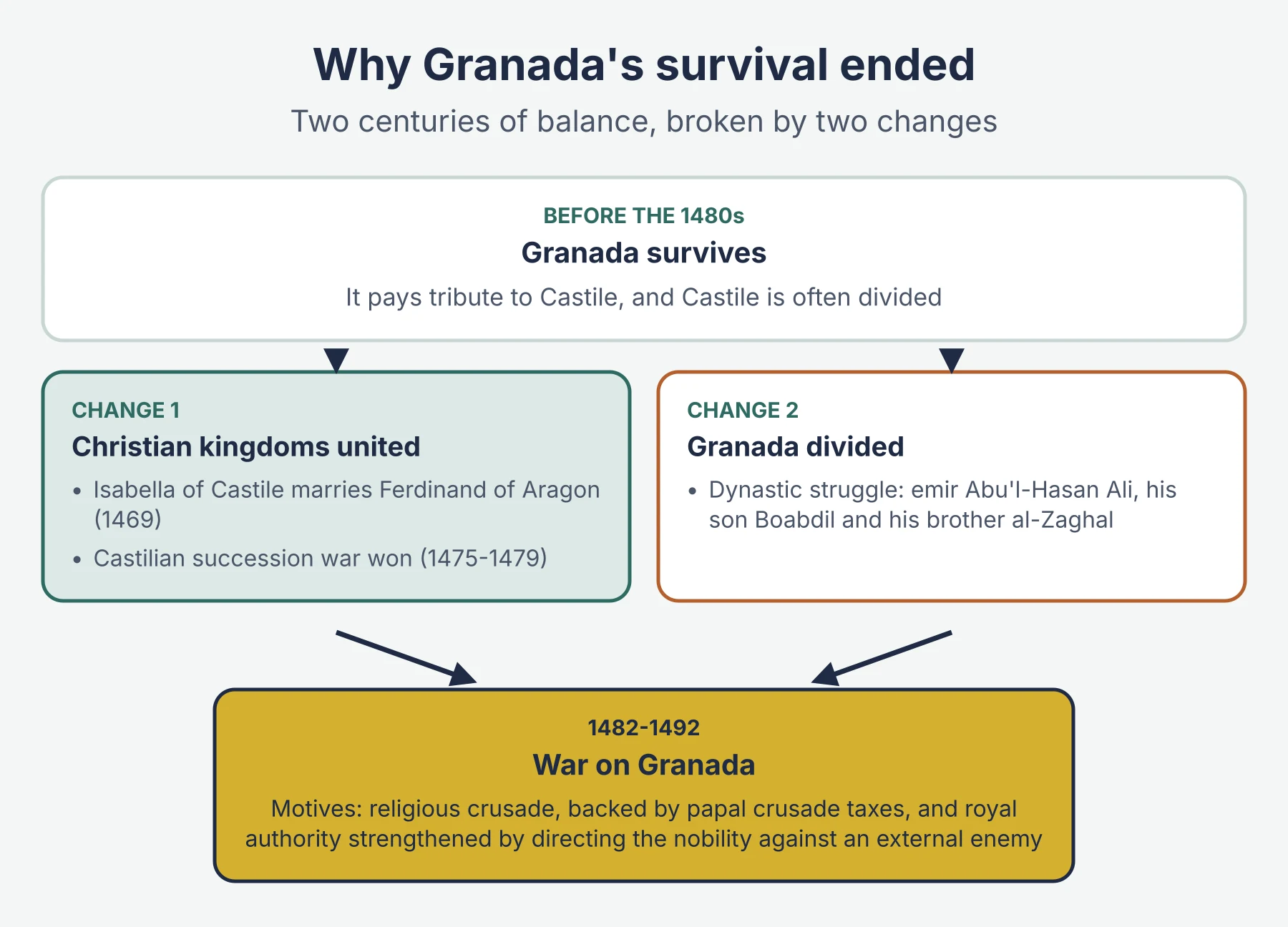
By the 1480s the Nasrid emirate of Granada was the last Muslim state in the peninsula. It had survived for two centuries partly by paying tribute to Castile and partly because Castile was often divided. Two changes ended that balance. The marriage of Isabella of Castile and Ferdinand of Aragon (1469) and their success in the Castilian succession war (1475-1479) united the two largest Christian kingdoms under joint rulers. Meanwhile Granada itself was split by a dynastic struggle among the emir Abu’l-Hasan Ali, his son Muhammad XII (Boabdil) and his brother Muhammad al-Zaghal.
The Catholic Monarchs’ motives combined religious crusade, backed by papal crusade taxes, with the wish to strengthen royal authority by directing the nobility against an external enemy.
Key events
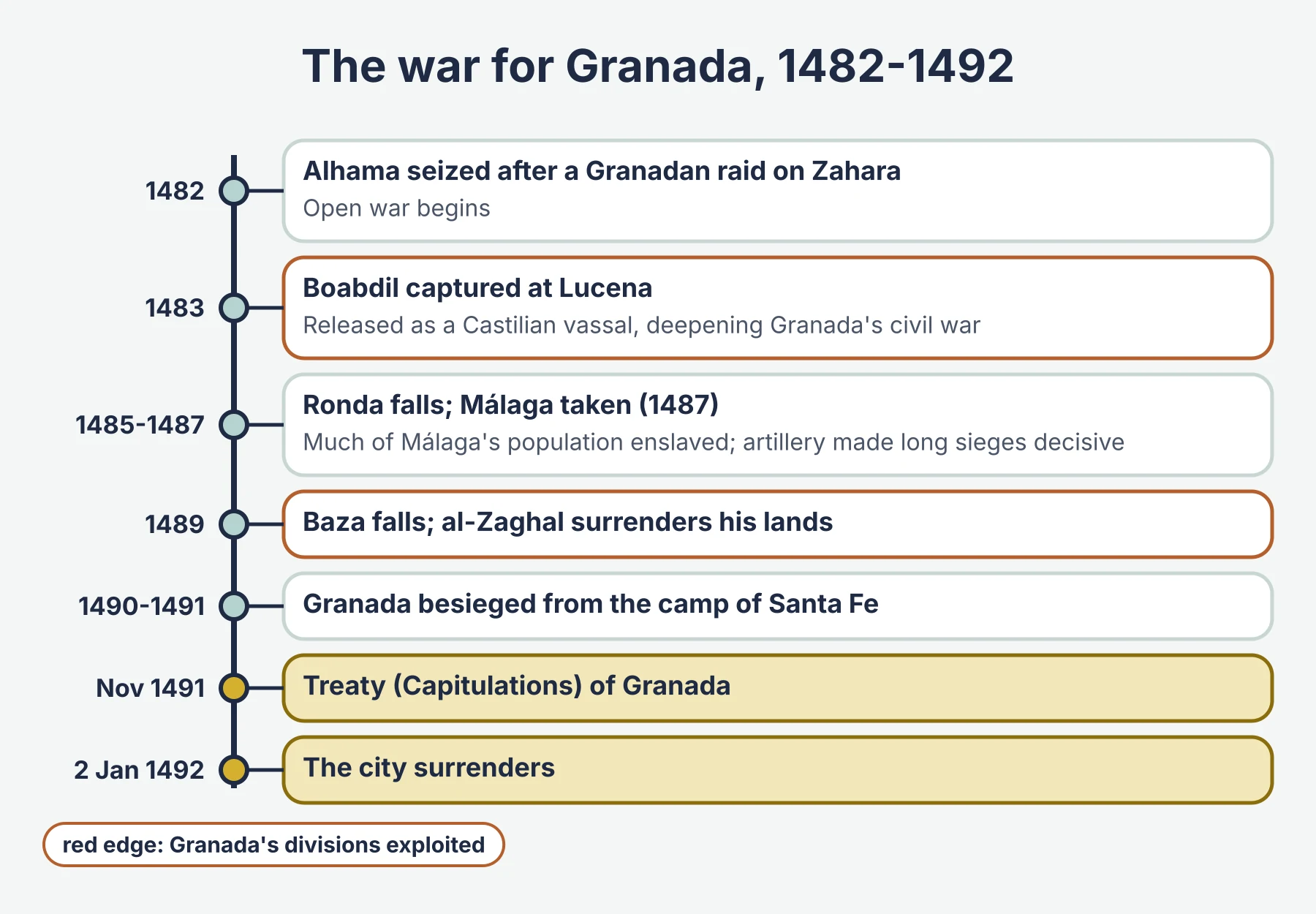
- 1482: Castilian forces seize Alhama after a Granadan raid on Zahara; open war begins.
- 1483: Boabdil, now in revolt against his father, is captured at Lucena and released as a Castilian vassal, deepening Granada’s civil war.
- 1485-1487: Ronda falls; Málaga is besieged and taken in 1487, and much of its population is enslaved. Artillery made long sieges decisive.
- 1489: Baza falls and al-Zaghal surrenders his lands.
- 1490-1491: Granada is besieged from the fortified camp of Santa Fe.
- November 1491: the Treaty (Capitulations) of Granada; the city surrenders on 2 January 1492.
Impact
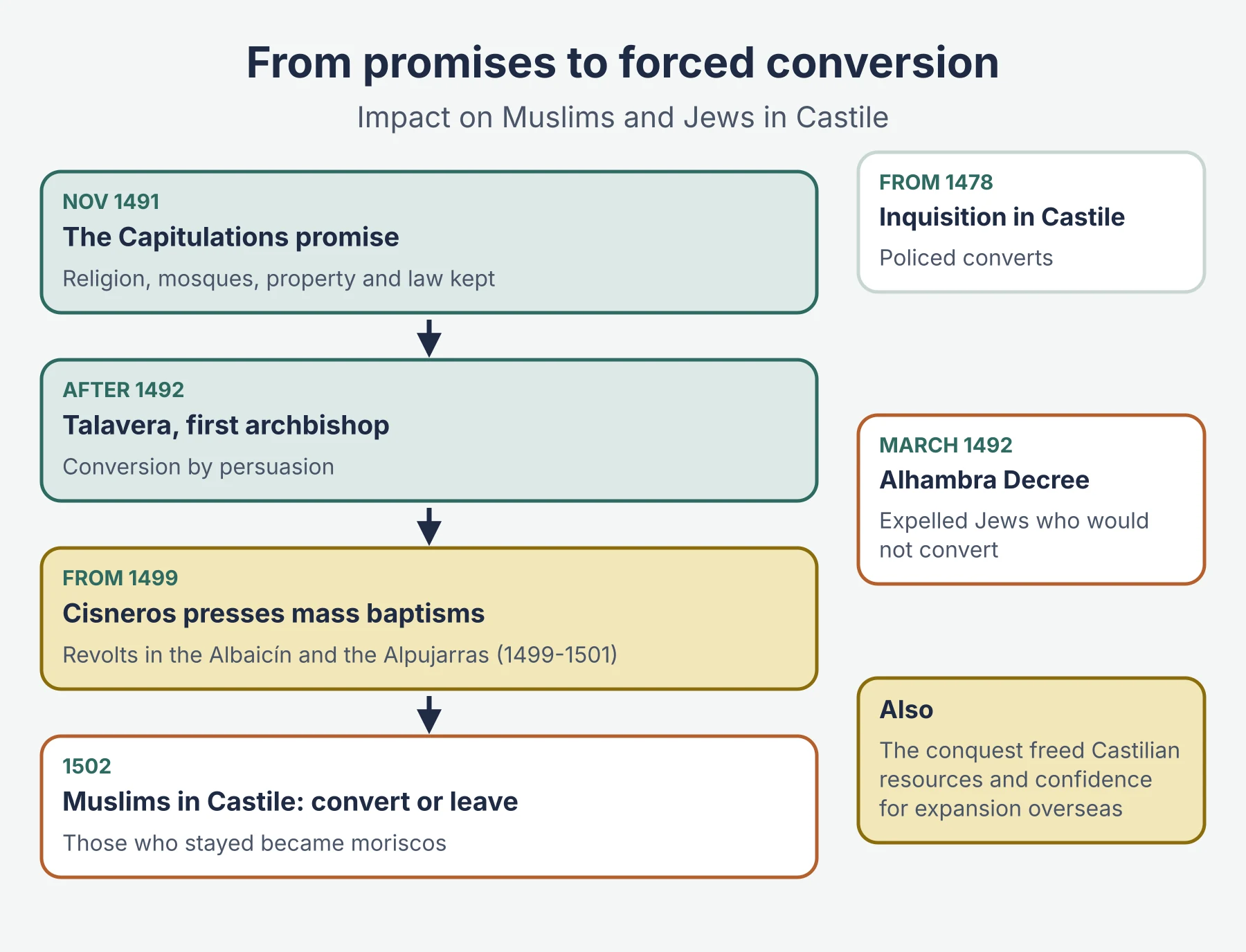
The Capitulations promised Muslims their religion, mosques, property and law. The first archbishop, Hernando de Talavera, sought conversion by persuasion. From 1499 Cardinal Cisneros pressed mass baptisms, provoking revolts in the Albaicín and the Alpujarras (1499-1501). In 1502 Muslims in Castile were ordered to convert or leave; those who stayed became moriscos. In March 1492 the Alhambra Decree expelled Jews who would not convert, and the Inquisition, established in Castile from 1478, policed converts. The conquest also freed Castilian resources and confidence for expansion overseas.
Case study 2: The conquest of Mexico and Peru
Context and motives
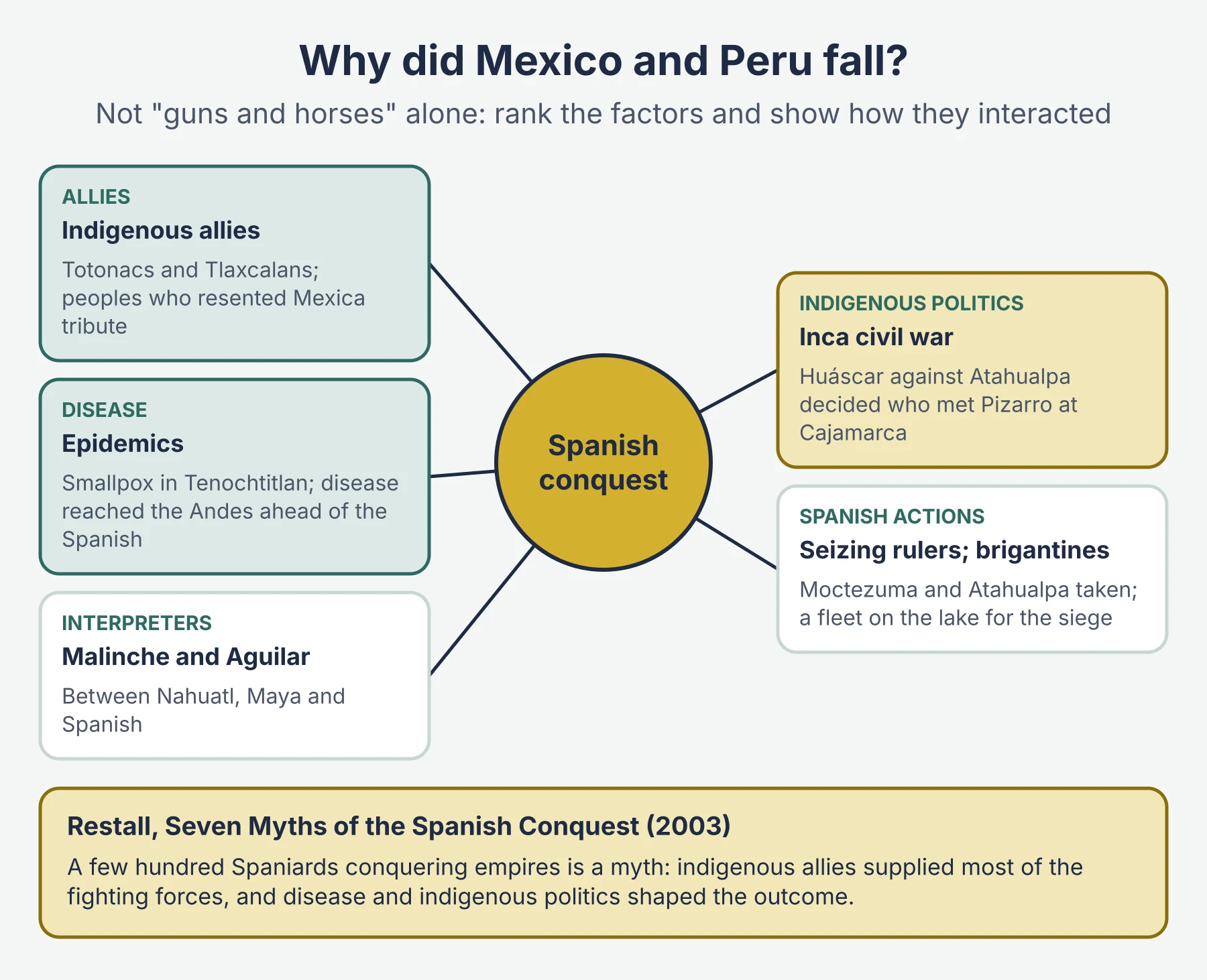
The Mexica (Aztec) state ruled from Tenochtitlan over tribute-paying peoples, several of whom resented it; the Tlaxcalans had never been conquered. The Inca empire was larger but had just been through a civil war between the brothers Huáscar and Atahualpa after their father Huayna Capac died, probably of an epidemic disease that reached the Andes ahead of the Spanish. Spanish motives combined the search for gold and lordship, service to the crown, and the duty to spread Christianity, which the crown used to justify its rule.
Key events: Mexico
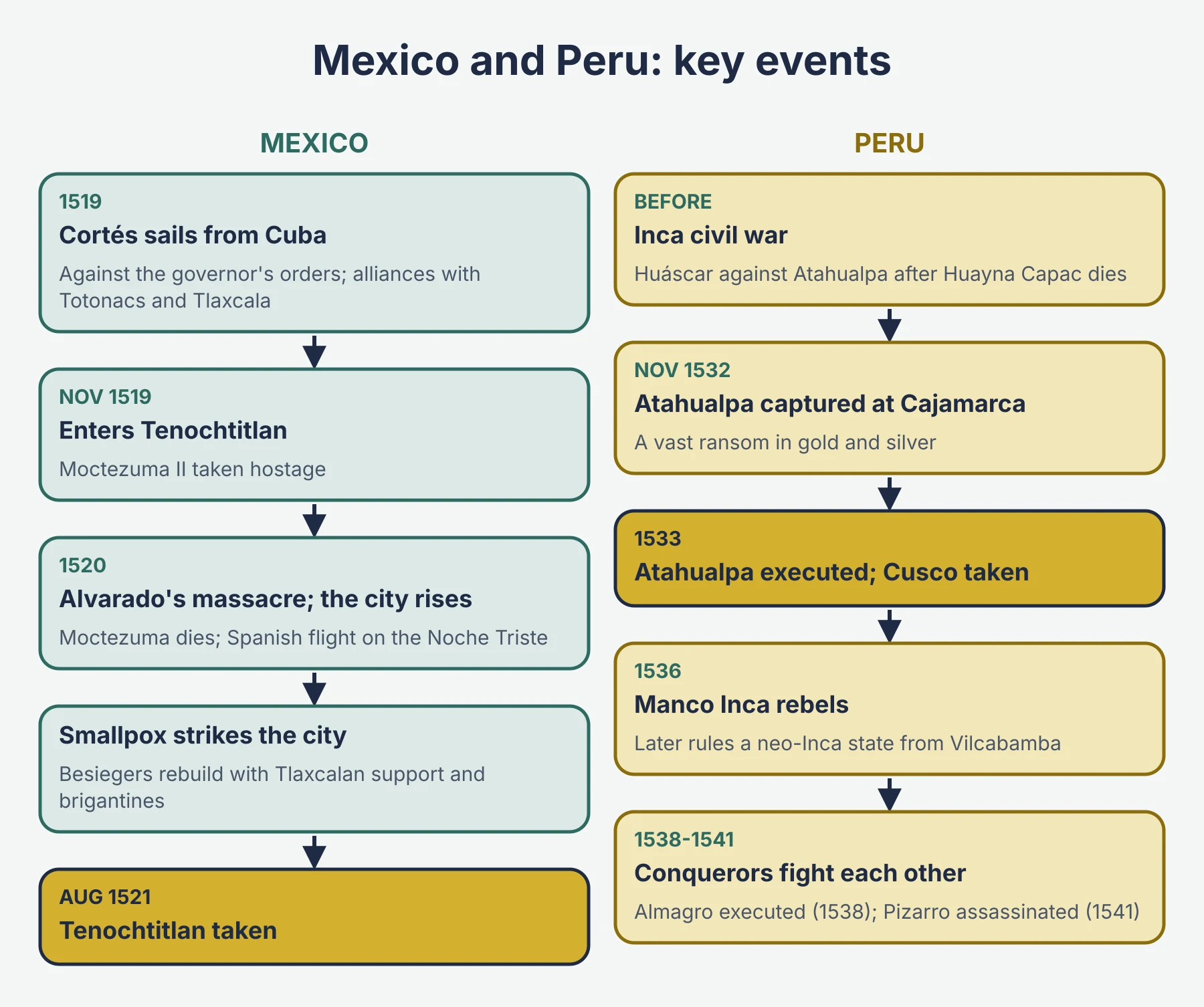
Hernán Cortés sailed from Cuba in 1519 against the governor’s orders. With the help of Malinche (Doña Marina), who interpreted between Nahuatl and Maya, and Jerónimo de Aguilar, he allied with the Totonacs and, after fighting, with Tlaxcala. He entered Tenochtitlan in November 1519 and took Moctezuma II hostage. After Pedro de Alvarado’s massacre of nobles at a festival in 1520, the city rose; Moctezuma died and the Spanish fled with heavy losses on the Noche Triste. Smallpox then struck the city. Rebuilt with Tlaxcalan support and a fleet of brigantines on the lake, the besiegers took Tenochtitlan in August 1521.
Key events: Peru
Francisco Pizarro captured Atahualpa at Cajamarca in November 1532, collected a vast ransom in gold and silver, and had him executed in 1533. Cusco was taken the same year. Manco Inca, first a Spanish puppet, rebelled in 1536 and later ruled a neo-Inca state from Vilcabamba. The conquerors then fought each other: Diego de Almagro was executed in 1538 and Pizarro assassinated in 1541.
Impact
The crown granted conquistadors encomiendas, the right to labour and tribute from indigenous communities in return for protection and Christian instruction. Disease and forced labour caused a catastrophic fall in population. Viceroyalties were created in New Spain (1535) and Peru (1540s). The Dominican Bartolomé de las Casas condemned the conquerors’ cruelty; the New Laws of 1542 restricted encomiendas and provoked revolt in Peru by Gonzalo Pizarro. The Valladolid debate (1550-1551) between Las Casas and Juan Ginés de Sepúlveda argued whether war on the indigenous peoples was just.
Worked example: a Question 3 comparison
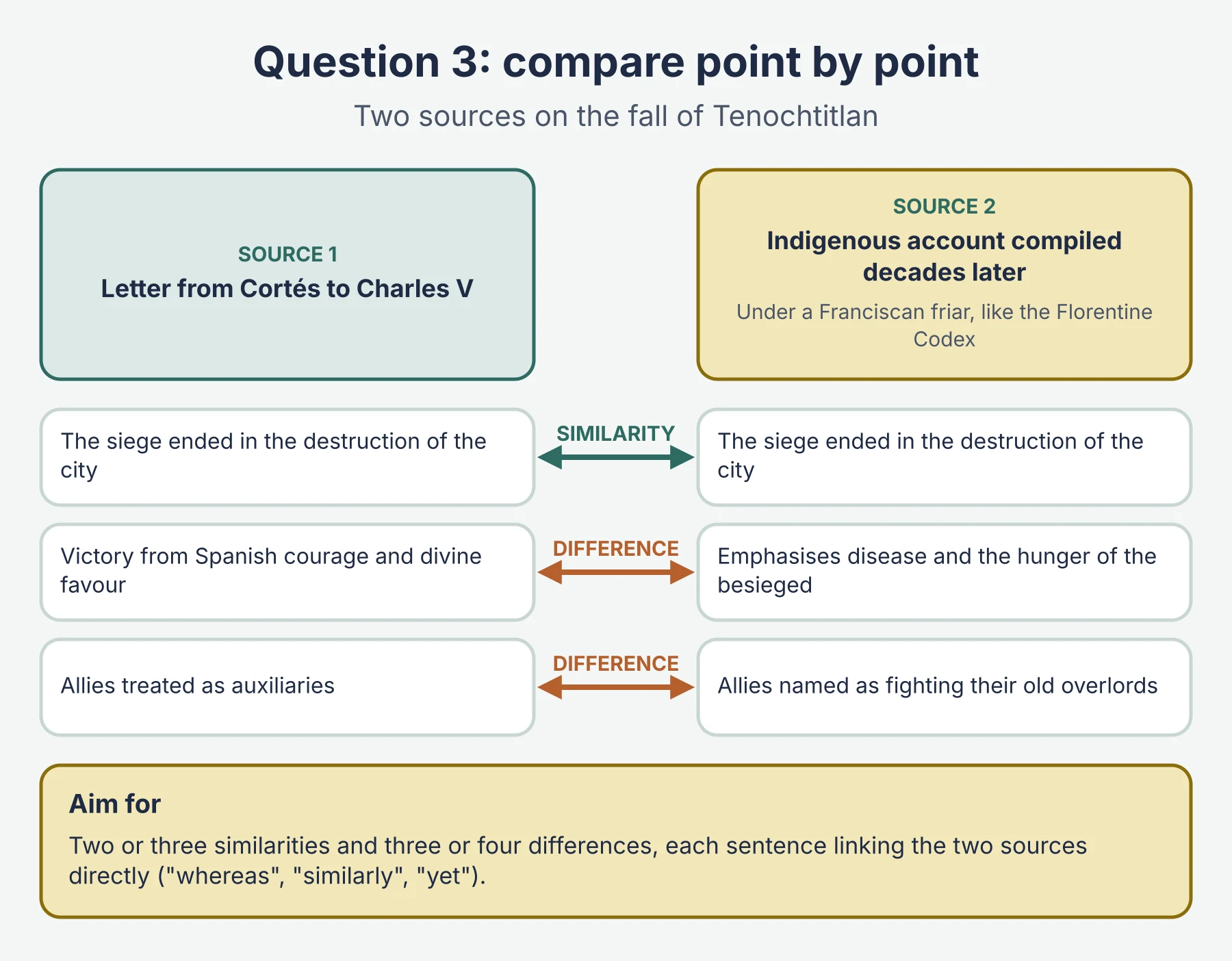
Imagine two sources on Tenochtitlan’s fall: a letter from Cortés to Charles V and an indigenous account compiled decades later under a Franciscan friar’s direction (the Florentine Codex, gathered by Bernardino de Sahagún, is a real example of this type).
A weak answer summarises each in turn. A strong answer is built point by point:
“Both sources agree that the siege ended in the destruction of the city, but they explain it differently. The letter presents victory as the result of Spanish courage and divine favour, whereas the indigenous account emphasises disease and the hunger of the besieged. Similarly, both mention allies, yet the letter treats them as auxiliaries while the indigenous account names them as fighting their old overlords.”
Each sentence links the two sources directly. Aim for two or three similarities and three or four differences.
Interpretations
Matthew Restall’s Seven Myths of the Spanish Conquest (2003) argues that the image of a few hundred Spaniards conquering empires is a myth: indigenous allies supplied most of the fighting forces, and disease and indigenous politics shaped the outcome. Sources often reflect the “Black Legend” of Spanish cruelty, which drew heavily on Las Casas, or, from the other side, celebratory accounts such as Bernal Díaz del Castillo’s history, written decades later by a veteran.
Common mistakes
- Dating the end of Muslim rule to 1609; the case study ends in 1492, and the expulsion of the moriscos lies outside it.
- Explaining Mexico by “guns and horses” alone and leaving out allies, disease and Mexica politics.
- Treating the Inca civil war as a side issue: it decided who met Pizarro at Cajamarca and how.
- Forgetting that impact includes Spanish debate and law, not only the fate of the conquered.
Exam technique
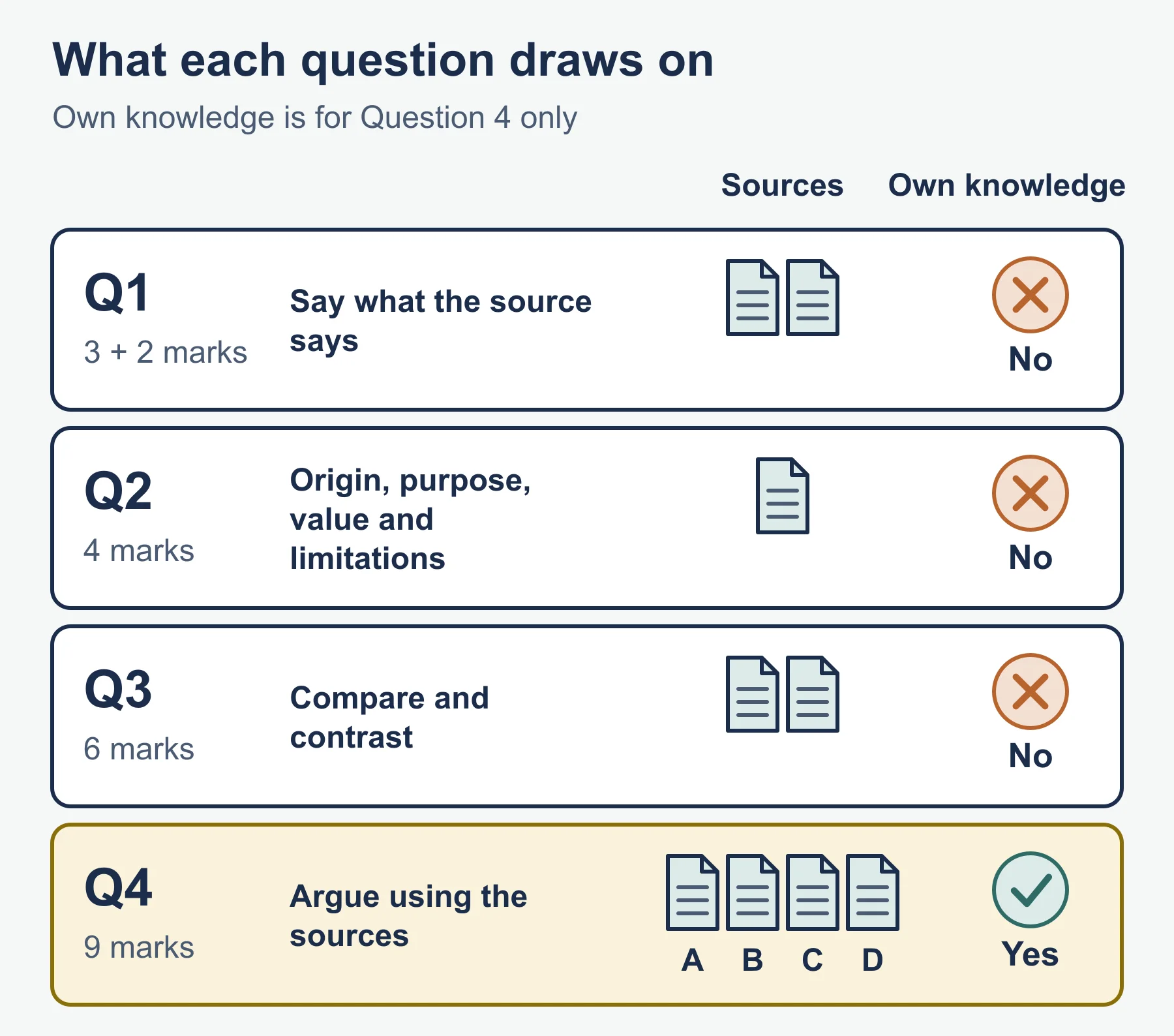
Discuss asks for a balanced review of factors; examine asks you to test a claim; compare and contrast needs both likenesses and differences. When a Question 4 asks “why” a conquest succeeded, rank your factors and explain how they interacted.
Revise with the Conquest and its impact revision notes and test yourself with the Conquest and its impact practice questions.
Related resources
-
Practice questions
IB DP History (DP History): Conquest and its impact – Practice Questions
Twelve original IB History practice questions on Conquest and its impact: recall on Mexico and Peru, then a Paper 1-style source set on the fall of Granada.
World History · International Baccalaureate · IB
Try questions -
Revision notes
IB DP History (DP History): Conquest and its impact – Revision Notes
Revision notes for IB History Paper 1 Conquest and its impact: Granada 1482-1492 and Mexico and Peru 1519-1551, key terms, traps and a self-test.
World History · International Baccalaureate · IB
Revise topic -
Study guides
IB DP History (DP History): The move to global war
Prescribed subject 3 for IB History Paper 1: causes, events and responses in Japanese expansion 1931-1941 and German and Italian expansion 1933-1940.
World History · International Baccalaureate · IB
Read guide
Get free revision emails (optional)
Occasional emails with practice questions, worked explanations and links to free resources for the qualification and subjects you choose. No spam, and you can unsubscribe from any email. The free tools on this site never need an email.