
Revision Notes
IGCSE Accounting: Business documents and books of prime entry (Cambridge 0452) – Revision Notes
Condensed revision notes on business documents, books of prime entry, discounts, the cash book and imprest petty cash for Cambridge IGCSE Accounting 0452.
- Subject
- Accounting
- Level
- IGCSE, O LEVELS
- Topic
- Sources and recording of data
- Author
- Marlbridge Academic Team
- Updated
- Reviewed by
- Javaid Iqbal Sabri (what this means)
Aligned to Cambridge IGCSE O Level Accounting (0452, 7707), 2027-2029. Official specification (IGCSE) ; Official specification (O Level) .
Syllabus page (what it covers and how it is assessed): Cambridge IGCSE Accounting; Cambridge O Level Accounting.
Syllabus points this page covers
0452
- 2.2 Business documents
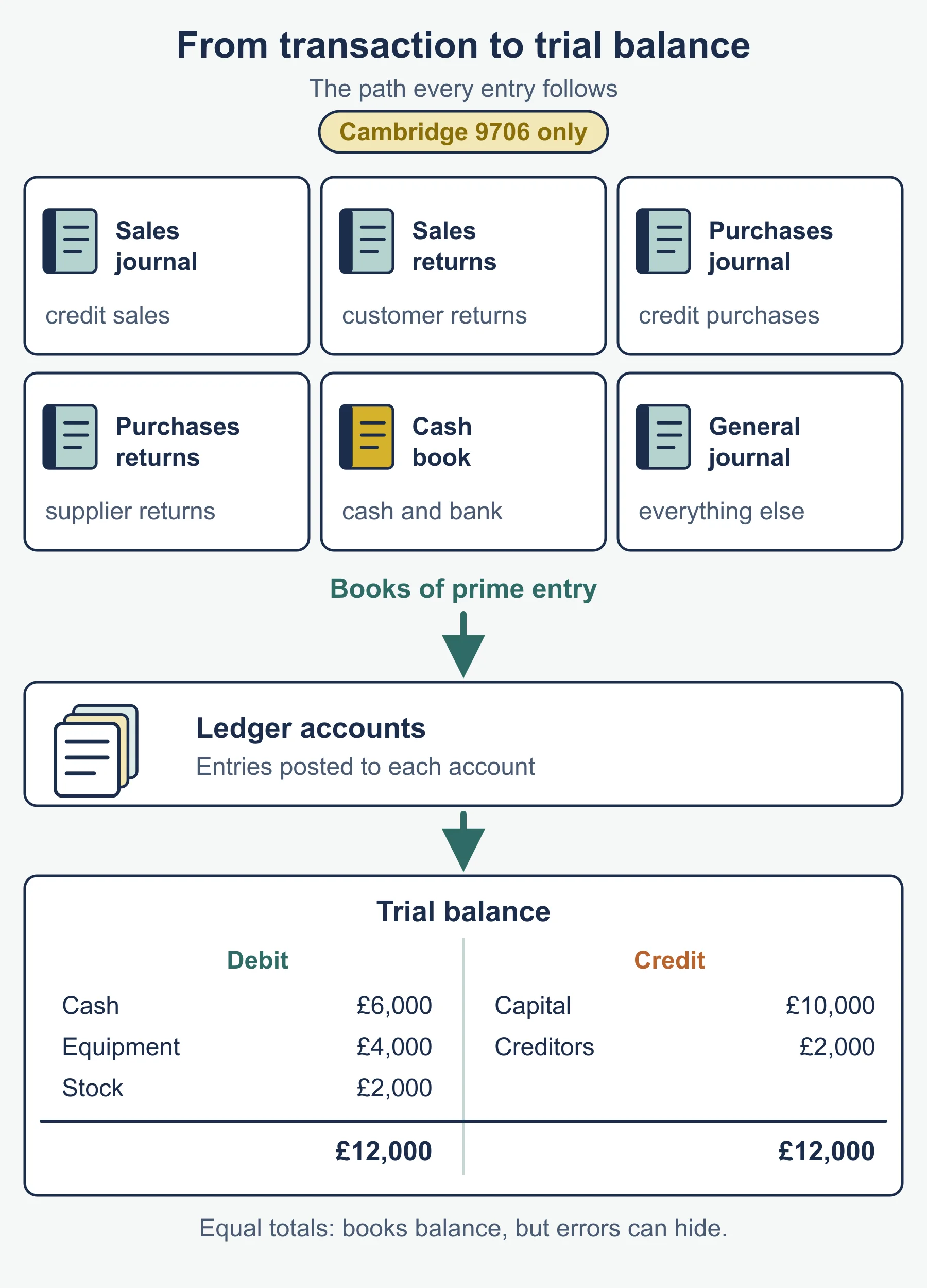
- 2.3 Books of prime entry
7707
- 2.2 Business documents
- 2.3 Books of prime entry
Found an error? Report a correction.
Want a teacher for this? Marlbridge teaches Accounting online. Request a free trial class.
Syllabus edition note. This resource follows the Cambridge IGCSE Accounting 0452 syllabus (and Cambridge O Level Accounting 7707, which has the same subject content for the same series) for exams in 2027, 2028 and 2029 (version 1), first examined in the March 2027 series in India and the June 2027 series elsewhere. If you sit 0452 in November 2026, you sit the 2026 syllabus (version 2), which differs: Paper 1 has 35 multiple-choice marks in 1 hour 15 minutes, not 40 marks in 1 hour 30 minutes; Topic 7 is “Accounting principles and policies”, without 7.2 Ethical considerations or 7.3 Technology and sustainability; 4.4 is “Irrecoverable debts and provision for doubtful debts”; income statements are named instead of statements of profit or loss; three-column running balance accounts are not required; Clubs and societies is 5.4 and Manufacturing accounts 5.5; and 6.3 is “Inter-firm comparison”. For this topic, the 2026 syllabus also asks candidates to complete pro-forma business documents and to explain the advantage of using books of prime entry, and it does not include digital ledger accounts or the benefits and limitations of keeping cash at the business property and of manual and digital original entry. If you sit in November 2026, work from the 2026 syllabus on the Cambridge International website.
These notes condense sections 2.2 Business documents and 2.3 Books of prime entry of the Cambridge IGCSE Accounting 0452 syllabus (version 1), valid for examination in 2027, 2028 and 2029. For full explanations and a longer worked month, use the study guide, then test yourself with the practice questions. The wider topic is covered in Sources and recording of data. Course pages: 0452 hub, printable checklist, 10-minute diagnostics. Every business and figure here is made up; amounts are in dollars.
The eight documents at a glance
| Document | Think of it as | Feeds |
|---|---|---|
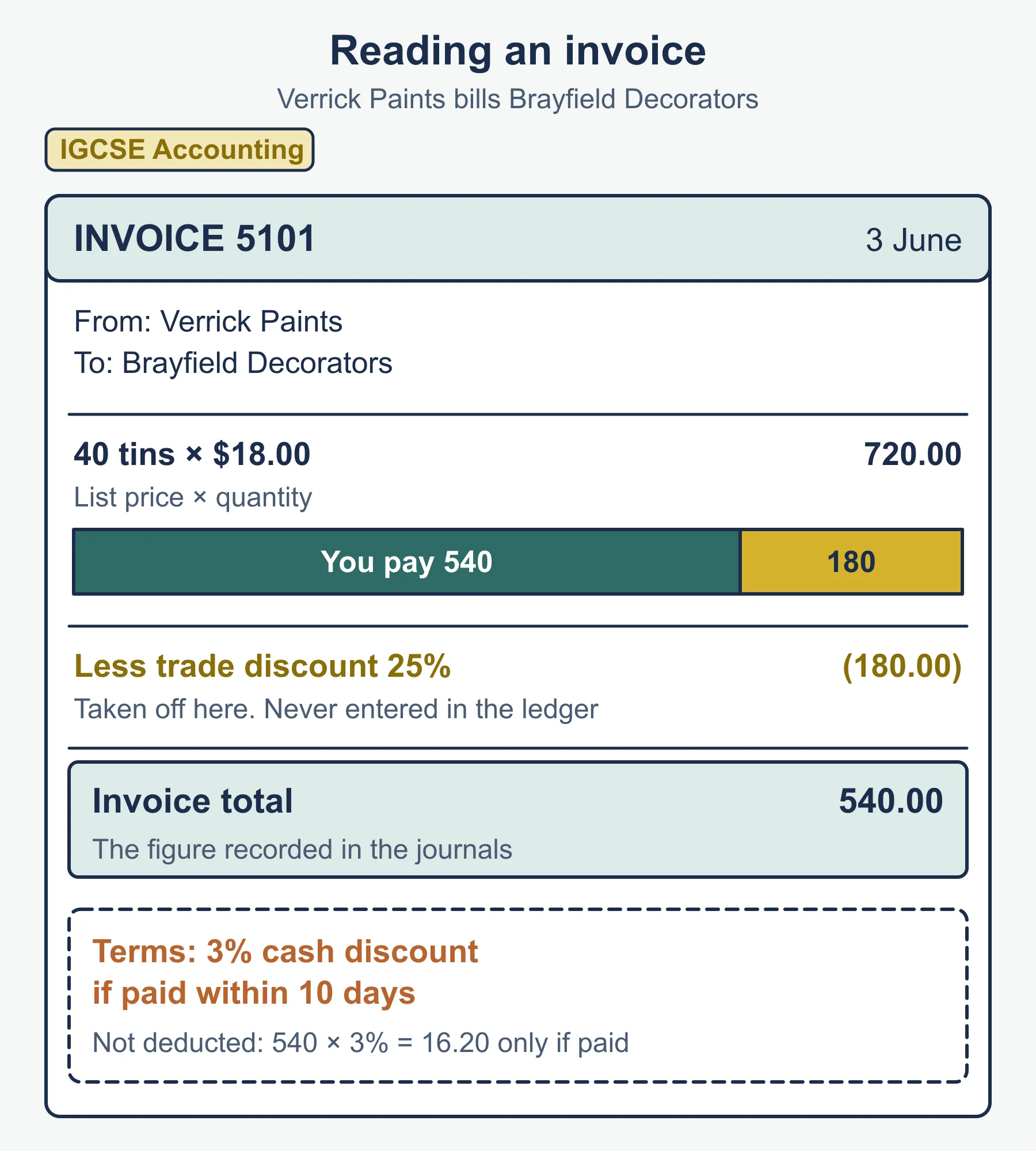
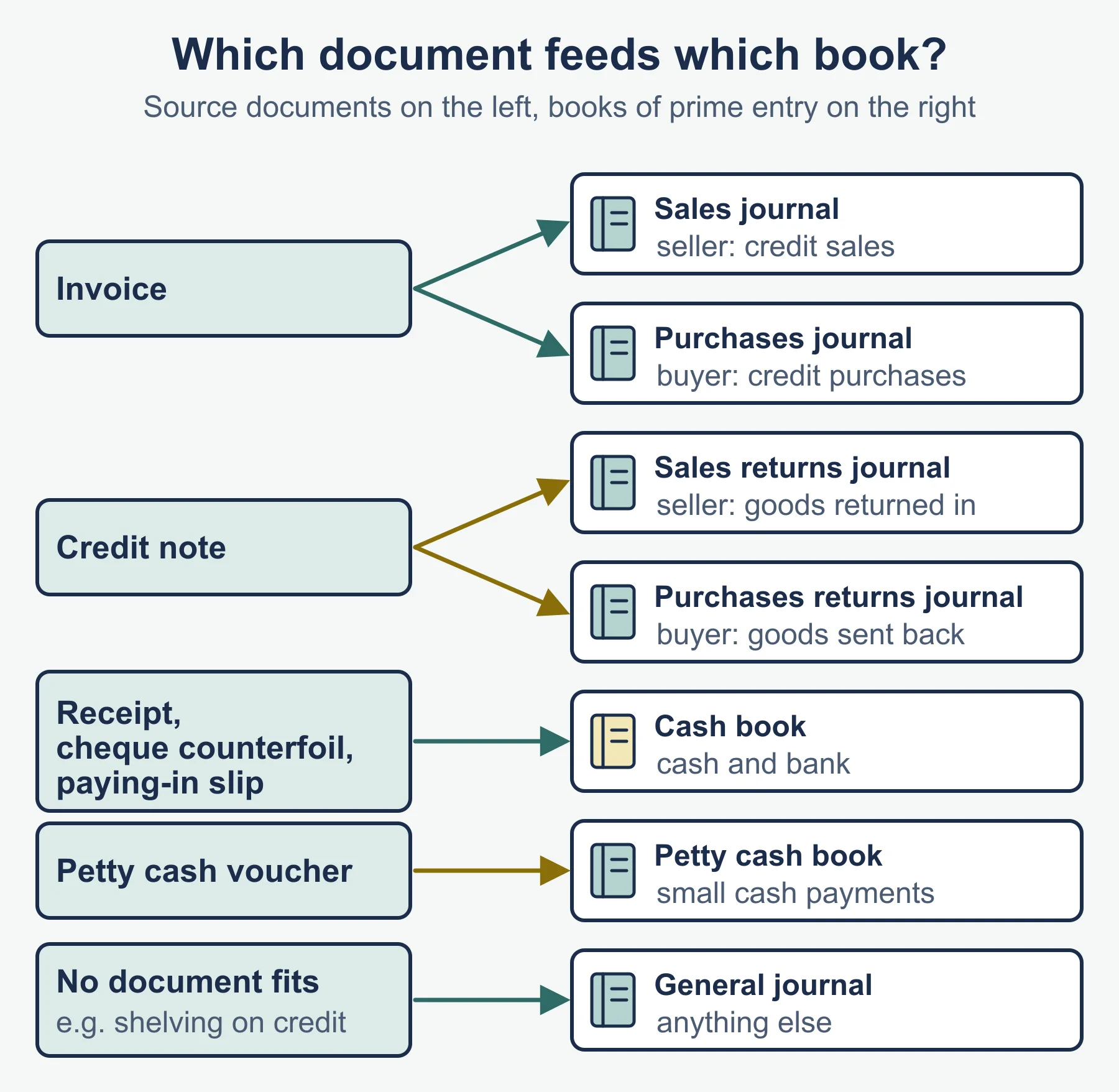
| Invoice | The bill | Sales journal (seller) or purchases journal (buyer) |
| Credit note | A reduction of the bill | Sales returns journal (seller) or purchases returns journal (buyer) |
| Debit note | A request for credit, or an extra charge | Followed by a credit note or an extra invoice |
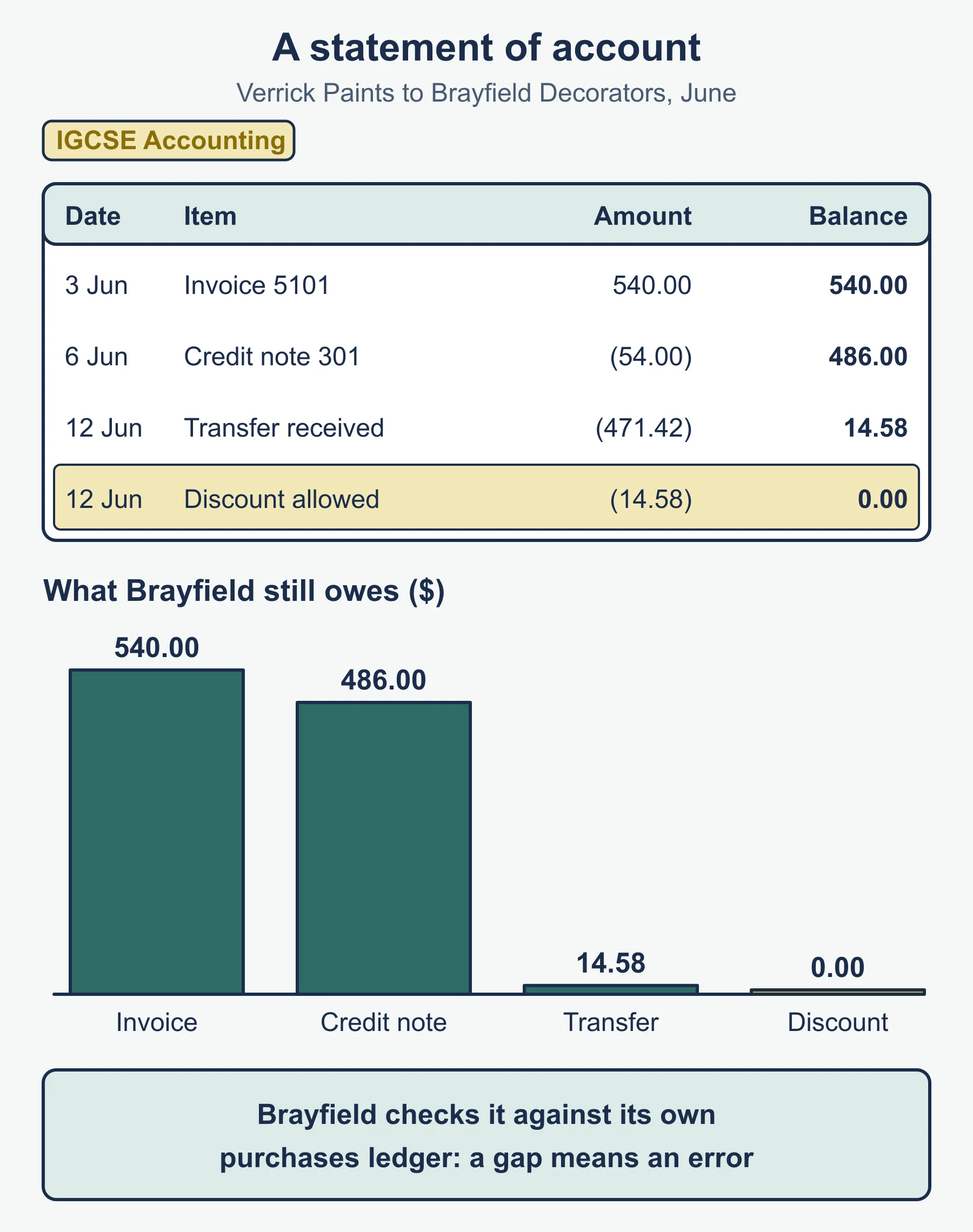
| Statement of account | A periodic summary of one customer’s account | Used to check the ledger account |
| Receipt | Proof that money was handed over | Cash book receipts |
| Cheque counterfoil | The payer’s stub | Cash book payments |
| Paying-in slip | The depositor’s record of a deposit | Cash book receipts in the bank column |
| Bank statement | The bank’s version of the bank account | Charges, interest and direct debits not yet in the cash book |
Use as a source: the document supplies the date, the party, the amount and the nature of the transaction. You record from it; you do not guess.
Manual or digital: documents may be written by hand with carbon copies or made, sent and stored by software. Digital documents can be emailed and searched; handwritten ones can be lost or misread.
Which book for which event
| Event | Book of prime entry |
|---|---|
| Goods sold on credit | Sales journal |
| Goods bought on credit for resale | Purchases journal |
| Customer returns goods | Sales returns journal |
| Goods sent back to a supplier | Purchases returns journal |
| Any receipt or payment through cash or bank | Cash book |
| Small payments from the float | Petty cash book |
| Non-current asset bought on credit; opening entries; correction of errors | General journal |
Test: was money received or paid at once? Then cash book. Is it a small payment from a float? Petty cash book. Otherwise ask whether it is a sale, purchase or return on credit, and use the matching journal. If it fits none, use the general journal.
Posting rules
| Book | Debit | Credit |
|---|---|---|
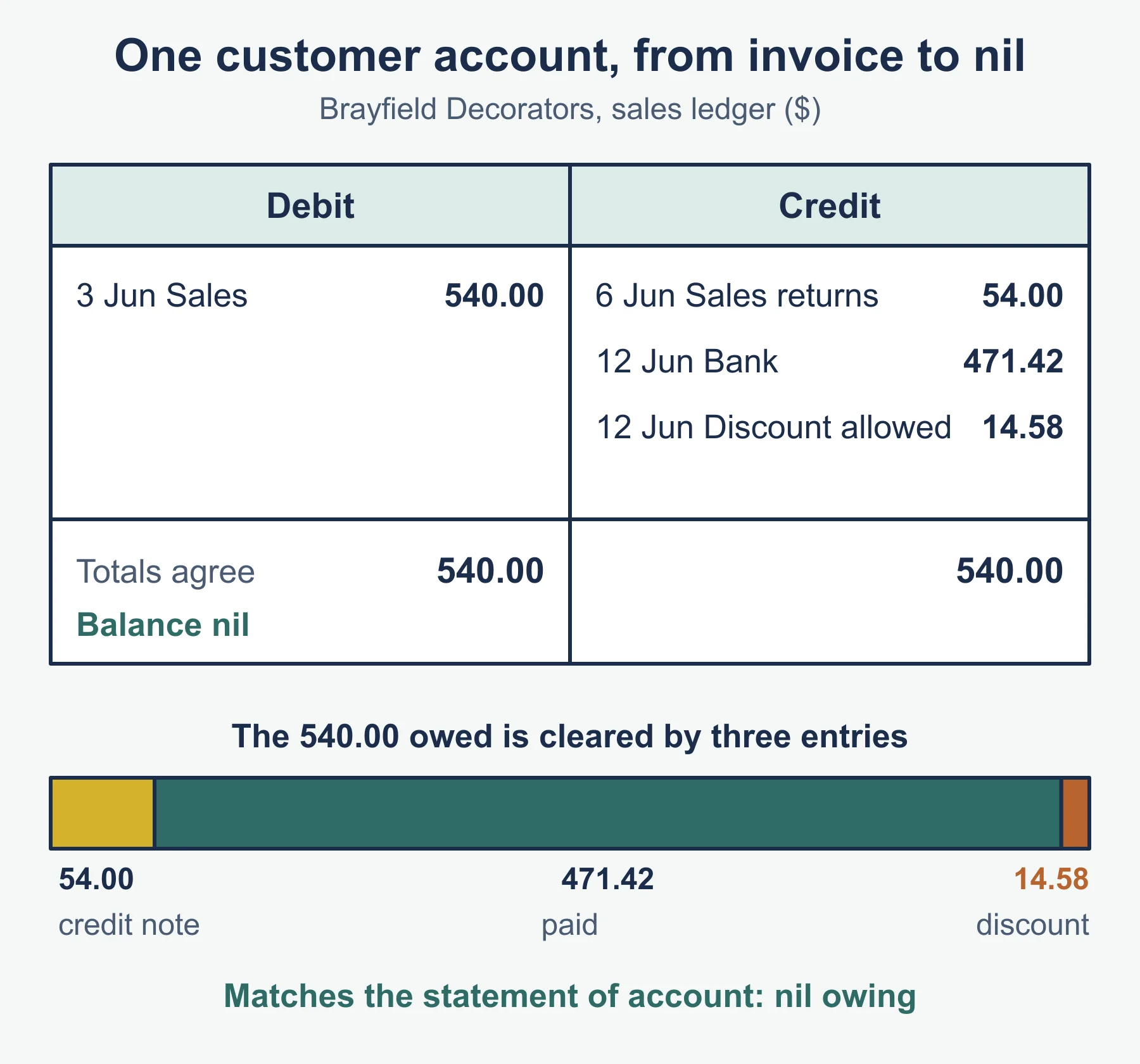
| Sales journal | Each customer | Sales (total) |
| Sales returns journal | Sales returns (total) | Each customer |
| Purchases journal | Purchases (total) | Each supplier |
| Purchases returns journal | Each supplier | Purchases returns (total) |
| Cash book, receipt | Cash or bank column (already in the book) | The customer or income account |
| Cash book, payment | The supplier or expense account | Cash or bank column (already in the book) |
| Discount columns | Discount allowed (total) | Discount received (total) |
| Petty cash book | Each expense column total | Petty cash account (restored from the bank through the cash book) |
Customers’ and suppliers’ accounts are in the sales and purchases ledgers. Everything else is in the nominal (general) ledger.
Discounts: the two rules
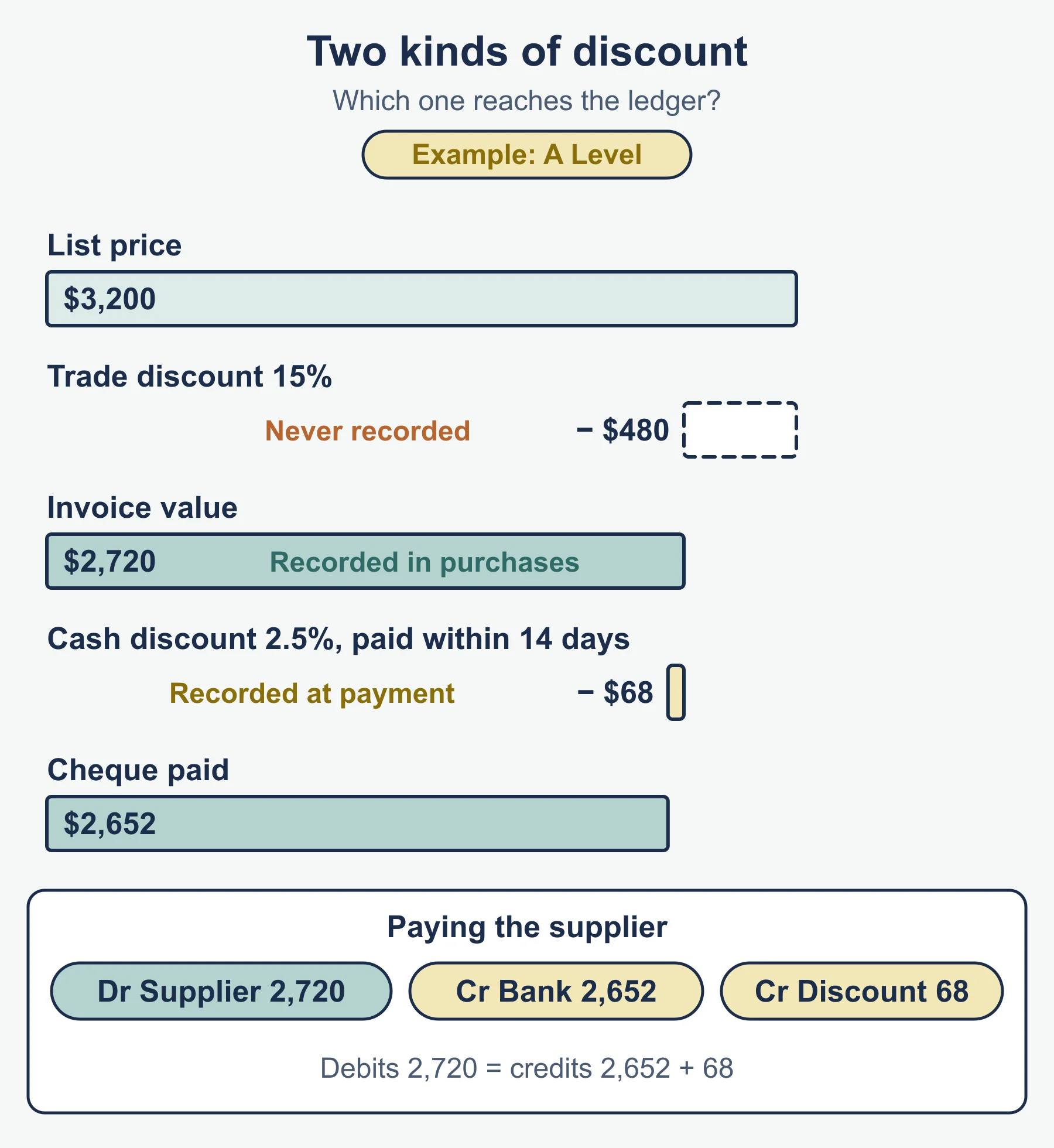
- Trade discount: taken off the list price on the invoice. Record only the net figure. No discount account.
- Cash discount: a reward for paying early, entered in the cash book when the money moves. Discount allowed is given by you to customers. Discount received is given to you by suppliers.
Worked reminder. Wintergill Cycles sells 25 helmets, list price 40 each, to Darrowby Sports with 20% trade discount and an allowance of 2.5% if it settles within 7 days.
Gross 25 x 40                       1,000.00
Less trade discount 20%              (200.00)
Net invoice (sales journal)            800.00
Cash discount if paid in time         20.00
Cash received in the bank            780.00
Darrowby then returns 3 helmets. The credit note is 3 x 40 less 20% = 96.00, so the balance is 704.00. If Darrowby pays in time on that balance, the discount is 17.60 and the bank receives 686.40. The discount applies to what is actually owed, not the original invoice.
The cash book
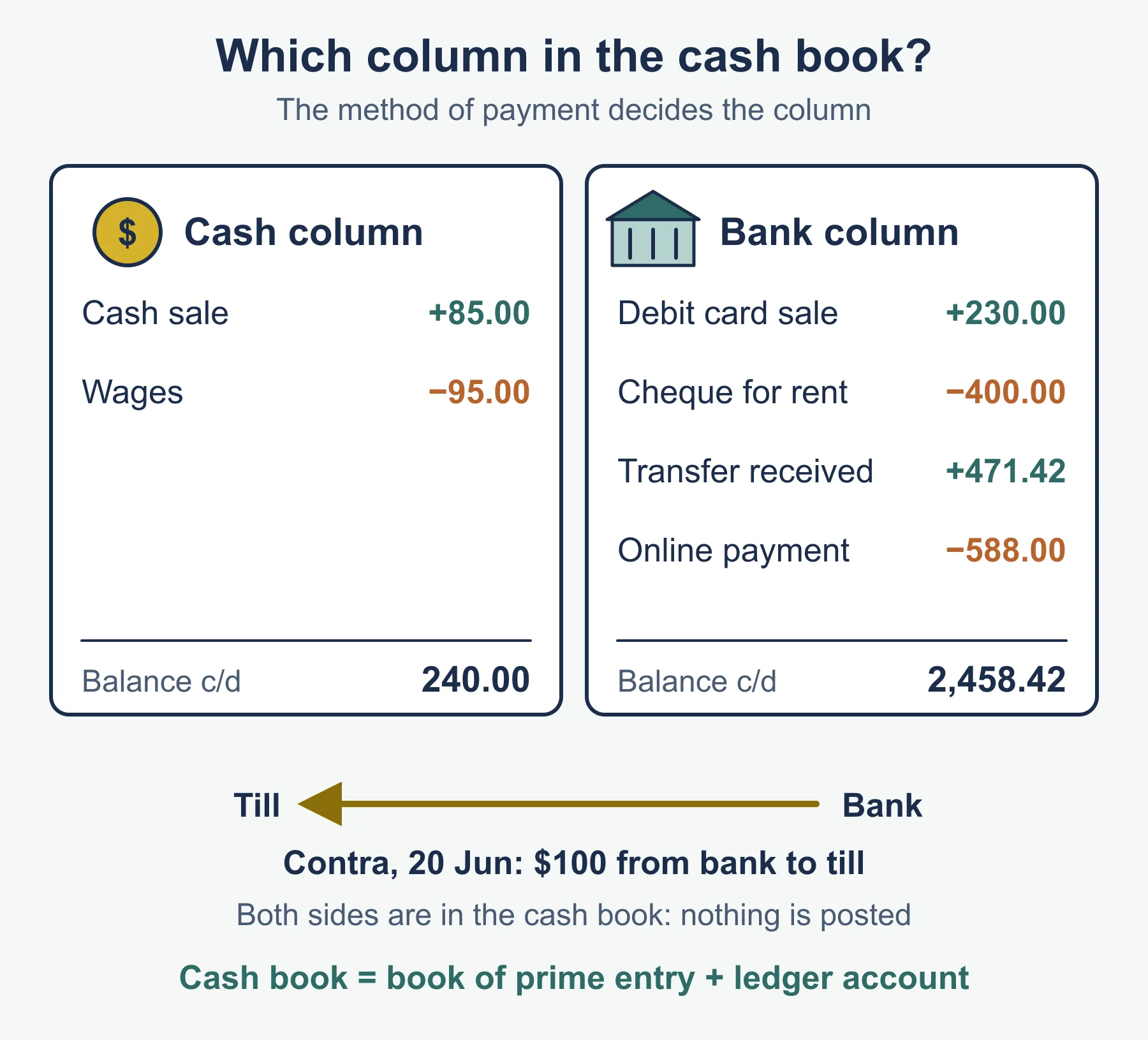
Dual function: a book of prime entry and the ledger account for cash and bank. Because of this, the ledger has no cash or bank account to post to.
Payment methods and columns
| Method | Column |
|---|---|
| Notes and coins | Cash |
| Cheque | Bank |
| Debit card or credit card | Bank |
| Online payment or bank transfer | Bank |
Balancing method
- Total each of the cash and bank columns on both sides.
- Take the smaller total from the larger to find the balance carried down.
- Put the balance on the smaller side so both totals agree.
- Bring the balance down on the opposite side on the next day.
- Total the discount columns separately and post them: allowed as a debit, received as a credit.
Contra: cash paid into the bank (or drawn out) appears on both sides of the cash book and is not posted anywhere else.
Petty cash and the imprest system
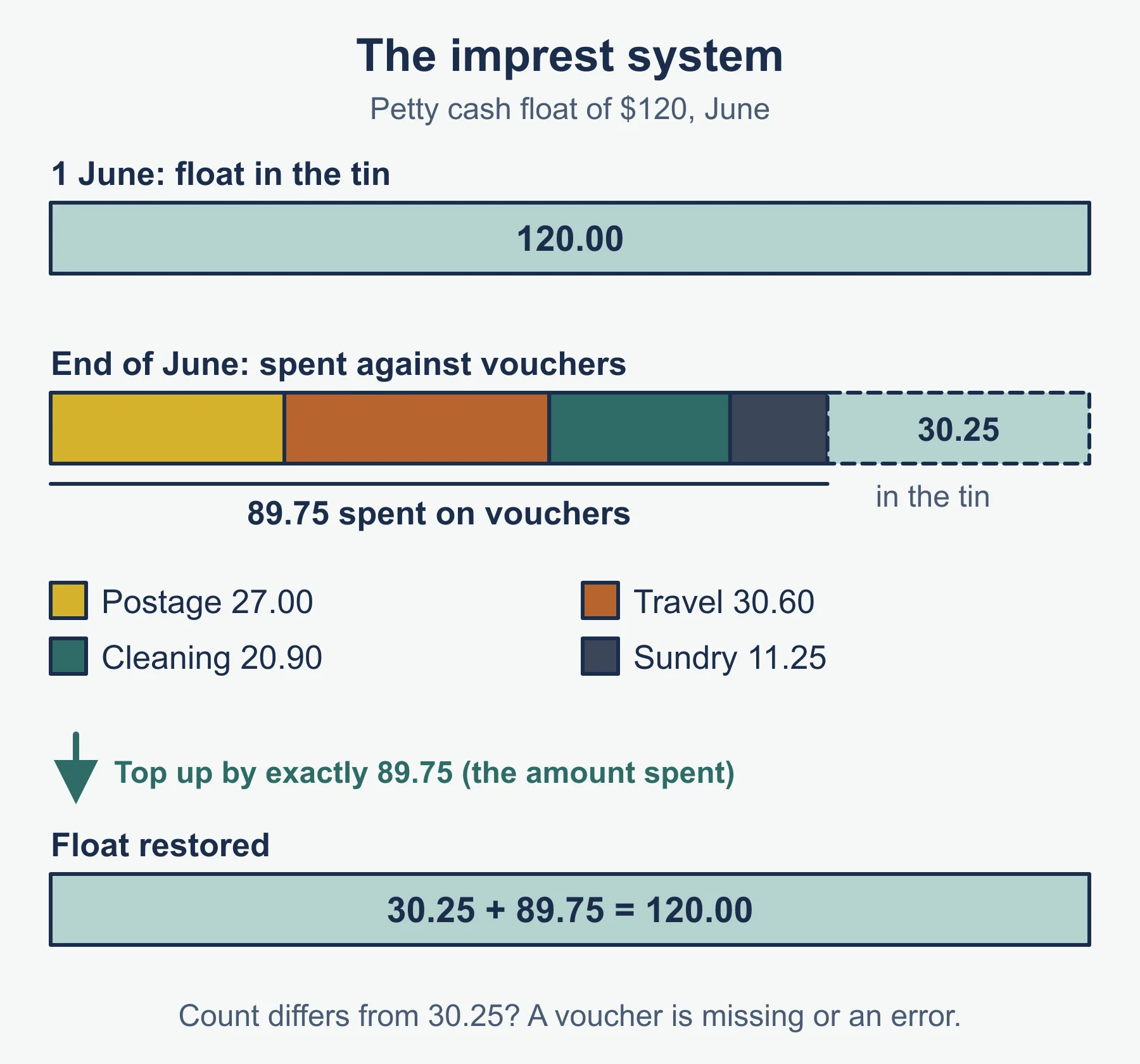
Purpose: to control small payments by giving one person a fixed amount and checking all spending against vouchers.
Method
- Start with the float.
- Record each voucher and analyse it to an expense column.
- Total the columns and check they equal the total column.
- Restore: the amount received equals the total spent.
- Check: cash left plus vouchers equals the float.
Worked reminder: a float of 80, with vouchers of 12.40, 9.85, 15.00, 6.30 and 17.75. Total spent 61.30, cash left 18.70, restoring payment 61.30, float back to 80.
Imprest versus non-imprest: under imprest the top-up changes each period and the opening float stays the same. If the top-up were a round figure the opening float would drift, and the control would be lost.
Benefits and limitations
| Benefits | Limitations | |
|---|---|---|
| Cash kept on the premises | Immediate small payments, change for customers | Theft, loss, miscounting, storage and insurance cost, no interest |
| Manual original entry | Cheap; no equipment; not affected by system failure | Slow; copying and arithmetic errors; harder to back up and search |
| Digital original entry | Quick; sums and postings done by the software; simple to back up and report from | Installation and staff training cost; breakdowns; one wrong input flows everywhere |
Must-know distinctions
- Credit note and debit note: a credit note lowers the amount owed. A debit note requests that, or adds a charge.
- Trade discount and cash discount: one is on the invoice and unrecorded; the other depends on payment and is recorded.
- Discount allowed and discount received: which side of the deal are you on?
- Book of prime entry and ledger: first record versus final account; the cash book is both.
- Invoice and statement: one transaction versus a summary of many.
- Receipt and paying-in slip: proof of payment handed over versus a record of money deposited.
Quick self-test
- Which document does a seller send to summarise a customer’s account at the month end?
- Which book records goods bought on credit for resale?
- An invoice shows 60 items at 15 each, with 10% trade discount. What is entered in the sales journal?
- The buyer in question 3 earns a 4% cash discount. How much is paid?
- In which cash book column is a debit card receipt entered?
- State the cash book’s dual function.
- A cash book bank column has a debit balance of 1,200 before receipts of 350 and payments of 475. What is the closing balance?
- A float of 150 has 112.60 spent. What is restored, and what is left in the tin?
- Name the book used when a business buys office furniture on credit.
- Give one limitation of digital original entry.
Answers
- A statement of account.
- The purchases journal.
- 810 (900 less 90).
- 777.60 (810 less 32.40).
- The bank column.
- It is a book of prime entry and the ledger account for cash and bank.
- 1,075 (1,200 + 350 - 475).
- 112.60 is restored; 37.40 is left.
- The general journal.
- Any one: cost and training, system failure or data loss, errors spread automatically.
Where marks are usually lost
- Naming a document correctly but not saying what it is used for.
- Entering the gross invoice figure in the sales journal.
- Calculating cash discount on the original invoice after a return.
- Using the cash column for a cheque or card receipt.
- Treating trade discount as a ledger entry.
- Writing the cash left in the tin as the petty cash top-up.
- Giving a benefit only (or a limitation only) when the question asks for both.
- Mixing up discount allowed and discount received.
Frequently asked questions
What is a debit note used for? A debit note has more than one use: a buyer may send one to list goods being returned and ask for a credit note, and a seller may send one to charge for an undercharge. Read the question’s wording carefully.
How much is given to the petty cashier under the imprest system? The petty cashier receives exactly the amount spent in the period, which restores the fixed float. Using the cash left in the tin as the top-up is a common error.
What is the purpose of a statement of account? A statement of account lists the invoices, credit notes, payments and discounts on a customer’s account and shows the balance owed. The customer checks it against its own records.
What is the difference between discount allowed and discount received? Discount allowed is given by a seller to a customer for early payment and is an expense, while discount received is earned by a buyer from a supplier and is income. Both are recorded in the discount columns of the cash book.
Official syllabus
Source: the Cambridge IGCSE Accounting 0452 syllabus (version 1), valid for examination in 2027, 2028 and 2029, from Cambridge University Press and Assessment (Cambridge International Education).
Get free revision emails (optional)
Occasional emails with practice questions, worked explanations and links to free resources for the qualification and subjects you choose. No spam, and you can unsubscribe from any email. The free tools on this site never need an email.
Related resources
-
Revision notes
IGCSE Accounting: Analysis and Interpretation — Revision Notes
Quick recall for Cambridge IGCSE Accounting 0452 Topic 6: ten ratios, reading them, profit versus cash, comparing businesses, users and statement limits.
Accounting · Cambridge · IGCSE, O Level
Revise topic -
Study guides
IGCSE Accounting: Sources and Recording of Data (Cambridge 0452)
Cambridge IGCSE Accounting 0452 Topic 2 guide to double entry, running balance accounts, business documents and the seven books of prime entry (2027-2029).
Accounting · Cambridge · IGCSE, O Level
Read guide -
Practice questions
Cambridge IGCSE Accounting: Sources and Recording of Data — Practice Questions
Cambridge IGCSE Accounting 0452 practice questions with marked answers on double entry, documents, books of prime entry, discounts and petty cash (Topic 2).
Accounting · Cambridge · IGCSE, O Level
Try questions
Related articles
-
teaching
A Level tuition in Dubai: Cambridge or Pearson Edexcel International A Level?
Schools in Dubai and Abu Dhabi teach either Cambridge International AS & A Level or Pearson Edexcel International A Level. How the two are structured, why it matters for tuition, and how online classes from Lahore work.
9 October 2026
-
curriculum guides
Choosing subjects at IGCSE and A Level
How subject choices at 14 and 16 affect university options later, and how to keep pathways open without overloading a timetable.
28 July 2026
Studying this with a teacher
Working through Accounting IGCSE, O LEVELS?
This page is free and stays free. If you would rather be taught it, Marlbridge runs Accounting classes one-to-one and in small groups of up to 15, online in your own time zone. The first trial class is free. WhatsApp replies within an hour (8am–11pm Pakistan time, every day); email the same day.
Cambridge Accounting teachers at Marlbridge

