
Study Guides
IGCSE Accounting: Business documents and books of prime entry (Cambridge 0452)
Business documents and the seven books of prime entry, with a worked month of journals, cash book and petty cash, for Cambridge IGCSE Accounting 0452.
- Subject
- Accounting
- Level
- IGCSE, O LEVELS
- Topic
- Sources and recording of data
- Author
- Marlbridge Academic Team
- Updated
- Reviewed by
- Javaid Iqbal Sabri (what this means)
Aligned to Cambridge IGCSE O Level Accounting (0452, 7707), 2027-2029. Official specification (IGCSE) ; Official specification (O Level) .
Syllabus page (what it covers and how it is assessed): Cambridge IGCSE Accounting; Cambridge O Level Accounting.
Syllabus points this page covers
0452
- 2.2 Business documents
- 2.3 Books of prime entry
7707
- 2.2 Business documents
- 2.3 Books of prime entry
Found an error? Report a correction.
Want a teacher for this? Marlbridge teaches Accounting online. Request a free trial class.
Syllabus edition note. This resource follows the Cambridge IGCSE Accounting 0452 syllabus (and Cambridge O Level Accounting 7707, which has the same subject content for the same series) for exams in 2027, 2028 and 2029 (version 1), first examined in the March 2027 series in India and the June 2027 series elsewhere. If you sit 0452 in November 2026, you sit the 2026 syllabus (version 2), which differs: Paper 1 has 35 multiple-choice marks in 1 hour 15 minutes, not 40 marks in 1 hour 30 minutes; Topic 7 is “Accounting principles and policies”, without 7.2 Ethical considerations or 7.3 Technology and sustainability; 4.4 is “Irrecoverable debts and provision for doubtful debts”; income statements are named instead of statements of profit or loss; three-column running balance accounts are not required; Clubs and societies is 5.4 and Manufacturing accounts 5.5; and 6.3 is “Inter-firm comparison”. For this topic, the 2026 syllabus also asks candidates to complete pro-forma business documents and to explain the advantage of using books of prime entry, and it does not include digital ledger accounts or the benefits and limitations of keeping cash at the business property and of manual and digital original entry. If you sit in November 2026, work from the 2026 syllabus on the Cambridge International website.
This guide covers sections 2.2 Business documents and 2.3 Books of prime entry of the Cambridge IGCSE Accounting 0452 syllabus (version 1), valid for examination in 2027, 2028 and 2029. It adds worked material to the wider guide, Sources and recording of data. Pair it with the revision notes and the practice questions. Course pages: 0452 hub, printable checklist, 10-minute diagnostics. Every business and figure here is made up; amounts are in dollars ($).
What you must cover
| Section | Outcome | Section of this guide |
|---|---|---|
| 2.2 | Eight documents; use as sources; manual or digital | Business documents |
| 2.3 | Seven books of prime entry; posting | Books; posting |
| 2.3 | Trade and cash discount | Discounts |
| 2.3 | Cash book dual function; payment methods | The cash book |
| 2.3 | Imprest system | Petty cash |
| 2.3 | Cash on the premises; manual versus digital | Benefits and limitations |
The debit note, general journal and benefits lists are the briefest parts.
Business documents
A business document is evidence that a transaction happened. It is the source of the figures you record.
| Document | Issued by | What it shows | Used as a source for |
|---|---|---|---|
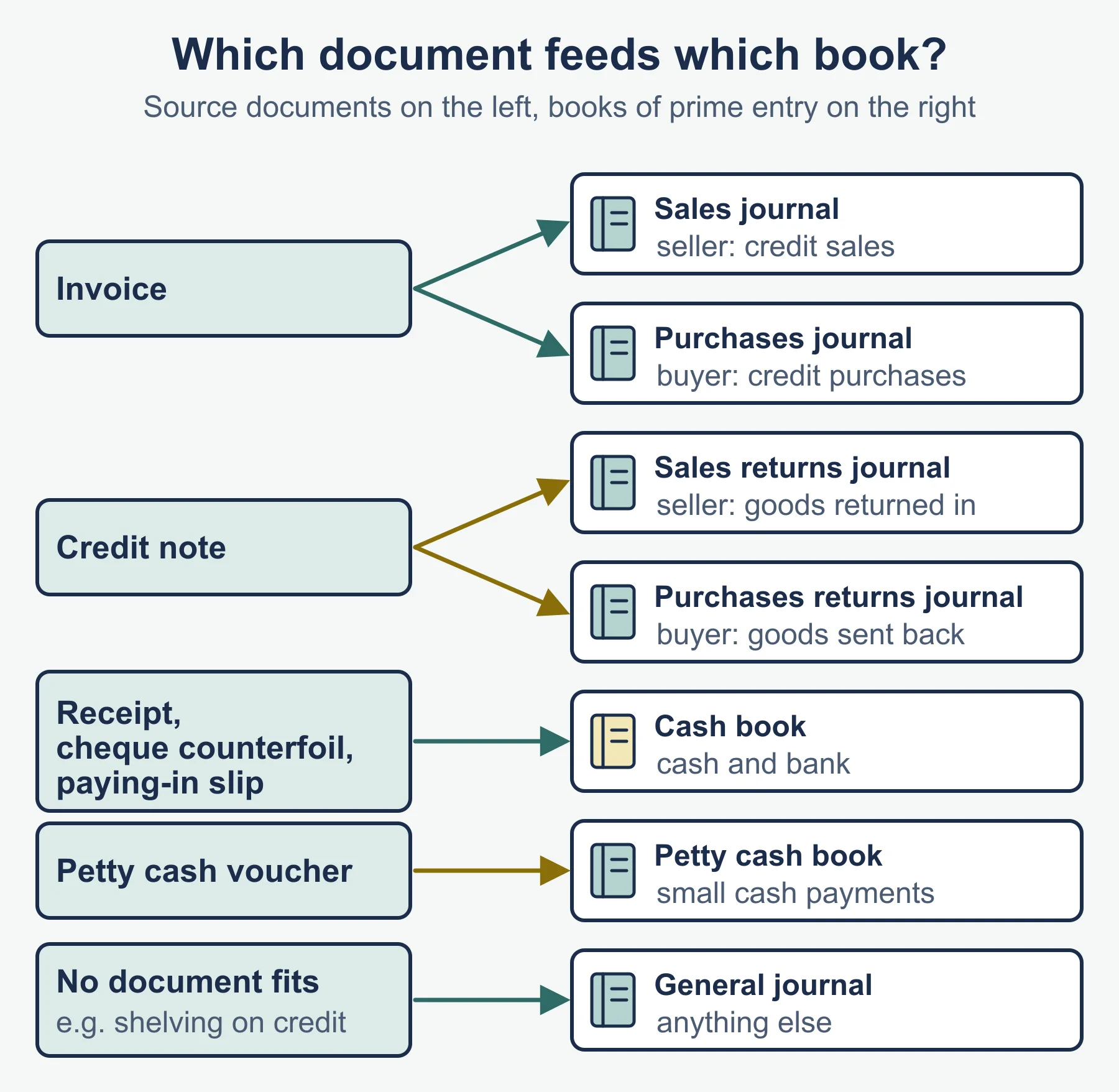
| Invoice | Seller to buyer | Goods, quantity, price, trade discount, total owed, terms | Seller: sales journal. Buyer: purchases journal |
| Credit note | Seller to buyer | Reduction in the amount owed (returns or overcharge) | Seller: sales returns journal. Buyer: purchases returns journal |
| Debit note | Buyer to seller, or seller to buyer | A request for credit, or an extra charge | The credit note or extra invoice that follows |
| Statement of account | Seller to buyer | Invoices, credit notes, payments and balance owing | Buyer checks it against the supplier’s account |
| Receipt | Whoever receives payment | Proof of amount, date and method of payment | Cash book (receipts) |
| Cheque counterfoil | Payer’s cheque book | Payee, date and amount of a cheque written | Cash book (payments side) |
| Paying-in slip | Business to bank | Cash and cheques paid into the bank | Cash book (bank receipts) |
| Bank statement | Bank to customer | Every deposit, withdrawal and charge | Items missing from the cash book; a check on it |
The debit note has more than one use, so read a question’s wording carefully. A buyer may send one to list goods being returned and ask for a credit note. A seller may send one to charge for an undercharge, recorded like a small invoice.
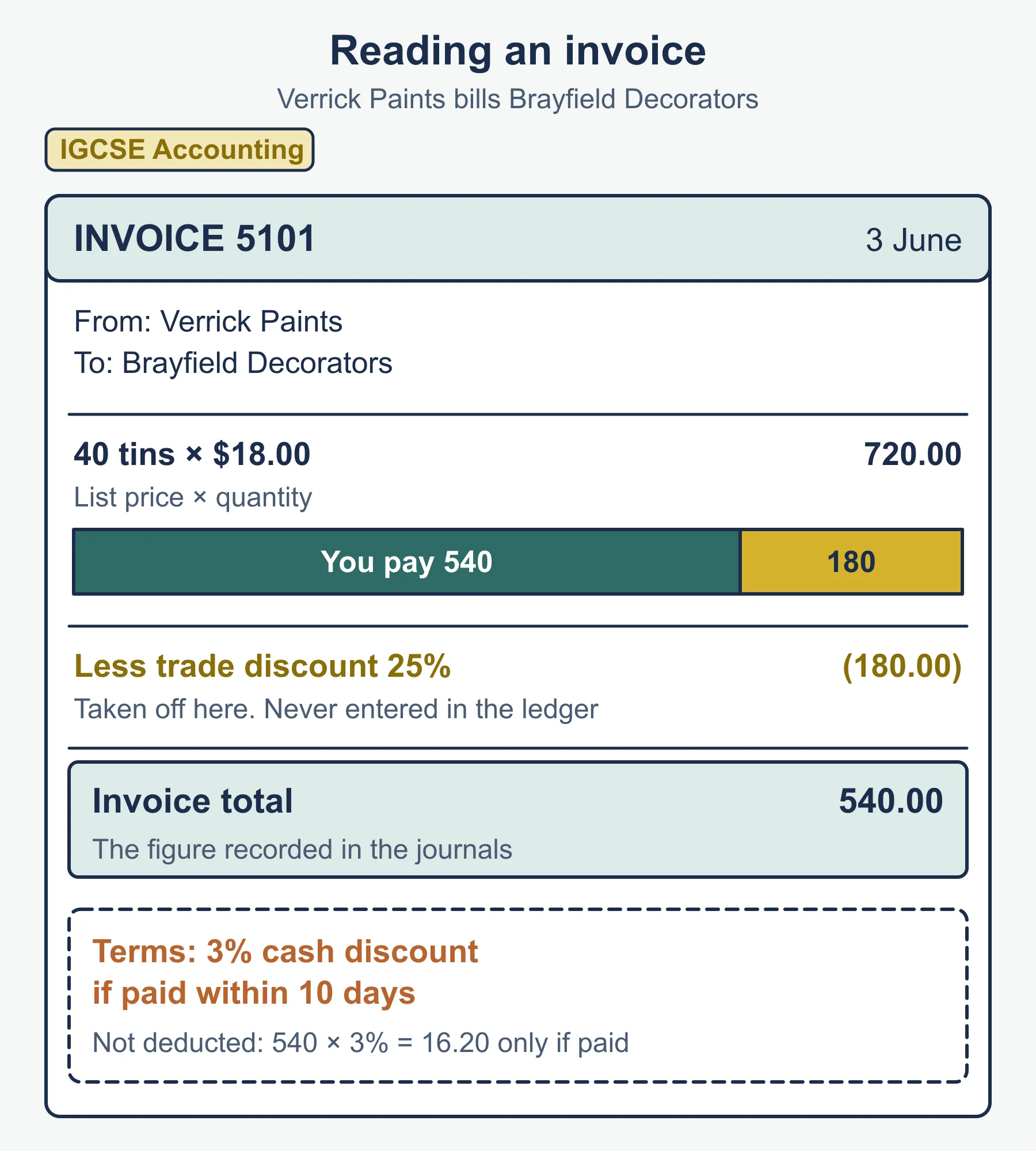
Worked example: an invoice. Verrick Paints sells 40 tins of paint at a list price of $18 to Brayfield Decorators. Trade discount is 25%. Payment terms: 3% cash discount if paid within 10 days.
Invoice 5101, 3 June
40 tins x $18.00                 720.00
Less trade discount 25%         (180.00)
Invoice total                    540.00
Terms: 3% cash discount if paid within 10 days
The invoice total, 540, is the figure recorded. The cash discount is not on the invoice as a deduction because it may never be earned; it is recorded only if Brayfield pays in time (540 x 3% = 16.20).
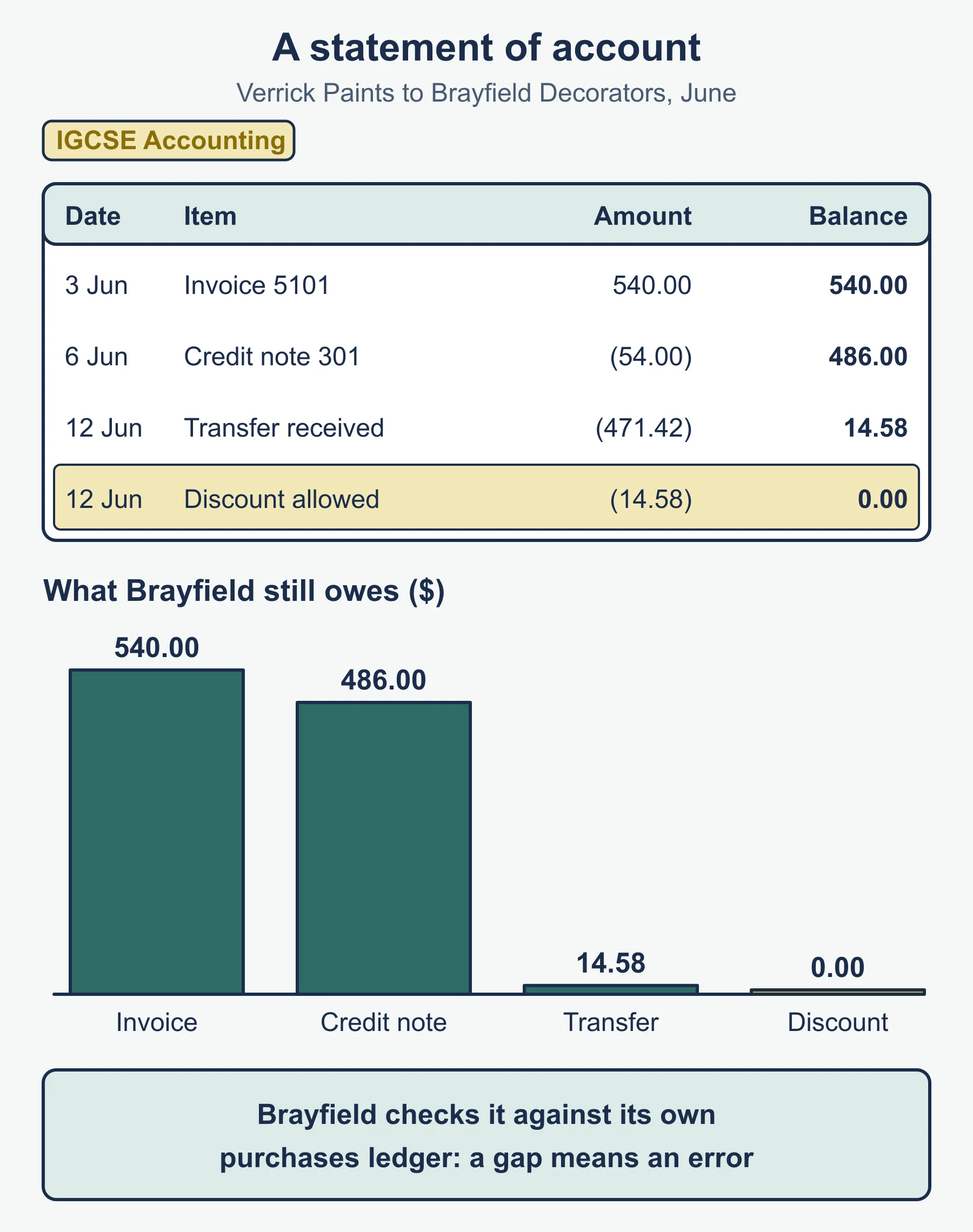
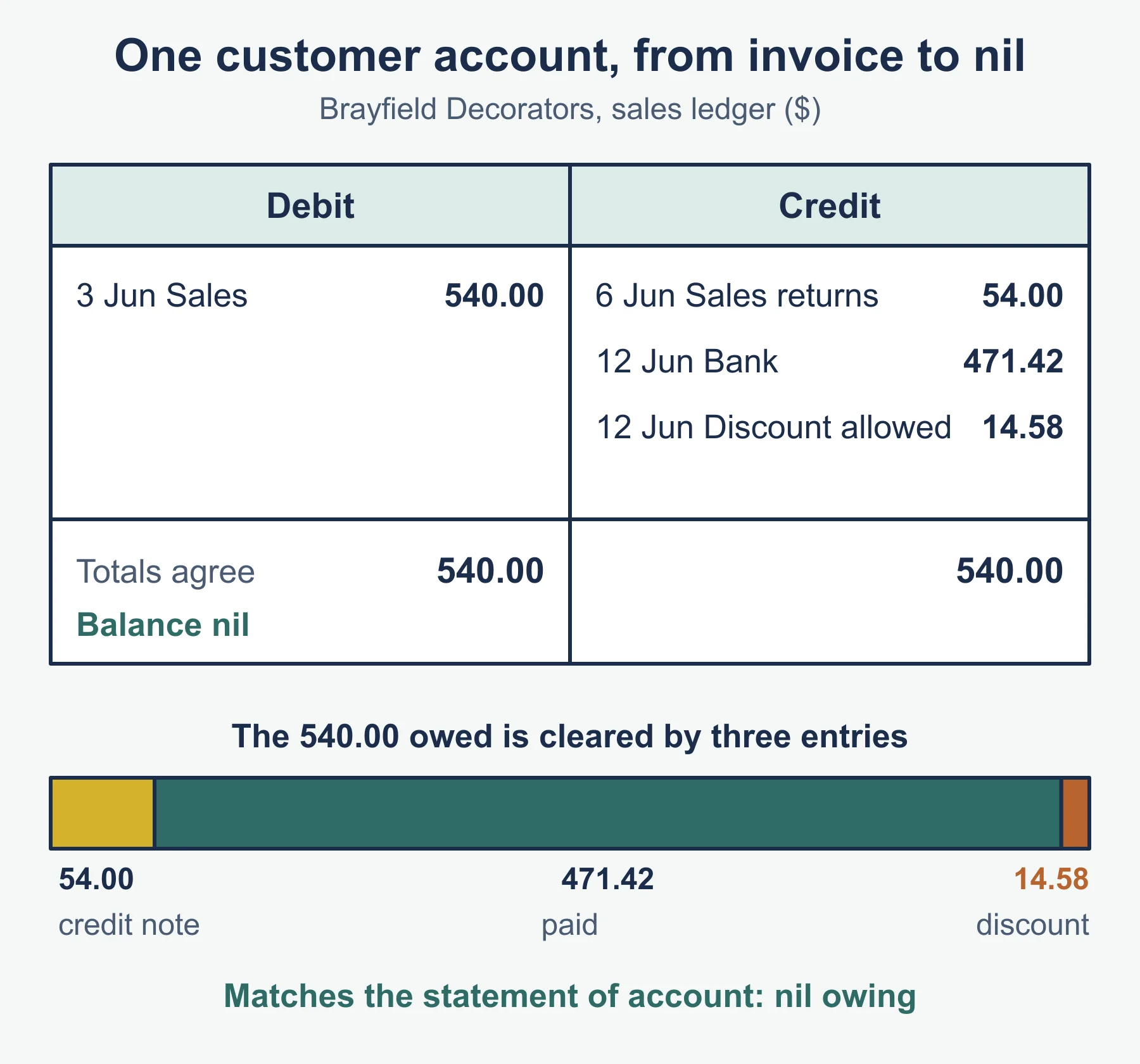
A statement of account. Verrick’s June statement to Brayfield lists invoice 5101 (540.00), the credit note (54.00), the transfer received (471.42) and the discount allowed (14.58), leaving a balance of nil. Brayfield checks it against its own purchases ledger; a difference means a missing document or an error.
Bank statements. Items on the statement but not yet in the cash book (bank charges, interest, a direct debit) are entered from it. A counterfoil or paying-in slip gives the details before the statement arrives.
Manual and digital documents
Documents can be produced and recorded either way.
- Manual: handwritten invoices with duplicate copies, a cheque book with counterfoils, paper receipt books, a posted statement.
- Digital: invoices, credit notes and statements generated by software and emailed, electronic receipts, an online bank statement, records stored in software.
The information is the same in both forms. Speed, storage and error risk differ (see the last section).
The books of prime entry
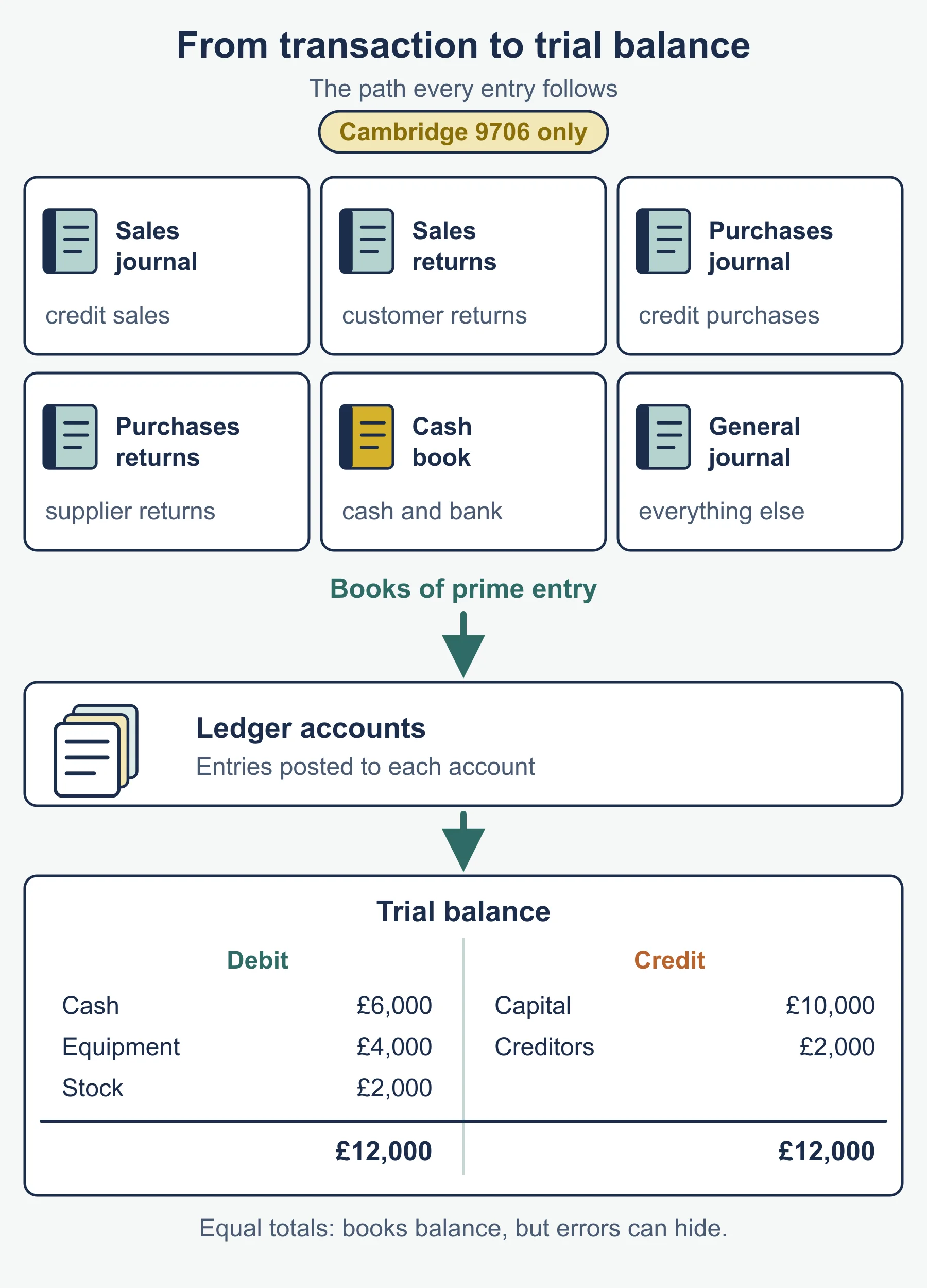
A book of prime entry holds the first record of a transaction, made from its source document. The ledger comes next, after posting. The seven books:
| Book | Records | Posted to |
|---|---|---|
| Sales journal | Credit sales | Customers’ accounts (sales ledger); sales account (nominal ledger) |
| Purchases journal | Credit purchases of goods for resale | Suppliers’ accounts (purchases ledger); purchases account |
| Sales returns journal | Goods customers return | Customers’ accounts; sales returns account |
| Purchases returns journal | Goods returned to suppliers | Suppliers’ accounts; purchases returns account |
| Cash book | Receipts and payments, cash and bank | Other side of each entry |
| Petty cash book | Small cash payments (vouchers) | Expense accounts |
| General journal | Anything fitting no other book | Accounts named in the entry |
Journals for a month
Verrick Paints, June. Invoices are entered at the amount after trade discount.
Sales journal
| Date | Customer | Invoice | Gross | Trade discount | Net |
|---|---|---|---|---|---|
| 3 Jun | Brayfield Decorators | 5101 | 720.00 | 180.00 | 540.00 |
| 9 Jun | Ostlund Hotels | 5102 | 400.00 | 40.00 | 360.00 |
| 17 Jun | Hexley & Sons | 5103 | 250.00 | 50.00 | 200.00 |
| Total to sales account | 1,100.00 |
Sales returns journal: 6 Jun Brayfield Decorators, 4 tins, credit note 301, 54.00 (4 x 18.00 less 25%); 22 Jun Ostlund Hotels, credit note 302, 45.00. Total 99.00.
Purchases journal: 5 Jun Aldersey Pigments 640.00; 14 Jun Kinloch Brushes 310.00. Total 950.00.
Purchases returns journal: 20 Jun Aldersey Pigments, credit note received, 40.00.
General journal. On 28 Jun Verrick buys shop shelving for 1,200 on credit from Tregear Fittings. Shelving is a non-current asset, not goods for resale, so it is kept out of the purchases journal.
| Date | Account | Debit | Credit |
|---|---|---|---|
| 28 Jun | Shop fittings | 1,200.00 | |
| Tregear Fittings | 1,200.00 |
Opening entries and corrections of errors also suit the general journal.
Discounts
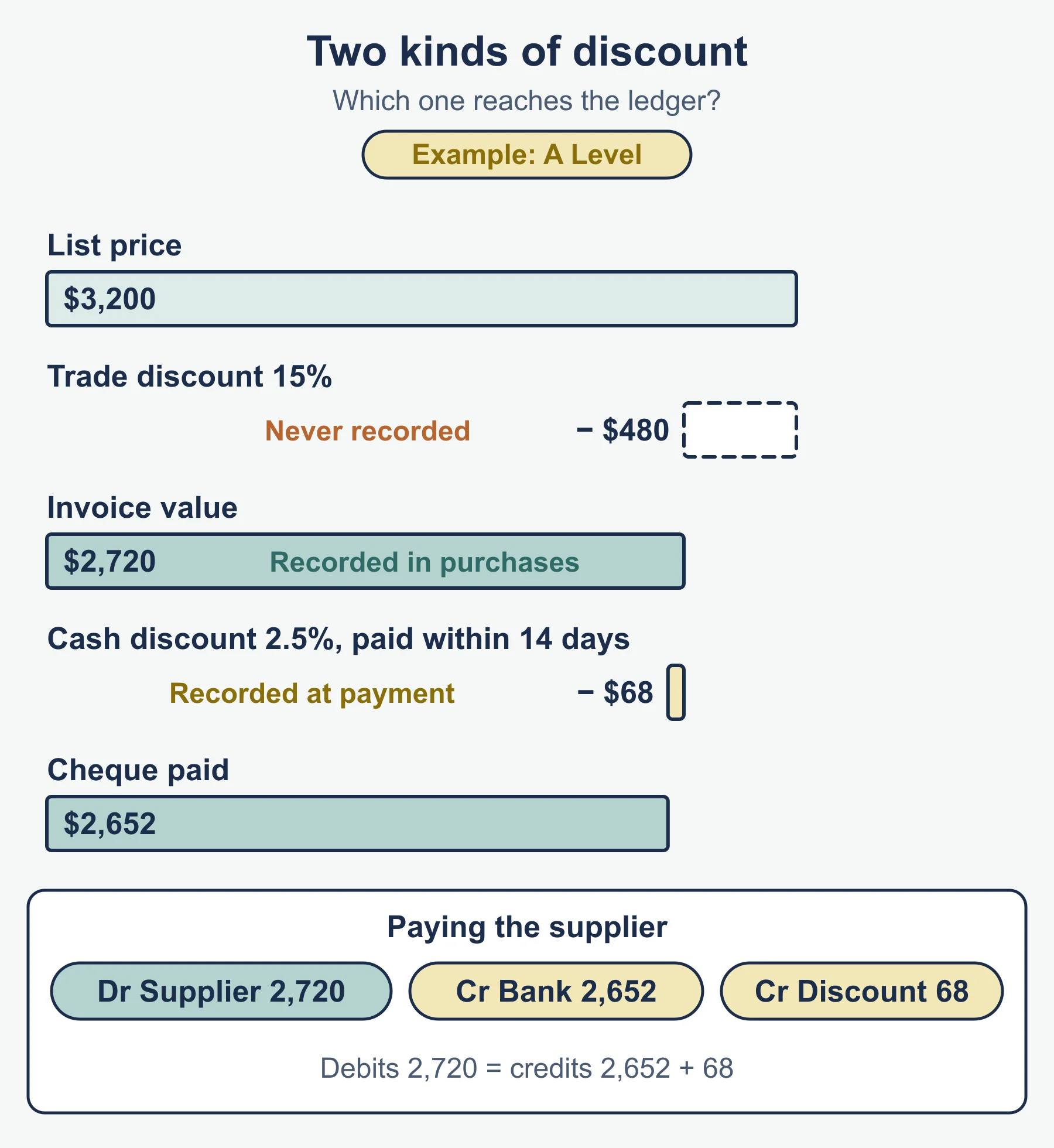
- Trade discount is deducted on the invoice, often for bulk orders or trade customers. It is never entered in the ledger: only the net figure is recorded.
- Cash discount rewards a buyer who settles early. Enter it when the payment is made: discount allowed (seller) and discount received (buyer) go in the cash book’s discount columns.
Check the conditions. Ostlund Hotels pays after the discount period, so it earns none.
The cash book
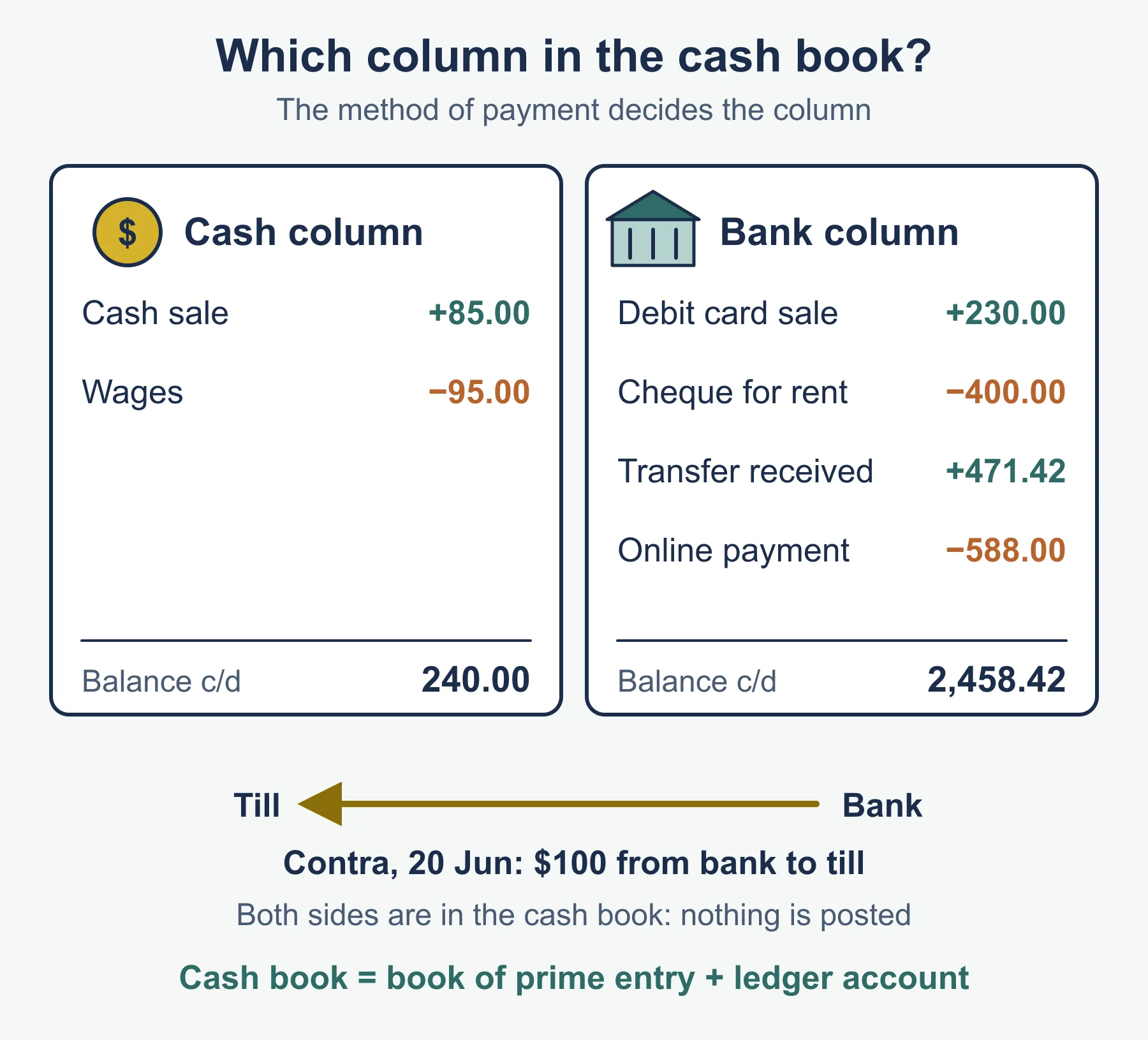
The cash book has a cash column and a bank column on each side, plus discount columns. Its dual function: it is a book of prime entry (transactions are first recorded in it) and the ledger account for cash and bank (its balances are those accounts’ balances). The ledger holds no separate cash or bank account.
The method of payment only changes the column. Cash goes in the cash column. Cheques, debit and credit card receipts, online payments and bank transfers go in the bank column, because the money moves through the bank account.
Opening balances 1 June: cash 150, bank 2,840.
| Date | Details | Discount allowed | Cash | Bank | Date | Details | Discount received | Cash | Bank |
|---|---|---|---|---|---|---|---|---|---|
| 1 Jun | Balances b/d | 150.00 | 2,840.00 | 12 Jun | Wages | 95.00 | |||
| 12 Jun | Brayfield (transfer) | 14.58 | 471.42 | 16 Jun | Rent (cheque) | 400.00 | |||
| 12 Jun | Sales | 85.00 | 20 Jun | Bank (contra) | 100.00 | ||||
| 18 Jun | Sales (debit card) | 230.00 | 27 Jun | Aldersey (online) | 12.00 | 588.00 | |||
| 20 Jun | Cash (contra) | 100.00 | 29 Jun | Kinloch (cheque) | 310.00 | ||||
| 25 Jun | Ostlund (cheque) | 315.00 | 30 Jun | Balances c/d | 240.00 | 2,458.42 | |||
| 14.58 | 335.00 | 3,856.42 | 12.00 | 335.00 | 3,856.42 |
The contra entry moves 100 from the bank to the till: both sides are in the cash book, so nothing is posted. Brayfield owed 540 less the 54 credit note = 486; the 3% discount is 14.58, so 471.42 was paid. Aldersey was owed 640 less 40 = 600; the 2% discount is 12.00, so 588.00 was paid.
Posting to the ledger
Each posting is the other half of the double entry.
- Sales journal: total 1,100 credited to sales; each invoice debited to the customer.
- Sales returns journal: total 99 debited to sales returns; each credit note credited to the customer.
- Purchases journal: total 950 debited to purchases; each invoice credited to the supplier.
- Purchases returns journal: total 40 credited to purchases returns; each credit note debited to the supplier.
- Cash book: receipts are credited to the customer or income account; payments are debited to the supplier or expense account. Discount allowed (14.58) is debited and discount received (12.00) is credited, as column totals.
Brayfield’s account after posting (sales ledger):
Brayfield Decorators account
3 Jun   Sales            540.00 | 6 Jun   Sales returns       54.00
                                | 12 Jun  Bank               471.42
                                | 12 Jun  Discount allowed    14.58
                         540.00 |                            540.00
The two sides agree, so the balance is nil, matching the statement.
Petty cash and the imprest system
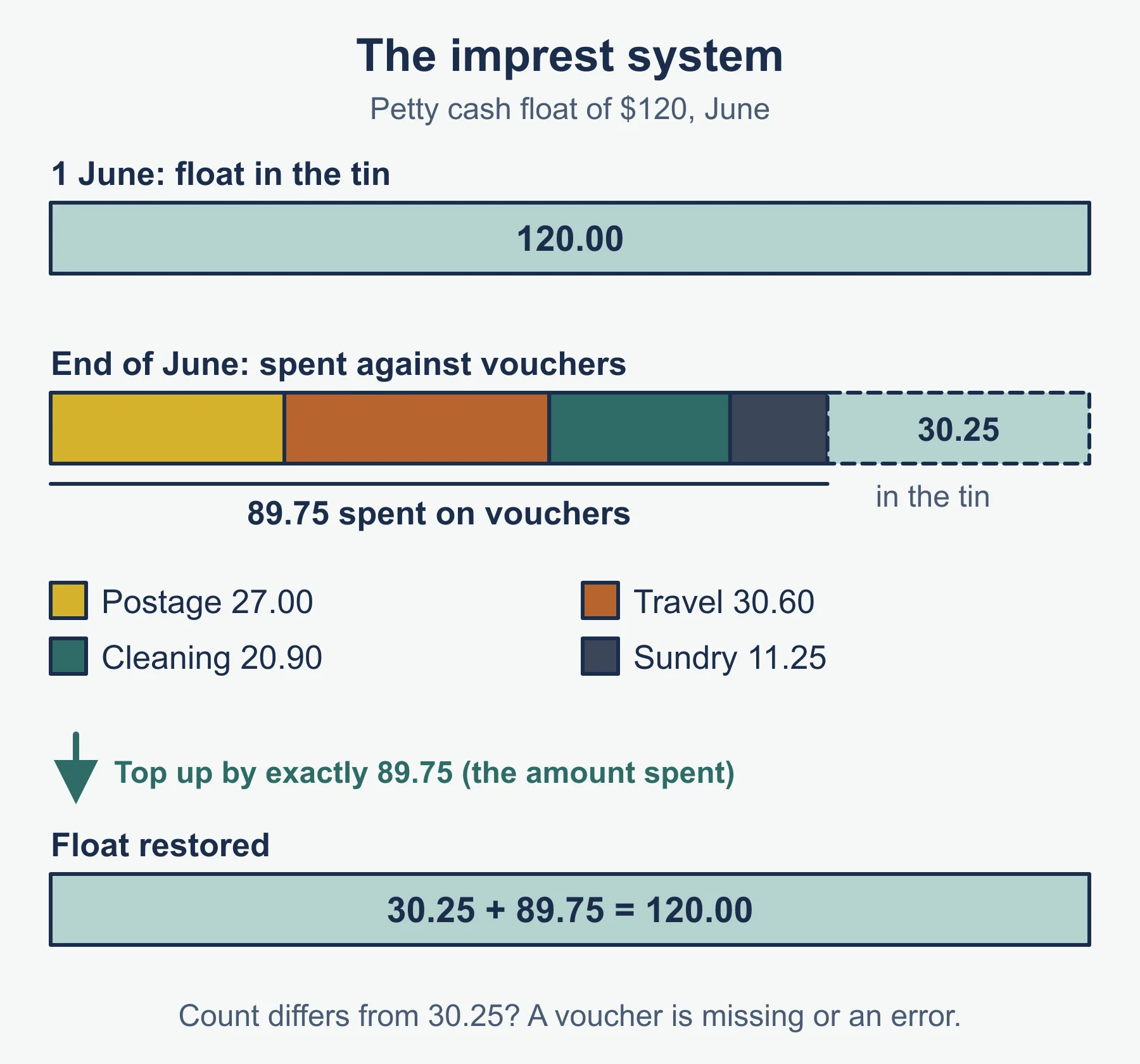
The petty cash book records small payments, such as stamps and fares. Under the imprest system the petty cashier holds a fixed float, pays out against vouchers, and is given exactly the amount spent, so the float is restored. Purpose: control. The chief cashier sees every voucher before topping up, and the main cash book is spared many small entries.
Verrick uses a $120 float. Payments in June:
| Date | Voucher | Details | Total | Postage | Travel | Cleaning | Sundry |
|---|---|---|---|---|---|---|---|
| 3 Jun | 1 | Stamps | 18.00 | 18.00 | |||
| 6 Jun | 2 | Taxi | 22.00 | 22.00 | |||
| 11 Jun | 3 | Cleaning materials | 14.50 | 14.50 | |||
| 14 Jun | 4 | Stamps | 9.00 | 9.00 | |||
| 19 Jun | 5 | Tea and coffee | 11.25 | 11.25 | |||
| 23 Jun | 6 | Bus fare | 8.60 | 8.60 | |||
| 27 Jun | 7 | Cleaning materials | 6.40 | 6.40 | |||
| Totals | 89.75 | 27.00 | 30.60 | 20.90 | 11.25 |
Cash left in the tin should be 120 less 89.75 = 30.25. The cashier receives 89.75 from the cash book (a bank payment) and the float is back to 120. The column totals are debited to postage, travel, cleaning and sundry expenses. If the count differs from 30.25, a voucher is missing or there is an error.
Benefits and limitations
Keeping cash at the business property
- Benefits: small payments and change are available at once.
- Limitations: theft, loss or miscounting; secure storage and insurance; no interest earned.
Manual original entry (handwritten books)
- Benefits: low cost, no equipment, works through a power cut.
- Limitations: slow; arithmetic and copying errors; hard to search, back up and summarise.
Digital original entry (software)
- Benefits: totals and postings calculated automatically; documents produced quickly; records simple to back up, search and report on.
- Limitations: set-up and training cost; system failure or data loss; an input error spreads to every record it feeds.
Common errors
- Recording the gross invoice, not the figure after trade discount.
- Putting a cheque payment in the cash column, or equipment in the purchases journal.
- Restoring the petty cash float with the cash left in the tin, not the amount spent.
Frequently asked questions
What are the seven books of prime entry in Cambridge IGCSE Accounting 0452? The seven books are the sales journal, sales returns journal, purchases journal, purchases returns journal, general journal, cash book and petty cash book. Each holds the first record of a transaction, made from its source document, before posting to the ledger.
What is the difference between trade discount and cash discount? Trade discount is deducted on the invoice, often for bulk orders or trade customers, and is never entered in the ledger. Cash discount rewards early settlement and is recorded only when payment is made, as discount allowed or discount received in the cash book.
What is the dual function of the cash book? The cash book is a book of prime entry, because transactions are first recorded in it, and it is also the ledger account for cash and bank. Its balances are the cash and bank account balances.
Is equipment bought on credit recorded in the purchases journal? No. The purchases journal is for goods bought for resale. A non-current asset such as shop shelving bought on credit is recorded in the general journal.
What are the benefits and limitations of digital original entry? Software calculates totals and postings automatically, produces documents quickly and makes records easy to back up, search and report on. Its limitations are set-up and training costs, the risk of system failure or data loss, and an input error spreading to every record it feeds.
Official syllabus
Source: the Cambridge IGCSE Accounting 0452 syllabus (version 1), valid for examination in 2027, 2028 and 2029, from Cambridge University Press and Assessment (Cambridge International Education).
Get free revision emails (optional)
Occasional emails with practice questions, worked explanations and links to free resources for the qualification and subjects you choose. No spam, and you can unsubscribe from any email. The free tools on this site never need an email.
Related resources
-
Revision notes
IGCSE Accounting: Analysis and Interpretation — Revision Notes
Quick recall for Cambridge IGCSE Accounting 0452 Topic 6: ten ratios, reading them, profit versus cash, comparing businesses, users and statement limits.
Accounting · Cambridge · IGCSE, O Level
Revise topic -
Practice questions
IGCSE Accounting: Business documents and books of prime entry (Cambridge 0452) – Practice Questions
Eleven original questions with worked answers on documents, books of prime entry, discounts, cash book and petty cash for Cambridge IGCSE Accounting 0452.
Accounting · Cambridge · IGCSE, O Level
Try questions -
Revision notes
IGCSE Accounting: Business documents and books of prime entry (Cambridge 0452) – Revision Notes
Condensed revision notes on business documents, books of prime entry, discounts, the cash book and imprest petty cash for Cambridge IGCSE Accounting 0452.
Accounting · Cambridge · IGCSE, O Level
Revise topic
Related articles
-
teaching
A Level tuition in Dubai: Cambridge or Pearson Edexcel International A Level?
Schools in Dubai and Abu Dhabi teach either Cambridge International AS & A Level or Pearson Edexcel International A Level. How the two are structured, why it matters for tuition, and how online classes from Lahore work.
9 October 2026
-
curriculum guides
Choosing subjects at IGCSE and A Level
How subject choices at 14 and 16 affect university options later, and how to keep pathways open without overloading a timetable.
28 July 2026
Studying this with a teacher
Working through Accounting IGCSE, O LEVELS?
This page is free and stays free. If you would rather be taught it, Marlbridge runs Accounting classes one-to-one and in small groups of up to 15, online in your own time zone. The first trial class is free. WhatsApp replies within an hour (8am–11pm Pakistan time, every day); email the same day.
Cambridge Accounting teachers at Marlbridge

