
Revision Notes
IGCSE Accounting: The double entry system of book-keeping (Cambridge 0452) – Revision Notes
Condensed revision notes for Cambridge IGCSE Accounting 0452 section 2.1: debit and credit rules, balancing steps, transfers, balances and a self-test.
- Subject
- Accounting
- Level
- IGCSE, O LEVELS
- Topic
- Sources and recording of data
- Author
- Marlbridge Academic Team
- Updated
- Reviewed by
- Javaid Iqbal Sabri (what this means)
Aligned to Cambridge IGCSE O Level Accounting (0452, 7707), 2027-2029. Official specification (IGCSE) ; Official specification (O Level) .
Syllabus page (what it covers and how it is assessed): Cambridge IGCSE Accounting; Cambridge O Level Accounting.
Syllabus points this page covers
0452
- 2.1 The double entry system of book-keeping
7707
- 2.1 The double entry system of book-keeping
Found an error? Report a correction.
Want a teacher for this? Marlbridge teaches Accounting online. Request a free trial class.
Syllabus edition note. This resource follows the Cambridge IGCSE Accounting 0452 syllabus (and Cambridge O Level Accounting 7707, which has the same subject content for the same series) for exams in 2027, 2028 and 2029 (version 1), first examined in the March 2027 series in India and the June 2027 series elsewhere. If you sit 0452 in November 2026, you sit the 2026 syllabus (version 2), which differs: Paper 1 has 35 multiple-choice marks in 1 hour 15 minutes, not 40 marks in 1 hour 30 minutes; Topic 7 is “Accounting principles and policies”, without 7.2 Ethical considerations or 7.3 Technology and sustainability; 4.4 is “Irrecoverable debts and provision for doubtful debts”; income statements are named instead of statements of profit or loss; three-column running balance accounts are not required; Clubs and societies is 5.4 and Manufacturing accounts 5.5; and 6.3 is “Inter-firm comparison”. For this topic, the 2026 syllabus also asks candidates to complete pro-forma business documents and to explain the advantage of using books of prime entry, and it does not include digital ledger accounts or the benefits and limitations of keeping cash at the business property and of manual and digital original entry. If you sit in November 2026, work from the 2026 syllabus on the Cambridge International website.
Condensed for the final weeks. For full explanations and the month-long worked example, use the study guide. These notes cover section 2.1, The double entry system of book-keeping, of the Cambridge IGCSE Accounting 0452 syllabus for exams in 2027, 2028 and 2029 (version 1). The syllabus is not tiered. Find the course on the Accounting hub and track progress on the checklist.
Syllabus map for 2.1
| Point in the syllabus | One-line summary |
|---|---|
| The double entry system | Every transaction: one debit, one credit, same amount |
| Prepare and post ledger accounts | Each half of the entry goes to its own account, naming the other account |
| Balances and transfers | Balance c/d and b/d; income and expenses close to the statement of profit or loss |
| Interpret accounts and balances | Say who owes whom, or what the figure represents |
| Three-column running balance | Debit, Credit and Balance columns; balance after every line |
| Division of the ledger | Sales ledger, purchases ledger, nominal (general) ledger |
| Digital ledgers | Enter once, software posts both sides |
Folio columns: you do not need to explain or use them.
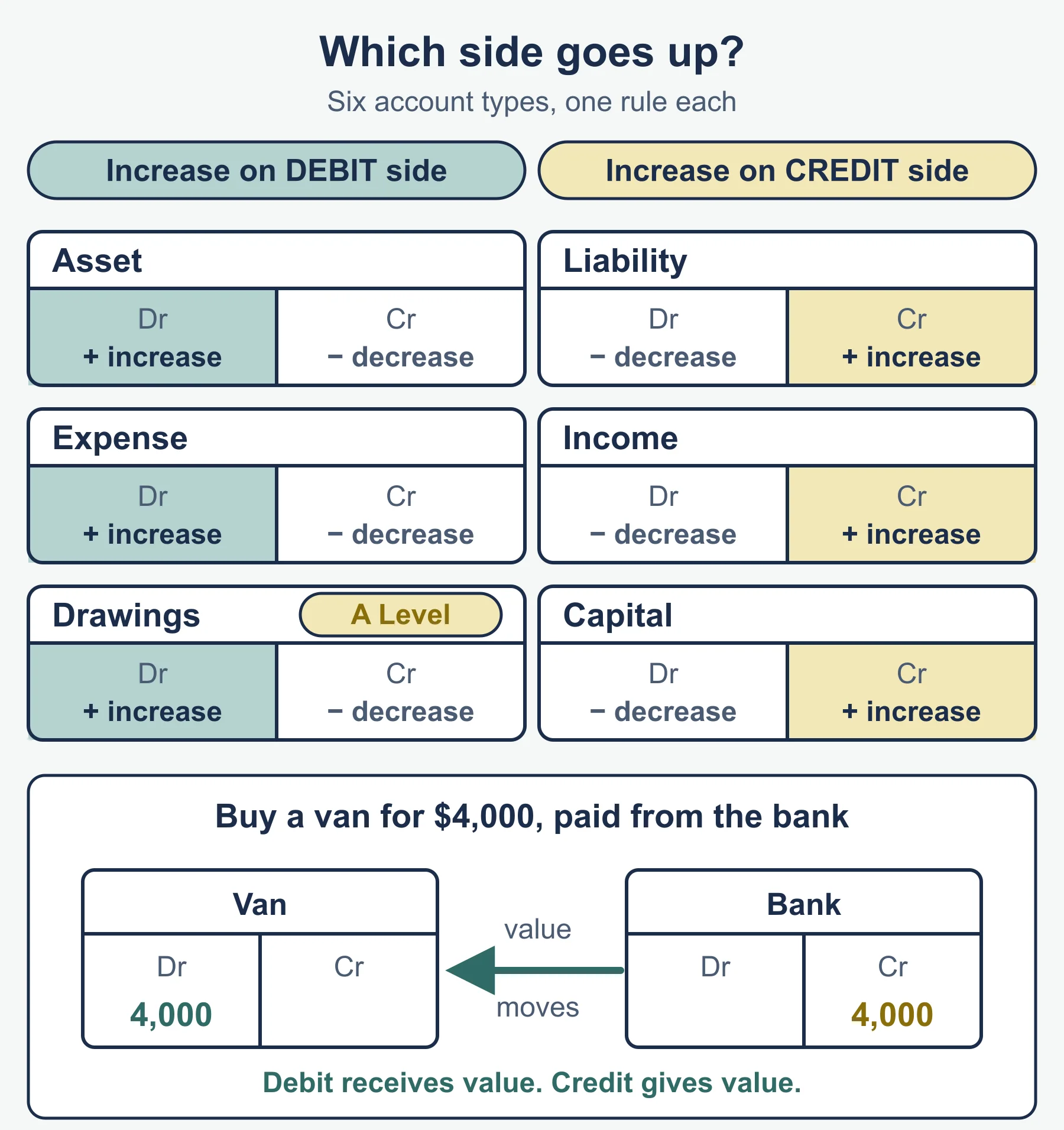
Debit and credit rules
| Account type | Debit side | Credit side |
|---|---|---|
| Assets | Rise | Fall |
| Drawings and expenses | Rise | Fall |
| Liabilities | Fall | Rise |
| Capital | Fall | Rise |
| Income, such as sales | Fall | Rise |
Memory aid: debit assets, expenses and drawings when they rise; credit liabilities, capital and income when they rise. Debit is not “bad” and credit is not “good”. They are only the left and the right.
Returns accounts take the opposite side to the account they reduce: sales returns are debited like an expense, purchases returns are credited like income.
Common entries
| Transaction | Debit | Credit |
|---|---|---|
| Owner pays more money into the bank | Bank | Capital |
| Bank loan received | Bank | Loan |
| Non-current asset bought by cheque | The asset | Bank |
| Non-current asset bought on credit | The asset | Supplier’s account |
| Goods for resale bought on credit | Purchases | Supplier’s account |
| Goods sold on credit | Customer’s account | Sales |
| Goods sold, money received into the bank | Bank | Sales |
| Goods sent back to a supplier | Supplier’s account | Purchases returns |
| Goods sent back by a customer | Sales returns | Customer’s account |
| Customer pays | Bank | Customer’s account |
| Supplier paid | Supplier’s account | Bank |
| Expense paid from the bank | The expense | Bank |
| Owner takes money for personal use | Drawings | Bank |
Method: posting
- Identify the two accounts.
- Decide whether each is increasing or decreasing.
- Use the rules to choose debit or credit.
- Write the date, the other account’s name and the amount in each account.
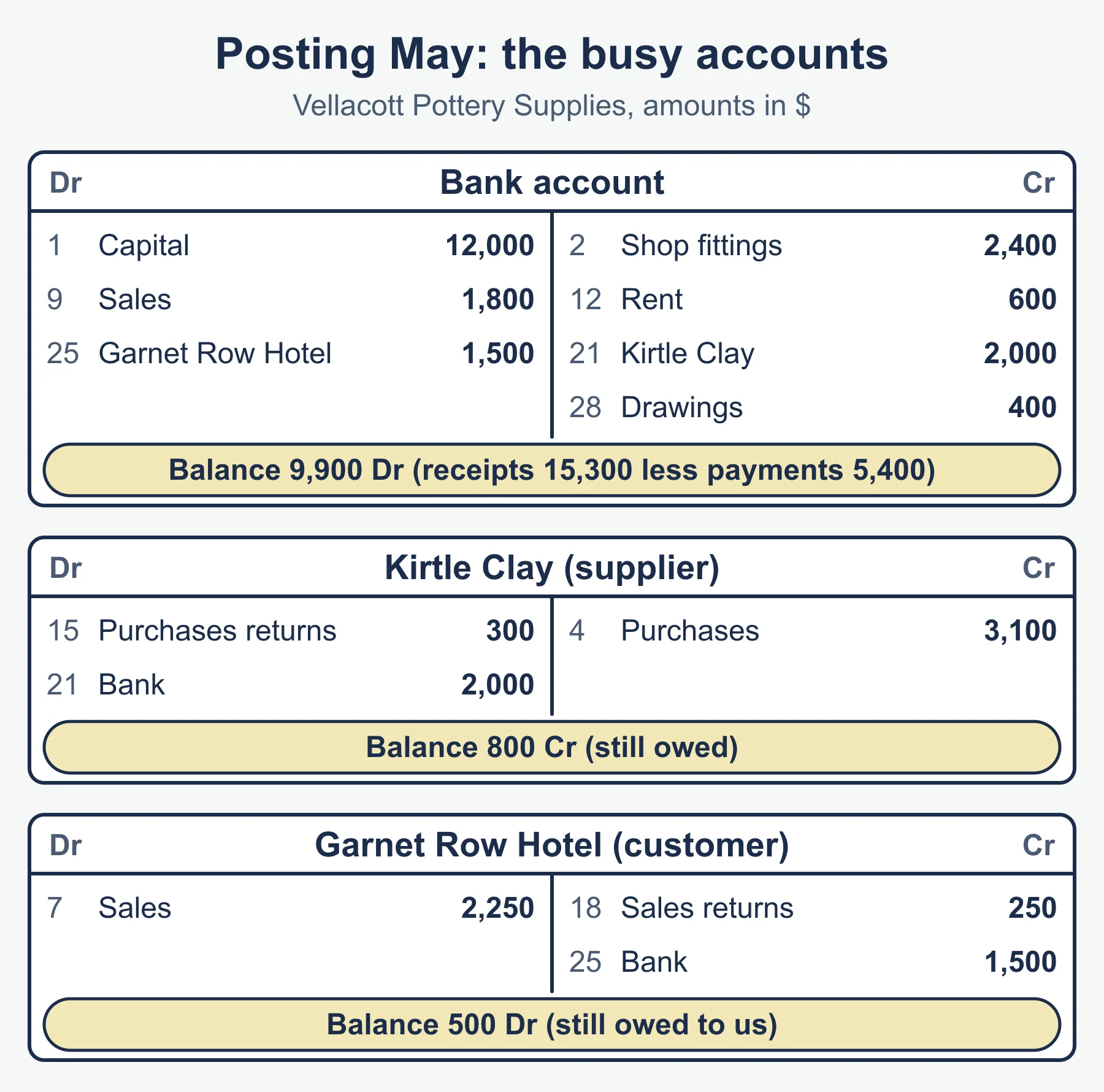
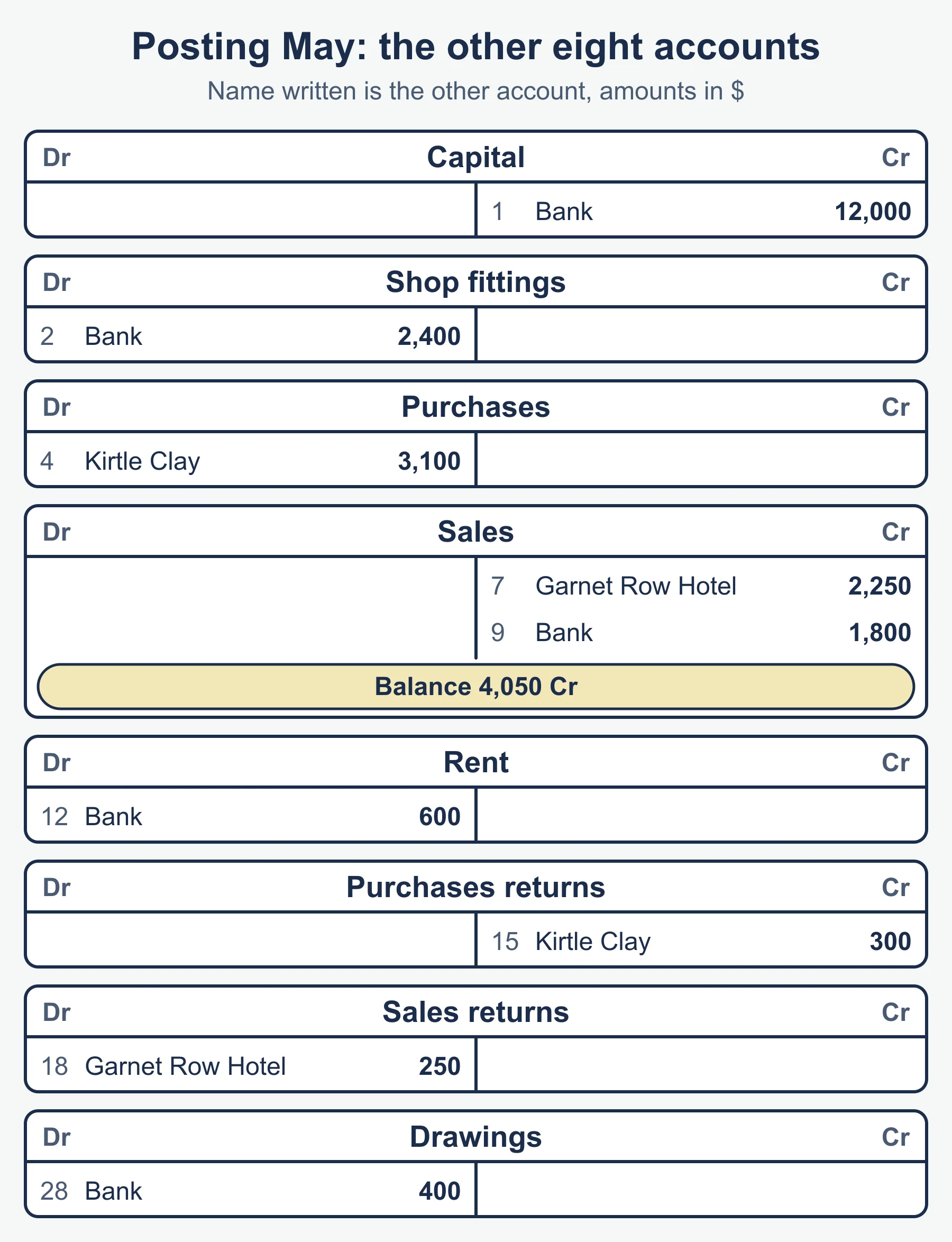
Method: balancing a two-sided account
- Total both sides.
- Subtract to find the balance.
- Put the balance on the smaller side as Balance c/d.
- Write the same total on both sides.
- Show the balance again, below the totals, on the other side as Balance b/d.
Torrance Hill Lamps sells lamps on credit to Wyndcombe Hotel for 2,640 on 6 June. The hotel pays 1,000 on 14 June and returns goods worth 340 on 26 June.
Wyndcombe Hotel account (June)
Dr                            |Cr
 6 Sales           2,640      |14 Bank              1,000
                              |26 Sales returns       340
                              |30 Balance c/d       1,300
                   2,640      |                     2,640
 1 Balance b/d     1,300
The hotel still owes 1,300, so this is a debit balance and a trade receivable. The debit total (2,640) minus the credit entries (1,000 and 340) gives 1,300.
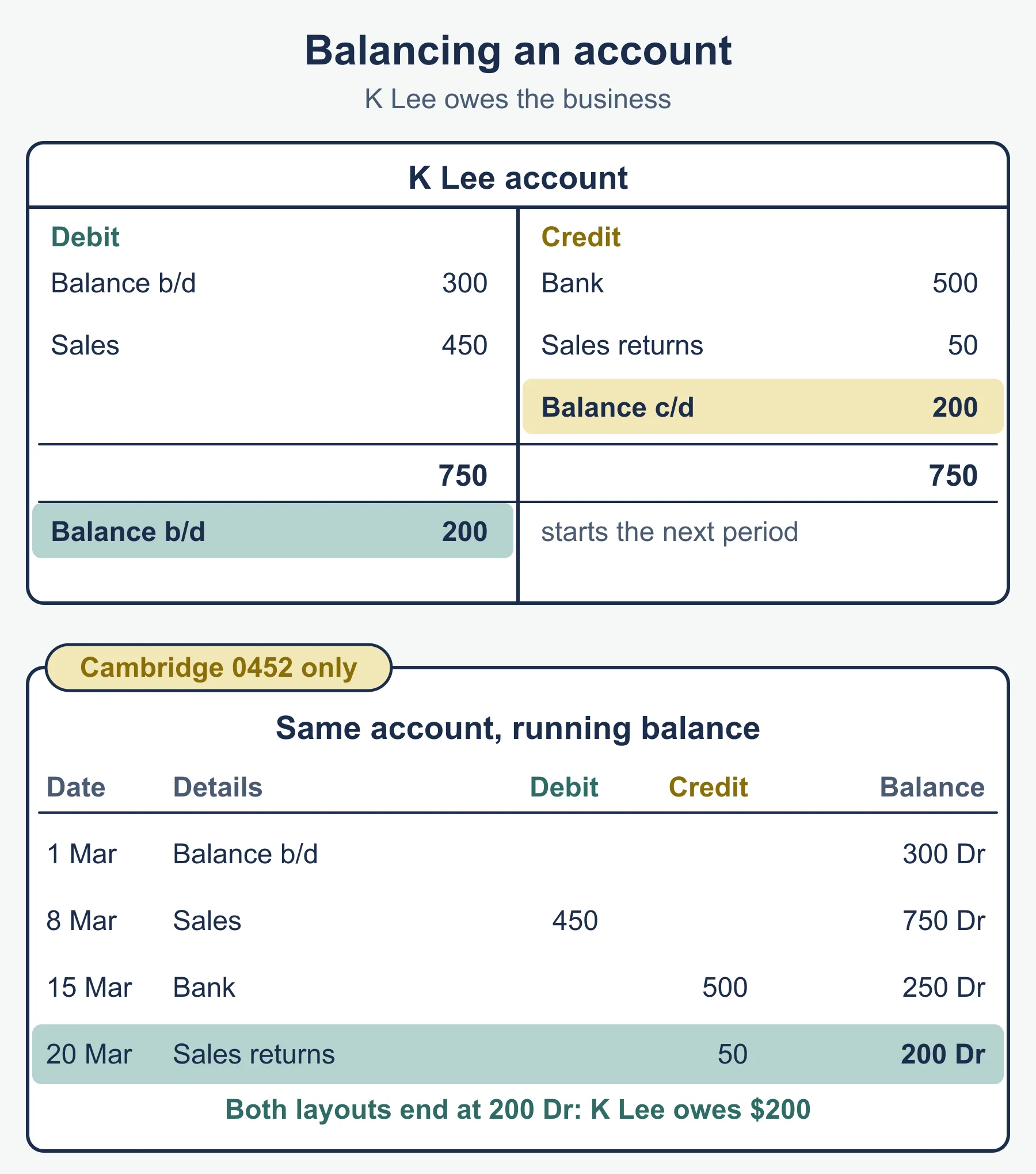
Running balance reminders
Same entries, one extra column. Work out the balance after every line and label it.
Sundby Metals account (purchases ledger), amounts in $
Date    Details            Debit    Credit    Balance
1 Jun   Purchases                    1,800    1,800 Cr
10 Jun  Purchases returns     200             1,600 Cr
20 Jun Bank 1,000 600 Cr- When the balance is a debit, add debits and subtract credits. When it is a credit, add credits and subtract debits.
- If a payment is larger than the balance, the label flips from Cr to Dr.
- The final line is the closing balance, so no balancing step is needed.
Transfers to the financial statements
| Balance at the year end | Where it goes |
|---|---|
| Sales (credit) | Statement of profit or loss |
| Sales returns (debit) | Statement of profit or loss |
| Purchases and purchases returns | Statement of profit or loss |
| Wages, insurance and other expenses (debit) | Statement of profit or loss |
| Motor vehicles (debit) | Statement of financial position, non-current assets |
| Bank, customers’ accounts (debit) | Statement of financial position, current assets |
| Suppliers’ accounts (credit) | Statement of financial position, current liabilities |
| Loan repayable after more than a year | Statement of financial position, non-current liabilities |
| Capital (credit) | Statement of financial position, capital |
| Drawings (debit) | Deducted from capital |
Closing an expense account is a credit in the expense account. Closing an income account is a debit in the income account.
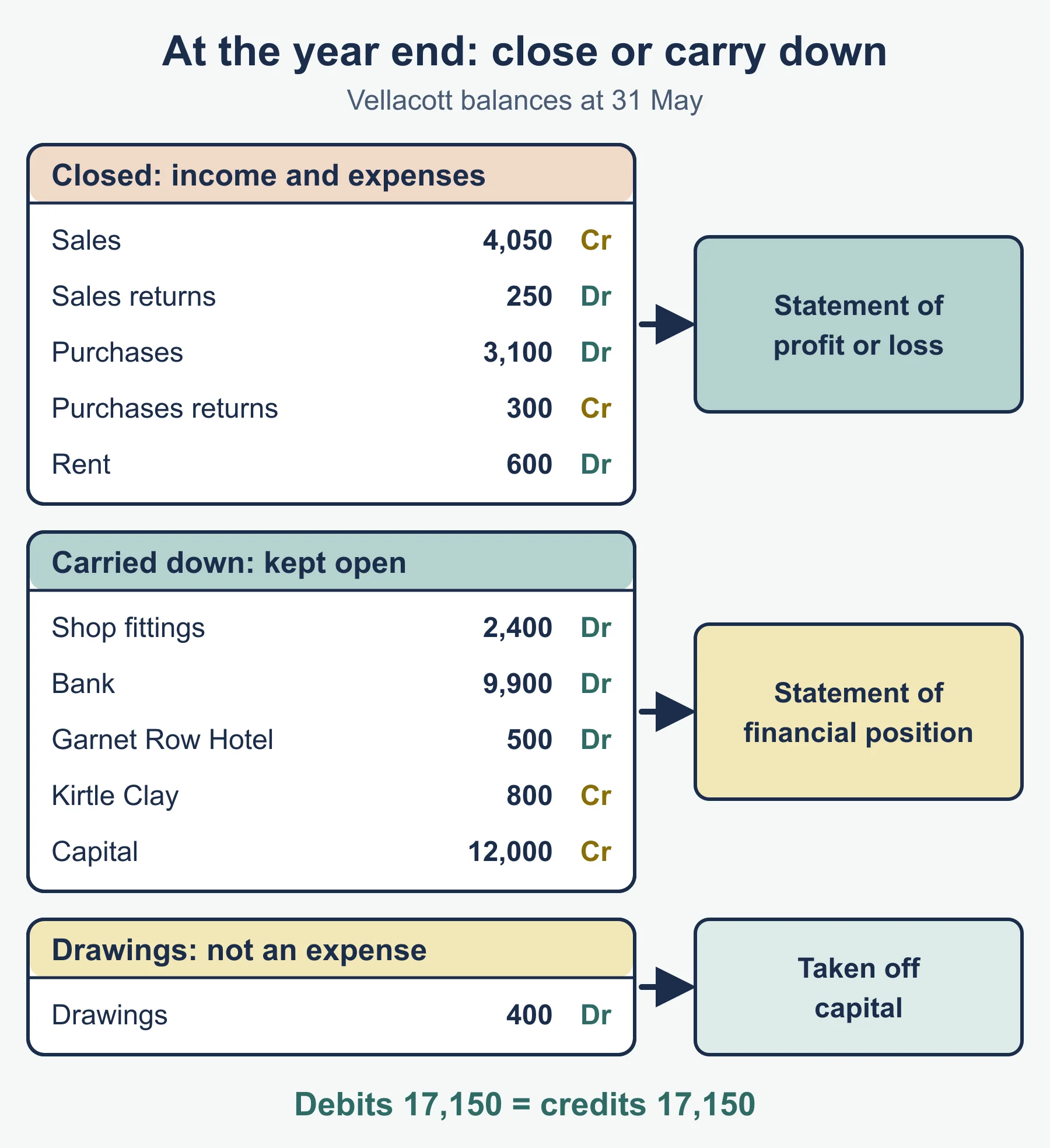
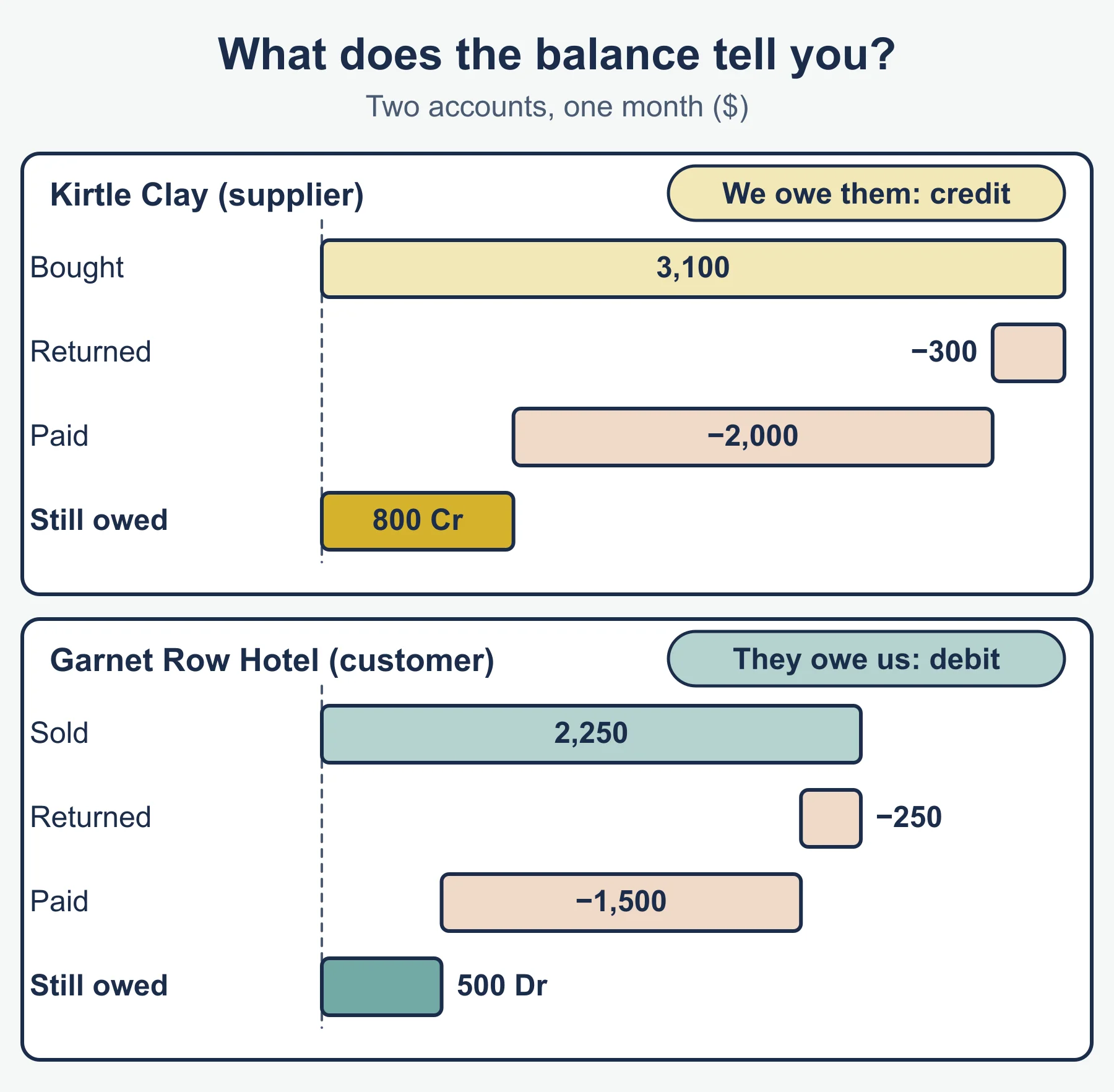
Reading balances
| Account | Debit balance | Credit balance |
|---|---|---|
| Customer | Customer owes you | You owe the customer |
| Supplier | Supplier owes you | You owe the supplier |
| Bank | Cash at bank | Overdraft |
Say what the figure means in words, not only “debit” or “credit”. A debit balance on a supplier’s account or a credit balance on a customer’s account is unusual, and it is often caused by an overpayment or a return after payment.
Ledger divisions
| Ledger | Holds |
|---|---|
| Sales ledger | Credit customers’ accounts |
| Purchases ledger | Credit suppliers’ accounts |
| Nominal (general) ledger | All other accounts |
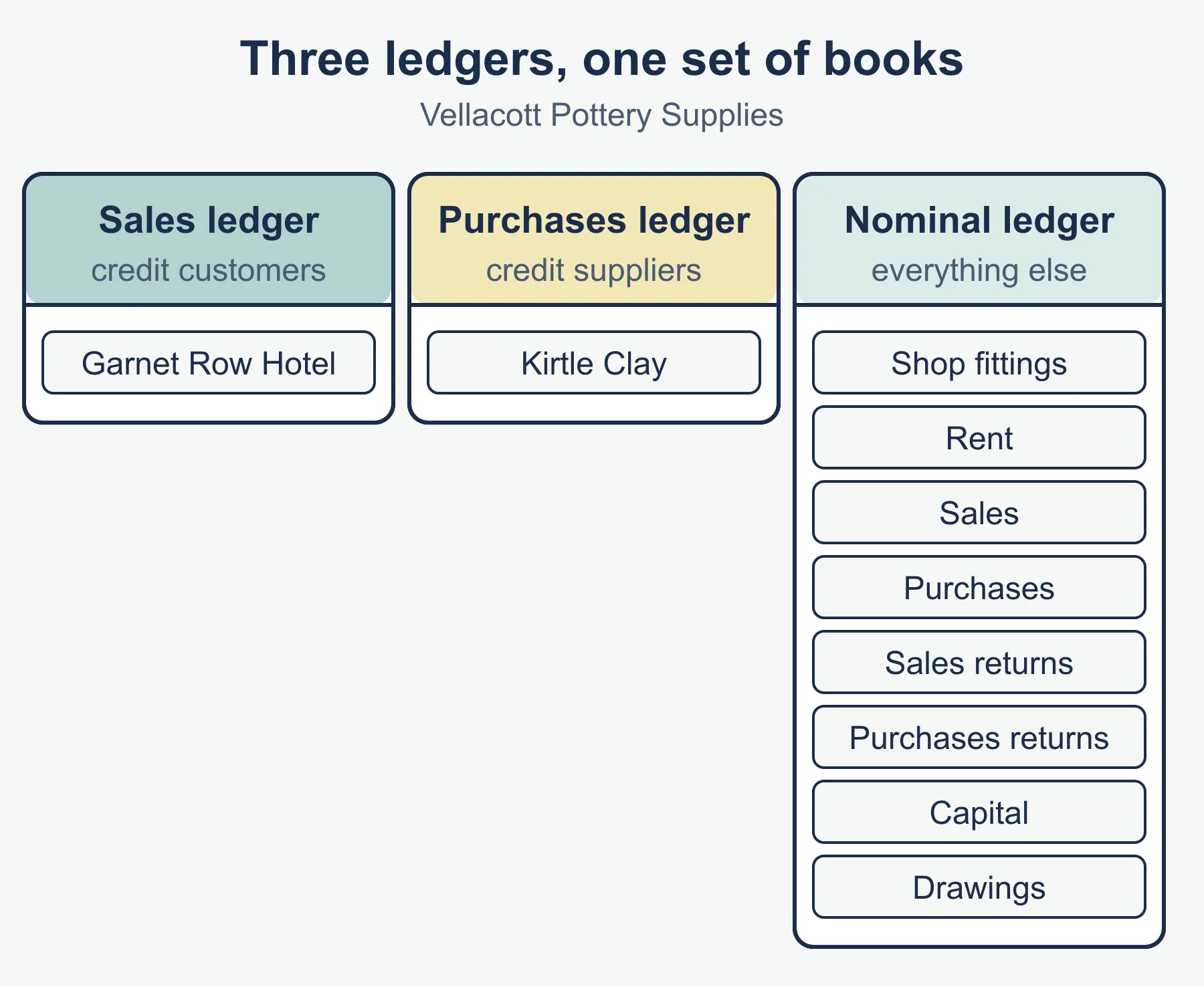
Digital ledgers
- Enter a transaction once; the software posts both sides and updates balances.
- Benefits: speed, fewer arithmetic slips, searching, backup, reports.
- Limitations: cost, training, system or power failure, security risk, and wrong account choices post everywhere.
Must-know distinctions
- Balance c/d versus a transfer. Carrying down keeps a balance for next period. A transfer to the statement of profit or loss closes the account to nil.
- Personal versus nominal accounts. Customers and suppliers are personal accounts in their own ledgers; everything else is nominal.
- Two-sided versus running balance. Layout differs; the double entry does not.
Quick self-test
All amounts are in dollars.
- On which side is an expense account increased?
- State the debit and credit for the owner withdrawing 300 from the bank.
- State the debit and credit for a bank loan of 5,000 being received.
- In which ledger is a supplier’s account kept?
- A customer’s account shows 480 Dr. Goods worth 220 are sold on credit, goods worth 60 are returned and 400 is paid. What is the new balance?
- A supplier’s account shows a balance of 150 Dr. What does it mean?
- The debit side of an account totals 7,350 and the credit side totals 6,100. State the side and amount of the balance c/d and the balance b/d.
- Which of wages, motor vehicles, sales returns and drawings are transferred to the statement of profit or loss?
- Why must you still understand debit and credit if you use accounting software?
- A bank account starts with 800 Dr, receives 5,200 and pays out 6,450. State the closing balance and what it means.
Answers
- The debit side.
- Debit Drawings 300; credit Bank 300.
- Debit Bank 5,000; credit Loan 5,000.
- The purchases ledger.
- 240 Dr (480 + 220 - 60 - 400).
- The supplier owes the business, perhaps through an overpayment or returns that exceed the amount owing.
- Balance c/d 1,250 on the credit side; balance b/d 1,250 on the debit side.
- Wages and sales returns. Motor vehicles are in the statement of financial position, and drawings are deducted from capital.
- Software posts what you tell it. If the wrong account is chosen, the error is posted automatically everywhere.
- 450 Cr (800 + 5,200 - 6,450 = -450). The bank account is overdrawn, so the business owes the bank.
Where marks are usually lost
- Putting an entry on the right account but the wrong side.
- Writing the account’s own name in the details column.
- Leaving off Balance b/d, so the next period’s opening figure is missing.
- Totals that differ on the two sides of a balanced account.
- Omitting Dr or Cr on a running balance, or getting the label wrong when a balance changes sign.
- Calling every debit balance an amount owed to the business.
- Sending drawings to the statement of profit or loss.
- Using vague words such as “wrong” for an unusual balance, instead of saying who owes whom.
Next steps
Work through the practice questions, try the free 10-minute diagnostics, and read the Topic 2 overview revision notes for documents and books of prime entry.
Frequently asked questions
Which accounts are debited when they increase in Cambridge IGCSE Accounting? Assets, expenses and drawings are debited when they rise; liabilities, capital and income are credited when they rise. Debit does not mean bad and credit does not mean good: they are just the two sides of an account.
Which side are returns accounts recorded on? Returns accounts take the opposite side to the account they reduce. Sales returns are debited, like an expense, and purchases returns are credited, like income.
What is the difference between carrying a balance down and transferring it? Carrying a balance down (balance c/d) keeps it in the account for the next period, as with assets, liabilities and capital. A transfer to the statement of profit or loss closes an income or expense account to nil at the year end.
What does a debit balance on a supplier’s account mean? It means the supplier owes the business money, for example after an overpayment. Normally a supplier’s account has a credit balance, showing that the business owes the supplier.
Is a running balance account a different double entry from a two-sided account? No. The layout differs, with a balance worked out after every line, but the debits and credits are exactly the same. When the balance is a debit, add debits and subtract credits; when it is a credit, do the reverse.
Official syllabus
Cambridge IGCSE Accounting 0452 syllabus for exams in 2027, 2028 and 2029 (version 1), Cambridge University Press and Assessment, section 2.1.
Get free revision emails (optional)
Occasional emails with practice questions, worked explanations and links to free resources for the qualification and subjects you choose. No spam, and you can unsubscribe from any email. The free tools on this site never need an email.
Related resources
-
Revision notes
IGCSE Accounting: Analysis and Interpretation — Revision Notes
Quick recall for Cambridge IGCSE Accounting 0452 Topic 6: ten ratios, reading them, profit versus cash, comparing businesses, users and statement limits.
Accounting · Cambridge · IGCSE, O Level
Revise topic -
Study guides
IGCSE Accounting: Business documents and books of prime entry (Cambridge 0452)
Business documents and the seven books of prime entry, with a worked month of journals, cash book and petty cash, for Cambridge IGCSE Accounting 0452.
Accounting · Cambridge · IGCSE, O Level
Read guide -
Practice questions
IGCSE Accounting: Business documents and books of prime entry (Cambridge 0452) – Practice Questions
Eleven original questions with worked answers on documents, books of prime entry, discounts, cash book and petty cash for Cambridge IGCSE Accounting 0452.
Accounting · Cambridge · IGCSE, O Level
Try questions
Related articles
-
teaching
A Level tuition in Dubai: Cambridge or Pearson Edexcel International A Level?
Schools in Dubai and Abu Dhabi teach either Cambridge International AS & A Level or Pearson Edexcel International A Level. How the two are structured, why it matters for tuition, and how online classes from Lahore work.
9 October 2026
-
curriculum guides
Choosing subjects at IGCSE and A Level
How subject choices at 14 and 16 affect university options later, and how to keep pathways open without overloading a timetable.
28 July 2026
Studying this with a teacher
Working through Accounting IGCSE, O LEVELS?
This page is free and stays free. If you would rather be taught it, Marlbridge runs Accounting classes one-to-one and in small groups of up to 15, online in your own time zone. The first trial class is free. WhatsApp replies within an hour (8am–11pm Pakistan time, every day); email the same day.
Cambridge Accounting teachers at Marlbridge

