
Study Guides
IGCSE Accounting: Control accounts (Cambridge 0452)
Step-by-step guide to sales ledger and purchases ledger control accounts for Cambridge IGCSE Accounting 0452: purpose, sources, layout and worked examples.
- Subject
- Accounting
- Level
- IGCSE, O LEVELS
- Topic
- Verification of accounting records
- Author
- Marlbridge Academic Team
- Updated
- Reviewed by
- Javaid Iqbal Sabri (what this means)
Aligned to Cambridge IGCSE O Level Accounting (0452, 7707), 2027-2029. Official specification (IGCSE) ; Official specification (O Level) .
Syllabus page (what it covers and how it is assessed): Cambridge IGCSE Accounting; Cambridge O Level Accounting.
Syllabus points this page covers
0452
- 3.4 Control accounts
7707
- 3.4 Control accounts
Found an error? Report a correction.
Want a teacher for this? Marlbridge teaches Accounting online. Request a free trial class.
Syllabus edition note. This resource follows the Cambridge IGCSE Accounting 0452 syllabus (and Cambridge O Level Accounting 7707, which has the same subject content for the same series) for exams in 2027, 2028 and 2029 (version 1), first examined in the March 2027 series in India and the June 2027 series elsewhere. If you sit 0452 in November 2026, you sit the 2026 syllabus (version 2), which differs: Paper 1 has 35 multiple-choice marks in 1 hour 15 minutes, not 40 marks in 1 hour 30 minutes; Topic 7 is “Accounting principles and policies”, without 7.2 Ethical considerations or 7.3 Technology and sustainability; 4.4 is “Irrecoverable debts and provision for doubtful debts”; income statements are named instead of statements of profit or loss; three-column running balance accounts are not required; Clubs and societies is 5.4 and Manufacturing accounts 5.5; and 6.3 is “Inter-firm comparison”. For this topic, the 2026 syllabus also lists dividends among the cash book updates, and it does not include the impact of digital transactions on bank reconciliation or on control accounts. If you sit in November 2026, work from the 2026 syllabus on the Cambridge International website.
This guide covers section 3.4 Control accounts of the Cambridge IGCSE Accounting 0452 syllabus for exams in 2027, 2028 and 2029. It teaches you what a sales ledger control account and a purchases ledger control account are for, where each entry comes from, and how to prepare both with every item the syllabus lists. Both papers are based on all the subject content, so this section can appear in either, and calculators may be used in both. For the wider topic, see Verification of accounting records. For a condensed version, use the revision notes, then test yourself with the practice questions. The course hub, the printable checklist and the free diagnostics show where you stand.
All businesses and figures in this guide are invented, and amounts are in dollars.
What section 3.4 asks for
| Syllabus point | Where it is covered below |
|---|---|
| Purposes of purchases ledger and sales ledger control accounts | Why keep a control account |
| Books of prime entry as sources of the entries | Where each entry comes from |
| Preparing both accounts with credit sales and purchases, receipts and payments, cash discounts, returns, irrecoverable debts, dishonoured cheques, interest on overdue accounts, contra entries, refunds, opening and closing balances (debit and credit within each account) | The two layouts and the three worked examples |
| Impact of digital recording on preparing and using control accounts | Digital recording |
The syllabus adds a note: you do not need to reconcile control account balances with the sales ledger and purchases ledger balances. This guide therefore never asks you to add up customer balances and compare them with the control account.
Why keep a control account
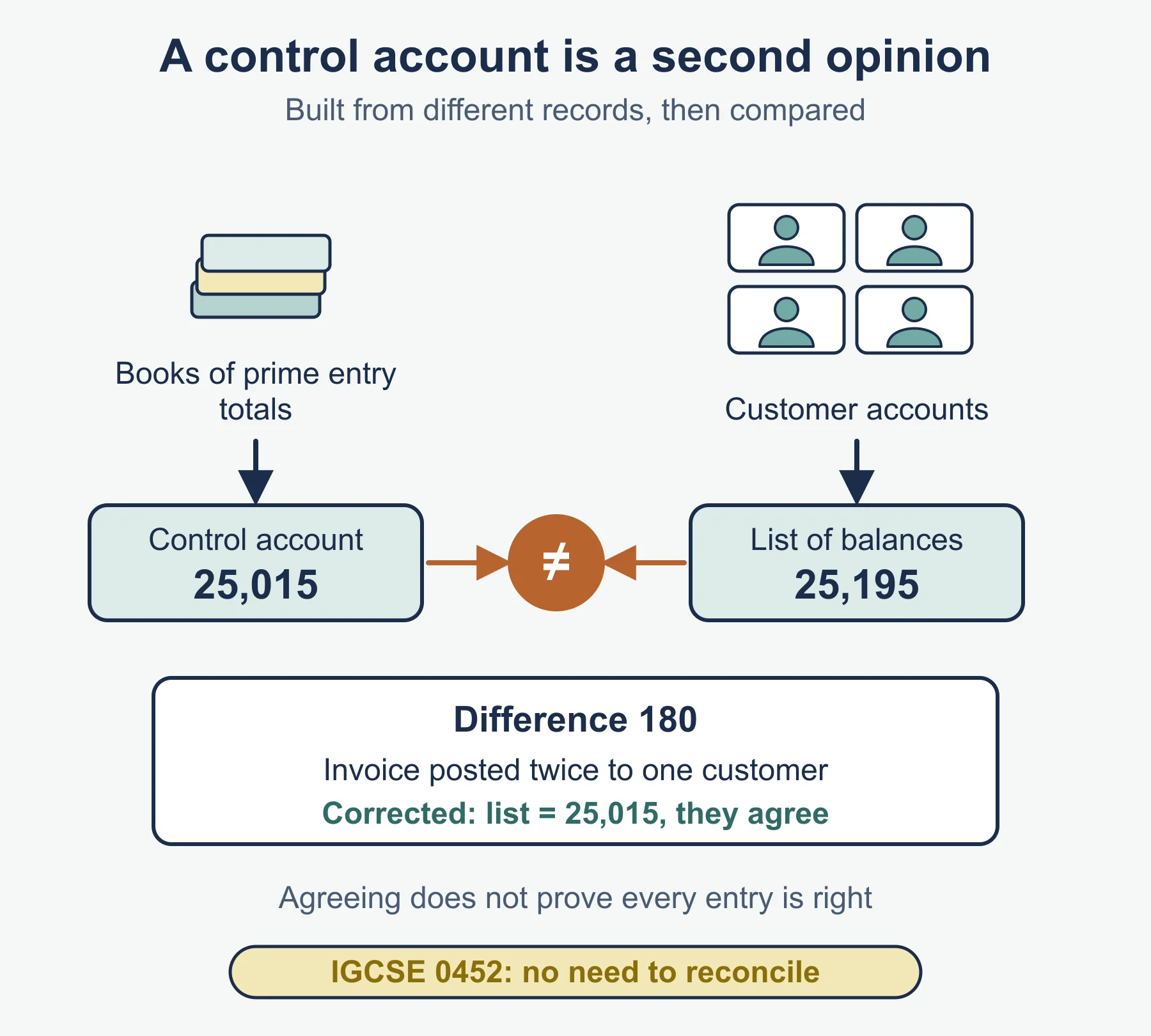
The sales ledger holds one account for each customer. The purchases ledger holds one account for each supplier. A control account is a single ledger account that summarises all of them, using totals from the books of prime entry instead of individual postings.
Its purposes:
- It gives the total trade receivables (sales ledger control) or total trade payables (purchases ledger control) at any date, without listing every customer or supplier.
- It acts as a check. A total built from the books of prime entry is a second, independent figure for the same balance, so a business that builds both can see whether its ledger postings look reasonable.
- It helps control. When one person keeps the control account and another keeps the individual accounts, it is harder for an error or a fraud to pass unnoticed.
- It supplies the figure for trade receivables or trade payables that goes into the statement of financial position.
- It is useful for finding a missing figure, such as credit sales, when the other totals are known.
Where each entry comes from
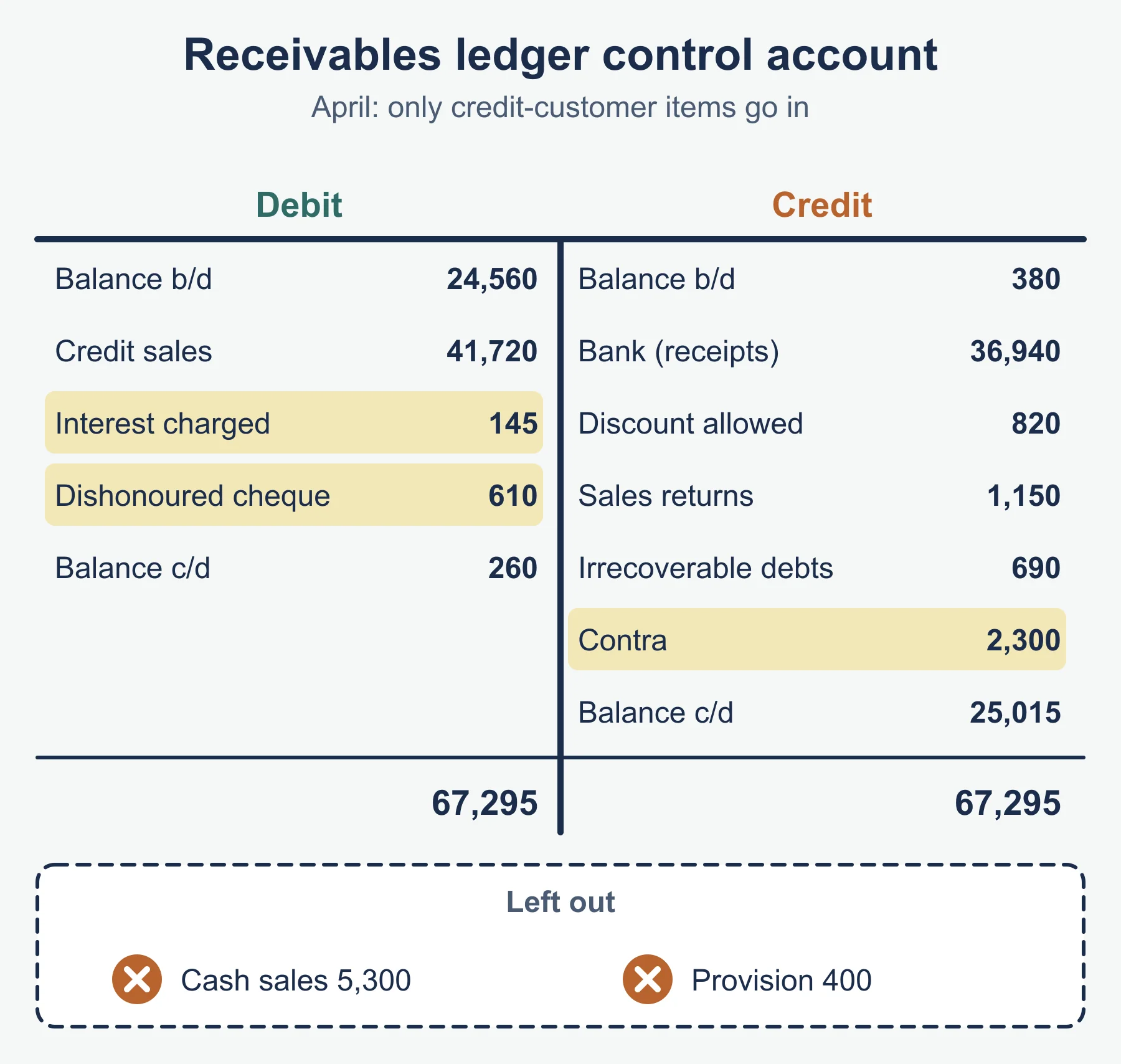
Control accounts are built from totals of the books of prime entry, not from the individual customer or supplier accounts.
| Item | Usual source | Sales ledger control | Purchases ledger control |
|---|---|---|---|
| Credit sales | Sales journal | Debit | |
| Credit purchases | Purchases journal | Credit | |
| Returns | Sales returns journal / purchases returns journal | Credit | Debit |
| Receipts from customers / payments to suppliers | Cash book (bank column) | Credit | Debit |
| Cash discounts | Cash book (discount columns) | Credit (discount allowed) | Debit (discount received) |
| Irrecoverable debts written off | General journal | Credit | |
| Dishonoured cheque | Cash book | Debit (customer’s cheque) | Credit (our cheque) |
| Interest on overdue accounts | General journal | Debit (charged to customer) | Credit (charged by supplier) |
| Contra entries | General journal | Credit | Debit |
| Refunds | Cash book | Debit (paid to customer) | Credit (received from supplier) |
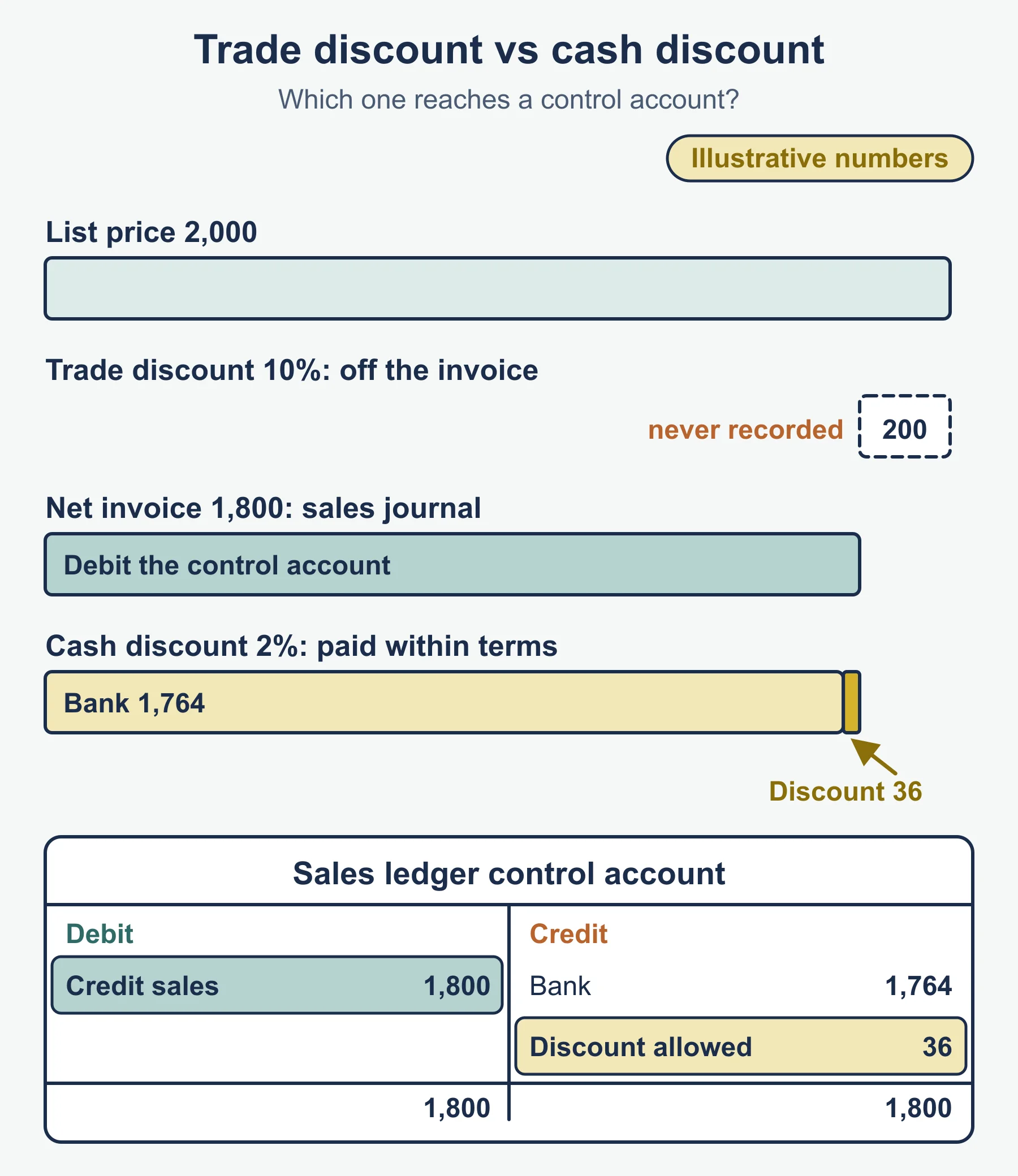
Cash discount is different from trade discount. Trade discount is deducted on the invoice, so it never appears in a control account; only the net invoice value is in the sales or purchases journal.
The two layouts
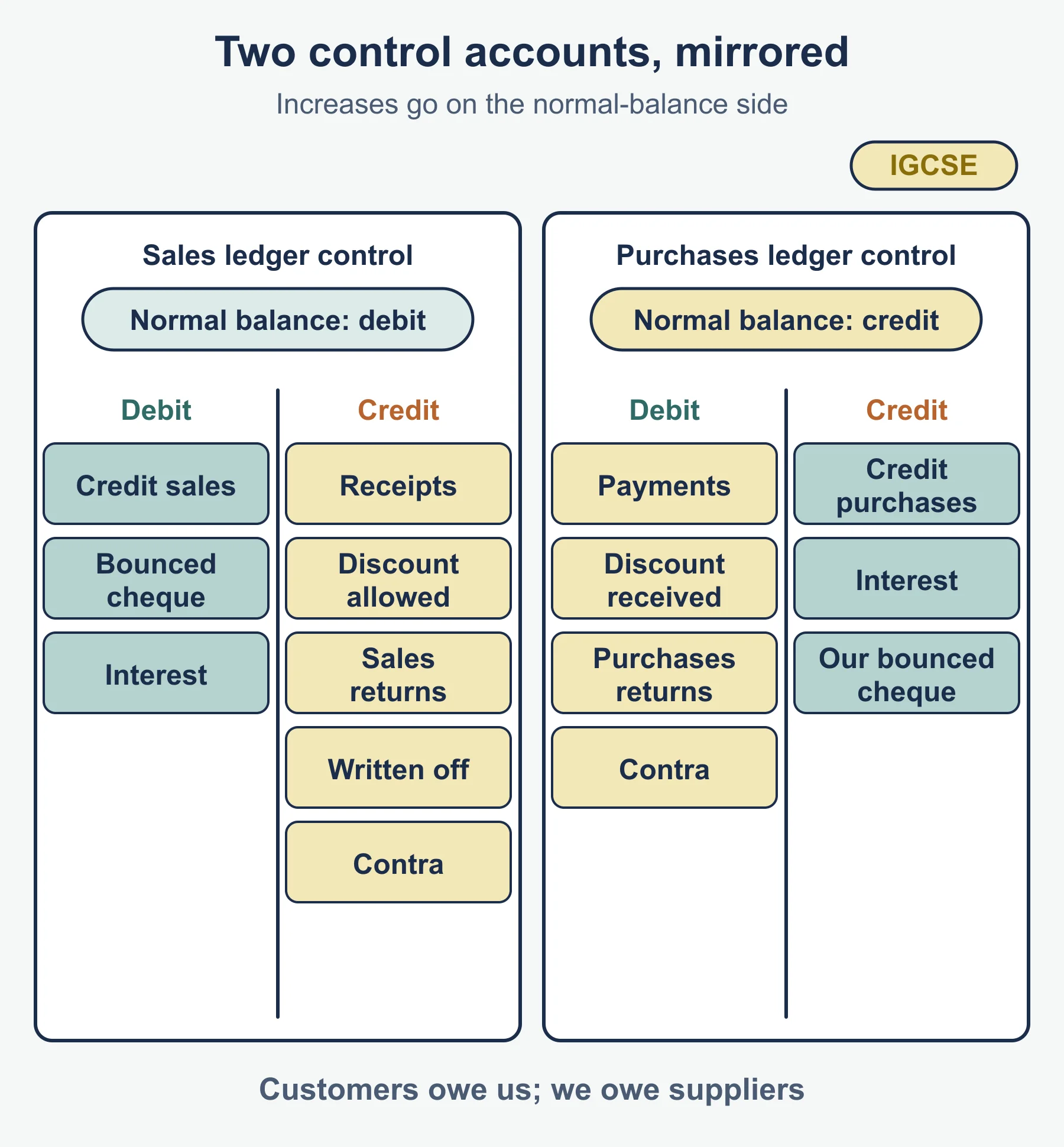
The rule. A customer normally owes you, so the sales ledger control account normally has a debit balance. A supplier is normally owed by you, so the purchases ledger control account normally has a credit balance. Increases go on the side of the normal balance. Decreases go on the other.
Debit and credit balances within each account. A few customers have credit balances, for example after an overpayment or a returned item that was already paid for. A few suppliers have debit balances, for example after you overpay. The syllabus lists “debit and credit within each account”, so show both kinds of balance.
- Sales ledger control: opening debit balances on the debit side, opening credit balances on the credit side. At the end, the closing credit balances are carried down on the debit side and the closing debit balances on the credit side, so the totals agree.
- Purchases ledger control: the same idea, with the sides reversed. Opening credit balances on the credit side, opening debit balances on the debit side.
Refunds. If a customer has a credit balance and you pay them back, you debit the sales ledger control account, which removes the credit balance. If a supplier has a debit balance and refunds you, you credit the purchases ledger control account.
Dishonoured cheques. A customer’s cheque that the bank will not pay means the customer still owes you, so you debit the sales ledger control account. If your own cheque to a supplier is dishonoured, you still owe the supplier, so you credit the purchases ledger control account.
Worked example 1: sales ledger control account
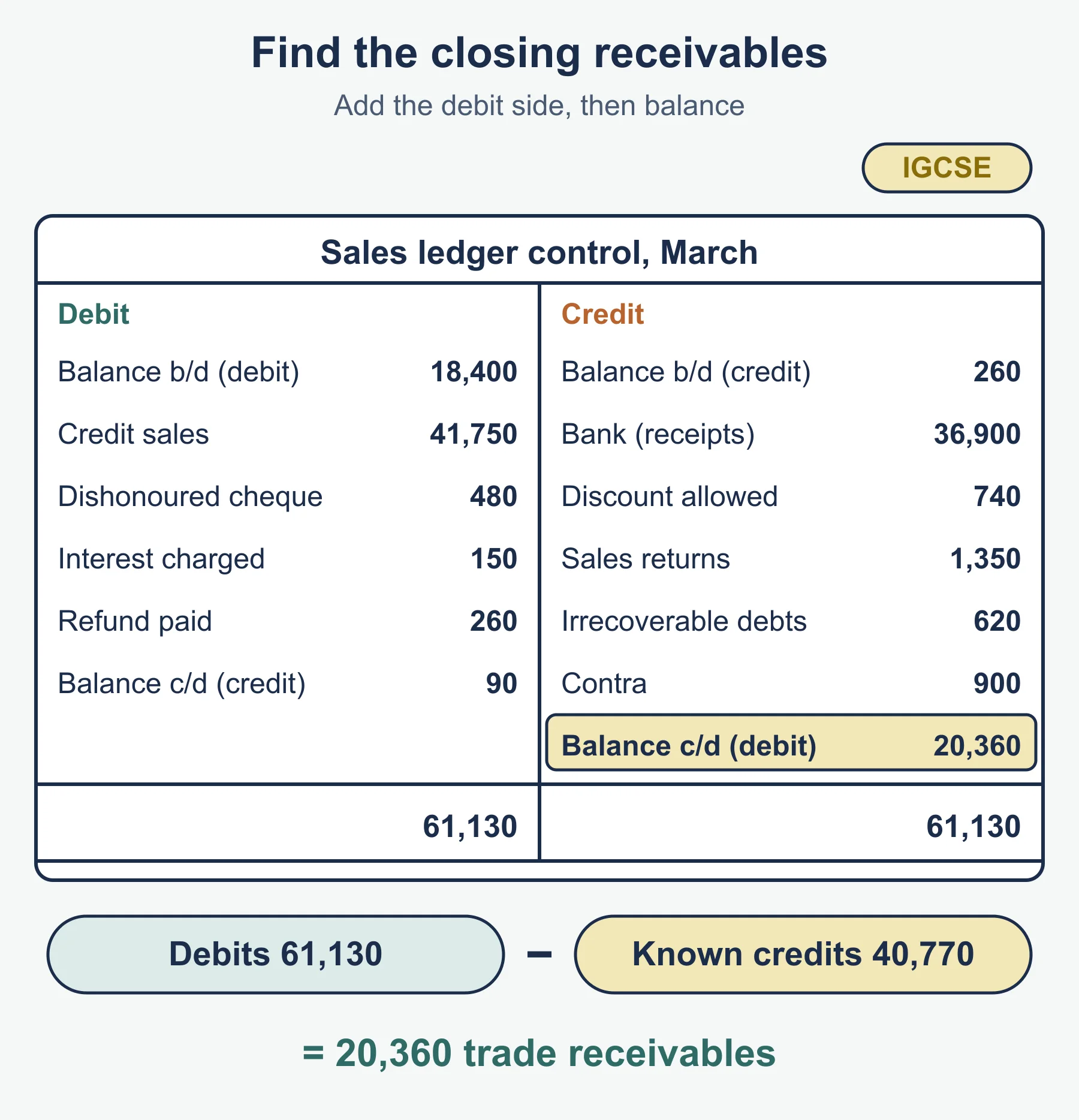
Brackenfell Paints sells on credit. For March the books of prime entry give these totals.
- Opening balances: customers owing 18,400 (debit) and customers in credit 260.
- Credit sales 41,750; sales returns 1,350.
- Cheques and bank transfers from customers 36,900; cash discounts allowed 740.
- Irrecoverable debts written off 620.
- A customer’s cheque for 480 was dishonoured.
- Interest of 150 was charged on overdue accounts.
- Contra with the purchases ledger 900.
- Refund of 260 paid to a customer whose account was in credit.
- Closing balances: customers in credit 90; the debit balances are not yet known.
| Sales ledger control account | |||
|---|---|---|---|
| Debit | Amount | Credit | Amount |
| Balance b/d (debit balances) | 18,400 | Balance b/d (credit balances) | 260 |
| Credit sales | 41,750 | Bank (receipts) | 36,900 |
| Bank (dishonoured cheque) | 480 | Discount allowed | 740 |
| Interest on overdue accounts | 150 | Sales returns | 1,350 |
| Bank (refund) | 260 | Irrecoverable debts | 620 |
| Balance c/d (credit balances) | 90 | Purchases ledger control (contra) | 900 |
| Balance c/d (debit balances) | 20,360 | ||
| 61,130 | 61,130 |
Method: add the debit side (61,130). Add the known credit items (40,770). The difference, 20,360, is the closing debit balance, which is the trade receivables figure. The balances brought down next period are debit 20,360 and credit 90.
Worked example 2: purchases ledger control account
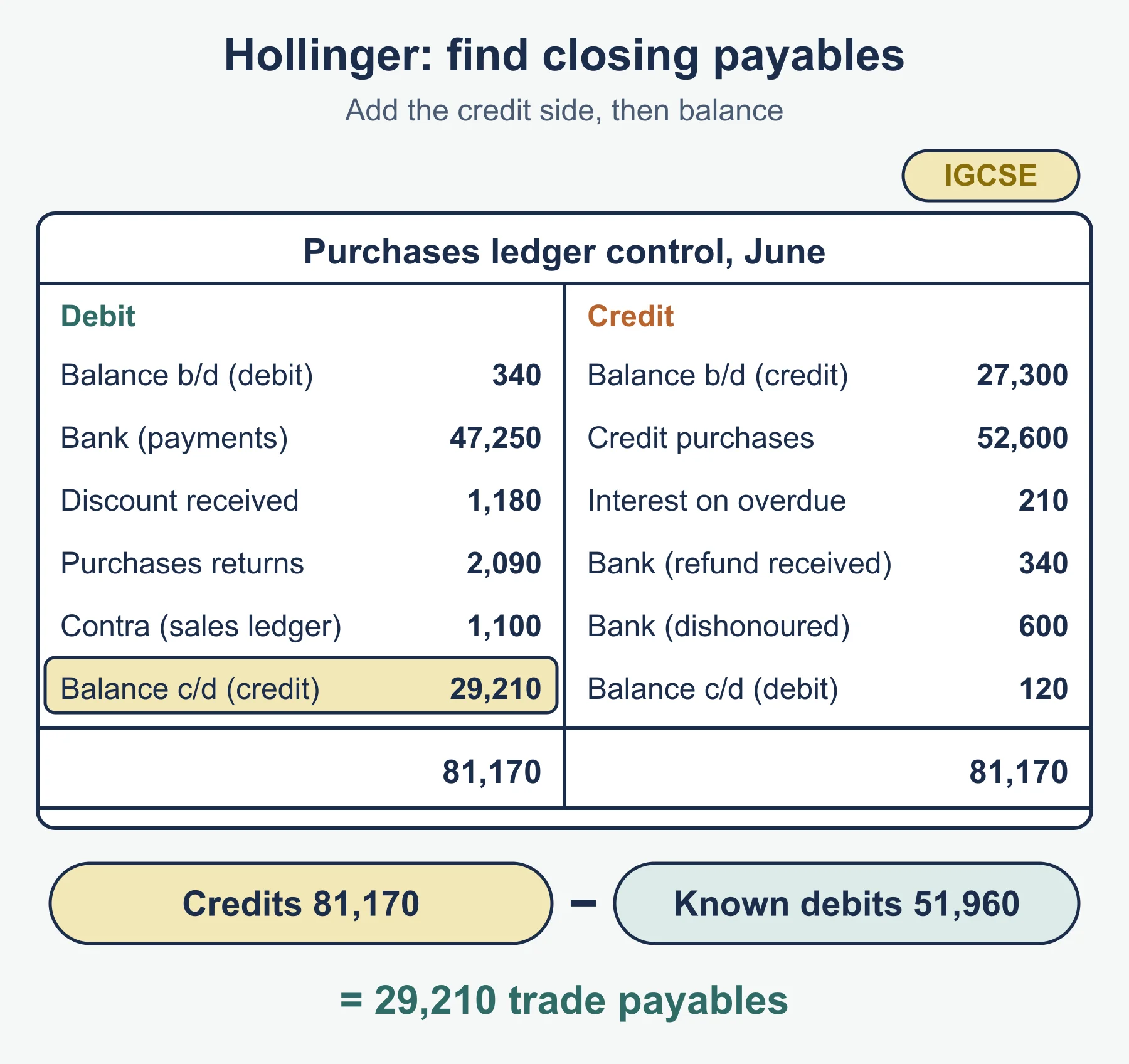
Hollinger Timber buys on credit. For June the totals are:
- Opening balances: suppliers owed 27,300 (credit) and suppliers who owe the business 340 (debit).
- Credit purchases 52,600; purchases returns 2,090.
- Payments to suppliers 47,250; cash discounts received 1,180.
- Contra with the sales ledger 1,100.
- Interest of 210 charged by suppliers on overdue accounts.
- A supplier refunded the 340 debit balance.
- The business’s cheque for 600 to a supplier was dishonoured.
- Closing debit balances 120; the credit balances are not yet known.
| Purchases ledger control account | |||
|---|---|---|---|
| Debit | Amount | Credit | Amount |
| Balance b/d (debit balances) | 340 | Balance b/d (credit balances) | 27,300 |
| Bank (payments) | 47,250 | Credit purchases | 52,600 |
| Discount received | 1,180 | Interest on overdue accounts | 210 |
| Purchases returns | 2,090 | Bank (refund received) | 340 |
| Sales ledger control (contra) | 1,100 | Bank (dishonoured cheque) | 600 |
| Balance c/d (credit balances) | 29,210 | Balance c/d (debit balances) | 120 |
| 81,170 | 81,170 |
Method: add the credit side (81,170), add the known debit items (51,960), and the balancing figure, 29,210, is the closing credit balance. That is the trade payables figure.
Worked example 3: finding a missing figure
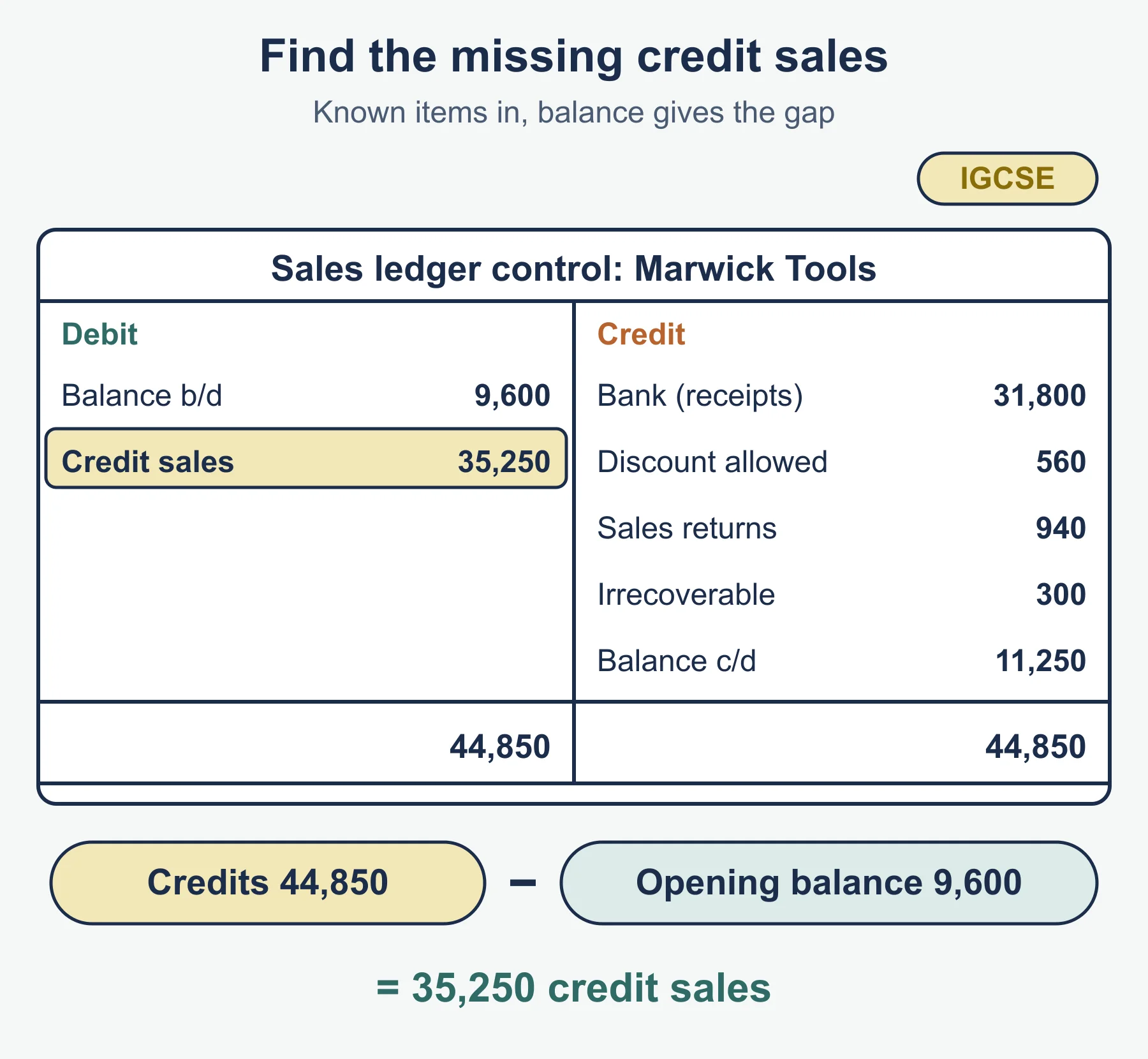
Marwick Tools has opening trade receivables of 9,600. During the month it received 31,800 from customers, allowed discounts of 560, accepted returns of 940 and wrote off 300 as irrecoverable. Closing trade receivables are 11,250. Find credit sales.
Credit sales go on the debit side, so they are the balancing figure.
- Credit side items: 31,800 + 560 + 940 + 300 + 11,250 = 44,850
- Debit side must equal 44,850. Opening balance is 9,600.
- Credit sales = 44,850 - 9,600 = 35,250
You can use the same method for any one missing item. Put in every known figure, total the side with more information, and find the difference.
Digital recording
Many businesses record transactions in accounting software. The syllabus asks about the effect on preparing and using control accounts.
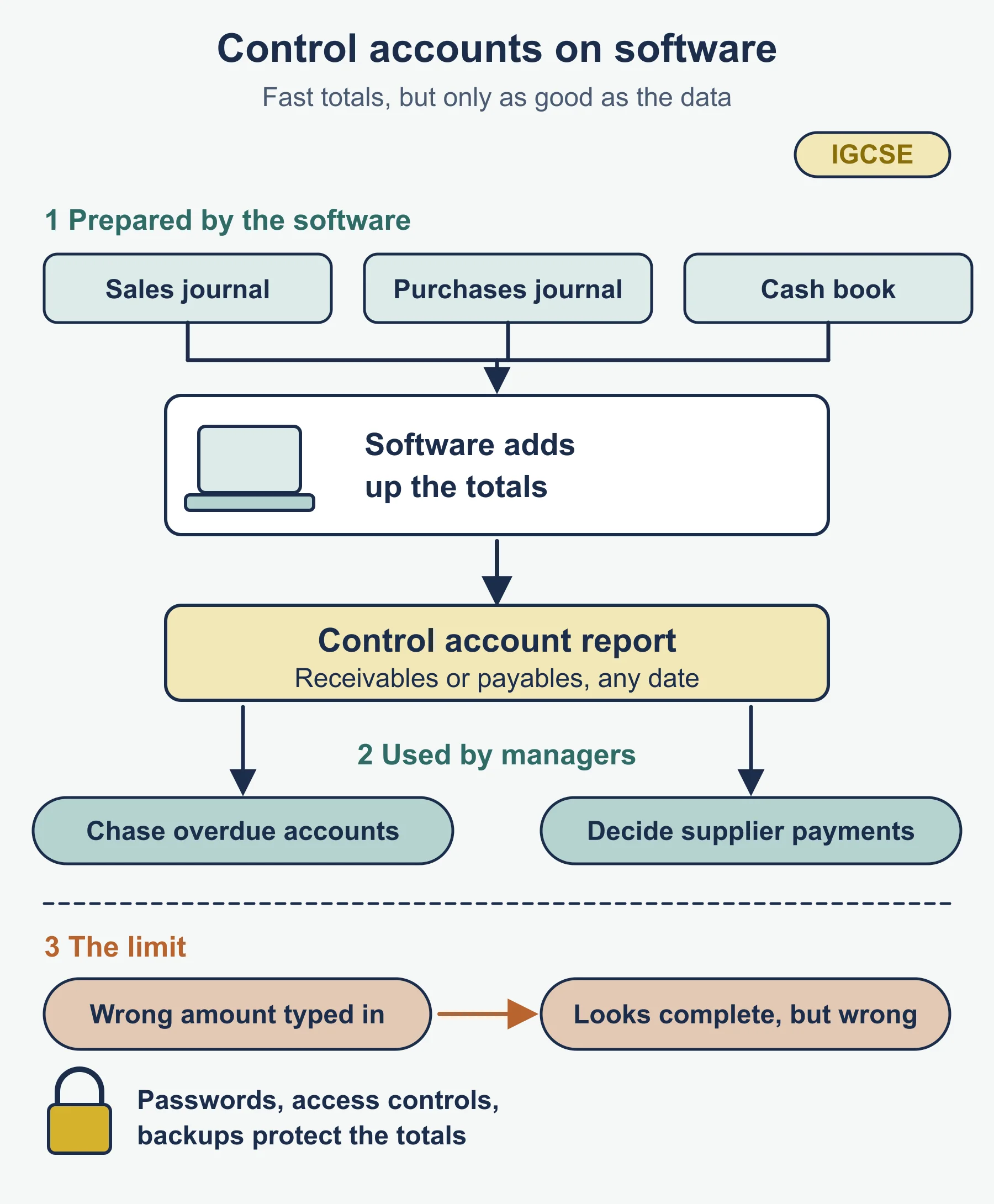
- Preparation. The software adds up the journals and ledger postings itself, so the control account can be produced automatically at any date. Totals are faster and arithmetic mistakes are rarer. You may see a control account as a system report rather than something you build by hand.
- Use. Up-to-date totals of trade receivables and trade payables are available whenever managers need them, for example before chasing overdue accounts or deciding on a supplier payment.
- Limits. The software cannot tell whether the data entered is right. A wrong amount, a wrong customer or a missed document still produces a control account that looks complete. Access controls, passwords and backups matter because anyone who can change the data can change the totals.
Common errors
- Putting the dishonoured cheque on the credit side. A customer’s dishonoured cheque is a debit in the sales ledger control account.
- Putting interest on overdue accounts on the wrong side for suppliers. Interest charged to you increases what you owe, so it is a credit in the purchases ledger control account.
- Forgetting that the contra appears in both control accounts, on opposite sides.
- Including trade discount as if it were a cash discount.
- Mixing up the sides when a closing credit balance in the sales ledger is carried down. It goes on the debit side.
- Using the cash sales figure from the cash book. Only credit sales belong in the account.
Frequently asked questions
What is a control account in Cambridge IGCSE Accounting 0452? A control account is a single ledger account that summarises all the individual customer or supplier accounts, using totals from the books of prime entry. The sales ledger control account gives total trade receivables and the purchases ledger control account gives total trade payables.
Do you need to reconcile control accounts with ledger balances in 0452? No. The syllabus note to section 3.4 says you do not need to reconcile control account balances with the sales ledger and purchases ledger balances. You do need to prepare the accounts and explain their purposes.
Why does the sales ledger control account normally have a debit balance? Customers normally owe the business money, so the sales ledger control account normally has a debit balance. Suppliers are normally owed money, so the purchases ledger control account normally has a credit balance.
Is trade discount entered in a control account? No. Trade discount is deducted on the invoice, so only the net invoice value appears in the sales or purchases journal and the control account. Cash discounts allowed and received are entered.
How does digital recording affect control accounts? Software adds up the journals and postings itself, so a control account can be produced automatically at any date with fewer arithmetic mistakes. It cannot tell whether the data entered is right, so input errors remain.
Official syllabus
Cambridge IGCSE Accounting 0452 syllabus for exams in 2027, 2028 and 2029 (version 1), published by Cambridge University Press & Assessment (Cambridge International Education): section 3.4 Control accounts.
Get free revision emails (optional)
Occasional emails with practice questions, worked explanations and links to free resources for the qualification and subjects you choose. No spam, and you can unsubscribe from any email. The free tools on this site never need an email.
Related resources
-
Revision notes
IGCSE Accounting: Analysis and Interpretation — Revision Notes
Quick recall for Cambridge IGCSE Accounting 0452 Topic 6: ten ratios, reading them, profit versus cash, comparing businesses, users and statement limits.
Accounting · Cambridge · IGCSE, O Level
Revise topic -
Practice questions
IGCSE Accounting: Control accounts (Cambridge 0452) – Practice Questions
Ten original practice questions with worked answers on sales ledger and purchases ledger control accounts for Cambridge IGCSE Accounting 0452.
Accounting · Cambridge · IGCSE, O Level
Try questions -
Revision notes
IGCSE Accounting: Control accounts (Cambridge 0452) – Revision Notes
Condensed recall notes on sales ledger and purchases ledger control accounts for Cambridge IGCSE Accounting 0452: entries, sides, sources, digital records.
Accounting · Cambridge · IGCSE, O Level
Revise topic
Related articles
-
teaching
A Level tuition in Dubai: Cambridge or Pearson Edexcel International A Level?
Schools in Dubai and Abu Dhabi teach either Cambridge International AS & A Level or Pearson Edexcel International A Level. How the two are structured, why it matters for tuition, and how online classes from Lahore work.
9 October 2026
-
curriculum guides
Choosing subjects at IGCSE and A Level
How subject choices at 14 and 16 affect university options later, and how to keep pathways open without overloading a timetable.
28 July 2026
Studying this with a teacher
Working through Accounting IGCSE, O LEVELS?
This page is free and stays free. If you would rather be taught it, Marlbridge runs Accounting classes one-to-one and in small groups of up to 15, online in your own time zone. The first trial class is free. WhatsApp replies within an hour (8am–11pm Pakistan time, every day); email the same day.
Cambridge Accounting teachers at Marlbridge

