
Revision Notes
IGCSE Accounting: Inter-business comparison, interested parties, limits (Cambridge 0452) – Revision Notes
Revision notes for Cambridge IGCSE Accounting 0452 sections 6.3 to 6.5: comparing businesses, who uses accounts and why statements have limits.
- Subject
- Accounting
- Level
- IGCSE, O LEVELS
- Topic
- Analysis and interpretation
- Author
- Marlbridge Academic Team
- Updated
- Reviewed by
- Javaid Iqbal Sabri (what this means)
Aligned to Cambridge IGCSE O Level Accounting (0452, 7707), 2027-2029. Official specification (IGCSE) ; Official specification (O Level) .
Syllabus page (what it covers and how it is assessed): Cambridge IGCSE Accounting; Cambridge O Level Accounting.
Syllabus points this page covers
0452
- 6.3 Inter-business comparison
- 6.4 Interested parties
- 6.5 Limitations of accounting statements
7707
- 6.3 Inter-business comparison
- 6.4 Interested parties
- 6.5 Limitations of accounting statements
Found an error? Report a correction.
Want a teacher for this? Marlbridge teaches Accounting online. Request a free trial class.
Syllabus edition note. This resource follows the Cambridge IGCSE Accounting 0452 syllabus (and Cambridge O Level Accounting 7707, which has the same subject content for the same series) for exams in 2027, 2028 and 2029 (version 1), first examined in the March 2027 series in India and the June 2027 series elsewhere. If you sit 0452 in November 2026, you sit the 2026 syllabus (version 2), which differs: Paper 1 has 35 multiple-choice marks in 1 hour 15 minutes, not 40 marks in 1 hour 30 minutes; Topic 7 is “Accounting principles and policies”, without 7.2 Ethical considerations or 7.3 Technology and sustainability; 4.4 is “Irrecoverable debts and provision for doubtful debts”; income statements are named instead of statements of profit or loss; three-column running balance accounts are not required; Clubs and societies is 5.4 and Manufacturing accounts 5.5; and 6.3 is “Inter-firm comparison”. For this topic, the 2026 syllabus lists eight ratios without inventory turnover in days (mark-up appears only in its ratio appendix), names ROCE’s numerator “net profit before interest”, lists interested parties as owners, managers, trade payables, banks, investors, club members and others such as governments and tax authorities, and gives the limitations of accounting statements as historic cost, difficulties of definition and non-financial aspects. If you sit in November 2026, work from the 2026 syllabus on the Cambridge International website.
Condensed recall for sections 6.3 Inter-business comparison, 6.4 Interested parties and 6.5 Limitations of accounting statements of Cambridge IGCSE Accounting 0452 (syllabus for exams in 2027, 2028 and 2029, version 1). For full explanations and worked cases, use the study guide; to test yourself use the practice questions. The ratios themselves are in the Analysis and Interpretation notes. Course hub: IGCSE Accounting; checklist; free diagnostics. There are no tiers: every candidate covers all of this.
6.3 Inter-business comparison
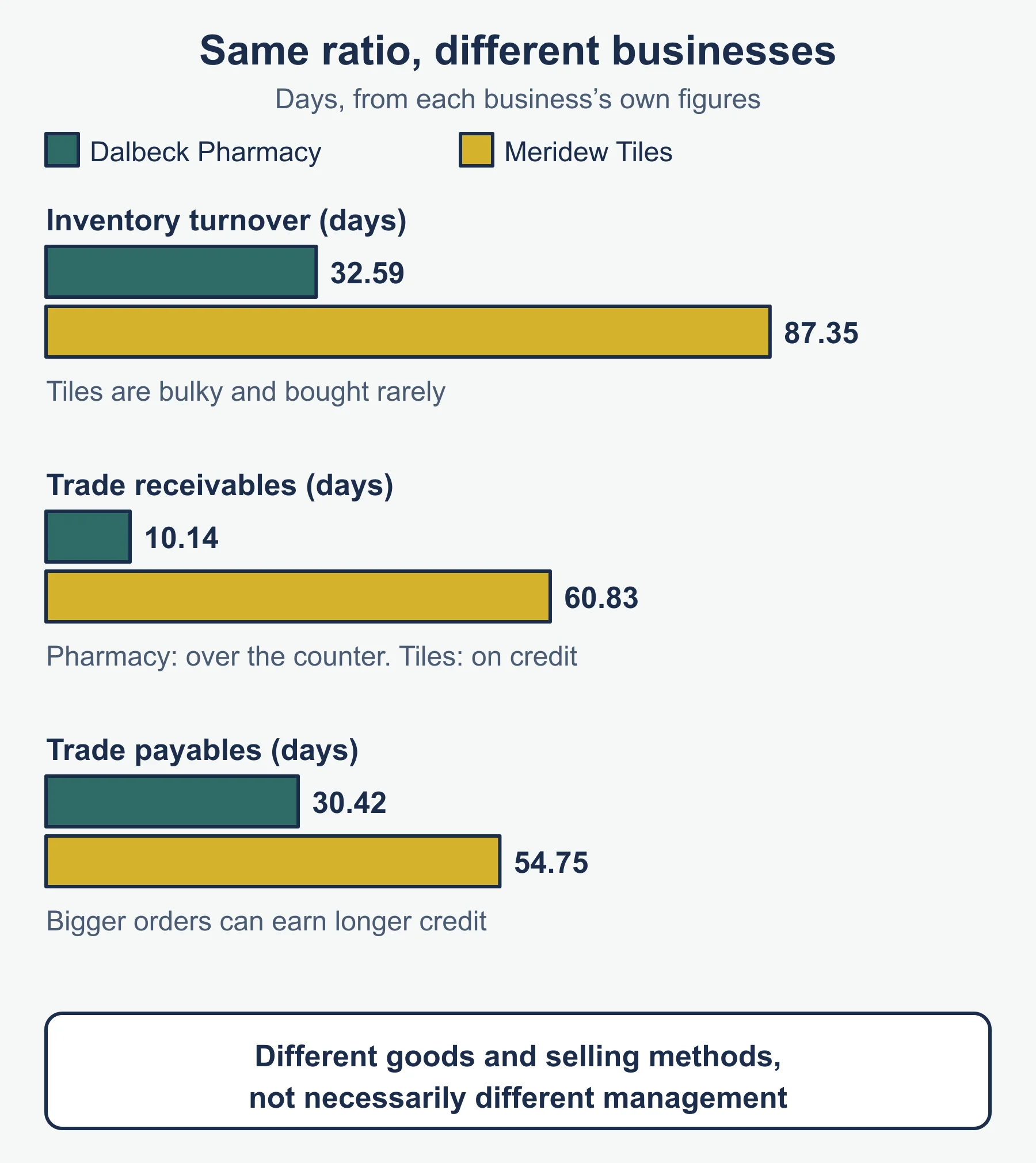
Which factor moves which ratio
| Factor | Ratio it is most likely to move | Typical direction |
|---|---|---|
| Fast-selling, low-price goods | inventory turnover | more times, fewer days |
| Mostly cash sales | trade receivables turnover (days) | very few days |
| Longer credit from suppliers | trade payables turnover (days) | more days |
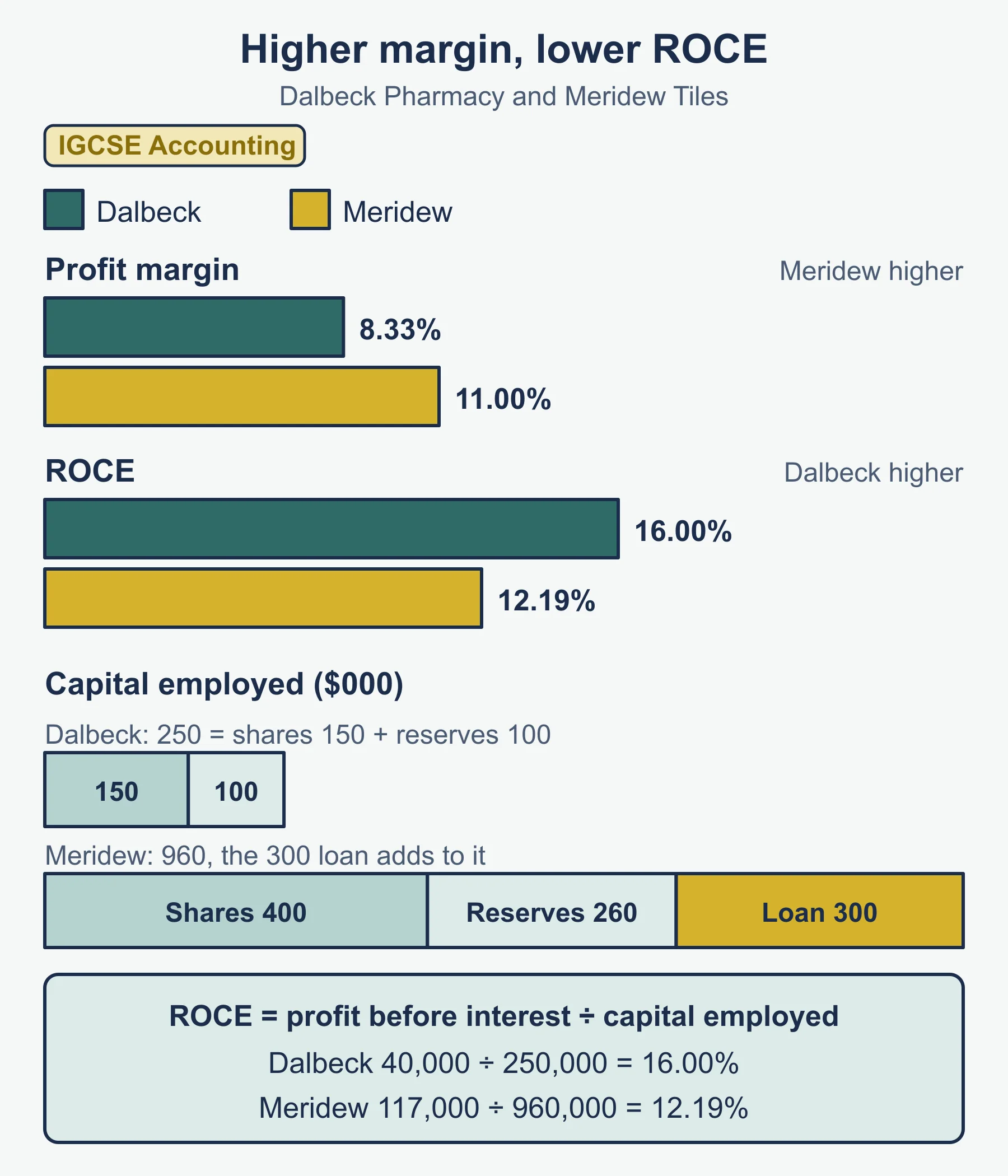
| Loans or debentures | ROCE | capital employed larger, ROCE lower |
| Premises owned, not rented | expenses and capital employed | rent falls, assets and depreciation rise |
| Bulk buying power | gross profit margin | higher |
| Low price, high volume policy | gross profit margin | lower |
| Different location | expenses and sales | rent, wages and customers differ |
| Different accounting policies | profit, assets, nearly every ratio | not caused by performance |
Problems of inter-business comparison
- Missing detail (credit figures, opening inventory).
- Policies that differ between the two.
- Year ends that fall on other dates.
- Businesses that are not really similar.
- A single unusual year.
- Non-financial aspects left out.
Method for a comparison answer
- Quote the ratio for each business.
- Say which looks stronger on that measure.
- Give a factor that could explain the gap that is not management.
- State one problem that limits the conclusion.
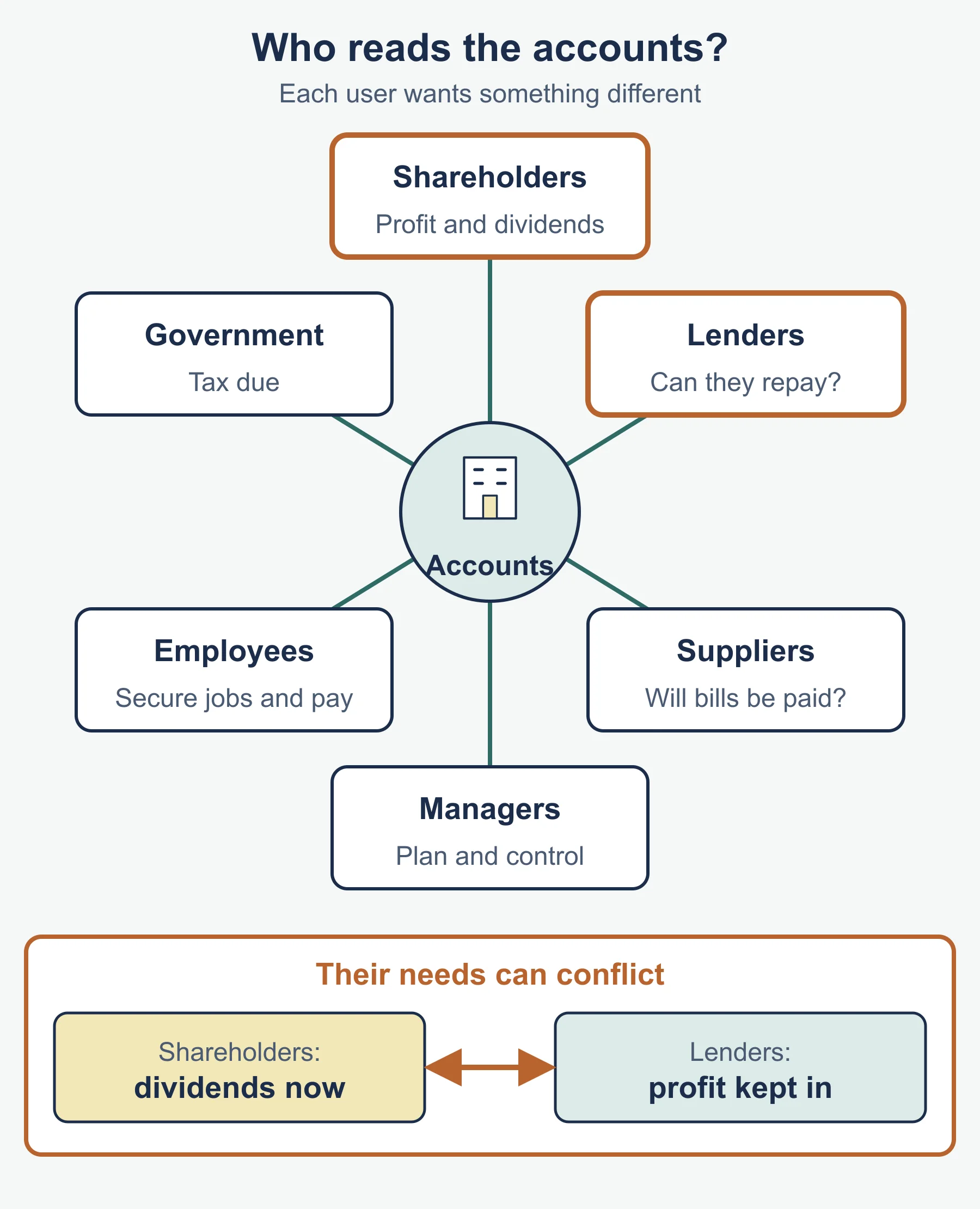
6.4 Interested parties
Cue cards
| Party | Question it asks | Figures it reaches for |
|---|---|---|
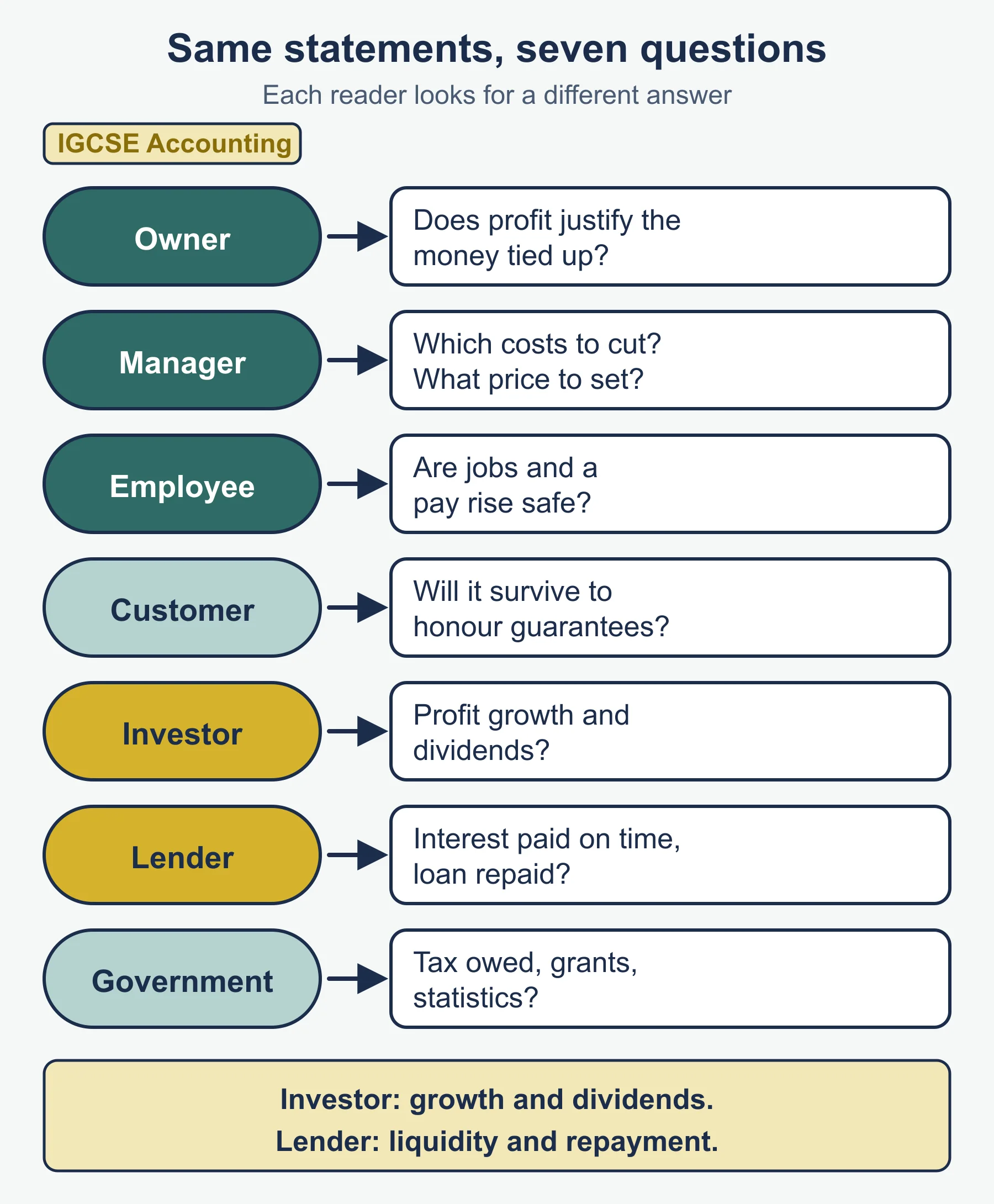
| Owners | Is my money earning enough? | profit for the year, ROCE |
| Managers | Where do I act? | margins, expenses, inventory and receivables days |
| Employees | Is my job safe, can I be paid more? | profit trend, liquidity |
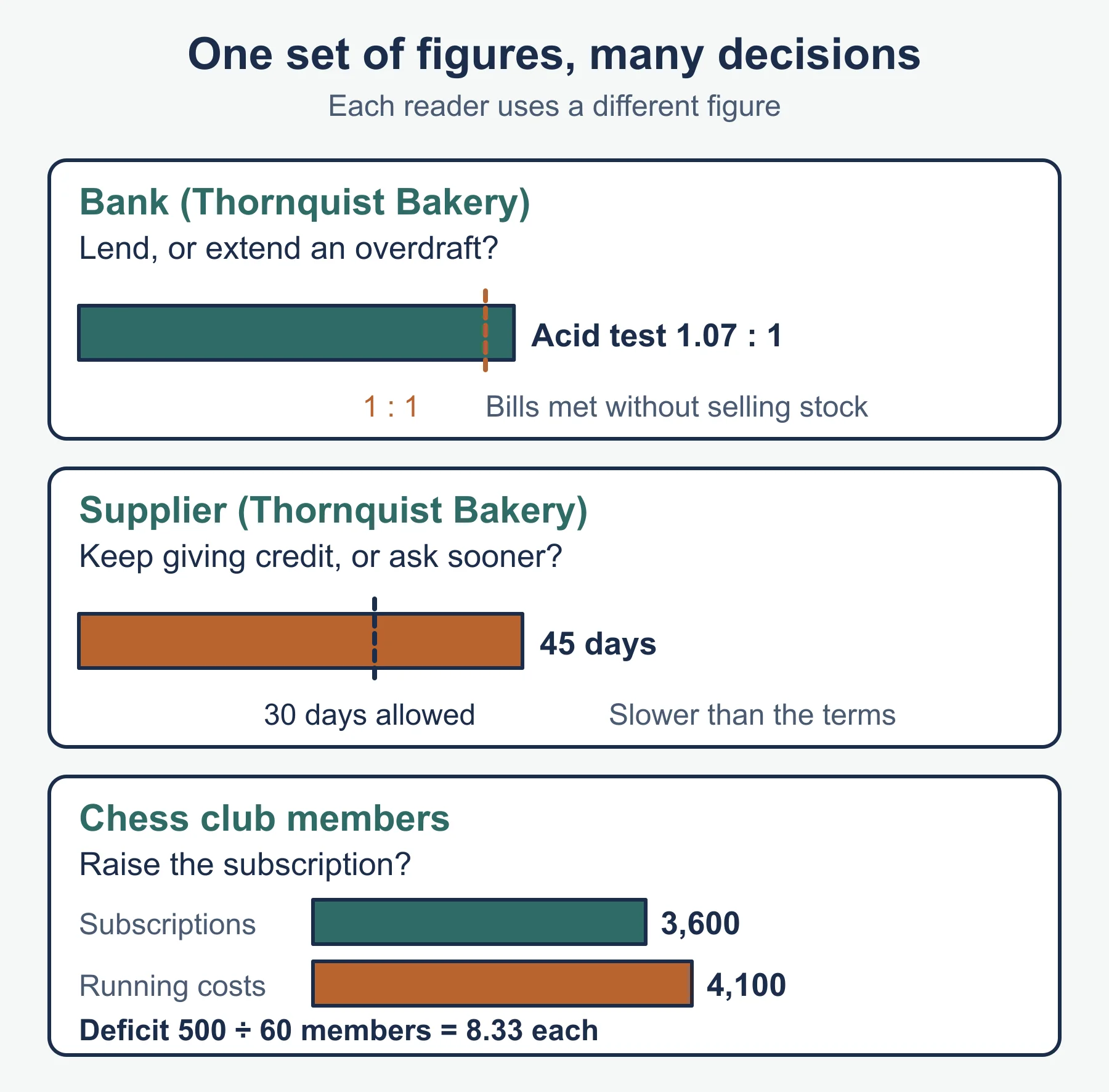
| Banks | Will the loan be repaid with interest? | current ratio, acid test, profit, assets |
| Investors | Will it grow, will it pay dividends? | profit trend, ROCE |
| Lenders | Will interest be paid and capital returned? | liquidity, existing loans |
| Suppliers | Will I be paid on time? | liquidity, payables days |
| Customers | Will it still be trading next year? | profit, liquidity |
| Governments / tax authorities | How much tax? Grants? Statistics? | profit for the year |
| Club members | Did subscriptions cover costs? | surplus or deficit |
| Public and environmental bodies | Effect on community and environment, jobs | overall performance |
Answer pattern: party, decision, figure. Investors take a share of risk, lenders ask to be repaid, so keep them apart.
6.5 Limitations of accounting statements
| Cause | What goes wrong | Short example |
|---|---|---|
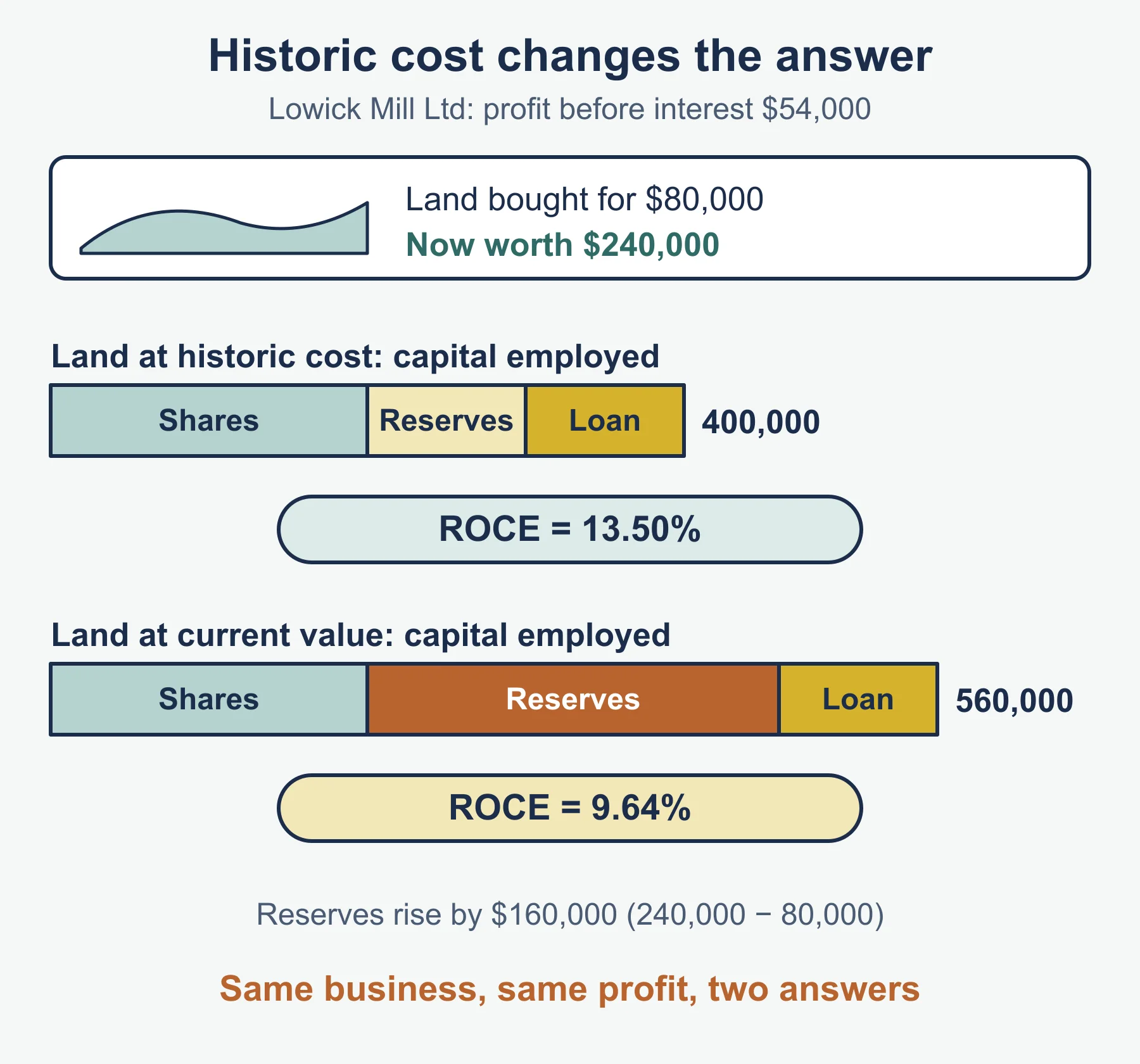
| Historic cost | Assets shown at purchase price, not current value; money of different years not comparable | Land bought long ago, now worth three times its cost |
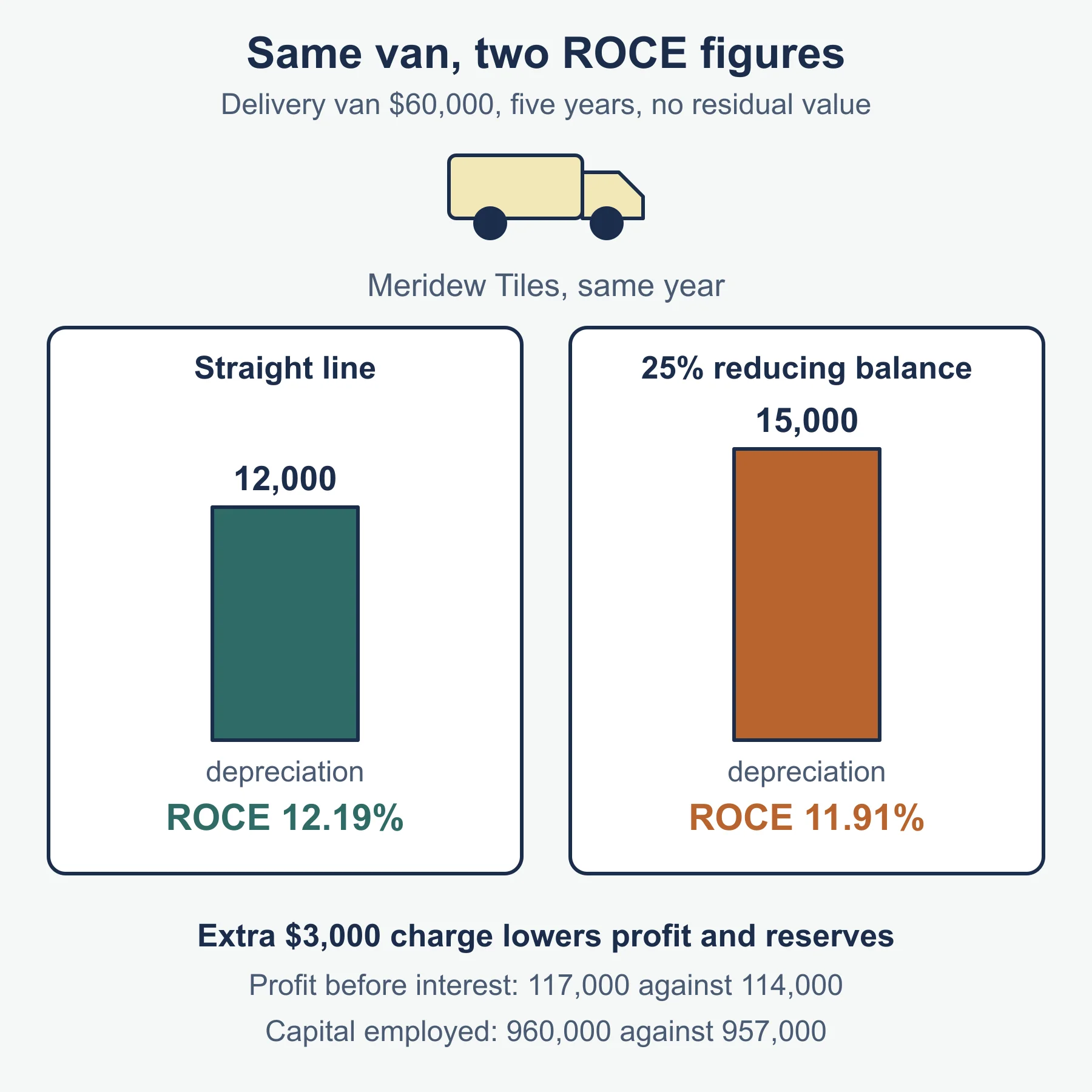
| Application of accounting policies | Estimates and choices change profit and asset values | Straight line versus reducing balance depreciation |
| Non-financial aspects | Things not measured in money do not appear | Workforce skill, business location, economic climate |
Effects of a policy choice, other things equal:
| Choice | Effect on profit | Effect on asset |
|---|---|---|
| Higher depreciation charge | lower | non-current asset lower |
| Closing inventory valued lower | lower | inventory lower |
| Larger allowance for irrecoverable debts | lower | net trade receivables lower |
Worked reminder: one policy, two margins
Fernside Cycles Limited has revenue of 200,000, opening inventory of 15,000 and purchases of 130,000 (figures in $). Its closing inventory is 20,000 at cost.
Cost of sales = 15,000 + 130,000 - 20,000 = 125,000
Gross profit  = 200,000 - 125,000          =  75,000
Gross profit margin = 75,000 / 200,000 x 100 = 37.50%
A rival values the same closing inventory at 17,000. Its cost of sales is 128,000, gross profit 72,000 and gross profit margin 36.00%. A gap of 1.50 percentage points appears from the valuation alone.
Must-know distinctions
- A problem of inter-business comparison (6.3) concerns setting two businesses side by side. A limitation of statements (6.5) concerns what a single set of statements can show. Several points belong to both, so label which one the question asks for.
- Historic cost is about what an asset is shown at. Depreciation is the spreading of that cost. Do not use one word for the other.
- Owners put money in and take the profit. Managers run the business and may not own it. Both read the statements, for different decisions.
- A non-financial aspect is real and can matter a great deal. It is missing from the statements because it is not measured in money.
Method in steps
For a 6.4 question:
- Name the party.
- State the decision it faces.
- Name the figure or ratio that helps.
- Say what the figure tells it.
For a 6.5 question:
- Name the cause (historic cost, policy or non-financial aspect).
- Give a specific example.
- Say how it makes the statements less reliable or less comparable.
Ratios used in these answers
Use only the syllabus’s formulas.
| Ratio | Formula |
|---|---|
| ROCE | (Profit for the year before interest ÷ capital employed) × 100 |
| Current ratio | Current assets ÷ current liabilities (as a ratio) |
| Acid test | (Current assets - inventory) ÷ current liabilities (as a ratio) |
| Trade receivables turnover | Trade receivables ÷ credit sales × 365 days |
| Trade payables turnover | Trade payables ÷ credit purchases × 365 days |
Capital employed = issued shares + reserves + non-current liabilities.
Quick self-test
All figures in $.
- Current assets are 27,000, including inventory of 9,000. Current liabilities are 12,000. Calculate the acid test ratio.
- Profit before interest is 24,000. Shares are 70,000, reserves 30,000 and non-current liabilities 20,000. Calculate ROCE.
- Trade receivables are 9,000 and credit sales 73,000. Calculate trade receivables turnover in days.
- Average inventory is 18,000 and cost of sales 219,000. Calculate inventory turnover in days.
- Name the three causes of limitation listed in the syllabus.
- State two problems of inter-business comparison.
- A machine costs 30,000 with no residual value. Business A depreciates it straight line over five years. Business B uses 30% reducing balance. State the first-year difference in profit.
- A club of 80 members made a deficit of 1,200. Calculate the deficit per member.
- State one difference between how investors and lenders use accounting information.
- Why might a business with excellent statements still fail?
Answers
- (27,000 - 9,000) ÷ 12,000 = 1.50 : 1.
- Capital employed = 120,000; 24,000 ÷ 120,000 × 100 = 20.00%.
- 9,000 ÷ 73,000 × 365 = 45.00 days.
- 18,000 ÷ 219,000 × 365 = 30.00 days.
- Historic cost; application of accounting policies; non-financial aspects.
- Any two: missing detail; different policies; different year ends; businesses not alike; unusual year; non-financial aspects ignored.
- A: 6,000. B: 9,000. Business B’s profit is 3,000 lower.
- 1,200 ÷ 80 = 15.00 per member.
- An investor looks for growth and dividends; a lender looks for interest paid and the loan repaid.
- Statements leave out items such as workforce skill, location and the economic climate, any of which can cause failure.
Where marks are usually lost
- Giving the reason for a gap without naming the ratio it affects.
- Treating inter-business comparison as a test of management only.
- Writing “different accounting policies” without a policy (depreciation method, inventory valuation, allowance for irrecoverable debts).
- Listing parties but not saying what each decides.
- Merging investors and lenders into one answer.
- Quoting a non-financial aspect as a number.
- Calling historic cost “wrong” instead of explaining that it shows past price, not current value.
- Stating a conclusion without one limit on the comparison.
Frequently asked questions
What are the three limitations of accounting statements in the 0452 syllabus? The syllabus names historic cost, the application of accounting policies and non-financial aspects. A question asking for the syllabus limitations expects all three.
How do club members use accounting information? Club members use the income and expenditure figures to decide whether to raise subscriptions, cut costs or run a fund-raising event, for example when running costs exceed subscription income.
Can different interested parties want opposite things? Yes. Owners may want to withdraw large amounts while lenders prefer cash to stay in the business. A good answer names the party, the decision and the figure used.
Why should a non-financial aspect not be given as a figure? A non-financial aspect, such as staff skill or location, is something the statements cannot show in money. Quoting it as a number misses the point of the limitation.
Official syllabus
Cambridge International Education, Cambridge IGCSE Accounting 0452 syllabus for 2027, 2028 and 2029 (version 1), sections 6.3 to 6.5.
Get free revision emails (optional)
Occasional emails with practice questions, worked explanations and links to free resources for the qualification and subjects you choose. No spam, and you can unsubscribe from any email. The free tools on this site never need an email.
Related resources
-
Revision notes
IGCSE Accounting: Analysis and Interpretation — Revision Notes
Quick recall for Cambridge IGCSE Accounting 0452 Topic 6: ten ratios, reading them, profit versus cash, comparing businesses, users and statement limits.
Accounting · Cambridge · IGCSE, O Level
Revise topic -
Study guides
IGCSE Accounting: Analysis and Interpretation (Cambridge 0452)
Cambridge IGCSE Accounting 0452 Topic 6 guide: the ten ratio formulas, two-year interpretation, inter-business comparison, users and limits of statements.
Accounting · Cambridge · IGCSE, O Level
Read guide -
Practice questions
IGCSE Accounting: Analysis and Interpretation — Practice Questions
Exam-style practice with worked answers on the ten ratios, profit versus cash, comparison, users and limitations for Cambridge IGCSE Accounting 0452 Topic 6.
Accounting · Cambridge · IGCSE, O Level
Try questions
Related articles
-
teaching
A Level tuition in Dubai: Cambridge or Pearson Edexcel International A Level?
Schools in Dubai and Abu Dhabi teach either Cambridge International AS & A Level or Pearson Edexcel International A Level. How the two are structured, why it matters for tuition, and how online classes from Lahore work.
9 October 2026
-
curriculum guides
Choosing subjects at IGCSE and A Level
How subject choices at 14 and 16 affect university options later, and how to keep pathways open without overloading a timetable.
28 July 2026
Studying this with a teacher
Working through Accounting IGCSE, O LEVELS?
This page is free and stays free. If you would rather be taught it, Marlbridge runs Accounting classes one-to-one and in small groups of up to 15, online in your own time zone. The first trial class is free. WhatsApp replies within an hour (8am–11pm Pakistan time, every day); email the same day.
Cambridge Accounting teachers at Marlbridge

