
Study Guides
IGCSE Accounting: Inter-business comparison, interested parties, limits (Cambridge 0452)
Study guide to Cambridge IGCSE Accounting 0452 sections 6.3 to 6.5: inter-business comparison, interested parties and limitations of statements.
- Subject
- Accounting
- Level
- IGCSE, O LEVELS
- Topic
- Analysis and interpretation
- Author
- Marlbridge Academic Team
- Updated
- Reviewed by
- Javaid Iqbal Sabri (what this means)
Aligned to Cambridge IGCSE O Level Accounting (0452, 7707), 2027-2029. Official specification (IGCSE) ; Official specification (O Level) .
Syllabus page (what it covers and how it is assessed): Cambridge IGCSE Accounting; Cambridge O Level Accounting.
Syllabus points this page covers
0452
- 6.3 Inter-business comparison
- 6.4 Interested parties
- 6.5 Limitations of accounting statements
7707
- 6.3 Inter-business comparison
- 6.4 Interested parties
- 6.5 Limitations of accounting statements
Found an error? Report a correction.
Want a teacher for this? Marlbridge teaches Accounting online. Request a free trial class.
Syllabus edition note. This resource follows the Cambridge IGCSE Accounting 0452 syllabus (and Cambridge O Level Accounting 7707, which has the same subject content for the same series) for exams in 2027, 2028 and 2029 (version 1), first examined in the March 2027 series in India and the June 2027 series elsewhere. If you sit 0452 in November 2026, you sit the 2026 syllabus (version 2), which differs: Paper 1 has 35 multiple-choice marks in 1 hour 15 minutes, not 40 marks in 1 hour 30 minutes; Topic 7 is “Accounting principles and policies”, without 7.2 Ethical considerations or 7.3 Technology and sustainability; 4.4 is “Irrecoverable debts and provision for doubtful debts”; income statements are named instead of statements of profit or loss; three-column running balance accounts are not required; Clubs and societies is 5.4 and Manufacturing accounts 5.5; and 6.3 is “Inter-firm comparison”. For this topic, the 2026 syllabus lists eight ratios without inventory turnover in days (mark-up appears only in its ratio appendix), names ROCE’s numerator “net profit before interest”, lists interested parties as owners, managers, trade payables, banks, investors, club members and others such as governments and tax authorities, and gives the limitations of accounting statements as historic cost, difficulties of definition and non-financial aspects. If you sit in November 2026, work from the 2026 syllabus on the Cambridge International website.
This guide covers sections 6.3 Inter-business comparison, 6.4 Interested parties and 6.5 Limitations of accounting statements of Cambridge IGCSE Accounting 0452, using the version 1 syllabus for the 2027, 2028 and 2029 exams. There are no tiers: all candidates take the same two papers. The syllabus says both papers are based on all the subject content, so questions on these sections can sit beside any other topic. Ratio calculations are taught in the existing ratio study guide; this guide uses those ratios and adds new cases. Other pages for this unit: revision notes and the practice questions. Course hub: IGCSE Accounting; printable checklist; free diagnostics.
What the syllabus asks for
| Section | You must understand |
|---|---|
| 6.3 | why two businesses’ ratios can differ, and what goes wrong when you compare them |
| 6.4 | the decisions that ten kinds of reader make from the figures: owners, managers, employees, banks, suppliers, customers, investors and lenders, club members, governments / tax authorities, and others such as public and environmental bodies |
| 6.5 | why statements fall short: historic cost, how accounting policies are applied, and non-financial aspects such as workforce skill, business location and the economic climate |
The syllabus also tells you to use only the ratio formulas printed in its accounting ratios list, and that AO3 (evaluation) carries 15% of Paper 2. These sections suit evaluation: you judge what the figures can and cannot show.
6.3 Inter-business comparison
A ratio on its own says little. Setting it beside the same ratio for a similar business gives a yardstick. The trouble is that two businesses can return different ratios for reasons that have nothing to do with management skill. The syllabus asks for two things: the factors behind the differences, and the problems of making the comparison at all.
A worked comparison
Dalbeck Pharmacy Limited and Meridew Tiles Limited are both trading companies. Their latest results are summarised below (figures in $).
                              Dalbeck Pharmacy   Meridew Tiles
Revenue                              480,000         900,000
Cost of sales                        336,000         585,000
Gross profit                         144,000         315,000
Profit for the year                   40,000          99,000
Interest paid                              0          18,000
Average inventory                     30,000         140,000
Credit sales                          36,000         780,000
Trade receivables                      1,000         130,000
Credit purchases                     300,000         600,000
Trade payables                        25,000          90,000
Capital employed                     250,000         960,000
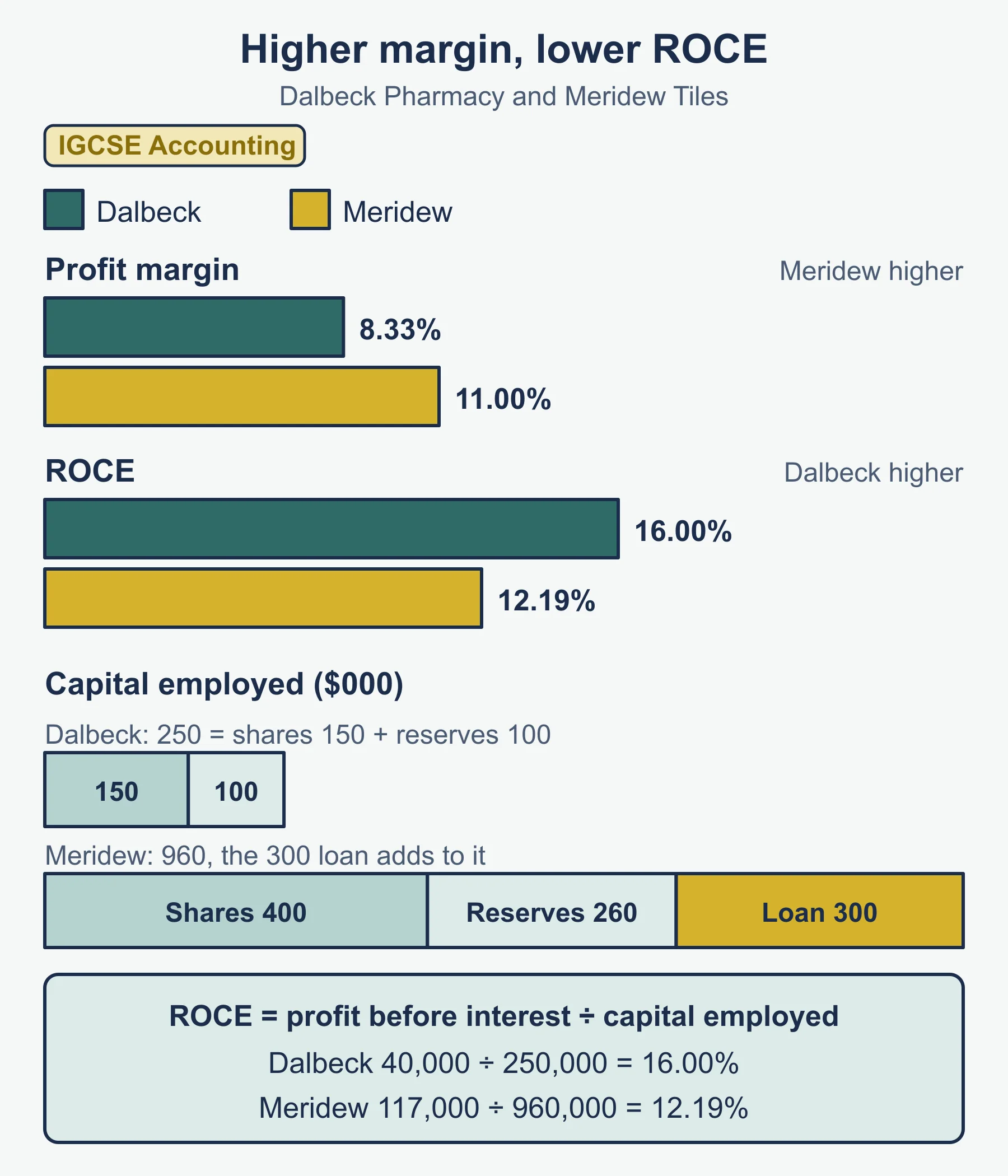
Capital employed is issued shares + reserves + non-current liabilities. Dalbeck has shares of 150,000 and reserves of 100,000 and no loans. Meridew has shares of 400,000, reserves of 260,000 and a loan of 300,000.
| Ratio | Dalbeck Pharmacy | Meridew Tiles |
|---|---|---|
| Gross profit margin | 30.00% | 35.00% |
| Profit margin | 8.33% | 11.00% |
| ROCE | 16.00% | 12.19% |
| Rate of inventory turnover | 11.20 times | 4.18 times |
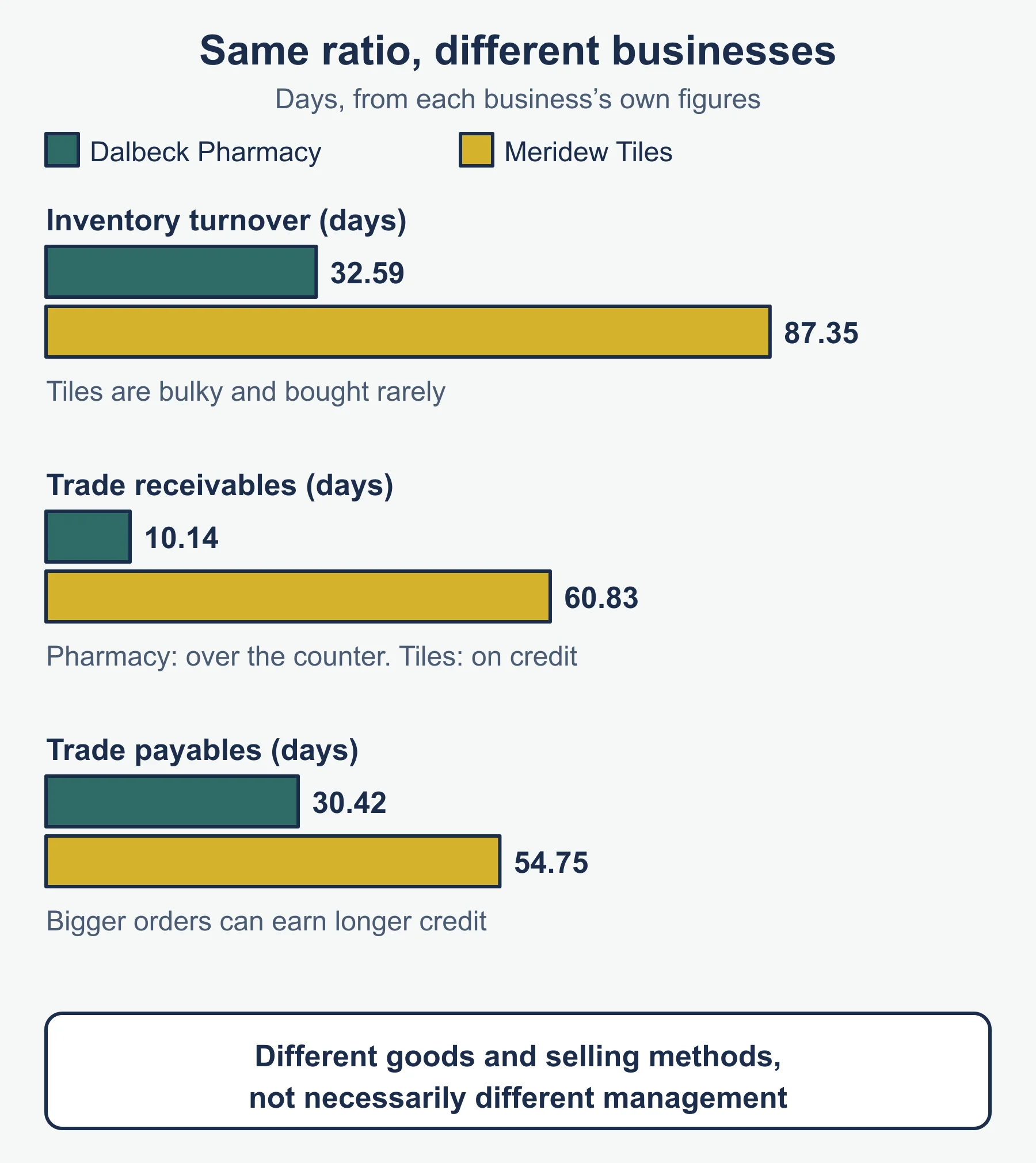
| Inventory turnover (days) | 32.59 days | 87.35 days |
| Trade receivables turnover (days) | 10.14 days | 60.83 days |
| Trade payables turnover (days) | 30.42 days | 54.75 days |
ROCE uses profit for the year before interest, so Meridew’s is (99,000 + 18,000) ÷ 960,000 × 100 = 12.19%.
Read the table and the differences are large. Linking each one to a factor is the skill the syllabus tests.
- Type of goods. Tiles are bulky and bought rarely, so inventory sits for about 87 days. Medicines are bought constantly, so inventory is replaced every 33 days or so.
- Cash or credit selling. Dalbeck takes most payments over the counter, so only 10.14 days of credit sales are outstanding. Meridew sells to builders on credit, so receivables take 60.83 days.
- Financing. Meridew’s loan raises its capital employed, which lowers ROCE even though its profit margin is higher.
- Pricing and margin. Meridew’s gross profit margin is higher (35.00% against 30.00%), which can reflect what each sells and the prices it charges.
- Size. Meridew’s larger purchases may earn a better price from suppliers and longer credit, which fits its 54.75 payables days.
None of this shows that either business is run better. That is why a conclusion should say what the ratios suggest and then name the differences that limit the comparison.
Accounting policies change the ratios
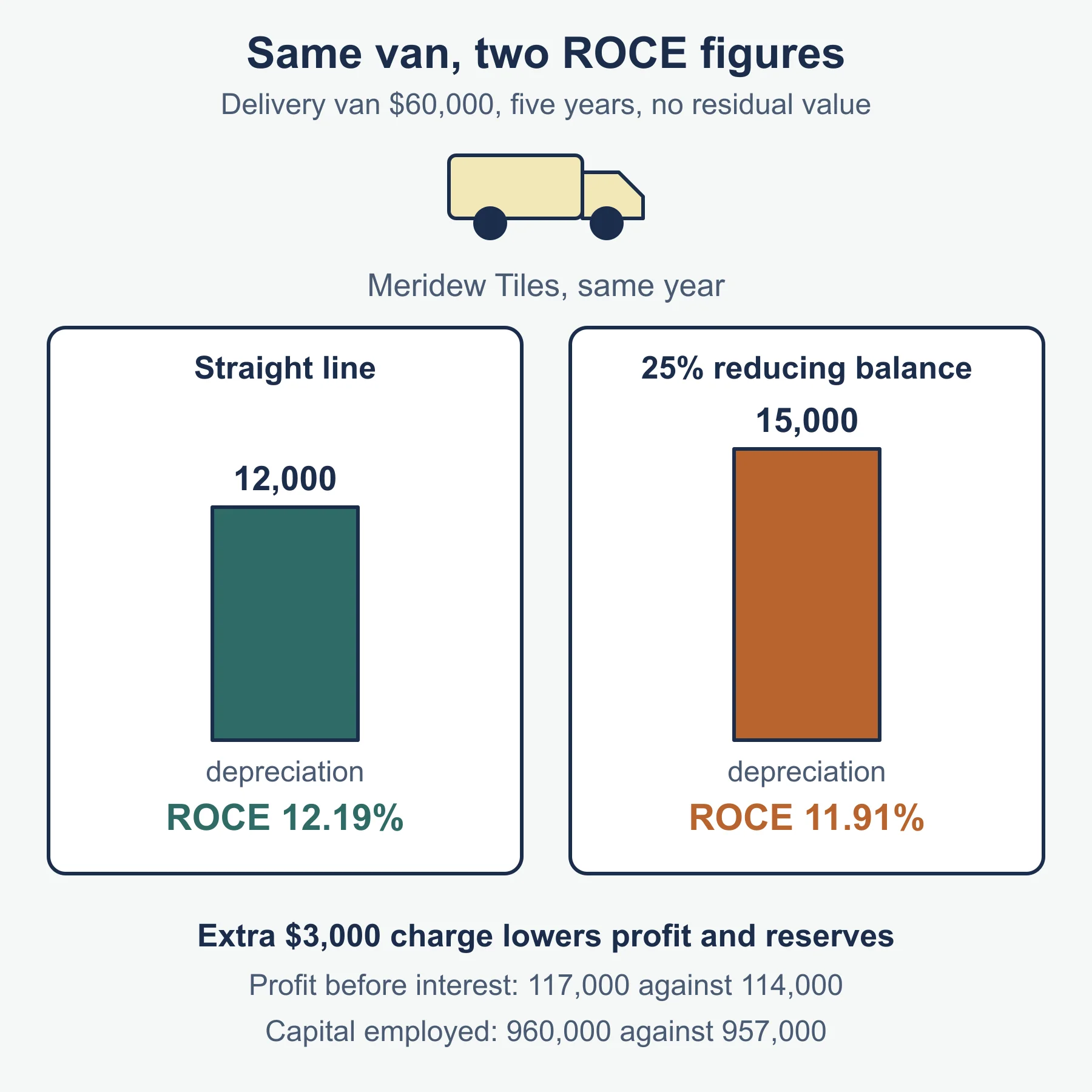
Suppose Meridew bought a delivery van for 60,000 at the start of the year. Straight line over five years with no residual value gives depreciation of 12,000. A 25% reducing balance gives 15,000, which is 3,000 more.
                          Straight line    Reducing balance
Depreciation                     12,000              15,000
Profit before interest          117,000             114,000
Capital employed                960,000             957,000
ROCE                             12.19%              11.91%
Capital employed falls by 3,000 because the extra charge reduces reserves. The same van and the same year give two ROCE figures. If Dalbeck chose differently from Meridew, any gap between them would partly be a policy gap. The size of the allowance for irrecoverable debts and the way inventory is valued work in the same way.
Problems of inter-business comparison
- Information may be missing. Another business may publish only summarised statements, with no credit sales, credit purchases or opening inventory, so some ratios cannot be calculated.
- Different year ends. A toy shop with a year end in January and one with a year end in July show very different inventory and receivables.
- Different policies, as above.
- The businesses may not be alike in size, activity, age of assets, premises owned or rented, or location.
- One year may be unusual for one of them.
- Non-financial aspects are ignored (see 6.5).
6.4 Interested parties
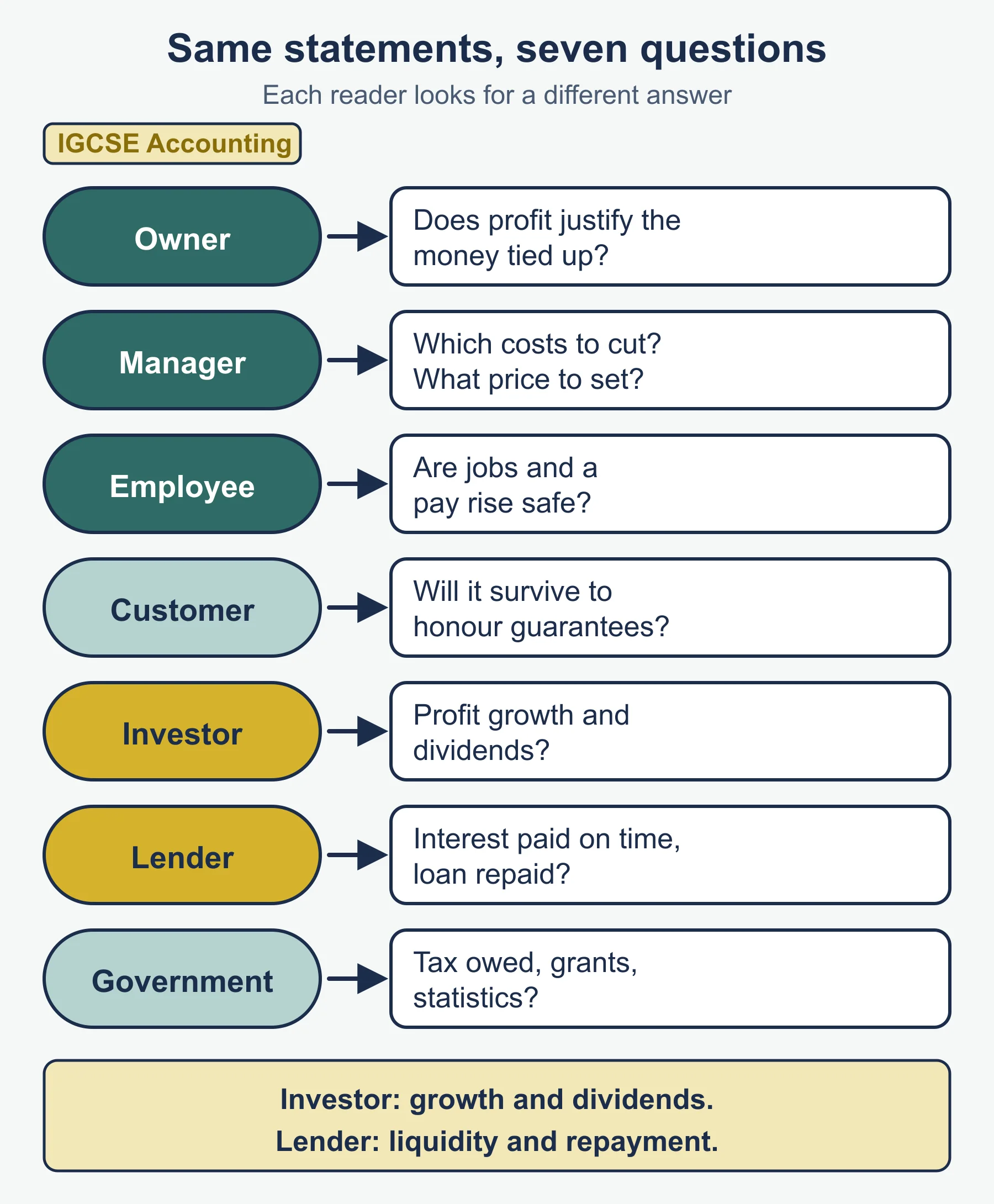
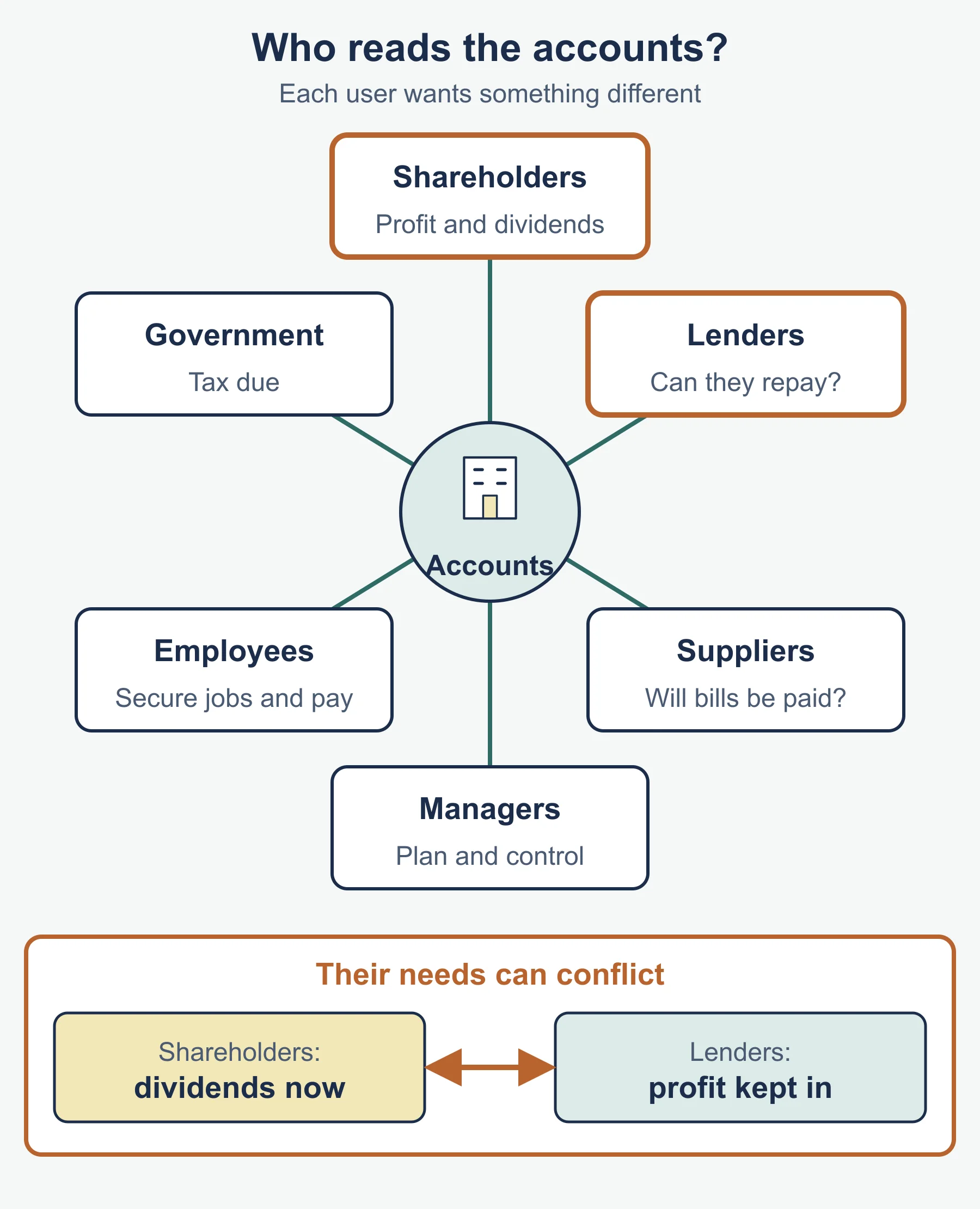
Every party reads the same statements but asks a different question, so the answer to a 6.4 question is the decision plus the figure that supports it.
One set of figures, many readers
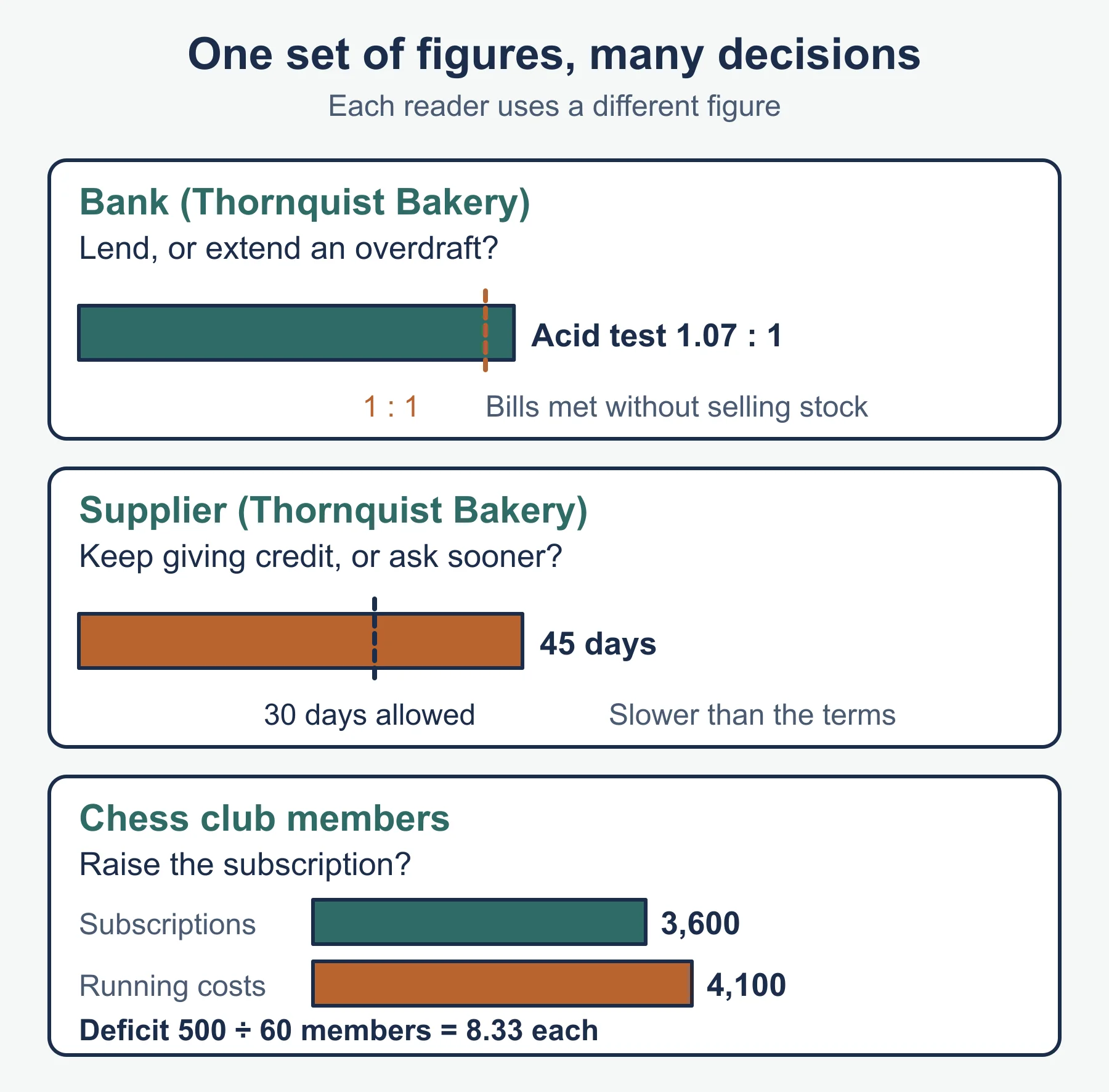
Thornquist Bakery is a sole trader. Its year-end figures (in $) are: current assets 41,000 including inventory 9,000; current liabilities 30,000; trade payables 18,000; credit purchases 146,000. Its suppliers allow 30 days’ credit.
- Current ratio = 41,000 ÷ 30,000 = 1.37 : 1.
- Acid test ratio = (41,000 − 9,000) ÷ 30,000 = 1.07 : 1.
- Trade payables turnover = 18,000 ÷ 146,000 × 365 = 45.00 days.
| Party | Figure it looks at here | Decision it supports |
|---|---|---|
| Bank | acid test 1.07 : 1 and profit | Whether to lend or extend an overdraft, since 1.07 : 1 suggests current liabilities can be met without selling inventory |
| Supplier | payables at 45.00 days against 30 allowed | Whether to keep offering credit or ask for payment sooner |
| Owner | profit for the year and capital | Whether the profit justifies the money tied up, and how much to withdraw |
| Manager | each expense against last year | Which costs to cut and what prices to set |
| Employees | profit and cash position | Whether jobs and a pay rise look safe |
| Tax authority | profit for the year | The tax to collect |
The remaining parties
- Investors and lenders. An investor buying shares wants profit growth and dividend prospects. A lender wants interest paid on time and repayment at the end, so the lender studies liquidity, assets and the existing non-current liabilities. State both, because a question on “investors and lenders” may reward the difference.
- Customers. They want to know that the business will survive to honour guarantees, supply spare parts and keep service going.
- Governments / tax authorities. Beyond tax, they use statements to decide on grants and to gather statistics on business activity.
- Club members. Ibsley Chess Club has 60 members paying 60 each, so subscriptions are 3,600. Its running costs for the year were 4,100. The deficit is 500, or 500 ÷ 60 = 8.33 per member. Members use this to decide whether to raise the subscription to about 68.33, cut costs or run a fund-raising event.
- Other interested parties, e.g. public and environmental bodies. A local council or environmental body may use the statements to judge whether the business can keep providing jobs and meet its obligations to the local community and environment.
Parties can want opposite things. Owners may want a high withdrawal while lenders prefer cash to stay in the business. A good answer names the party, the decision, and the figure used.
6.5 Limitations of accounting statements
The statements are a useful but incomplete picture. The syllabus names three causes.
Historic cost
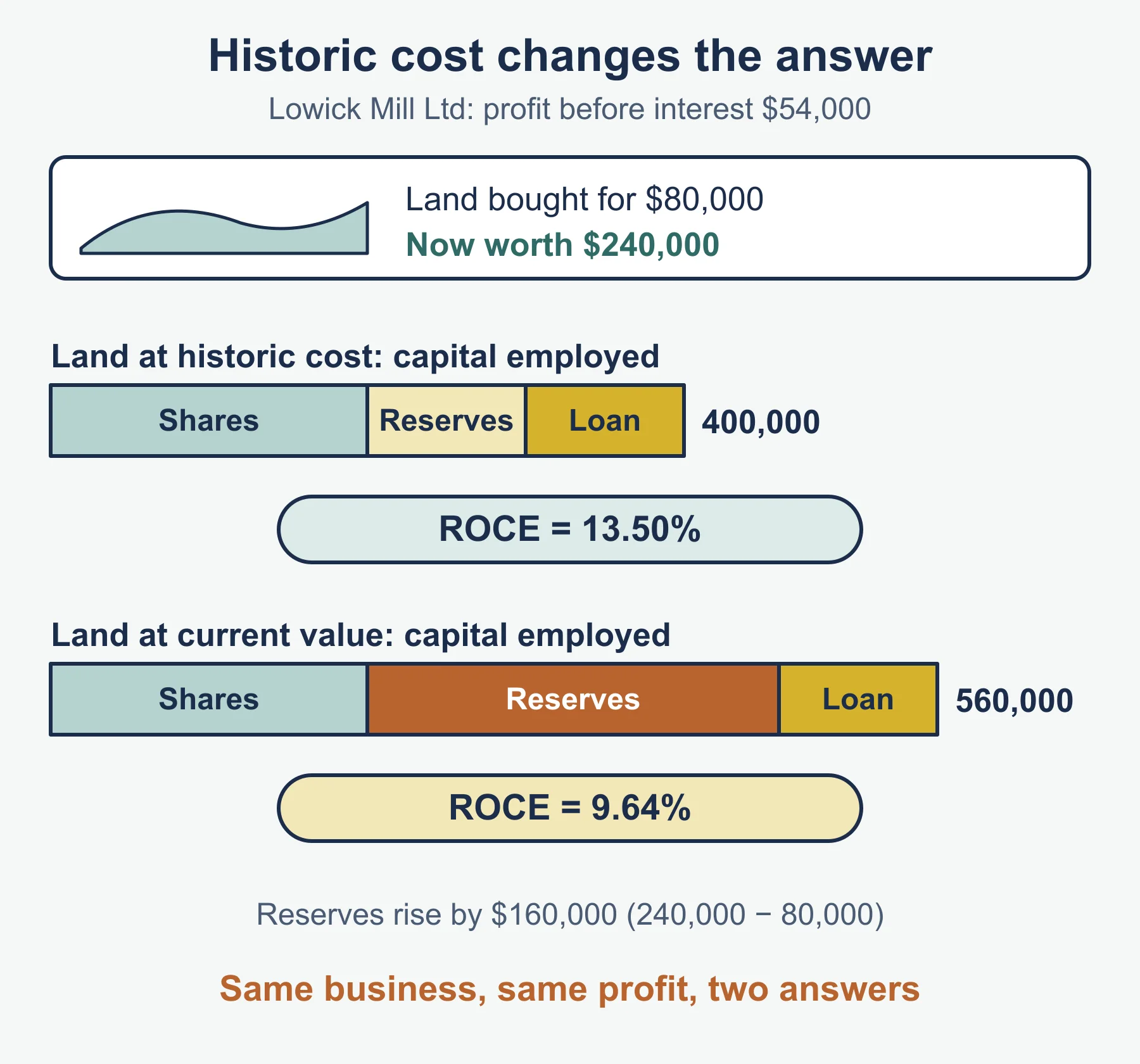
Assets are recorded at what they cost. Lowick Mill Limited has a profit before interest of 54,000 and capital employed of 400,000 (shares 200,000, reserves 100,000, loan 100,000). Its land cost 80,000 many years ago and is now worth 240,000.
- ROCE with the land at historic cost = 54,000 ÷ 400,000 × 100 = 13.50%.
- If the land were shown at 240,000, reserves would rise by 160,000, capital employed would be 560,000 and ROCE would be 54,000 ÷ 560,000 × 100 = 9.64%.
Same business, same profit, two answers. Historic cost also means figures from different years use money of different purchasing power, so a rise in revenue may partly be higher prices.
Application of accounting policies
The van example above shows it. Depreciation method, inventory valuation and the allowance for irrecoverable debts are choices and estimates. The statements are only as comparable as the policies behind them, and a change of policy breaks the link with earlier years.
Non-financial aspects
The statements record what can be measured in money. Three examples from the syllabus:
- Skill of the workforce. A well-trained team may improve quality and service, but its skill is not an asset in the statement.
- Location of the business. A site near passing trade can raise sales for years, and a road closure can ruin it. Neither appears.
- Economic climate. A recession lowers customers’ spending, and rising interest rates raise borrowing costs.
Common errors
- Writing “Meridew is better” from one ratio. Give the ratio, the reason it might differ, and a limit on the comparison.
- Listing parties without a decision. “Banks use the statements” earns no mark; “banks use the acid test to decide whether to lend” does.
- Treating “investors and lenders” as identical.
- Naming only two of the three 6.5 limitations when asked for the limitations in the syllabus.
- Giving a non-financial aspect as a figure. It must be something the statements cannot show.
Frequently asked questions
Why can two businesses have different ratios even if both are well managed? Ratios can differ because of the type of goods sold, whether sales are mainly for cash or credit, how each business is financed, pricing and size. For example, a business with a large loan has higher capital employed, which lowers its ROCE.
How do accounting policies affect inter-business comparison? Different choices of depreciation method, inventory valuation or allowance for irrecoverable debts give different profits and asset values from the same events. Any gap in ratios between two businesses may partly be a policy gap.
How do lenders and investors use accounting statements differently? An investor buying shares looks for profit growth and dividend prospects. A lender wants interest paid on time and repayment, so it studies liquidity, assets and existing non-current liabilities.
How does historic cost limit accounting statements in Cambridge IGCSE Accounting 0452? Assets are recorded at what they cost, so land bought long ago may be shown well below its current value, which can make ratios such as ROCE look higher. Figures from different years also use money of different purchasing power.
What non-financial aspects are not shown in accounting statements? The syllabus examples are the skill of the workforce, the location of the business and the economic climate. None can be measured in money, yet each can affect how well the business does.
Official syllabus
Cambridge International Education, Cambridge IGCSE Accounting 0452 syllabus for 2027, 2028 and 2029 (version 1), sections 6.3 to 6.5.
Get free revision emails (optional)
Occasional emails with practice questions, worked explanations and links to free resources for the qualification and subjects you choose. No spam, and you can unsubscribe from any email. The free tools on this site never need an email.
Related resources
-
Revision notes
IGCSE Accounting: Analysis and Interpretation — Revision Notes
Quick recall for Cambridge IGCSE Accounting 0452 Topic 6: ten ratios, reading them, profit versus cash, comparing businesses, users and statement limits.
Accounting · Cambridge · IGCSE, O Level
Revise topic -
Practice questions
IGCSE Accounting: Inter-business comparison, interested parties, limits (Cambridge 0452) – Practice Questions
Original practice questions with worked answers on Cambridge IGCSE Accounting 0452 inter-business comparison, interested parties and limitations.
Accounting · Cambridge · IGCSE, O Level
Try questions -
Revision notes
IGCSE Accounting: Inter-business comparison, interested parties, limits (Cambridge 0452) – Revision Notes
Revision notes for Cambridge IGCSE Accounting 0452 sections 6.3 to 6.5: comparing businesses, who uses accounts and why statements have limits.
Accounting · Cambridge · IGCSE, O Level
Revise topic
Related articles
-
teaching
A Level tuition in Dubai: Cambridge or Pearson Edexcel International A Level?
Schools in Dubai and Abu Dhabi teach either Cambridge International AS & A Level or Pearson Edexcel International A Level. How the two are structured, why it matters for tuition, and how online classes from Lahore work.
9 October 2026
-
curriculum guides
Choosing subjects at IGCSE and A Level
How subject choices at 14 and 16 affect university options later, and how to keep pathways open without overloading a timetable.
28 July 2026
Studying this with a teacher
Working through Accounting IGCSE, O LEVELS?
This page is free and stays free. If you would rather be taught it, Marlbridge runs Accounting classes one-to-one and in small groups of up to 15, online in your own time zone. The first trial class is free. WhatsApp replies within an hour (8am–11pm Pakistan time, every day); email the same day.
Cambridge Accounting teachers at Marlbridge

