
Study Guides
IGCSE Accounting: Manufacturing accounts (Cambridge 0452)
Study guide to manufacturing accounts for Cambridge IGCSE Accounting 0452: prime cost, factory overheads, work in progress and factory cost of production.
- Subject
- Accounting
- Level
- IGCSE, O LEVELS
- Topic
- Preparation of financial statements
- Author
- Marlbridge Academic Team
- Updated
- Reviewed by
- Javaid Iqbal Sabri (what this means)
Aligned to Cambridge IGCSE O Level Accounting (0452, 7707), 2027-2029. Official specification (IGCSE) ; Official specification (O Level) .
Syllabus page (what it covers and how it is assessed): Cambridge IGCSE Accounting; Cambridge O Level Accounting.
Syllabus points this page covers
0452
- 5.4 Manufacturing accounts
7707
- 5.4 Manufacturing accounts
Found an error? Report a correction.
Want a teacher for this? Marlbridge teaches Accounting online. Request a free trial class.
Syllabus edition note. This resource follows the Cambridge IGCSE Accounting 0452 syllabus (and Cambridge O Level Accounting 7707, which has the same subject content for the same series) for exams in 2027, 2028 and 2029 (version 1), first examined in the March 2027 series in India and the June 2027 series elsewhere. If you sit 0452 in November 2026, you sit the 2026 syllabus (version 2), which differs: Paper 1 has 35 multiple-choice marks in 1 hour 15 minutes, not 40 marks in 1 hour 30 minutes; Topic 7 is “Accounting principles and policies”, without 7.2 Ethical considerations or 7.3 Technology and sustainability; 4.4 is “Irrecoverable debts and provision for doubtful debts”; income statements are named instead of statements of profit or loss; three-column running balance accounts are not required; Clubs and societies is 5.4 and Manufacturing accounts 5.5; and 6.3 is “Inter-firm comparison”. For this topic, the 2026 syllabus covers only trading and service businesses in 5.1 and limits drawings adjustments to goods taken by the owner for own use; for limited companies it excludes cumulative and non-cumulative preference shares, rights issues, share premium and capital redemption reserve but requires the difference between redeemable and non-redeemable preference shares (the 2027-2029 syllabus lists none of these); and for incomplete records it does not ask why businesses keep them or what their advantages are. If you sit in November 2026, work from the 2026 syllabus on the Cambridge International website.
This guide covers section 5.4 Manufacturing accounts of the Cambridge IGCSE Accounting 0452 syllabus for exams in 2027, 2028 and 2029 (version 1). You learn how a business that makes its own goods finds the cost of what it made, and how that figure flows into the statement of profit or loss and the statement of financial position. The topic overview is in Preparation of financial statements, which shows a different worked example. Use this guide with the revision notes and the practice questions. Find your level on the Cambridge IGCSE Accounting hub, tick off topics on the checklist and test yourself with the free diagnostics.
What the syllabus asks for
| Syllabus point in 5.4 | Where it is taught here |
|---|---|
| Direct and indirect costs | Section 1 |
| Direct material, direct labour, prime cost and factory overheads | Section 2 |
| Adjustments for work in progress | Section 3 |
| Factory cost of production | Section 3 |
| Preparing manufacturing accounts, statements of profit or loss and statements of financial position | Sections 4 and 5 |
| Adjustments to financial statements as detailed in 5.1 | Section 6 and the worked example |
1. Direct and indirect costs
A direct cost can be traced to the goods being made. An indirect cost is needed to run the factory but cannot be traced to one unit of output. Costs of the office and of selling are not factory costs at all.
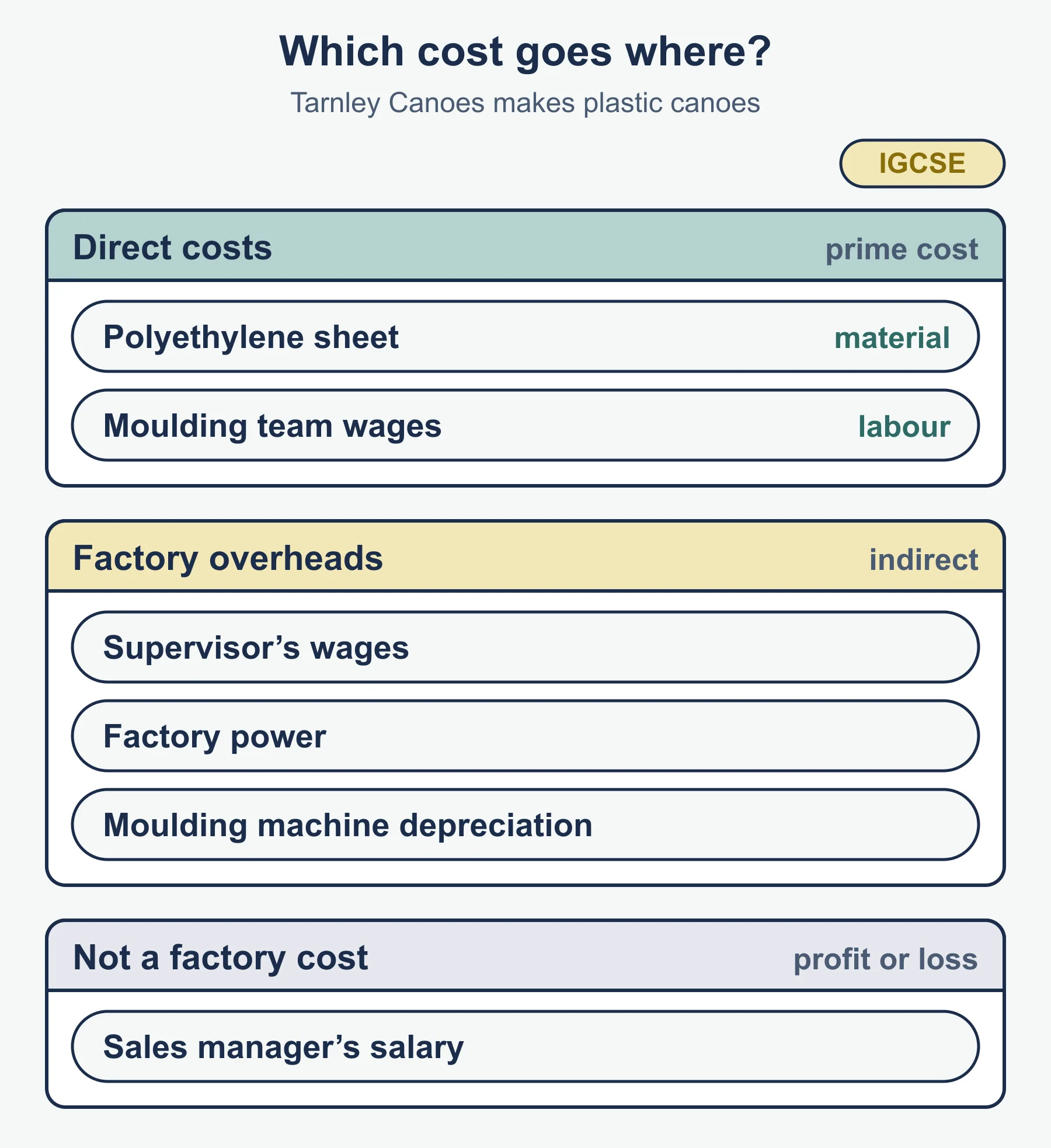
Tarnley Canoes makes plastic canoes. Here is how its costs are classified.
| Cost | Class | Why |
|---|---|---|
| Polyethylene sheet | Direct (material) | Becomes part of every canoe |
| Wages of the moulding team | Direct (labour) | Paid to the people who make the canoes |
| Wages of the factory supervisor | Indirect (factory overhead) | Helps all production, traced to no single canoe |
| Factory power | Indirect (factory overhead) | Runs the machines for all output |
| Depreciation of moulding machine | Indirect (factory overhead) | A cost of owning the factory equipment |
| Salary of the sales manager | Not a factory cost | Goes in the statement of profit or loss |
2. Direct material, direct labour, prime cost and factory overheads
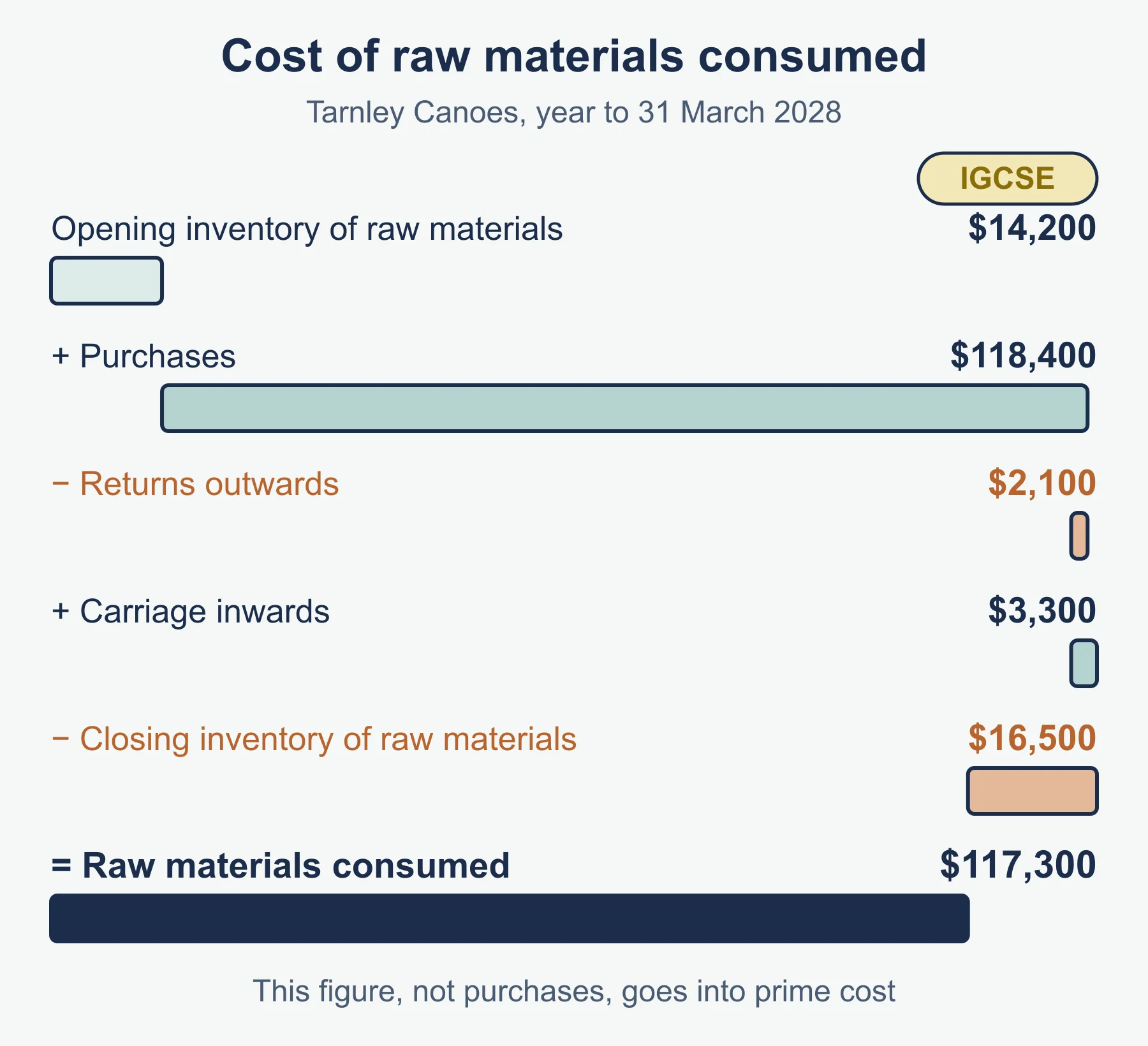
Direct material is shown as the cost of raw materials consumed, not as purchases, because some materials are in inventory at each end of the year.
Cost of raw materials consumed = opening inventory of raw materials + purchases + carriage inwards - returns outwards - closing inventory of raw materials
Direct labour is the wages of the production workers.
Prime cost = direct material + direct labour
Factory overheads are all the indirect factory costs: indirect wages, factory rent, power, insurance and depreciation of factory machinery. Add them to prime cost.
3. Work in progress and factory cost of production
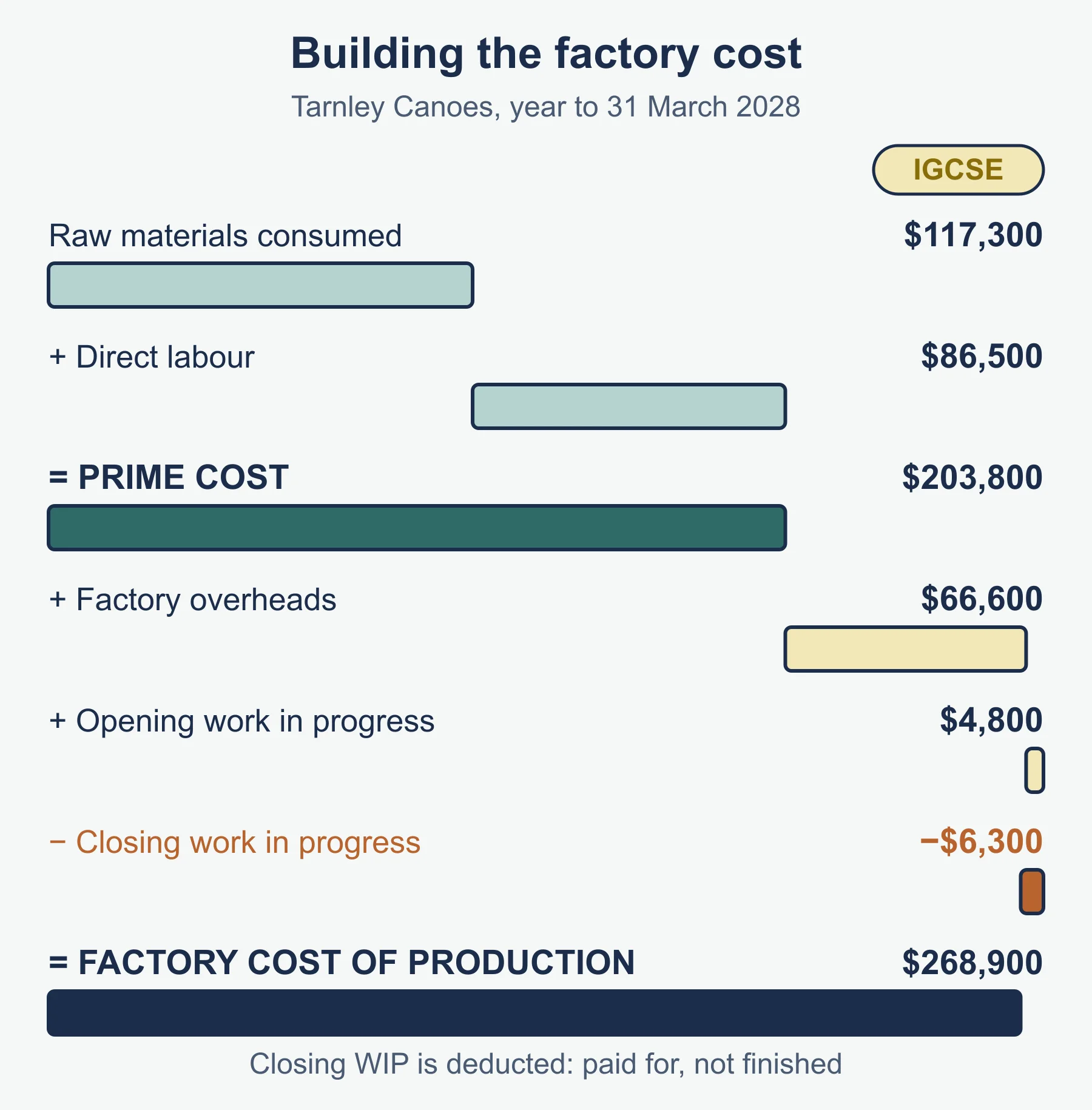
Work in progress (WIP) is part-finished goods still in the factory. The opening WIP was paid for last year but is finished this year, so you add it. The closing WIP has been paid for this year but is not finished, so you deduct it.
Factory cost of production = prime cost + factory overheads + opening WIP - closing WIP
Effect of a change: if closing WIP is 1,000 higher, factory cost of production is 1,000 lower, cost of sales is 1,000 lower and gross profit is 1,000 higher. An understated closing WIP does the reverse.
4. How the statements link
- The manufacturing account ends with factory cost of production.
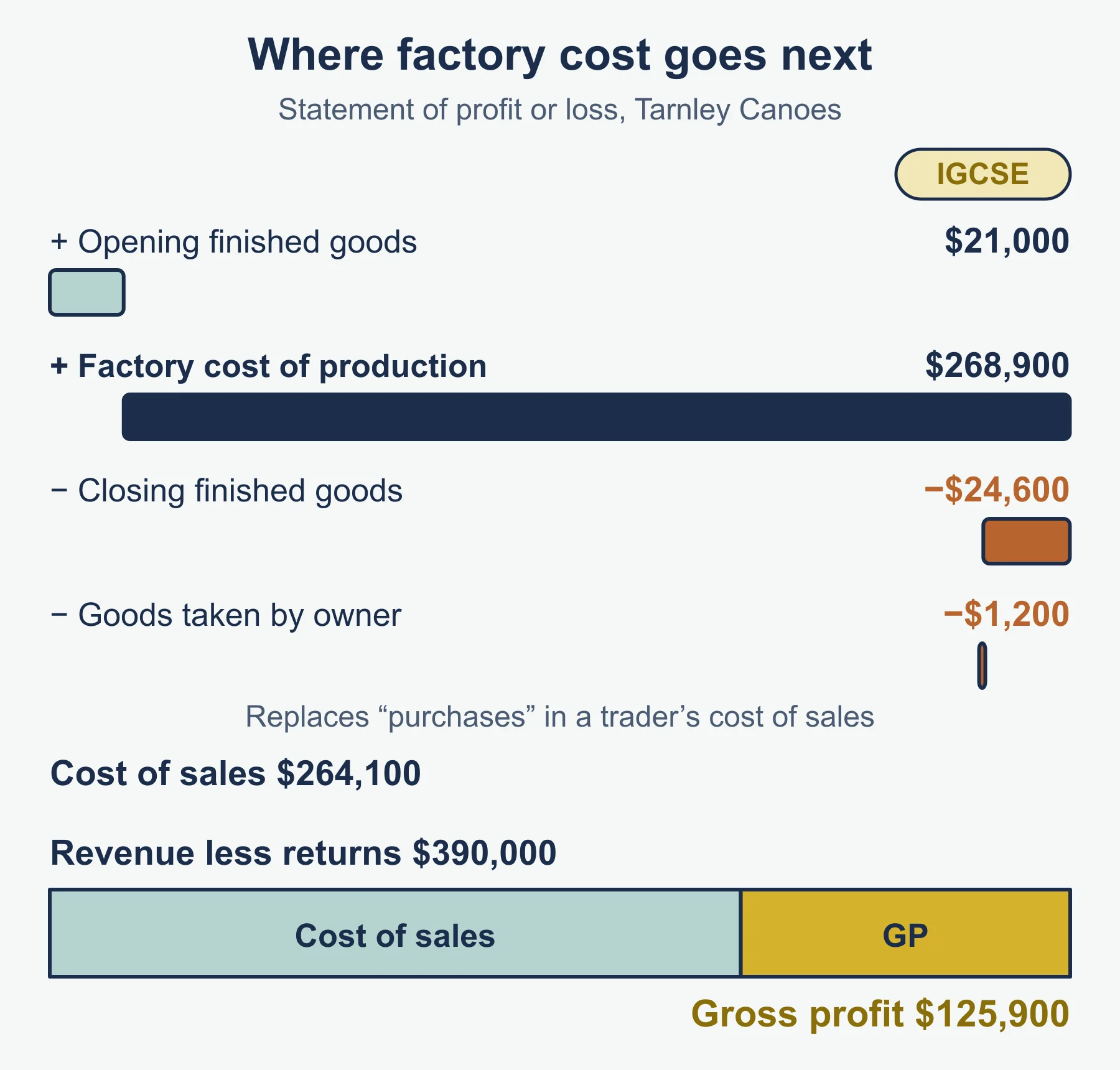
- In the statement of profit or loss, a manufacturer’s cost of sales is opening inventory of finished goods + factory cost of production - closing inventory of finished goods. A trader would use purchases here.
- A business that both makes goods and buys finished goods to resell adds purchases of finished goods to that cost of sales.
- Office, selling and distribution expenses stay in the statement of profit or loss, below gross profit.
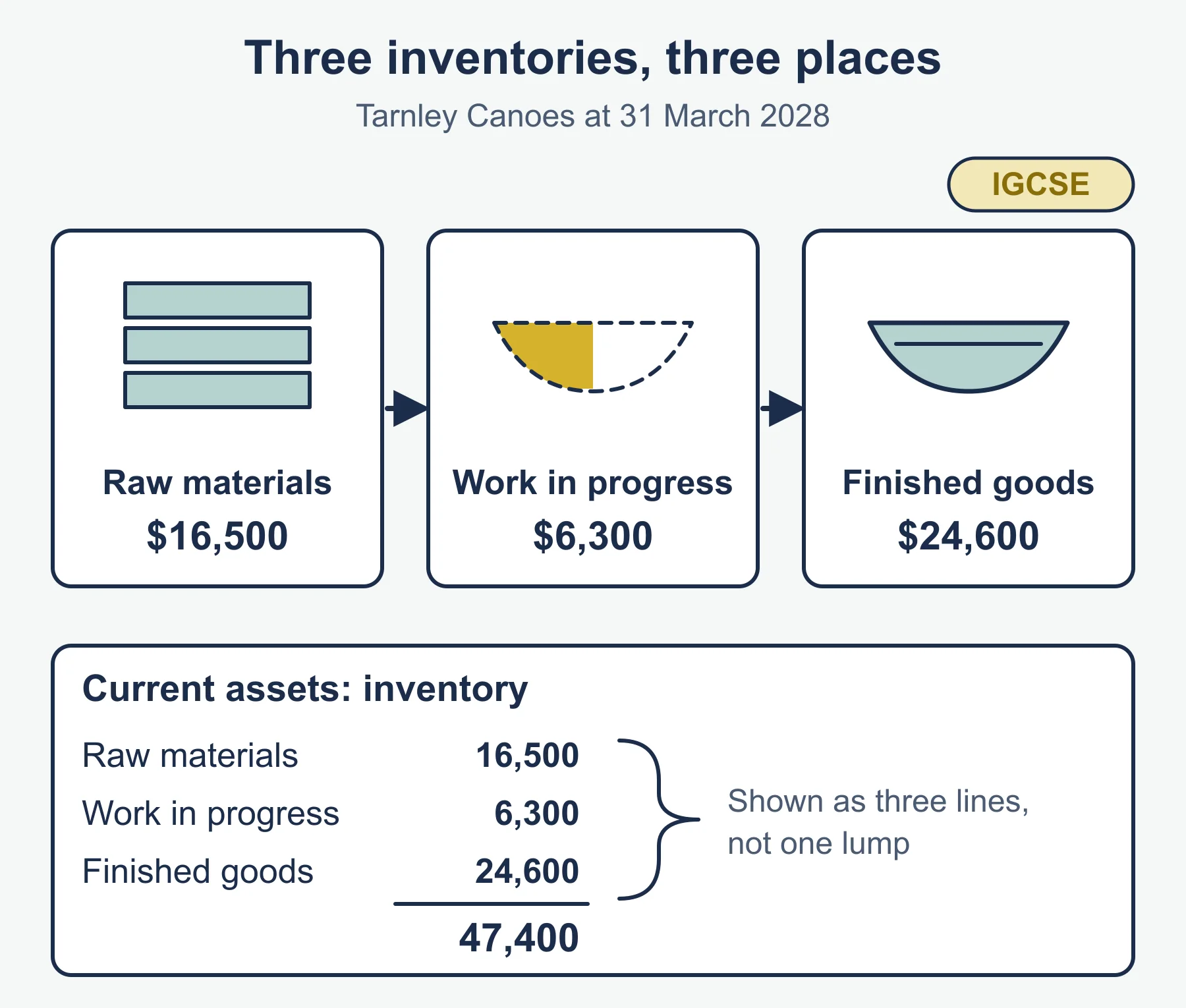
- The statement of financial position shows three inventories under current assets: raw materials, work in progress and finished goods.
5. Worked example
Tarnley Canoes is a sole trader. Year ended 31 March 2028. Balances and information:
| Item | $ |
|---|---|
| Raw materials inventory, 1 April 2027 | 14,200 |
| Raw materials inventory, 31 March 2028 | 16,500 |
| Purchases of raw materials | 118,400 |
| Returns outwards (raw materials) | 2,100 |
| Carriage inwards on raw materials | 3,300 |
| Direct factory wages | 86,500 |
| Indirect factory wages | 21,400 |
| Factory power paid | 9,600 |
| Factory rent paid | 19,500 |
| Factory machinery at cost | 120,000 |
| Accumulated depreciation on machinery, 1 April 2027 | 36,000 |
| WIP, 1 April 2027 / 31 March 2028 | 4,800 / 6,300 |
| Finished goods, 1 April 2027 / 31 March 2028 | 21,000 / 24,600 |
| Revenue / returns inwards | 392,000 / 2,000 |
| Office salaries | 38,000 |
| Office expenses | 14,500 |
| Carriage outwards | 6,200 |
| Irrecoverable debts written off | 1,350 |
| Trade receivables / allowance for irrecoverable debts | 25,000 / 1,000 |
| Rent received from letting a shed | 3,600 |
| Office equipment at cost / accumulated depreciation | 18,000 / 5,400 |
| Trade payables / bank | 17,200 / 9,800 |
| Drawings (cash) | 24,000 |
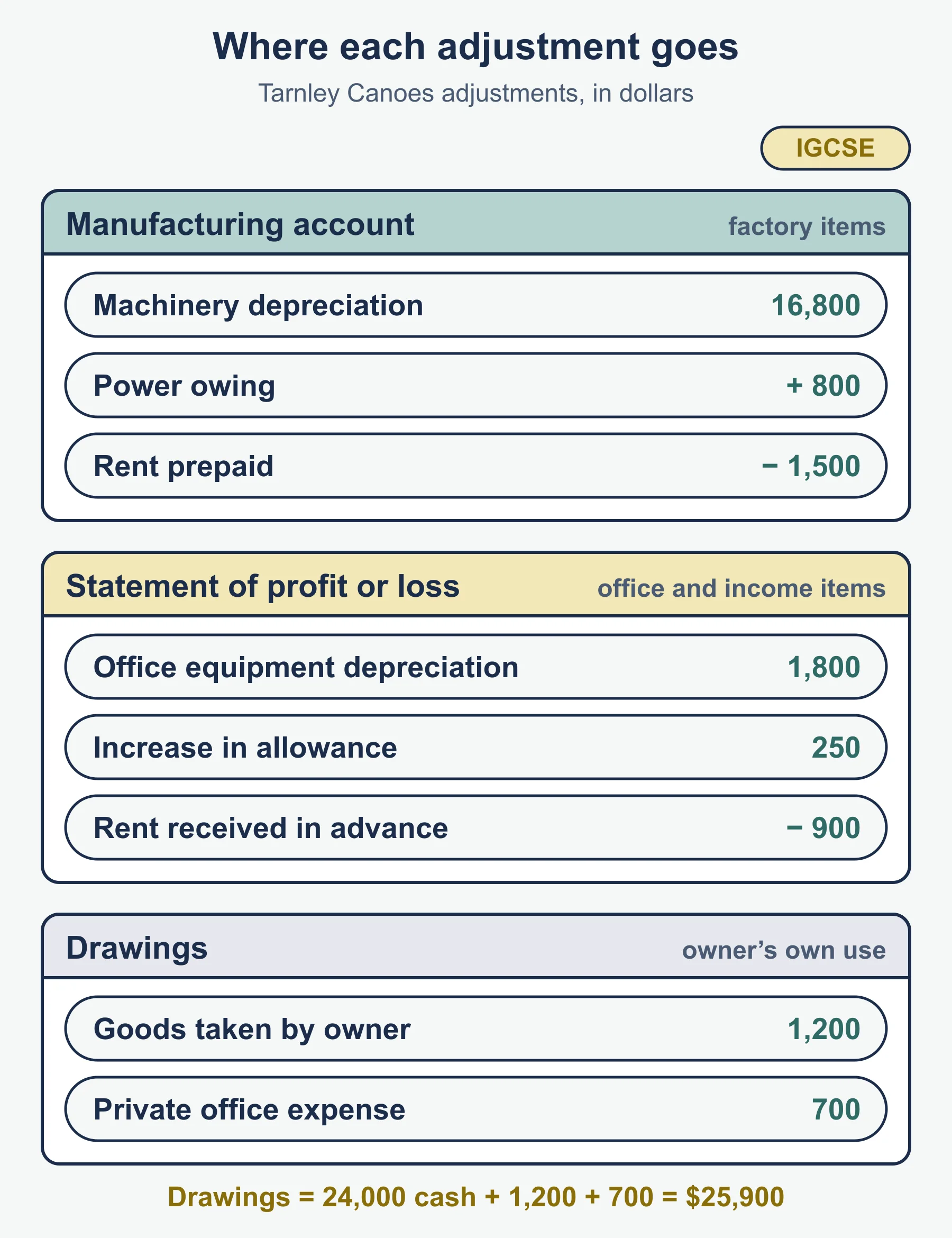
Adjustments: power owing 800; factory rent prepaid 1,500; machinery depreciated at 20% on reducing balance; office equipment depreciated 10% on cost straight line; allowance to be 5% of trade receivables; 900 of the rent received relates to next year; the owner took finished goods costing 1,200 for own use; 700 of the office expenses is the owner’s private expense.
Tarnley Canoes
Manufacturing account for the year ended 31 March 2028
                                      (amounts in $; subtotals left)
Inventory of raw materials 1 April 2027      14,200
Purchases                                   118,400
Less Returns outwards                         2,100
                                            116,300
Carriage inwards                              3,300
                                            133,800
Less Inventory of raw materials 31 March 2028 16,500
Cost of raw materials consumed                         117,300
Direct labour                                           86,500
Prime cost                                             203,800
Factory overheads
  Indirect wages                             21,400
  Power (9,600 + 800)                        10,400
  Rent (19,500 - 1,500)                      18,000
  Depreciation: machinery (20% x 84,000)     16,800
                                                        66,600
                                                       270,400
Add Work in progress 1 April 2027                        4,800
                                                       275,200
Less Work in progress 31 March 2028                      6,300
Factory cost of production                             268,900
Statement of profit or loss for the year ended 31 March 2028
(amounts in $; subtotals left)
Revenue 392,000
Less Returns inwards 2,000
390,000
Less Cost of sales
Inventory of finished goods 1 April 2027 21,000
Factory cost of production 268,900
289,900
Less Inventory of finished goods 31 March 2028 24,600
265,300
Less Goods taken by owner 1,200
264,100
Gross profit 125,900
Add Rent received (3,600 - 900) 2,700
128,600
Less Expenses
Office salaries 38,000
Office expenses (14,500 - 700) 13,800
Carriage outwards 6,200
Irrecoverable debts 1,350
Increase in allowance (1,250 - 1,000) 250
Depreciation: office equipment 1,800
61,400
Profit for the year 67,200Statement of financial position at 31 March 2028
Cost Acc dep NBV
Non-current assets (amounts in $)
Factory machinery 120,000 52,800 67,200
Office equipment 18,000 7,200 10,800
138,000 60,000 78,000
Current assets
Inventory: raw materials 16,500
work in progress 6,300
finished goods 24,600 47,400
Trade receivables 25,000
Less Allowance 1,250 23,750
Prepayment 1,500
Bank 9,800 82,450
Current liabilities
Trade payables 17,200
Accrued power 800
Rent received in advance 900 18,900
Working capital 63,550
141,550
Capital 1 April 2027 100,250
Add Profit for the year 67,200
167,450
Less Drawings (24,000 + 1,200 + 700) 25,900
141,550Check the balance: net assets 141,550 = closing capital 141,550. Factory machinery’s accumulated depreciation is 36,000 + 16,800 = 52,800.
6. Adjustments from section 5.1 in a manufacturing business
| Adjustment | Where it goes |
|---|---|
| Depreciation, straight line (cost - residual value) / years, reducing balance (a % of net book value), revaluation (opening value + additions - closing value) | Factory assets: manufacturing account, as a factory overhead. Office assets: statement of profit or loss |
| Accrued and prepaid factory expenses | Adjust the expense in the manufacturing account; accrual is a current liability, prepayment a current asset |
| Accrued and prepaid office expenses | Adjust the expense in the statement of profit or loss |
| Accrued and prepaid income | Adjust the income added after gross profit; accrued income is a current asset, income received in advance a current liability |
| Irrecoverable debts and allowance for irrecoverable debts | Statement of profit or loss; receivables shown net of the allowance |
| Goods taken by the owner | Deducted in cost of sales at the cost given; added to drawings |
| Owner’s private expenses paid by the business | Removed from the expense; added to drawings |
If a question tells you to split one expense, such as rent, between the factory and the office, apply the given fraction and put each part in its own statement.
Common errors
- Putting purchases of raw materials, not the cost of raw materials consumed, into prime cost.
- Adding closing WIP and deducting opening WIP.
- Treating the factory supervisor’s wages as direct labour.
- Putting office salaries or carriage outwards into factory overheads.
- Forgetting that the factory machinery depreciation goes in the manufacturing account, not the statement of profit or loss.
- Using factory cost of production where prime cost is asked for, or the reverse.
- Showing one lump of inventory in the statement of financial position instead of raw materials, WIP and finished goods.
- Leaving the owner’s goods or private expenses out of drawings.
Frequently asked questions
What is the difference between a direct cost and an indirect cost in a manufacturing account? A direct cost can be traced to the goods being made, such as raw materials and production workers’ wages. An indirect cost, or factory overhead, is needed to run the factory but cannot be traced to one unit, such as factory rent, power and a supervisor’s wages.
How is factory cost of production calculated in Cambridge IGCSE Accounting 0452? Factory cost of production is prime cost plus factory overheads plus opening work in progress minus closing work in progress. Prime cost is direct material (raw materials consumed) plus direct labour.
What happens to gross profit if closing work in progress is higher? A higher closing work in progress lowers factory cost of production and cost of sales by the same amount, so gross profit rises. An understated closing work in progress has the reverse effect.
How is cost of sales calculated for a manufacturer? Cost of sales is opening inventory of finished goods plus factory cost of production minus closing inventory of finished goods. If the business also buys finished goods to resell, those purchases are added too.
Where does depreciation of factory machinery go? Depreciation of factory machinery is a factory overhead in the manufacturing account. Depreciation of office equipment and other office, selling and distribution expenses stay in the statement of profit or loss.
Official syllabus
Cambridge IGCSE Accounting 0452 syllabus for exams in 2027, 2028 and 2029 (version 1), Cambridge International, section 5.4 Manufacturing accounts.
Get free revision emails (optional)
Occasional emails with practice questions, worked explanations and links to free resources for the qualification and subjects you choose. No spam, and you can unsubscribe from any email. The free tools on this site never need an email.
Related resources
-
Revision notes
IGCSE Accounting: Analysis and Interpretation — Revision Notes
Quick recall for Cambridge IGCSE Accounting 0452 Topic 6: ten ratios, reading them, profit versus cash, comparing businesses, users and statement limits.
Accounting · Cambridge · IGCSE, O Level
Revise topic -
Practice questions
IGCSE Accounting: Manufacturing accounts (Cambridge 0452) – Practice Questions
Original practice questions with worked answers on manufacturing accounts for Cambridge IGCSE Accounting 0452: prime cost, factory cost and statements.
Accounting · Cambridge · IGCSE, O Level
Try questions -
Revision notes
IGCSE Accounting: Manufacturing accounts (Cambridge 0452) – Revision Notes
Condensed revision notes on manufacturing accounts for Cambridge IGCSE Accounting 0452, with layouts, adjustments, a self-test and common mark losses.
Accounting · Cambridge · IGCSE, O Level
Revise topic
Related articles
-
teaching
A Level tuition in Dubai: Cambridge or Pearson Edexcel International A Level?
Schools in Dubai and Abu Dhabi teach either Cambridge International AS & A Level or Pearson Edexcel International A Level. How the two are structured, why it matters for tuition, and how online classes from Lahore work.
9 October 2026
-
curriculum guides
Choosing subjects at IGCSE and A Level
How subject choices at 14 and 16 affect university options later, and how to keep pathways open without overloading a timetable.
28 July 2026
Studying this with a teacher
Working through Accounting IGCSE, O LEVELS?
This page is free and stays free. If you would rather be taught it, Marlbridge runs Accounting classes one-to-one and in small groups of up to 15, online in your own time zone. The first trial class is free. WhatsApp replies within an hour (8am–11pm Pakistan time, every day); email the same day.
Cambridge Accounting teachers at Marlbridge

