
Revision Notes
IGCSE Accounting: Financial statements of limited companies (Cambridge 0452) – Revision Notes
Condensed recall notes on limited company accounts for Cambridge IGCSE Accounting 0452 section 5.3: terms, layouts, share capital formulas and a self-test.
- Subject
- Accounting
- Level
- IGCSE, O LEVELS
- Topic
- Preparation of financial statements
- Author
- Marlbridge Academic Team
- Updated
- Reviewed by
- Javaid Iqbal Sabri (what this means)
Aligned to Cambridge IGCSE O Level Accounting (0452, 7707), 2027-2029. Official specification (IGCSE) ; Official specification (O Level) .
Syllabus page (what it covers and how it is assessed): Cambridge IGCSE Accounting; Cambridge O Level Accounting.
Syllabus points this page covers
0452
- 5.3 Limited companies
7707
- 5.3 Limited companies
Found an error? Report a correction.
Want a teacher for this? Marlbridge teaches Accounting online. Request a free trial class.
Syllabus edition note. This resource follows the Cambridge IGCSE Accounting 0452 syllabus (and Cambridge O Level Accounting 7707, which has the same subject content for the same series) for exams in 2027, 2028 and 2029 (version 1), first examined in the March 2027 series in India and the June 2027 series elsewhere. If you sit 0452 in November 2026, you sit the 2026 syllabus (version 2), which differs: Paper 1 has 35 multiple-choice marks in 1 hour 15 minutes, not 40 marks in 1 hour 30 minutes; Topic 7 is “Accounting principles and policies”, without 7.2 Ethical considerations or 7.3 Technology and sustainability; 4.4 is “Irrecoverable debts and provision for doubtful debts”; income statements are named instead of statements of profit or loss; three-column running balance accounts are not required; Clubs and societies is 5.4 and Manufacturing accounts 5.5; and 6.3 is “Inter-firm comparison”. For this topic, the 2026 syllabus covers only trading and service businesses in 5.1 and limits drawings adjustments to goods taken by the owner for own use; for limited companies it excludes cumulative and non-cumulative preference shares, rights issues, share premium and capital redemption reserve but requires the difference between redeemable and non-redeemable preference shares (the 2027-2029 syllabus lists none of these); and for incomplete records it does not ask why businesses keep them or what their advantages are. If you sit in November 2026, work from the 2026 syllabus on the Cambridge International website.
These revision notes condense syllabus section 5.3 Limited companies from the Cambridge IGCSE Accounting 0452 syllabus for examination in 2027, 2028 and 2029 (Version 1). For full explanations and the complete worked statements, read the study guide. When you are ready to test yourself, use the practice questions. The wider topic is in the topic 5 study guide, topic 5 revision notes and topic 5 practice. Course links: Cambridge IGCSE Accounting hub, printable checklist and the free diagnostics.
Key terms
| Term | Say it like this |
|---|---|
| Limited company | A separate legal entity owned by shareholders; it can trade, provide services, manufacture, or combine these |
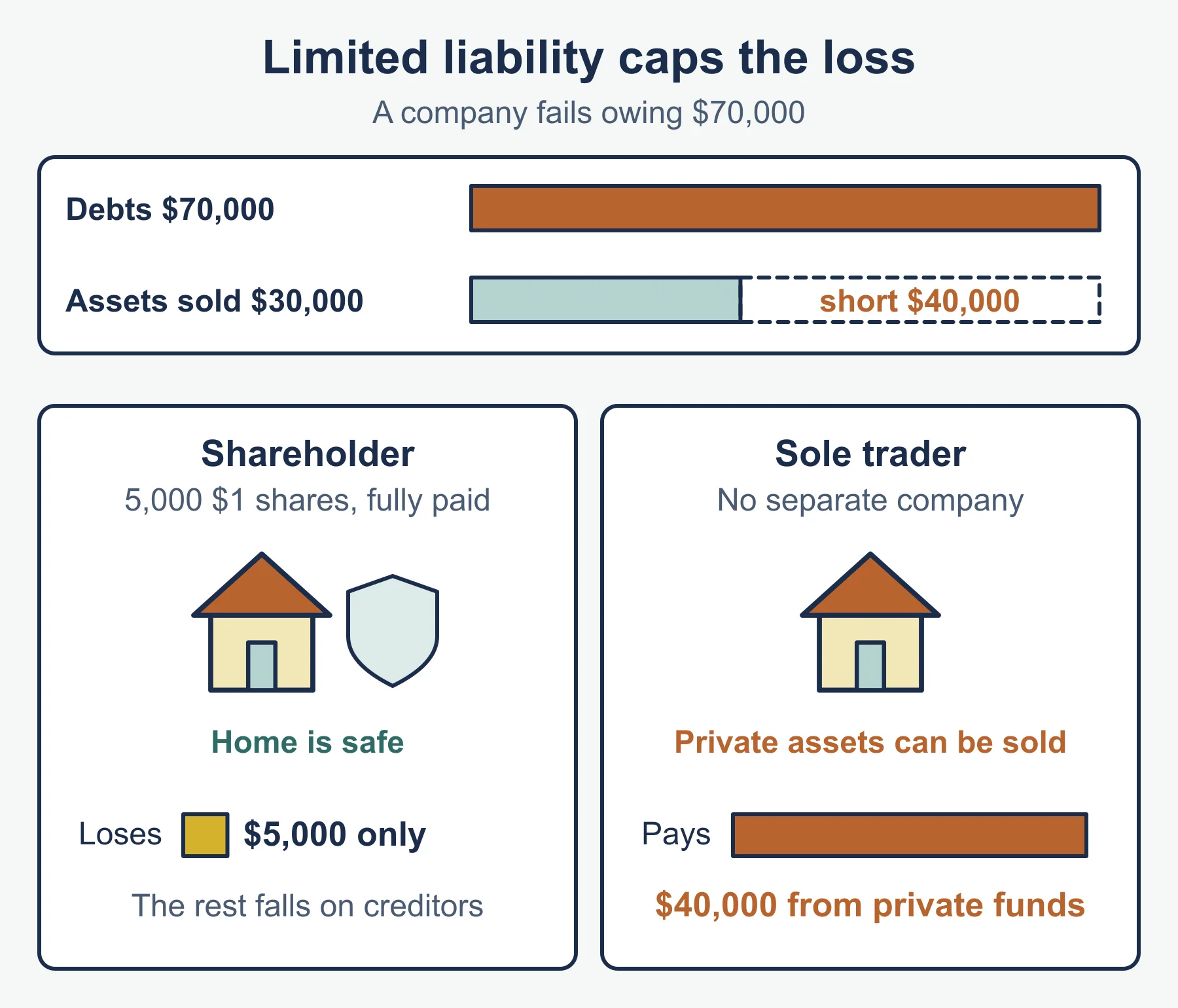
| Limited liability | A shareholder can lose no more than the amount paid, or agreed to be paid, for their shares |
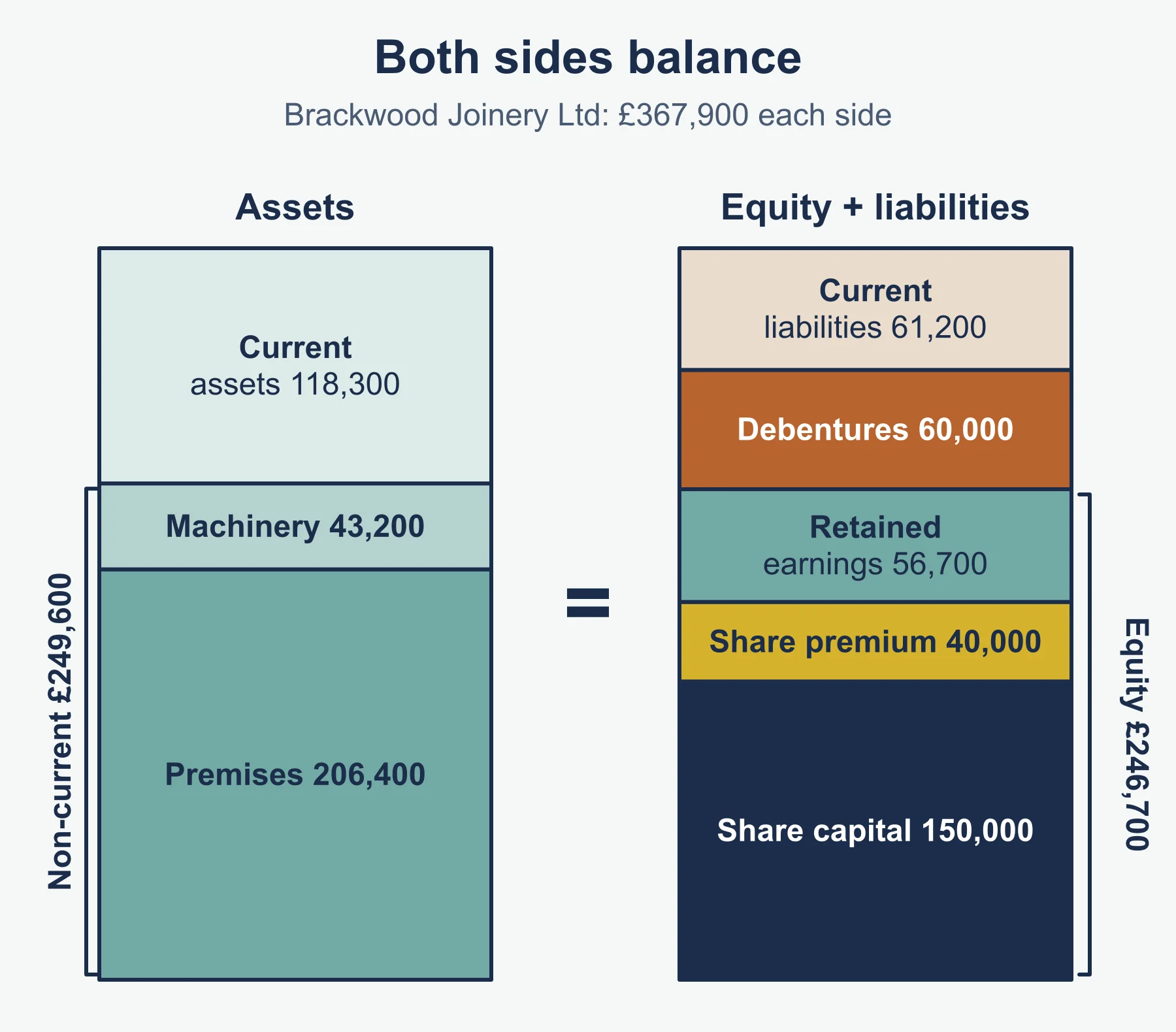
| Equity | Total assets less total liabilities: share capital plus reserves |
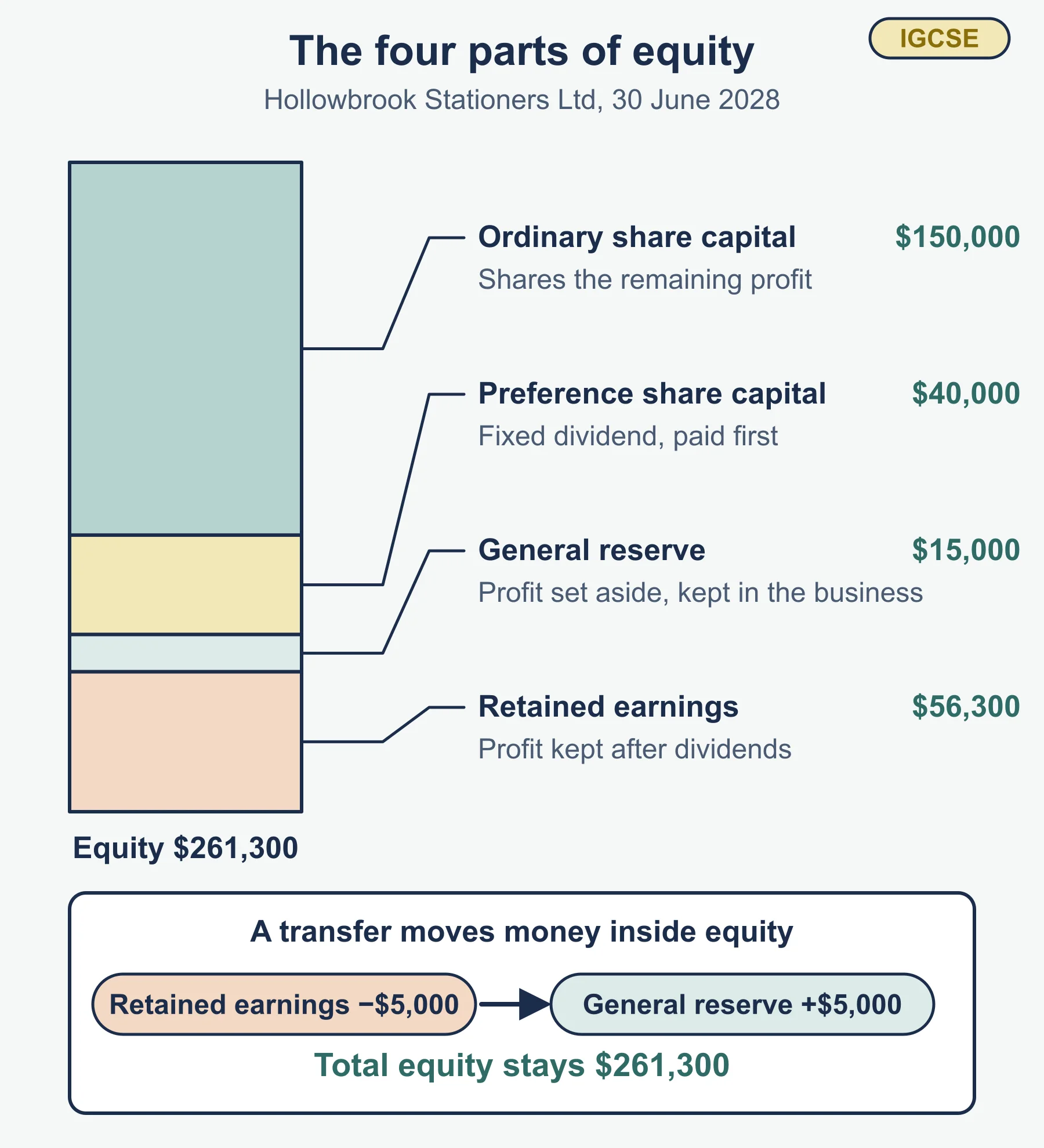
| Preference share capital | Fixed rate of dividend, paid before ordinary shareholders receive anything |
| Ordinary share capital | Owners’ shares; the dividend varies and may be nil |
| General reserve | Profit moved out of retained earnings and kept in the business |
| Retained earnings | Profit kept after dividends and transfers, accumulated over time |
| Debentures | Loan capital; holders are lenders paid fixed interest |
Advantages and disadvantages
- For: limited liability; large sums raised from many investors; continuity; easier borrowing.
- Against: legal requirements and costs; profit shared as dividends; accounts may be public; owners may not manage.
- Evaluation tip: pick the points that fit the business in the question, then give a judgement.
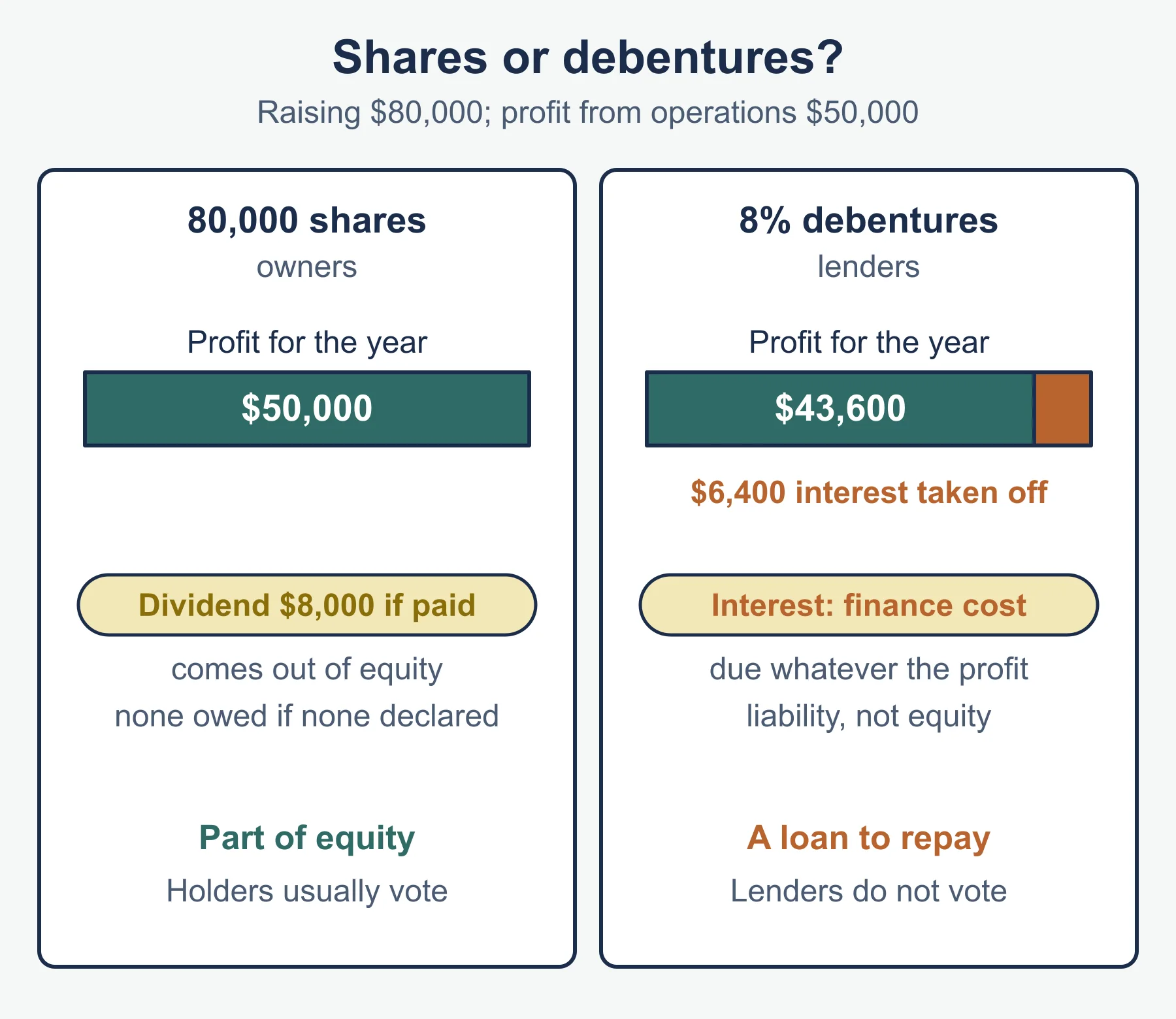
Ordinary shares or debentures
| Feature | Ordinary share capital | Debentures |
|---|---|---|
| Holder is | An owner | A lender |
| Return | Dividend, variable, not compulsory | Interest, fixed, compulsory |
| Appears in | Equity | Non-current liabilities |
| Return shown in | Statement of changes in equity | Statement of profit or loss, as a finance cost |
| Vote | Usually | No |
| Repayment | Not normally repaid while trading | On the agreed date |
Share capital formulas
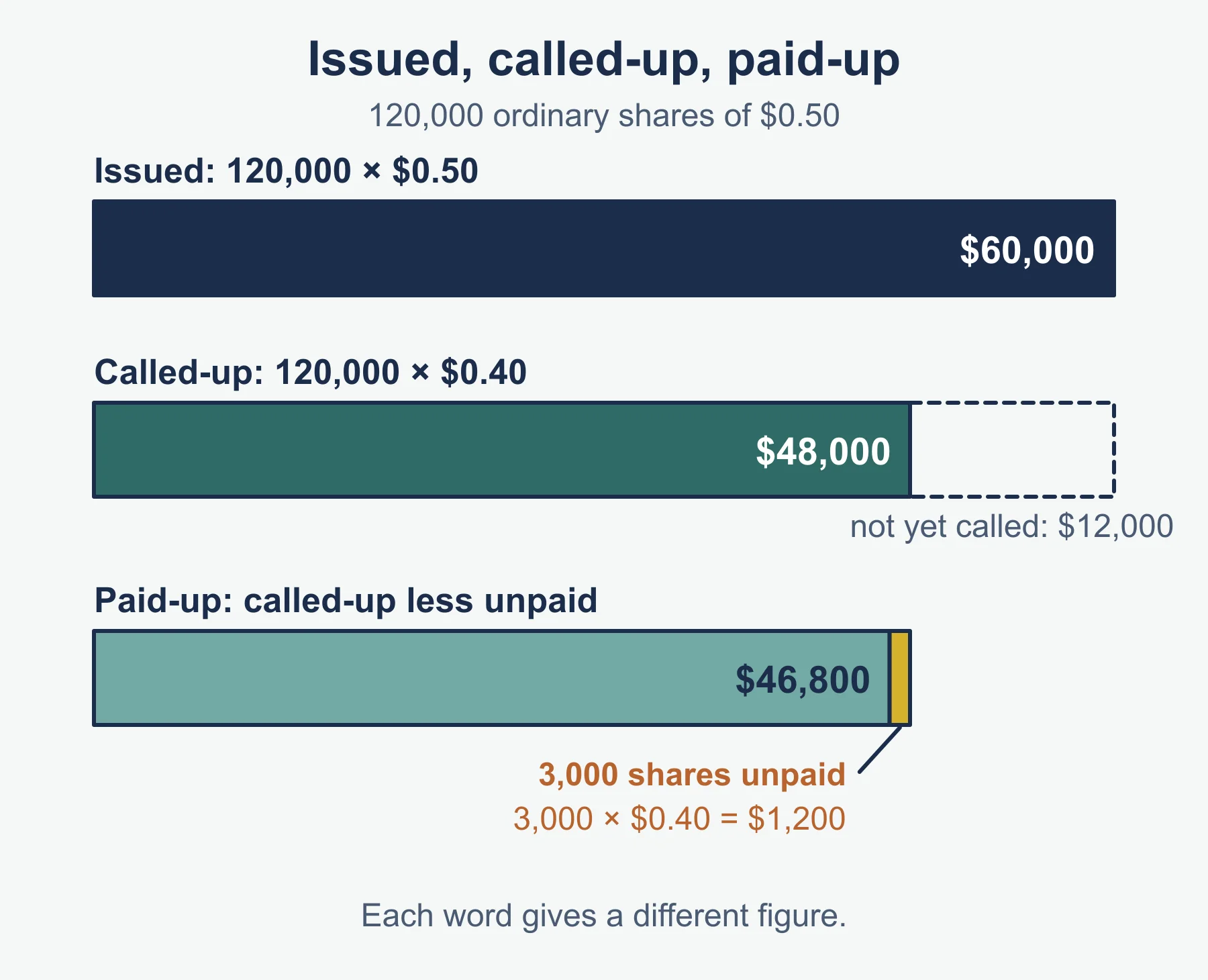
- Issued = number of shares x nominal value.
- Called-up = number of shares x amount called per share.
- Paid-up = called-up less amounts called but not yet paid.
- Preference dividend = rate x nominal value of preference shares.
- Ordinary dividend = number of ordinary shares x dividend per share.
- Debenture interest = rate x nominal value of debentures, whether paid or still owing.
Method in steps
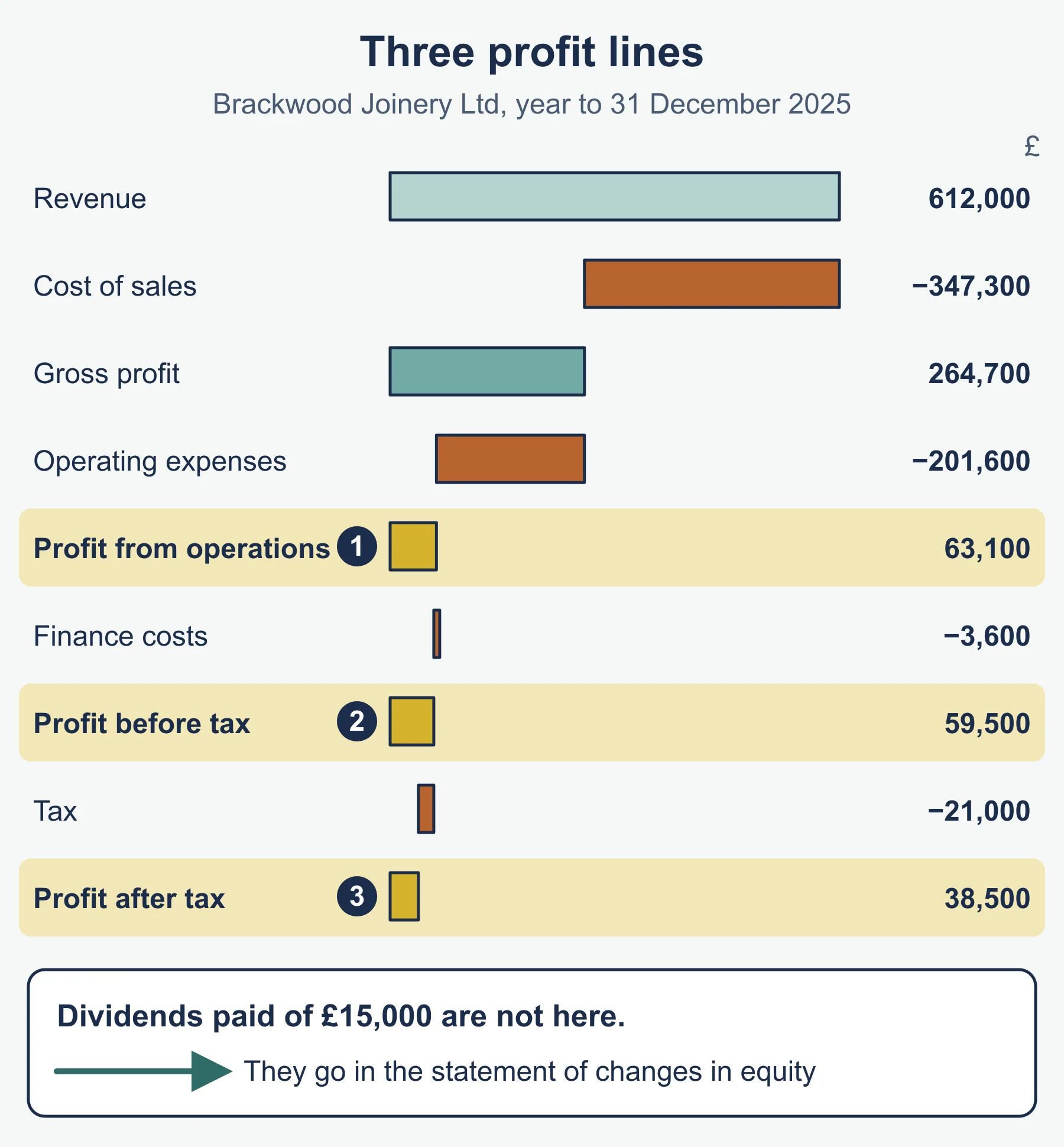
- Statement of profit or loss. Revenue less cost of sales gives gross profit. Make every 5.1 adjustment, deduct expenses to reach profit from operations, deduct debenture interest (finance costs) for profit for the year.
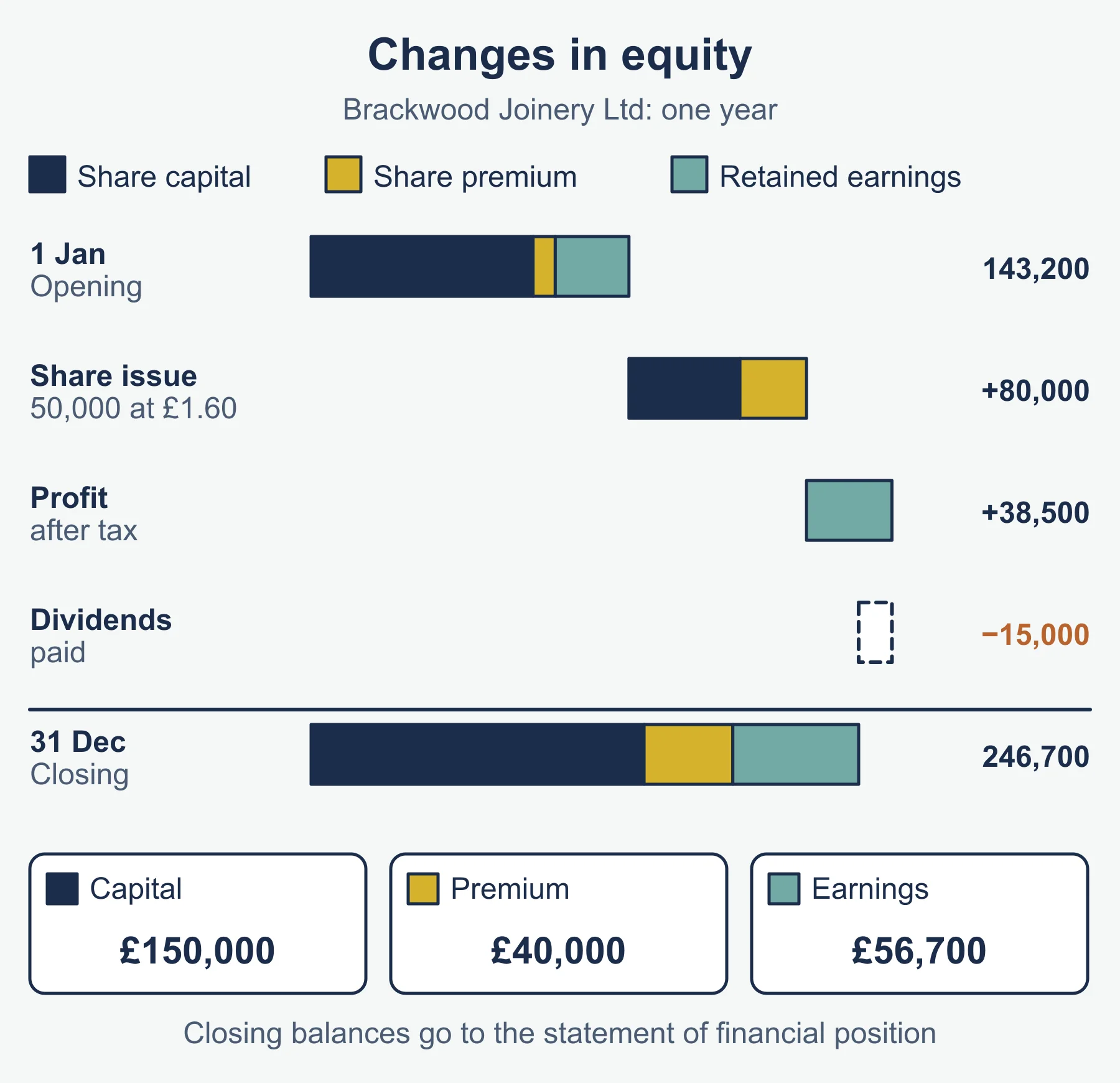
- Statement of changes in equity. Start with opening balances in each column. Add shares issued and profit for the year. Move any transfer from retained earnings to the general reserve. Deduct dividends paid from retained earnings. Add across for the total and down for each closing balance.
- Statement of financial position. Non-current assets at cost, accumulated depreciation and carrying value; current assets; equity copied from step 2; debentures as non-current liabilities; current liabilities including other payables for accrued interest. Total assets must equal total equity and liabilities.
Worked reminder: statement of changes in equity
Hartsholme Paints Ltd, year ended 31 March 2028. Opening: ordinary shares $80,000, 5% preference shares $20,000, general reserve $12,000, retained earnings $18,500. During the year it issued 20,000 ordinary shares of $1 at $1, made a profit for the year of $21,300, transferred $3,000 to the general reserve, and paid the preference dividend and $0.07 a share on all 100,000 ordinary shares.
                          Ordinary  Preference General Retained   Total
                             share      share   reserve earnings
                           capital    capital
                               USD        USD      USD      USD     USD
At 1 April 2027             80,000     20,000   12,000   18,500 130,500
Ordinary shares issued      20,000                                20,000
Profit for the year                                      21,300  21,300
Transfer to general reserve                      3,000   (3,000)      -
Preference dividend paid                                 (1,000) (1,000)
Ordinary dividend paid                                   (7,000) (7,000)
At 31 March 2028           100,000     20,000   15,000   28,800 163,800
Dividends: 5% x $20,000 = $1,000 and 100,000 x $0.07 = $7,000.
Worked reminder: what a missing adjustment does
Suppose the accounts of a company leave out each item below. Each line is independent.
| Item left out | Profit for the year | Equity | Statement of financial position |
|---|---|---|---|
| Electricity owing $900 | Overstated by $900 | Overstated by $900 | Other payables too low |
| Depreciation $2,500 | Overstated by $2,500 | Overstated by $2,500 | Carrying value too high |
| Insurance prepaid $400 | Understated by $400 | Understated by $400 | Other receivables too low |
| Accrued debenture interest $1,000 | Overstated by $1,000 | Overstated by $1,000 | Other payables too low |
| Transfer to general reserve $5,000 | No effect | No effect | Reserve and retained earnings wrong by $5,000, total right |
Adjustments in one glance
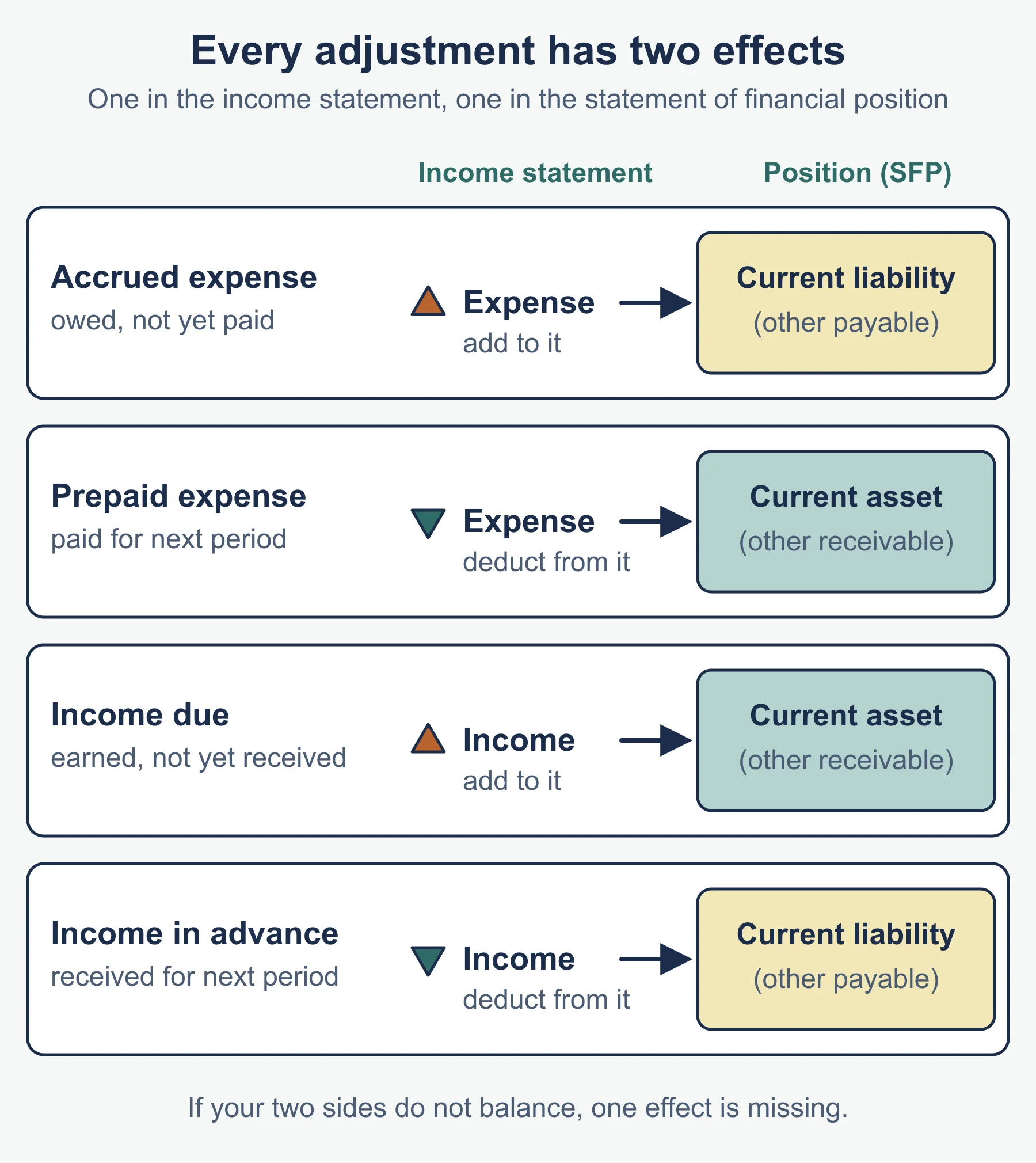
- Accruals: add to the expense, show as other payables.
- Prepayments: deduct from the expense, show as other receivables.
- Irrecoverable debts: expense, and take out of trade receivables.
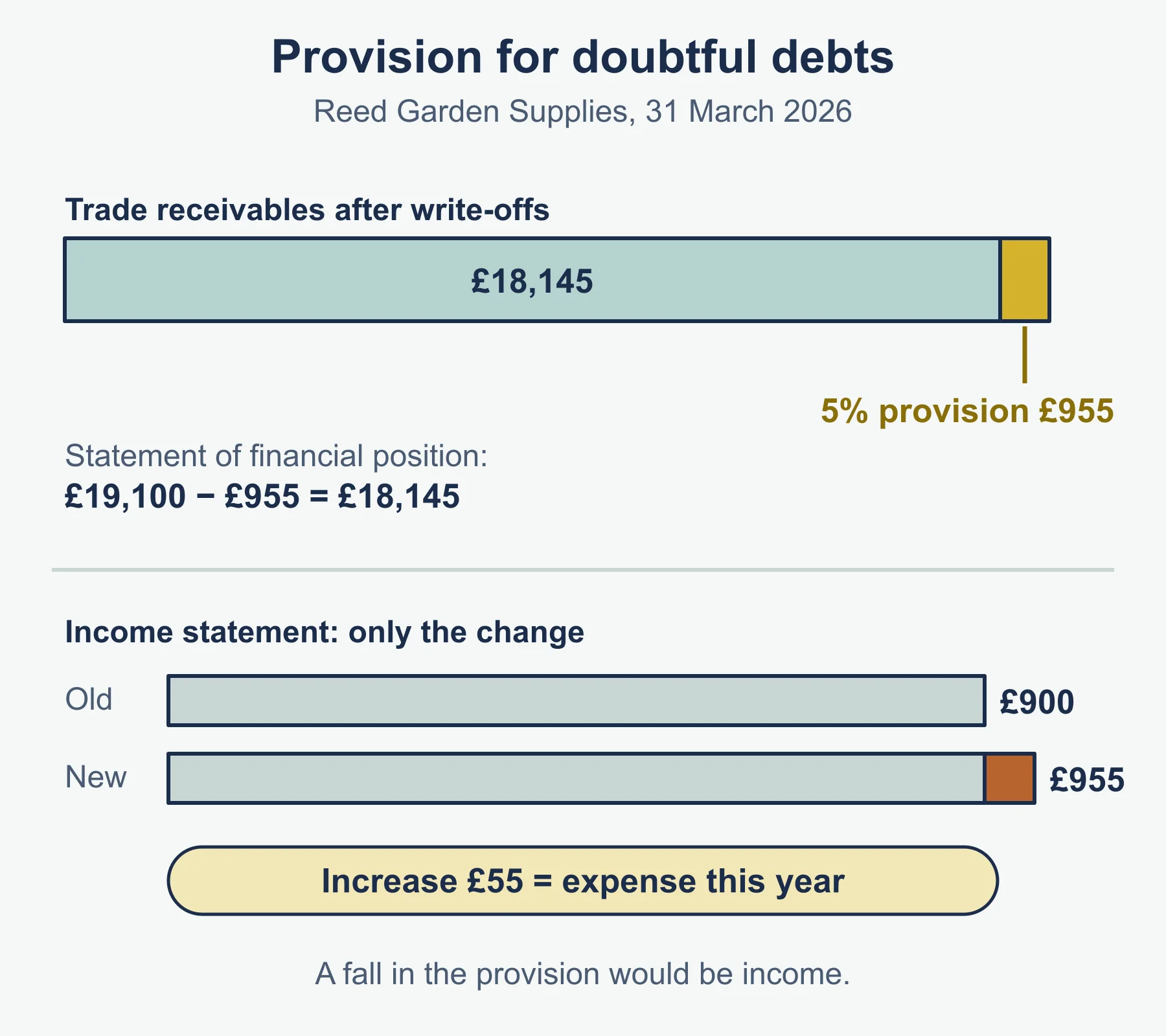
- Allowance for irrecoverable debts: charge only the increase (add back a decrease), and deduct the allowance from trade receivables.
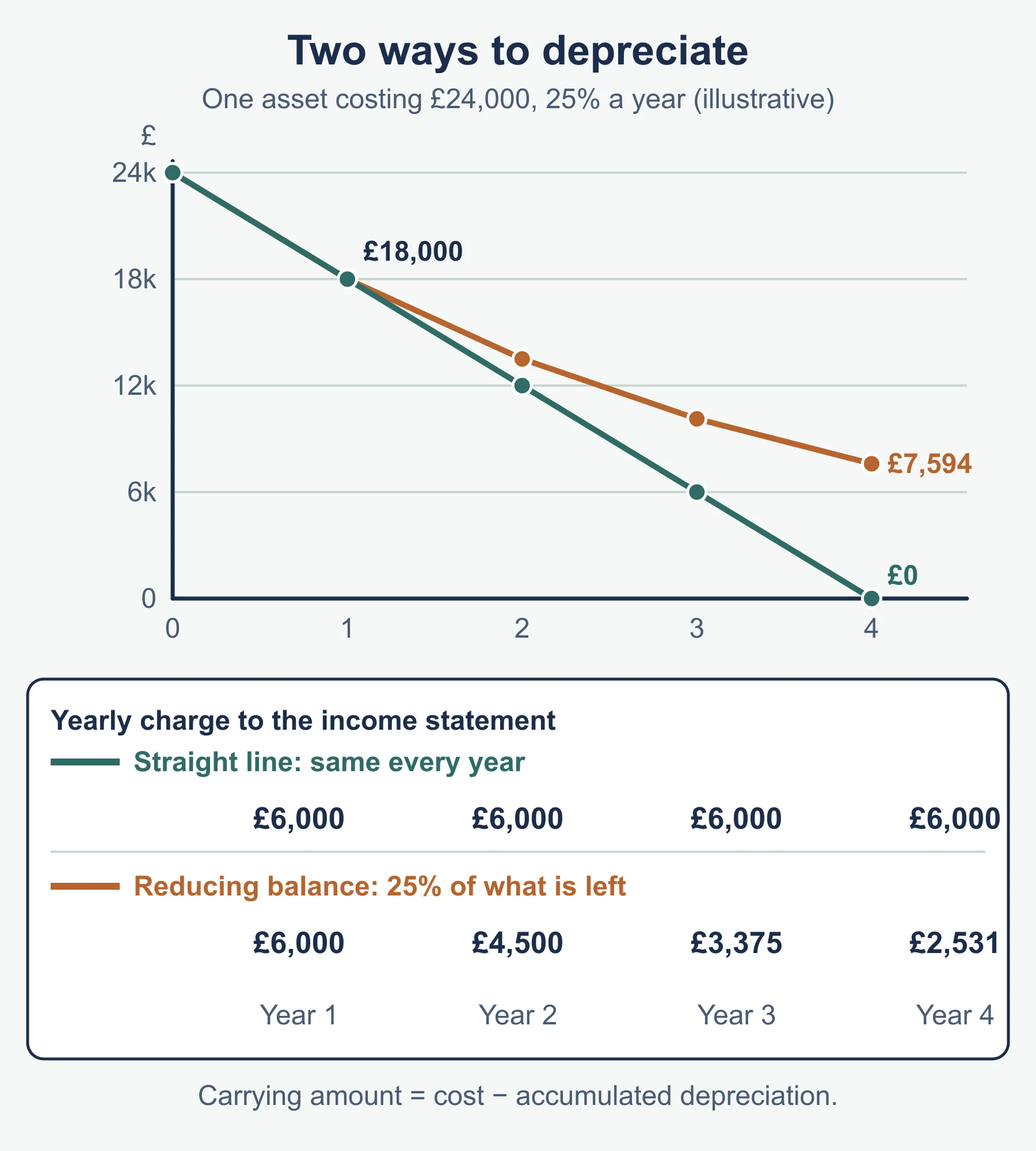
- Depreciation: straight line on cost; reducing balance on the carrying value at the start; revaluation method is opening value plus additions less closing valuation.
- Drawings adjustments are in the 5.1 list; revise the method in the topic 5 guide.
Must-know distinctions
- Dividends: statement of changes in equity. Debenture interest: statement of profit or loss.
- Profit from operations comes before finance costs; profit for the year comes after.
- A transfer to the general reserve changes the split of equity, not the total.
- Issued, called-up and paid-up are three different figures.
- Statement of financial position equity uses closing balances, not opening ones.
Quick self-test
- What is the most a shareholder can lose if all their shares are fully paid?
- Assets are $96,000 and liabilities $31,500. What is equity?
- Name the four parts of a limited company’s capital structure.
- A company issues 90,000 ordinary shares of $0.50 and calls up $0.30 a share. The holders of 2,000 shares have not paid. Find issued, called-up and paid-up capital.
- Where does debenture interest appear in the statements?
- Profit from operations is $36,400. There are $40,000 of 7% debentures, all interest paid. Find profit for the year.
- What effect does a $4,000 transfer to the general reserve have on total equity?
- Debentures repayable in six years’ time: which heading in the statement of financial position?
- Retained earnings start at $22,000. Profit for the year $15,000, $2,000 is transferred to the general reserve, preference dividend $1,200, ordinary dividend $6,000. Find closing retained earnings.
- Which statement shows the ordinary dividend?
Answers
- The amount invested in the shares. 2. $96,000 - $31,500 = $64,500. 3. Preference share capital, ordinary share capital, general reserve, retained earnings. 4. Issued $45,000; called-up $27,000; paid-up $27,000 - (2,000 x $0.30) = $26,400. 5. Finance costs in the statement of profit or loss, after profit from operations. 6. Interest $2,800, so $36,400 - $2,800 = $33,600. 7. None; it moves between reserves. 8. Non-current liabilities. 9. $22,000 + $15,000 - $2,000 - $1,200 - $6,000 = $27,800. 10. The statement of changes in equity.
Where marks are usually lost
- Dividends deducted in the statement of profit or loss.
- Debentures placed inside equity, or interest left as a dividend.
- Interest on debentures for part of the year left out because only half had been paid.
- Transfers to the general reserve added to the total column.
- Called-up and paid-up capital mixed up.
- Statements that do not balance because an adjustment is used once instead of twice.
- Evaluation answers that list advantages without linking them to the business described.
Frequently asked questions
What is equity in a limited company? Equity is the shareholders’ stake, equal to total assets minus total liabilities. It is made up of share capital and reserves, such as a general reserve and retained earnings.
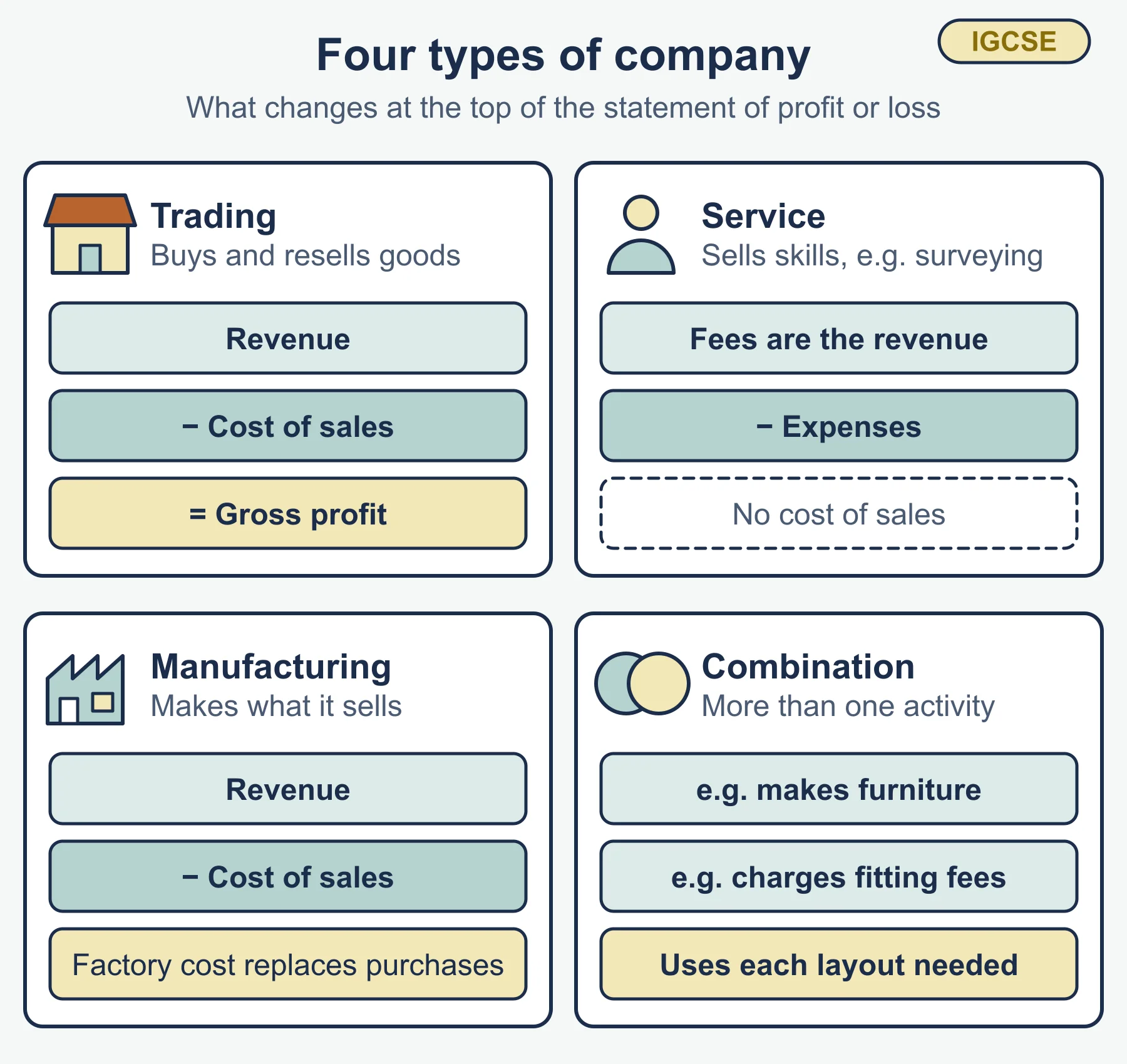
What types of limited company are there? A trading company buys and sells goods, a service company sells skills and has no cost of sales, a manufacturing company makes what it sells, and a combination does more than one of these. The type decides how the statement of profit or loss starts.
Which retained earnings figure goes in the statement of financial position? Use the closing retained earnings from the statement of changes in equity, after profit, transfers and dividends. Using the opening figure is a common error.
Why might the statement of financial position not balance? A common cause is using an adjustment only once instead of twice, for example including an accrual in an expense but leaving it out of other payables. Each adjustment affects both statements.
Official syllabus
Cambridge IGCSE Accounting 0452 syllabus for examination in 2027, 2028 and 2029 (Version 1), section 5.3 Limited companies, Cambridge International.
Get free revision emails (optional)
Occasional emails with practice questions, worked explanations and links to free resources for the qualification and subjects you choose. No spam, and you can unsubscribe from any email. The free tools on this site never need an email.
Related resources
-
Revision notes
IGCSE Accounting: Analysis and Interpretation — Revision Notes
Quick recall for Cambridge IGCSE Accounting 0452 Topic 6: ten ratios, reading them, profit versus cash, comparing businesses, users and statement limits.
Accounting · Cambridge · IGCSE, O Level
Revise topic -
Study guides
IGCSE Accounting: Financial statements of partnerships (Cambridge 0452)
Study guide to section 5.2 Partnerships for Cambridge IGCSE Accounting 0452: appropriation accounts, current accounts and full worked examples.
Accounting · Cambridge · IGCSE, O Level
Read guide -
Practice questions
IGCSE Accounting: Financial statements of partnerships (Cambridge 0452) – Practice Questions
Original practice questions with worked answers on partnership accounts, appropriation and current accounts for Cambridge IGCSE Accounting 0452.
Accounting · Cambridge · IGCSE, O Level
Try questions
Related articles
-
teaching
A Level tuition in Dubai: Cambridge or Pearson Edexcel International A Level?
Schools in Dubai and Abu Dhabi teach either Cambridge International AS & A Level or Pearson Edexcel International A Level. How the two are structured, why it matters for tuition, and how online classes from Lahore work.
9 October 2026
-
curriculum guides
Choosing subjects at IGCSE and A Level
How subject choices at 14 and 16 affect university options later, and how to keep pathways open without overloading a timetable.
28 July 2026
Studying this with a teacher
Working through Accounting IGCSE, O LEVELS?
This page is free and stays free. If you would rather be taught it, Marlbridge runs Accounting classes one-to-one and in small groups of up to 15, online in your own time zone. The first trial class is free. WhatsApp replies within an hour (8am–11pm Pakistan time, every day); email the same day.
Cambridge Accounting teachers at Marlbridge

